And while I’m still huddling in front of our wood-burning stove like a Depression era bum, the moody hail-filled clouds have moved on to harass someone else.
My house still stands.
The big one at least.
Sure, it’s covered in wall-to-wall mud.
Sure our boots and winter jackets line the floor of my hallway.
But it’s here, planted on solid ground. Not upside down; not on top of a smushed witch in Kansas.
I won’t gripe out loud that it’s not fair that you get to spend your day making snow angels and sipping choco, while I have to spend mine behind the computer working or behind the Israeli version of a mop doing sponga.
Nope, I won’t moan or groan or say how unfair it is. (As if Jerusalem doesn’t already have big malls, natural food stores, a good public transportation, and the blessing of God. Now you get SNOW?)
Nope. I’m happy for you guys.
Really, I am.
I’ll prove it. Post links to your pics below. I want to revel in your snow joy!
Two years ago, it snowed like the apocalypse in Newark, New Jersey.
Nevertheless, the airports were open the next day and early in the morning December 28, we packed our three kids and 15 duffel bags into a shuttle bus. As the sun rose, we headed up the NJ Turnpike from my mother’s house in Cherry Hill to Newark International Airport to meet a plane full of Jews preparing for a Nefesh B’Nefesh flight to Israel.
Not the Israel that threatened to burn your skin lobster red or put you in a hospital in Beer Sheva for dehydration.
We landed in winter Israel; which, apparently, gets really wet and cold. For months.
I’m embarrassed to admit this, but do you know that I did not pack in one of those 15 duffel bags a pair of sweat pants? Not for me; not for my children.
I’m pretty sure I packed two pairs of pants for each kid and about 10 pairs of shorts.
I kid you not.
For January.
In Northern Israel.
To be fair, I had only been to Israel once in winter. And, while it’s true, I DID spend two weeks volunteering on a God Forsaken army base outside of Tzfat, during which I vaguely recall sleeping beneath a wool blanket in my large, down-lined khaki army jacket; I think my memories of being dehydrated by the Dead Sea prevailed.
I thought it was perpetual summer in Israel. I thought the worst it got was windbreaker and jeans weather.
Nope.
Luckily, a month after we arrived in Israel with our duffel bags, our shipping container arrived in Haifa. And, two weeks after that, following a port workers strike, our winter jackets and hats arrived. And my two pairs of Wellington boots.
The boots have been my best friends through two and half winters.
Now I know better: Winter in Israel, on a good year, is wet. And cold.
And on kibbutz — very, very muddy.
But, as naive as I may have once been about winter in Israel — I feel very out of place in, and a tad bit disturbed, by the winter wonderland brought on by this storm.
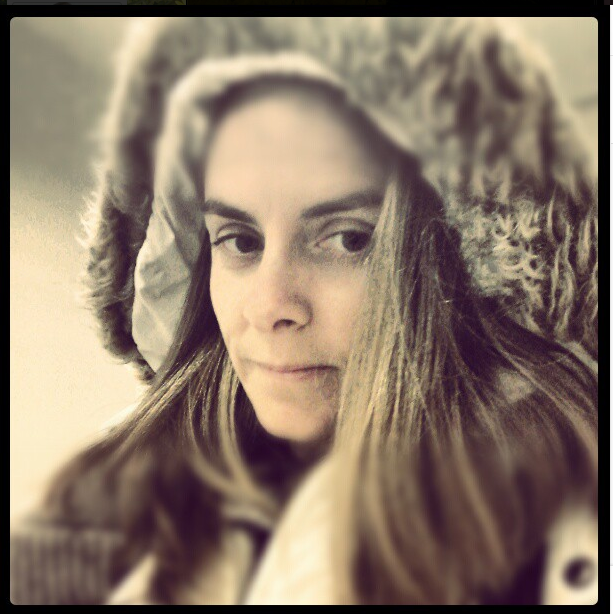
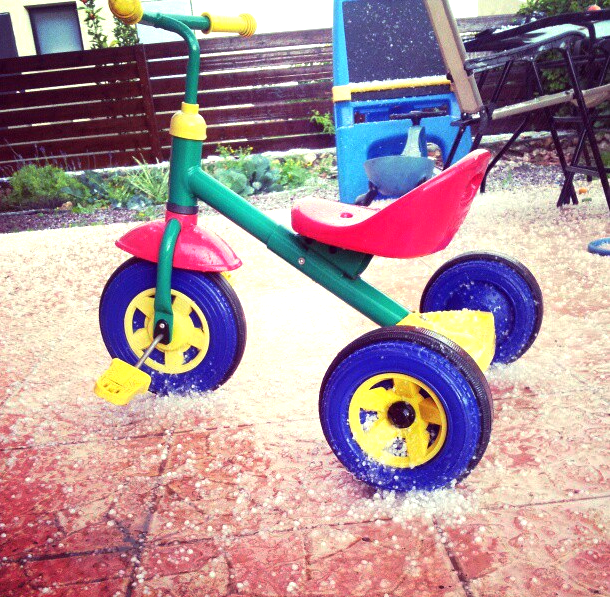
I’m lucky I brought my down jacket from New Jersey with its faux eskimo hoodB-ice-cycle in our backyard
Ice raining down on my porch?
Driving winds slamming against the side of my house?
And if it were one random stand alone instance of freak weather, I’d probably chuckle and enjoy the cheers of my 4-year-old who doesn’t remember the snow of the blizzard we left New Jersey in. She thinks this freezing rain is snow.
But, I don’t have to tell you it’s not a stand alone instance of freak weather.
Where ever you’re reading this from — Australia (where wild fires rage), the midwestern and southern U.S. (where the impacts of drought are still being felt), Seaside Heights (still soggy from Sandy), flooded Great Britain — you know what I’m talking about.
Freak weather is becoming less freakish; and more freakishly common.
Winter in Israel was never this wintery. At least, not in a long time.
And after we make it through this storm, I wonder if anyone is going to be talking about it.
Or if they’ll simply shrug their shoulders in a “Huh, wasn’t that interesting” sorta way and praise the Lord for the rising of the Sea of Galilee.
Don’t get me wrong — we need water here. I am certainly grateful for the water.
Bragging moment: I was accepted into the University Honors Program in college. I even got a scholarship.
That letter in the mail was likely the pinnacle of my academic career. That, or the poetry award I won from Mr. Schaeffer at the end of 9th Grade.
I was your classic underachiever in school. And in retrospect, I completely wasted the distinction The George Washington University placed on me.
In order to maintain the scholarship and my place in the program, I was required to take at least one class each semester offered by the honors track. As always, I did the bare minimum. I followed the rules and aimed for a grade acceptable to me and my parents. (A “B” or above.)
The only classes I remember are two semesters of “An Introduction to Soviet Cinema”– from which I walked away better educated about cinematographic license and with the easiest “A” I ever earned — and my senior seminar with Professor Harry Harding, an expert on Asian-American relations.
I don’t remember why I took this class with Harding, since my interest area was the Middle East. I probably heard from someone that he was kind or didn’t give a lot of homework. I do remember, however, the brilliant research thesis topic I dreamed up for the paper I had to write at the end of the year:
“The Influence of Zen Buddhism on American Pop Culture”
I wish I could get my hands on that paper. And, then completely rewrite it. Because whatever I wrote was complete crap and/or borderline plagiarism, I’m sure.
This time, if given the opportunity, I’d actually do the research. I’d read more than the three required books. I’d actually do primary research. Find people to interview. Listen to their stories. Imagine what their lives were like. Swim in their memories. Meditate on them. And then produce a paper that truly encapsulated my brilliant findings and analysis.
But, like most 20-year-olds, I hated writing research papers. And this was a 25 page research paper, which was the longest by far I was ever required to write before or since.
I loved learning, but I was too bound by the rules and the concern for a good grade and the concern for a good job and a good career and a good paycheck and a good pitcher of beer to actually do what I imagine most teachers want you to do — learn about something and carry that education forward into your life.
I remembered this research paper yesterday when I watched a video a friend shared on Facebook.
It’s a series of images that illustrate a lecture given once by Alan Watts entitled “What If Money Were No Object?”
The name sounded familiar. I Googled him. Oh, yeah. He was the guy in my research paper from senior seminar; recognized as one of the key individuals responsible for bringing Zen Buddhism to the West.
I chuckled. Here was the voice of Alan Watts speaking to me — primary research, 20 years too late.
If only the internet had been more than a chat room on AOL when I was in college.
If only I had heard Watts say:
“What do you desire?
What makes you itch?
What would you like to do if money were no object?
How would you really enjoy spending your life?”
I might have spent more time on my research paper. I might have spent more time wondering if this Alan Watts guy was more than just page filler.
What would I have thought if I had been in that crowd? Would Watts have inspired me?
What message would I have taken away from that lecture?
Would I be the philosopher, the novelist, the soap opera star I sometimes wish I was?
“Crowds of students say, ‘We’d like to be painters. We’d like to be poets. We’d like to be writers.’
But as everybody knows you can’t earn any money that way…
When we finally get down to something which the individual says they really want to do, I will say to them, “You do that. And forget the money.”
Amen, I thought to myself, when I heard Watts challenge the audience to “forget the money.”
And then, “I wish someone had said that to me when I was 20.”
Easy for me to say now.
Easy now, at 38 years old, with a steady paycheck and two decades of experience making it on my own.
But would I have been able to really hear Watts then?
Would his words have led me to walk a different path?
I don’t know.
My life might have turned out exactly the same.
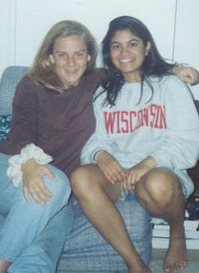
I was a lot more stubborn then. A lot less likely to listen to someone wiser than me. I might have done exactly what I did. Graduate. Get a job in a non-profit. Be happy that I was finally earning my own paycheck and had my own money to spend on jeans at The Gap in Georgetown. Or on big scrunchies.
Jen in college.
I really wanted my own money back then. I wanted freedom from my parents. I wanted room to make my own choices. I didn’t see any possible way to achieve both freedom and my desire.
Which makes me think Watts’ advice would have registered only as a temporary instigation.
Not inspiration.
Learn more at alanwatts.com
Because in our current society set up, it’s practically impossible to forget the money.
We have to follow our desires in spite of the money.
What you need to know if you choose to forget the money is how you will stay true to your desire when the rest of the world says you need money over everything else. You need to know how you will navigate the expectations of your family, your friends, your neighbors. You need to know how to avoid the pitfalls of consumerism. How to live without a TV; without an SUV; without a weekend getaway.
You need to build your life so that your life is your weekend getaway.
= = = = =
If anyone had asked me when I was 20, I wouldn’t have said then, “I’d like to be a philosopher.”
I wouldn’t have said, “I’d like to be a craniosachral therapist.”
I absolutely would not have said, “I want, more than anything, to be a full-time, paid-loads-for-a-living celebrated writer.”
I didn’t know it then.
And I couldn’t see the way.
And yet, I’ve been fortunate to find my way. To have either landed in or created circumstances in which I’ve been able to recreate my career based on my passions and desires.
I listened to and followed my itch; years before hearing Alan Watts’ speech.
But, along the way, I’ve had to give up desires, too. Ignore certain itches.
I’ve had to choose.
Sometimes I’ve been able to forget the money.
And sometimes not.
Watts does not talk about choices…and consequences.
It’s not easy to follow your desire instead of following the money.
= = = = =
What would I say to a crowd of young people today?
How would I guide them?
I might say something similar to what Watts says: “Better to have a short life that is full of what you like doing, than a long life spent in a miserable way.”
I believe this to be true. And I like to think that somehow, accidentally, when I was writing that research paper in college, Watts’ advice penetrated my tired mind as I was lazily investigating the influence of Zen Buddhism on American pop culture.
Perhaps, subtly his words have been guiding me ever since.
But I would also suggest being as flexible as you are determined.
For who knows what you will be when you grow up?
You don’t.
I didn’t. I still don’t.
I still ask myself every day, “What do you desire?”
And then listen for the answer.
Forget the money, yes. But be flexible. At every turn, there is an opportunity if you are primed to notice it.
Ask yourself every day, “What do I desire?” And be strong enough to acknowledge the answer and take action, even if the answer is, “Money.”
Sometimes I imagine I am a woman on her death bed.
How else to explain the sense of wonder I have the minute I pull out of my driveway each morning to head to work?
Before I even leave the boundaries of my small community in Northern Israel, my head turns from side to side looking out the car window for a sign of nature’s wonder.
Morning light breaking through a stunning cloud formation overhead.
The sun rising over the Eshkol Reservoir.
The first kalanit popping up in the fields lining the road into our neighborhood.
Who else does this but a woman about to die?
Sometimes I catch myself imagining I am her — a woman on her death bed.
I am paralyzed. Frightened.
Could it be true?
What if it was?
And then I laugh with the realization that it is true.
We all are.
We are born to die.
And as much as we fear it, we spend our lives rushing towards it…towards death.
Rushing through breakfast; pushing the kids out the door; grabbing three different bags – a laptop bag, a lunch bag, a pocketbook – and throwing them into the back seat. We drink a to-go cup of coffee on the way. We turn on the radio and scan the words for news. News that will help us make decisions; make us feel right; make us feel wrong.
Get us there quicker.
We breeze by our coworkers; we tweet through our days. Our fingers sore from scrolling, from typing, from pointing.
Who else but a woman about to die notices the teeny tiny wren perched on the tallest branch of a pine tree across the street from the entrance to Rafael?
Who else catches through her passenger side window the hearty laugh of a teenage girl in a bronze glittery head scarf waiting for the bus to Karmiel?
Who else but a woman on the brink of demise notices the blend of hope and fear on the faces of the black men – the ones standing on the side of the kikar at the entrance to Kfar Manda — as she passes them during rush hour?
Who else but a woman about to die?
We characterize our behavior as “living,” but really we are rushing towards death. Getting there quicker, richer, righter.
Until we stop.
And in the moment we stop – in the slow minutes spent behind a tractor trailer chugging up a hill, for instance – we slow down death.
It’s a trend in the last decade or so for writers or celebrities to pen letters to their younger, seemingly more innocent and vulnerable selves.
While sometimes introspective and poignant, this practice is a waste of time.
Letters lead only to wistful and wishful thinking.
Energy is better spent focusing on inventing a time travel machine. Time travel is an action plan.
The thing is, I have trouble understanding the directions to my 6-year-old’s “Blockers” board game, let alone the mind-bending quantum physics required to figure out how time travel would work.
The closest we writers will likely get to inventing a time travel machine is live tweeting a Quantum Leap marathon.
And so, we write letters.
Reading and writing letters are the next best thing to time travel.
I learned this last week as I was looking at old emails from the past 10 years.
Why was I looking at old emails from the past 10 years?
Because today I celebrate 10 years of being a mother.
I was looking for something in particular in my old sent letters.
A file called, “Tobey Grows.”
When I was pregnant with Tobey, I was a complete lunatic.
My husband told me so at the time, but I didn’t believe him. I thought he was just being an insensitive asshole.
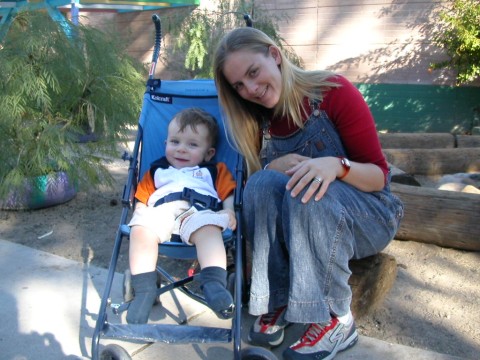
But time traveling back into 2002 and reading the journal I kept both during my pregnancy and during Tobey’s first year of life, I see what a complete and utter crazy, control freak I was.
Don’t get me wrong: I was also really cute. Hot even. (Man, my hair will never be that blonde again. Damn, hormones.)
12/2003, Tucson, Arizona
But I was convinced that I was so powerful…and yet often felt completely and utterly powerless.
I thought that by maintaining control over my world, over my child’s world, that I could somehow protect him. Keep him safe. Turn him into the healthiest, strongest human being ever poised to be President of the United States of America.
And at the same time, as I read these journal entries and think back to that younger, blonder time, I realize how terrified I was.
How in a moment powerful transformed into powerless.
A fall from a swing. A slip in the bath. A bug bite. An allergic reaction.
That’s all it took to turn me into a powerless heap of Jello.
My life as a mother hasn’t changed all that much. Powerful still turns into powerless in an instant.
But now, I know that powerful is an illusion.
I know that control is an illusion.
I know that I am not in control.
I’m not the driver.
I’m the navigator, sometimes.
I’m the backseat driver, a lot.
I’m the guy who writes the instructions manual.
I’m the girl upstairs who edits the manual three years later.
I’m the old lady who laughs at the manual years later when cars learn how to drive themselves.
* * * *
This is not an easy understanding to retain, dear 38-year-old Me.
I’m still very susceptible to believing I am in control.
That I can keep him safe.
That I can protect him from this scary world.
That he will make it…thanks to me.
I’m still a bit of a complete lunatic. And I still think my husband is being a complete asshole when he tells me so.
But, for the record, he’s usually right.
The only difference now, 10 years later, is I can recognize my craziness a lot quicker.
And acknowledge it. And forgive it.
I’m a lot more forgiving of myself now.
It took me 10 years to let compassion for myself in.
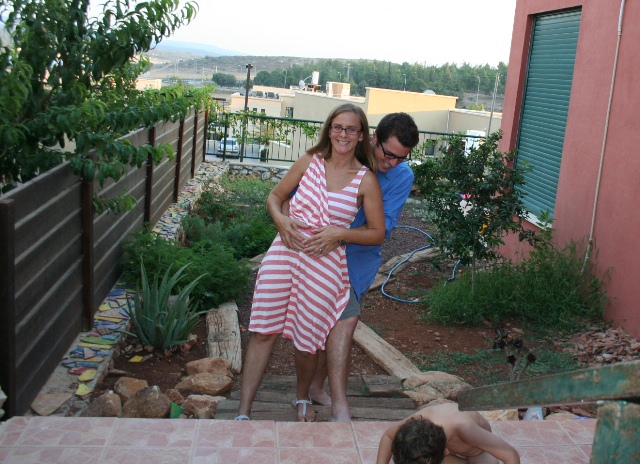
And while my hair is not as blonde, my shoulders are a lot lighter than they were 10 years ago when I first became a mother.
2012, Israel
And the compassion I have for myself spreads to those around me…
To my husband.
To my own mother.
To my mother-in-law.
To my children.
To my friends.
To my enemies.
To strangers.
* * * *
Dear 38-year-old Me:
Since opening my heart to my son 10 years ago, I have become so much more vulnerable to pain, to fear.
And somehow, strangely, during that same period of time I’ve managed to let go of pain, of fear.
A bit.
And let in love — a bit more.
I’m writing this letter to you today to remind you of that.
So that tomorrow, when fear creeps in, when control takes over, you remember that it’s all an illusion.
This understanding transformed a recurring nightmare into an opportunity for introspection. An ongoing opportunity.
And while I don’t have catastrophe dreams very often anymore, when I do, I know it’s time to slow down. It’s time to recalibrate. Return to the basics. Ask myself what’s important.
Remind myself to live less in my mind and more in the moment.
This moment.
It’s all we can do.
It’s all we have.
This moment.
This understanding is what we wake up to in the moment following tragedy.
This understanding is what we wake up to in the moment before a perceived catastrophe.
And then we fall asleep again.
But, what if we were to carry this understanding with us?
Into the next moment?
Into this very moment?
The only moment we have.
Life is a catastrophe, to paraphrase Jon Kabat-Zinn, the mindfulness guru who probably best perpetuated in the U.S. this concept of “living in the moment.”
Bills to pay. Kids to feed. Spouses to please. Bosses to appease. The everyday catastrophes of life.
Which means we can stop waiting for a catastrophe to happen.
This is it.
And to paraphrase an unwitting proponent of mindfulness, Jonathan Larsen, the creator of the hit Broadway musical Rent — who died the day before his show premiered Off-Broadway:
There’s no day but today.
Words that constitute the same concept as “living in the moment” but with a musically moving execution. And the topical catastrophe of AIDS.
AIDS or not. Natural disaster or not. Mayan apocalypse or not. Madness or not. Pain or not. Fear or not.
“There is no future. There is no past….”
There’s no day but today. And it’s not bad background music to hum to a Mayan apocalypse.
Twice a month, on average, I travel to Tel Aviv for work.
And twice a month, on average, after I park my car on Menachem Begin street in Ramat Gan I walk over to Cafe Cafe to order an espresso k’tzar to go.
Today, I walked into Cafe Cafe and before I could order, the waitress hanging out by the bar looked at me and said “Espresso k’tzar?”
Incredulous, I asked her in Hebrew, “You remember? Really?”
She said, “Of course.”
Now, a skeptic might say, she has a statistically high chance of guessing what I will order at an espresso bar in Israel and nailing it. After all Cafe Cafe is no Starbucks, and there’s no peppermint or pumpkin or other array of holiday coffee drink specials.
However, anyone who knows Israel would know that the waitress’ chances would have been 5x as high if she had said instead of espresso k’tzar:
“Hafooch?”
Since 9.75 times out of 10, Israelis in Tel Aviv order hafooch (a latte).
But she didn’t. She said a short espresso, which is what I always order the two times a month I am in Cafe Cafe in Ramat Gan.
And this little gesture — this “remembering” of little old me — made me stop. Completely stop. I stopped inside a moment I would normally speed through.
Suddenly, I looked at this stranger differently. I interacted with my coffee differently.
All it took was one, seemingly simple interaction to change the way I walked the three blocks from the cafe to my destination.
Instead of noticing the sewage smell emanating from open garbage container like I normally do on this walk, I noticed the shimmer of a single bee stopping to buzz in the sunlight above a sidewalk block.
Do you see it?
I couldn’t capture its majesty in the moment. But I got closer to a bee than I ever have before. Because, for once, its beauty resonated with me more than its potential danger.
And, for me, this is huge.
Beauty overtook fear.
My interaction with a nameless barista was a moment of magic in my day. And considering I had just gotten out of my car after having spent two hours in bad traffic on the highway alone, magic was much-needed.
The magic of you is the minor yet major factor in whether or not my day starts off with wonder and hope or with cynicism and despair.
Of course, I play a part in the magic trick, too. I am the magician’s assistant. I need to be willing to see and believe in the magic in order for it to work.
It helped that I was listening to a series of TED talks on my commute to work this morning. It helped that one of those talks was Shawn Achor’s “The Happy Secret to Better Work.” I was in the right frame of mind to be happy. It helped that one of those talks was Louie Schwartzberg’s “Nature. Beauty. Gratitude.” I was in the right frame of mind to appreciate and be thankful for all that my eyes could see during that three block walk.
Shawn and Louie — strangers on a stage — helped.
Sometimes you are a magician. And I am your assistant.
In college, one of my best friends was Stephanie. We met sophomore year as we both hesitantly decided to join the eager freshman girls in sorority rush. By the time Rush Week was over, we knew that no matter how much or little we ended up liking the girls dressed in matching t-shirts and hair ribbons, we’d have each other.
And we did. Until the summer before Junior year when Stephanie got sick. She didn’t return for fall semester, and instead spent the next nine months receiving treatment for lymphoma. We spoke on the phone often during that time — in fact, when I remember Stephanie, I remember her phone voice, “Hey Jen, It’s Steph.” But I visited her only once at her parent’s home in Pennsylvania, a winter break road trip I dared alone from my parent’s house across the Delaware River.
I remember carefully washing my hands when I entered the house, and I remember how cheerful Steph was that day despite being clearly weakened. We played board games, and she showed me her computer station in the basement. The place, she told me, where she still felt connected to the world.
This was in 1994. The internet was still very young. I can’t remember if I even had an email address yet. If I did, I didn’t use it for anything other than connecting with my friends at school. But to Steph, the internet was everything. It was her only thing.
She told me about the friends she had made online; the games they could actually play together; the chat rooms. I remember being curious, but also sad. Who were these “friends” that my friend was so eager to meet each day; and how could she possibly get to know them simply through the green letters peppering a dark monitor screen?
But now I understand.
Almost 20 years later, I understand.
I understand how a stranger can make you feel alive.
How technology can be a life line.
And while for some, this is a more literal truth than for others; I do believe it can be a truth for us all.
I’m no technophile. In fact, I’m the mom that severely limits her kid’s computer time; rolls her eyes at her husband’s urgent need for the new IPhone; and worries that the next generation will never learn how to spell because they’ve never lived without Spell Check.
But, I’m no technophobe either. In fact, I believe that technology, and more specifically social media, just might be what saves us.
It’s a lofty statement with modest origins.
I realized today, for instance, how using Instagram has reignited my sense of wonder.
Through the lens of my mobile phone camera and the filter of Instagram, I suddenly find myself marveling at the beauty that is the backyard of my otherwise unattractive rental home in the Galilee:
I’m touched by the remnants of a lost time and place:
I feel in my heart the true miracle that is my son playing on the playground the day after a cease fire:
Through Instagram, I see the world with hopeful eyes, and from that space find myself seeking new objects of wonder.
Every day.
Wonder. Hope.
I’m on the look out for wonder and hope.
And when I find it, I want to share it.
This is what the world needs more of.
And it’s not just Instagram. Twitter ignites my curiosity. It’s in this space that I meet up with science geeks; where I’m reminded of just how many people out there really, truly want to save our planet. It’s in this space that I found my community in Israel; where I realized I’m not alone in my quest to make this land and the gentle hearts of those of us who live here understood by those who don’t.
Wonder and hope.
And Facebook, too. It’s here I’m inspired by the joy of the people I love. It’s here where I’m reminded by just how much people care about me, and just how much I care about others. How much my heart can burst at the photograph of a new baby born to someone I’ve never met in real life, but know through her blog what a gift that baby truly is.
Wonder and hope.
Social media –and your sharing bits and pieces of your wonder and hope — makes me feel alive.
And together, our joy at living, just might be what saves us.
Lyrics written before I was born, and yet as I sing them out loud today, I feel their depth and their truth. They penetrate my heart, and silence my mind.
But only for a moment.
And then the mind awakens.
How many of us are empty and aching and don’t know why?
How many of us do know why, but are afraid to admit it? Afraid to do anything about it?
Paralyzed?
How many of us are, like Kathy, sleeping?
And at the same time restless?
Casually cognizant of our discontent but resigned to its permanence in this one precious life we have to live?
Why don’t we do something?
===
We are 9 days away from an internationally-renowned pop culture event – the end of the long count of the Mayan calendar. Otherwise known as the Mayan Apocalypse, aka 2012, aka End of Days.
Whoever was in charge of brand strategy for the Mayan civilization should get a big fat bonus.
No matter where we fall, our lives are certainly about to feel like a scene from a Michael Bay movie.
And no matter where we fall, for a moment, for certain, we will awaken.
What is going to happen next? we wonder.
Will the sky fall?
Will the stock market crash?
Will Target run out of transistor radios and matches?
And who gets to score the soundtrack?
===
Here’s my question:
Is it possible that we crave disasters?
That there’s something soothing about an imagined apocalypse?
An end to the agonizing restlessness of our real lives? A beginning of a craved banding together of humanity?
Is this the spark that created Doomsday Preppers? World War Z? The Walking Dead?
This interest in disaster is not just the stuff of the fringe. It’s not just the stuff of zealous religious folk who think the End of Days heralds the coming of Jesus. It’s not just the stuff of conspiracy theorists who are certain the Mayans knew what they were talking about and the government does too, but is hiding the secret from the good people.
It’s the stuff of all of us.
Secretly, perhaps, we all wish for something that will shake us from our slumber.
Secretly, or not so secretly, we wish for something that will force us to make a decision. To take action. To live a life of deeper meaning.
A life where our actions feed our hearts, not our heads.
And, perhaps, we think the answer lies only in global catastrophe.
How else but a global catastrophe could we justify leaving our jobs? Selling our house? Breaking our lease? Ending our broken relationships? Dropping out of school? Trekking across Africa alone for seven years?
If the zombies were to take over, on the other hand, we’d finally have an excuse to quit our job. To change majors. To tell people what we really think of them.
On the other side of catastrophe is a new beginning.
===
“Toss me a cigarette, I think there’s one in my raincoat
Is it when you feel the urge to buy cotton harem pants that drop just below the knee?
Is it when you recognize the country’s top celebs?
Mentors on Israel’s The Voice
If so, I’m not there yet.
Yesterday, on my drive into Tel Aviv for a meeting, I noticed a billboard for The Voice staring down at me from high above the freeway. Four faces: And none were remotely recognizable to me.
I couldn’t relate to the dress or hairstyle on any of the four. None looked like my friend, my father, or even someone I’d choose to be on of my top 5 list “freebies.”
Where am I? I thought.
Tel Aviv, my self answered.
And I live here? I thought.
No, not in Tel Aviv. And that’s part of the problem.
I live in the outskirts. I live a sheltered life.
On purpose.
But what happens when you live a quiet, sheltered life on purpose is this feeling of complete and utter disconnect. It takes a lot longer, presumably, to feel like an “Israeli” among Israelis.
Of course, part of the problem is I have a nice big fat crutch called “English.”
I work mostly in English. Many of my friends speak in English.
I stick to my English books on my Kindle and the little TV I watch is in English.
At some point in the last six months or so, I stopped trying so hard to fit in.
Which on the one hand makes my life a lot easier, but on the other hand keeps me stuck feeling like a tourist in this country. A foreigner. An outsider.
I’m a lot less lost than I was two years ago, but I’m not quite found yet either.
Which is okay.
Think about it, I told myself as I parked the car in Ramat Gan.
You spent 30-something years in New Jersey, and you never quite found yourself there either.
Nor could I relate to the celebrities plastered on billboards. Nor were any of those celebs on my “top 5 freebie list.”
This was only after I got confirmation that my two good friends in Tel Aviv were safe, and heard the same from my coworker who has an IDF-aged son stationed close to where it happened. My online Tel Aviv based “tweeps” had all reported in, as well.
Was it a friend of a friend? The cousin of a neighbor?
Back when I lived in the States, especially when I worked for the Jewish newspaper, I always waited anxiously for the list.
You know which list, right?
The one with the names. The one with the ages. Sometimes, the one with pictures. Faces that would never change.
Back then, we would get the news feed by email and fax. The Jerusalem Post was the main English news source reporting from the region at the time, and the only one with an online presence.
Now, we get our news everywhere. Up-to-the-minute. Unconfirmed. Confirmed. BREAKING. Photos from the scene. Retweets from eye witnesses.
And, as a result of the very same phenomenon — social media — our circles have widened…and at the same time narrowed.
Take my circle, for example.
I live in Israel.
I have community in Israel.
My real-life community in Israel and my online community in Israel.
If I could maneuver Adobe Illustrator, I’d show you all the hands I’m holding online. They would extend to America, Great Britain, Canada, Italy, and even Gaza.
Now, not just because I live here, but because I have an extended community here, I know more people in Israel.
More potential victims.
And you know me.
Or you feel like you do because you read my blogs. You follow my twitter feed. You’re subscribed to my posts on Facebook.
We’re holding hands in that imaginary graphic.
And now …
BOOM!
You know someone who lives here.
Now, when you read the lists, you’ll scan for someone you know.
Knowing someone here makes the situation a lot more real.
To be fair, however, “telling it like it is” on Twitter also is pretty subjective. Even when it’s told by those of us with a traditional journalism background.
So what to do for a girl who wants to get the real story?
At least, those of us on the front lines of the social media war do.
* * * *
Politicians or military professionals, if they bothered to listen to the mothers, would laugh at us. Belittle us. Keep us far away from the battleground.
We can’t risk opening our hearts too wide, the combat professionals would say. We can’t allow ourselves to be too vulnerable.
And yet, what any social media expert will tell you is that the true value of social media is connection.
Don’t bother using social media — not for any cause, not for any business — unless you are prepared to be vulnerable. To share of yourself. To engage.
And this is why the mothers in Israel are a most effective tool in this social media war.
You believe us.
Why? Because our stories feel … real.
They feel real because you know us.
Or, at least you feel like you do.
Because we dared to open our hearts to you.
Yet, there’s a side effect to listening to the mothers …
Be prepared.
You might become susceptible to love.
Susceptible to love not just for your own child, but for another woman’s child.
(Even for the child of your supposed enemy in this not-quite-yet-a-war.)
When I listen to the mothers, my heart opens to other mothers.
Not just to the mothers of 19-year-old Israeli soldiers. Mothers who must be very conflicted: Protect my son? Or protect my country?
But also to the mother in Gaza, who might have a blog post ready to burst out from her heart, but no outlet through which to express it.
When I listen to the mothers, my heart opens
My heart…
Opens.
And it hurts. Like it should.
War should hurt.
War should hurt.
When war hurts, we are one step closer to being desperate enough to let go enough to end it.









 and yadda yadda, an aliyah blog