I’m a superstitious kind of girl, for one. And, two, I do think our thoughts impact our reality.
If I add a war category to my blog, how does that impact my reality?
Call it what you want: law of attraction; positive thinking; pessimism; subjectivity. I’m someone who believes that we see the world the way we see it. The world is interpreted by us. And every time we put an idea or an action into the world, we receive an idea and action in kind.
If we want our world to be different, we need to start thinking and acting differently.
If I want a world without war, what happens to that desire when I start blogging about war?
* * * *
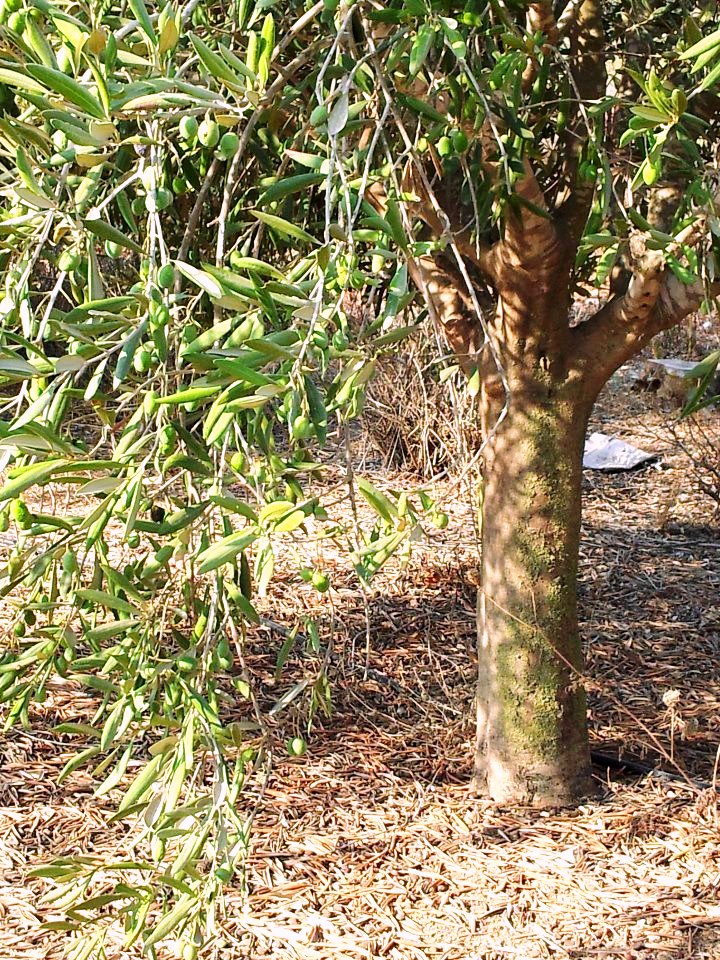
This morning, on my drive to work, I spotted a blossoming olive tree on the main road in the kibbutz. It made me so happy to see the baby green olives peppering the branches. On a macro level, it reminded me of what makes me happy about living on a kibbutz in Northern Israel. On a micro level, it reminded me that this August heat is half way out the door and autumn is just around the corner.
I snapped a photo of tree and shared it on Facebook. I wanted my joy to spread. Spreading joy makes the world appear joyous.
I think it worked, at least a little. I smiled as I left Hannaton and turned left to drive towards Misgav.
Each weekday morning, I pass by Kfar Manda, the Arab village next door to ours. And every morning it’s a stark contrast of how we in Hannaton see the world differently from the people in Kfar Manda.
Of course, I can only guess that we see the world differently: Arab Israelis living in a mini city and Jewish Israelis living in a small kibbutz. I don’t have any friends from Kfar Manda so I have no one to interview and discuss this with.
Today, as I drove by Kfar Manda and held on to the joy that began with an olive tree, I saw smoke coming up from above the Western, residential side of the city. I felt my joy dissipate.
When I rounded the curve and passed the main entrance to the city, I saw the source of the smoke.
I couldn’t tell from my car if it was one of the trash fires I often see or smell burning in Kfar Manda. (A trash fire is exactly that –> burning trash.) Or if it was intentionally set for an agricultural reason, since the fire was on the edge of a vegetable field. How an intentional fire serves any of us in this dry, scorching hot month of August is beyond me.
In any event, there was no one nearby trying to put out the fire. It just burned. And the smoke seeped into my nostrils as I rolled the car window down to take a picture of it.
And my joy disappeared.
My world was no longer olive blossoms. My world was fires burning at the edge of a beautiful field.
Every other week I have the distinct pleasure of partaking in a woman’s group in the community in which I live in Northern Israel. The woman’s group, which was informally started almost a year ago and has grown to a bi-weekly gathering of about 10 – 12 women, has a multi-focused purpose. Mainly the goal is to gather and grow as individuals in an effort to move forward both as people and as community members. We also get the chance to do inner work and get to know our friends and neighbors on a more intimate level.
Most weeks, I’m happy to go.
Some weeks, however, I have PMS…and I am too raw and irritable to handle deep thinking or to listen with care and compassion to other people’s inner struggles.
Often on those nights, I leave the meeting a bit frustrated with my inability to understand the nuances of conversational Hebrew, and/or emotionally drained.
This week, our women’s group meeting fell on a PMS week. As much as I needed a night off from family time, I was worried how women’s group was going to mesh with my hormones
But lovely Linda was facilitating, which eased my concerns some because Linda is an art therapist, and her activities are ones I typically enjoy and move in and out of with ease. They don’t usually release the beast…or require too much Hebrew.
I was right. Her exercise was relaxing — essentially a visualization activity, but the way Linda positioned it to the group was like this:
Take ten minutes to imagine a dream world. A place of your choosing. There are no boundaries; no limitations. What does that world look like? Who are you there? What are you doing?
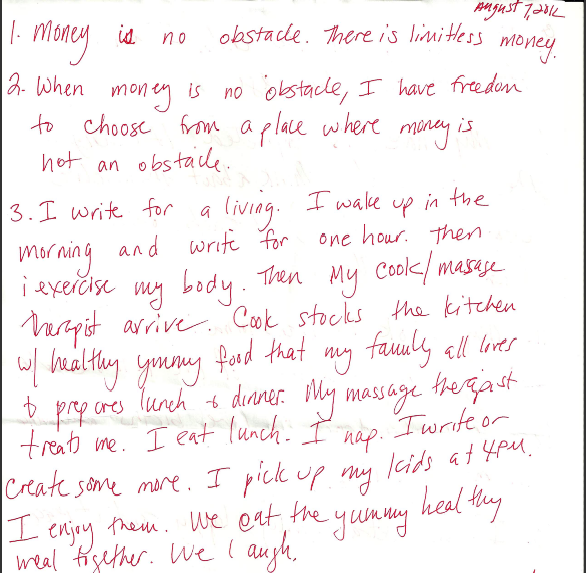
As soon as Linda handed us a sheet of paper and said go, I leapt into action. Without thinking at all, I started writing a sequential list. And this is what it looked like when I finished:
1. Money is no obstacle. There is limitless money.
2. When money is no obstacle, I have freedom to choose from a place where money is not an obstacle.
My handwritten visualization
3. I write for a living. I wake up in the morning and I make myself an espresso. (I edited this from the original. Espresso is a necessity in my dream world.)
I sit down at a lovely wooden desk with a view and I write for one hour. Then I exercise my body. Then my cook and my massage therapist arrive. My cook stocks the kitchen with healthy, yummy food that my family all loves. She prepares our lunch and dinner. My massage therapist gives me a treatment for about an hour. I eat my healthy yummy lunch…slowly. I nap. I write or create some more. I pick up my kids at 4 pm. I enjoy them. We eat a yummy healthy dinner together. We laugh.
4. Once a week (maybe twice) my husband and I go out alone. Sex is sometimes involved.
5. We vacation often, and in luxury.
6. We discover the cure for food allergies and for all cancer.
7. We discover the secret to world peace, too. We implement it.
8. All my previous wrongdoings are forgiven.
9. I clean up all loose ends. I am free of guilt and emotional baggage.
10. I complete my book. It changes the way people think about themselves (for the better). It changes the way people treat each other.
11. My book is transformational. It brings an abundance of love into the world.
12. The abundance brought about by my book brings abundance into my own life.
13. I am extraordinarily happy and at peace.
14. And, most of all, I’ve managed to not mess up my kids or my marriage along the way.
As I completed the exercise, I had an overwhelming, yet unexplainable feeling that the entire kit and kaboodle was actually attainable. From the smallest triumph (write for a living) to the largest (world peace), that somehow the solution was as simple as imagining it.
I know for most people this concept is heresy — that all it takes to solve a problem is to dream up the answer. That all it takes to live the life we imagine, is to imagine it.
I mean, really, if it was as easy as all that, why haven’t we achieved world peace or cured cancer already?
And I see the truth in this way of thinking.
And yet, I see the truth in the accessibility of all I list above.
Really, what are dreams?
Are they involuntary and insignificant images that pop up during sleep? Are they the stories we concoct and ruminate over each day? The visions of the not so distant tomorrow that terrify us? That keep us in unhappy relationships or stressful jobs?
Are these really our dreams?
Or are our dreams the vehicles with which we create our reality?
One could say this visualization practice of mine the other night was no different from the anxious thoughts that keep us from doing what we really want. Except, in this case I let my mind spiral towards all that I want — not all that I am afraid of.
In the past, I’ve daydreamed a wish into reality. I bet you have, too.
My dream to fall in love. My dream to have children. My dream to move to Israel.
Once upon a time, those were dreams written out on a piece of paper — in a journal, or on an application.
And now, those dreams are my reality.
How do we reconcile this truth with the one we sell ourselves everyday? That dreams don’t come true?
Everything, in fact, begins as a dream.
And therefore everything — from personal cook to world peace — is ours for the taking.
When someone dies, we often use that opportunity to express how we truly feel about them. And how we truly feel about them is often… beautiful.
“You were a light in my life.”
“I’m so grateful we were friends.”
“Thank you for making a difference in the world.”
It used to be that homages were reserved for funerals. Eulogies over a coffin or flowery obituaries. But now we eulogize everyone everywhere. RIP hashtags on Twitter. Memes on Facebook. Dedicated blog posts honoring people we’ve loved and lost; as well as people we never knew at all.
On the one hand, I think that this modern way of grieving and of consolation is extraordinarily cathartic and moving. On the other hand, online memorials and tributes often make me wonder how much goes unsaid during our lifetimes.
What drives us to bare our heart after someone dies? What prevents us from showering the people we know with our love and gratitude before they die? Before they fall ill?
It’s an age-old question; not one that was created by and for the new media age. But I do wonder if the new media age might not also offer us a platform to be just as generous with our love, gratitude, and praise in advance of death as we are after it. We’re already doing this for people we don’t know in real life.
One of many memes that circulated after Jobs’ death
Those of us active on social media likely spend more of our time updating our Facebook statuses with fond remarks for celebrities or politicians we have never met, than people who have directly impacted our lives — even if only for one moment. The neighbor who made you feel welcome when you moved into the community. The teacher who spent extra time working with your child. The co-worker who always remembers to ask you at the beginning of the week how your weekend was.
With ease, we acknowledge celebrities more readily than the folks who could match our picture with our first and last name if asked. And likely, one day, we will publicly mourn these dead celebrities in 140 characters or less more readily than we will tell our friends and neighbors how much they mean to us while they live. It’s only after they’re gone — the people who truly fashion the days of our lives — that we find ourselves moved to the point to express how much their being in the world made a difference in ours.
Buds of hope do surface every once in a while. Today, a friend commented on a picture of me I shared on Facebook by saying, “You grow even more beautiful as you grow older.”
I felt flush with love and gratitude when I read that.
But soon after — because my thinking often overpowers my feeling — I wondered, “Would she have told that to my face?”
I’m not sure she would have. Though not because she doesn’t think it, obviously.
The screen provides a bit of a safety net. Or else the speed with which we are used to responding on social media prompts us to type out the words we really mean rather than the ones we allow after self-censoring.
And while I’m often outraged at what people are willing to say online that they wouldn’t say to my face (think anonymous talkbacks on this blog), I cautiously posit that this impulsiveness may be used for good.
Tell someone you love them today.
Tell someone how pretty she is.
Tell someone how her smile makes you feel better about the world.
Tell someone that he was a role model for you.
That he turned a bad day into a good one.
That he taught you how to be a better man, a better dad, a better friend.
There is one day a year I can count on for public displays of affection. My birthday (which is in a few weeks, by the way.) On my birthday, my Facebook Wall is all a-clutter with love. But not in the same way I imagine it would be if I were dead.
“Have a great birthday” doesn’t carry the same weight as “You were a light in my life.”
It doesn’t mean I don’t appreciate the sentiments. Of course, I do.
But I think we can all do a better job at acknowledgment. Use talkbacks for good. Out our anonymous admiration, and be the light of someone’s life while they’re alive.
Do you remember where you were during the September 11 attacks in the United States?
Do you remember where you were during the Holocaust?
Think now to how you relate to the victims of the 9/11 attacks compared to how you relate to the victims of the Holocaust.
If you are an American under the age of 60, it’s more likely that you knew someone, or knew someone who knew someone, that was personally impacted by the terrorist attacks of 9/11 than someone who was personally impacted by the Holocaust.
If you didn’t know someone affected personally by 9/11 you’re lucky, but perhaps you used to work in the World Trade Center, or you interned one summer at the Pentagon. Maybe you visited New York on a field trip once. Or your boyfriend had a friend who worked for Cantor Fitzgerald.
Or maybe you’re American and you watched the whole thing go down minute-by-minute on television.
Most likely, the tragedy of 9/11 is a lot more real to you than the Holocaust. And no matter how many times you see Schindler’s List or The Pianist; no matter how many times you try to wrap your mind around the horror of the Holocaust; and no matter how many times you try to imagine “what would I have done if that was me?”; it’s really challenging to personally connect to the tragedy.
Jewish or not.
It’s not a matter of compassion. It’s a matter of reality.
Philosophers, psychologists, scientists, and Zen masters have spent their entire lives, their entire careers, debating what’s real. Freud, Jung, Nietzsche, Wittgenstein, the Dalai Lama.
But for those of us on the ground, what’s real is what we know.
The closer we get to knowing something or someone, the more real it becomes.
I became present to this very human phenomenon over the past few days as I processed two horrific tragedies — the terrorist attack on Israeli tourists in Bulgaria and the shooting of movie-goers in a theater in Aurora, Colorado.
I wrote soon after the attacks in Bulgaria that for the first time I felt personally frightened by an act of terror on Israelis. Whereas before, as a Jew living in the States (and as a human being), I had always felt sorrow and compassion when Israelis were killed in terror attacks, I never felt it in my gut the way I did on Wednesday.
When you personally know a terror victim, the icky feelings stay long after their story has been told. The thoughts don’t leave you because you quickly understand that it could have been a family member or close friend. That it could have even been you and your boyfriend on the way to a long-awaited vacation.
Rebounding after a tragedy is deeply rooted in our human instinct for survival. But the closer to home a tragedy hits, the harder it is to rebound.
I felt equal amounts of horror in response to the two attacks this week, and yet I was painfully aware — on Facebook and on Twitter — that the majority of the people I know (mostly Americans), expressed greater public empathy for the victims of Aurora.
I understand this.
I understand how it’s easier to feel complete and utter horror when you hear that an innocent American citizen was gunned down simply because she wanted to catch the premiere of a Batman movie.
I understand how disturbing it is to hear about a seemingly random attack on seemingly normal folks in a movie theater in a suburb of Denver, Colorado.
Aurora is a suburb just like the one you live in. Those people were holding popcorn settling into a movie you saw the same night with your teenage son. The mourners look like you. They’re sobbing over their sister, their boyfriend, their wife: Alex, Matt, John, Jessica.
Not like the mourners in Israel crying over victims with foreign sounding names — Itzhik, Amir, Maor, Elior, Kochava. Names you can’t even pronounce.
Not like the victims of Israel’s tragedy — people who lived in towns a world away from where you live. Who were visiting a country you’ve never heard of, let alone considered vacationing in.
I understand this.
And, from the bottom of my heart, I don’t judge this.
But as someone who now understands Israeli reality (though not yet as well as I understand American reality), I am that much closer to understanding how the Israeli victims of terror were just like the Aurora victims of terror. They weren’t victims of war. They were innocent victims, plain and simple.
The Israeli victims were also doing something regular people do: They were on their summer vacation. They were giggling with excitement imagining the hot steamy sex they were about to have on their couples only romantic getaway — the first one since the baby was born. They couldn’t stop thanking their lucky stars they snagged such a great package deal complete with fruity drinks on the beach.
That morning, they had checked off all the items from their packing list before they left the house. Did they have their passport, camera, heart medication? They had printed out the “While We’re Away” list for the doting grandparents taking care of the baby. They had turned on their “out of the office” notification in Microsoft Outlook.
They’re as close to being real to me as the folks in Aurora.
I understand how my American friends may more easily relate to shooting victims in an Aurora, Colorado movie theater than to the victims of the terrorist attack on Israelis in Bulgaria
With my heart, I understand. And I pray that neither you nor I ever come close to experiencing the reality that is knowing someone who knows someone who has been the victim of a senseless attack on innocent victims.
With my heart, I pray neither ever becomes truly real.
I was feeling very bold and brave as I pressed “publish;” even daring with my mind anonymous internet lunatics to post crazy biblically-inspired apocalyptic remarks in the comments section.
This was going to be fun.
Agitated a bit by the screaming headlines on the Times of Israel home page about the unrest in Syria, I secretly hoped the news would drive more traffic to my latest post, featured as a “Top Op” a few scrolls down. I know that makes me sound like an insensitive bitch. I’m not. I suffer over how helpless I feel about the situation in Syria. But the headlines were about bad guys being killed. It allowed me to embrace the numb.
Hours ago I was feeling clever, confident… and now
I feel sick to my stomach.
If you had told me a year ago or two I would feel this way following a planned attack on Israelis travelling abroad, I’m not sure I would have believed you.
When I read the news an hour ago, I didn’t feel the same type of composed sympathy I used to feel when I read about horrific terrorist attacks in Israel before I made Aliyah. Back then, when I worked at the Jewish newspaper for instance, and we would get word from JTA that something terrible happened to Israelis (like the 2002 Passover massacre in Netanya), I would sigh with sadness and I’d shudder over the list of names.
But I wasn’t scared. I didn’t have that sensation that I just barely missed something terrible happening to someone I love.
Or to me.
Now, I feel a tiny bit terrified.
The way you do when you narrowly miss the car accident on the highway. Like it could’ve been you.
In April, my husband and I purchased one of those package vacation deals. If you’ve been to Israel, you may know what I’m talking about. It’s really easy to get a great last minute deal to other Mediterranean countries — Greece, Cyprus, and formerly, Turkey. Since relations with Turkey have soured in recent months, Israelis have been going to Bulgaria instead. In fact, one of my coworkers was there last summer and another has a vacation planned for this summer.
To be honest, I don’t know if he was on that flight. I really don’t know. I didn’t see him at the office today.
When I saw the headline, I felt in my gut like I narrowly missed a personal tragedy.
And yet, that somehow the tragedy still belongs to me.
I’m a jokester at heart. Snide, sarcastic, internally begging for your laughter from the minute I open my mouth.
All I want to do is talk to you.
But I can’t. I’m afraid.
I’m afraid I’ll say it wrong. I’m afraid I’ll say it right and you’ll respond.
I’m afraid you’ll want my answer.
I’m not so good at answering.
Unless I agree with you. L’gamrei. Or you’re looking for the bathroom. Or the elevator. Or the way to Karmiel.
But like a devoted scholar of deception, I’ve mastered the art of small talk.
I can tell you how much I love your dress. I can even ask you where you got it and feign surprise.
But don’t ask me for my opinion on the latest political scandal.
I know. You won’t. You’re just as afraid to talk serious with me as I am with you.
But trust me.
I have so much more to offer you than unoriginal compliments and directions to the nearest facility.
I’m a story weaver. A speech giver. A pulpit preacher – desperate to shove my opinion down your throat.
And I am just as tired of telling the same story in the coffee room as you are of hearing it. The one where I justify my espresso addiction by relaying how I used to think café shachor was a quaint regional delicacy until I made Aliyah. No one thinks this story is more old and tired than I do.
Trust me.
I’m quick and clever. The comeback I crafted in my head after your joke in that meeting the other day was three different shades of awesome until I tried to translate it word for word into Hebrew. I got as far as “Your mother is,” when I realized you were already half way out the door.
Trust me.
Back in the old country, folks thought I was cute because I’m short and blonde and snarky, not because I mixed up my feminine and masculine. Back where I come from, I never mistook masculine for feminine unless I was lost in Chelsea.
Trust me, that joke wasn’t my best. And if I was able to make more than small talk with you, you would know that by now. You’d give me slack on that one because you would already know just how witty my typical ditty is.
By now, if we made more than small talk, I would have won you over with my charm, style, or my inexplicable ability to interpret your crazy dreams – a talent I exhibit best over espresso…in English.
How do I know this? Because Ms. Levin, my second grade teacher told me so. Seriously, my nickname in second grade was Motor Mouth, a moniker craftily created by my teacher at the time, who occasionally relented to my excessive hand-raising by saying, “Yes, M.M.?”
As borderline abusive as this practice was, there was some truth in the designation. I talked a lot. All the time, in fact. I talked to my neighbors at my table. I talked to my friends across the room. Often I would mutter to myself. I was a social creature. I still am.
My poor husband, not a social creature by nature, now carries the burden of Ms. Levin. But unfortunately for him, he has not only my incessant chatter to contend with, but also our oldest son’s and daughter’s. They inherited the Motor Mouth gene.
My chatter tends to run over into my writing. I’ve said often in the past that I “write in order to know what I think.” I didn’t make that up. Author Stephen King has said it. Historian Daniel Boorstin is claimed to have said a version of it. I wonder if those guys were motor mouths, too. Probably.
The best part about blogging is that it’s almost acceptable to be a motor mouth. Not so with traditional, published writing. In magazines, books, and newspapers — the kind of publications people still pay money to read on a regular basis — our motoring is required to be more thoughtful and refined. I respect this. I think it’s a sensible, if often boring, practice — carefully choosing your words and paying fastidious detail to grammar and punctuation.
Which is why, when I have a more thoughtful and potentially refined idea for a story, I don’t blog it. I save it.
I have one right now, in fact.
It’s been percolating inside of me for about two weeks, ever since I first started saving books from the recycling bin.
As you know, I live on a kibbutz in northern Israel. It’s a kibbutz that was established about 30 years ago by the Masorti movement in Israel; Masorti being the equivalent of Conservative Judaism in America. Many of the new residents of the kibbutz were from English speaking countries: the U.S., South Africa, England. When they came to Hannaton, they also brought with them their English language books, which presumably went into the communal library once they landed at Hannaton.
Recently, the library at Hannaton, like the kibbutz itself, underwent a huge renewal project. A volunteer committee sorted through the books to determine which ones would remain in the new library and which ones were either duplicates or in an unsuitable condition. There were thousands of books to sort — and since we’re in a Hebrew speaking country, there weren’t many nearby options for donating. The committee decided to put the unsuitable books in the recycling pile.
But, as we know, one person’s trash — or in this case, reusable waste — is another person’s treasure.
And this is how I came to spend a week and a half trash surfing for treasure; embarking on what I call the “Orphaned Book Project.”
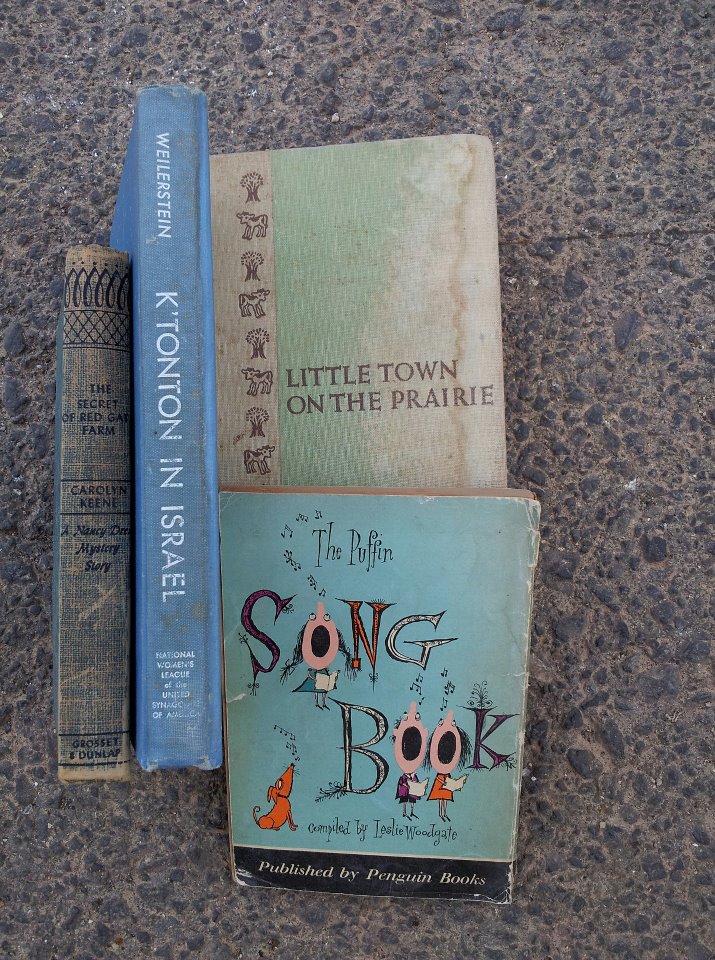
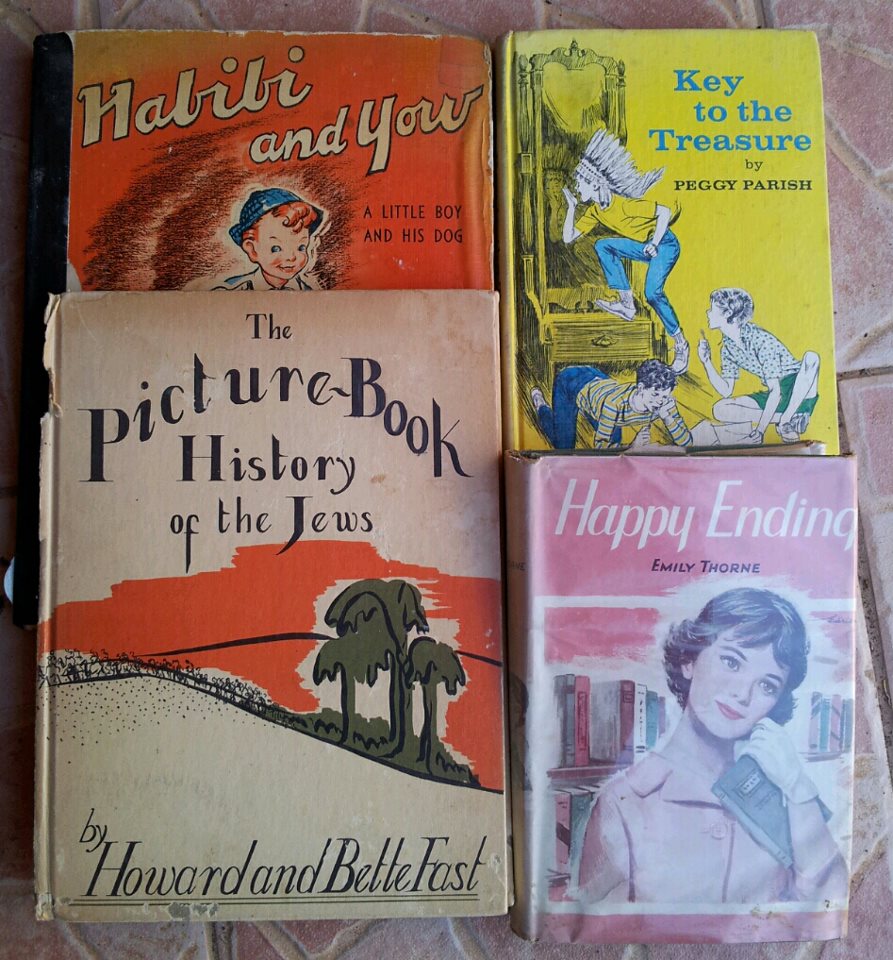
When the books were finally hauled away by the recycling truck, I had saved about 30 books and 15 magazines, including Highlights from the 1980s with “Hidden Puzzles” left untouched for my 5 year old to explore; and a Cricket magazine from the year I was born, 1974. I saved a Scholastic paperback from 1981 written by Ann Reit, an author and editor I had the privilege of briefly working with, and who has since passed away from cancer. I saved a much older Scholastic paperback whose jacket cover previews a young adult fiction story that centers on racial integration in the 1950s. I saved a few ChildCraft How-to science books that are surprisingly still reasonably current, and a few history books that aren’t, but are still fun for my 9 year old to leaf through over a bowl of cereal in the morning.
There were Hebrew books, too, but I didn’t save any. The only Hebrew language publication I saved was a pamphlet printed by a professor in 1944 that documented all the agricultural settlements and their products up until that time.
On the title page, in English, are written the words:
Printed in Palestine.
First I saved a couple of original Nancy Drews, and hardcover Little House, and a classic K’Ton Ton, and a kitschy song bookI have no need for more dusty coffee table books, but couldn’t resist this vintage They All Are Jews, a gift to “David” in 1951, after his confirmation. Inside I found a newspaper clipping from when Miss Israel won Miss Universe.It wasn’t until my final visit that I found the true personal treasure: Peggy Parish’s Key to the Treasure, the last in a middle grade trilogy I loved as a girl and had been collecting
It took me three years of pretending to like Twitter to finally like it. But I do.
And now I have fallen out of rank and file with the folks who spend all day commenting on friends’ kids’ photos on Facebook, but sneer and roll their eyes at Twitter thinking it’s still a social media application that sends 3,456 updates to your phone via SMS text all day. A platform reserved for pesky teenagers obsessed with Justin Bieber or smartasses talking in hipster jargon.
It’s not.
As a consumer of information and a lifelong community seeker, Twitter is a gift to me now that I know how to use it right. Rather than following 9,000 people with the words “wellness,” “green,” “eco,” or “holistic” in their handle like I did three years ago when I signed up as The Wellness Bitch and was looking to build my blog readership, I decided instead to thoughtfully observe for a while when I registered a new account following my move to Israel in early 2011. Also, I logged in as “me” this time, and not as my brand, so I wanted to be cautious while figuring out who exactly I wanted to be in this new medium, and who I hoped would pay attention.
A year later, I’ve almost figured it out.
I’m me.
Well, let’s say, the 80% version of me that I’ve deemed acceptable for public consumption.
At first, I started following people I know personally. After all, I was a new expat in Israel, and it was essential for me to keep ties to the folks back in the States, as a reminder that there are folks in real life who know me and kinda love me.
Then, I started following other English speaking olim: @onaliyah (who works for Nefesh B’Nefesh but also happens to be someone I know from the States), @LauraBenDavid (the social media guru for Nefesh B’Nefesh), and @carolw, (who I have never met in real life but who a friend of mine in New Jersey promised was really funny in an LOL sorta way).
For a while, I didn’t post a thing. I just eavesdropped on other people’s conversations. And, when friends of friends said something funny, or retweeted an article that piqued my interest, I clicked through to the profiles of strangers. Sometimes I followed them. And slowly but surely I stopped stalking and started speaking. And my list of followers slowly grew.
And while most of my new followers weren’t people I knew in real life — I never shook their hands hello; I never caught their gaze; heck, I had no idea what their real voices even sounded like — I began to make friends in the same way I make friends in real life.
If you’re really funny, but have enough social skills to know when your crude has crossed the line, you can be my friend.
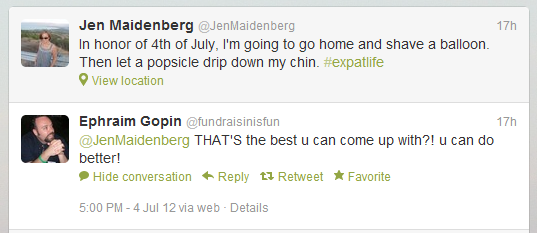
If you retweet me when I am trying to be funny, but don’t say things like “THAT’s the best you can do,” you can be my friend. (If you’re super sweet, I even give you a second chance when you cut me down.)
If you are a science geek, but are well-rounded enough to follow both NASA and quote Buffy the Vampire Slayer, you can be my friend. (NOTE: If you know the lyrics to every song in “Once More with Feeling,” and I am not following you, please Direct Message me immediately so we can be best friends.)
If you’re a blogger living in Israel, particularly the expat kind that knows “the trouble I’ve seen,” you can be my friend.
If you’re a celeb writer I wish I could be friends with in real life — someone I admire both for what you produce on the page and for how you engage with your readership — you can be my friend. (Good examples are @jenniferweiner, @margaretatwood, and @jaltucher).
Some of my imaginary friends don’t even live in Israel or the United States. Some live in their own little worlds. But as long as the law of the land in their worlds is fairly similar to mine — ie. rape is bad; rootbeer is good — I’m okay with widening my circle.
Some of my imaginary friends are out of my demographic. They’re not women or moms or married. They’re not Jewish. They’re not writers. And yet, we’ve accidentally found each other through a shared interest in archaeology or space weather or time travel or a dream to one day be Sarah Silverman.
My imaginary friends are not a substitute for my real friends — and I use “real” both loosely and lovingly, because otherwise we’re getting into a conversation far deeper than I had intended.
My imaginary friends complement my real life friends. My imaginary friends helped me bridge the gap between the semi-social butterfly I was in New Jersey and the awkward recluse I was when I first moved to Hannaton. Unintentionally, because our conversations are always in English, they helped soften the frustration I felt when I couldn’t properly articulate my thoughts and feelings to many of my new “real life” friends in Israel. And without knowing it, they supported me in my quest to remain tied and connected to my American self, while still figuring out what my Israeli self looked like.
And while imaginary friends can’t give you the kind of in-person intimate huggy kissy love and attention your real life friends can, and hopefully do, your imaginary friends can make you feel smart when you feel stupid and heard when you feel ignored or overlooked.
So, thank you imaginary friends of @JenMaidenberg, for being my “virtual kehillah” here in Israel while I still eagerly but cautiously grow my real-life one. You, my imaginary friends, with your double entendres and your <winks> are often accidentally my imaginary cheerleaders, too.
So when I think back to the beginning of January 2011 when I got the “brilliant” idea to chronicle my Aliyah experience on a personal blog, I giggle in minor embarrassment.
When I started blogging about my life in Israel, about motherhood here, and about making friends, it was an exercise in maintaining sanity. Truly, the way I process life’s ever stimulating handouts is through writing.
Sometimes, of course, this practice gets me into trouble. Especially when I want to make and keep friends, or get good grades, or convince people to pay me a high salary.
“Running my mouth off” before thinking — a phrase I used to hear a lot from my mother and my 2nd grade teacher, Ms. Levin, and my 8th grade teacher Mrs. Lingo — isn’t necessarily wise. Luckily, as an immigrant who still can’t carry on a conversation with a 3rd grader, I’m not as much at risk of mouth running as I used to be.
That said, my fingers inevitably find their way to the laptop and my previously diagnosed diarrhea of the mouth expresses itself through the raised cavities of my keyboard.
It’s all part of the ever elusive “process” we writers apparently possess. A process that for me, basically looks like this:
Driving/pooping/singing my daughter to sleep for an hour ==>
Thought ==>
A-ha moment ==>
Aggravating pause in between deciding I want to write and having the time to write ==>
Bitter and ugly resentment at all the people in my life who keep me from writing when I want to write ==>
GRITTED TEETH ==>
Hiding in the bathroom with my laptop pretending to poop ==>
Writing…ahhh ==>
Wishing I had time to edit my post before publishing ==>
Deciding I don’t ==>
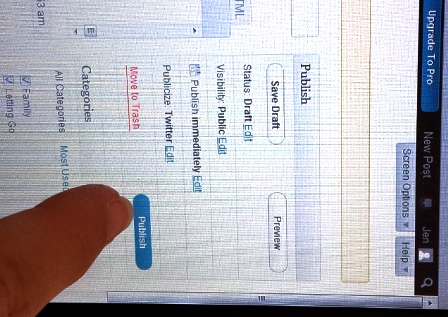
Pressing the PUBLISH button anyway ==>
Smiling with pleasure and relief, while simultaneously cringing with concern.
It looks something like this.
Yes, my friends. That is my process.
Maybe if I had a cartoon dog, things would be different.
I could run ideas by him before I wrote them down, before they ever reached another person’s pair of eyes. Before they reached my mother, my husband, my neighbor, my boss.
He could help me identify which ideas were good, and which better belonged in my journal/rant notebook.
He could warn me when I was likely going to piss someone off.
He could surreptitiously serve me cocktails so I do it anyway.
And then he could hug me all the way back to self-assuredness.
In real life, this person is called an editor. But sadly, in the imaginary world that is blogging while working full time and raising children, good editors are rare.
As is ample time to think twice before hitting publish.
Tonight my son was the student of a lesson I’ve been actively trying to learn all week all my life.
How to keep thinking you’re a rock star when the world hands you proof otherwise.
The setting? My son’s soccer ceremony. The kick in the gut? Instead of being awarded the “best player” trophy at his soccer ceremony tonight, it was presented to one of his friends.
Props to my kid in that instead of losing his shit like one of the younger kids who screamed and stormed off at the end of the presentations, mine actually held back tears long enough to mutter a mom-forced congratulations to his friend, and pose for a picture with him. But as soon as possible, he grabbed my hand to walk far enough away to break down.
“It’s not fair,” he cried. “Everyone knows I’m the best player! The coach favors H. and everyone knows it! I should have gotten that trophy, not him.”
I nodded sympathetically. Maybe I agreed with him. But even if I didn’t, I couldn’t help but relate to how much it sucks when you know you’ve done something really great and people aren’t recognizing you adequately.
I feel this way at least once a day.
What I found truly amazing, however, as my son was lamenting his coach’s bias is that he never once said:
“I suck at soccer. I’ll never get the trophy.” Or,
“I’m not good enough. If I was, my coach would have given me the trophy!”
Instead, he insisted time and again some version of “It’s not fair. I’m the best. Everyone knows it. I deserved that trophy.”
So why the agony?
What stops us from just believing our inner rock star?
Like my son, I’ve always been moderately confident. And in a chicken or the egg sort of puzzle, I’ve never been able to figure out if I’m confident thanks to my successes or if my success is linked directly to my confidence. But as confident as I often appear (to myself and others), there’s always a moment when cocksure turns to doubt.
Like my son, I want the trophy. I want the recognition. I want people to understand how great I am and tell me. Over and over and over again.
If the key opinion leaders in my life — the people I’ve deemed smart, successful, funny, cute, sexy, or otherwise worthy of my worship and/or attention — praise me for my work, I’m on cloud 9. “People really get me,” I think. I have proof I am great.
But if the KOLs don’t agree with my own personal assessment of me (that I’m great/working hard/ trying to be kind), or they don’t shout it out loud, my confidence slowly begins to dissolve.
I like the applause. I like it when people think I’m special.
But is it possible to like it without believing it?
The recognition has clearly become an addiction, and I don’t like being dependent on it. As with any dependency, I suffer when I go through withdrawal. On the other hand, what happens to our greatness when no one notices? Or when someone else sees your greatness as mediocrity at best?
Philosophers, Buddhist monks, and fans of the Matrix still debate whether or not an object exists if someone is not around to perceive it.
How on earth do I evaluate my performance without counting on a grade/raise/applause/pat on the back/book deal?
* * *
My son and I both simultaneously live in two different realities. The one in which “I am great and I know it.” And the one in which “I am great and nobody knows it.”
In fact, most of us are constantly perched at the center of a seesaw, one foot on the side of certain and the other on the side of afraid. It’s up to each of us, in every moment, to choose where to place our weight. This much I know.
But is believing our inner rock star really as simple as deciding to?
Can we simply choose to live the reality in which we are great? Instead of the reality in which we’re waiting for others to notice?
Is it possible to be the rock star without the audience?
In another lifetime, I was a budding talking head.
I arrived in Washington, DC, as an undergrad with the intention of studying political communications. But one boring “History of Journalism” class later I switched to archaeology. And one boring “Introduction to Archaeology” class after that I switched to international politics. It was in politics I stayed – mostly because I’m a rule follower, and the rule was you needed to choose a major by sophomore year.
The placement suited me, though, since the summer before I had traveled to Israel for the first time on a program organized by what was then ZOA/Masada and returned home armed with a love of Israel and firm ideas about how to keep her safe.
I wrote a term paper freshman year — practically copied straight from the 8 x 10 black paperback handbook I had received on my Israel trip — on why it was imperative that Israel never give up any of the West Bank. (I think I may have even used exclamation points in the title.) My TA, who would later go on to become a founding member of MEMRI, gave me an A+.
The following year, I landed a highly sought-after public affairs internship at the Embassy of Israel. This was in 1993, probably one of the most exciting times to be working at the Embassy of Israel, in the days leading up to Oslo and handshakes on the White House lawn. As I painfully tried to translate newspaper articles fresh off the fax machines, I reconsidered my stance on Arab-Israel relations. I started reading Amos Oz.
In my senior year of college, I applied for and got a research internship at the Washington Institute for Near East Policy, a think tank where one of my professors was working at the time, and an organization which was, at the time, generally regarded as a melting pot of opinion. But when my more right-leaning professor left the Washington Institute to head up a very right-leaning think tank, I left with him. I liked him better than the institute and this time, more important, I was offered a paying job, as an executive assistant. My ticket to adult freedom was only a few blocks away.
In this position, I was lucky enough to both observe history in the making, and not have my name attached to it. I proofread and formatted a very famous paper, written by brilliant lovers of Israel who would later become key decision-makers in a Republican government. I knew these “neocons” as real people, not as “foreign policy hard-liners” or strategists. These individuals were my professional mentors — no matter what their position was on Israel or Iraq or Iran — and they encouraged me to continue in the field, to go back to get a higher degree, to educate myself, and to be part of the continuing dialogue.
I didn’t, though. I quit before I even started. Only a handful of internships and two jobs into it, I was already frustrated, exhausted, and uninterested in working in a career where I couldn’t see the light at the end of the tunnel. As a thinker and a writer, I love dialogue. But I couldn’t see how we were ever going to solve the conflict with just dialogue. Educate, perhaps. Enlighten, maybe. But to solve this thing, we would need action. And I wasn’t convinced that either side would ever be interested in acting. In the summer of 1997, I left Washington, moved to New York, and started a career in publishing.
It’s only now, almost 15 years later, that I understand that my experience in DC at that time was not just educational, but truly formative as it relates to my stance on Israel. Accidentally, I became a centrist. And more specially, it was then I decided I preferred to be an observer of the region rather than a policy maker. A student of human relations rather than international relations.
* * *
Two days ago, I sat in an auditorium in Jerusalem with a thousand other attendees of the 2012 Israeli Presidential Conference, all passionate in one way or another about Israel. The strength of their convictions alone could fill the room. The energy was uplifting, but a voice nagged in the back of my head. “Words, words, words…” it said.
The VIP bloggers sit for a photo opp with President Shimon Peres (I’m sitting on the right)
As the conference continued, I sat and listened to well-renowned, content producing opinion makers debate whether Americans have the right to interfere in Israel’s national security policies (applause!) or whether Israel alone knows what’s best for herself (applause!). During the few politically inspired panels I sat in I thought to myself, “Have I traveled back in time? Either it’s 1997 or these guys have been talking in circles for the last 15 years.”
In all the political back and forth during the conference — back and forth that often felt more back than forth — two people I heard made me feel grounded in 2012: Peter Beinart, author of The Crisis of Zionism, and Ayaan Hirsu-Ali, a fellow at the American Enterprise Institute and the writer of Submission, a film about the oppression of women in conservative Islamic cultures.
It wasn’t their forward thinking strategies or their bright visions for the future that captured my attention. In fact, each of them possesses potentially dark visions of the future. Futures in which Israel may not exist, or in which our children are still carrying on the same back and forth we carry on today (as long as we avoid a nuclear war with Iran and survive the end of the Mayan calendar).
It was because when they spoke, they moved me. I felt the heart inside his and her words. I felt their love for humanity, their hopes for our children, and their desire to see change in our time, or at least in our children’s time. I didn’t hear talking heads when I sat in front of them. I heard human beings.
And while, admittedly, my experience at the conference was limited to a handful of panels and speakers, and my reasoning was based not on critical thinking, but on feeling, I move forward today, post-conference, with a firm belief that was planted almost 15 years ago.
It’s we, the students of human relations — not international relations — who will one day help guide this region to a solution. Humans, through their need for one another and their true, deep desire to connect and to love — not just survive — are the only true hope for peace.
* * *
My husband and I are growing passionfruit in our backyard in northern Israel. Passionfruit vines are known for their strength and their ability to grab hold of and flourish on fences. They’re stubborn plants, but susceptible to the blustery afternoon wind we get from the west.
We planted four next to our fence, but only one survived. For a time, I couldn’t understand how this one made it while the others didn’t. We watered them the same. They receive the same amount of sun and shade, and presumably the same quality of soil.
But one day, I saw peeking through our neighbors fence another passionfruit vine. Slowly but surely this vine has extended itself toward ours, and our vine reaches for it. One day soon they will connect – without any help from me. Why? Because they want to. One dared to reach across the fence.
Time passes slowly as I wait patiently for their two hands to grab hold of one another. Good days and bad days pass. My children grow. The weather changes. World opinion shifts.
Okay. Wink your left eye for yes, your right eye for no.
No, wait.
Really. I don’t know want to know. Don’t tell me.
I think I already know, and it’s making me squint and squirm.
Okay, fine. I’ll ask:
Your kids are scared of me, right?
Stop denying it over forced uncomfortable astonishment and laughter. I can see right through you.
Be honest: When I invite your kids over to my house in my broken backwards Hebrew, they’re not just being shy when they hide between your legs and refuse to answer me no matter how sickly sweet I make over my voice. They are trembling with fear. Right?
They’re thinking:
There is no way you can get me to go anywhere with that thing.
They don’t see a kind-hearted, fun-loving lady in front of them – they see stranger danger. Massive stranger danger. Forked tongue kind of stranger danger.
I might as well live in the abandoned house with the broken shutters.
I might as well be the old Russian lady handing out dusty-wrapped sucking candy at the entrance to the new $1 store.
I might as well be the hungover clown handing out balloons outside Foot Locker.
It makes me cry a little inside. And laugh a little inside.
Maniacally.
Look, I understand where they’re coming from. I don’t begrudge your kids their worry.
It’s hard enough for an adult, let alone a four year old, to summon up the courage to go to a friend’s house alone, where she will be assaulted by the sounds and smells of someone else’s life. It’s hard enough for an adult, let alone a four year old, not to know immediately where the cleanest bathroom is or what kind of snacks are in the pantry.
So I understand her resistance to going alone to a stranger’s house where the mommy is a gibberish-speaking freak. Where she can’t be sure if I’ll understand what she’s asking for when she wants to leave or when she wants marshmallows and wafflim…together…as a sandwich…for dinner.
It doesn’t matter if her BFF actually seems to love that gibberish-speaking freak. And sometimes even wants to kiss it. (ich!) Your kid can clearly see how different I am from the other mommies.
Different mommies are scary.
Which is why we hardly ever seem to have playdates at our house.
Not necessarily a bad thing. It means our house is often quiet at 6:30 pm and we can actually attempt a reasonable dinner and bedtime routine – something I long for from the States more than grass-fed beef and Bounty paper towels. Back in the days when my kids were fed by 5 and in bed by 7, as opposed to falling asleep on the couch while my husband and I try to sneak in an episode of Mad Men.
Every once in a while, however, I do come home from work to find my daughter playing princesses with a friend from preschool. Someone brave who accepted an invitation from my husband, who speaks perfect Hebrew and therefore is presumably a lot less scary.
I’ll put my bags down and move to hug my daughter who is thrilled to see me. Then I’ll notice the little girl hiding behind the couch wearing a pink Sleeping Beauty gown and clip-on earrings. Don’t worry, I say with my eyes, I only eat little boys.
Out loud, however, in my broken Hebrew, in my sugary sweetest voice, I say to her, “Want you come eat my house?”

 and shared it on Facebook. I wanted my joy to spread. Spreading joy makes the world appear joyous.









 and yadda yadda, an aliyah blog