Blog

Culture, Letting Go

Putting the sexy in immigrant

They say an oleh is truly settled here when he starts buying Israeli deodorant instead of importing American roll-on via generous relatives, or when he finally settles for chunk light tuna instead of white albacore.

For sure, a girl’s showing signs of improvement when she commits to an Israeli hairdresser.

I walked into Effi’s Tiberias salon the other day looking for a cleanup. Since it’s summer, the season in which I let my hair grow long to remind myself of the blonde I used to be, I told him I didn’t want him to take too much off. Just enough to remind myself I’m a hot mama, not a Hanson brother.

I hadn’t had a haircut in more than six months; the last time was during an unexpected visit to New Jersey in December for my grandmother’s funeral. The day before the funeral, my mom treated me to a cut and blow (the words of which alone transform me from kibbutznik to suburban chic). Since then, however, I’ve been letting my hair grow out, compensating for the split ends with ponytails and braids. Until the other day, when a co-worker chuckled and asked me, “So? You’re going for the Princess Leia look now, huh?” At which point, I realized it was time for action.

I had tried out Effi once before, a few months after we made Aliya. He’s the regular hairdresser for both of my husband’s parents, and, get this, once employed Israeli celeb pop singer Moshe Peretz in his salon. I should have been really excited when Effi told me Moshe Peretz was due into his salon any minute to give Effi himself a cut.

Had I known who Moshe Peretz was, and had I not been reeling from what Effi had told me only minutes before, maybe I would have giggled. Instead, I was distracted and tingly in a way a woman approaching 40 can only be when a man who is not her husband or her five year old son gives her an accidental compliment.

As I sat down in his chair, I had told Effi I wanted to keep my hair long, but other than that he had free reign. Effi looked me up and down through the reflection in the mirror, paused, and told me what a big change he could see in me since the last time I was in.

“Really?” I asked. “How?”

“You don’t look so American anymore,” he said, working on his English. “When you were here last, I thought to myself, ‘This woman is so stiff. So square.’ You wouldn’t let me do anything. Now, look at you.”

A year ago, I would have been insulted. Instead, I took inventory. I looked at myself in the mirror. What was he talking about? I was wearing my standard pair of Old Navy Jeans, sporting the wannabe adorkable red glasses I bought at Cohen’s Fashion Optical right before we made Aliya, and my hair was growing in Zac Hanson circa 1997. True, I was wearing the new lemony top I had bought on sale from Azrieli’s Forever 21 store, but I can’t imagine one shirt made in China sold at a Tel Aviv chain store geared for teenagers and hookers could really make much of a difference.

What did he see in the mirror?

“I see it happen to people all the time,” he said. “They come to me fresh off the boat. And then a year or two later you can see Israel all over them. Their hair gets lighter. They buy funky clothes. This country gets into them. It…”

He struggled for the English.

“It makes them more alive?” I asked.

“Something like that,” he answered.

I sat with it for a bit. The old me – the one fresh off the boat – would probably have ruminated about his comments the entire time he cut my hair. But the me in the chair, the new me (apparently), could only shiver with delight as he snipped away the 12 year old Zac Hanson and created a haircut suitable to the Israeli woman he saw in the mirror.

I felt sexy in that chair…and, I guess, more alive.

After he finished his work, I paid and took the sexy Israeli with me out the door, along with a bag full of new hair products. I strut my stuff down the Tiberias boulevard, flipped my hair from side to side, and with my eyes, dared anyone to try, just try to speak English to me.

I’m no tourist, my eyes said sparkling. I’m no square immigrant.

I’m alive. Israeli style.

(This was originally posted on The Times of Israel.)
Family, Love, Mindfulness, Parenting

Taking a picture in my mind

Back when this little guy was a tad bit younger than he is today, he used to “take pictures with his mind.” He’d put his pointer fingers up to his temples, lean down towards the object he wanted to focus on (typically a kitten or a flower), and snap his eyes shut for a moment. He would soon open his eyes with a satisfied look on his face and later return home to sketch and color what he observed.

A boy with his homemade sun scope, after observing the Transit of Venus in 2012

When I was his age (or a little bit older), I used to call this practice “making memories.”

I read it in a book once.

It sounded romantic. The idea that every moment was an opportunity to make a memory if only we stopped to notice it.

I would sometimes walk home from the bus stop, forcing myself to quit counting steps and skipping over sidewalk cracks, and look around instead at the scene on my street: The sun shining through the oaks and birch trees that lined the sidewalks. The children coloring chalk figures in their driveways. The woman opening and shutting the mailbox.

I’d stop and make a memory.

It was an experiment. Something that made me feel exotic and older. Only now do I realize that this was my first attempt at practicing mindfulness, of being in the present moment.

Now, as a mother, I realize that there is indeed something very romantic about being in the moment, and it’s not the making of the memory. It is the moment itself that is romantic — for it’s the space in which you truly experience love and joy. But, recognizing this in the moment itself is one of the greatest challenges of parenthood.

Oftentimes, instead of embracing the love and joy of being with my child, I get caught up in the awareness that I’m already a memory.

A reflection. A reverberation. A remnant.

And sometimes I panic that I’m not making enough good memories of me. Or that the memory of me will land him on the analyst’s couch or on the streets shooting up.

But this morning, hours after my picture-in-his-mind-taking son woke me up at 3 am to ask “Is it time to watch Venus?,”  I found myself immersed in the 100% pure extract of love that comes only from being in the moment when it happens… and being aware of it.

There was a moment or two when my excitement almost got squashed by the unexpected falling boulders that often overwhelm us — the scope wasn’t working, the clouds were blocking the sun. And it’s a real challenge, to say the least, not to let them completely derail our original intentions.

But then suddenly the sun broke through from the clouds and lined up just as it should through the pinpoint of a dot at the top of the homemade cardboard box viewing scope and I shouted with delight, “There it is!”

There it is.

It is.

Is.

Ecstasy.

Love. Joy.

Right now.

Did we see Venus?

No, not really. But we saw something. And more important, we all felt something. Together. In the moment. Exactly in that moment.

Proving the experiment a success.

Education, Middle East Conflict, Politics, Religion

Perspectives you don’t get from a degree…or a subscription

There is so much I didn’t know or understand about Israel until I lived here.

That may sound obvious, but it wasn’t obvious to me.

After all, I had visited this country six times before I lived here.

I majored in International Politics with a concentration in Middle Eastern studies.

I studied the Hebrew language for three years at a University level.

I interned at the Embassy of Israel. And worked at three other Israel-related organizations all before I was 24.

I was an assistant editor of a Jewish newspaper in the United States.

And then a freelance journalist covering Jewish news.

I shepherded 20 teenagers on a teen tour through the country.

I married an Israeli.

I thought this qualified me as an expert.

And perhaps I am more expert than some…at reading and writing about Israel.

But not at living here.

Which is okay. Because, now I know so.

A lot of people outside of Israel don’t. And they write about this country, and they flaunt an expert bio and CV they’ve earned through study and degrees and guest spots on political commentary shows.

I don’t begrudge them their bios and CVs. I respect them for their dedication and commitment to the topic of Israel.

However, I do think what’s missing from the bios and CVs of experts on Israel is detailed information about how long they’ve lived here. About what it was like for them to live as a community member among Israelis. To share the roads and the air and the land with Arabs. To walk among us.

Today, on the drive to work, the same I drive five days a week, I found myself passing through Kfar Manda again. It’s the Arab village right next to Hannaton. I pass it every morning on my way to work.

Some mornings I’m listening to the news, and concentrating so hard, I hardly notice the details around me. Some mornings I’m singing Michelle Shocked at the top of my lungs (or the soundtrack from Miss Saigon) and I just give Kfar Manda a nod as I pass through. Some mornings there’s a mix playing, and Kfar Manda is a backdrop for the wistful melodies.

Some mornings, like today, the village comes alive and poetry is born. And in that moment I am far from an expert. Just a student of life. Exploring the world around me. Understanding what I think after writing it all down and seeing what turns up.

I’ve gone back to school. And it’s opening up a world of discovery unlike any I’ve known.

I wish it was a prerequisite to being an expert.

Mindfulness, Spirituality

Star gazing

I’m a minor space geek.

Minor because I’ve never fully engaged in studying the skies above me; rather remained content to swim in the magical mystery of it all:

Glow-in-the dark constellations arranged haphazardly on my bedroom ceiling

“Star light star bright first star I see tonight”

Scanning the skies for falling streaks of light

Romantic summer nights

sprawled out on a blanket

Space is humbling. It’s a reminder of how much we have yet to discover.

And it’s awe-inspiring. When I allow myself to be swallowed up in space, I’ve suddenly accessed the wonder of a child.

Everything else slips away. Work. Mortgages. Car payments. Doctor’s appointments. The drama of the day-to-day.

It’s just me and space.

= = =

Since moving out to the countryside, far away from the city glare, I am no longer able to simply walk anywhere at night. I can only stroll, with my neck craning back, my eyes on countless stars, seeking understanding, succumbing to not.

I so easily get lost up there.

And so, for weeks I’ve been anticipating the transit of Venus.  Transits of Venus “occur in pairs with more than a century separating each pair.” As if the mysteries of our solar system and what lies beyond isn’t enough of a draw, the idea of witnessing something that won’t again appear in my lifetime — or sharing this experience with my children — is simply irresistible. (We’ve created an “eclipse” scope to view the event together at sunrise on June 6 in Israel.)

Venus last passed in between Earth and the sun on June 8, 2004. I missed it. I was too busy parenting a toddler in his terrible twos, building a career in freelance writing, making mommy friends, navigating the precarious curves and junctions of “married with a kid.”

So much has happened in my life in the eight years between when Venus last transited and today. But my milestones can easily be squashed when you consider what’s become of humanity since Venus’ slow march across the glare of the sun in 1882 — back in the days of Billy the Kid and the OK Corral. Before the Brooklyn Bridge was built. Before George Eastmen created the modern camera.  Before the moon landing. Before we glimpsed the Earth from above.

Before me. Before you.

And the mind can get lost in curiosity or despair when she imagines what might transpire between now and when Venus is scheduled for another transit  105 years from now.

After me. After you. After my children, too.

Humbling.

Mind bending.

===

As I said, I’m a minor space geek — more a magician’s apprentice than student. Content mostly to revel in the experience of being puzzled without having to actually solve anything. Content to point out a planet to my son. Content to scan the skies for a shooting star with my daughter. Content to share a bottle of wine with my husband on a blanket in the middle of a field under the romance-inducing canopy that is the vast night sky.

And content to stand in my backyard as the sun rises on June 6 staring into a cardboard box, eyes wide open — a child among my children. Dazzled and bewildered by space. Content to swim in the magical mystery of it all.

Our homemade eclipse scope for viewing Venus’ transit

Learning Hebrew, Letting Go

Pay attention

New language acquisition is a journey that is part concentration, part commitment, and part willingness to look stupid.

Do not move to a non-English speaking country if you are proud. Because until you master the native language, you will spend most of your interactions with locals either looking or acting like the village idiot.

This is particularly challenging for individuals who are serial blushers, easily mortified, or folks who would rather die than be singled out in a crowd.

Now, since I have gotten used to being singled out in a crowd (for being blonde, short or for possessing an inherited impulse to say whatever is on my mind), I’m probably more qualified than most for the inevitable humiliation that comes with not understanding what’s being said to me or accidentally cursing someone when I meant to ask for water.

At the very least, since moving to Israel and opening my mouth for the first time, I have built up a tolerance for shame.

There are days in Israel when I feel like an A+ student. Days when I navigate the train system without any assistance. Days where I manage to tell an EMT which of my veins usually works the best. Days where I manage to set up playdates on the right day and at the right time.

Then there are days when I’m the kid who needs the 504 plan.

Sometimes Hebrew is just too hard for me to pay attention to. Sometimes I just want a government-funded translator to accompany me through life.

Recently, I started taking my friend Tamar’s Pilates class. Now, Tamar is great. Once she finally realized how bad my Hebrew truly is (for months, she thought I was exaggerating), she started breaking her teeth to speak more English to me. She works really hard during Pilates class to make sure I understand what’s going on — when to squeeze my stretched out post-pregnancies pelvic floor. When to release.  When to breathe in. When to fall to the floor in agony.

Despite my petite and seemingly flexible frame, I’m not one of these dancer types. I hide my lack of coordination very well … until you get to know me better, or walk anywhere with me and discover how clumsy I am. So Pilates, even when taught to me in English, is a challenge for me. I’m the girl in the class that never knows whether I’m meant to mirror the teacher or do the opposite — because, after all, her right is my left. Right?

I’m the girl who always does repetitions to her own beat even when the instructor indicates otherwise. Not because I’m a rebel, but because I didn’t get it.

I’m the girl who works really hard to pay attention when the teacher is looking at me because I know chances are I’ve been doing it wrong. Otherwise, I would have actually felt it when the teacher shouted, “Ladies, do you feel it?!” I did not, however, feel it. Not in my thighs nor in my lower abdomen, only in that place you feel embarrassment and reproach.

So taking a Pilates class that is offered in Hebrew is a real sign of courage on my part. Or desperation. My belly is getting too flabby for a woman who is not having any more children.

I need something. And I’m willing to suck up the shame to look better in a bathing suit this summer.

The problem is I have to concentrate 100% of the time during Pilates class. I can’t let my guard down at all. This is not unique to exercise class in Israel. It was true also in the U.S. whenever I took yoga or Pilates because of the above-mentioned lack of coordination and confusion. But it’s more of a challenge here because when Tamar calls my name and asks kindly in Hebrew, “Jen, do you understand?” I can’t say yes or no because, truth is, I wasn’t listening.

Instead of actively listening, I was off in la-la land wondering if people liked my Facebook post; or if anyone retweeted my zombie apocalypse article (or if the zombie apocalypse article was too over the top for my “target audience.”) When you don’t fully understand the language you don’t possess the ability for instant recovery. You can’t do two things at one time.

You probably haven’t realized how adept your brain is, have you? Think about the last time you weren’t paying attention to your spouse or your child. They asked you a question and you either gave a half-assed nod or didn’t answer at all. As soon as they get pissed off at you or, in the case of my youngest child, stole your smartphone out of your hand and tugged on your left breast, what did you do? You quickly put “recall mode” into action, right? And somehow, you managed to recall some or most of what the person just asked you.

This does not happen when you are not listening to someone speaking your non-native language.

Recall mode fails.

But, while I’ll never be the dancer, I’m a bit of an actress. I got the chops.

And when I’m caught by surprise, woken up from my mind’s wandering, I play the role of dumb immigrant really well.

Of course, I’ve had a lot of practice.

(This was originally posted on the Aliyah blog section of The Jerusalem Post.)

Climate Changes, Culture, Terrorism

Experts say Israel safer than most

So I was thinking about the zombie apocalypse the other day afterreading the story about the Florida man who was shot while attempting to eat another man’s face. I was tweeting about it with comedian Rachel Dratch (okay fine, I was retweeting Rachel Dratch, who doesn’t know I exist…yet), and felt once again a sense of security in the belief that if the apocalypse were to happen, Israel would be the last sucker to go.

Since moving to Israel 18 months ago from New Jersey, I have slowly let down my anxiety-induced guard. Now it’s actually possible for me to walk into a Café Aroma and not worry about being blown up, especially at the Café Aroma in Karmiel, where I eat lunch every now and again and where I feel somewhat irrationally appeased by the fact that half the patrons are local Arabs and would make this particular Café Aroma a poor terrorist target.

Terrorism is no joke. I know this. Sarcasm is my crutch. Along with meditation. And 70% dark chocolate.

But just as some of you worry about terrorist attacks and the possibility of a nuclear attack from Iran, I worry about the zombie apocalypse.

Or  the pole shift phenomenon as dramatized in the 2009 Roland Emmerich film, “2012.” Or snakes crawling up my toilet and biting my privates when I pee in the middle of the night.

While there’s certainly a lot about living in Israel that exacerbates my anxiety, you might be surprised to know I actually feel safer living in a country that is prepared for the shit to hit the fan.

Israel is the place you want to be when Michael Crichton books start coming true. We have loads of creative scientists who can immediately turn their focus from investigating testes in a test-tube to finding the magical antidote for the zombie virus.

If an asteroid really does come super close to earth, enough to cause danger to human civilization, Israel can come to the rescue. Gather up all the engineers working secretly behind Rafael’s secured gates and hole them up inside Israel’s Space Agency until they come up with a plan for as asteroid destroyer, one that puts the “Armageddon nuke to shame. (Did you know that Israel is the “smallest country with indigenous launch capabilities?”)

I feel comfort in the fact that I don’t have to be a crazy prepper survivalistwith my own YouTube channel in order to feel comfortable saying out loud that I actually have my very own secured, hideout bunker stocked with canned sardines and a month’s supply of toilet paper. My MAMADcame standard with my house. So there, haters!

I may still get nervous boarding public buses, and watch my back on the windy Galilee roads I drive to and from work. Yeah, I still feel jittery about the end of the Mayan calendar, and notice with interest the billboards about the Rapture that occasionally pop up even here in Israel. But in a nutshell, I have faith that unless an advanced alien civilization (the one that secretly runs the New World Order) shows up on December 21, 2012, and tells us our time is up and that we need to be pulverized into dust for messing up this planet beyond repair — well, I actually believe that living in Israel is as safe as living anywhere else.

If not safer. (Or so claim the imaginary expert voices in my brain.)

This was originally published (with a lot of fun zombie pics) on The Times of Israel.

Family, Kibbutz

Barefoot kibbutz children make for good photo ops

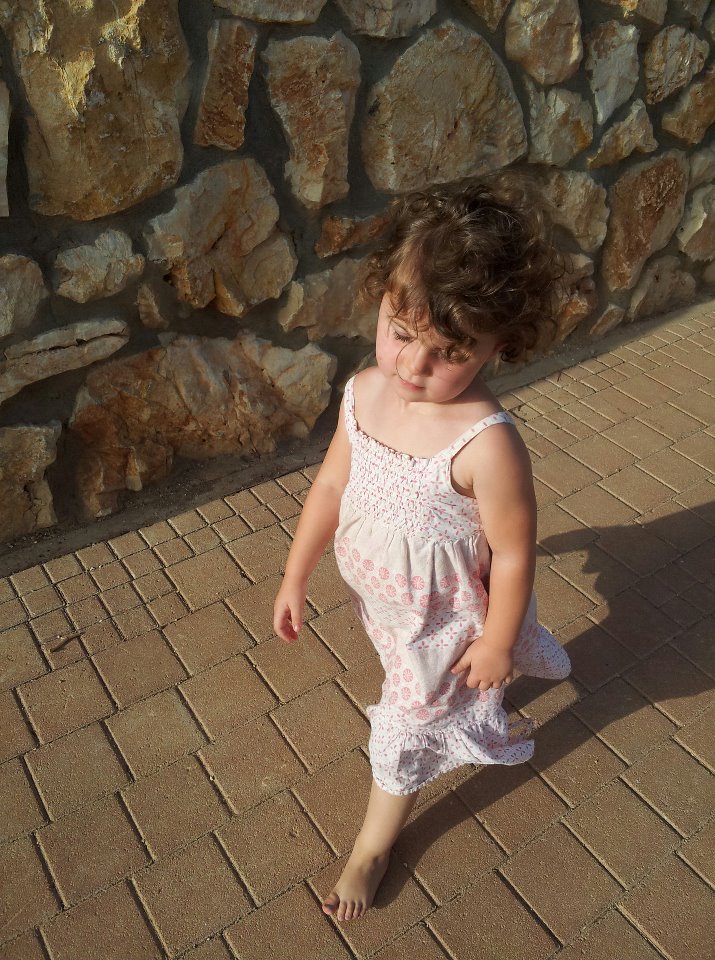
My barefoot daughter walking along the sidewalk of our kibbutz

Ode to Found Love on Kibbutz

Flowers, dirt, and stray cats
Dogs that bark at midnight
The cow-infused downwind from the refet at 4:30 pm…
My children at 4:30 pm…
My husband at 4:30 pm…

Taking the trash out in my pajamas
Dressing up in grownup clothes for Shabbat
Singing Shiru L’adonai

Picking up snails, picking up trash
Picking up friends at the park
Showing up.
Speaking up… when I’m afraid to speak at all.

Finding out someone else is pregnant
Thanking God it’s not me.

Breathing in shnitzel,  shwarma, and secondhand smoke

The beach and the sunset and the Jerusalem stone
And the kibbutz children, my children
Who pepper my pictures with delight.

Culture, Education, Family, Kibbutz

What happens to the boys with flowers in their hair?

I have a theory about Israeli men.

The reason they’re so secure in their masculinity is not due to months of paratrooper training or mandatory military exercises out in the desert.

It’s because, from a very young age, boys are formally taught and encouraged to dance.

And wear leafy crowns.

And carry flowery baskets.

And hold hands.

And revel in the beauty of their own bodies.

Very subtly, the women of Israel (and in modern times, men as well) have taught our male children that moving their bodies in rhythm and wearing beautiful crowns are not signs of femininity. They are expressions of joy.

I was tickled pink the week I accompanied my then four-year-old son to gan when we first made Aliya last year. In addition to the culture shock I got as a mother – kids climbing on top of chairs to build block castles and digging through trash to find treasures in what seemed like a junkyard turned playground out back – I remarked at how integral both singing and dancing were to the preschool program.

Every day, the children would learn a new song, either about the approaching season or an upcoming holiday celebration, and most Fridays, I would arrive at pickup to find my son in the middle of a dance circle, made up only of boys, carrying and waving brightly-colored scarves and stepping in tune to the music.

Not a one stood outside the circle – ashamed to be holding a purple scarf or embarrassed to be moving his body and holding hands with other boys.

Instead, they threw themselves fully into the act – even the ones wearing cargo pants; even the ones who prefer toy trucks to dolls; even the ones who might grow up to be tough guys. They all danced.

Israeli children at gan, Shavuout

And, today, as our community celebrates the harvest festival of Shavuout, the young boys all arrived at school wearing olive crowns and carrying harvest baskets, decorated with white linen and flowers.

As a woman, but particularly as a mother of boys, it’s magnificent to witness – my son and his peers expressing their joy through movement and song without reserve.

But it’s also puzzling. What happens to these boys as they grow up? I wonder. How do they move from dancing to disrespecting and speaking harshly to each other on the soccer field? What happens to these boys who used to hold hands and dance? Who used to wear flowers in their hair and sing songs about the harvest?

I’m still so new in this country. And still so new as a mother, despite almost a decade of parenting.  It’s true, I don’t know yet of the heartache that hardens our sons. The burdens they think they bear. The walls they think they need to put up to protect themselves once they leave the safety of the garden.

I am also still naïve enough, however, to think that there must be something innocent that remains once they leave the gan – something that helps carry our boys through adolescence in a country where men often have to act like “MEN.” Where boys mock each other on the playground and fathers hurl insults at each other from their car windows. Where men, in particular, but all of us need often to operate in a “shuk mentality,” as my husband refers to it. Keep up your guard. Be wary of those who might want to cheat you or steal from you. Yell first, think later.

Something must remain. Something beyond the images the mothers hold dear to their hearts, images of young boys wearing white shirts and flowers in their hair.

It’s been told to me that men grow close to each other during the army. That bonds are formed there. Perhaps, this is true. It’s certainly the obvious answer.

But part of me thinks the bond starts earlier, and then is sidetracked by life. The bonds are built on top of foundations made from purple scarves and olive crowns.

The bonds begin with a dance.

Culture, Family, Food, Parenting

Transforming duty into delight

Every once in a while, someone says to me, “I don’t know how you do it – work full time, parent, and still have the energy to blog.”

I smile bashfully (but secretly pleased), and explain that “writing is not a choice for me.” I’m compulsive. When I get an idea into my head, I can’t move forward until it’s on the page. Writing offers me relief.

Additionally, I’m the lamest mother on earth when it comes to holiday celebrations, which affords me more time to write.

As compulsive as I am, I can’t compel myself to make flowery Shavuot baskets or hand-sew Purim costumes for my kids to show off at school.

Photo credit: J. Whine

I have very mixed feelings about this. I love seeing my daughter wearing the exquisite crown of flowers her grandmother made especially for her preschool celebration. I am so grateful that she gets to feel like a princess because my husband crafted her a breakfast basket filled with carefully prepared dairy delicacies. I just can’t be bothered to make the effort myself.

I’m not lazy. (Note comment above.) I just completely lack holiday spirit; in particular, I loathe school holiday celebrations.

It could have something to do with how much I resent arts & crafts.

I stopped liking arts & crafts in 2nd grade when I realized precision was integral when working with glue and felt. It frustrated me that I was never able to generate in reality the beautiful concept I had envisioned in my mind.  It frustrated me even more when I couldn’t remove the excess felt from my fingertips. Now, even the words “arts and crafts” conjure up only feelings of frustration and inadequacy.

But to blame my resistance solely on the arts and crafts would be bogus.

Bottom line? I’m the Jewish Grinch. There’s nothing about holidays I like.

I know that depending on what we’re commemorating, I’m supposed to feel grateful, blessed, or triumphant. But, mostly I feel obligated, stressed, or depressed. In Israel, holidays usually mean my three children require three different outfits that I have to remember to launder in advance; three different lists of supplies to bring to school – from burekas to bisquits to bisli. And, often three different days on which they’re celebrating!

Holidays mean dancing in front of other adults, a fate worse than death for me. Holidays mean gathering around bonfires singing songs I don’t know the words to. Holidays mean eating foods that I’d otherwise avoid because they give me cramps, or turn my children into demons.

In Israel, like in America, holidays mean vacation for my kids and their teachers, but not always vacation for working parents. So, holidays also mean I need to figure out babysitting for my kids, so my husband and I can work.

I’m a bummer. I’m a buzzkill. I’m a Grinch.

I want to revel. But I can’t. I don’t feel it.

I didn’t revel in American holidays either. It drove me nuts there, too. Sign up lists at Halloween and Thanksgiving – Who would bake the pumpkin pie? Who would bring in the orange frosted cupcakes?

I vaguely remember once upon a time when I used to feel joy for holiday celebrations. The excitement accompanying unexpected Valentine’s Day cards. The joy with which I sang songs at my Hebrew school’s mock Passover Seder.

Where has that joy gone? How can I transform duty back into delight?

= =

There is a moment, I’ll admit it.

There’s a moment when my heart opens. It’s like a wisp of a memory that I can almost touch, but not quite.

It happens when I watch my daughter twirl in her white gown. When I see my five year old son and his classmates dance with glee in front of their beaming parents. When I catch my 9 year old laughing and leaping with his friends from haystack to haystack.

In those moments, I feel my irritability dissolve; my load lighten. I let joy in. I feel relief.

There’s a glimmer of hope then — that next time I’ll be able to enjoy it…not just blog about it.

Culture

Thank You, Dr. Hussein

I’m still belching out mild nausea, but compared to how I felt last night, I am grateful to be able to sit up and type.

Last night, my husband and I went to a nearby Middle Eastern restaurant for a quick dinner before heading to a parents’ meeting at our son’s school. He had the chicken and I had the fish, along with the usual assortment of side salads.

I had barely put the last bite of fish in my mouth when I started to feel sick.

I’ll never know for sure whether it was an accidental allergic reaction — I have diagnosed food allergies, but not to anything I ate – or severe food poisoning. The doctor at the E.R. said it was impossible to know for sure.  But I do know for sure I will never feel the same about my neighbors – in particular, the members of the first response team from neighboring Kfar Manda and the Jewish EMTs in the ambulance that soon followed: The confident one who called me “Mami” and told me I was going to be alright, and the cute one wearing the kippah who didn’t look older than 18. I’ll remember the nurses and doctor who took care of me at the Holy Family Hospital of Nazareth, and the patients in the beds next to me screaming in Arabic.

As you probably guessed, we never made it to the parents’ meeting. My husband took me straight home, where I stayed in the bathroom, violently ill. After about 20 minutes of this, I knew the reaction was severe and required attention. First, I told my husband to grab the epi-pen I carry in my purse. I’ve lugged this thing around with me for seven years, ever since my son was diagnosed with severe nut allergies at age 2. It’s maintained residency there at the bottom of my handbag along with the dusty gum wrappers and old pen caps, but I’ve never had to use it.

I’ve certainly obsessed about using it – on him or on me – and I’ve instructed countless teachers and relatives on how. But last night, when I popped the safety off the top and jabbed it into my thigh, I proved to myself what I’ve always told the anxious adults who care for my child, “When you need to use it, you won’t hesitate.”

My husband’s eyes bulged as he watched me stab myself and as I told him to call the Israeli version of 9-1-1.

The next hour is a blur. I recognized the Arab accents on the three gentlemen who entered my house holding medical gear in large metal containers, but I didn’t care. I just wanted the shaking to stop.  It was only much later, after one of them popped his head into my room in the E.R. to check on me, that my husband told me he was one of the first response team who came from Kfar Manda, the Arab village next to Hannaton, where I live.

As hazy as the ride to the hospital was, my memory of the E.R. is clear. By then, I had been pumped with steroids and two bags of saline drip. I was still nauseous, but significantly improved and alert. Too alert. Soon after I arrived, two patients were checked into the beds next to me. One seemed to be in a similar situation to me – severe pain and vomiting. As she moaned, my husband remarked that it was probably lucky we don’t know Arabic; I just held my ears and hummed to myself. You didn’t need to speak the woman’s language to know she was praying to God for help, and begging for relief.

I held back tears as they brought the next guy in. In my imagination, as I unwillingly listened to his screams, he had either lost a limb or his wife. We found out later, when the police came to interview him, he was the victim of a terrible crime.

By that point, grateful for the food poisoning and/or for the epi-pen, I just wanted to go home and recover. Moreso, I wanted to hug my sleeping children; snuggle against their pure innocence; watch them breathe. My mind, which had been up until that point fogged with fear and discomfort, was now all too filled with socio-economics, class structure, and war.

In this country, I constantly feel like a young child, always learning something new and aroused by a here-to-fore unknown awareness of the world around me.

Today, I am moved by the pain of my neighbors here in this land where appearances are more than deceiving; they are cause for confusion and often unnecessary fear. Today, I am touched by the love of my neighbors, who despite what they may learn as children from jaded adults and from personal experience, still find reason to commit their lives to caring for people who are different from them; people they might just as easily consider enemies.

Today I am grateful – for my health, of course, but also for our level of consciousness, which is more elastic than we think, and able to shift in a moment. One minute our eyes are closed; and the next they are open. One minute we judge; the next we offer our gratitude. One minute we hate; the next we love.

Let it be love that carry us forward.

(This was originally posted on The Times of Israel.)

Culture, Kibbutz, Learning Hebrew, Letting Go

The Jewish cowgirl rides again

(Originally posted as “Kibbutz girl in the city” on the Times of Israel)

Long ago and far way, before I got married and had kids, I worked in Manhattan for five years, almost three of which I spent living downtown in what is now chic NoHo. I’d say (and I often do) that such a biographical detail lends me an urban edge, but 12 years later, that edge has just about disappeared.

What I have retained, however, is the mythical city-girl handbook I used to carry; the informal list of safety rules I used at all hours of the day or night in that big city long ago, but have since shelved for only occasional browsing when I find myself in a big city without my car, or my husband, or a city dweller to hold my hand.

Last night, I dusted off the mythical city-girl handbook and slipped it into my trendy kisim handbag. (In case I’ve given you the idea that I actually know how to choose a trendy handbag, let me assure you it was a gift from my mother-in-law.)

After attending a work event in the outskirts of Tel Aviv, I was dropped off by my colleague in front of the Azrieli center downtown. We had just spent the day kicking off Israel’s 2012 Agritech conference with about 200 others at the AgriVest Summit, a conference where investors and entrepreneurs explored big topics like feeding the world and solving the global water crisis.

After getting dropped off at the center in front of one of the three towers at Azrieli, I was tired but still breathing in the fumes of post-conference self-assuredness. I thought my task would be easy: Find the Crowne Plaza Hotel, which supposedly was located somewhere in the Azrieli Center.

Azrieli Tower, Tel Aviv (courtesy Wikipedia)

Looking up to the top of the skyscrapers, I could see signs that indicated the shopping mecca inside: H&M, Forever 21, Fox.  But I couldn’t see a sign for the hotel.

Don’t panic, whispered the tall skinny girl sipping a frappacino on the cover of the city-girl handbook.When you don’t know where something is, she reminded me, ask a policeman or a taxi driver.

There were at least 10 taxi drivers in front of the Azrieli Center and not one of them knew where the Crowne Plaza City Center was. One told me, “Forty shekels, I take you there.” The other explained defiantly, “Crowne Plaza is by beach. I take you there. Forty shekels.” A third told me in Hebrew, “After the pedestrian bridge. See it? Just down the street? I take you there. Forty shekels.”

Hmm…I thought, maybe I should find a policeman.

Instead, I looked for a café where I could charge my phone, which had died an hour before. (The city girl handbook was written before there was 3G or Google maps.)

On my way to find the café, I happened upon the Crowne Plaza City Center exactly where it was supposed to be, in the lobby of one of the three towers. As I approached the reception area, I had to decide who I wanted to be: Israeli resident or tourist? When we’re in the big city, where you often find tourists, we olim get to choose — do our best attempt at native or pretend to be naive tourists. After our klita package runs out, this freedom to choose is just about the only benefit we olim have left.

Built up with confidence that the hotel receptionist was paid to be nice to me, I tried on my Israeli. I offered her my teudat zehut, my national identity card, instead of my passport when she asked for ID.

“Oh, so you are Israeli?” she asked. “Well, sorta,” I answered, the only response that comes naturally to me at this point, only 18 months post-aliya and still struggling with the future tense.

“Should we continue this transaction in Hebrew or English?” she asked me in a voice that sounded like a proposition.

Considering the last time a stranger flirted with me, I almost considered continuing the banter in English. Lack of stimulating banter is one of the things I miss most in this country. Instead, I shyly told her we could try and see how far we’d get in Hebrew.

We got pretty far. So far, in fact, I ended up holding a room key and a frequent traveler card.

After check in, I proceeded to the elevator, where I found myself in front of a panel of buttons that resembled no panel of buttons I had ever seen in front of an elevator. I couldn’t figure out how to get up to my room on the 14th floor. I once again consulted the city-girl handbook in my mind and remembered words from the final chapter: “When in doubt, watch what the person next to you is doing and mimic her.” Which is what I did, and yet I still wasn’t able to get to the 14th floor; the elevator only stopped at 12. And there were no up or down buttons. I was trapped!

Finally I asked the other rider for help — in Hebrew, but in a thick American accent because this is what you do in Israel when you need to ask a stupid question. She explained how the panel worked only by pressing the digits of the floor you need.

By the time I got into my hotel room I felt really, really foreign. Like a big fat 7-11-slurpee-drinking, baseball watching American foreigner. I went to sleep a bit defeated. Tomorrow would be a new day…hopefully.

The next day, however, didn’t start off much better. As I walked into the Agritech conference, my hands aching with the weight of the heavy boxes I was holding, the lobby was awash with long lines and pushing people. The wait at the registration desk seemed like it would take forever. Oy! When was this adventure going to get easier?

I stood in line for a few minutes and then looked around. I saw that there was no one monitoring the entrance to the exhibition hall. I picked up my boxes and headed toward the entrance. The American in me was hesitant to cross the invisible line that marked the boundary between the registration area and the exhibit hall. I didn’t have a badge. I hadn’t checked in yet. I couldn’t just walk in, could I? But the Israeli in me holding the heavy boxes had no more patience to spare.

And the Israeli is the one who crossed the invisible line.

The American in me shuddered at what I perceived as a security breach, but the Israeli in me (and the former city girl) was proud when I made it all the way to the booth without being stopped.

And the tall girl holding the frappacino on the cover of the city-girl handbook? She smiled and whispered knowingly, “When in Rome…”

= = = =

P.S. Thanks and love to Devora, my favorite Jewish cowgirl, for the inspiration for today’s headline.

Education

Brought to you by the rock I hide under

When I’ve had enough coffee in the morning, I choose to listen to the Israeli news on my drive to work instead of the latest self help guru I am following.

Truth is, I am not fluent in Hebrew enough yet to understand exactly what the newscaster reports, but I know enough key words to get the gist of the headlines, and unfortunately too many keywords not to panic when I hear pigua (attack) or Ahmadinejad.

Celebrity news, like Whitney Houston’s death this year, comes through loud and clear. I love it when they splice in a comment in English from Obama or, in the case of Whitney, Crying Funeral Goer #4. I feel really smart in those moments.

But when they start discussing the crime beat or internal political developments, I am in way over my head. Not only that, but I also get this overwhelming feeling that I should be understanding what they’re discussing. Like, it’s important or something. CONTINUE READING