
Since I began chronicling my life experiences in a public forum like a blog, I’ve learned there are feelings and personal experiences I might have been better off keeping to myself. Looking at blog posts I wrote three years ago is almost as mortifying as leafing through the journal I kept in 9th grade; the one that’s peppered with love poems only an angst-ridden teenager living in upper middle class suburbia could write… READ MORE
Blog
Action, action, we want action
There’s a chorus inside my head that won’t shut up.
It’s the group of internal activists (who look remarkably like me except they wear sexy wife beater tank tops and cargo pants) holding up signs that read:
STOP TALKING ABOUT IT AND DO SOMETHING
The activists look like me, but they are a lot louder and a lot less lazy. They also speak better Hebrew than I do because they are imaginary (and sexy).
I can’t be sure, but I think they run on adrenaline. Or hormones. Or fear. They certainly are antagonized easily.
I’ve been trying to shushy them since I moved to Israel. I rocked the boat enough in the good ole’ U.S. of A. and I was hoping for a fresh start here in Israel where everyone thinks I’m that nice, but boring introvert who lives in the ugliest house on Hanaton.
But the hot chorus girls in my head won’t shut up.
They keep saying to me, “Do something! You know you can. You know you want to.”
What are they talking about?
Okay, I’ll tell you. But promise you won’t tell anyone?
I like to change things.
I like to figure out what’s not working (in my life or yours) and make it better.
Some people call that complaining, but I call it innovation. Or coaching, depending on whether or not you asked for it.
There are some things that bother me about living in Israel. Some of it I’ve agreed to suck up and get used to: like imitation Ziploc bags. And some of it I tolerate: like signs with egregious spelling mistaeks. (I mean mistakes). But there are other things that I just can’t tolerate, and I know these are the things that the hot sexy chorus girls in my head are screaming about.
Things like garbage fires. Which aren’t as bad as tire fires, I guess, but still really, really bad for my asthma, and probably for anyone else’s healthy lungs.
Or, like trash in my backyard. Not the stuff that looks like trash in my backyard. Those old bikes and toys we actually still play with. But, I mean the actual trash that litters the beautiful fields behind our kibbutz.
And, of course, the health of our children, my own three and the “children of Israel.” The angry mom in me; the woman that a whole slew of activist moms in the States know as “The Wellness Bitch,” she is the leader of the hot chorus girls. She’s the loudest one. Because she has seen how I can affect change when I set my mind to it and when I empower others to do the same. And she’s bored with nice, quiet Jen.
She wants me to make some phone calls. She wants me to push people’s buttons. She wants me to write to government officials and call out Israeli food companies that use Yellow #5. She wants me to hang flyers in Kupat Holim promoting natural birth. She wants me to seek out all the amazing wellness practitioners that she knows exist here in Northern Israel and create community.
But she knows I’m afraid. So she hasn’t pushed too hard. But she’s getting antsy. Or maybe she is taking advantage of the fact that she can read my mind and she knows I’m a little less afraid than I used to be.
So, now I have two choices. I can hope that a few Extra Strength Excedrin will do the trick. Or I can start making a list of people to call in the Ministry of Health or Environment to see what can be done about those garbage fires. Apparently, there’s already a law against them. But that’s not stopping my neighbors in the next village over.
It’ll be a small first step, I know, but that along with a visit to the organic farm where we buy our veggies might be just enough to appease the hot girls inside my head… for a little while.
Seeing double
When I first moved to Israel, before I got my full-time job here, I started networking in search of freelance writing work. I had already started writing this blog about my Aliyah experience and had gotten positive feedback from both friends and colleagues. One of my colleagues suggested I reach out to Kveller.com, a new blog for Jewish parents, thinking they would be interested in syndicating this blog or hiring me to write another.
I wrote to the editors at Kveller and pitched my blog idea, confident they would write back to me with a big, fat YES.
Pitch: Fun, snarky Jewish mom leaves the comfort of her chic New Jersey suburb with her husband and three kids to try to make it as a kibbutznik in Northern Israel.
The editors wrote back that they liked my writing style, but that they already had a cool Jewish mom makes Aliyah to kibbutz column.
What?!?
There’s two of us?
Well, apparently there are. At least two of us.
The editors forwarded me Sarah’s blog post about moving to Israel, and I thought to myself, “Hmm. I guess I’m not so unique after all.” Sarah’s writing reminded me of my own, a blend I like to consider “tell-it-like-it-is honesty infused with snarky vulnerability.”
Figuring out that someone else had already pitched my idea and got the gig before me was a tiny blow to the ego, I’ll admit. Nonetheless, I secretly smiled knowing there was another Jen-like new olah mom out there.
So it was little surprise to me to see it was Sarah who wrote the article that popped up today on my Facebook news feed from The Times of Israel called, My Israel: A Land of Spoiled Milk and Honey.
The first half of the article was like reading the California Girl version of my life, or at least an alterno-verse version of the summer I first visited Israel in 1992.
I laughed at Sarah’s recollections of her first visit to the Kotel which were “spiritual” and “meaningful” and “fucking awesome.” And I smiled knowingly at what she recalled as her passionate statement to the Israeli passport control worker promising that “one day she would return.”
I remember being that passionate girl. I remember being madly in love with an Israeli soldier. Um, I mean, Israel.
I could also relate to her experience of missing that connection to Judaism once she returned to the States. It happened to me, too. And I spent years trying unsuccessfully to recreate it while living in America.
But what I couldn’t fully relate to in Sarah’s post were her expectations that moving to Israel would somehow be a seemless transition into Israeli life and culture. I didn’t share the expectation that being a Jew in a Jewish land would naturally translate into being understood or loved or accepted by your friends and neighbors. In fact, I was really worried that no one here would get me. That our family would not fit in. That I would never feel like this was my home.
In fact, the one thing that drives me nuts about the “Aliyah Movement” is the idea that American Jews moving to Israel are, in fact, “coming home.”
That sentiment, when I am at my ugliest, makes me want to vomit. When I am feeling kind, it simply bewilders me.
This “Coming Home” slogan is plastered all over the Nefesh B’Nefesh marketing materials. It’s the titles of videos on YouTube. It’s written in permanent marker on poster board and embroidered onto hats. And all the time I think to myself, “Is it true? Are you? Do you?”
For a little while, the fact that I didn’t feel that way made me feel like a fraud, like an imitation oleh. Like the fake tofu version of a new oleh.
Where was the meat?
Did I really deserve this Aliyah if I wasn’t 100% sure Israel was my home? That this decision was the right one? That I would be happy here? That I would stay?
In the 16 months since I made Aliyah, I have come a long way. In the 16 months since my Aliyah, I have worked hard to make this country my home. I have worked hard to learn the language; to make friends; to take on challenges that scare me; and to be tolerant and even accepting of cultural difference that are so offensive to me that I want to jump on the next plane back to Newark Liberty International.
For instance, I have learned that I can both hate the Israeli woman up my ass in the line at the pharmacy and at the same time admire her for being ambitious and bold. I can both cringe at the reckless abandon of Israeli parents when it comes to their child’s safety; and at the same time, smile with pride at the independence my children have acquired since figuring out that falling 5 feet from the top of the jungle gym onto concrete really, really hurts. I can scream at the dogs who run off their leashes; and quietly be happy they’re around to bark at the would-be robbers.
I have learned to love and accept this country, and my community. And I still reserve the right to complain about her.
If that’s not home, what is?
The real problem lies not with Israel. Nor does it lie with immigrants who are constantly comparing their new home to their old one. And certainly, the solution is not, as some of the commenters on Sarah’s post would have one believe, “If you don’t like it, then leave.”
If anything, what we new immigrants need is compassion. Compassion from our neighbors, both the Israelis and the olim who have figured it out already.
And compassion for ourselves, as it takes a lot more than a slogan or a birthright to feel at home.
Camaraderie
Last night, the siren sounded at 8 pm for Yom HaZikaron.
I didn’t expect the tears.
As the siren sounded, my children got up from the couch where they had been watching a cartoon and all stood at attention. Even as he stood, though, my five year old started to cry.
It might be easy to assume he cried out of fear: the siren is very loud and disturbing. My older son, like I do, associates the noise with rockets falling, even though we have never been close enough to hear a rocket fall. It would have been easy to say my younger son was crying because he was scared.
But when we asked him, my five year old told us he was crying for “all the lost ‘sabas,’ he said. Saba, the Hebrew word for grandfather.
He cried, even though he did not lose his Saba in a war.
He cried for all the sabas…and the men who would never become sabas.
For a moment, I worried the worries of an immigrant Israeli mother: What have I done? How did I bring my children to this country? How can I expose them to such pain? What does a five year old need to know of war and loss?
In the next moment though, I held him. And as he cried in my arms, I knew his tears were not the result of stories told to him at Gan. I also knew with certainty that even if we did not live in a country familiar with war and loss, and even if my child was not given at Gan the words to express what he felt in that moment, I knew that this sensitive child of mine would cry real tears in response to another’s pain.
I knew, as a mother knows, that his tears flowed directly from the Source. The siren simply opened the door.
The Hope, 2012
It’s been a busy month in Israel. And a busy month or two for me, as I completed a huge work-related milestone in March — organizing and executing a 5-city U.S. Investor Road Show for 13 Israeli hi-tech start-ups.
For me, the last few months of winter were intense as I balanced the demands of work with the demands of my family. I was in in the states for the last 10 days of March and back in Israel in time for Passover, with it’s two week school break.
Now we’re deep into Israel’s nationalistic stretch: The days encompassing Yom HaShoah, YomHaZikaron, and Yom HaAtzmaut (Holocaust Remembrance Day, Israel’s Fallen Soldiers Remembrance Day, and Independence Day). There is certainly much for a new oleh to observe and reflect upon during this time. But the truth is, I still feel very much an outsider when it comes to honoring Israel’s fallen and celebrating the miracle of her existence.
Of course, I will do as anyone living in Israel would do during this week: Perhaps I will watch a documentary or two on the life of a fallen soldier and the impact of his death on his family. I will show up to the events organized by my community. I will dress my kids in blue and white. I will snap photos of my children and my husband singing nationalistic songs. I will feel awkward that I don’t know the words or the melodies. But nonetheless I will feel pride: for them, my family, the loves of my life.
I might shed a tear or two.
But the truth is, I don’t feel these holidays in my heart of hearts.
Don’t feel sorry for me. Don’t judge me. I am sure it’s normal, and not a sign of some pathology.
The fact that I don’t feel in my heart of hearts the hurt of losing a brother or a father in the Yom Kippur War is, in fact, a blessing to me. It’s a gift. It’s a hurt I don’t miss.
The fact that I don’t yet feel connected to the relief that comes with knowing your homeland is safe, after war, is also a blessing.
The fact that I live in Israel and don’t feel connected to the pain or to the relief means that it’s possible to live in Israel and feel safe. It means that it is possible to live in Israel and experience a tragedy-free life.
There are not many who would acknowledge this to be true or even understand how such words can come from my lips as headlines shout the threat of war with Iran, or as sirens continue to wail in Southern Israel.
There are some who will call me stupid for thinking it, and insensitive for writing it.
And there are some — The ones who dream. The ones who create the worlds we live into. The ones who imagine the future as they would have it be — Those people would smile. And nod knowingly.
Those people would see that we already live in the future we all hope for.
The future in which Israel is safe. Free of violence. Free of war. Free of fear.
Because for me, that future is today. This moment. Right now.
And if for one day, I may live in Israel and not feel the pain or fear or suffering, doesn’t it mean a safe, war-free Israel already exists?
Sit with it for a moment: Israel is safe. Israel is a place without suffering.
If it is true, may this be a comfort to those who have lost loved ones in Israel’s wars?
It should be. Because it’s what their loved ones were fighting for.
May it be a comfort to those who still bear scars from terrorist attacks or from rockets?
I hope so. Because it means there is hope that there will be no more scars.
If one person can live in Israel and for just one moment feel safe and secure and free to live her life –work, play laugh, love — then it must be true.
It is in this moment, in this one moment, when hope is born; and futures, as we dream them, are real.
Second Spring
The weather is perfect today.
Blissfully perfect.
And by some magical alignment, my family is perfect today, too.
Tfoo. Tfoo. Tfoo.
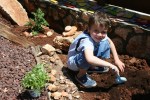
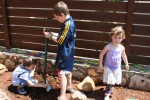
We spent the morning together cleaning our yard, which had gotten frightfully ghetto this winter. Miraculously, everyone pitched a hand. Even my 9 year old, whom we hardly ever see anymore because he spends most of his spare daylight hours running around with his friends.
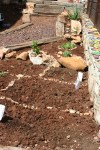
Our hand painted inspirational tiles from last spring didn’t make it through the winter, despite what we thought was a careful choice of paint and sealant. We laid them to rest along the side of our yard to make way for another herb garden and an experimental vegetable garden.
After spending some time together at the small nursery just outside Kfar Manda, we chose which plants to experiment with. With multi-generational love and care, with songs and brachot, with a little bit of mandatory blood, sweat and tears, we planted “Bubbi’s Garden,” in honor and loving memory of Bubbi (Marion Abrams) who would have been 87 years young tomorrow.
May we all only generate joy, love and beauty this spring and in the seasons to come.








Breakfast of Champions
When you first travel to Israel, one of the first things you are bound to notice at any youth hostel or hotel is the Israeli breakfast.
It can be a bit of a culture shock if you’re used to Lucky Charms or Dunkin Donuts in the morning. On the other hand, if you like vegetables and cheese, you are in heaven, particularly if you are staying at a nice hotel.
When I first traveled to Israel, I was a bagel and cream cheese kinda gal. Back then (in 1992), bagels existed only on Ben Yehuda street in Jerusalem, and they were as hard as rocks. They sold some mock cream cheese to spread on top, but it wasn’t worth the arm and a leg you’d pay for it — it was basically “g’vina levana” with a sour aftertaste.
Now, it’s easier to find a decent bagel with cream cheese in Israel, if you really want to, but still quite the challenge to find a good Belgian waffle, and impossible to find bacon. Before I made Aliyah I was a waffle and bacon kinda girl.
I know that sounds really unhealthy, but the waffles were organic and gluten free; and the bacon was all natural turkey bacon.
Neither of which you can find in Israel.
I miss my waffles and bacon.
So this morning when I joined two of my Israeli colleagues for breakfast in the lounge of the hotel I’m staying in here in Chicago, I skipped the cornflakes and ran immediately over to the waffle maker.
Within a few minutes I sat down with my freshly made waffle, and gazed lovingly at the plate, “Oh my darling,” I thought with a grin. “How I’ve missed you…”
Yes, I admit it. I made mental love to the hotel waffle.
In that same exact moment, as if reading my mind, my Israeli colleague said out loud, “Wow, do I miss Israel breakfast when I am in the States.”
(Perhaps in the exact same moment I was engaged in sordid thoughts with my waffle, he was longing for a diced cucumber.)
Out loud, he noted how strange it is for him to show up at a breakfast in a hotel and not find a single vegetable. He missed his salads and his cheeses and was not satisfied by the obligatory apple/banana basket and Yoplait. The other colleague of ours, also Israeli, agreed with him.
I also agreed with him, to be honest, but happily continued eating my Belgian waffle, knowing that the waffle was be a rare treat for me.
As much as I miss my waffles, I am proud of the Israeli breakfast. For as much as I complain about how unhealthy I think Israelis can be when it comes to food, I think they do breakfast right. Unfortunately, though, with increasing Western influence (in the form of Nestle Crunch Nougat Rolls cereal), they are on the path to destroying their picture perfect healthy breakfast.
Public service announcements aside, it was of interest to me that these grown men, both in their 40s, who aren’t exactly what I would call “outwardly health-conscious” would long for vegetables in the morning. Without knowing either too well, I would guess that their vegetable cravings were not necessarily connected to how health-minded they are or not.
I think their longing for vegetables is simple conditioning.
Which goes to show that what they say is true: Start a kid off eating the right foods and he will carry those tastes with him his whole life.
I think these two men are used to eating fresh vegetables for breakfast because it’s the cultural norm in Israel. Children grow up in the preschool system being fed a mid-morning meal that consists of cut up salad vegetables, eggs, hummus, and cheese. Hence, those children grow up to be adults used to eating that kind of food for breakfast.
The typical American breakfast I grew up with, on the other hand, was cereal and milk on weekdays, and pancakes on the weekend. My family was your average American family — We were allowed the occasional sugar cereal, but typical stuck to Rice Kripsies and Life cereal (which were actually considered healthy cereals in those days). On the weekend, my dad made pancakes with white buttermilk mix from a package, which we smothered in Aunt Jemima.
I took that early conditioning with me into my life, as well. I still love me a maple smothered carb-filled breakfast. My mind and belly say no, but my taste buds say, yessssss. It’s been hard to re-condition my taste buds to love salad in the morning.
There is a P.R. opportunity for Israel here amongst the chopped vegetables I think.
We should invite Michelle Obama, a great advocate for children’s health, to take a look at how we feed the kids in our daycare system. Vegetables might not lead directly to peace in the Middle East, but feeding our kids veggies from day one is definitely something we can be proud of and rally around.
Consumerista
Once a year, my husband and I used to head to Woodbury Common, a nice outlet mall off the NY Thruway. I remember laughing in bewilderment at the Asian or European tourists who would be bussed in by the dozens to the outlet center and would schlep out with bags and bags of who knows what like they were giving it away.
On the contrary, we’d usually leave with just a few things, a pair of pants from the Banana Republic outlet or a pair of Skechers or maybe last year’s LeSport Sac. And I would wonder, “Are things really that expensive in Asia? Do they not have malls in other countries? Where do they get the money to buy all this discounted crap? It’s not even that discounted!”
Well, after only a year of living in Asia (Middle Eastern Asia, that is) I have become the Asian tourist.
And I can tell you, they don’t have anything like Woodbuy Common in Israel. And the discounted jeans or handbags or Jockey underwear they sell in any outlet mall is indeed like giving it away to those of us who are used to buying such things in Israel.
Yes, Israel has its fragrant, bustling shuks, and of course, higher end chic goods, as well. But suburbia — with its malls and its Target and its Trader Joe’s — well, that doesn’t really exist in Israel. And the version that comes close (let’s say Kfar Saba, for example) comes at three times the price.
I don’t miss American suburbia too much when I am in Israel, but when I am back in the States, watch out. I become as delusional as a self-indulgent reality show housewife…without the bank account to back up my delusions.
For various reasons, none of them good, I’ve had to return to the States a few times since making Aliyah. This is my third trip back. I’m in Chicago right now preparing for a whirlwind business trip. Tomorrow, my colleagues will join me in Chicago, Day One of a six day “road show,” during which I will be accompanying 13 technology start-ups across the U.S. to present their companies to potential investors. But today, I am on my own for a few hours on Magnificent Mile.
Despite the saggy jetlagged eyelids and the airplane  smell that’s still stuck to my cardigan sweater, I feel pretty sophisticated when I say “whirlwind business trip” and “potential investors.” And, quite frankly, if you saw me right now sitting at the desk of my Comfort Suites hotel room, you’d say I could almost pass for sophisticated. Particularly when you consider the view outside my Michigan Avenue hotel window.
But if you had seen me at Trader Joe’s earlier today, salivating over the “Avocados Number” Guacamole, or trying on hundreds of headbands and rings at Charming Charlie’s (where the Accessory Place meets Jelly Belly ) or at Walgreen’s snapping up the Gas-X on sale, you might have thought otherwise.
It’s hard to pinpoint who I reminded myself of…a cross between Madison, the mermaid from Splash, and Julia Roberts in Pretty Woman (before she had class), with a little bit of midget thrown in to account for the difference in height.
Before you get too disgusted with my materialism, I must tell you I’ve realized there’s a thoughtful side to this madness, too. The side that appreciates what I have…and what I don’t. The side that sees the life I used to live as a treat reserved now for special occasions. And the side that sees how suffering the absence of all the things that I thought made my life easy –like fruit-flavored chewy kids’ vitamins — makes me appreciate those things more than ever before.
When was the last time you walked slowly through Trader Joe’s, lovingly gazing at the frozen packaged gluten free waffles? When was the last time you walked into a Starbucks and closed your eyes as the Caramel Macchiato scented air filled your nostrils? When was the last time you felt exuberant at the discovery of “Angry Birds” Band-Aids, knowing that when you brought them home to your kids, they’d practically pee their pants with joy?
I held my Starbucks coffee today like it was a prize I had won. I ate my good old-fashioned American chocolate chip cookie like it was a delicacy reserved for royalty. I spent the little money I have for spending with reserve and care, knowing that I only have one suitcase, and four people back in Israel who are excited for the treasure they’ll be handed upon my return.
Treasure.
I can see treasure inside a teddy bear shaped bottle of vitamins fromTrader Joe’s.
It’s a little disgusting, I know. But sweet, too. Don’t you think?
Tears in the desert
When I really want to feel life, I put on Billy Joel’s “Songs in the Attic” and drive to work.
It doesn’t have to be Billy Joel. Jackson Browne also works. Depending on the season, so does Randy Newman or the Beach Boys or Elvis Costello’s and Burt Bacharach’s Painted from Memory. In fact, I created a “Songs that Move Me” mix for the very purpose of crying in the car.
If I was more disciplined, I would commit to a regular heart-opening practice, such as meditation or journaling. But as a full-time immigrant executive mom of three, my ride to work is about the only reliable stretch of quiet time I’ve got these days.
I realized this one day, as I was driving the 20 minutes from my house to my office, amongst the green hills of the Western Galilee. “Hmm,” I thought. “Rather than listen to the news or gripe about the traffic, this would be quite the picturesque opportunity to feel.”
Not move. Not do. Not think.
Feel.
I can’t speak for the rest of humanity, but I’m not well-trained for feeling and being. Very well-trained for moving and doing, but not feeling and being.
One of my intentions when I moved to Israel was to get better at “being.” Being present. Experiencing life fully.
If there’s a place in the world to live that brings you ever closer to the realization that there’s “no day but today,” it’s the Middle East. But since I got a full-time job here, and moreso since I was promoted to a senior level management position at the company for which I work, my doing is trumping my being. I realized how severe the problem was when I started dreaming about people from work. I started to understand just how not present I was when rockets started falling again in Southern Israel a few weeks ago.
Like everyone else, I thought a lot about it. I read about it. I posted articles on Facebook.
But, in all honesty, I didn’t feel it much.
And that worries me.
I don’t miss the booming or the shaking — For that, I am grateful. I am grateful that we live three hours North of where the kassams are falling. I am grateful our kids are still going to school. I am grateful I can leave for work in the morning and feel fairly confident that all will be well when I return in the evening.
As much as any of us in the world can, at least.
But I worry that I don’t physically feel that ache in my heart for the children who are missing school because the sirens won’t stop or physically feel in my throat the lump that represents compassion for the parents who have to drop down to the ground and shield their children each time there is “tzeva adom” (red alert).
Of course, I am not an animal. I think compassion and I think worry and I even think fear. I think about it a lot. But I don’t know that I feel it. At least, not deeply enough to do me good.
Martha Beck writes,
“Emotional discomfort, when accepted, rises, crests and falls in a series of waves. Each wave washes a part of us away and deposits treasures we never imagined.
Out goes naivete, in comes wisdom; out goes anger, in comes discernment; out goes despair, in comes kindness. No one would call it easy, but the rhythm of emotional pain that we learn to tolerate is natural, constructive and expansive… The pain leaves you healthier than it found you.”
In her bestseller, Expecting Adam, Beck also writes, “You’ll never be hurt as much by being open as you have been hurt by remaining closed.”
I know this to be true. And yet sometimes I forget.
And while I can’t speak for all humanity, I would guess that a lot of us do. Forget, that is. Feel numb, that is. Turn our faces away from the scenes that disturb us. Turn up the loud music to drown out the voices that worry us, or the memories that cause us pain. Breathe a sigh of relief that someone else’s worry is not our worry today.
I won’t drive down South with my children to experience the fear and pain of rockets for myself. But I can and will drive to work with my “Songs that Move Me” mix or my Billy Joel so that I feel the rhythm of emotional pain.
It’s an emotional pain I can tolerate. It’s, as Beck says, constructive and expansive.
I often compare my “heart-opening drive” to Holly Hunter’s cry in “Broadcast News.” For some reason, since I first fell in love with this film at age 13, I always related to the Holly Hunter character. In particular, to the scene when she unplugs the phone in her motel room and allows herself five minutes just to cry.
What is she doing? I always thought, when I watched this movie as a young adult. I don’t get it.
But now I do.
That motel room. Those five minutes of silence. It’s a safe space for her to flirt with deep emotion.
And my mountainous, twisting and turning commute up towards the Western Galilee offers me the same.
The solitude provides me with the opportunity; and the right choice of music weakens my chest just enough to let a little feeling in.
Today on my car radio, Billy Joel sings Summer, Highland Falls. And I cry.
Perhaps Joel was writing about his messy divorce, or his childhood, but this morning when I listen to the emotionally heavy poetry woven into his words, I only hear Israel:
“And so we’ll argue and we’ll compromise, and realize that nothing’s ever changed.
For all our mutual experience, our separate conclusions are the same…
Now we are forced to recognize our inhumanity…A reason coexists with our insanity…
And so we choose between reality and madness
It’s either sadness or euphoria.”
Ob-la-di
As I was getting my kids into the bath last night, I heard a helicopter fly by close over our house. And I didn’t jump or startle.
I must be getting used to Israel.
When we first moved here, I jumped at every little sound: Not just the military helicopters flying by, but any loud booming noise; of which there are many in rural Northern Israel. Sometimes the sound comes from a digger breaking ground on a new lot; sometimes it’s an invisible jet soaring by, leaving a sonic boom in its wake and shaking the windows “The Right Stuff” style. Sometimes it’s just a tractor trailer driving by on its way to deliver petrol or chickens.
When we first moved here, I did a lot of pretending. Pretending like I didn’t worry about terrorist attacks or war. It wasn’t strategic or intentional pretending, mind you, and I was never actively scared to live here. It was the kind of pretending young women do when they choose to walk home by themselves from the club on Avenue A at one o’clock in the morning. You know that it’s both unlikely and yet still possible that you will get raped or mugged. But you have calculated the odds manually in your head, and counted the spare change in your wallet, and decided that walking home is your best bet.
Israel seemed like a good bet for us, despite the possibilities of terrorism or war.
But still, before I got a job, I was home a lot during the day…and jumpy. One day, a small propeller plane flew so close to my house I could see the pilot’s face. He flew across my street and back again. I tried to keep my panic in check for a few minutes as I carefully observed his flight pattern, but after about 5 flybys, I frantically called my friend Shira, who lived down the street, and who was already by that time a veteran olah. When she didn’t answer the phone, I ran down the street in my flip flops, covering my head with my hands, hoping to avoid the spray of bullets or heavy metal things he might drop out the window of his plane.
“Do you see that plane flying by?” I shouted to her before she opened the front door. She said she saw it, but without much trace of worry in her voice.
“What is it doing here? Why is flying over our houses?” I asked her.
“I think it’s spraying the wheat,” she replied. “But I’ll call the security guy.” The security guy confirmed that yes indeed the plane was there to spray the wheat fields adjacent to our homes with pesticides. We had nothing to worry about, he said, except poison exposure. (Emphasis mine, of course.)
Phew.
If my friend Shira was not as kind as she is, she would tell you about the other time I freaked out; when I made her hide behind a tractor to avoid the creepy-looking, strung out guy driving around our neighborhood aimlessly. I was convinced he was hiding an Uzi beneath his seat, hunting for some Jews to kill.
Or the other time I freaked out; when I ran to my de facto shelter because they were making announcements over the loudspeaker and I couldn’t hear, let alone understand, what they were saying repetitively in Hebrew. In my imagination, it was surely, “Run! Rockets are falling!” But, in reality, turned out to be “Blood drive today! Blood drive today!”
It’s not that I’m no longer jumpy. The other day, in fact, I literally jumped twice in one day: Once when thunder boomed over head and shook the windows. (I think, in general, windows are crap here in Israel.) And the second time, when I was about the fall asleep and my daughter’s balloon popped in the kitchen. I didn’t run to the shelter, but I easily lost 5 or 6 years from my life thanks to that scare.
I suppose I have become, for the most part, desensitized to the regular military drills that happen and general presence in and around Israel.
I imagine it’s this same desensitization that allows me to casually ignore headlines like “Will Israel attack Iran?” and “Officials to discuss Israel-Iran showdown.”
I wonder about myself sometimes, though. Am I in denial? Stupid? Numb? Crazy?
And then I think about the fact that I used to live six minutes from one of the most dangerous cities in the U.S. — Newark, NJ. That muggings, drug deals and murders took place, literally sometimes, ten blocks away from my kids’ synagogue preschool, which sits on the border between South Orange and Newark, NJ. In fact, many of us New Jersey natives grew up only minutes away from some of the country’s most crime-ridden cities: Camden, Elizabeth, Paterson.
Is my life in Israel all that more dangerous?
Sure there’s tension, conflict, terrorism, really terrible drivers. But none of those things detract from the every day life stuff like homework, exams, chores, errands, my awesome sex life, mortgage, car repairs, illness, wellness, office politics, reality TV. The same stuff that distracts Americans from the dangers in their own backyards.
We humans have a lot to worry about: Purim costumes, for instance, and taxes and mammograms.
I can’t see spending much time worrying about Iran unless you’re paying me to.
I know it’s easy for me to say. I haven’t lived in Israel during an active time of war. I haven’t sent a kid off to the army. I haven’t been in the army myself. But I get the sense that even for those of my friends who have, and who do, the answer remains the same.
Life goes on here. There is only so much room in the human heart for worry.
Angry mom
This was originally posted as my alter ego, “The Wellness Bitch.” Please take that into consideration as you read it. The WB posts with a slightly different tone. Considering the relevance to my Aliyah experience here in Israel, however, I choose to re-post it, despite the chance that it might incite my friends and alienate my neighbors.
With any luck, though, maybe a few of you will join me in a “Makolet Ban” or an “Anti-Makolet March” or at the very least, one “No Makolet Day” each year.
I feel blessed in my life for the moms who get it. I’m glad for the ones I’ve met in real life and the ones I have come to know and love virtually.
It’s these moms — the ones who struggle day in and day out to provide their families with their version of “healthy” despite society’s constant roadblocks — that bring me back down off the angry ledge. It’s these fellow moms who struggle as hard as I do; who understand the often daily battles I fight with myself and my kids. The struggle between giving my kids what they want and giving them what I think they need. The struggle between saying yes and saying no. The struggle between choosing to fight a battle and choosing to lose it. The struggle between choosing easy and choosing hard.
I need such a support group desperately here, in my real life community, where I am forced to make choices all the time between what I know is right for my kids and what other moms let their kids get away with.
I’m feeling very, very “angry mom” lately.
Here, in the small community in Israel where I live, there is so much I love. But what I hate to my utter core is the “makolet.”
The makolet is basically a corner grocery store. The Israel equivalent of a NYC bodega. Internally, I like to call it “the kiddie crack house.” Sure, conceptually, it’s nice to know I can run up the hill for a carton of eggs or a package of baking powder, but 99% of the time, it’s the bane of my existence here and representative of something I really can’t stand about Israel: For as advanced as this country is, it is still very far behind in the healthy eating revolution, and in denial that what you feed your kids contributes to their physical and emotional well-being.

Every day here, it seems, the average Israeli child walks out from his preschool and is taken by the hand to the makolet where the average Israeli parent buys his child the average Israeli after-school snack — namely a popsicle, a chocolate milk, a snack pack of peanut butter puffed corn, yogurt topped with candy or just plain candy.
It’s the Wellness Bitch’s worst nightmare. Can you imagine?

For over a year, I’ve tried to make peace with the makolet. My husband and I have tried various incentive plans to get our kids on board with the idea that we don’t feed them makolet crack every day. These are kids who, up until a year ago, were happy to get candy once a month at a birthday party, and whose daily sweet treats included an organic sandwich cookie or a beet-colored fruit roll up. Now, these kids can be seen walking once a week clutching a bag of “Kliks,” slurping on sour gummy worms, or sucking down a spray bottle filled with the EU version of Red #40.
We’ve tried “Makolet Day,” one day a week when our kids get to pick something from the little store. But one “Makolet Day” a week suddenly turns into three when Saba comes to visit, or when the 3-year-old goes home with a different parent for a playdate and the two kids wind up sucking down “Shock-o,” the  chocolate milk drink packaged in sports bottles mechanically engineered for preschoolers’ tiny mouths. “Makolet Day” becomes a way of life here when my kids are treated to a “krembo” by their teachers or tutors or soccer coaches for doing a job well done. “Makolet Day” in not just a day here when it’s piled upon birthday parties and holiday celebrations and kiddushim, for which the focal point is sugary, processed crap masquerading as food.
Yesterday, I lost it because my daughter walked out from preschool with a snack bag full of candy thanks to an in-school birthday party (which they seem to have twice a month here). I told her she could have the birthday candy or “Makolet Day,” not both. She agreed. She proceeded to eat a handful of m-n-m’s and then ran to the makolet to pick out

her weekly treat. When I reminded her of our agreement, she had a meltdown. That melt-down turned into a kicking and screaming performance for all my friends and neighbors (Did I imagine the tongues clicking in compassion for my daughter ?)
As I buckled her into her car seat, I screamed out loud in frustration to her and her two brothers, “That is it! No more makolet! I hate the makolet. I hate it so much I am going to come here in the middle of the night and spray graffiti all over the makolet! Do you hear me?? Graffiti!!!!”
Don’t you love days like that? When you are so angry, and yet so defeated, that graffiti is your best threat? (What would I even write? “F-off Makolet?” “Die, Makolet, Die?” And, really, how long would it take before they discovered the English expletives belonged to me?)
Don’t you love it when, in an effort to do right by your kids, you completely do wrong?
Don’t you love it when their meltdowns produce your meltdowns?
Somebody, please hand me a Krembo.
For years, I was luckier than I realized. I had a built-in community and support system in New Jersey. I lived in an educated, middle to upper middle class, health conscious neighborhood. I had a Whole Foods Market ten minutes to the West and one ten minutes to the East. I had a “Holistic Moms” network nearby, five yoga studios to choose from, a “green thumb” and a “wellness” committee at my kids’ schools.
For all that I gained when I moved to a small, country kibbutz in Israel, I lost that wellness-focused community.
And now I have two choices: I can stay angry or I can build…community, that is.
I do both really, really well.
I simply need to choose now, as we all do at some point, which one serves me best.
I recently mentioned to the members of my bi-weekly woman’s group that I think it’s time I start speaking up — getting “my leader on,” so to speak. On the one hand, it’s been nice living in my bubble, the one in which I pretend like I don’t have much of an opinion and don’t have experience leading community efforts for change.
Inside this bubble, I’ve allowed “little Hebrew” to become synonymous for “little voice.”
But the truth is, I have a voice. And it’s loud. And it’s lonely hiding here inside the bubble.
The green Zionist in me
Even though it’s officially more than a year since we made Aliyah, I just now feel as if one full cycle is complete.
My first real memory of our first real family experience here in Israel (one that didn’t involve a government agency) is of Tu B’Shevat.
A week or two after we moved into our house on Hannaton, there was a Tu B’Shevat celebration for children that included arts and craft activities, picking up litter around the grounds, and planting new flowers. 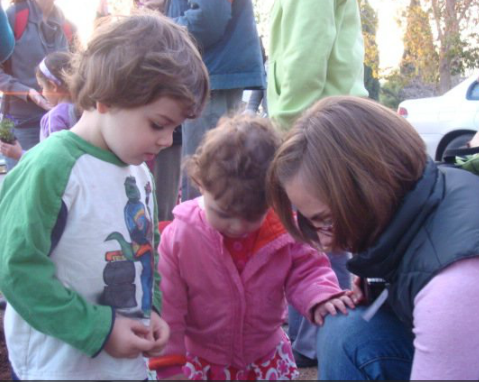 I look at the few pictures my friend Shira took of my kids and realize how far they, and we, have come since then. How little, and how American, they were then. And how big, and how Israeli, they have become in just one year.
Evidence of this is not just in their ability to speak Hebrew almost fluently, but in their transformation into real Israeli children.
My children dance when there is rain; my children sing with joy that Tu B’shevat has arrived; and they can identify not just dried fruits and nuts, but also leaves and trees by their Hebrew names. (When I compare what I know about our natural habitat to what they know, I am comforted in knowing that if the economy collapses and we need to depend on our local vegetation for food, they’ll know which ones are edible and which ones are poison.)
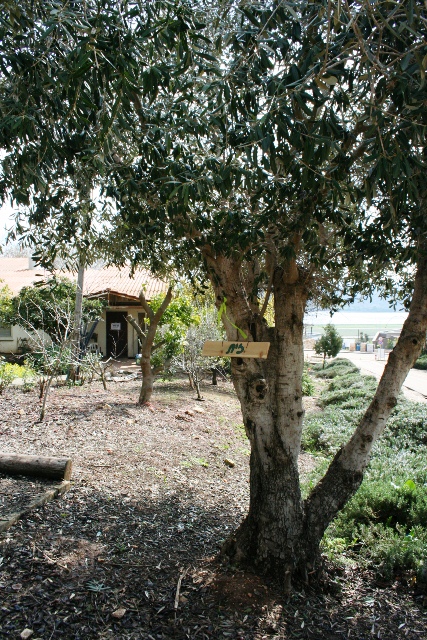
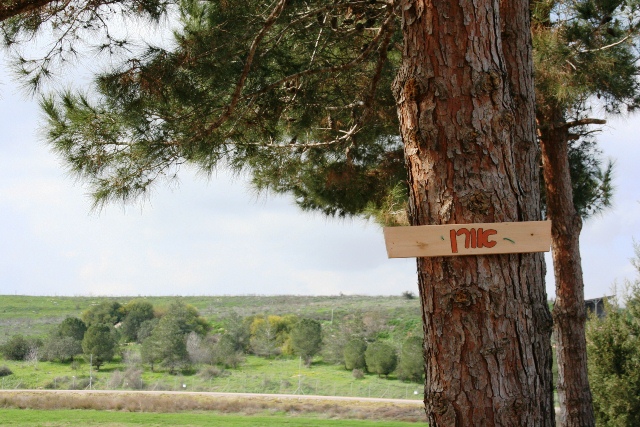
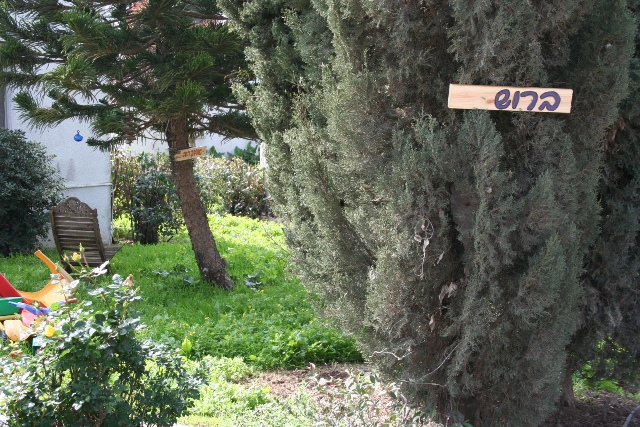
The other day, my middle son was home sick from school, but not sick enough for us not to take advantage of the brief break in the rain and to stroll around Hannaton admiring the blossoming trees and snapping photos of the ones tagged with signs in honor of Tu B’shevat. It was a fun mini scavenger hunt for us, and a brief eco-lesson.
When I think of my experience of Tu B’Shevat growing up in the States, I remember a minor holiday celebrated at Hebrew School. I remember coloring in a line art cartoon drawing of a young Israeli pioneer child standing next to a pine tree and bringing home a certificate marking the planting of one by JNF in Israel.
I admit I get a little bit excited that my children are those pioneer children — minus the vintage overalls and cotton baseball cap. Even though it’s 2012 (and not 1948), my children’s hands are dirtied with Israeli soil, their voices sing with pride, and their hearts are filled with the love of Israeli land.


 and yadda yadda, an aliyah blog