Blog

Culture, Environment, Health

Anemone

Soon after we made Aliyah in January 2010, my son and I created mini videos for our friends and family back in NJ with our Flip camera.  At the time, the kalaniyot were just beginning to bloom here in the North and there is this poignant moment during one of our virtual walking tours of Hannaton where my son, in the middle of some explanation of a particular cultural difference between the U.S. and Israel, stops walking, bends down, gazes at,  and then plucks from the ground a beautiful red anemone.

We learned soon after that these flowers are on the endangered list here in Israel, and it’s forbidden to pick them.  The kalaniyot (anemones in Hebrew) are so breathtaking it’s no wonder they caught my son’s ever wandering eye, and it’s no wonder they beckon us all to the fields when they start to pop up in January. If you do a Google search for pictures of kalaniyot, you’ll see what I mean.

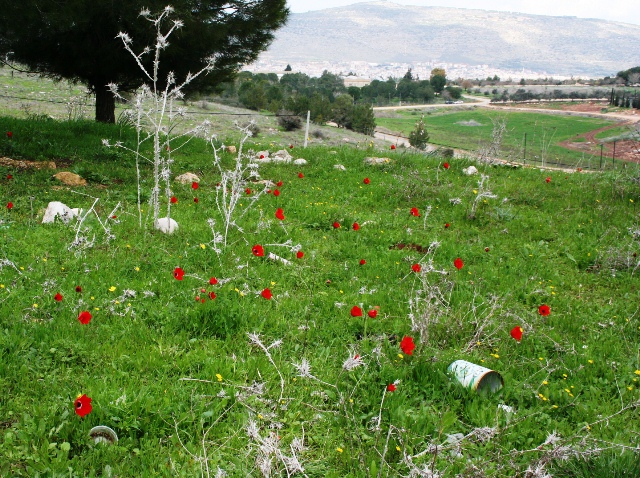
I’ve been eager to go on a photo expedition myself among the kalaniyot on Hannaton, but I put it off due to sickness and continual bad weather. Finally the rains stopped enough for me to take a quiet Shabbat walk this past weekend to the fields above Hannaton overlooking nearby Kfar Manda and the Eshkol reservoir here in the Lower Galilee.

What I found was, as I expected, overwhelmingly and breathtakingly beautiful.

Kalaniyot overlook Hannaton

And, at the same time, heartbreaking.
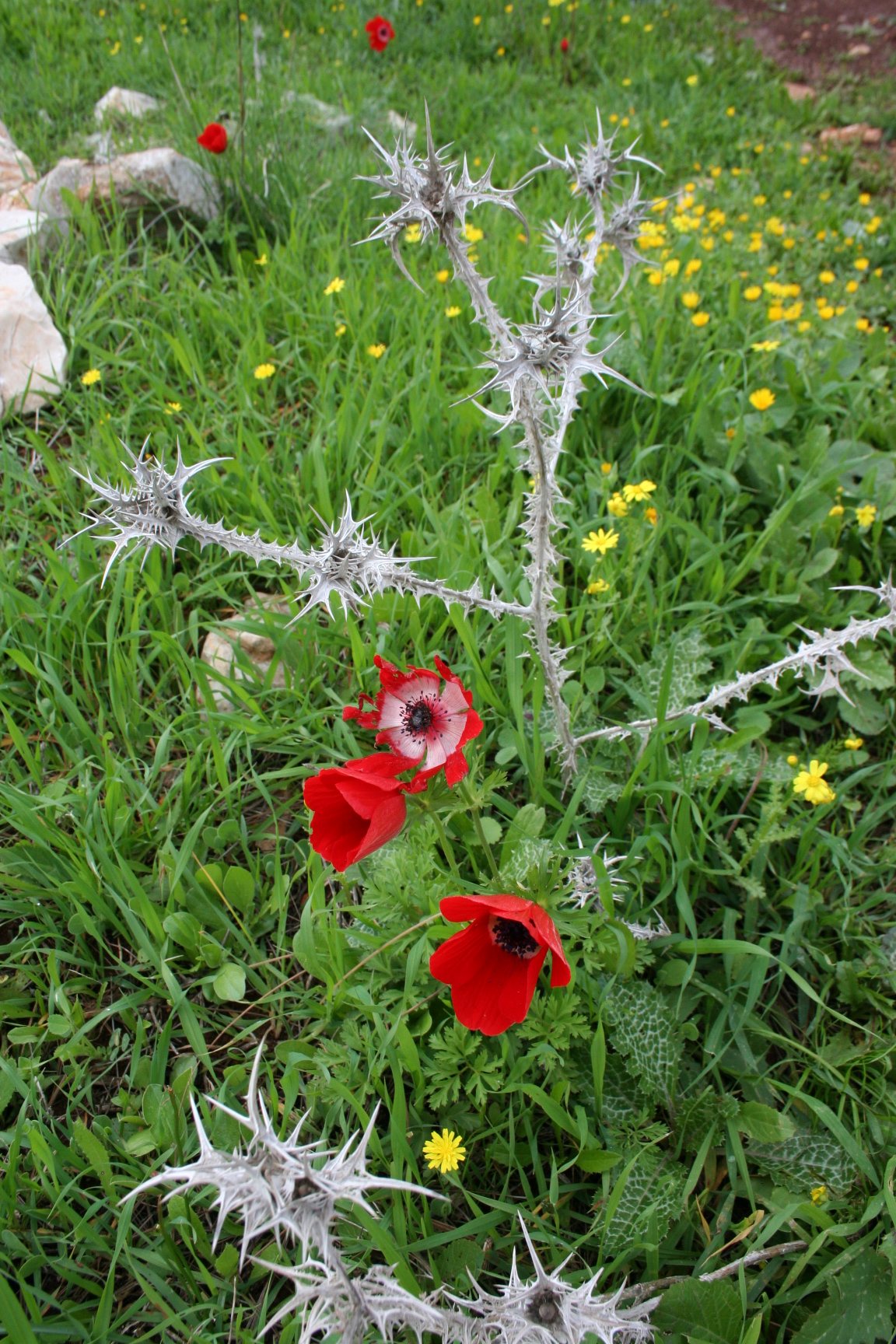
Kalaniyot amongst the thorns

Heartbreaking how?

Heartbreaking in that as much as we revel in Israel’s beauty, and as much as we fight for ownership of her lands, we fail her.
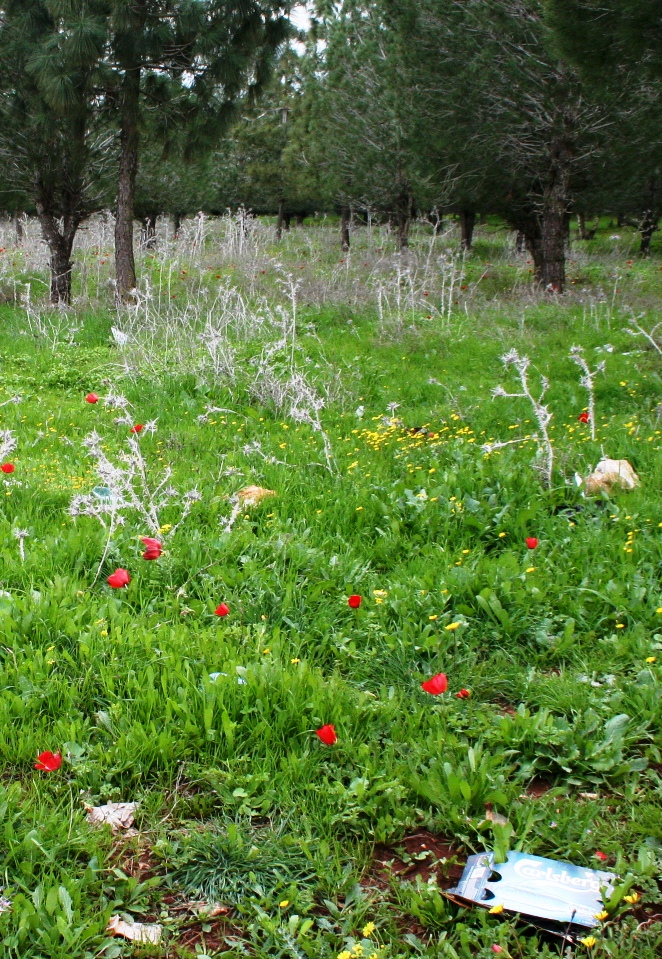
To trash or protect, that is the question

Do you see what I mean? We are prohibited from plucking her beauty, and perhaps rightfully so, in an effort to preserve it. And while efforts to maintain the wildflower population seem to be working, efforts to enforce cleanliness are failing…immensely.

Is this the land we're fighting over?

Garbage litters this beautiful land — from fields to parks to beaches to city streets.  When out and about amongst Israel’s unparalleled landscapes, I often feel transported back to 1970s-era America where it was still socially acceptable to toss trash out the window of a moving car or leave your Happy Meal bag in the mall parking lot next to your car instead of carrying it the extra few steps to the trash can. I see the remains of picnics left behind without a thought in our heavily funded Keren Kayemet national parks — picnics from many season ago no doubt. I grimace as I see plastic bottles floating along the rim of the Kinerret. I am ashamed when I bring tourists to a treasured local landmark, and they have to navigate around discarded cigarette packs and broken beer bottles.

It’s a puzzle to me.
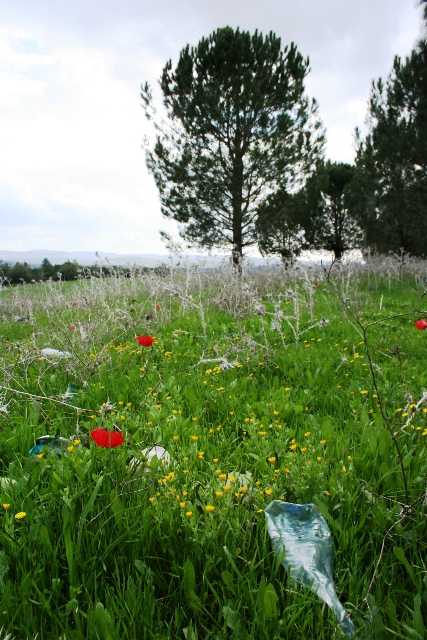
Plastic bottles decorate our landscape

How is it that the most contended over real estate on the planet is not cleaner? How is it that our Holy Land is not treated as sacred? 

Remains of the Israeli picnic

How are we so disconnected, so unimpacted by this irony?

How is it that we will scream and shout our political battles over borders and boundaries, but we won’t speak up when we see our neighbor litter? How is it that we, as a country, are careful so about Kashrut, but not proactive as individuals in our daily lives with honoring “God’s creation,” our land?
Paint the landscape of the Galilee

When I bring this up among my friends, they often blame our “cousins,” by whom they mean our Arab neighbors. But if that were true, why is there so much trash here on Hannaton? And I don’t mean on the fields just beyond our yishuv gates where our Arab neighbors will often picnic (as will we). But also in the playground our children play in, in our yishuv streets, in our driveways and in our yards? I walked along the beach just outside Haifa a few months ago and it was covered in trash. Again, reminding me of Jersey beaches decades before when we had to be mindful not to walk barefoot on syringes.

Plastic bag dots the green

I don’t imagine our Arab neighbors are coming by with their Bamba bags and dropping them on our Hannaton basketball court. I don’t think our Arab neighbors are sending their dogs over to poop on our playground.

Bamba in the fields

In my work over the past few years educating our communities about holistic health and wellness, I often shied away from calling myself an “environmental activist.” My main intention was always to teach people ways they could prevent illness, in particular chronic illness or cancer, by adjusting their lifestyle and dietary habits. I always noted the secondary benefits of living a less toxic life included “healing our planet.”

But more and more over the years, I’ve come to understand exactly how hand-in-hand these two initiatives are: healing ourselves and healing our planet. They are one and the same. One cannot succeed without the other.

And those of us who yearn for peace in this land — in other words, her healing — must understand that this poor land is ravaged both by emotional and physical pain. And to heal her, we must take a holistic approach. We must understand the unspoken implication of dropping our garbage thoughtlessly onto Israel’s earth, of polluting Israel’s water, of suffocating her with toxic fumes.

What message do we send to her when we treat her this way?

You wouldn’t court a beautiful woman with screams, bloodshed, and empty plastic bottles and bags, would you?

Culture, Middle East Conflict, Politics, Religion, Terrorism

Who’s Afraid of the Big Bad Wolf?

(This originally appeared as “Israeli in Progress” on The Jerusalem Post)

Before I lived in Israel, I was a tourist to Israel.

I visited Israel three times as a program participant between the years 1992 and 2000, and twice independently with family.

Each time, there were outright rules and admonitions from tour guides, concerned locals, or experienced travelers to Israel (“Don’t drive to Jerusalem via Jericho.”); and unspoken or whispered advice (“You’re young. You’re blonde. Stay out of Arab villages and east Jerusalem.”)

The message received? “Sure, Israel is a lot safer than she often looks on t.v., but there is a real danger here nonetheless, and that danger is Arab.”

Twice during my earlier travels to Israel, I found myself alone with Arabs and frightened. Once deservedly – an Arab cab driver picked me up near the Kotel in Jerusalem and made me ride in the front seat with him and more than once on the way to my destination caressed my knee. Funny enough, I was less worried about being raped than I was of the idea of being dragged to east Jerusalem.

The second time was when I ended up lost on my way driving alone from Tel Aviv to Tiberias, and found myself in Nazareth. All it took for hysteria to set in was the sight of a billboard in Arabic promoting a fruit drink endorsed by Yasser Arafat. I quickly pulled into a parking lot and hid in my car trembling while I consulted the map. Thankfully, no one tried to make me drink the Arafat fruit punch.

When we made Aliyah, I arrived to Israel carrying the “Arabs are scary” baggage still.

In fact, it was only after we decided to live on Hannaton that I realized that Kfar Manda, the next big town over, was an Arab town, and that essentially, we were surrounded by Arab villages (some Muslim, some Druze — all Israeli). Once I found out, outwardly I felt proud, in the same way a white girl living in Harlem might. But inwardly, especially when I heard a rumor that Manda houses an active terrorist cell, I felt that same sense of discomfort. “Arabs are scary.” Whether or not the terrorist cell rumor has any truth to it, I still don’t know. But so far my comfort level extends only to getting gas at the station just outside of town (because it’s on my way home from work), but not heading into the town center alone for a shwarma or some vegetables.

I’m fully aware that my fear of Arabs is directly related to my ignorance and to lack of personal experience. That it has nothing to do with personal human interaction, and everything to do with stories spread by fearful people. Some of these stories are true, of course; but some are exaggerated. And, none of the stories belong to me.

In fact, all of my interactions with Arabs since I’ve moved to Israel have not only been benign, but a few have even been memorable examples of human kindness.

For instance, there’s a Middle Eastern restaurant my in-laws frequent: of all the restaurants we’ve been to Israel, it’s the one where the kitchen staff is the most sensitive to my kids’ food allergies. And just yesterday, I was driving home from a business meeting in Tel Aviv when I realized something was terribly wrong with my car. I ignored the noise for a good ten minutes, long enough to get off the beach highway and pull over to the shoulder. It didn’t take long to understand that the piece hanging off the front side of my car was not necessarily going to stop the car from running, but certainly was not going to allow me to get home safely if it kept dragging. I made it to the nearest gas station, one near an Arab Village, where two Arab attendants fixed my car temporarily. They didn’t hesitate when I asked them to help me and they didn’t ask for payment.

If I had followed the “Rules for American Jewish Girls Travelling in Israel,” I would have never made it home. The Arab-run gas station was the only one around for miles.

I can’t hold myself up as the picture of co-existence or tolerance just because I live in the lower Galilee and ask for help from handy, young Arab guys. But I have realized in the short time that I have lived here that my understanding of the situation between Jews and Arabs in Israel is transforming from one informed by stories to one informed by experience — and we all know that it’s real, live interaction between people that is the miraculous cure to both real and imagined conflict.

And my real, live Jewish interaction with real, live Arabs makes us all one teeny tiny step closer to peace

Family, Kibbutz, Learning Hebrew, Letting Go, Living in Community, Love, Making Friends, Parenting, Religion

A year in reflection

In retrospect, I’m glad we made Aliyah at the end of a calendar year. At the time, moving during the first of New Jersey’s many blizzards and dealing with holiday travel didn’t seem like such a good idea. But now, as I reflect on the year that we’ve been living in Israel, I find comfort in the awareness that I will never have to struggle to remember when we moved here. It was at the end of December, in the winter of the end of a decade. 

And, as if leaving our friends and family to move to a new country wasn’t turbulent or memorable enough, there was plenty else to mark this year in my memory. I lost a cousin. I lost my grandmother. And through these and other extraordinarily difficult times for my family this year, I was here and they were there.

In the chapters that mark my life, 2011 will be one I remember without a bookmark, without a folded over corner.

My kind friends and loving husband might argue with this, but the marks of this year also show on my face, which seems to be finally showing signs of age. This year, as exciting as its been, has also been the year that I started feeling aches in my joints and noticing that my body is not as resilient as it used to be.

This was the year I closed my business and started a new job. It was the year I gave up my Blackberry and then found it again, at least the Israeli Nokia version. It was the year I moved to the house down the street of one of my oldest childhood friends and the year I found that sometimes, moving away from your closest friends, actually draws you nearer to them.

This was the year I stopped obsessively focusing on healing others; and truly starting looking inward in an effort to heal myself.  It was the year I rediscovered the healing power of song and prayer; love and community.

This was the year I decided that a heaping helping of humble pie was good for me. That learning something new every day can be painful, but active listening often works better than talking, even when you want so badly to communicate who you are and what you want.

This was the year my husband really learned to appreciated me as a mother. And I him as a hard-working professional. It was the year I resigned myself to the growing up of my children, and the year I decided that they would be okay — in spite of my fears and worries.

It was the year I let go.

This morning, after I dropped off my five-year-old at gan, I shook my head in amazement. He had woken up this morning with a bellyache and asked not to go to school. After hesitating only a minute, we decided it was okay if he stayed behind and rested in his room this morning. After all, it’s a long week, and Fridays are half-day, looser schedules for kids in preschool here.

At around 9 am, he decided he felt better and asked if he could go to gan. I asked him, “Are you sure? You can stay home if you want. It’s fine.” He insisted he felt well and asked that I take him up.

When we got to the door of his classroom, he gave me a quick kiss, and with one last look back, left my side to play with his friends.

This was the same kid who one year ago, walked off the plane at Ben Gurion Airport, pale as a ghost, after vomiting for 12 hours straight. This was the kid who cried every morning for months when we dropped him off at gan; who wouldn’t let us leave; who begged us to stay home.  This same kid was now opting for gan over a day off at home. This same kid, didn’t know a word of Hebrew when we arrived a year ago, but now speaks completely in Hebrew with his friends…and with confidence.

This morning, my five-year-old’s brother is off playing with his own friends; and his sister, I’m sure, is chatting away in Hebrew with hers at her own school. My husband is preparing food for our Shabbat meal tonight with friends, and I’m here, taking a break from cleaning the house.

This was the year we turned our life upside down.

And our life righted itself.

Family, Religion, Spirituality

The emerging Jew in me

(This was originally posted on the blog section of The Jerusalem Post.)

Despite years of being a Jew in a Jewish family, Jewish tradition and, more specifically, Jewish practice often feel very alien to me. Shabbat meals, Shabbat services, Jewish prayers and rituals.  And despite being a bat mitzvah and many years a student in Hebrew school, there is little that I feel confident practicing, and there’s lots that I don’t.

In the past, this ignorance would sometimes surface as fear and loathing when, for instance, I was a teenager at USY events and I didn’t know how to do the Birkat HaMazon (“Grace after Meals”), let alone joyfully pound on the tables at just the right moments, like my friends did (the ones who had been doing it for years at Camp Ramah or Hebrew day school). Or when my college boyfriend took me to a Shabbat lunch at his friend’s apartment at the Jewish Theological Seminary and I was wearing jeans and a tank top, and all the other women covered their shoulders and knees. Or even in recent years, when I found myself in synagogue, standing next to my mother who was saying Kaddish for her father or when we chose a reform Mohel for my son’s Brit Milah, and accidentally offended my in-laws.

What surfaced as fear and loathing back then was likely fear and shame, as I understand it now. Feeling all the time that I was an impostor…stupid…uninformed. That there was something I should have learned along the way, but didn’t. As someone who thrives on information and knowledge (and who shrinks at feeling ignorant), I rejected Judaism. Flat out. I wasn’t interested.

It wasn’t until I got married in a Jewish ceremony that I started considering, even for a second, that there was beauty in Jewish practice and that certain elements of the practice might be accessible and available to me.  It wasn’t until I sent my kids to Jewish preschool that I once again found delight in singing Jewish songs and chanting Jewish prayers, a joy that was familiar to me from childhood, but so distant.  It wasn’t until I moved to Israel a year ago that I started understanding and accepted that it was safe for me to open my heart to Judaism, even though I still had lots of questions and found few answers.

Last week, I traveled back to my home town in New Jersey for my grandmother’s funeral. And for the first time ever, that I can remember, felt comforted by Jewish practice.

In the past, when I found myself in uncomfortable or anxious situations, whether it was a painful experience like childbirth or an emotionally challenging experience like public speaking, I would soothe myself by humming a chant or a mantra I learned in yoga class 12 years ago.

Shri ram, jai ram, jai jai ram

I learned this chant in 1999 at a yoga studio in Manhattan. It stuck and I’ve been humming it for over a decade — I’ve even taught it to my kids and encourage us all to use it when things get a little…hairy…around the house.

But in New Jersey recently, on the way to my Bubbi’s funeral, I found myself humming something different. A nigun we often sing as we enter into prayer on Hannaton for Kabbalat Shabbat.

Laiiiii lai lai lai lai lai

And humming the nigun soothed my nerves and eased me into the Jewish practices yet to come. Mourning and remembrance.

Over the next few days, as I participated in the rituals that followed — Shiva, prayer, Mourner’s Kaddish — I hummed the tune. I taught it to my brother who figured the melody out on his guitar. I’d even say we bonded over this nigun, something we haven’t done for years.

Over five days, I realized that I actually knew so much more “Judaism” than I thought I had. And even more impactful, I understood that it was okay that there were practices and rituals I didn’t know. That I could take from the ones that served and supported me; and refrain from those that didn’t. That there is a time for learning and a time for engaging. That, in fact, I could know absolutely nothing about Jewish practice and ritual…and still benefit from participating in it.

That practicing a ritual you do not fully understand is not hypocritical or stupid or insincere.  It’s okay.

I also realized that once your heart is open, even a little, it may be easily filled by the power of those rituals — the ones you’ve chosen; the ones that fit your needs at that moment.

It’s easy for me to say that living here in Israel is opening my heart to Judaism. That living on a Masorti kibbutz in Israel and participating in its activities have acclimated me more to Judaism. I imagine that’s what it looks like to my friends and family observing the process. That, suddenly, I have “found” religion.
 
But, it could also be that I’ve entered that time of life when we need the comfort of prayer and ritual more often. Or that my heart has softened after years of marriage and raising children, of losing friends to illness, of losing grandparents to age, of watching my parents age and lose their parents. That my awareness is growing day by day that life is fragile and community is comforting and ritual is soothing.

It may be that my path of spiritual seeking has become more refined or less judgmental.

It may be a mix of all the above.

But, for certain, the key is my opening heart.  And my willingess to let strangers –or strangeness–in.

Letting Go, Religion, Spirituality

ID

When my husband and I were deep into the process of coordinating our Aliyah back in the States, we received a lot of email communication from Nefesh B’Nefesh, some of which was extraordinarily helpful. (In addition to weekly webinars, NBN also has a robust website with lots of information for potential new olim — I would have been a lot better off if I had read any of it before I landed in Israel.)

Occasionally, though, I would get an email from NBN in my inbox and I would be really confused; in the same way I sometimes feel confused when I go to Shabbat services these days and in the middle of the service everyone starts bowing or shuffling their feet and I have no idea why or what I am supposed to do.

There I was 12 months ago: Confident enough in my intention and desire to make Aliyah — married to an American Israeli; 10 years of Hebrew school and USY under my belt; synagogue membership; two kids in Jewish preschool — but still, in many ways, feeling like an impostor.  This was not a new feeling for me — uncertain of my Jewishness among Jews– but a feeling that was becoming much more pronounced with my decision to make Aliyah.

While preparing for Aliyah, there were some things I didn’t understand, but felt awkard asking for an explanation. Shouldn’t I already know the answer? If was “Jewish enough” to be making Aliyah, shouldn’t I have been Jewish enough to understand all the steps involved in transforming from an American Jew into an Israeli?

This was all very subliminal, mind you. I wasn’t consicously aware that I was questioning my own qualifications for making Aliyah. Consciously I was preparing all the documents with ease. I am a Jew after all. I have the figurative C.V. to prove it.

But just as I had never felt Jewish enough among Jews, I didn’t feel “oleh enough” among the olim.

Let me offer you an example. Apparently, when Jews from other countries make Aliyah, they will sometimes change their names.  You could be a 45-year-old woman, whom her whole life has been called Randi, and one day she lands in Israel and her name is Rivka. In December, you’re Susan or Bill or  Mandelovitch and, in January, you’re suddenly Shoshana or Ruven or Manof.

And it’s not just make believe. It’s legal. I don’t know exactly what happens, particularly when you go back to the States to visit, but it’s legal in Israel.  I imagine your American passport still lists you as Susan, but for all official and unofficial intents and purposes here in Israel, you are Shoshanna.

So, Nefesh B’Nefesh sent us this email a month before we made Aliyah asking us if we would be changing our names, and instructing us what to do if so. Huh? I thought. Change my name? Isn’t that something only zealots and freaks do? (Yes, judging, judging, judging.)

I could see the practicality of changing our names — all of which save for my husband’s are very Anglo — but I could not imagine calling my son Oliver by his Hebrew name, Itamar. Or by any name other than Oliver.  Certainly, as an idea, it seemed fun to come up with a new beautiful name for myself–one of my own choosing, one that was easy to say– or to have a second chance in naming our children (particularly our daughter whose name I think we chose in haste). But I couldn’t imagine it. For better or for worse, I am a Jennifer who likes to be called Jen.

Then, soon after receiving that email, we went to an NBN job fair a month before making Aliyah. If we didn’t feel out of place enough already at the event — fairly secular Jews in a sea of Orthodox –we were introduced to a seemingly secular couple our age who was also making Aliyah to the North around the same time we were. They introduced themselves to us by their “new names,” with a shy footnote that they were trying those new names on for the first time. My husband Avi and I smiled and nodded politely, but after they parted, we exchanged looks as if to say, “Say WHAT?” (This was one of those delightful moments where I once again thanked the Divine for gifting me a husband who I could have “say what” moments with.)

Who were these people we were making Aliyah with? Who were we to be making Aliyah?

Who am I to be making Aliyah?

And really…Who am I to call myself a Jew?

My husband was already an Israeli citizen. He was born in the States to two Israeli parents who moved to the U.S. as young adults. His parents returned to Israel with their children when my husband was in preschool and they lived here for many years while he was growing up. He’s Israeli. He may not “look Israeli” or “act Israeli” (this is something I heard over the years from my family and friends when they first met my husband.) But he’s Israeli. This (along with the eight years he spent at Solomon Schecter)  lends legitimacy to his both his Judaism and his Israeli-ness, in my eyes.

But who am I? Am I Jewish enough to live here? Am I Jewish at all?

The irony, I have learned in the 11 months that I have lived in Israel is: I am not the only Israeli asking myself this question.

In fact, a lot of Israelis are asking themselves this question. And, in some ways, I might be considered “more” Jewish than the ones who aren’t  because I am asking the question.

As deficient as a Jew as I often felt in the States, I am feeling here…awakened spiritually. Indeed, more awakened possibly than Israelis who have lived in this country since birth…Israelis who have never stepped foot in a synagogue their entire lives. Perhaps, even more awakened than religious Israelis who have been praying daily in the synagogue for years.

I bring this up not to judge or to compare, but to transform my judgment into compassion. My judgment of myself. My judgment of others.  My judgment of religion, of spirituality. My judgment of the words “God,” or “Universe,” or “Divine.” My judgment of prayer practices, of devotion.

I share this with you as a way to publicly offer myself compassion retroactively and to ask forgiveness for the judging.

My wish is that as my spiritual journey continues, however it continues, may I continue to explore Judaism (my version and yours) with curiousity and compassion…and an open heart and mind.

And, as always, your feedback and contribution to the discussion (via Comments) are welcomed.

Culture, Living in Community

A big girl in a little bubble

(This was originally posted on my Jerusalem Post blog, Israeli in Progress)
 
My husband and I often laugh that we really enjoy the little bubble we’ve created for ourselves here in Israel.

We live on a small kibbutz in the North. We have a 20 minute drive to the nearest supermarket, and a 45 minute drive to the nearest shopping mall. That might be off-putting to most; and admittedly it’s sometimes off-putting to us. But placing ourselves at a great distance from crowds and commercialism forces us to live a more simple life. We have less decisions to make, less traffic to navigate, less people to growl at.

We’ve noticed that “The Bubble,” as we call it, keeps us relatively safe from the stresses of modern family life. The stressors I’m referring to include mainly getting in and out of cars, weaving in and out of traffic, suffering the impacts of noise pollution, air pollution, and people pollution.

Instead of packing ourselves in and out of our cars multiple times a day, or boarding busses or trains; we walk our two little kids to preschool in the morning and our oldest son walks himself to a bus stop on our street.

When we get together with friends for playdates or social outings, it’s typically at our house or theirs. And we walk there. We hardly ever eat out. We hardly ever go out, to be honest. I work 20 minutes from the house and my husband works mostly from home. Our most spontaneous and adventurous day is typically Saturday, when we might hop in the car for a drive up to the Golan to hike, explore ancient ruins in the Galilee, or spend Shabbat with my in-laws who live 20 minutes away.

Some would call our simple life boring. But we call it easy. And easy translates for us as good.

This is not to say that everything about our life here is easy, but we’ve successfully managed to eliminate a lot of the every-day life stressors that we felt while living in New Jersey, without adding too many new ones to the mix.

(If you read my blog, you know the short list of Israel-related stressors includes:

1. Too many nuts here; 2. Rockets sometimes fall nearby; and 3. Hebrew is hard.)

Yes, our little Israeli bubble is nice. Our Bubble is quiet. Our Bubble is fairly uncomplicated.

But, it’s still a bubble, of course, which makes it a world contained within itself. There is a world, however, that still exists outside of it.  And in this world lives my extended family, my friends, and my colleagues.

So unless I plan on completely walking away from modern life, which my husband tells me I can’t, it’s important to exit the Bubble every now and again, as scary as that can be.

After ten years of American suburban life, I learned that if you don’t, you undoubtedly lose movement in your “brave muscle,” the one that keeps your inner scaredy cat in check.

In the States, this fear to leave your safe little bubble is sometimes a side effect of Suburban Malaise – when you move out from the City to the suburbs and your life becomes a bit too predictable; a bit too mundane; a bit too regimented and conformed. I imagine there are some people who also experience Kibbutz Malaise, a depression stemming from being away from all that city excitement when you move up North.

But not me. Here in my little Israeli Bubble, with its cozyness and simplicity, I risk suffering from Kibbutz Contentment.  The condition stems not from being stuck, but rather, not wanting to ever leave.

When you suffer Kibbutz Contentment and you have a pressing need to venture out from your bubble, you find yourself fretting for days beforehand. You scour Google maps, plot your routes in advance, and, if you have rusty Hebrew, write down all the words you will need in your own handmade little pocket dictionary.

When you suffer Kibbutz Contentment you avoid not only planes, trains and automobiles, but platforms, lines, and crowds. Sometimes you are brave enough for parking garages or malls, but never big sales and only during the week and mid-day hours.

When you suffer Kibbutz Contentment, you’re often worried equally at the idea of being alone in the city and being around too many people. Taxi drivers are your enemies, as are cashiers, waitresses, and homeless people. Why? Because they all want to talk to you.

I was in Tel Aviv at least five times in the past month for work, and all five times I experienced anxiety as I prepared to head out of The Bubble. But I have to say, I worked my Brave Muscle and it came out the other side achy, yet stronger.

I rode the train. I’ve even switched trains… three times! I bought multiple tickets. I spoke (in Hebrew) to all my “enemies” — the taxi drivers, the waitresses, and the clerks — and even the sophisticated Tel Avivians I had to conduct meetings with.

I was courted at fancy schmancy agencies and conference centers; sipped espresso in cafes; and pushed my way in and out of ticket lines. Twice this week, I drove Cvish HaHof, the beach highway to Tel Aviv from the North, as well as the super-highway, Cvish 6. I drove alone and pumped my own gas; which isn’t as easy as you would think considering all the instructions are in Hebrew.

After a long week of working my Brave Muscle, I returned home from work last night as exhausted as I would have coming home from an extreme workout at the gym. But I smiled as I drove through the yellow gate that separates my Bubble from the rest of the world.“Aizeh Bogeret,” I said to myself.What a big girl you are.

And the hugs and kisses and big glass of red wine that awaited me as I walked into the door of my bubble within a  bubble were all sweeter for having missed them.

Family, Learning Hebrew, Making Friends, Parenting

What do you call this?

When I first started blogging about my Aliyah experience, about two weeks into our new life here, a friend in Israel (also an oleh from the States) told me he had also started a blog when he first made Aliyah. But he soon found he “didn’t have much to say or was too busy to write.”

I smiled and thought to myself, “I can’t imagine ever feeling as if I had nothing to say about our experience here or no time (or inclination, rather) to write about it.”

That was almost a year ago. And my last blog post was a month ago.

I have asked myself many times over this past month, “Why aren’t you blogging about this or that?”

The answer in my mind each time was some version of, “I’m too tired.”

But I think the real answer is, “I’m too busy living here to write about it.”

I am approaching my one year anniversary of making Aliyah. And, thus, approaching the time of reflection.

And suddenly, reflecting on my life here, seems a luxury I do not have.

There are too many va’adot (committees); too many aseifot (meetings); too many parent-teacher conferences; playdates; conference calls; rush projects; and networking meetings.

There are nights when I have to work late. There’s the weekly ulpan I am a part of. There’s the appointment with the massage therapist and the vaccinations the kids have to get.

Of course, there are the seven loads of laundry each week and the dishes every night. There’s homework, volunteer projects, yoga class, birthday parties, Shabbat dinners, and Skype calls with the folks back in the States.

There’s life.

For so long, our life was focused on klita (absorption.)  Our klita was front and center. For a time, our life revolved around visits to this Misrad or that Misrad. Our life was filled with papers to sign and documents to scan. Our life focused on meeting new people and navigating new roads.  Our world centered on making sure everyone was mentally safe and sound here in a new land, new community, new school. Our life revolved around figuring out whether or not we were “going to make it.”

I think we figured that one out.
 
At least, for now.

Psychologists would likely agree that all five of us in my little family unit are still very much in the process of “absorption,” particularly emotionally. But it’s clear to me, that we’ve pretty much been absorbed.

There’s a word in Hebrew for moving here: Aliyah.

There’s a word for the process of getting adjusted and trying to fit in: Klita.

But is there a word for the space in which I now exist? The space in which I live, with both feet planted, yet still not so firmly?

Is there a word to describe the space in which:

I still find myself fretting when I wait in line at the grocery store?

I still find myself scripting out all my conversations in my head before I have them in Hebrew?

I still find myself screaming at drivers?

I still find myself longing for American stores and American conveniences?

I still find myself grateful for English signs and English speakers?

I still find myself crying sometimes at how hard it all seems?

The space in which I do those things and yet  also know with confidence that I am happy? That I have friends? That my children have friends?

That we’re all better-than-okay?

Is there a word for this space?

There is a phrase, I’ve learned, that parents use to try to get their kids to calm down when they’re acting up or, in the case of our lovely Shabbat lunch last week, acting out while the grownups are trying to enjoy good food and wine.
 
Their parents say to them:

“Tistadroo!” Which loosely, and with typical Israeli brashness, translates as “Manage!” 

Often in response, the child will say Ani m’soodar! Which could be loosely translated as “I’m arranged!” or “I’m settled!”

Any person, but especially any parent, who has been through a big life change understands, there comes a point at which you, too, have to “Manage!” When you no longer have the luxury — or the inclination to– focus on “The Change.”

And one day, God willing, you notice you’re managing pretty well.

And that’s when you’re m’soodar.

You’re settled.

Climate Changes, Food, Kibbutz

Who Am I?

Somewhere, in the piles of bureacratic papers they handed us at Ben Gurion Airport last December, they must have hidden a green thumb.

For how else can I explain this new found commitment I have to what can only be characterized as…gardening? It’s clearly a bi-product of my Aliyah, this tender love and compassion for the newly sprouting and already rooted life in my yard.

My pre-Aliyah thumb was as black as black could be. I snubbed my thumb at greenery. I kept it safe and warm inside. My thumb knew only the tappity tap of the keyboard, whether it was the one on my laptop or the one on my Blackberry. My pre-Aliyah thumb did not know dirt; was not trained in carefully measuring the pressure placed on the nozzle of the garden hose; did not suffer the wounds of thorns.

My thumb…and I…wonder, “Who are we?”

Now we both suffer when we realize we’ve forgotten to water the plants. And we both yearn to be outside playing in the yard, rather than typing on a computer.

And we’re both, thumb and I, enjoying the fruits of our labor, and marveling at our transformation.

Growing fruit, veggies and art


Passionfruit vine spreading love


If you can't find 'em, grow 'em
 
 
Clementines are ready to pick
Culture

A boy in soldier’s clothes

I have no idea what it’s like to send your son off to the army.

And before I moved to Israel, I didn’t much think about it.

Of course, my oldest child is not even 9, but still, any mother will tell you that time passes quickly when you are raising children. As I consider how quickly nine years has passed since I was pregnant with my first child, I become very present to the fact that nine years will be here before I know it. And if we’re still living in Israel, my son too will leave for the army. So will his classmates, his girlfriend, his buddies, the kids he now rides the bus with or plays soccer with. The kid who sits next to him in math class. The kid whose mom packs him hummus with pickles in a pita. The kid with the glasses. The one who still doesn’t know how to ride his bike. The boy who likes Legos.  The girl who still sleeps with a blankie.

Little boys and girls now. Soldiers some day soon.

They will all serve. The smart ones and the dumb ones. The ones with their faces in books and the ones who prefer TV. There’s no profile of soldiers in Israel. There’s differentiation between units, of course. And there are also exceptions to the rules. The teenagers with really bad eyesight or asthma get excused or you can register for office duty instead of active combat. Gilad could have avoided combat duty because of medical issues, apparently, but he chose not to.

I have many mixed feelings through this entire process, like most Israelis, like most Jews, like most human beings.

I am thankful that this event is getting international coverage and sparking conversation. I know that I will always remember this day and my experience as a new immigrant in this country — the celebration and joy. The anguish and heartbreak. The confusion. The frustration.

And crying for all of it. Tears for the reunited family embracing on tv and tears for the childless parents who must face the darkness that accompanies the knowledge that your child’s murderer has been set free.

Mostly today I will remember being a mother. A mother who doesn’t see a soldier returning home, but an emaciated boy who was forced to grow up too soon.

I pray for you Gilad. I pray that you will find love and light in your life. That you will find a pathyway to healing. I pray for your fellow soldiers, for your friends and your former classmates. For the children running around in adult clothing.

I pray for those still missing. I pray for those who have fallen.

I pray for understanding and for empathy.

I pray for humanity, for a miracle, for peace.

But mostly, in this moment, I pray for the mothers. My heart, today, is with the mothers.

Culture, Family, Kibbutz, Letting Go, Living in Community, Love, Making Friends, Parenting, Spirituality, Uncategorized

Unwound

A friend of mine moved from NJ to Guam with her husband and two boys a few months before we decided to make Aliyah. On Facebook, I followed her move and her family’s transition with interest, particularly once we decided we were moving to Israel.

Despite what I assume must be vast differences in culture and landscape between Guam and Israel, I often find myself nodding in agreement and understanding when I read Shelley’s posts. (This could also have much to do with our common interests in holistic parenting and healthy eating, as well.)

There is, I’ve realized, companionship in leaving the busy American suburbs, the busy American life, for the “outskirts.”

Today Shelley wrote, “There are times when I miss living in the States with all of its modern conveniences, but then there are days like yesterday when I never want to leave our little bubble in Guam.”

I know exactly what she means.

Except our bubble is not Israel, per say, as Israel is no island paradise: She possesses as much hassle, aggravation, and overstimulation as any developed country.

My bubble is Kibbutz Hannaton, the small 120-or-so family Lower Galilee community in which we live. And a sub-bubble of Hannaton is my little red house with green shutters.  And yet another sub-bubble is my little work enclave of former Americans whom allow me eight hours a day to pretend I still live and work in the U.S.

But the true sub-bubble is the one I created for myself with intention last December when I  chose not just to live somewhere different, but to live differently.

I often tell people (in fact, I did so just yesterday during lunch) that our successful “absorption” here is due in large part to the community in which we chose to live: one made up of young, growing families like our own. One where friendships are only now being formed…because the community is still new and finding itself. So, despite being different, we still somehow fit in.

But I also credit our successful transition to the conscious lifestyle changes we, as a family unit, decided to make in conjunction with our move.

In addition to many of the comforts we gave up — the modern conveniences Shelley mentions in her post — we also gave up our attachments to what we knew up until then as the “right way to live” in the hopes that we might find happiness living another way.

One modern convenience I gave up was information overload.

I was (and still am in many ways) an information addict. My understanding up until recently was that with more information comes more control…over my own life…over what happens to me and to my kids. My understanding was that information made me safer; made my life easier. This is why I easily fell in love with the Internet, email, blogs, Facebook. And, to some extent all those modern conveniences have improved my life. But what I’ve discovered, retroactively, was how much they also controlled my life.

I had a really good excuse for feeding my addiction; addicts always do. I was a business owner. A writer. A blogger. My success depended on my communication with the outside world. I needed to check check check…all the time. Who knew when the next big opportunity, client or connection would land in my inbox? At the height of my addiction, I had six different email addresses, four blogs, two Facebook profiles, three Fan Pages, a LinkedIn and two Twitter accounts to manage. Not to mention those I managed for my clients. 

I also had kids with asthma and allergies. I had unexplained chronic illness of my own. I had an acute awareness that with more information about the world around me, the greater chance I had of healing myself and healing them. Information provided answers. Tools. Connections to the right people. How could I give up information? 

I also consciously understood that my information interface, so to speak, was possibly unhealthy.  Which made for a bit of a contradiction.

Despite my awareness that my commitment to my online personas (and to my business and clients) was likely impacting my real-life relationships with my husband and my kids, I persisted.  Despite the fact that my comments on your “feed” may have been keeping me from experiencing real, waking, daily pleasures, I couldn’t shut down. I couldn’t give it up. I couldn’t walk away from it.

Until I started walking away from it. Taking baby steps. That started once my feet touched ground in Israel.

As I said, my information withdrawal began first with an intention. But I followed through with an action: I purposefully did not register my Blackberry here in Israel. I got myself a regular old cellphone with a regular old phone call plan. No emails, no SMS packages. My husband did not register his IPhone either which was a HUGE shocker for me because my husband loves his IPhone more than I love information. Or, at least, equally as much.

Just this simple choice, along with the decision not to purchase Cable TV made a great impact on the quality of our lives in the first few months we lived here.  We quickly adjusted to checking emails only on our computer (remember when you used to do that?) and our kids spent more time outside and not in front of the TV than they had ever in their lives.

And that was nice for a while. I’d like to say that we remained unplugged, but we didn’t. A few months in, we used Hebrew immersion as an excuse to sign up for basic cable. The kids still only watch a portion of what they used to. (I haven’t watched an episode of the evening news or any sitcom, save for Israel’s Ramzor.)

A few months after that, my husband bought a new IPhone, much to my dismay, and I often find him face down fingering the thing with pleasure. That said, it only takes one semi- dirty look from me for him to put the thing down when the kids are asking him a question (repeatedly) and his finger keeps methodically sliding across the little touchpad as if it’s in a trance. He also gave up TV and for the first time in many years I can now find him in bed in the evenings reading e-books on the Nook. 

Once I got a full-time job, they handed me a Smartphone with my work email configured, but amazingly, without the unspoken expectation that I be attached to it 24-7. And I like that. I like that a lot.

Despite the reintroduction of information overload devices, my information withdrawal continues. I didn’t configure my personal email into to my new phone. I never check my work email after I leave the office or on the weekend. And I have found as the months pass, I check my personal email less and less often: Sometimes going as much as 2-3 days without checking. People who were used to hearing from me immediately would write back after only hours asking me, “Where are you? Did you get my email?”

Sure, I am still on Facebook. It’s my lifeline to friends and family who didn’t follow me to Israel. But I’m hardly on Twitter; have no interest in this new thing called Google Plus. Sometimes, I even find it difficult to motivate myself to blog. I find that at the end of the day, after working and spending time with my family, I prefer to walk and then to read. And then to sleep.

Yesterday, I discovered my main personal email account was down. I had forgotten to pay the web host for a month or two and they shut my account down temporarily. People reached out to me via Facebook or SMS asking me what happened to my email. Why were mails being bounced back?

At first I panicked that my email was down, “What if someone is trying to reach me??” But my panic lasted only a minute. Soon after, the feeling transformed into freedom.

I realized I had passed over the hurdle of my information addiction. I was now able to say no. To be without. To let go. In particular, I wasn’t worried about what I had missed or would miss over the day or so the email account would be down. I wasn’t worried about what people might think when they received their emails returned, unread.  In fact, I decided right then and there to pare down all my email accounts, returning only to one. One that I may or may not check during the day.

This is not to say I’m unplugging completely. Or that I will ever really be able to fully walk away from easy access information. There is no guarantee that this represents a permanent recovery from information addiction. But it certainly indicates a big step in the right direction.

I think I’ve developed a taste for something new.

Being here. Being present. Absorbing today. Still with an eye on tomorrow, but with a good solid foot planted in today.

Culture, Education, Family, Kibbutz, Learning Hebrew

Fool’s errand

This morning, as I was just starting to feel better about my tough week, my husband corrected my Hebrew.

It’s perfectly okay that he corrects my Hebrew — it’s something I have asked him to do with the intention of learning quicker. After all, aren’t your mistakes sometimes more memorable than your achievements?

Despite the fact that I’ve asked him to correct me, I still often feel like an asshole when he does. Particularly when I realize that I’ve previously made the same mistake in front of someone who didn’t correct me. Someone who let my mistake just hang there in midair. Who just nodded, but inside thought to herself either a) “awww…isn’t the new immigrant so cute?” or b) “dumbass.”

The correction, in case you are wondering, was my use of the word “chuggim” when I really meant “chaggim.” Chuggim, for those who don’t speak Hebrew, are after-school enrichment type classes. Chaggim are literally holidays or festivals, but refers here in Israel to the Jewish High Holidays. In  September, people are constantly referring to “achrei hachaggim” (after the holidays) because the chaggim are as disruptive to your life and schedule here in Israel as winter break is in the States. In September, you’re just getting your life back on track after the summer break and then WHAM, the chaggim hit you.

I actually know the difference between chuggim and chaggim. It wasn’t a true mistake; the kind where I used the wrong word because I thought it was the right word.  It was a mistake of confidence. It was a mistake rooted in my desire to speak Hebrew without thinking, which is what all the veteran immigrants advise you to do.

The two words are similar sounding and used frequently (at least by weary parents). Chuggim just came out. I quickly understood my mistake after my husband corrected me and also suddenly realized it wasn’t the first time I made it…and that the previous time was to a friend of mine. (A friend, I hope, in the “aww….isn’t she cute” category.)

The chuggim/chaggim mistake came up in the context of my mother’s upcoming visit to Israel, which we are all very excited for. (Yes, emphasis added with love for my mother who reads every word of every blog post…and then analyzes what I must have really meant when I wrote it.)

In June, I asked everyone I knew if they had a school calendar for the upcoming school year. My mother was planning a trip during the chuggim (which is probably what I  said at the time, though you now know I meant chaggim). It was my intention to coordinate her trip with the break from school and work during the chaggim.

Everyone assured me that yes, there would be a national holiday declared, but they couldn’t tell me the exact dates.

What?!? This was maddening to me, and more so to my mother, from whom I inherited my “bordering on maniacal” organizational skills and obsessive need to plan in advance. How could they not know in June the official school break for the High Holidays? Wasn’t it the same every year? Didn’t it occur between Rosh Hashana and Yom Kippur? Or during Sukkot? Or both? Sure, our winter break in the States varies from year to year, but it basically starts a few days before Christmas and ends a day or two after New Year’s. It’s predictable! You can plan around it! You don’t need to be a fortune teller to figure it out.

But no one here could answer my question. Not the parents with kids currently in the system and not parents of older kids. No one knew. I even searched our regional web site (in Hebrew!!!) to try to find out the answer on my own (after my husband politely decided not to on my behalf).

I finally just heard yesterday from a coworker who heard it announced on the radio that the school break would be during Sukkot (the week after my mom’s visit.) I think, but I’m not 100% sure, that the Ministry of Education just decided this the day before school started.

So much for trying to coordinate my mom’s visit. (Yes, mom, I am still taking time off work and we will keep the kids home so they can visit properly with you.)

“You could have called the school,” I blamed my husband this morning when he got the “official” announcement in his email inbox.

Huh, what are you talking about?, his look said back to me.

“Don’t you see? This is my life here,” I wailed at him this morning before he left for a meeting. “Half the time I feel like a moron and the other half I feel like an imbecile!!! Maybe you should take pity on me! Moving to Israel made me stupid!”

“On your walk to your meeting,” I spat at him with venom (but really sadness and frustration), “think about that! Spend some time thinking about what it must feel like to be ME! Stupid, stupid me!” (The words I actually used were a little more foul, but the above is basically what I meant.)

In a moment of brilliant patience and kindness, my husband kept his mouth shut, nodded, and walked out the door. Whether or not he actually spent time pitying me on his way to work is another issue.

I was blessed with a quiet house in the hour after he left. My oldest kid was out at a friend’s house and the two little ones were in Gan. I spent this luxurious hour sulking, cleaning my dirty house, sulking, putting in some dirty laundry, and catching up on the lives of my far-away friends through their posts on Facebook.

While scanning the Facebook updates from Hurricane Irene-damaged New Jersey (and still selfishly sulking), I was fortunate enough to find a video link in my News Feed from my FB friend Carol, a veteran American immigrant to Israel who I’ve never met in real life. The video she posted reminded me of something very important; something that wiped the sulk away and replaced it with a guilty sigh.

In between the moments I feel like a moron and the moments I feel like an imbecile, I actually feel alive. More alive than before. More connected to myself, my kids, my husband, my community, my planet.

It’s my acknowledgment of and addiction to this feeling that makes the stupid bearable. It makes me want to stay, instead of leave.

True, when I lived in New Jersey, when I had my own business, when I was considered a community leader and an educator, when I was writing for important publications and being interviewed by journalists, I felt like a smart Somebody. It was a really good feeling.  But, in truth, what was attached to that feeling of being smart was a compelling need to constantly know more and do more. To research, to learn and to share. Naturally, I was addicted to my computer, to my BlackBerry, and to social media outlets. In order to maintain my competitive edge in that space, I had to be turned on all the time.

All the time.

What were the consequences of being turned on all the time?

You know what they are. Think about your irritation when your husband interrupts you when you are in the middle of an email; or the compelling urge to check Facebook while you are sitting at a table in the Food Court across from your son; or the panic you feel when your internet isn’t working.

My life here has allowed me (forced me?) to disconnect. Not completely, obviously, but significantly.

And, suddenly, I remember there’s a good side to being Stupid.

Culture, Education, Family

The immigrant mother goes to school

When we began seriously considering making Aliyah, one of the obvious concerns I had was regarding our kids’ transitions into new schools. We loved our children’s preschool in N.J. and both of our preschoolers were in the middle of fantastic years with loving teachers. Our oldest son was in the middle of 2nd grade with a teacher who adored him and encouraged him, at a school that just hired a vibrant, energetic principal who was making positive changes. We were (I was) afraid to rock the boat.

 On top of the typical transitional concerns of moving schools and moving countries, we were debating whether or not to move to Israel in December, during Winter Break in the U.S., or to wait until summer. When a rental on Hannaton became available in October (for a January move-in), we felt the need to decide.

In general, most of the “experts” we spoke to (ie. Nefesh B’Nefesh/Jewish Agency/child psychology professionals) agreed that a move during the summer would be ideal for our kids. In this optimal scenario, the children would finish the school year in the States and start the new school year in Israel with the rest of their peers in September after adjusting over the summer to the new community and culture.

Well, as is typical when my husband and I make big decisions, we decided to buck the system. We moved in December – and our kids entered their classes in the middle of the school year.

But, you know what, future olim? Despite the warnings and concerns, I think it was the best decision we could have made for them.

Perhaps, it might have been more difficult for kids with different personalities or needs. But for our family, it actually worked. And, in retrospect, moving in January turned out to be better for us than moving in August would have!

Since our oldest was excelling academically (insert bragging moment:  he was reading in English above his grade level), we comfortably encouraged him to focus his early school efforts here in Israel mostly on learning Hebrew and making friends, rather than on academics. Bottom line: We weren’t too worried that he was working in the first grade workbook while his classmates were in the 2nd grade workbook, as long as he left in the morning and came home happy. The stretch from January to June, in our minds, was designated a “get adjusted period;” with July and August as a summer breather.

We applied the same thinking to our 2 and 5 year olds. Now, post adjustment period, the two year old is practically caught up. The middle guy, who took the longest to adjust, is fortunate to return again this year to his multi-age classroom, now  as a part of the older, experienced group.  Were we lucky? Or did we accidentally make a really good decision?

I am not sure, but today, on their first day back at school, my children no longer look or act like the new immigrant kids in the middle of “klita,” but veterans.

Not so their mother.

(Cue pout.)

I’ve still got immigrant written all over my face.

Last week, before school started for my now third grader, we were invited to a back-to-school Open House evening during which we could meet privately with my son’s new teacher and with the other parents in the class.

I normally love these type events.

I love them.

As a “mindful mama,” I am very involved in my children’s education and I am always very interested in the teacher’s technique and style.

Let me be perfectly clear: How my child experiences school is very important to me.

Therefore, up until now, I’ve been the “school parent” – the one who sits on committees, and meets attentively with the teacher during conferences. The one who files away report cards along with the special drawings and milestone achievements. I’ve participated in “special meetings” behind the scenes with school community leaders. I’ve donated my time to parent-run after school activities. I’m a presence at my child’s school – intentionally. I feel my presence is necessary in an age where public education is not set up to holistically meet our children’s individual needs. I accept this challenge and welcome it.

And now, I am powerless (or, more accurately, language-less) to meet that challenge.

This feeling of helplessness goes against my nature, as anyone who has been fortunate enough to be on the receiving end of my “Everything Is a Choice” lecture will tell you.

The bottom line of my lecture? We human beings are never powerless. We are always making choices. Sometimes we choose between good and bad. Sometimes we choose between bad and worse. Sometimes, when we are very lucky, we get to choose between good and even better.

And our family has made some choices:

  1. To move to Israel where they speak Hebrew;
  2. To move to the North where English is not the first nor second spoken language (like in Jerusalem), but the third; and
  3. For me to forgo an intensive language ulpan to instead work full time at a company where I may speak English every day.

These were our choices, which we made willingly (and even excitedly).
But these choices are difficult to acknowledge when I am filled with bitter mom resignation and have tears of frustration streaming down my cheeks.

As you might imagine, at the school open house I did not volunteer for any committees, nor did I stay to listen to the teacher’s speech about her educational and disciplinary style when she shared it during the parent meeting. Instead, I resentfully banished myself outside to watch my two little ones who were  hyped up on the sugar and artificial food coloring from the taffy candy the teacher gave out at the beginning of her talk. Like their little friends, they ran around the brick walkway barefoot (despite my warnings and yells) while I sulked.

Why should I bother to stay, I thought. I’m not going to understand what the teacher says anyway. And even if I do understand a little, I won’t adequately be able to express my questions or concerns to her. And even if I can express myself even a little, all the other parents will just think I am too strict or too involved or too American.

Boo hoo hoo. Poor me.

(Later my husband would give me the Cliff Notes version of the teacher’s talk which he may or may not have doctored to make me feel better. Because the picture he painted of my son’s teacher — inspired and patient, but tough– did in fact make me feel better.)

So, instead of engaging at all, I sat by myself on the expansive patio in between the school buildings, and swallowed my bitterness until my friend Ian came along and coaxed the disappointment (and tears) out of me with a kind question and compassionate eyes. Though he has been in Israel a little bit longer than I have, and his Hebrew is stronger than mine, Ian can also relate to what it feels like to be an outsider in this country. His was a good shoulder to subtly weep on. And all he could do was nod in sympathy, and tell me it would (most likely, but not for sure) get better.

Kind and compassionate friends is the only happy ending to this story. And, if I am lucky enough to keep them despite my sour puss, my kind and compassionate friends will continue to be the soul bright spot in the ongoing lamentations of this immigrant mother until more time passes, more opportunities arise, and more choices are made.

My fellow immigrant mother friends all assure me “It Gets Better.”  I have hope that this blog will one day be a testament to that.