Community, Living in Community, Making Friends, Mindfulness, Parenting

Other people’s garbage

What I am about to say doesn’t apply to everyone.

It doesn’t apply to the immigrant family just arrived from Darfur.

It doesn’t apply to the disabled veteran living in a box on the corner.

But it DOES apply to anyone with enough money and sustenance to afford a computer, an IPhone, a tablet.

What I am about to say applies to those of us lucky enough to be in the middle or upper class.

What I am about to say applies to the family who pays 150 NIS to send their kid to basketball class, and another 500 NIS on the uniform.

What I am about to say applies to the family who owns a car, a three-bedroom home.

What I am about to say applies to the family who takes their kids on vacation to Eilat.

What I am about to say applies to some of my friends and neighbors.

What I am about to say is going to piss you off.

Your kid disgusts me.

Yes, your kid.

The 13-year-old who just threw a plastic cup under the bushes next to the preschool without thinking twice.

He disgusts me.

Sure, it’s only for a moment. A passing moment.

He’s only a kid after all.

Until it happens again.

Until the 6-year-old, the one who is in the same class as my son, rips the wrapper off his popsicle and drops it onto the street without worrying for a second about getting in trouble.

Disgust.

Again.

Today was not the first time I’ve seen a young person throw trash on the ground here in my community; here in Israel.

Today was not the first time I saw your kid throw trash on the ground as if the ground was going to take care of it.

As if the ground serves as his garbage can,

The same ground that braced your child’s fall when he was just learning to walk.

The same ground that nourishes the wildflowers you use as a beautiful background for family photos.

The same ground that you pay taxes to tend to.

Your kid just trashed that ground.

Now, you might think me harsh or judgmental.

You might think me smug.

You might spend the next two weeks watching my children like a hawk to see if they ever once throw trash on the ground.

They might.

And if they do, I hope that you will call to them, gently but not so gently scold them, insist they pick their garbage off the ground and place it in the proper receptacle.

Do what I didn’t just do.

Teach them.

I missed an opportunity. I let your kid walk away.

I let my ego get in the way — too afraid that I wouldn’t use the right words in Hebrew, I waited til he walked away and I picked up the cup myself.

And then I shook my head. At him. At you. At me.

It’s easy to make excuses.

My excuse is language.

My excuse is fear.

What is yours?

The truth is: There are no excuses for our children throwing garbage on the ground.

Not children who go to basketball, and play Wii, and own their own phones.

Not children who eat organic tomatoes or gluten-free pita.

Not children who are raised on hikes along the Jordan River; on a deep love for this land.

There are no excuses.

plastic on the ground

Is this the land we're fighting over?

Plastic bag dots the green

Community, Family, Living in Community, Love

A woman on the brink of death

(This was originally posted on the Times of Israel)

Sometimes I imagine I am a woman on her death bed.

How else to explain the sense of wonder I have the minute I pull out of my driveway each morning to head to work?

Before I even leave the boundaries of my small community in Northern Israel, my head turns from side to side looking out the car window for a sign of nature’s wonder.

Morning light breaking through a stunning cloud formation overhead.

cloud formation

The sun rising over the Eshkol Reservoir.

sun over eshkol

The first kalanit popping up in the fields lining the road into our neighborhood.

kalanit

Who else does this but a woman about to die?

Sometimes I catch myself imagining I am her — a woman on her death bed.

I am paralyzed. Frightened.

Could it be true?

What if it was?

And then I laugh with the realization that it is true.

We all are.

We are born to die.

And as much as we fear it, we spend our lives rushing towards it…towards death.

Rushing through breakfast; pushing the kids out the door; grabbing three different bags – a laptop bag, a lunch bag, a pocketbook – and throwing them into the back seat. We drink a to-go cup of coffee on the way. We turn on the radio and scan the words for news. News that will help us make decisions; make us feel right; make us feel wrong.

Get us there quicker.

We breeze by our coworkers; we tweet through our days. Our fingers sore from scrolling, from typing, from pointing.

Who else but a woman about to die notices the teeny tiny wren perched on the tallest branch of a pine tree across the street from the entrance to Rafael?

Who else catches through her passenger side window the hearty laugh of a teenage girl in a bronze glittery head scarf waiting for the bus to Karmiel?

Who else but a woman on the brink of demise notices the blend of hope and fear on the faces of the black men – the ones standing on the side of the kikar at the entrance to Kfar Manda — as she passes them during rush hour?

Who else but a woman about to die?

We characterize our behavior as “living,” but really we are rushing towards death. Getting there quicker, richer, righter.

Until we stop.

And in the moment we stop – in the slow minutes spent behind a tractor trailer chugging up a hill, for instance – we slow down death.

We drink in life.

Drink it in.

annabel bowling

Community, Letting Go, Love

There’s only this catastrophe

I’ve been a tad bit obsessed with catastrophe since I was nine years old.

Maybe longer; but I remember waking up in a sweat from catastrophe dreams around that time.

Tornadoes, earthquakes, tsunamis.

The dreams weren’t always nightmares. In fact, sometimes I woke up feeling empowered because no matter how scary the dream, I always woke up alive.

Sometimes I even kicked some tsunami ass.

jon kabat zinn

I learned later that catastrophe dreams typically indicate anxiety or stress. (Surprise, surprise.)

This understanding transformed a recurring nightmare into an opportunity for introspection. An ongoing opportunity.

And while I don’t have catastrophe dreams very often anymore, when I do, I know it’s time to slow down. It’s time to recalibrate. Return to the basics. Ask myself what’s important.

Remind myself to live less in my mind and more in the moment.

This moment.

It’s all we can do.

It’s all we have.

This moment.

This understanding is what we wake up to in the moment following tragedy.

This understanding is what we wake up to in the moment before a perceived catastrophe.

And then we fall asleep again.

But, what if we were to carry this understanding with us?

Into the next moment?

Into this very moment?

The only moment we have.

Life is a catastrophe, to paraphrase Jon Kabat-Zinn, the mindfulness guru who probably best perpetuated in the U.S. this concept of “living in the moment.”

Bills to pay. Kids to feed. Spouses to please. Bosses to appease. The everyday catastrophes of life.

Which means we can stop waiting for a catastrophe to happen.

This is it.

And to paraphrase an unwitting proponent of mindfulness, Jonathan Larsen, the creator of the hit Broadway musical Rent — who died the day before his show premiered Off-Broadway:

There’s no day but today.

Words that constitute the same concept as “living in the moment” but with a musically moving execution. And the topical catastrophe of AIDS.

AIDS or not. Natural disaster or not. Mayan apocalypse or not. Madness or not. Pain or not. Fear or not.

“There is no future. There is no past….”

There’s no day but today.  And it’s not bad background music to hum to a Mayan apocalypse.

Community, Making Friends, Middle East Conflict

Narrow circles

“Everyone you know okay?

I SMSed my friend in Netanya.

This was only after I got confirmation that my two good friends in Tel Aviv were safe, and heard the same from my coworker who has an IDF-aged son stationed close to where it happened.  My online Tel Aviv based “tweeps” had all reported in, as well.

They weren’t on the bus.

But names of injured have not yet been released.

So you never know.

Not yet.

Who was on the bus?

Was it a friend of a friend? The cousin of a neighbor?

Back when I lived in the States, especially when I worked for the Jewish newspaper, I always waited anxiously for the list.

You know which list, right?

The one with the names. The one with the ages. Sometimes, the one with pictures. Faces that would never change.

Back then, we would get the news feed by email and fax. The Jerusalem Post was the main English news source reporting from the region at the time, and the only one with an online presence.

Now, we get our news everywhere. Up-to-the-minute. Unconfirmed. Confirmed. BREAKING. Photos from the scene. Retweets from eye witnesses.

And, as a result of the very same phenomenon — social media — our circles have widened…and at the same time narrowed.

Take my circle, for example.

I live in Israel.

I have community in Israel.

My real-life community in Israel and my online community in Israel.

If I could maneuver Adobe Illustrator, I’d show you all the hands I’m holding online. They would extend to America, Great Britain, Canada, Italy, and even Gaza.

Now, not just because I live here, but because I have an extended community here, I know more people in Israel.

More potential victims.

And you know me.

Or you feel like you do because you read my blogs. You follow my twitter feed. You’re subscribed to my posts on Facebook.

We’re holding hands in that imaginary graphic.

And now …

BOOM!

You know someone who lives here.

Now, when you read the lists, you’ll scan for someone you know.

Knowing someone here makes the situation a lot more real.

Almost as real as it gets.

But still, not quite real.

Community, Love, Relationships

What comes after bliss

One of the first blogs I wrote about my Aliyah experience was a basic explanation of why we moved to Hannaton, and centered around our desire to live in an intentional community. I wrote this post less than a month after landing in Israel and only 12 days into our life on Hannaton.

I was in bliss mode.

Are you familiar with that method of operation?

Bliss mode:

* The first three months with your new boyfriend.
* The day before you marry your husband.
* The first two weeks your newborn baby is in the world. When he is so exhausted from birth he sleeps all the time. And you are still surrounded by friends and family who want to feed you and hold the baby.
* The first month at your new job. The one with the new title and the higher salary.

Bliss mode:

* The minutes after the editor accepts your pitch, but ten months and ten revisions before the piece is actually ready to submit.
* The first week in your new apartment, your new neighborhood. When you are absolutely, positively sure you made the best decision EVER!

When I look back at that post from January 2011, I can see how some of my friends and family back in New Jersey were upset with me. Put off by what they interpreted as my comparison between how I saw community here on Hannaton (“desired,” “nurtured,” “preserved”) and my all but outright trashing of community “back in America.”

Sorry about that. That was crappy of me. I would have been pissed off at me too.

Some of the less personally insulted friends and family, however, might have read the post and thought, “Ha! Give it time. You’re still in bliss mode, silly.”

I do that sometimes when someone is clearly operating in bliss mode.

And those seeming cynics would have been right.

The same way my brother-in-law — the one who told me and my husband in the first months of our courtship:

“You two are very cute. Enjoy it while it lasts.”

— was right.

Except, they’re not cynics. Not really.

His was not intended as a warning or a prediction or a buzz kill. It wasn’t a commentary on his own marriage or the strength of mine and my husband’s relationship or love for each other.

It’s just the truth.

Bliss mode begins and it ends.

It is scientifically proven.

And, as the researchers say, if we were constantly in bliss mode, we would never get anything done.

Think about it. Bliss mode is not sustainable.

Think about how much focused attention and energy it takes to build and maintain relationships; to create and raise a family; to build and sustain community; to develop a successful business.

If we were constantly in bliss mode … never in “Hey! You smell like cow manure all the time” mode … we would be so focused on our personal bliss that we couldn’t see the areas in which our situation could be improved.

Room for improvement doesn’t cancel out bliss.

It just reframes it.

And so I remind myself of this when I step in dog poop on my sidewalk for the 50th time this week. And I remind myself of this when I get yelled  at and honked at by an impatient driver, who happens to also be my neighbor. And I remind myself of this as my kids track in mud to my living room…and as your kids track in mud to my living room…and then they all eat shlukim on my new couch and spit out the wrappers onto the floor.

I remind myself that just because it’s no longer bliss…doesn’t mean it’s no longer love.

The best bliss is one that transforms into a loving and long-term attachment; a dedicated and loyal commitment.

Yes: Gorgeous sunsets over grassy hills and hot sex in inappropriate settings are bliss-scented bonuses that keep us warm during metaphorically cold, dark winter periods in our relationships — whether those relationships are with our partners or with our communities.

But attachment and commitment are what surely sustain us.


Community, Spirituality

Alternative Atonement

I really love the word alternative.

A little too much, probably.

When I imagine the word alternative in my mind it’s pure white.

It represents something good, something spiritual, something I can connect too.

Like Yom Kippur.

Like reflection. Contemplation. Healing. Forgiveness. Fasting.

When I let my mind rest, words become colors. And colors become emotions. And emotions connect me to my spiritual side.

What a colorful world it is when I let my mind rest.

This is my pathway to Yom Kippur.

*   *   *   *

Soon I will walk up to the Hannaton Spiritual and Education Center to sit in on a “dharma talk” given by one of the teachers leading a retreat organized by Tovana, an “organization that disseminates spiritual teachings and practices derived from the Buddhist teachings, the Dharma, [to] help us discover a deep inner peace and awakening and a life of harmony and wisdom.” Had I known about the silent Yom Kippur meditation retreat in advance, I likely would have convinced my husband to give me a couple of days off to participate.  But I only heard about it last weekend. And so, I won’t be reflecting, atoning, or meditating Jew Bu style.

Luckily, though,  Hannaton residents are invited to listen to one of the few talks that take place in the middle of the otherwise silent retreat. So this is where I’m going in a few minutes. Before I leave, I will shut down my computer. And keep it shut for the next 36 hours or so. Sitting at a dharma talk — another pathway to Yom Kippur.

When I come home, I will turn off my phone. I will turn off my IPad. I’ll spend time with my children. Time with my husband. Time with my new kitty. Time in my garden (read more about how that connects to Yom Kippur here.)  Time in the synagogue with friends. Time outside the synagogue with friends.

All pathways to Yom Kippur.

It’s amazing, really.

And simple.

White. Pure.

Yom Kippur.

Community, Letting Go, Love, Parenting

Tell me you love me

When someone dies, we often use that opportunity to express how we truly feel about them. And how we truly feel about them is often… beautiful.

“You were a light in my life.”

“I’m so grateful we were friends.”

“Thank you for making a difference in the world.”

It used to be that homages were reserved for funerals. Eulogies over a coffin or flowery obituaries. But now we eulogize everyone everywhere. RIP hashtags on Twitter. Memes on Facebook. Dedicated blog posts honoring people we’ve loved and lost; as well as people we never knew at all.

On the one hand, I think that this modern way of grieving and of consolation is extraordinarily cathartic and moving. On the other hand, online memorials and tributes often make me wonder how much goes unsaid during our lifetimes.

What drives us to bare our heart after someone dies? What prevents us from showering the people we know with our love and gratitude before they die? Before they fall ill?

It’s an age-old question; not one that was created by and for the new media age. But I do wonder if the new media age might not also offer us a platform to be just as generous with our love, gratitude, and praise in advance of death as we are after it. We’re already doing this for people we don’t know in real life.

One of many memes that circulated after Jobs’ death

Those of us active on social media likely spend more of our time updating our Facebook statuses with fond remarks for celebrities or politicians we have never met, than people who have directly impacted our lives — even if only for one moment. The neighbor who made you feel welcome when you moved into the community. The teacher who spent extra time working with your child. The co-worker who always remembers to ask you at the beginning of the week how your weekend was.

With ease, we acknowledge celebrities more readily than the folks who could match our picture with our first and last name if asked. And likely, one day, we will publicly mourn these dead celebrities in 140 characters or less more readily than we will tell our friends and neighbors how much they mean to us while they live. It’s only after they’re gone — the people who truly fashion the days of our lives — that we find ourselves moved to the point to express how much their being in the world made a difference in ours.

Buds of hope do surface every once in a while. Today, a friend commented on a picture of me I shared on Facebook by saying, “You grow even more beautiful as you grow older.”

I felt flush with love and gratitude when I read that.

But soon after — because my thinking often overpowers my feeling — I wondered, “Would she have told that to my face?”

I’m not sure she would have. Though not because she doesn’t think it, obviously.

The screen provides a bit of a safety net. Or else the speed with which we are used to responding on social media prompts us to type out the words we really mean rather than the ones we allow after self-censoring.

And while I’m often outraged at what people are willing to say online that they wouldn’t say to my face (think anonymous talkbacks on this blog), I cautiously posit that this impulsiveness may be used for good.

Tell someone you love them today.

Tell someone how pretty she is.

Tell someone how her smile makes you feel better about the world.

Tell someone that he was a role model for you.

That he turned a bad day into a good one.

That he taught you how to be a better man, a better dad, a better friend.

There is one day a year I can count on for public displays of affection. My birthday (which is in a few weeks, by the way.) On my birthday, my Facebook Wall is all a-clutter with love. But not in the same way I imagine it would be if I were dead.

“Have a great birthday” doesn’t carry the same weight as “You were a light in my life.”

It doesn’t mean I don’t appreciate the sentiments. Of course, I do.

But I think we can all do a better job at acknowledgment. Use talkbacks for good. Out our anonymous admiration, and be the light of someone’s life while they’re alive.

This was originally posted at The Times of Israel.

Community, Middle East Conflict, Politics, Uncategorized

An understanding heart

Do you remember where you were during the September 11 attacks in the United States?

Do you remember where you were during the Holocaust?

Think now to how you relate to the victims of the 9/11 attacks compared to how you relate to the victims of the Holocaust.

If you are an American under the age of 60, it’s more likely that you knew someone, or knew someone who knew someone, that was personally impacted by the terrorist attacks of 9/11 than someone who was personally impacted by the Holocaust.

If you didn’t know someone affected personally by 9/11 you’re lucky, but perhaps you used to work in the World Trade Center, or you interned one summer at the Pentagon. Maybe you visited New York on a field trip once. Or your boyfriend had a friend who worked for Cantor Fitzgerald.

Or maybe you’re American and you watched the whole thing go down minute-by-minute on television.

Most likely, the tragedy of 9/11 is a lot more real to you than the Holocaust. And no matter how many times you see Schindler’s List or The Pianist; no matter how many times you try to wrap your mind around the horror of the Holocaust; and no matter how many times you try to imagine “what would I have done if that was me?”; it’s really challenging to personally connect to the tragedy.

Jewish or not.

It’s not a matter of compassion. It’s a matter of reality.

Philosophers, psychologists, scientists, and Zen masters  have spent their entire lives, their entire careers, debating what’s real. Freud, Jung, Nietzsche, Wittgenstein, the Dalai Lama.

But for those of us on the ground, what’s real is what we know.

The closer we get to knowing something or someone, the more real it becomes.

I became present to this very human phenomenon over the past few days as I processed two horrific tragedies — the terrorist attack on Israeli tourists in Bulgaria and the shooting of movie-goers in a theater in Aurora, Colorado.

I wrote soon after the attacks in Bulgaria that for the first time I felt personally frightened by an act of terror on Israelis. Whereas before, as a Jew living in the States (and as a human being), I had always felt sorrow and compassion when Israelis were killed in terror attacks, I never felt it in my gut the way I did on Wednesday.

Fellow olah, Marina Boykis, takes a little heat in the comments section of her post on the Times of Israel for expressing something similar. For her, the reality hit when she found out she knew personally a victim of the Bulgaria terror attack.

She writes:

When you personally know a terror victim, the icky feelings stay long after their story has been told. The thoughts don’t leave you because you quickly understand that it could have been a family member or close friend. That it could have even been you and your boyfriend on the way to a long-awaited vacation.

Rebounding after a tragedy is deeply rooted in our human instinct for survival. But the closer to home a tragedy hits, the harder it is to rebound.

I felt equal amounts of horror in response to the two attacks this week, and yet I was painfully aware — on Facebook and on Twitter — that the majority of the people I know (mostly Americans), expressed greater public empathy for the victims of Aurora.

I understand this.

I understand how it’s easier to feel complete and utter horror when you hear that an innocent American citizen was gunned down simply because she wanted to catch the premiere of a Batman movie.

I understand how disturbing it is to hear about a seemingly random attack on seemingly normal folks in a movie theater in a suburb of Denver, Colorado.

Aurora is a suburb just  like the one you live in. Those people were holding popcorn settling into a movie you saw the same night with your teenage son. The mourners look like you. They’re sobbing over their sister, their boyfriend, their wife: Alex, Matt, John, Jessica.

Not like the mourners in Israel crying over victims with foreign sounding names — Itzhik, Amir, Maor, Elior, Kochava. Names you can’t even pronounce.

Not like the victims of Israel’s tragedy — people who lived in towns a world away from where you live.  Who were visiting a country you’ve never heard of, let alone considered vacationing in.

I understand this.

And, from the bottom of my heart, I don’t judge this.

But as someone who now understands Israeli reality (though not yet as well as I understand American reality), I am that much closer to understanding how the Israeli victims of terror were just like the Aurora victims of terror. They weren’t victims of war. They were innocent victims, plain and simple.

The Israeli victims were also doing something regular people do: They were on their summer vacation. They were giggling with excitement imagining the hot steamy sex they were about to have on their couples only romantic getaway — the first one since the baby was born. They couldn’t stop thanking their lucky stars they snagged such a great package deal complete with fruity drinks on the beach.

That morning, they had checked off all the items from their packing list before they left the house. Did they have their passport, camera, heart medication? They had printed out the “While We’re Away” list for the doting grandparents taking care of the baby. They had turned on their “out of the office” notification in Microsoft Outlook.

They’re as close to being real to me as the folks in Aurora.

I understand how my American friends may more easily relate to shooting victims in an Aurora, Colorado movie theater than to the victims of the terrorist attack on Israelis in Bulgaria

With my heart, I understand. And I pray that neither you nor I ever come close to experiencing the reality that is knowing someone who knows someone who has been the victim of a senseless attack on innocent victims.

With my heart, I pray neither ever becomes truly real.

Community, Culture, Family, Kibbutz, Letting Go

Speechless

When I was a girl, I was a motor mouth.

How do I know this? Because Ms. Levin, my second grade teacher told me so. Seriously, my nickname in second grade was Motor Mouth, a moniker craftily created by my teacher at the time, who occasionally relented to my excessive hand-raising by saying, “Yes, M.M.?”

As borderline abusive as this practice was, there was some truth in the designation. I talked a lot. All the time, in fact. I talked to my neighbors at my table. I talked to my friends across the room. Often I would mutter to myself. I was a social creature. I still am.

My poor husband, not a social creature by nature, now carries the burden of Ms. Levin. But unfortunately for him, he has not only my incessant chatter to contend with, but also our oldest son’s and daughter’s. They inherited the Motor Mouth gene.

My chatter tends to run over into my writing. I’ve said often in the past that I “write in order to know what I think.” I didn’t make that up. Author Stephen King has said it. Historian Daniel Boorstin is claimed to have said a version of it. I wonder if those guys were motor mouths, too. Probably.

The best part about blogging is that it’s almost acceptable to be a motor mouth. Not so with traditional, published writing. In magazines, books, and newspapers — the kind of publications people still pay money to read on a regular basis — our motoring is required to be more thoughtful and refined. I respect this. I think it’s a sensible, if often boring, practice — carefully choosing your words and paying fastidious detail to grammar and punctuation.

Which is why, when I have a more thoughtful and potentially refined idea for a story, I don’t blog it. I save it.

I have one right now, in fact.

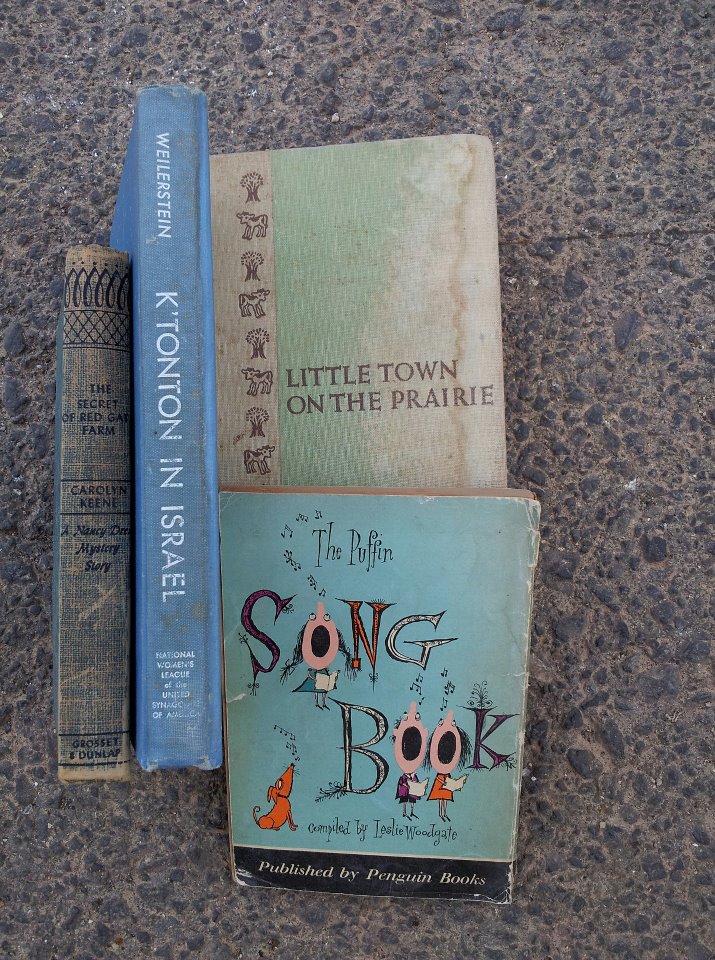
It’s been percolating inside of me for about two weeks, ever since I first started saving books from the recycling bin.

As you know, I live on a kibbutz in northern Israel. It’s a kibbutz that was established about 30 years ago by the Masorti movement in Israel; Masorti being the equivalent of Conservative Judaism in America. Many of the new residents of the kibbutz were from English speaking countries: the U.S., South Africa, England. When they came to Hannaton, they also brought with them their English language books, which presumably went into the communal library once they landed at Hannaton.

Recently, the library at Hannaton, like the kibbutz itself, underwent a huge renewal project. A volunteer committee sorted through the books to determine which ones would remain in the new library and which ones were either duplicates or in an unsuitable condition. There were thousands of books to sort — and since we’re in a Hebrew speaking country, there weren’t many nearby options for donating. The committee decided to put the unsuitable books in the recycling pile.

But, as we know, one person’s trash — or in this case, reusable waste — is another person’s treasure.

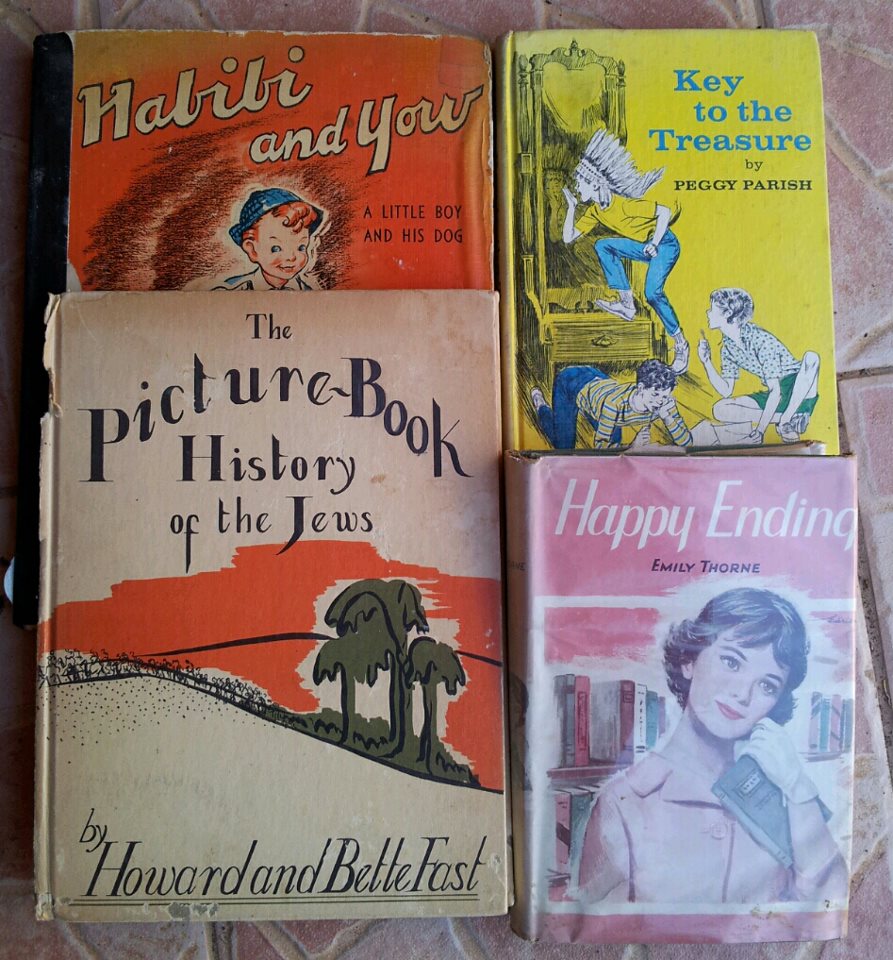
And this is how I came to spend a week and a half trash surfing for treasure; embarking on what I call the “Orphaned Book Project.”

When the books were finally hauled away by the recycling truck, I had saved about 30 books and 15 magazines, including Highlights from the 1980s with “Hidden Puzzles” left untouched for my 5 year old to explore; and a Cricket magazine from the year I was born, 1974. I saved a Scholastic paperback from 1981 written by Ann Reit, an author and editor I had the privilege of briefly working with, and who has since passed away from cancer.  I saved a much older Scholastic paperback whose jacket cover previews a young adult fiction story that centers on racial integration in the 1950s.  I saved a few ChildCraft How-to science books that are surprisingly still reasonably current, and a few history books that aren’t, but are still fun for my 9 year old to leaf through over a bowl of cereal in the morning.

There were Hebrew books, too, but I didn’t save any. The only Hebrew language publication I saved was a pamphlet printed by a professor in 1944 that documented all the agricultural settlements and their products up until that time.

On the title page, in English, are written the words:

Printed in Palestine.

First I saved a couple of original Nancy Drews, and hardcover Little House, and a classic K’Ton Ton, and a kitschy song book
I have no need for more dusty coffee table books, but couldn’t resist this vintage They All Are Jews, a gift to “David” in 1951, after his confirmation. Inside I found a newspaper clipping from when Miss Israel won Miss Universe.
It wasn’t until my final visit that I found the true personal treasure: Peggy Parish’s Key to the Treasure, the last in a middle grade trilogy I loved as a girl and had been collecting
Community

Tweet-a-loo Virtual Community

I’ve taken a liking to Twitter.

It took me three years of pretending to like Twitter to finally like it. But I do.

And now I have fallen out of rank and file with the folks who spend all day commenting on friends’ kids’ photos on Facebook, but sneer and roll their eyes at Twitter thinking it’s still a social media application that sends 3,456 updates to your phone via SMS text all day. A platform reserved for pesky teenagers obsessed with Justin Bieber or smartasses talking in hipster jargon.

It’s not.

As a consumer of information and a lifelong community seeker, Twitter is a gift to me now that I know how to use it right. Rather than following 9,000 people with the words “wellness,” “green,” “eco,” or “holistic” in their handle like I did three years ago when I signed up as The Wellness Bitch and was looking to build my blog readership, I decided instead to thoughtfully observe for a while when I registered a new account following my move to Israel in early 2011. Also, I logged in as “me” this time, and not as my brand, so I wanted to be cautious while figuring out who exactly I wanted to be in this new medium, and who I hoped would pay attention.

A year later, I’ve almost figured it out.

I’m me.

Well, let’s say, the 80% version of me that I’ve deemed acceptable for public consumption.

At first, I started following people I know personally. After all, I was a new expat in Israel, and it was essential for me to keep ties to the folks back in the States, as a reminder that there are folks in real life who know me and kinda love me.

Then, I started following other English speaking olim: @onaliyah (who works for Nefesh B’Nefesh but also happens to be someone I know from the States), @LauraBenDavid (the social media guru for Nefesh B’Nefesh), and @carolw, (who I have never met in real life but who a friend of mine in New Jersey promised was really funny in an LOL sorta way).

For a while, I didn’t post a thing. I just eavesdropped on other people’s conversations. And, when friends of friends said something funny, or retweeted an article that piqued my interest, I clicked through to the profiles of strangers. Sometimes I followed them. And slowly but surely I stopped stalking and started speaking. And my list of followers slowly grew.

And while most of my new followers weren’t people I knew in real life — I never shook their hands hello; I never caught their gaze; heck, I had no idea what their real voices even sounded like — I began to make friends in the same way I make friends in real life.

If you’re really funny, but have enough social skills to know when your crude has crossed the line, you can be my friend.

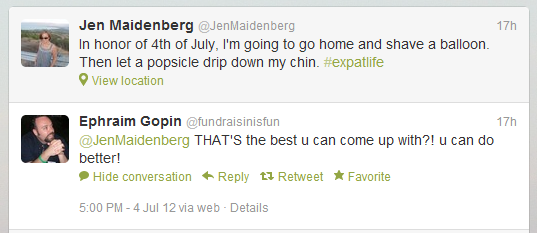
If you retweet me when I am trying to be funny, but don’t say things like “THAT’s the best you can do,” you can be my friend. (If you’re super sweet, I even give you a second chance when you cut me down.)

If you are a science geek, but are well-rounded enough to follow both NASA and quote Buffy the Vampire Slayer, you can be my friend. (NOTE: If you know the lyrics to every song in “Once More with Feeling,” and I am not following you, please Direct Message me immediately so we can be best friends.)

If you’re a blogger living in Israel, particularly the expat kind that knows “the trouble I’ve seen,” you can be my friend.

If you’re a celeb writer I wish I could be friends with in real life — someone I admire both for what you produce on the page and for how you engage with your readership — you can be my friend. (Good examples are @jenniferweiner, @margaretatwood, and @jaltucher).

Some of my imaginary friends don’t even live in Israel or the United States. Some live in their own little worlds. But as long as the law of the land in their worlds is fairly similar to mine — ie. rape is bad; rootbeer is good — I’m okay with  widening my circle.

Some of my imaginary friends are out of my demographic. They’re not women or moms or married. They’re not Jewish. They’re not writers. And yet, we’ve accidentally found each other through a shared interest in archaeology or space weather or time travel or a dream to one day be Sarah Silverman.

My imaginary friends are not a substitute for my real friends — and I use “real” both loosely and lovingly, because otherwise we’re getting into a conversation far deeper than I had intended.

My imaginary friends complement my real life friends. My imaginary friends helped me bridge the gap between the semi-social butterfly I was in New Jersey and the awkward recluse I was when I first moved to Hannaton. Unintentionally, because our conversations are always in English, they helped soften the frustration I felt when I couldn’t properly articulate my thoughts and feelings to many of my new “real life” friends in Israel. And without knowing it, they supported me in my quest to remain tied and connected to my American self, while still figuring out what my Israeli self looked like.

And while imaginary friends can’t give you the kind of in-person intimate huggy kissy love and attention your real life friends can, and hopefully do, your imaginary friends can make you feel smart when you feel stupid and heard when you feel ignored or overlooked.

So, thank you imaginary friends of @JenMaidenberg, for being my “virtual kehillah” here in Israel while I still eagerly but cautiously grow my real-life one. You, my imaginary friends,  with your double entendres and your <winks> are often accidentally my imaginary cheerleaders, too.

Community, Family, Letting Go, Mindfulness, Parenting

Believing your inner rock star

Tonight my son was the student of a lesson I’ve been actively trying to learn all week all my life.

How to keep thinking you’re a rock star when the world hands you proof otherwise.

The setting? My son’s soccer ceremony. The kick in the gut?  Instead of being awarded the “best player” trophy at his soccer ceremony tonight, it was presented to one of his friends.

Props to my kid in that instead of losing his shit like one of the younger kids who screamed and stormed off at the end of the presentations, mine actually held back tears long enough to mutter a mom-forced congratulations to his friend, and pose for a picture with him. But as soon as possible, he grabbed my hand to walk far enough away to break down.

“It’s not fair,” he cried. “Everyone knows I’m the best player! The coach favors H. and everyone knows it! I should have gotten that trophy, not him.”

I nodded sympathetically. Maybe I agreed with him. But even if I didn’t, I couldn’t help but relate to how much it sucks when you know you’ve done something really great and people aren’t recognizing you adequately.

I feel this way at least once a day.

What I found truly amazing, however, as my son was lamenting his coach’s bias is that he never once said:

“I suck at soccer. I’ll never get the trophy.” Or,

“I’m not good enough. If I was, my coach would have given me the trophy!”

Instead, he insisted time and again some version of “It’s not fair. I’m the best. Everyone knows it. I deserved that trophy.”

So why the agony?

What stops us from just believing our inner rock star?

Like my son, I’ve always been moderately confident. And in a chicken or the egg sort of puzzle, I’ve never been able to figure out if I’m confident thanks to my successes or if my success is linked directly to my confidence.   But as confident as I often appear (to myself and others), there’s always a moment when cocksure turns to doubt.

Like my son, I want the trophy. I want the recognition. I want people to understand how great I am and tell me. Over and over and over again.

If the key opinion leaders in my life — the people I’ve deemed smart, successful, funny, cute, sexy, or otherwise worthy of my worship and/or attention — praise me for my work, I’m on cloud 9. “People really get me,” I think.  I have proof I am great.

But if the KOLs don’t agree with my own personal assessment of me (that I’m great/working hard/ trying to be kind), or they don’t shout it out loud, my confidence slowly begins to dissolve.

I like the applause. I like it when people think I’m special.

But is it possible to like it without believing it?

The recognition has clearly become an addiction, and I don’t like being dependent on it. As with any dependency, I suffer when I go through withdrawal. On the other hand, what happens to our greatness when no one notices? Or when someone else sees your greatness as mediocrity at best?

Philosophers, Buddhist monks, and fans of the Matrix still debate whether or not an object exists if someone is not around to perceive it.

How on earth do I evaluate my performance without counting on a grade/raise/applause/pat on the back/book deal?

*     *     *

My son and I both simultaneously live in two different realities. The one in which “I am great and I know it.” And the one in which “I am great and nobody knows it.”

In fact, most of us are constantly perched at the center of a seesaw, one foot on the side of certain and the other on the side of afraid.  It’s up to each of us, in every moment, to choose where to place our weight. This much I know.

But is believing our inner rock star really as simple as deciding to?

Can we simply choose to live the reality in which we are great? Instead of the reality in which we’re waiting for others to notice?

Is it possible to be the rock star without the audience?