Culture, Religion, Spirituality

Tradition

Do you celebrate Rosh Hashana like your parents did? What do you borrow from the High Holiday celebrations of your youth?

This is what I am thinking today on Rosh Hashana 5773, Day Two.

It occurred to me this morning, the second day of the new Jewish Year that we didn’t go to services the day before.

Even writing that statement feels funny. It occurred to me. I’m a little embarrassed; a little ashamed, even.

I accidentally forgot to go to services.

This is particularly ironic since, when I was a kid, Rosh Hashana was one of two days during the year when you could be sure to find me inside a synagogue (or at the very least, on the playground of a synagogue, or in a crowded hallway of a synagogue among other hormonal teenage girls spying on well-groomed oblivious teenaged boys.)

It’s ironic because now I am an adult living on a fairly traditional kibbutz in Northern Israel; now, I go to Friday night services at least twice a month; now, I speak Hebrew and think about God:

Now, is when I forgot to go to services.

Instead of going to synagogue on the morning of Rosh Hashana — and I write “instead” very loosely since there really was no active choice involved; I simply forgot — I hung around my in-laws’ house, enjoyed a nice breakfast with my family, and played with the baby kitten my son befriended in the yard.

It’s not that I forgot it was Rosh Hashana. Certainly not. It’s a state holiday. I dipped apples in honey. I thought about the people I had hurt the year before and made a silent intention to right wrongs. I sent New Year’s greetings to loved ones and blessed my children. I kissed my husband with gratitude. I ate brisket.

But I didn’t go to services.

It only occurred to me once we returned to Hannaton later that evening that we really should go to synagogue. It was Rosh Hashana after all.

I thought back to the High Holidays of my youth. I thought about my young parents; and my childhood home. I thought about sweet kugel at my Bubbi’s house. I thought about the new dress from Botwinick’s my mom and I would shop for and the fresh pair of itchy tights we’d break out of the package on the morning of Rosh Hashana. I thought about my brother struggling into a suit from Fleet’s and my dad in a black nylon kippah. I thought about my mom in high heels. My mom hardly ever wore high heels.

I thought about posed family photographs in the front driveway. Plastic smiles, but pretty pictures.

I thought about making it to synagogue early enough to hear the Torah, but not so early that we were the first ones there (10:15 am). I thought about the challenge to find parking in the neighborhood behind Beth El. And worse yet, on the years it would rain.

I thought about parting with my parents as they made their way to their assigned seats in the auditorium…and in later years to the Main Sanctuary. I thought about the classrooms turned into babysitting rooms; and the small chapel I dutifully spent ten minutes inside.

As I recall the Rosh Hashanas of my youth, I don’t recall prayer. This is certain.

But I recall tradition.

Intentional or accidental, our family had a Rosh Hashana tradition. A custom practiced year upon year and, in some little way, passed down to generations. Customs out of the ordinary that I only associate with the High Holidays.

Last night, when it occurred to me that we didn’t go to services, I suggested to my husband that we take the kids the next morning and he agreed.

Not because I felt compelled to pray. Not for fear of the wrath of God. Not even because I thought it was “the right thing to do.”

I took my kids to synagogue because remembering the boring, overdressed, agitated, sometimes hormonal, often drama-filled High Holidays of my youth opens up my heart.

It’s like playing an 80s video on YouTube.

It’s like reading an old journal entry.

It’s like running into an ex-boyfriend on the street.

It’s like smelling your grandmother’s perfume.

It’s like looking at the pictures of your baby’s birth on his 6th birthday.

This is the nature — and the merits — of tradition.

And I want my children to experience the overwhelm of their hearts opening.

They can’t possibly know it today as they argue over who got a bigger glass of grape juice; as they complain about having to pin the kippah to their heads; as they moan and groan as we walk up the hill to the Beit Knesset underneath the hot sun.

But someday they will remember.

And their hearts will burst with feeling.

And they will welcome in the New Year.

Culture, Family

Seducing Fall

You wouldn’t know it from the digits on the thermometer but we’re a few breaths away from Fall.

Evidence mounts, instead, on friends’ Facebook photos and in the mess of backpacks and lunchboxes thrown haphazardly in my hallway.

A new year of school has begun and our second Israeli summer is almost behind us.

I know I’m adjusting to life in Israel because I inhale the faint smells of Fall with desire and relief.  As opposed to how I’ve always associated summer; here, Fall is the season in which we get to play outside and explore.

The summer heat is oppressive, as are the masses at public beaches and parks. In the fall, on the other hand, the weather and the tourists taper off, and the locals get to play a little. Especially with the Jewish High Holidays smack dab in the middle of our transition back into our “regular schedules.” Government and school holidays from Rosh Hashana thru Sukkot provide many of us with a veritable Indian Summer. Mandatory days off from work. An excuse to slack a little.

While I’ve always been a summer lovin’ kinda girl, Israel — and perhaps age –have created a rift between me and my childhood steady, the Summer Sun. I no longer crave his touch as much as I used to, and when we spend too much time together I bristle from it instead.  For the the first time ever, I don’t think I will have a hard time bidding him goodbye.

And with a more mature, but just as selfish abandon, I beckon Fall instead.

Culture, Middle East Conflict

I’m Israeli

Hours ago I was at the computer giggling, putting the finishing touches on a post explaining why I want to be like comedienne Sarah Silverman.

I was feeling very bold and brave as I pressed “publish;” even daring with my mind anonymous internet lunatics to post crazy biblically-inspired apocalyptic remarks in the comments section.

This was going to be fun.

Agitated a bit by the screaming headlines on the Times of Israel home page about the unrest in Syria, I secretly hoped the news would drive more traffic to my latest post, featured as a “Top Op” a few scrolls down. I know that makes me sound like an insensitive bitch. I’m not. I suffer over how helpless I feel about the situation in Syria. But the headlines were about bad guys being killed. It allowed me to embrace the numb.

I’m numb still.

But for different reasons.

My “top op” seems so frivolous now in comparison to the tragic news coming from Bulgaria, where three Israeli tourist buses were apparently targeted in a terrorist attack this afternoon.

Hours ago I was feeling clever, confident… and now

I feel sick to my stomach.

If you had told me a year ago or two I would feel this way following a planned attack on Israelis travelling abroad, I’m not sure I would have believed you.

When I read the news an hour ago, I didn’t feel the same type of  composed sympathy I used to feel when I read about horrific terrorist attacks in Israel before I made Aliyah. Back then, when I worked at the Jewish newspaper for instance, and we would get word from JTA that something terrible happened to Israelis (like the 2002 Passover massacre in Netanya), I would sigh with sadness and I’d shudder over the list of names.

But I wasn’t scared. I didn’t have that sensation that I just barely missed something terrible happening to someone I love.

Or to me.

Now, I feel a tiny bit terrified.

The way you do when you narrowly miss the car accident on the highway. Like it could’ve been you.

In April, my husband and I purchased one of those package vacation deals. If you’ve been to Israel, you may know what I’m talking about. It’s really easy to get a great last minute deal to other Mediterranean countries — Greece, Cyprus, and formerly, Turkey. Since relations with Turkey have soured in recent months, Israelis have been going to Bulgaria instead. In fact, one of my coworkers was there last summer and another has a vacation planned for this summer.

To be honest, I don’t know if he was on that flight. I really don’t know. I didn’t see him at the office today.

When I saw the headline, I felt in my gut like I narrowly missed a personal tragedy.

And yet, that somehow the tragedy still belongs to me.

When I saw the headline, I felt Israeli.

Community, Culture, Family, Kibbutz, Letting Go

Speechless

When I was a girl, I was a motor mouth.

How do I know this? Because Ms. Levin, my second grade teacher told me so. Seriously, my nickname in second grade was Motor Mouth, a moniker craftily created by my teacher at the time, who occasionally relented to my excessive hand-raising by saying, “Yes, M.M.?”

As borderline abusive as this practice was, there was some truth in the designation. I talked a lot. All the time, in fact. I talked to my neighbors at my table. I talked to my friends across the room. Often I would mutter to myself. I was a social creature. I still am.

My poor husband, not a social creature by nature, now carries the burden of Ms. Levin. But unfortunately for him, he has not only my incessant chatter to contend with, but also our oldest son’s and daughter’s. They inherited the Motor Mouth gene.

My chatter tends to run over into my writing. I’ve said often in the past that I “write in order to know what I think.” I didn’t make that up. Author Stephen King has said it. Historian Daniel Boorstin is claimed to have said a version of it. I wonder if those guys were motor mouths, too. Probably.

The best part about blogging is that it’s almost acceptable to be a motor mouth. Not so with traditional, published writing. In magazines, books, and newspapers — the kind of publications people still pay money to read on a regular basis — our motoring is required to be more thoughtful and refined. I respect this. I think it’s a sensible, if often boring, practice — carefully choosing your words and paying fastidious detail to grammar and punctuation.

Which is why, when I have a more thoughtful and potentially refined idea for a story, I don’t blog it. I save it.

I have one right now, in fact.

It’s been percolating inside of me for about two weeks, ever since I first started saving books from the recycling bin.

As you know, I live on a kibbutz in northern Israel. It’s a kibbutz that was established about 30 years ago by the Masorti movement in Israel; Masorti being the equivalent of Conservative Judaism in America. Many of the new residents of the kibbutz were from English speaking countries: the U.S., South Africa, England. When they came to Hannaton, they also brought with them their English language books, which presumably went into the communal library once they landed at Hannaton.

Recently, the library at Hannaton, like the kibbutz itself, underwent a huge renewal project. A volunteer committee sorted through the books to determine which ones would remain in the new library and which ones were either duplicates or in an unsuitable condition. There were thousands of books to sort — and since we’re in a Hebrew speaking country, there weren’t many nearby options for donating. The committee decided to put the unsuitable books in the recycling pile.

But, as we know, one person’s trash — or in this case, reusable waste — is another person’s treasure.

And this is how I came to spend a week and a half trash surfing for treasure; embarking on what I call the “Orphaned Book Project.”

When the books were finally hauled away by the recycling truck, I had saved about 30 books and 15 magazines, including Highlights from the 1980s with “Hidden Puzzles” left untouched for my 5 year old to explore; and a Cricket magazine from the year I was born, 1974. I saved a Scholastic paperback from 1981 written by Ann Reit, an author and editor I had the privilege of briefly working with, and who has since passed away from cancer.  I saved a much older Scholastic paperback whose jacket cover previews a young adult fiction story that centers on racial integration in the 1950s.  I saved a few ChildCraft How-to science books that are surprisingly still reasonably current, and a few history books that aren’t, but are still fun for my 9 year old to leaf through over a bowl of cereal in the morning.

There were Hebrew books, too, but I didn’t save any. The only Hebrew language publication I saved was a pamphlet printed by a professor in 1944 that documented all the agricultural settlements and their products up until that time.

On the title page, in English, are written the words:

Printed in Palestine.

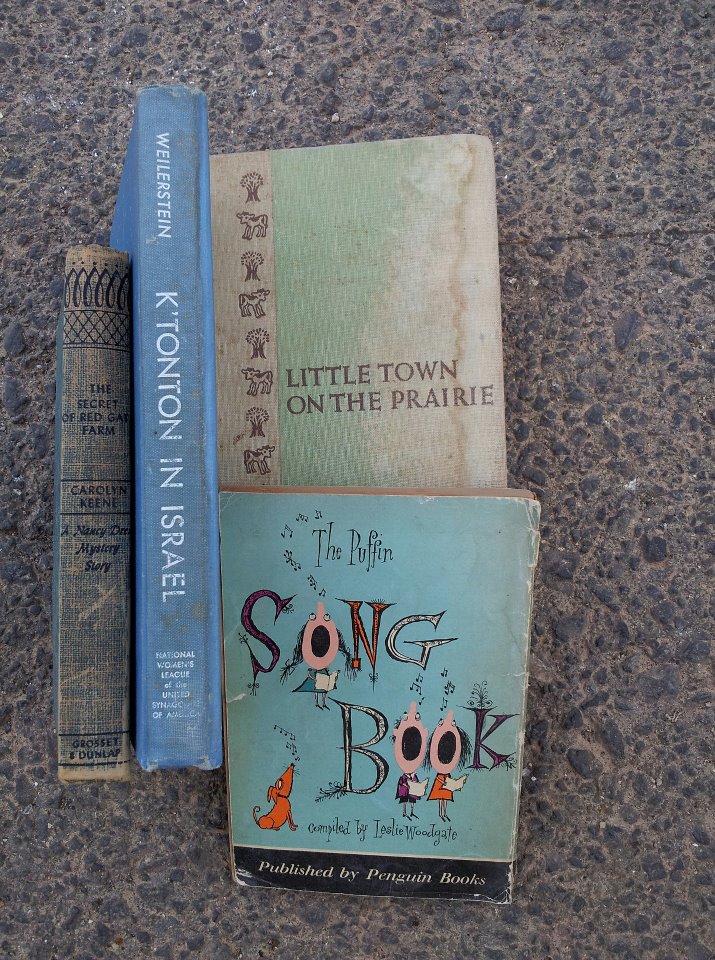
First I saved a couple of original Nancy Drews, and hardcover Little House, and a classic K’Ton Ton, and a kitschy song book
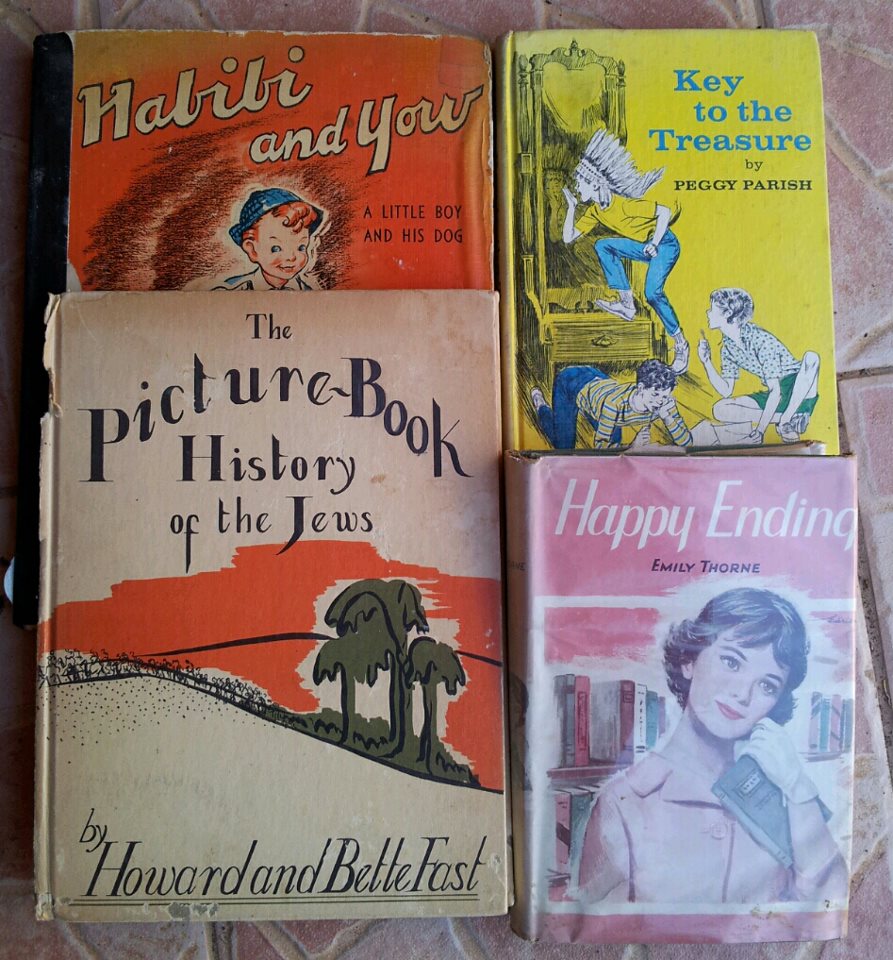
I have no need for more dusty coffee table books, but couldn’t resist this vintage They All Are Jews, a gift to “David” in 1951, after his confirmation. Inside I found a newspaper clipping from when Miss Israel won Miss Universe.
It wasn’t until my final visit that I found the true personal treasure: Peggy Parish’s Key to the Treasure, the last in a middle grade trilogy I loved as a girl and had been collecting
Culture, Letting Go

Putting the sexy in immigrant

They say an oleh is truly settled here when he starts buying Israeli deodorant instead of importing American roll-on via generous relatives, or when he finally settles for chunk light tuna instead of white albacore.

For sure, a girl’s showing signs of improvement when she commits to an Israeli hairdresser.

I walked into Effi’s Tiberias salon the other day looking for a cleanup. Since it’s summer, the season in which I let my hair grow long to remind myself of the blonde I used to be, I told him I didn’t want him to take too much off. Just enough to remind myself I’m a hot mama, not a Hanson brother.

I hadn’t had a haircut in more than six months; the last time was during an unexpected visit to New Jersey in December for my grandmother’s funeral. The day before the funeral, my mom treated me to a cut and blow (the words of which alone transform me from kibbutznik to suburban chic). Since then, however, I’ve been letting my hair grow out, compensating for the split ends with ponytails and braids. Until the other day, when a co-worker chuckled and asked me, “So? You’re going for the Princess Leia look now, huh?” At which point, I realized it was time for action.

I had tried out Effi once before, a few months after we made Aliya. He’s the regular hairdresser for both of my husband’s parents, and, get this, once employed Israeli celeb pop singer Moshe Peretz in his salon. I should have been really excited when Effi told me Moshe Peretz was due into his salon any minute to give Effi himself a cut.

Had I known who Moshe Peretz was, and had I not been reeling from what Effi had told me only minutes before, maybe I would have giggled. Instead, I was distracted and tingly in a way a woman approaching 40 can only be when a man who is not her husband or her five year old son gives her an accidental compliment.

As I sat down in his chair, I had told Effi I wanted to keep my hair long, but other than that he had free reign. Effi looked me up and down through the reflection in the mirror, paused, and told me what a big change he could see in me since the last time I was in.

“Really?” I asked. “How?”

“You don’t look so American anymore,” he said, working on his English. “When you were here last, I thought to myself, ‘This woman is so stiff. So square.’ You wouldn’t let me do anything. Now, look at you.”

A year ago, I would have been insulted. Instead, I took inventory. I looked at myself in the mirror. What was he talking about? I was wearing my standard pair of Old Navy Jeans, sporting the wannabe adorkable red glasses I bought at Cohen’s Fashion Optical right before we made Aliya, and my hair was growing in Zac Hanson circa 1997. True, I was wearing the new lemony top I had bought on sale from Azrieli’s Forever 21 store, but I can’t imagine one shirt made in China sold at a Tel Aviv chain store geared for teenagers and hookers could really make much of a difference.

What did he see in the mirror?

“I see it happen to people all the time,” he said. “They come to me fresh off the boat. And then a year or two later you can see Israel all over them. Their hair gets lighter. They buy funky clothes. This country gets into them. It…”

He struggled for the English.

“It makes them more alive?” I asked.

“Something like that,” he answered.

I sat with it for a bit. The old me – the one fresh off the boat – would probably have ruminated about his comments the entire time he cut my hair. But the me in the chair, the new me (apparently), could only shiver with delight as he snipped away the 12 year old Zac Hanson and created a haircut suitable to the Israeli woman he saw in the mirror.

I felt sexy in that chair…and, I guess, more alive.

After he finished his work, I paid and took the sexy Israeli with me out the door, along with a bag full of new hair products. I strut my stuff down the Tiberias boulevard, flipped my hair from side to side, and with my eyes, dared anyone to try, just try to speak English to me.

I’m no tourist, my eyes said sparkling. I’m no square immigrant.

I’m alive. Israeli style.

(This was originally posted on The Times of Israel.)
Climate Changes, Culture, Terrorism

Experts say Israel safer than most

So I was thinking about the zombie apocalypse the other day afterreading the story about the Florida man who was shot while attempting to eat another man’s face. I was tweeting about it with comedian Rachel Dratch (okay fine, I was retweeting Rachel Dratch, who doesn’t know I exist…yet), and felt once again a sense of security in the belief that if the apocalypse were to happen, Israel would be the last sucker to go.

Since moving to Israel 18 months ago from New Jersey, I have slowly let down my anxiety-induced guard. Now it’s actually possible for me to walk into a Café Aroma and not worry about being blown up, especially at the Café Aroma in Karmiel, where I eat lunch every now and again and where I feel somewhat irrationally appeased by the fact that half the patrons are local Arabs and would make this particular Café Aroma a poor terrorist target.

Terrorism is no joke. I know this. Sarcasm is my crutch. Along with meditation. And 70% dark chocolate.

But just as some of you worry about terrorist attacks and the possibility of a nuclear attack from Iran, I worry about the zombie apocalypse.

Or  the pole shift phenomenon as dramatized in the 2009 Roland Emmerich film, “2012.” Or snakes crawling up my toilet and biting my privates when I pee in the middle of the night.

While there’s certainly a lot about living in Israel that exacerbates my anxiety, you might be surprised to know I actually feel safer living in a country that is prepared for the shit to hit the fan.

Israel is the place you want to be when Michael Crichton books start coming true. We have loads of creative scientists who can immediately turn their focus from investigating testes in a test-tube to finding the magical antidote for the zombie virus.

If an asteroid really does come super close to earth, enough to cause danger to human civilization, Israel can come to the rescue. Gather up all the engineers working secretly behind Rafael’s secured gates and hole them up inside Israel’s Space Agency until they come up with a plan for as asteroid destroyer, one that puts the “Armageddon nuke to shame. (Did you know that Israel is the “smallest country with indigenous launch capabilities?”)

I feel comfort in the fact that I don’t have to be a crazy prepper survivalistwith my own YouTube channel in order to feel comfortable saying out loud that I actually have my very own secured, hideout bunker stocked with canned sardines and a month’s supply of toilet paper. My MAMADcame standard with my house. So there, haters!

I may still get nervous boarding public buses, and watch my back on the windy Galilee roads I drive to and from work. Yeah, I still feel jittery about the end of the Mayan calendar, and notice with interest the billboards about the Rapture that occasionally pop up even here in Israel. But in a nutshell, I have faith that unless an advanced alien civilization (the one that secretly runs the New World Order) shows up on December 21, 2012, and tells us our time is up and that we need to be pulverized into dust for messing up this planet beyond repair — well, I actually believe that living in Israel is as safe as living anywhere else.

If not safer. (Or so claim the imaginary expert voices in my brain.)

This was originally published (with a lot of fun zombie pics) on The Times of Israel.

Culture, Education, Family, Kibbutz

What happens to the boys with flowers in their hair?

I have a theory about Israeli men.

The reason they’re so secure in their masculinity is not due to months of paratrooper training or mandatory military exercises out in the desert.

It’s because, from a very young age, boys are formally taught and encouraged to dance.

And wear leafy crowns.

And carry flowery baskets.

And hold hands.

And revel in the beauty of their own bodies.

Very subtly, the women of Israel (and in modern times, men as well) have taught our male children that moving their bodies in rhythm and wearing beautiful crowns are not signs of femininity. They are expressions of joy.

I was tickled pink the week I accompanied my then four-year-old son to gan when we first made Aliya last year. In addition to the culture shock I got as a mother – kids climbing on top of chairs to build block castles and digging through trash to find treasures in what seemed like a junkyard turned playground out back – I remarked at how integral both singing and dancing were to the preschool program.

Every day, the children would learn a new song, either about the approaching season or an upcoming holiday celebration, and most Fridays, I would arrive at pickup to find my son in the middle of a dance circle, made up only of boys, carrying and waving brightly-colored scarves and stepping in tune to the music.

Not a one stood outside the circle – ashamed to be holding a purple scarf or embarrassed to be moving his body and holding hands with other boys.

Instead, they threw themselves fully into the act – even the ones wearing cargo pants; even the ones who prefer toy trucks to dolls; even the ones who might grow up to be tough guys. They all danced.

Israeli children at gan, Shavuout

And, today, as our community celebrates the harvest festival of Shavuout, the young boys all arrived at school wearing olive crowns and carrying harvest baskets, decorated with white linen and flowers.

As a woman, but particularly as a mother of boys, it’s magnificent to witness – my son and his peers expressing their joy through movement and song without reserve.

But it’s also puzzling. What happens to these boys as they grow up? I wonder. How do they move from dancing to disrespecting and speaking harshly to each other on the soccer field? What happens to these boys who used to hold hands and dance? Who used to wear flowers in their hair and sing songs about the harvest?

I’m still so new in this country. And still so new as a mother, despite almost a decade of parenting.  It’s true, I don’t know yet of the heartache that hardens our sons. The burdens they think they bear. The walls they think they need to put up to protect themselves once they leave the safety of the garden.

I am also still naïve enough, however, to think that there must be something innocent that remains once they leave the gan – something that helps carry our boys through adolescence in a country where men often have to act like “MEN.” Where boys mock each other on the playground and fathers hurl insults at each other from their car windows. Where men, in particular, but all of us need often to operate in a “shuk mentality,” as my husband refers to it. Keep up your guard. Be wary of those who might want to cheat you or steal from you. Yell first, think later.

Something must remain. Something beyond the images the mothers hold dear to their hearts, images of young boys wearing white shirts and flowers in their hair.

It’s been told to me that men grow close to each other during the army. That bonds are formed there. Perhaps, this is true. It’s certainly the obvious answer.

But part of me thinks the bond starts earlier, and then is sidetracked by life. The bonds are built on top of foundations made from purple scarves and olive crowns.

The bonds begin with a dance.

Culture, Family, Food, Parenting

Transforming duty into delight

Every once in a while, someone says to me, “I don’t know how you do it – work full time, parent, and still have the energy to blog.”

I smile bashfully (but secretly pleased), and explain that “writing is not a choice for me.” I’m compulsive. When I get an idea into my head, I can’t move forward until it’s on the page. Writing offers me relief.

Additionally, I’m the lamest mother on earth when it comes to holiday celebrations, which affords me more time to write.

As compulsive as I am, I can’t compel myself to make flowery Shavuot baskets or hand-sew Purim costumes for my kids to show off at school.

Photo credit: J. Whine

I have very mixed feelings about this. I love seeing my daughter wearing the exquisite crown of flowers her grandmother made especially for her preschool celebration. I am so grateful that she gets to feel like a princess because my husband crafted her a breakfast basket filled with carefully prepared dairy delicacies. I just can’t be bothered to make the effort myself.

I’m not lazy. (Note comment above.) I just completely lack holiday spirit; in particular, I loathe school holiday celebrations.

It could have something to do with how much I resent arts & crafts.

I stopped liking arts & crafts in 2nd grade when I realized precision was integral when working with glue and felt. It frustrated me that I was never able to generate in reality the beautiful concept I had envisioned in my mind.  It frustrated me even more when I couldn’t remove the excess felt from my fingertips. Now, even the words “arts and crafts” conjure up only feelings of frustration and inadequacy.

But to blame my resistance solely on the arts and crafts would be bogus.

Bottom line? I’m the Jewish Grinch. There’s nothing about holidays I like.

I know that depending on what we’re commemorating, I’m supposed to feel grateful, blessed, or triumphant. But, mostly I feel obligated, stressed, or depressed. In Israel, holidays usually mean my three children require three different outfits that I have to remember to launder in advance; three different lists of supplies to bring to school – from burekas to bisquits to bisli. And, often three different days on which they’re celebrating!

Holidays mean dancing in front of other adults, a fate worse than death for me. Holidays mean gathering around bonfires singing songs I don’t know the words to. Holidays mean eating foods that I’d otherwise avoid because they give me cramps, or turn my children into demons.

In Israel, like in America, holidays mean vacation for my kids and their teachers, but not always vacation for working parents. So, holidays also mean I need to figure out babysitting for my kids, so my husband and I can work.

I’m a bummer. I’m a buzzkill. I’m a Grinch.

I want to revel. But I can’t. I don’t feel it.

I didn’t revel in American holidays either. It drove me nuts there, too. Sign up lists at Halloween and Thanksgiving – Who would bake the pumpkin pie? Who would bring in the orange frosted cupcakes?

I vaguely remember once upon a time when I used to feel joy for holiday celebrations. The excitement accompanying unexpected Valentine’s Day cards. The joy with which I sang songs at my Hebrew school’s mock Passover Seder.

Where has that joy gone? How can I transform duty back into delight?

= =

There is a moment, I’ll admit it.

There’s a moment when my heart opens. It’s like a wisp of a memory that I can almost touch, but not quite.

It happens when I watch my daughter twirl in her white gown. When I see my five year old son and his classmates dance with glee in front of their beaming parents. When I catch my 9 year old laughing and leaping with his friends from haystack to haystack.

In those moments, I feel my irritability dissolve; my load lighten. I let joy in. I feel relief.

There’s a glimmer of hope then — that next time I’ll be able to enjoy it…not just blog about it.

Culture

Thank You, Dr. Hussein

I’m still belching out mild nausea, but compared to how I felt last night, I am grateful to be able to sit up and type.

Last night, my husband and I went to a nearby Middle Eastern restaurant for a quick dinner before heading to a parents’ meeting at our son’s school. He had the chicken and I had the fish, along with the usual assortment of side salads.

I had barely put the last bite of fish in my mouth when I started to feel sick.

I’ll never know for sure whether it was an accidental allergic reaction — I have diagnosed food allergies, but not to anything I ate – or severe food poisoning. The doctor at the E.R. said it was impossible to know for sure.  But I do know for sure I will never feel the same about my neighbors – in particular, the members of the first response team from neighboring Kfar Manda and the Jewish EMTs in the ambulance that soon followed: The confident one who called me “Mami” and told me I was going to be alright, and the cute one wearing the kippah who didn’t look older than 18. I’ll remember the nurses and doctor who took care of me at the Holy Family Hospital of Nazareth, and the patients in the beds next to me screaming in Arabic.

As you probably guessed, we never made it to the parents’ meeting. My husband took me straight home, where I stayed in the bathroom, violently ill. After about 20 minutes of this, I knew the reaction was severe and required attention. First, I told my husband to grab the epi-pen I carry in my purse. I’ve lugged this thing around with me for seven years, ever since my son was diagnosed with severe nut allergies at age 2. It’s maintained residency there at the bottom of my handbag along with the dusty gum wrappers and old pen caps, but I’ve never had to use it.

I’ve certainly obsessed about using it – on him or on me – and I’ve instructed countless teachers and relatives on how. But last night, when I popped the safety off the top and jabbed it into my thigh, I proved to myself what I’ve always told the anxious adults who care for my child, “When you need to use it, you won’t hesitate.”

My husband’s eyes bulged as he watched me stab myself and as I told him to call the Israeli version of 9-1-1.

The next hour is a blur. I recognized the Arab accents on the three gentlemen who entered my house holding medical gear in large metal containers, but I didn’t care. I just wanted the shaking to stop.  It was only much later, after one of them popped his head into my room in the E.R. to check on me, that my husband told me he was one of the first response team who came from Kfar Manda, the Arab village next to Hannaton, where I live.

As hazy as the ride to the hospital was, my memory of the E.R. is clear. By then, I had been pumped with steroids and two bags of saline drip. I was still nauseous, but significantly improved and alert. Too alert. Soon after I arrived, two patients were checked into the beds next to me. One seemed to be in a similar situation to me – severe pain and vomiting. As she moaned, my husband remarked that it was probably lucky we don’t know Arabic; I just held my ears and hummed to myself. You didn’t need to speak the woman’s language to know she was praying to God for help, and begging for relief.

I held back tears as they brought the next guy in. In my imagination, as I unwillingly listened to his screams, he had either lost a limb or his wife. We found out later, when the police came to interview him, he was the victim of a terrible crime.

By that point, grateful for the food poisoning and/or for the epi-pen, I just wanted to go home and recover. Moreso, I wanted to hug my sleeping children; snuggle against their pure innocence; watch them breathe. My mind, which had been up until that point fogged with fear and discomfort, was now all too filled with socio-economics, class structure, and war.

In this country, I constantly feel like a young child, always learning something new and aroused by a here-to-fore unknown awareness of the world around me.

Today, I am moved by the pain of my neighbors here in this land where appearances are more than deceiving; they are cause for confusion and often unnecessary fear. Today, I am touched by the love of my neighbors, who despite what they may learn as children from jaded adults and from personal experience, still find reason to commit their lives to caring for people who are different from them; people they might just as easily consider enemies.

Today I am grateful – for my health, of course, but also for our level of consciousness, which is more elastic than we think, and able to shift in a moment. One minute our eyes are closed; and the next they are open. One minute we judge; the next we offer our gratitude. One minute we hate; the next we love.

Let it be love that carry us forward.

(This was originally posted on The Times of Israel.)

Culture, Kibbutz, Learning Hebrew, Letting Go

The Jewish cowgirl rides again

(Originally posted as “Kibbutz girl in the city” on the Times of Israel)

Long ago and far way, before I got married and had kids, I worked in Manhattan for five years, almost three of which I spent living downtown in what is now chic NoHo. I’d say (and I often do) that such a biographical detail lends me an urban edge, but 12 years later, that edge has just about disappeared.

What I have retained, however, is the mythical city-girl handbook I used to carry; the informal list of safety rules I used at all hours of the day or night in that big city long ago, but have since shelved for only occasional browsing when I find myself in a big city without my car, or my husband, or a city dweller to hold my hand.

Last night, I dusted off the mythical city-girl handbook and slipped it into my trendy kisim handbag. (In case I’ve given you the idea that I actually know how to choose a trendy handbag, let me assure you it was a gift from my mother-in-law.)

After attending a work event in the outskirts of Tel Aviv, I was dropped off by my colleague in front of the Azrieli center downtown. We had just spent the day kicking off Israel’s 2012 Agritech conference with about 200 others at the AgriVest Summit, a conference where investors and entrepreneurs explored big topics like feeding the world and solving the global water crisis.

After getting dropped off at the center in front of one of the three towers at Azrieli, I was tired but still breathing in the fumes of post-conference self-assuredness. I thought my task would be easy: Find the Crowne Plaza Hotel, which supposedly was located somewhere in the Azrieli Center.

Azrieli Tower, Tel Aviv (courtesy Wikipedia)

Looking up to the top of the skyscrapers, I could see signs that indicated the shopping mecca inside: H&M, Forever 21, Fox.  But I couldn’t see a sign for the hotel.

Don’t panic, whispered the tall skinny girl sipping a frappacino on the cover of the city-girl handbook.When you don’t know where something is, she reminded me, ask a policeman or a taxi driver.

There were at least 10 taxi drivers in front of the Azrieli Center and not one of them knew where the Crowne Plaza City Center was. One told me, “Forty shekels, I take you there.” The other explained defiantly, “Crowne Plaza is by beach. I take you there. Forty shekels.” A third told me in Hebrew, “After the pedestrian bridge. See it? Just down the street? I take you there. Forty shekels.”

Hmm…I thought, maybe I should find a policeman.

Instead, I looked for a café where I could charge my phone, which had died an hour before. (The city girl handbook was written before there was 3G or Google maps.)

On my way to find the café, I happened upon the Crowne Plaza City Center exactly where it was supposed to be, in the lobby of one of the three towers. As I approached the reception area, I had to decide who I wanted to be: Israeli resident or tourist? When we’re in the big city, where you often find tourists, we olim get to choose — do our best attempt at native or pretend to be naive tourists. After our klita package runs out, this freedom to choose is just about the only benefit we olim have left.

Built up with confidence that the hotel receptionist was paid to be nice to me, I tried on my Israeli. I offered her my teudat zehut, my national identity card, instead of my passport when she asked for ID.

“Oh, so you are Israeli?” she asked. “Well, sorta,” I answered, the only response that comes naturally to me at this point, only 18 months post-aliya and still struggling with the future tense.

“Should we continue this transaction in Hebrew or English?” she asked me in a voice that sounded like a proposition.

Considering the last time a stranger flirted with me, I almost considered continuing the banter in English. Lack of stimulating banter is one of the things I miss most in this country. Instead, I shyly told her we could try and see how far we’d get in Hebrew.

We got pretty far. So far, in fact, I ended up holding a room key and a frequent traveler card.

After check in, I proceeded to the elevator, where I found myself in front of a panel of buttons that resembled no panel of buttons I had ever seen in front of an elevator. I couldn’t figure out how to get up to my room on the 14th floor. I once again consulted the city-girl handbook in my mind and remembered words from the final chapter: “When in doubt, watch what the person next to you is doing and mimic her.” Which is what I did, and yet I still wasn’t able to get to the 14th floor; the elevator only stopped at 12. And there were no up or down buttons. I was trapped!

Finally I asked the other rider for help — in Hebrew, but in a thick American accent because this is what you do in Israel when you need to ask a stupid question. She explained how the panel worked only by pressing the digits of the floor you need.

By the time I got into my hotel room I felt really, really foreign. Like a big fat 7-11-slurpee-drinking, baseball watching American foreigner. I went to sleep a bit defeated. Tomorrow would be a new day…hopefully.

The next day, however, didn’t start off much better. As I walked into the Agritech conference, my hands aching with the weight of the heavy boxes I was holding, the lobby was awash with long lines and pushing people. The wait at the registration desk seemed like it would take forever. Oy! When was this adventure going to get easier?

I stood in line for a few minutes and then looked around. I saw that there was no one monitoring the entrance to the exhibition hall. I picked up my boxes and headed toward the entrance. The American in me was hesitant to cross the invisible line that marked the boundary between the registration area and the exhibit hall. I didn’t have a badge. I hadn’t checked in yet. I couldn’t just walk in, could I? But the Israeli in me holding the heavy boxes had no more patience to spare.

And the Israeli is the one who crossed the invisible line.

The American in me shuddered at what I perceived as a security breach, but the Israeli in me (and the former city girl) was proud when I made it all the way to the booth without being stopped.

And the tall girl holding the frappacino on the cover of the city-girl handbook? She smiled and whispered knowingly, “When in Rome…”

= = = =

P.S. Thanks and love to Devora, my favorite Jewish cowgirl, for the inspiration for today’s headline.

Culture, Letting Go, Love, Making Friends

Be kind to writers

Since I began chronicling my life experiences in a public forum like a blog, I’ve learned there are feelings and personal experiences I might have been better off keeping to myself. Looking at blog posts I wrote three years ago is almost as mortifying as leafing through the journal I kept in 9th grade; the one that’s peppered with love poems only an angst-ridden teenager living in upper middle class suburbia could write… READ MORE

Culture, Family, Kibbutz, Letting Go, Living in Community, Making Friends

Seeing double

When I first moved to Israel, before I got my full-time job here, I started networking in search of freelance writing work. I had already started writing this blog about my Aliyah experience and had gotten positive feedback from both friends and colleagues. One of my colleagues suggested I reach out to Kveller.com, a new blog for Jewish parents, thinking they would be interested in syndicating this blog or hiring me to write another.

I wrote to the editors at Kveller and pitched my blog idea, confident they would write back to me with a big, fat YES.

Pitch: Fun, snarky Jewish mom leaves the comfort of her chic New Jersey suburb with her husband and three kids to try to make it as a kibbutznik in Northern Israel.

The editors wrote back that they liked my writing style, but that they already had a cool Jewish mom makes Aliyah to kibbutz column.

What?!?

There’s two of us?

Well, apparently there are. At least two of us.

The editors forwarded me Sarah’s blog post about moving to Israel, and I thought to myself, “Hmm. I guess I’m not so unique after all.” Sarah’s writing reminded me of my own, a blend I like to consider “tell-it-like-it-is honesty infused with snarky vulnerability.”

Figuring out that someone else had already pitched my idea and got the gig before me was a tiny blow to the ego, I’ll admit. Nonetheless, I secretly smiled knowing there was another Jen-like new olah mom out there.

So it was little surprise to me to see it was Sarah who wrote the article that popped up today on my Facebook news feed from The Times of Israel called, My Israel: A Land of Spoiled Milk and Honey.

The first half of the article was like reading the California Girl version of my life, or at least an alterno-verse version of the summer I first visited Israel in 1992.

I laughed at Sarah’s recollections of her first visit to the Kotel which were “spiritual” and “meaningful” and “fucking awesome.”  And I smiled knowingly at what she recalled as her passionate statement to the Israeli passport control worker promising that “one day she would return.”

I remember being that passionate girl. I remember being madly in love with an Israeli soldier. Um, I mean, Israel.

I could also relate to her experience of missing that connection to Judaism once she returned to the States. It happened to me, too. And I spent years trying unsuccessfully to recreate it while living in America.

But what I couldn’t fully relate to in Sarah’s post were her expectations that moving to Israel would somehow be a seemless transition into Israeli life and culture.  I didn’t share the expectation that being a Jew in a Jewish land would naturally translate into being understood or loved or accepted by your friends and neighbors. In fact, I was really worried that no one here would get me. That our family would not fit in. That I would never feel like this was my home.

In fact, the one thing that drives me nuts about the “Aliyah Movement” is the idea that American Jews moving to Israel are, in fact, “coming home.”

That sentiment, when I am at my ugliest, makes me want to vomit. When I am feeling kind, it simply bewilders me.

This “Coming Home” slogan is plastered all over the Nefesh B’Nefesh marketing materials. It’s the titles of videos on YouTube. It’s written in permanent marker on poster board and embroidered onto hats.  And all the time I think to myself, “Is it true? Are you? Do you?”

For a little while, the fact that I didn’t feel that way made me feel like a fraud, like an imitation oleh. Like the fake tofu version of a new oleh.

Where was the meat?

Did I really deserve this Aliyah if I wasn’t 100% sure Israel was my home? That this decision was the right one? That I would be happy here? That I would stay?

In the 16 months since I made Aliyah, I have come a long way.  In the 16 months since my Aliyah, I have worked hard to make this country my home. I have worked hard to learn the language; to make friends; to take on challenges that scare me; and to be tolerant and even accepting of cultural difference that are so offensive to me that I want to jump on the next plane back to Newark Liberty International.

For instance, I have learned that I can both hate the Israeli woman up my ass in the line at the pharmacy and at the same time admire her for being ambitious and bold. I can both cringe at the reckless abandon of Israeli parents when it comes to their child’s safety; and at the same time, smile with pride at the independence my children have acquired since figuring out that falling 5 feet from the top of the jungle gym onto concrete really, really hurts. I can scream at the dogs who run off their leashes; and quietly be happy they’re around to bark at the would-be robbers.

I have learned to love and accept this country, and my community. And I still reserve the right to complain about her.

If that’s not home, what is?

The real problem lies not with Israel. Nor does it lie with immigrants who are constantly comparing their new home to their old one. And certainly, the  solution is not, as some of the commenters on Sarah’s post would have one believe, “If you don’t like it, then leave.”

If anything, what we new immigrants need is compassion. Compassion from our neighbors, both the Israelis and the olim who have figured it out already.

And compassion for ourselves, as it takes a lot more than a slogan or a birthright to feel at home.