What matters to me most in life and politics is what’s closest to my heart. It’s related directly to my own personal experience.
Isn’t that true for everyone?
And, perhaps, why I haven’t connected to the elections in Israel is because what matters most to me doesn’t matter to most of the people voting in this election. Or most of the people that live in Israel.
But what I still don’t get is why?
In between fighting wars, and between reading the newspaper in the morning and watching the news at night, don’t we all need/want to live healthy lives?
Don’t my neighbors, friends, relatives understand that nothing else matters once your health is poor?
Taxes won’t matter.
Housing prices won’t matter.
Military duty won’t matter.
Statehood won’t matter.
Once a health crisis takes over, little else matters.
And each and every one of us are in some stage of a health crisis right now.
Many of us are only days, weeks, years away from cancer due to chemicals in our food and self care products.
Many of our children are only days, weeks, years away from debilitating asthma due to air pollution.
Many of our grandchildren are…
Many of our grandchildren are…
Many of our grandchildren are…
an impossibility
due to rising infertility rates … climate change … drought…. famine…diminishing resources on our planet.
Two years ago, it snowed like the apocalypse in Newark, New Jersey.
Nevertheless, the airports were open the next day and early in the morning December 28, we packed our three kids and 15 duffel bags into a shuttle bus. As the sun rose, we headed up the NJ Turnpike from my mother’s house in Cherry Hill to Newark International Airport to meet a plane full of Jews preparing for a Nefesh B’Nefesh flight to Israel.
Not the Israel that threatened to burn your skin lobster red or put you in a hospital in Beer Sheva for dehydration.
We landed in winter Israel; which, apparently, gets really wet and cold. For months.
I’m embarrassed to admit this, but do you know that I did not pack in one of those 15 duffel bags a pair of sweat pants? Not for me; not for my children.
I’m pretty sure I packed two pairs of pants for each kid and about 10 pairs of shorts.
I kid you not.
For January.
In Northern Israel.
To be fair, I had only been to Israel once in winter. And, while it’s true, I DID spend two weeks volunteering on a God Forsaken army base outside of Tzfat, during which I vaguely recall sleeping beneath a wool blanket in my large, down-lined khaki army jacket; I think my memories of being dehydrated by the Dead Sea prevailed.
I thought it was perpetual summer in Israel. I thought the worst it got was windbreaker and jeans weather.
Nope.
Luckily, a month after we arrived in Israel with our duffel bags, our shipping container arrived in Haifa. And, two weeks after that, following a port workers strike, our winter jackets and hats arrived. And my two pairs of Wellington boots.
The boots have been my best friends through two and half winters.
Now I know better: Winter in Israel, on a good year, is wet. And cold.
And on kibbutz — very, very muddy.
But, as naive as I may have once been about winter in Israel — I feel very out of place in, and a tad bit disturbed, by the winter wonderland brought on by this storm.
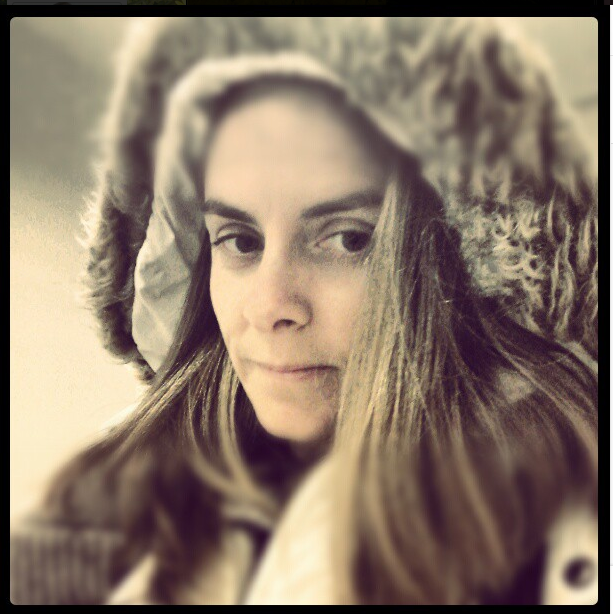
I’m lucky I brought my down jacket from New Jersey with its faux eskimo hoodB-ice-cycle in our backyard
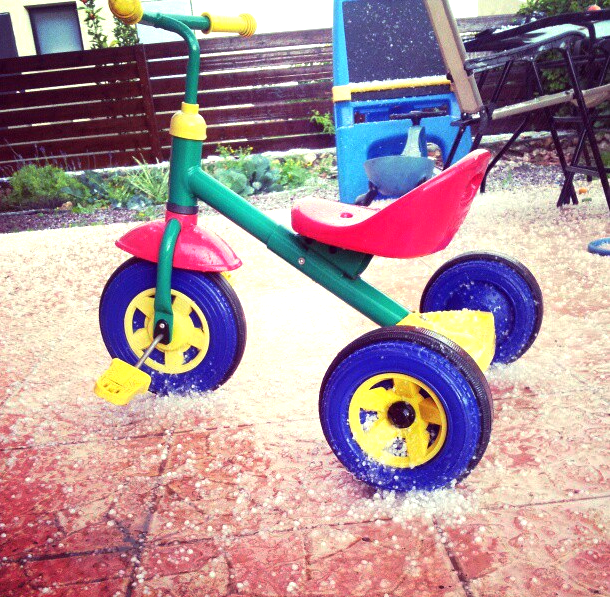
Ice raining down on my porch?
Driving winds slamming against the side of my house?
And if it were one random stand alone instance of freak weather, I’d probably chuckle and enjoy the cheers of my 4-year-old who doesn’t remember the snow of the blizzard we left New Jersey in. She thinks this freezing rain is snow.
But, I don’t have to tell you it’s not a stand alone instance of freak weather.
Where ever you’re reading this from — Australia (where wild fires rage), the midwestern and southern U.S. (where the impacts of drought are still being felt), Seaside Heights (still soggy from Sandy), flooded Great Britain — you know what I’m talking about.
Freak weather is becoming less freakish; and more freakishly common.
Winter in Israel was never this wintery. At least, not in a long time.
And after we make it through this storm, I wonder if anyone is going to be talking about it.
Or if they’ll simply shrug their shoulders in a “Huh, wasn’t that interesting” sorta way and praise the Lord for the rising of the Sea of Galilee.
Don’t get me wrong — we need water here. I am certainly grateful for the water.
There’s a chorus inside my head that won’t shut up.
It’s the group of internal activists (who look remarkably like me except they wear sexy wife beater tank tops and cargo pants) holding up signs that read:
STOP TALKING ABOUT IT AND DO SOMETHING
The activists look like me, but they are a lot louder and a lot less lazy. They also speak better Hebrew than I do because they are imaginary (and sexy).
I can’t be sure, but I think they run on adrenaline. Or hormones. Or fear. They certainly are antagonized easily.
I’ve been trying to shushy them since I moved to Israel. I rocked the boat enough in the good ole’ U.S. of A. and I was hoping for a fresh start here in Israel where everyone thinks I’m that nice, but boring introvert who lives in the ugliest house on Hanaton.
But the hot chorus girls in my head won’t shut up.
They keep saying to me, “Do something! You know you can. You know you want to.”
What are they talking about?
Okay, I’ll tell you. But promise you won’t tell anyone?
I like to change things.
I like to figure out what’s not working (in my life or yours) and make it better.
Some people call that complaining, but I call it innovation. Or coaching, depending on whether or not you asked for it.
There are some things that bother me about living in Israel. Some of it I’ve agreed to suck up and get used to: like imitation Ziploc bags. And some of it I tolerate: like signs with egregious spelling mistaeks. (I mean mistakes). But there are other things that I just can’t tolerate, and I know these are the things that the hot sexy chorus girls in my head are screaming about.
Things like garbage fires. Which aren’t as bad as tire fires, I guess, but still really, really bad for my asthma, and probably for anyone else’s healthy lungs.
Or, like trash in my backyard. Not the stuff that looks like trash in my backyard. Those old bikes and toys we actually still play with. But, I mean the actual trash that litters the beautiful fields behind our kibbutz.
And, of course, the health of our children, my own three and the “children of Israel.” The angry mom in me; the woman that a whole slew of activist moms in the States know as “The Wellness Bitch,” she is the leader of the hot chorus girls. She’s the loudest one. Because she has seen how I can affect change when I set my mind to it and when I empower others to do the same. And she’s bored with nice, quiet Jen.
She wants me to make some phone calls. She wants me to push people’s buttons. She wants me to write to government officials and call out Israeli food companies that use Yellow #5. She wants me to hang flyers in Kupat Holim promoting natural birth. She wants me to seek out all the amazing wellness practitioners that she knows exist here in Northern Israel and create community.
But she knows I’m afraid. So she hasn’t pushed too hard. But she’s getting antsy. Or maybe she is taking advantage of the fact that she can read my mind and she knows I’m a little less afraid than I used to be.
So, now I have two choices. I can hope that a few Extra Strength Excedrin will do the trick. Or I can start making a list of people to call in the Ministry of Health or Environment to see what can be done about those garbage fires. Apparently, there’s already a law against them. But that’s not stopping my neighbors in the next village over.
It’ll be a small first step, I know, but that along with a visit to the organic farm where we buy our veggies might be just enough to appease the hot girls inside my head… for a little while.
And by some magical alignment, my family is perfect today, too.
Tfoo. Tfoo. Tfoo.
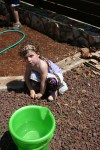
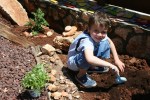
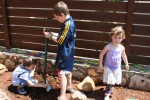
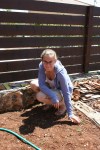
We spent the morning together cleaning our yard, which had gotten frightfully ghetto this winter. Miraculously, everyone pitched a hand. Even my 9 year old, whom we hardly ever see anymore because he spends most of his spare daylight hours running around with his friends.
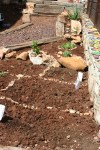
Our hand painted inspirational tiles from last spring didn’t make it through the winter, despite what we thought was a careful choice of paint and sealant. We laid them to rest along the side of our yard to make way for another herb garden and an experimental vegetable garden.
After spending some time together at the small nursery just outside Kfar Manda, we chose which plants to experiment with. With multi-generational love and care, with songs and brachot, with a little bit of mandatory blood, sweat and tears, we planted “Bubbi’s Garden,” in honor and loving memory of Bubbi (Marion Abrams) who would have been 87 years young tomorrow.
May we all only generate joy, love and beauty this spring and in the seasons to come.
This was originally posted as my alter ego, “The Wellness Bitch.” Please take that into consideration as you read it. The WB posts with a slightly different tone. Considering the relevance to my Aliyah experience here in Israel, however, I choose to re-post it, despite the chance that it might incite my friends and alienate my neighbors.
With any luck, though, maybe a few of you will join me in a “Makolet Ban” or an “Anti-Makolet March” or at the very least, one “No Makolet Day” each year.
It’s these moms — the ones who struggle day in and day out to provide their families with their version of “healthy” despite society’s constant roadblocks — that bring me back down off the angry ledge. It’s these fellow moms who struggle as hard as I do; who understand the often daily battles I fight with myself and my kids. The struggle between giving my kids what they want and giving them what I think they need. The struggle between saying yes and saying no. The struggle between choosing to fight a battle and choosing to lose it. The struggle between choosing easy and choosing hard.
I need such a support group desperately here, in my real life community, where I am forced to make choices all the time between what I know is right for my kids and what other moms let their kids get away with.
The makolet is basically a corner grocery store. The Israel equivalent of a NYC bodega. Internally, I like to call it “the kiddie crack house.” Sure, conceptually, it’s nice to know I can run up the hill for a carton of eggs or a package of baking powder, but 99% of the time, it’s the bane of my existence here and representative of something I really can’t stand about Israel: For as advanced as this country is, it is still very far behind in the healthy eating revolution, and in denial that what you feed your kids contributes to their physical and emotional well-being.
Israel's national snack food, bamba
Every day here, it seems, the average Israeli child walks out from his preschool and is taken by the hand to the makolet where the average Israeli parent buys his child the average Israeli after-school snack — namely a popsicle, a chocolate milk, a snack pack of peanut butter puffed corn, yogurt topped with candy or just plain candy.
It’s the Wellness Bitch’s worst nightmare. Can you imagine?
A family "favorite"
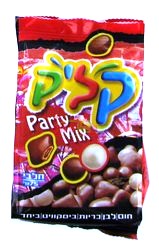
For over a year, I’ve tried to make peace with the makolet. My husband and I have tried various incentive plans to get our kids on board with the idea that we don’t feed them makolet crack every day. These are kids who, up until a year ago, were happy to get candy once a month at a birthday party, and whose daily sweet treats included an organic sandwich cookie or a beet-colored fruit roll up. Now, these kids can be seen walking once a week clutching a bag of “Kliks,” slurping on sour gummy worms, or sucking down a spray bottle filled with the EU version of Red #40.
We’ve tried “Makolet Day,” one day a week when our kids get to pick something from the little store. But one “Makolet Day” a week suddenly turns into three when Saba comes to visit, or when the 3-year-old goes home with a different parent for a playdate and the two kids wind up sucking down “Shock-o,” the chocolate milk drink packaged in sports bottles mechanically engineered for preschoolers’ tiny mouths. “Makolet Day” becomes a way of life here when my kids are treated to a “krembo” by their teachers or tutors or soccer coaches for doing a job well done. “Makolet Day” in not just a day here when it’s piled upon birthday parties and holiday celebrations and kiddushim, for which the focal point is sugary, processed crap masquerading as food.
Yesterday, I lost it because my daughter walked out from preschool with a snack bag full of candy thanks to an in-school birthday party (which they seem to have twice a month here). I told her she could have the birthday candy or “Makolet Day,” not both. She agreed. She proceeded to eat a handful of m-n-m’s and then ran to the makolet to pick out
"Krembo" the Israeli chocolate coconut cream treat
her weekly treat. When I reminded her of our agreement, she had a meltdown. That melt-down turned into a kicking and screaming performance for all my friends and neighbors (Did I imagine the tongues clicking in compassion for my daughter ?)
As I buckled her into her car seat, I screamed out loud in frustration to her and her two brothers, “That is it! No more makolet! I hate the makolet. I hate it so much I am going to come here in the middle of the night and spray graffiti all over the makolet! Do you hear me?? Graffiti!!!!”
Don’t you love days like that? When you are so angry, and yet so defeated, that graffiti is your best threat? (What would I even write? “F-off Makolet?” “Die, Makolet, Die?” And, really, how long would it take before they discovered the English expletives belonged to me?)
Don’t you love it when, in an effort to do right by your kids, you completely do wrong?
Don’t you love it when their meltdowns produce your meltdowns?
Somebody, please hand me a Krembo.
For years, I was luckier than I realized. I had a built-in community and support system in New Jersey. I lived in an educated, middle to upper middle class, health conscious neighborhood. I had a Whole Foods Market ten minutes to the West and one ten minutes to the East. I had a “Holistic Moms” network nearby, five yoga studios to choose from, a “green thumb” and a “wellness” committee at my kids’ schools.
For all that I gained when I moved to a small, country kibbutz in Israel, I lost that wellness-focused community.
And now I have two choices: I can stay angry or I can build…community, that is.
I do both really, really well.
I simply need to choose now, as we all do at some point, which one serves me best.
I recently mentioned to the members of my bi-weekly woman’s group that I think it’s time I start speaking up — getting “my leader on,” so to speak. On the one hand, it’s been nice living in my bubble, the one in which I pretend like I don’t have much of an opinion and don’t have experience leading community efforts for change.
Inside this bubble, I’ve allowed “little Hebrew” to become synonymous for “little voice.”
But the truth is, I have a voice. And it’s loud. And it’s lonely hiding here inside the bubble.
Even though it’s officially more than a year since we made Aliyah, I just now feel as if one full cycle is complete.
My first real memory of our first real family experience here in Israel (one that didn’t involve a government agency) is of Tu B’Shevat.
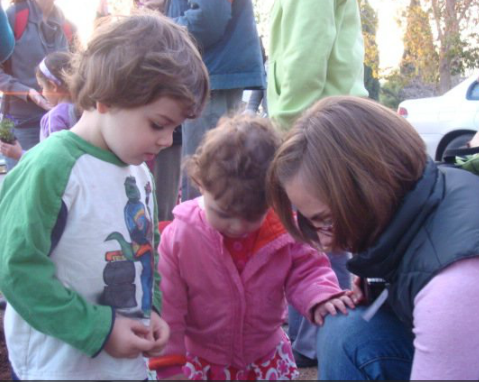
A week or two after we moved into our house on Hannaton, there was a Tu B’Shevat celebration for children that included arts and craft activities, picking up litter around the grounds, and planting new flowers. I look at the few pictures my friend Shira took of my kids and realize how far they, and we, have come since then. How little, and how American, they were then. And how big, and how Israeli, they have become in just one year.
Evidence of this is not just in their ability to speak Hebrew almost fluently, but in their transformation into real Israeli children.
My children dance when there is rain; my children sing with joy that Tu B’shevat has arrived; and they can identify not just dried fruits and nuts, but also leaves and trees by their Hebrew names. (When I compare what I know about our natural habitat to what they know, I am comforted in knowing that if the economy collapses and we need to depend on our local vegetation for food, they’ll know which ones are edible and which ones are poison.)
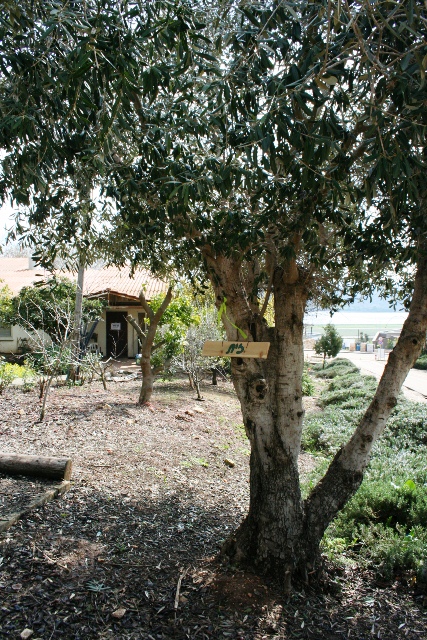
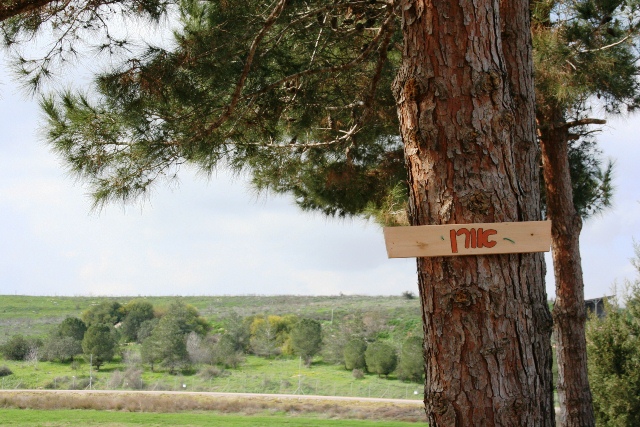
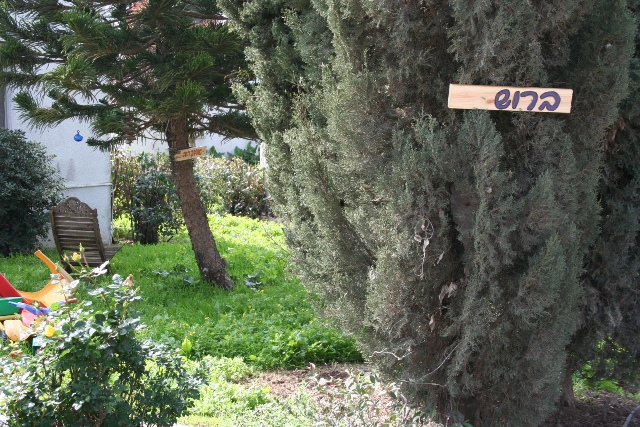
The other day, my middle son was home sick from school, but not sick enough for us not to take advantage of the brief break in the rain and to stroll around Hannaton admiring the blossoming trees and snapping photos of the ones tagged with signs in honor of Tu B’shevat. It was a fun mini scavenger hunt for us, and a brief eco-lesson.
When I think of my experience of Tu B’Shevat growing up in the States, I remember a minor holiday celebrated at Hebrew School. I remember coloring in a line art cartoon drawing of a young Israeli pioneer child standing next to a pine tree and bringing home a certificate marking the planting of one by JNF in Israel.
I admit I get a little bit excited that my children are those pioneer children — minus the vintage overalls and cotton baseball cap. Even though it’s 2012 (and not 1948), my children’s hands are dirtied with Israeli soil, their voices sing with pride, and their hearts are filled with the love of Israeli land.
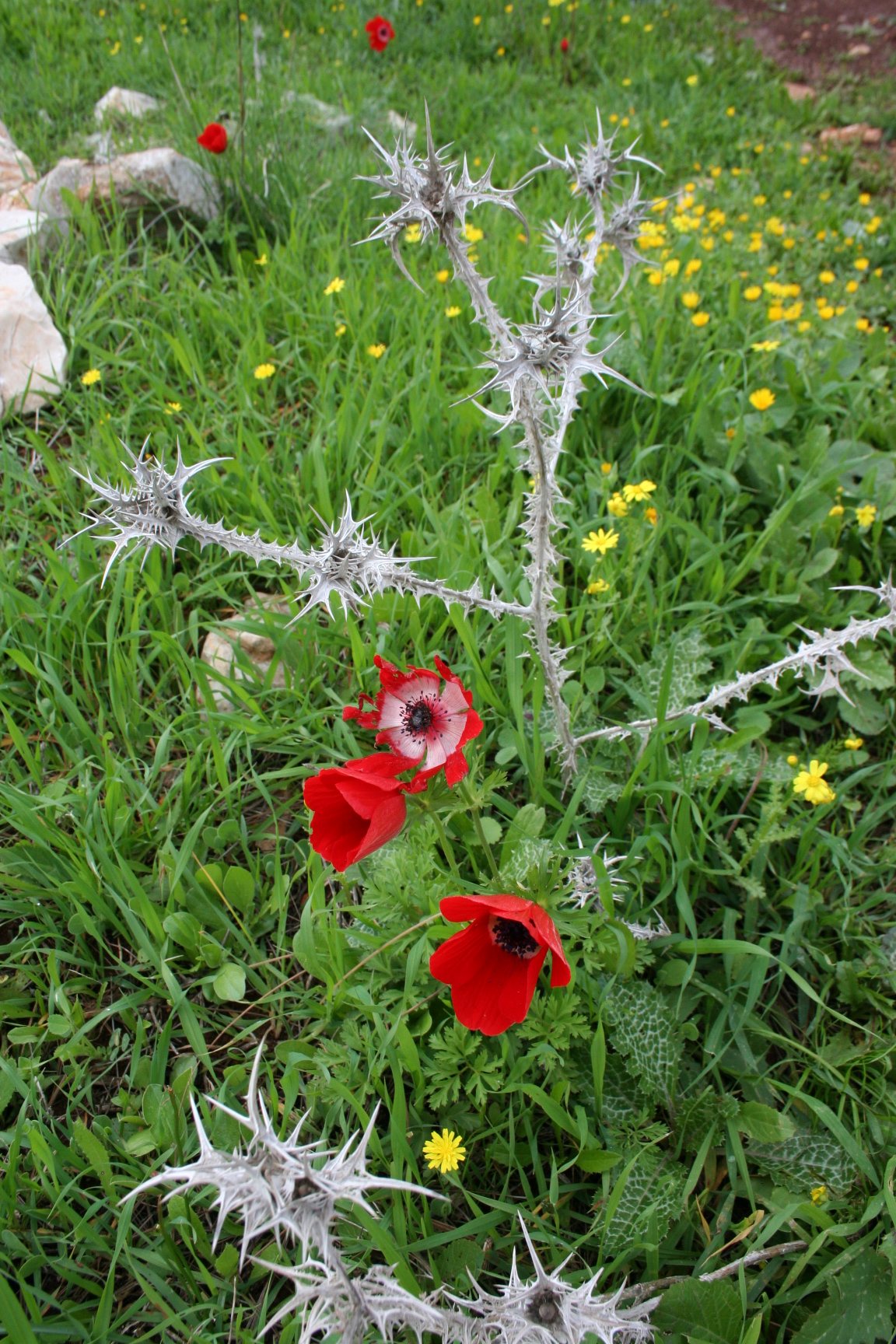
Soon after we made Aliyah in January 2010, my son and I created mini videos for our friends and family back in NJ with our Flip camera. At the time, the kalaniyot were just beginning to bloom here in the North and there is this poignant moment during one of our virtual walking tours of Hannaton where my son, in the middle of some explanation of a particular cultural difference between the U.S. and Israel, stops walking, bends down, gazes at, and then plucks from the ground a beautiful red anemone.
We learned soon after that these flowers are on the endangered list here in Israel, and it’s forbidden to pick them. The kalaniyot (anemones in Hebrew) are so breathtaking it’s no wonder they caught my son’s ever wandering eye, and it’s no wonder they beckon us all to the fields when they start to pop up in January. If you do a Google search for pictures of kalaniyot, you’ll see what I mean.
I’ve been eager to go on a photo expedition myself among the kalaniyot on Hannaton, but I put it off due to sickness and continual bad weather. Finally the rains stopped enough for me to take a quiet Shabbat walk this past weekend to the fields above Hannaton overlooking nearby Kfar Manda and the Eshkol reservoir here in the Lower Galilee.
What I found was, as I expected, overwhelmingly and breathtakingly beautiful.
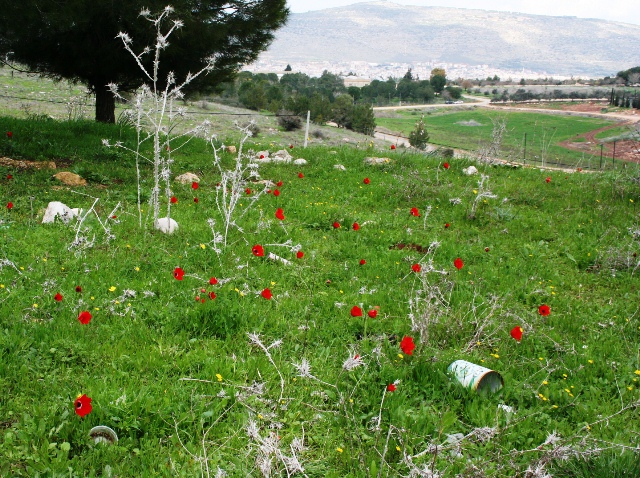
Kalaniyot overlook Hannaton
And, at the same time, heartbreaking.
Kalaniyot amongst the thorns
Heartbreaking how?
Heartbreaking in that as much as we revel in Israel’s beauty, and as much as we fight for ownership of her lands, we fail her.
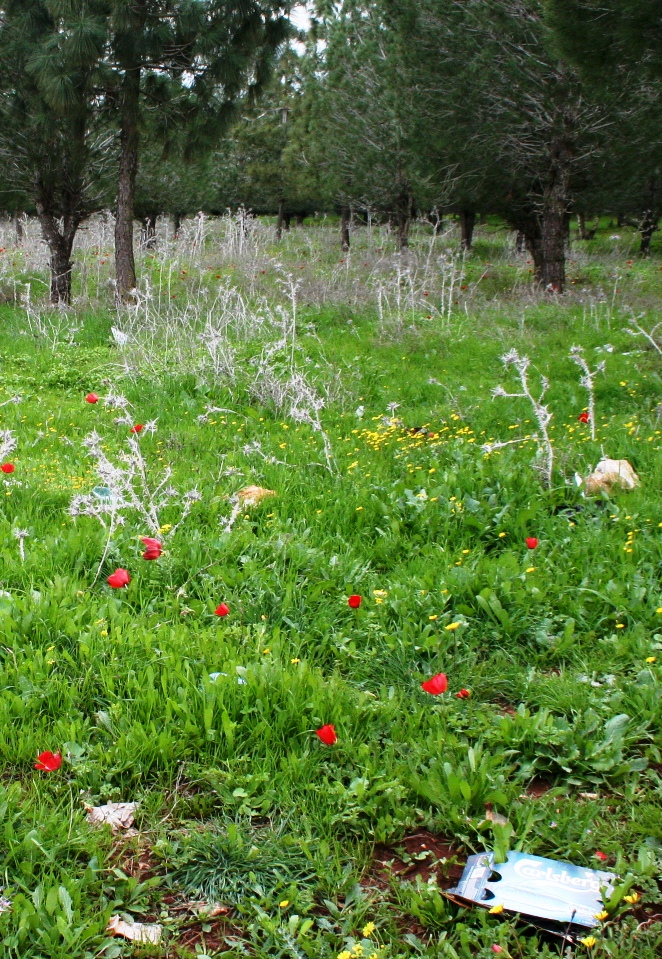
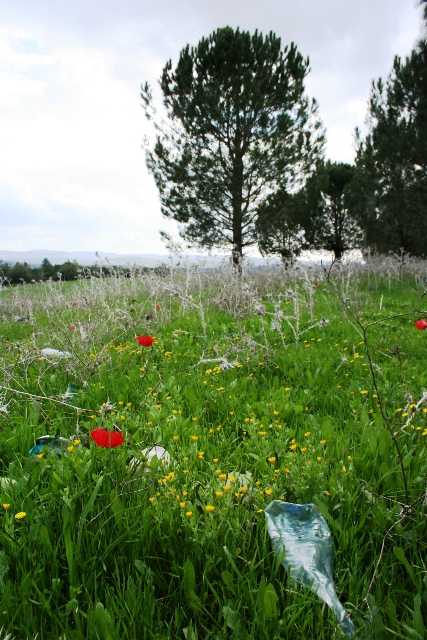
To trash or protect, that is the question
Do you see what I mean? We are prohibited from plucking her beauty, and perhaps rightfully so, in an effort to preserve it. And while efforts to maintain the wildflower population seem to be working, efforts to enforce cleanliness are failing…immensely.
Is this the land we're fighting over?
Garbage litters this beautiful land — from fields to parks to beaches to city streets. When out and about amongst Israel’s unparalleled landscapes, I often feel transported back to 1970s-era America where it was still socially acceptable to toss trash out the window of a moving car or leave your Happy Meal bag in the mall parking lot next to your car instead of carrying it the extra few steps to the trash can. I see the remains of picnics left behind without a thought in our heavily funded Keren Kayemet national parks — picnics from many season ago no doubt. I grimace as I see plastic bottles floating along the rim of the Kinerret. I am ashamed when I bring tourists to a treasured local landmark, and they have to navigate around discarded cigarette packs and broken beer bottles.
It’s a puzzle to me.
Plastic bottles decorate our landscape
How is it that the most contended over real estate on the planet is not cleaner? How is it that our Holy Land is not treated as sacred?
Remains of the Israeli picnic
How are we so disconnected, so unimpacted by this irony?
How is it that we will scream and shout our political battles over borders and boundaries, but we won’t speak up when we see our neighbor litter? How is it that we, as a country, are careful so about Kashrut, but not proactive as individuals in our daily lives with honoring “God’s creation,” our land?
Paint the landscape of the Galilee
When I bring this up among my friends, they often blame our “cousins,” by whom they mean our Arab neighbors. But if that were true, why is there so much trash here on Hannaton? And I don’t mean on the fields just beyond our yishuv gates where our Arab neighbors will often picnic (as will we). But also in the playground our children play in, in our yishuv streets, in our driveways and in our yards? I walked along the beach just outside Haifa a few months ago and it was covered in trash. Again, reminding me of Jersey beaches decades before when we had to be mindful not to walk barefoot on syringes.
Plastic bag dots the green
I don’t imagine our Arab neighbors are coming by with their Bamba bags and dropping them on our Hannaton basketball court. I don’t think our Arab neighbors are sending their dogs over to poop on our playground.
Bamba in the fields
In my work over the past few years educating our communities about holistic health and wellness, I often shied away from calling myself an “environmental activist.” My main intention was always to teach people ways they could prevent illness, in particular chronic illness or cancer, by adjusting their lifestyle and dietary habits. I always noted the secondary benefits of living a less toxic life included “healing our planet.”
But more and more over the years, I’ve come to understand exactly how hand-in-hand these two initiatives are: healing ourselves and healing our planet. They are one and the same. One cannot succeed without the other.
And those of us who yearn for peace in this land — in other words, her healing — must understand that this poor land is ravaged both by emotional and physical pain. And to heal her, we must take a holistic approach. We must understand the unspoken implication of dropping our garbage thoughtlessly onto Israel’s earth, of polluting Israel’s water, of suffocating her with toxic fumes.
What message do we send to her when we treat her this way?
You wouldn’t court a beautiful woman with screams, bloodshed, and empty plastic bottles and bags, would you?
















 and yadda yadda, an aliyah blog