Family, Kibbutz

When the novelty wears off

What to do when the novelty wears off?

This is the question I didn’t realize I have been asking myself all summer.

What happens after you’ve lived in a new country for a full year, a full four seasons? What happens when you’re no longer the hot new family in the neighborhood? The charming foreigners? The intriguing mystery couple in the red rental house?

What happens when the cultural differences are no longer cute? When the adventure takes back seat to the normal every day demands of life?

What happens when you’re life become less about navigating national landmarks and more about homework? Grocery shopping? Haircuts? Conference calls? Birthday parties? Forms? Soccer practice?

What happens when you suddenly realize you live here; and that it’s time you start living here?

What happens then?

What happens is that you get a little depressed. You find yourself frustrated. Then in a funk. Then frustrated again. Then in a funk. Then you spend a few days longing for your old friends; your old neighborhood; your old book club; your old familiar premium natural foods market just down the street. You long for things you hated “back home”: the mall, the post office, the emergency room at the local hospital.

You wonder if you should move back to New Jersey. Back to Arizona. Back to somewhere that has a premium natural food market.

Somewhere that sells kale.

You wonder if you’re really happy at your job.

You consider getting a hair cut. New glasses.

You cry in the shower.

You blog about it.

Then…

something magical happens.

You force yourself to go to a community potluck. You look around and you realize you have friends. Not just one or two. But a few friends.  Women and men you can laugh with. And you know exactly which ones you can laugh with!

You realize you don’t have to hide in the corner anymore talking to the one person who will tolerate your pitiful Hebrew. You realize there are a few conversations you could easily interrupt and join. A few people who would be happy you did. A few people who know the right questions to ask you, and care about your answers. A few people who can even smell the funk on you, and ask, “Is everything okay?”

A few people who want to know the truth.

The truth.

The truth is, when the novelty wears off, you find that the sunset over the reservoir isn’t as AMAZING as it was when you first arrived. You find that the smell from the cow farm isn’t really SO QUAINT and AUTHENTIC.  You find that the FARM FRESH eggs actually come from chickens kept in teeny tiny horribly inhumane coops and that despite living on real live farms raised by real live farmers the chickens are treated so poorly they might as well be raised in factories.

The truth is, you realize you didn’t move to a dream. You didn’t move to a Facebook photo album. You didn’t move to a Lifetime movie for women.

You moved to a life.

And one sign that your new life is good is that when the novelty wears off, you’re able to go to a community potluck…and find a friend… and laugh.

Even if there’s no kale.

Culture, Family

Seducing Fall

You wouldn’t know it from the digits on the thermometer but we’re a few breaths away from Fall.

Evidence mounts, instead, on friends’ Facebook photos and in the mess of backpacks and lunchboxes thrown haphazardly in my hallway.

A new year of school has begun and our second Israeli summer is almost behind us.

I know I’m adjusting to life in Israel because I inhale the faint smells of Fall with desire and relief.  As opposed to how I’ve always associated summer; here, Fall is the season in which we get to play outside and explore.

The summer heat is oppressive, as are the masses at public beaches and parks. In the fall, on the other hand, the weather and the tourists taper off, and the locals get to play a little. Especially with the Jewish High Holidays smack dab in the middle of our transition back into our “regular schedules.” Government and school holidays from Rosh Hashana thru Sukkot provide many of us with a veritable Indian Summer. Mandatory days off from work. An excuse to slack a little.

While I’ve always been a summer lovin’ kinda girl, Israel — and perhaps age –have created a rift between me and my childhood steady, the Summer Sun. I no longer crave his touch as much as I used to, and when we spend too much time together I bristle from it instead.  For the the first time ever, I don’t think I will have a hard time bidding him goodbye.

And with a more mature, but just as selfish abandon, I beckon Fall instead.

Family, Letting Go, Love, Making Friends, Spirituality

The 5 minute answer to world peace? Imagination

Every other week I have the distinct pleasure of partaking in a woman’s group in the community in which I live in Northern Israel. The woman’s group, which was informally started almost a year ago and has grown to a bi-weekly gathering of about 10 – 12 women, has a multi-focused purpose. Mainly the goal is to gather and grow as individuals in an effort to move forward both as people and as community members. We also get the chance to do inner work and get to know our friends and neighbors on a more intimate level.

Most weeks, I’m happy to go.

Some weeks, however, I have PMS…and I am too raw and irritable to handle deep thinking or to listen with care and compassion to other people’s inner struggles.

Often on those nights, I leave the meeting a bit frustrated with my inability to understand the nuances of conversational Hebrew, and/or emotionally drained.

This week, our women’s group meeting fell on a PMS week. As much as I needed a night off from family time, I was worried how women’s group was going to mesh with my hormones

But lovely Linda was facilitating, which eased my concerns some because Linda is an art therapist, and her activities are ones I typically enjoy and move in and out of with ease. They don’t usually release the beast…or require too much Hebrew.

I was right. Her exercise was relaxing — essentially a visualization activity, but the way Linda positioned it to the group was like this:

Take ten minutes to imagine a dream world. A place of your choosing. There are no boundaries; no limitations. What does that world look like? Who are you there? What are you doing?


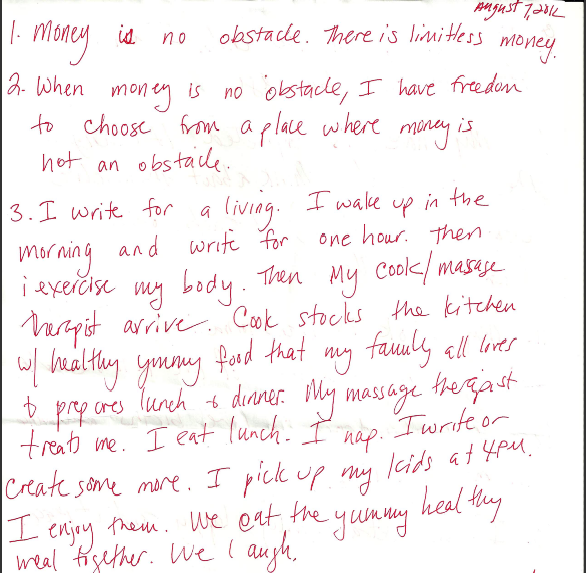
As soon as Linda handed us a sheet of paper and said go, I leapt into action. Without thinking at all, I started writing a sequential list. And this is what it looked like when I finished:

1. Money is no obstacle. There is limitless money.

2. When money is no obstacle, I have freedom to choose from a place where money is not an obstacle.

My handwritten visualization

3. I write for a living. I wake up in the morning and  I make myself an espresso. (I edited this from the original. Espresso is a necessity in my dream world.)

I sit down at a lovely wooden desk with a view and I write for one hour. Then I exercise my body. Then my cook and my massage therapist arrive. My cook stocks the kitchen with healthy, yummy food that my family all loves. She prepares our lunch and dinner. My massage therapist gives me a treatment for about an hour. I eat my healthy yummy lunch…slowly.  I nap.  I write or create some more. I pick up my kids at 4 pm. I enjoy them. We eat a yummy healthy dinner together. We laugh.

4. Once a week (maybe twice) my husband and I go out alone. Sex is sometimes involved.

5. We vacation often, and in luxury.

6. We discover the cure for food allergies and for all cancer.

7. We discover the secret to world peace, too. We implement it.

8. All my previous wrongdoings are forgiven.

9. I clean up all loose ends. I am free of guilt and emotional baggage.

10. I complete my book. It changes the way people think about themselves (for the better). It changes the way people treat each other.

11. My book is transformational. It brings an abundance of love into the world.

12. The abundance brought about by my book brings abundance into my own life.

13. I am extraordinarily happy and at peace.

14. And, most of all, I’ve managed to not mess up my kids or my marriage along the way.

As I completed the exercise, I had an overwhelming, yet unexplainable feeling that the entire kit and kaboodle was actually attainable. From the smallest triumph (write for a living) to the largest (world peace), that somehow the solution was as simple as imagining it.

I know for most people this concept is heresy — that all it takes to solve a problem is to dream up the answer. That all it takes to live the life we imagine, is to imagine it.

I mean, really, if it was as easy as all that, why haven’t we achieved world peace or cured cancer already?

And I see the truth in this way of thinking.

And yet, I see the truth in the accessibility of all I list above.

Really, what are dreams?

Are they involuntary and insignificant images that pop up during sleep? Are they the stories we concoct and ruminate over each day? The visions of the not so distant tomorrow that terrify us? That keep us in unhappy relationships or stressful jobs?

Are these really our dreams?

Or are our dreams the vehicles with which we create our reality?

One could say this visualization practice of mine the other night was no different from the anxious thoughts that keep us from doing what we really want. Except, in this case I let my mind spiral towards all that I want — not all that I am afraid of.

In the past, I’ve daydreamed a wish into reality. I bet you have, too.

My dream to fall in love. My dream to have children. My dream to move to Israel.

Once upon a time, those were dreams written out on a piece of paper — in a journal, or on an application.

And now, those dreams are my reality.

How do we reconcile this truth with the one we sell ourselves everyday? That dreams don’t come true?

Everything, in fact, begins as a dream.

And therefore everything — from personal cook to world peace — is ours for the taking.

Community, Culture, Family, Kibbutz, Letting Go

Speechless

When I was a girl, I was a motor mouth.

How do I know this? Because Ms. Levin, my second grade teacher told me so. Seriously, my nickname in second grade was Motor Mouth, a moniker craftily created by my teacher at the time, who occasionally relented to my excessive hand-raising by saying, “Yes, M.M.?”

As borderline abusive as this practice was, there was some truth in the designation. I talked a lot. All the time, in fact. I talked to my neighbors at my table. I talked to my friends across the room. Often I would mutter to myself. I was a social creature. I still am.

My poor husband, not a social creature by nature, now carries the burden of Ms. Levin. But unfortunately for him, he has not only my incessant chatter to contend with, but also our oldest son’s and daughter’s. They inherited the Motor Mouth gene.

My chatter tends to run over into my writing. I’ve said often in the past that I “write in order to know what I think.” I didn’t make that up. Author Stephen King has said it. Historian Daniel Boorstin is claimed to have said a version of it. I wonder if those guys were motor mouths, too. Probably.

The best part about blogging is that it’s almost acceptable to be a motor mouth. Not so with traditional, published writing. In magazines, books, and newspapers — the kind of publications people still pay money to read on a regular basis — our motoring is required to be more thoughtful and refined. I respect this. I think it’s a sensible, if often boring, practice — carefully choosing your words and paying fastidious detail to grammar and punctuation.

Which is why, when I have a more thoughtful and potentially refined idea for a story, I don’t blog it. I save it.

I have one right now, in fact.

It’s been percolating inside of me for about two weeks, ever since I first started saving books from the recycling bin.

As you know, I live on a kibbutz in northern Israel. It’s a kibbutz that was established about 30 years ago by the Masorti movement in Israel; Masorti being the equivalent of Conservative Judaism in America. Many of the new residents of the kibbutz were from English speaking countries: the U.S., South Africa, England. When they came to Hannaton, they also brought with them their English language books, which presumably went into the communal library once they landed at Hannaton.

Recently, the library at Hannaton, like the kibbutz itself, underwent a huge renewal project. A volunteer committee sorted through the books to determine which ones would remain in the new library and which ones were either duplicates or in an unsuitable condition. There were thousands of books to sort — and since we’re in a Hebrew speaking country, there weren’t many nearby options for donating. The committee decided to put the unsuitable books in the recycling pile.

But, as we know, one person’s trash — or in this case, reusable waste — is another person’s treasure.

And this is how I came to spend a week and a half trash surfing for treasure; embarking on what I call the “Orphaned Book Project.”

When the books were finally hauled away by the recycling truck, I had saved about 30 books and 15 magazines, including Highlights from the 1980s with “Hidden Puzzles” left untouched for my 5 year old to explore; and a Cricket magazine from the year I was born, 1974. I saved a Scholastic paperback from 1981 written by Ann Reit, an author and editor I had the privilege of briefly working with, and who has since passed away from cancer.  I saved a much older Scholastic paperback whose jacket cover previews a young adult fiction story that centers on racial integration in the 1950s.  I saved a few ChildCraft How-to science books that are surprisingly still reasonably current, and a few history books that aren’t, but are still fun for my 9 year old to leaf through over a bowl of cereal in the morning.

There were Hebrew books, too, but I didn’t save any. The only Hebrew language publication I saved was a pamphlet printed by a professor in 1944 that documented all the agricultural settlements and their products up until that time.

On the title page, in English, are written the words:

Printed in Palestine.

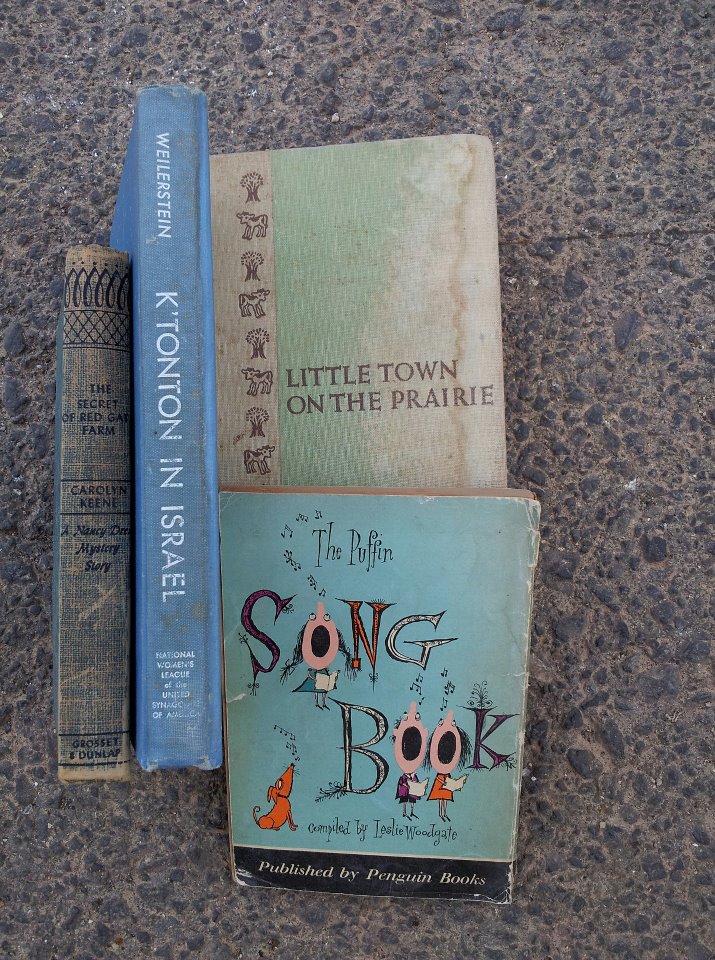
First I saved a couple of original Nancy Drews, and hardcover Little House, and a classic K’Ton Ton, and a kitschy song book
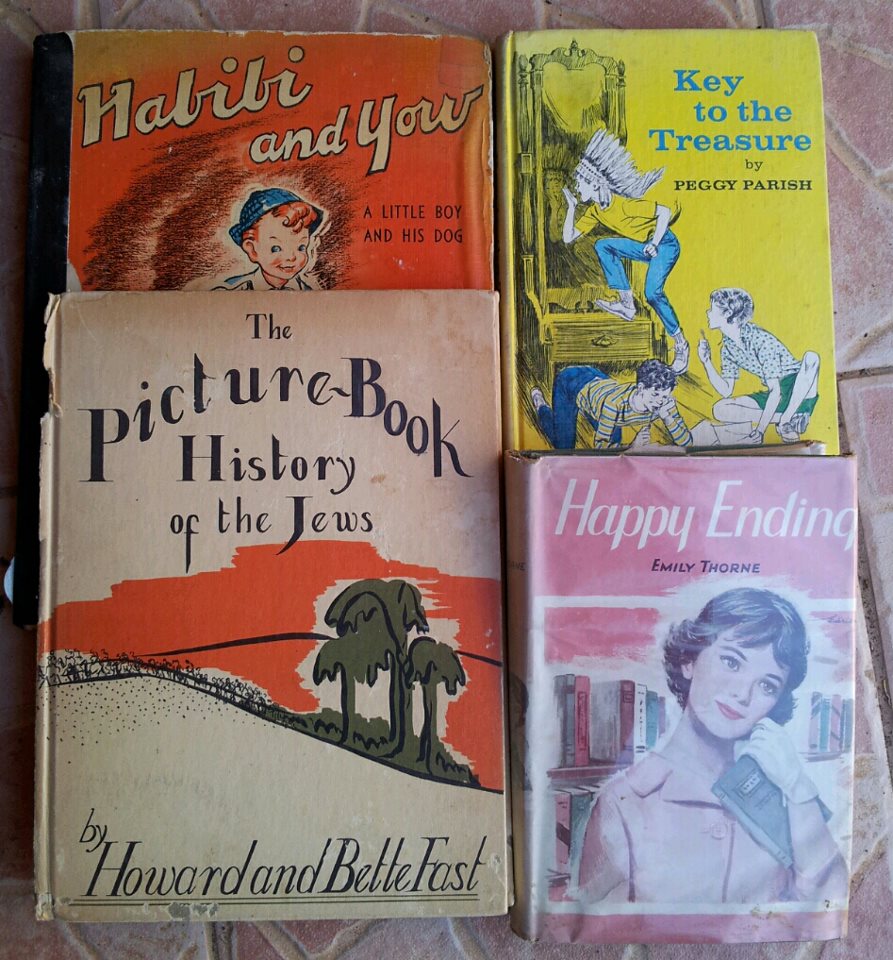
I have no need for more dusty coffee table books, but couldn’t resist this vintage They All Are Jews, a gift to “David” in 1951, after his confirmation. Inside I found a newspaper clipping from when Miss Israel won Miss Universe.
It wasn’t until my final visit that I found the true personal treasure: Peggy Parish’s Key to the Treasure, the last in a middle grade trilogy I loved as a girl and had been collecting
Family, Letting Go

Random mouth running on a Thursday aka blogging

As we all know by now but never admit, there are no original ideas.

So when I think back to the beginning of January 2011 when I got the “brilliant” idea to chronicle my Aliyah experience on a personal blog, I giggle in minor embarrassment.

Did I really think that no one else was already blogging about the culture shock and the emotional upheaval that accompanies moving to a foreign country?

Did I really think I was the first non-observant, mostly secular Jewish mom to move to a kibbutz?

Did I really think I was the only self-described hipster mom observing local moms with a foreign-made lens?

Did I really think I was the only wellness bitch blogging for an English speaking Israeli audience?

There are no original ideas.

When I started blogging about my life in Israel, about motherhood here, and about making friends, it was an exercise in maintaining sanity. Truly, the way I process life’s ever stimulating handouts is through writing.

Sometimes, of course, this practice gets me into trouble. Especially when I want to make and keep friends, or get good grades, or convince people to pay me a high salary.

“Running my mouth off” before thinking — a phrase I used to hear a lot from my mother and my 2nd grade teacher, Ms. Levin, and my 8th grade teacher Mrs. Lingo — isn’t necessarily wise. Luckily, as an immigrant who still can’t carry on a conversation with a 3rd grader, I’m not as much at risk of mouth running as I used to be.

That said, my fingers inevitably find their way to the laptop and my previously diagnosed diarrhea of the mouth expresses itself through the raised cavities of my keyboard.

It’s all part of the ever elusive “process” we writers apparently possess. A process that for me, basically looks like this:

Driving/pooping/singing my daughter to sleep for an hour ==>

Thought ==>

A-ha moment ==>

Aggravating pause in between deciding I want to write and having the time to write ==>

Bitter and ugly resentment at all the people in my life who keep me from writing when I want to write ==>

GRITTED TEETH ==>

Hiding in the bathroom with my laptop pretending to poop ==>

Writing…ahhh ==>

Wishing I had time to edit my post before publishing ==>

Deciding I don’t ==>

Pressing the PUBLISH button anyway ==>

Smiling with pleasure and relief, while simultaneously cringing with concern.

It looks something like this.

Yes, my friends. That is my process.

Maybe if I had a cartoon dog, things would be different.

I could run ideas by him before I wrote them down, before they ever reached another person’s pair of eyes. Before they reached my mother, my husband, my neighbor, my boss.

He could help me identify which ideas were good, and which better belonged in my journal/rant notebook.

He could warn me when I was likely going to piss someone off.

He could surreptitiously serve me cocktails so I do it anyway.

And then he could hug me all the way back to self-assuredness.

In real life, this person is called an editor. But sadly, in the imaginary world that is blogging while working full time and raising children, good editors are rare.

As is ample time to think twice before hitting publish.

[Cut to finger]

Community, Family, Letting Go, Mindfulness, Parenting

Believing your inner rock star

Tonight my son was the student of a lesson I’ve been actively trying to learn all week all my life.

How to keep thinking you’re a rock star when the world hands you proof otherwise.

The setting? My son’s soccer ceremony. The kick in the gut?  Instead of being awarded the “best player” trophy at his soccer ceremony tonight, it was presented to one of his friends.

Props to my kid in that instead of losing his shit like one of the younger kids who screamed and stormed off at the end of the presentations, mine actually held back tears long enough to mutter a mom-forced congratulations to his friend, and pose for a picture with him. But as soon as possible, he grabbed my hand to walk far enough away to break down.

“It’s not fair,” he cried. “Everyone knows I’m the best player! The coach favors H. and everyone knows it! I should have gotten that trophy, not him.”

I nodded sympathetically. Maybe I agreed with him. But even if I didn’t, I couldn’t help but relate to how much it sucks when you know you’ve done something really great and people aren’t recognizing you adequately.

I feel this way at least once a day.

What I found truly amazing, however, as my son was lamenting his coach’s bias is that he never once said:

“I suck at soccer. I’ll never get the trophy.” Or,

“I’m not good enough. If I was, my coach would have given me the trophy!”

Instead, he insisted time and again some version of “It’s not fair. I’m the best. Everyone knows it. I deserved that trophy.”

So why the agony?

What stops us from just believing our inner rock star?

Like my son, I’ve always been moderately confident. And in a chicken or the egg sort of puzzle, I’ve never been able to figure out if I’m confident thanks to my successes or if my success is linked directly to my confidence.   But as confident as I often appear (to myself and others), there’s always a moment when cocksure turns to doubt.

Like my son, I want the trophy. I want the recognition. I want people to understand how great I am and tell me. Over and over and over again.

If the key opinion leaders in my life — the people I’ve deemed smart, successful, funny, cute, sexy, or otherwise worthy of my worship and/or attention — praise me for my work, I’m on cloud 9. “People really get me,” I think.  I have proof I am great.

But if the KOLs don’t agree with my own personal assessment of me (that I’m great/working hard/ trying to be kind), or they don’t shout it out loud, my confidence slowly begins to dissolve.

I like the applause. I like it when people think I’m special.

But is it possible to like it without believing it?

The recognition has clearly become an addiction, and I don’t like being dependent on it. As with any dependency, I suffer when I go through withdrawal. On the other hand, what happens to our greatness when no one notices? Or when someone else sees your greatness as mediocrity at best?

Philosophers, Buddhist monks, and fans of the Matrix still debate whether or not an object exists if someone is not around to perceive it.

How on earth do I evaluate my performance without counting on a grade/raise/applause/pat on the back/book deal?

*     *     *

My son and I both simultaneously live in two different realities. The one in which “I am great and I know it.” And the one in which “I am great and nobody knows it.”

In fact, most of us are constantly perched at the center of a seesaw, one foot on the side of certain and the other on the side of afraid.  It’s up to each of us, in every moment, to choose where to place our weight. This much I know.

But is believing our inner rock star really as simple as deciding to?

Can we simply choose to live the reality in which we are great? Instead of the reality in which we’re waiting for others to notice?

Is it possible to be the rock star without the audience?

Family, Learning Hebrew

Want you come?

Don’t tell me. I don’t want to know.

Okay. Wink your left eye for yes, your right eye for no.

No, wait.

Really. I don’t know want to know. Don’t tell me.

I think I already know, and it’s making me squint and squirm.

Okay, fine. I’ll ask:

Your kids are scared of me, right?

Stop denying it over forced uncomfortable astonishment and laughter. I can see right through you.

Be honest: When I invite your kids over to my house in my broken backwards Hebrew, they’re not just being shy when they hide between your legs and refuse to answer me no matter how sickly sweet I make over my voice. They are trembling with fear. Right?

They’re thinking:

There is no way you can get me to go anywhere with that thing.

They don’t see a kind-hearted, fun-loving lady in front of them – they see stranger danger. Massive stranger danger.  Forked tongue kind of stranger danger.

I might as well live in the abandoned house with the broken shutters.

I might as well be the old Russian lady handing out dusty-wrapped sucking candy at the entrance to the new $1 store.

I might as well be the hungover clown handing out balloons outside Foot Locker.

I might as well be this leperous hag from The Princess Bride.

I told you I didn’t want to know.

It makes me cry a little inside. And laugh a little inside.

Maniacally.

Look, I understand where they’re coming from. I don’t begrudge your kids their worry.

It’s hard enough for an adult, let alone a four year old, to summon up the courage to go to a friend’s house alone, where she will be assaulted by the sounds and smells of someone else’s life.  It’s hard enough for an adult, let alone a four year old, not to know immediately where the cleanest bathroom is or what kind of snacks are in the pantry.

So I understand her resistance to going alone to a stranger’s house where the mommy is a gibberish-speaking freak. Where she can’t be sure if I’ll understand what she’s asking for when she wants to leave or when she wants marshmallows and wafflim…together…as a sandwich…for dinner.

It doesn’t matter if her BFF actually seems to love that gibberish-speaking freak. And sometimes even wants to kiss it. (ich!) Your kid can clearly see how different I am from the other mommies.

Different mommies are scary.

Which is why we hardly ever seem to have playdates at our house.

Not necessarily a bad thing. It means our house is often quiet at 6:30 pm and we can actually attempt a reasonable dinner and bedtime routine – something I long for from the States more than grass-fed beef and Bounty paper towels.  Back in the days when my kids were fed by 5 and in bed by 7, as opposed to falling asleep on the couch while my husband and I try to sneak in an episode of Mad Men.

Every once in a while, however, I do come home from work to find my daughter playing princesses with a friend from preschool. Someone brave who accepted an invitation from my husband, who speaks perfect Hebrew and therefore is presumably a lot less scary.

I’ll put my bags down and move to hug my daughter who is thrilled to see me. Then I’ll notice the little girl hiding behind the couch wearing a pink Sleeping Beauty gown and clip-on earrings. Don’t worry, I say with my eyes, I only eat little boys.

Out loud, however, in my broken Hebrew, in my sugary sweetest voice,  I say to her, “Want you come eat my house?”

Family, Love, Mindfulness, Parenting

Taking a picture in my mind

Back when this little guy was a tad bit younger than he is today, he used to “take pictures with his mind.” He’d put his pointer fingers up to his temples, lean down towards the object he wanted to focus on (typically a kitten or a flower), and snap his eyes shut for a moment. He would soon open his eyes with a satisfied look on his face and later return home to sketch and color what he observed.

A boy with his homemade sun scope, after observing the Transit of Venus in 2012

When I was his age (or a little bit older), I used to call this practice “making memories.”

I read it in a book once.

It sounded romantic. The idea that every moment was an opportunity to make a memory if only we stopped to notice it.

I would sometimes walk home from the bus stop, forcing myself to quit counting steps and skipping over sidewalk cracks, and look around instead at the scene on my street: The sun shining through the oaks and birch trees that lined the sidewalks. The children coloring chalk figures in their driveways. The woman opening and shutting the mailbox.

I’d stop and make a memory.

It was an experiment. Something that made me feel exotic and older. Only now do I realize that this was my first attempt at practicing mindfulness, of being in the present moment.

Now, as a mother, I realize that there is indeed something very romantic about being in the moment, and it’s not the making of the memory. It is the moment itself that is romantic — for it’s the space in which you truly experience love and joy. But, recognizing this in the moment itself is one of the greatest challenges of parenthood.

Oftentimes, instead of embracing the love and joy of being with my child, I get caught up in the awareness that I’m already a memory.

A reflection. A reverberation. A remnant.

And sometimes I panic that I’m not making enough good memories of me. Or that the memory of me will land him on the analyst’s couch or on the streets shooting up.

But this morning, hours after my picture-in-his-mind-taking son woke me up at 3 am to ask “Is it time to watch Venus?,”  I found myself immersed in the 100% pure extract of love that comes only from being in the moment when it happens… and being aware of it.

There was a moment or two when my excitement almost got squashed by the unexpected falling boulders that often overwhelm us — the scope wasn’t working, the clouds were blocking the sun. And it’s a real challenge, to say the least, not to let them completely derail our original intentions.

But then suddenly the sun broke through from the clouds and lined up just as it should through the pinpoint of a dot at the top of the homemade cardboard box viewing scope and I shouted with delight, “There it is!”

There it is.

It is.

Is.

Ecstasy.

Love. Joy.

Right now.

Did we see Venus?

No, not really. But we saw something. And more important, we all felt something. Together. In the moment. Exactly in that moment.

Proving the experiment a success.

Family, Kibbutz

Barefoot kibbutz children make for good photo ops

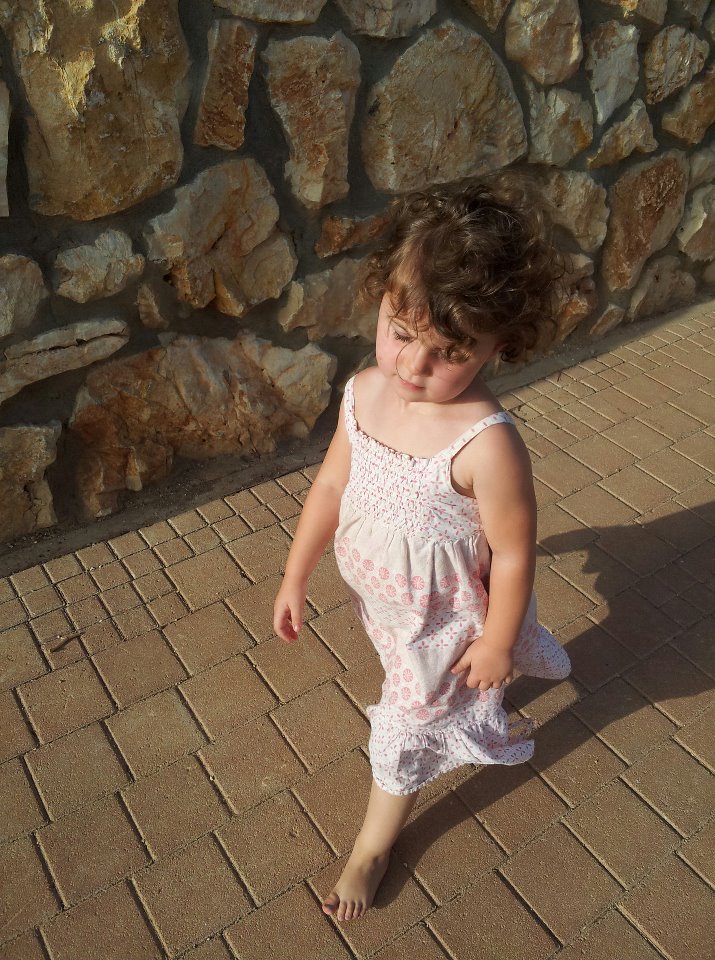
My barefoot daughter walking along the sidewalk of our kibbutz

Ode to Found Love on Kibbutz

Flowers, dirt, and stray cats
Dogs that bark at midnight
The cow-infused downwind from the refet at 4:30 pm…
My children at 4:30 pm…
My husband at 4:30 pm…

Taking the trash out in my pajamas
Dressing up in grownup clothes for Shabbat
Singing Shiru L’adonai

Picking up snails, picking up trash
Picking up friends at the park
Showing up.
Speaking up… when I’m afraid to speak at all.

Finding out someone else is pregnant
Thanking God it’s not me.

Breathing in shnitzel,  shwarma, and secondhand smoke

The beach and the sunset and the Jerusalem stone
And the kibbutz children, my children
Who pepper my pictures with delight.

Culture, Education, Family, Kibbutz

What happens to the boys with flowers in their hair?

I have a theory about Israeli men.

The reason they’re so secure in their masculinity is not due to months of paratrooper training or mandatory military exercises out in the desert.

It’s because, from a very young age, boys are formally taught and encouraged to dance.

And wear leafy crowns.

And carry flowery baskets.

And hold hands.

And revel in the beauty of their own bodies.

Very subtly, the women of Israel (and in modern times, men as well) have taught our male children that moving their bodies in rhythm and wearing beautiful crowns are not signs of femininity. They are expressions of joy.

I was tickled pink the week I accompanied my then four-year-old son to gan when we first made Aliya last year. In addition to the culture shock I got as a mother – kids climbing on top of chairs to build block castles and digging through trash to find treasures in what seemed like a junkyard turned playground out back – I remarked at how integral both singing and dancing were to the preschool program.

Every day, the children would learn a new song, either about the approaching season or an upcoming holiday celebration, and most Fridays, I would arrive at pickup to find my son in the middle of a dance circle, made up only of boys, carrying and waving brightly-colored scarves and stepping in tune to the music.

Not a one stood outside the circle – ashamed to be holding a purple scarf or embarrassed to be moving his body and holding hands with other boys.

Instead, they threw themselves fully into the act – even the ones wearing cargo pants; even the ones who prefer toy trucks to dolls; even the ones who might grow up to be tough guys. They all danced.

Israeli children at gan, Shavuout

And, today, as our community celebrates the harvest festival of Shavuout, the young boys all arrived at school wearing olive crowns and carrying harvest baskets, decorated with white linen and flowers.

As a woman, but particularly as a mother of boys, it’s magnificent to witness – my son and his peers expressing their joy through movement and song without reserve.

But it’s also puzzling. What happens to these boys as they grow up? I wonder. How do they move from dancing to disrespecting and speaking harshly to each other on the soccer field? What happens to these boys who used to hold hands and dance? Who used to wear flowers in their hair and sing songs about the harvest?

I’m still so new in this country. And still so new as a mother, despite almost a decade of parenting.  It’s true, I don’t know yet of the heartache that hardens our sons. The burdens they think they bear. The walls they think they need to put up to protect themselves once they leave the safety of the garden.

I am also still naïve enough, however, to think that there must be something innocent that remains once they leave the gan – something that helps carry our boys through adolescence in a country where men often have to act like “MEN.” Where boys mock each other on the playground and fathers hurl insults at each other from their car windows. Where men, in particular, but all of us need often to operate in a “shuk mentality,” as my husband refers to it. Keep up your guard. Be wary of those who might want to cheat you or steal from you. Yell first, think later.

Something must remain. Something beyond the images the mothers hold dear to their hearts, images of young boys wearing white shirts and flowers in their hair.

It’s been told to me that men grow close to each other during the army. That bonds are formed there. Perhaps, this is true. It’s certainly the obvious answer.

But part of me thinks the bond starts earlier, and then is sidetracked by life. The bonds are built on top of foundations made from purple scarves and olive crowns.

The bonds begin with a dance.

Culture, Family, Food, Parenting

Transforming duty into delight

Every once in a while, someone says to me, “I don’t know how you do it – work full time, parent, and still have the energy to blog.”

I smile bashfully (but secretly pleased), and explain that “writing is not a choice for me.” I’m compulsive. When I get an idea into my head, I can’t move forward until it’s on the page. Writing offers me relief.

Additionally, I’m the lamest mother on earth when it comes to holiday celebrations, which affords me more time to write.

As compulsive as I am, I can’t compel myself to make flowery Shavuot baskets or hand-sew Purim costumes for my kids to show off at school.

Photo credit: J. Whine

I have very mixed feelings about this. I love seeing my daughter wearing the exquisite crown of flowers her grandmother made especially for her preschool celebration. I am so grateful that she gets to feel like a princess because my husband crafted her a breakfast basket filled with carefully prepared dairy delicacies. I just can’t be bothered to make the effort myself.

I’m not lazy. (Note comment above.) I just completely lack holiday spirit; in particular, I loathe school holiday celebrations.

It could have something to do with how much I resent arts & crafts.

I stopped liking arts & crafts in 2nd grade when I realized precision was integral when working with glue and felt. It frustrated me that I was never able to generate in reality the beautiful concept I had envisioned in my mind.  It frustrated me even more when I couldn’t remove the excess felt from my fingertips. Now, even the words “arts and crafts” conjure up only feelings of frustration and inadequacy.

But to blame my resistance solely on the arts and crafts would be bogus.

Bottom line? I’m the Jewish Grinch. There’s nothing about holidays I like.

I know that depending on what we’re commemorating, I’m supposed to feel grateful, blessed, or triumphant. But, mostly I feel obligated, stressed, or depressed. In Israel, holidays usually mean my three children require three different outfits that I have to remember to launder in advance; three different lists of supplies to bring to school – from burekas to bisquits to bisli. And, often three different days on which they’re celebrating!

Holidays mean dancing in front of other adults, a fate worse than death for me. Holidays mean gathering around bonfires singing songs I don’t know the words to. Holidays mean eating foods that I’d otherwise avoid because they give me cramps, or turn my children into demons.

In Israel, like in America, holidays mean vacation for my kids and their teachers, but not always vacation for working parents. So, holidays also mean I need to figure out babysitting for my kids, so my husband and I can work.

I’m a bummer. I’m a buzzkill. I’m a Grinch.

I want to revel. But I can’t. I don’t feel it.

I didn’t revel in American holidays either. It drove me nuts there, too. Sign up lists at Halloween and Thanksgiving – Who would bake the pumpkin pie? Who would bring in the orange frosted cupcakes?

I vaguely remember once upon a time when I used to feel joy for holiday celebrations. The excitement accompanying unexpected Valentine’s Day cards. The joy with which I sang songs at my Hebrew school’s mock Passover Seder.

Where has that joy gone? How can I transform duty back into delight?

= =

There is a moment, I’ll admit it.

There’s a moment when my heart opens. It’s like a wisp of a memory that I can almost touch, but not quite.

It happens when I watch my daughter twirl in her white gown. When I see my five year old son and his classmates dance with glee in front of their beaming parents. When I catch my 9 year old laughing and leaping with his friends from haystack to haystack.

In those moments, I feel my irritability dissolve; my load lighten. I let joy in. I feel relief.

There’s a glimmer of hope then — that next time I’ll be able to enjoy it…not just blog about it.

Culture, Family, Kibbutz, Letting Go, Living in Community, Making Friends

Seeing double

When I first moved to Israel, before I got my full-time job here, I started networking in search of freelance writing work. I had already started writing this blog about my Aliyah experience and had gotten positive feedback from both friends and colleagues. One of my colleagues suggested I reach out to Kveller.com, a new blog for Jewish parents, thinking they would be interested in syndicating this blog or hiring me to write another.

I wrote to the editors at Kveller and pitched my blog idea, confident they would write back to me with a big, fat YES.

Pitch: Fun, snarky Jewish mom leaves the comfort of her chic New Jersey suburb with her husband and three kids to try to make it as a kibbutznik in Northern Israel.

The editors wrote back that they liked my writing style, but that they already had a cool Jewish mom makes Aliyah to kibbutz column.

What?!?

There’s two of us?

Well, apparently there are. At least two of us.

The editors forwarded me Sarah’s blog post about moving to Israel, and I thought to myself, “Hmm. I guess I’m not so unique after all.” Sarah’s writing reminded me of my own, a blend I like to consider “tell-it-like-it-is honesty infused with snarky vulnerability.”

Figuring out that someone else had already pitched my idea and got the gig before me was a tiny blow to the ego, I’ll admit. Nonetheless, I secretly smiled knowing there was another Jen-like new olah mom out there.

So it was little surprise to me to see it was Sarah who wrote the article that popped up today on my Facebook news feed from The Times of Israel called, My Israel: A Land of Spoiled Milk and Honey.

The first half of the article was like reading the California Girl version of my life, or at least an alterno-verse version of the summer I first visited Israel in 1992.

I laughed at Sarah’s recollections of her first visit to the Kotel which were “spiritual” and “meaningful” and “fucking awesome.”  And I smiled knowingly at what she recalled as her passionate statement to the Israeli passport control worker promising that “one day she would return.”

I remember being that passionate girl. I remember being madly in love with an Israeli soldier. Um, I mean, Israel.

I could also relate to her experience of missing that connection to Judaism once she returned to the States. It happened to me, too. And I spent years trying unsuccessfully to recreate it while living in America.

But what I couldn’t fully relate to in Sarah’s post were her expectations that moving to Israel would somehow be a seemless transition into Israeli life and culture.  I didn’t share the expectation that being a Jew in a Jewish land would naturally translate into being understood or loved or accepted by your friends and neighbors. In fact, I was really worried that no one here would get me. That our family would not fit in. That I would never feel like this was my home.

In fact, the one thing that drives me nuts about the “Aliyah Movement” is the idea that American Jews moving to Israel are, in fact, “coming home.”

That sentiment, when I am at my ugliest, makes me want to vomit. When I am feeling kind, it simply bewilders me.

This “Coming Home” slogan is plastered all over the Nefesh B’Nefesh marketing materials. It’s the titles of videos on YouTube. It’s written in permanent marker on poster board and embroidered onto hats.  And all the time I think to myself, “Is it true? Are you? Do you?”

For a little while, the fact that I didn’t feel that way made me feel like a fraud, like an imitation oleh. Like the fake tofu version of a new oleh.

Where was the meat?

Did I really deserve this Aliyah if I wasn’t 100% sure Israel was my home? That this decision was the right one? That I would be happy here? That I would stay?

In the 16 months since I made Aliyah, I have come a long way.  In the 16 months since my Aliyah, I have worked hard to make this country my home. I have worked hard to learn the language; to make friends; to take on challenges that scare me; and to be tolerant and even accepting of cultural difference that are so offensive to me that I want to jump on the next plane back to Newark Liberty International.

For instance, I have learned that I can both hate the Israeli woman up my ass in the line at the pharmacy and at the same time admire her for being ambitious and bold. I can both cringe at the reckless abandon of Israeli parents when it comes to their child’s safety; and at the same time, smile with pride at the independence my children have acquired since figuring out that falling 5 feet from the top of the jungle gym onto concrete really, really hurts. I can scream at the dogs who run off their leashes; and quietly be happy they’re around to bark at the would-be robbers.

I have learned to love and accept this country, and my community. And I still reserve the right to complain about her.

If that’s not home, what is?

The real problem lies not with Israel. Nor does it lie with immigrants who are constantly comparing their new home to their old one. And certainly, the  solution is not, as some of the commenters on Sarah’s post would have one believe, “If you don’t like it, then leave.”

If anything, what we new immigrants need is compassion. Compassion from our neighbors, both the Israelis and the olim who have figured it out already.

And compassion for ourselves, as it takes a lot more than a slogan or a birthright to feel at home.