Health, Love, Mindfulness, Relationships, Spirituality

Unconventional workout

I started running.

Yup.

I’m a runner.

A short-distance, short-time runner.

For almost a month, I have been running for 15 minutes every day except for Shabbat.

That’s it. 15 minutes.

And it works. I finally found an exercise regimen that works.

For now.

Maybe it’s not enough for everyone, but it’s enough for me.

For now.

I’ve also committed to writing more.

Tiny tidbits here and there.

A blog or the start of a new short story or a poem for fun spurred by a random writing prompt.

I find, the more I write, the more I write.

And the better I feel.

So between the running and the writing, my physical and emotional health seems to be on the up and up.

I know because my hormones say so.

They say so by being quiet when they are normally loud.

Quiet hormones. Quiet head.

Ahh….

But I think I could add a third element to my personalized workout:

Gratitude.

Gratitude, as we know, is such an energy boost. It’s a life lifter.

When we feel gratitude — the day after a violent stomach bug, or the minute after you avoided a tragedy or danger, or simple moments of love between you and your spouse or your child or your cat — we love life.

In the very moment we feel gratitude, we love life.

And loving life is all any of us ever want. It’s why we exercise. It’s why we write.

It’s why we exist at all — to love life.

So, I’m going to try to add 15 minutes of gratitude to my daily workout regimen.

If it’s that easy to love life, why wouldn’t I?

Want to join me?

Food allergies, Health

Ode to Nut-free Desserts (an allergic Israeli kid’s lament)

ode to nut free desserts

It’s not easy being a kid with nut allergies in Israel. Israelis love love love their nuts. It’s impossible (and I stand by that extreme) to find a baked good without them.

Food, Food allergies, Health

Israel creamed me

For three years before I moved to Israel, I was dairy free.

And not just, “No thank you, I won’t have extra parmesan on top of my fettuccine alfredo” dairy free.

I was hard core, no dairy, no way, not even a lick from the spoon after making my kids Mac and Cheese, dairy free.

Why?

Because I realized about a decade ago the connection between what I ate and how I felt, both physically and emotionally.

On top of that, my kids were all diagnosed with food allergies and our home became food-focused and poop-focused.

(There’s a lot you can tell about your health by being poop-focused, don’t ya know? Good poop. Good times.)

The best I ever felt in my entire life — physically and emotionally– was when I was dairy free, wheat free and sugar free.

I carried on like this for a good year or so. And despite the inconvenience to my family and my book club, I felt AMAZING.

Practically everything I ever thought was going to kill me one day (stomach pain, gas, anxiety, asthma, eczema, migraines) practically up and disappeared when I stopped eating those foods.

Since moving to Israel, however, I no longer cut the cheese.

The cheese cuts me.

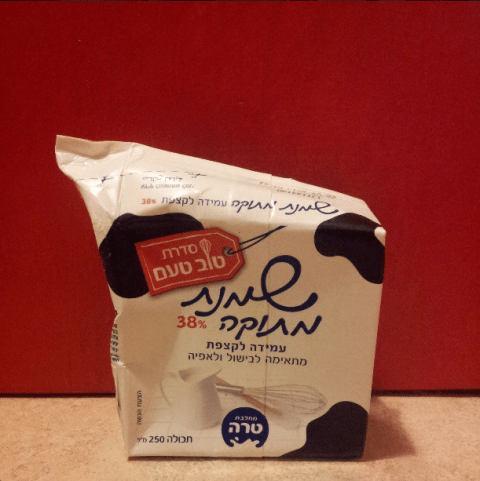
cream

I tried to stay away from it. And succeeded for a while.

Until Shavuout.

Damn you, Shavuout.

Shavuout 2011 was my downfall.

Quiche, lasagna, blintzes, cheesecake, chocolate mousse.

After that, I totally I cheesed out.

Started with goat cheese. I was one of those girls who was all like “I’m so totally healthy because, like, I only eat organic, locally-grown Feta now.”

But cheese is cheese.

For me, at least.

Before long, Feta became mozzarella became butter became sour cream became homemade whipped cream three times a week became

OUT OF CONTROL.

And I am pretty sure my body has suffered because of it.

True, I’m getting old. And true, I live on a kibbutz — home to every environmental allergen imaginable.

But I have to believe that the dairy (and the sugar!) are playing a big role in how downhill my physical health seems to have gone in the past two years. (I’ll spare you the details.)

So, in honor of Shavuout this year, in honor of the dietary laws passed down from generation to generation, I am pledging to not pass anything this year. Nothing foul at least.

I’m giving up dairy again.

It won’t be easy. I’ve grown really fond of homemade whipped cream.

And this guy.

goat cheese guy

* * * *

(Follow my last hurrah on Instagram )

Climate Changes, Community, Environment, Food, Health, Mindfulness, Politics

Environment is not a dirty word (and being green doesn’t mean being perfect)

There’s a story I’ve shared quite a few times over the past six years since I became an accidental activist for holistic health and conscious living.

The story goes like this: I used to roll my eyes at environmentalists.

I used to snore that obnoxious snore that one inhales at the back of one’s throat when one thinks that someone else is holier than thou … naive … peace loving … do-gooding…world saving.

I was like, “Give it up, poser.”

And then one day I became the person other people roll their eyes at.

Oops.

It happened sometime in 2010.

After denying for years I was an earth loving, peace seeking hippie, I realized that all the efforts I had made to be healthy; to protect my kids from toxins in their food and surroundings; to connect people to wellness practitioners that allowed them to avoid a life spent on medication  — all those things — also helped the Earth.

And what did I understand soon after that?

If there was no Earth for my children to live on, it wouldn’t matter how organic, how natural, how toxin-free they were.

They’d be homeless.

And just like that I was an environmentalist.

Not the kind of environmentalist that saves otters or spends two years in a treehouse in the Amazon.

Just a simple environmentalist:

One that stops and thinks before she buys something; before she throws something away.

One that reads food labels.

One that brings an extra plastic bag on a picnic for trash — and then feels a little guilty she has a plastic bag in her possession to begin with.

jen pick up trash

One that teaches her kids that killing ants is cruel and eating animals is something I wrestle with.

I find that many people think that being green means being totally and completely careful and sure about every single thing you do, eat, buy. As if going green means going whole hog, vegan, hemp-wearing, off-the-grid hippie.

It doesn’t.

Truth telling time:

My kids own plastic toys.

Sometimes I throw them in the trash.

My community doesn’t recycle glass.

Sometimes I pack the glass bottles up in bags with the intention of taking them over to the next community for recycling.

Weeks go by. I throw the glass bottles in the trash instead.

I eat non-organic food.

Sometimes that non-organic food is called McDonald’s.

I like long, hot showers.

And sometimes I take them — in spite of the fact I live in a country where water is a luxury.

I don’t like dogs.

Sometimes I fantasize about kicking dogs. (I don’t kick them, but not because I like them).

I am human. But at the same time, I am a thinker.

I am someone who thinks green… by default, at first. And now, on purpose.

I think; therefore, I am.

I am someone who acts green.

Not because it’s politically correct or trendy.

And not because I think that my one or two or ten choices will mean that there will be a planet for my children to live on in 20 years.

In fact, some days I find myself banking on Mars.

Some days I think we’re all just f-ing doomed.

I am an environmentalist because once I started thinking, I realized it was impossible for me to be anything but…

an environmentalist.

Climate Changes, Education, Environment, Family, Food, Health

What matters to me most

What matters to me most in life and politics is what’s closest to my heart. It’s related directly to my own personal experience.

Isn’t that true for everyone?

And, perhaps, why I haven’t connected to the elections in Israel is because what matters most to me doesn’t matter to most of the people voting in this election. Or most of the people that live in Israel.

But what I still don’t get is why?

In between fighting wars, and between reading the newspaper in the morning and watching the news at night, don’t we all need/want to live healthy lives?

Don’t my neighbors, friends, relatives understand that nothing else matters once your health is poor?

Taxes won’t matter.

Housing prices won’t matter.

Military duty won’t matter.

Statehood won’t matter.

Once a health crisis takes over, little else matters.

And each and every one of us are in some stage of a health crisis right now.

Many of us are only days, weeks, years away from cancer due to chemicals in our food and self care products.

Many of our children are only days, weeks, years away from debilitating asthma due to air pollution.

Many of our grandchildren are…

Many of our grandchildren are…

Many of our grandchildren are…

an impossibility

due to rising infertility rates … climate change … drought…. famine…diminishing resources on our planet.

Vote what matters.

Policy wordle

Culture, Family, Food allergies, Health

Peanut-flavored twist of fate, or a miracle?

I’m writing this while it’s still very fresh.

Because I feel like I need to process it all.

Earlier this week I was engaged in a heated discussion in the comments section of a fellow blogger and fellow mom of food allergic kids about how Israel doesn’t take food allergies seriously.

Earlier this morning, I blogged about how frustrated I feel with the Israel medical care system.

And then, like a freak thunderstorm that knocks down the tree that just misses your house, the Universe decided it wanted to tell me something.

I think. Or else it’s all a very very strange coincidence.

Around lunch time, I got a call from my husband. He was on his way home with the boys from school. The 9 year old had just thrown up all over the car. My husband then told me that my son had eaten a candy at school and started feeling sick after. He was afraid it had nuts in it.

But he wasn’t sure. My son hadn’t read the ingredients.

Our smart son; our careful son; the one who has had now 7 years of experience living with food allergies… he slipped up.

Of course, one can understand. It was a sucking candy. Not a chocolate bar. Not a cake or a cookie or a brownie. An orange-flavored hard candy. At least that’s what it looked like and even tasted like to him.

In all our years of reading ingredients, we have never once ever come upon a hard sucking candy with nuts in it (save for coconut oil, which he is not allergic to.)

I think he got complacent. And, like any 9 year old boy, careless.

Maybe we got complacent. We stopped nudging him.

Either way, today, after years of wondering what it would be like to look anaphylaxis  in the face, I did. Smack dab.

This wasn’t my son’s first allergic reaction. He’s had three reactions in the past — one last Spring even to a new food he wasn’t allergic to in the past — but all have been treated  successfully with Benadryl, an antihistamine. It’s the first course of treatment according to our allergists, unless his lips swell or he can’t breathe.

Today, his lips weren’t swollen and he could still breathe, but yet, he was not right. I could tell. Kinda. But not for certain.

As soon as he got home, I could see he was pale. He also couldn’t breathe from his nose. And while he could still breathe from his mouth, his throat hurt and his voice sounded like he had something stuck in there.

I wasn’t quite sure he “needed” the epipen. But I held on to it as I evaluated him. I looked in his throat. It looked swollen.

I had just given myself the epipen a few months before for what I had thought was allergy but turned out to be food poisoning. At the time, I told myself, “It was good you did. Now you know it doesn’t really hurt. Now you will really give it to the kids if they need it and not worry about it hurting.” (Ask any parent of kids with food allergies and most will tell you they worry about having to give the epipen to their kid. “I don’t want to give him the shot. It will hurt.”)

I looked at my son and asked, “Do you feel I should give you the epipen?”

He was scared. He hesitated. He didn’t say, No. But he couldn’t say, Yes.

I said yes for him.

I reminded him that it wouldn’t hurt. It would help.

He was brave. Very brave, as I stuck the epipen in his thigh.

Thank goodness, I did. Later, after we took him to the doctor; after the doctor checked his vitals; after he gave him steroids as a follow up treatment; he told us, we did the right thing.

And it was only after that, my husband pulled out one of the wrapped candies the teacher had given us to show us what he ate. Another child had handed them out during recess when the teacher wasn’t there.

The candy said Praline on the wrapper.

Pralines are not nuts, themselves. They are a nut-flavored candy or cookie.  It wasn’t part of our vocabulary … the one we’ve always used when training him on what to do around food. My son didn’t know what a praline was. Because it’s a nut candy, he’s never eaten it. Also, it’s not something children generally eat in anywhere in America I’ve ever been (except Georgia, now that I think about it). My son has never seen anything like that.

Of course, if he had read the ingredients written in teeny tiny crumpled up type on the wrapper, he would have seen the word “peanut.” We did.

I can’t be angry at my son. I am too thankful right now he is alive.

I am thankful he trusted his body and got help right away.

I’m thankful that his teacher called us immediately as soon as she heard he had eaten the candy.

I’m thankful my husband happened to be nearby with the car and could get him from school.

I’m thankful I had the courage to give him the epipen even though I wasn’t sure he “needed” it.

I’m thankful there was a clinic open to see my child (even though the first two ones we called were closed and no one available to answer the phones).

I’m thankful we had friends around to help us with our other kids.

I’m thankful traffic on the one lane road to the clinic wasn’t extraordinarily slow as it often can be.

I’m thankful the doctor on call at the clinic happened to be our pediatrician, who knew us, and who we felt comfortable with.

I’m happy he took us seriously. I’m happy the nurse and the receptionist at the clinic also took us very seriously. I’m happy the teacher (who called us later to check on him and express her concern) and the children in my son’s class all took it seriously.

Of course, I am most thankful he is sitting next to me right now bugging me to get off the computer and get him a popsicle.

He is ok.

He is ok.

And, perhaps, there are Israelis who take food allergies seriously.

After today, I imagine some of them will likely take them more seriously than they did before.

I’m not suggesting the turn of events was all the work of something supernatural or magical. Or that someone or something was really trying to send me a message.

(They do take it seriously.)

(He is in safe hands.)

(You will know what to do.)

(He will be okay.)

But, one way or another?

Message received.

Health, Learning Hebrew

Olah’s Lament: Health Care in Hebrew

Universal Health Care is not all Peaches and Herb, as I once thought.

(And yes, by Peaches and Herb, I mean peaches and cream.  But ever since I accidentally once said “peaches and herb” (with a soft h) when I really meant peaches and cream, I am compelled to use the much sillier Peaches & Herb. It’ll catch on, you’ll see.)

Back to Universal Health Care.

Why am I title capping Universal Health Care: it’s not a proper noun.

And yet people speak of it as if they know it intimately. As if it’s a person or a place that requires commitment to or vehemence against. As if it requires an I.D. bracelet.

Since, in general, I tend to be non-committal or centrist when it comes to most heated political issues, I typically spoke in the past of universal health care in lower case.

Until I moved to Israel.

Because now, being in the system (as opposed to just daydreaming about it), I have stronger opinions.

Now, all of a sudden Universal Health Care is title capped. It’s personal.

When I first moved to Israel, I loved that I could go to the doctor whenever I wanted (or so I thought). I could get bloodwork done, a strep test, and an anti-fungal cream all in the same place, and pay practically nothing. No co-pays for visits. Pills cheap like candy. And all because I had a little card with my name in Hebrew and my new Israeli ID number.

Universal Health Care, you the Man! I thought.

Why is everyone up in arms about this concept? Who wouldn’t want doctors at the ready? Prescriptions for 5 bucks a pop?

Now, two years later and nine months into a mystery health condition to which I can’t seem to get anyone to pay attention, I’m a little less enamored with the concept that once seemed simple.

Of course,  lack of personal attention is not a problem unique to Universal Health Care, you might say. We also have this problem in the United States, where health care is privatized.

True. We do.

But, in the States I managed to find a few doctors within my insurance program who gave me a certain level of specialized attention. It was attainable, if not a little challenging.

But here, I feel very much as if I can’t find anyone in the system to care. Like, no matter how hard I tried, I wouldn’t be able to find a doctor who would see me through this condition until we figured out what it is and what to do about it.

Don’t worry about me. I’m not dying.

But if I was, I wouldn’t know it. Because no one will give me an answer! They just keep passing me on to someone else who is “more specialized” than they are.

My next visit (4 doctors and two ultrasounds since the first visit) is supposed to be to a “general surgeon.”

Can anyone tell me what that guy does?

How does he know more than the “general practitioner?”

Or the “woman’s doctor?”

Or the “woman’s doctor surgeon?”

The Hebrew word for surgeon SEEMS to be used interchangeably with specialist. Which is just as confusing if not more than the fact that the Hebrew word for infection (daleket) is the same as the Hebrew word for inflammation

Infection and inflammation are TWO VERY DIFFERENT diagnoses!

Just as different as surgeon and specialist…at least where I come from.

The surgeons here are apparently the only doctors in Israel that learn a specialty. Which, if taken literally, is really upsetting to me as someone who likes to avoid invasive procedures.

Worse, the surgeons are super-specialized to the point that if your problem falls just outside the boundaries of the region they are specialized in, they give you the “Ain Ma La’asot” shrug of the shoulder and send you off to the next guy. Who, of course, doesn’t have an open appointment until 6 weeks from Wednesday.

6 weeks from Wednesday at 8:10 pm.

(By the way, no one — not the hottest super model; not the youngest, most peaches and herby looking man or woman — looks good doing the “Ain Ma La’asot shrug.” If we don’t give this cultural expression/body language up simply because it’s defeatist and obnoxious; we should give it up because we look ugly doing it.)

The funny thing about Universal Health Care in Israel is that everyone here is happy they have it, but if they want someone to take them seriously, they see a private doctor.

By which I mean specialist.

By which I mean surgeon.

By which I mean general surgeon … 6 weeks from Wednesday.

It’s possible this is all one big misunderstanding.

That there is some secret I don’t know because I’m new here. Or there’s some magical expression I need to say in Hebrew when I call *2700, the hotline for my kupah.

It could very well be one big misunderstanding.

Especially, since there’s no “manual of services” available in English when you join the Universal Health Care system in Israel. Not even if you pay extra to be in “Mooshlam,” the upgraded platinum level of service. Which, as Americans pre-conditioned to be terrified of socialized medicine, we all buy into.

Yes, it could just be yet again one big misunderstanding.

My recommendation to Nefesh B’Nefesh in 2013, in light of the damning article and follow up posts about them in Ha’aretz this week?

Work with the kupat holim on an American-friendly semi-private health care system. A happy hybrid between Private and Universal. Something to please the centrists — those of us who prefer our health care systems to be lower capped, as long as they work in our favor.

Health, Kibbutz, Spirituality, War

Relevance

I just added a new category to my blog:

War.

I hesitated before I clicked.

I’m a superstitious kind of girl, for one. And, two, I do think our thoughts impact our reality.

If I add a war category to my blog, how does that impact my reality?

Call it what you want: law of attraction; positive thinking; pessimism; subjectivity. I’m someone who believes that we see the world the way we see it.  The world is interpreted by us. And every time we put an idea or an action into the world, we receive an idea and action in kind.

If we want our world to be different, we need to start thinking and acting differently.

If I want a world without war, what happens to that desire when I start blogging about war?

*   *   *   *

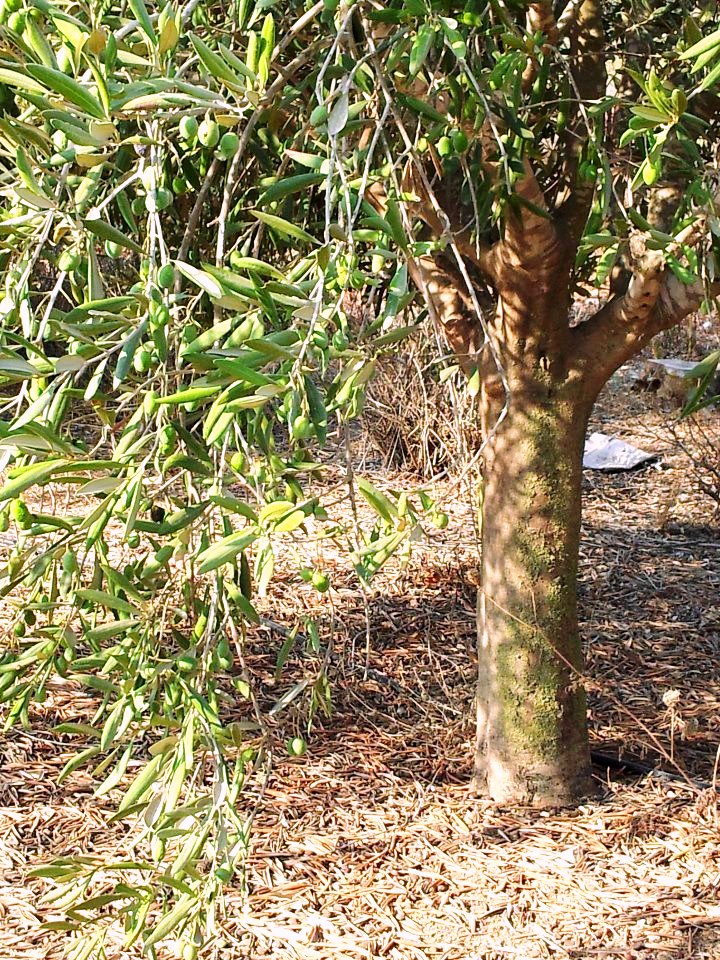
This morning, on my drive to work, I spotted a blossoming olive tree on the main road in the kibbutz. It made me so happy to see the baby green olives peppering the branches. On a macro level, it reminded me of what makes me happy about living on a kibbutz in Northern Israel. On a micro level, it reminded me that this August heat is half way out the door and autumn is just around the corner.

I snapped a photo of tree  and shared it on Facebook. I wanted my joy to spread. Spreading joy makes the world appear joyous.

I think it worked, at least a little. I smiled as I left Hannaton and turned left to drive towards Misgav.

Each weekday morning, I pass by Kfar Manda, the Arab village next door to ours. And every morning it’s a stark contrast of how we in Hannaton see the world differently from the people in Kfar Manda.

Of course, I can only guess that we see the world differently: Arab Israelis living in a mini city and Jewish Israelis living in a small kibbutz. I don’t have any friends from Kfar Manda so I have no one to interview and discuss this with.

Today, as I drove by Kfar Manda and held on to the joy that began with an olive tree, I saw smoke coming up from above the Western, residential side of the city. I felt my joy dissipate.

When I rounded the curve and passed the main entrance to the city, I saw the source of the smoke.

I couldn’t tell from my car if it was one of the trash fires I often see or smell burning in Kfar Manda. (A trash fire is exactly that –> burning trash.) Or if it was  intentionally set for an agricultural reason, since the fire was on the edge of a vegetable field. How an intentional fire serves any of us in this dry, scorching hot month of August is beyond me.

In any event, there was no one nearby trying to put out the fire. It just burned. And the smoke seeped into my nostrils as I rolled the car window down to take a picture of it.

And my joy disappeared.

My world was no longer olive blossoms. My world was fires burning at the edge of a beautiful field.

Culture, Family, Health, Middle East Conflict, Politics

Ob-la-di

As I was getting my kids into the bath last night, I heard a helicopter fly by close over our house. And I didn’t jump or startle.

I must be getting used to Israel.

When we first moved here, I jumped at every little sound: Not just the military helicopters flying by, but any loud booming noise; of which there are many in rural Northern Israel. Sometimes the sound comes from a digger breaking ground on a new lot; sometimes it’s an invisible jet soaring by, leaving a sonic boom in its wake and shaking the windows “The Right Stuff” style. Sometimes it’s just a tractor trailer driving by on its way to deliver petrol or chickens.

When we first moved here, I did a lot of pretending. Pretending like I didn’t worry about terrorist attacks or war. It wasn’t strategic or intentional pretending, mind you, and I was never actively scared to live here. It was the kind of pretending young women do when they choose to walk home by themselves from the club on Avenue A at one o’clock in the morning. You know that it’s both unlikely and yet still possible that you will get raped or mugged. But you have calculated the odds manually in your head, and counted the spare change in your wallet, and decided that walking home is your best bet.

Israel seemed like a good bet for us, despite the possibilities of terrorism or war.

But still, before I got a job, I was home a lot during the day…and jumpy. One day, a small propeller plane flew so close to my house I could see the pilot’s face. He flew across my street and back again. I tried to keep my panic in check for a few minutes as I carefully observed his flight pattern, but after about 5 flybys, I frantically called my friend Shira, who lived down the street, and who was already by that time a veteran olah. When she didn’t answer the phone, I ran down the street in my flip flops, covering my head with my hands, hoping to avoid the spray of bullets or heavy metal things he might drop out the window of his plane.

“Do you see that plane flying by?” I shouted to her before she opened the front door. She said she saw it, but without much trace of worry in her voice.

“What is it doing here? Why is flying over our houses?” I asked her.

“I think it’s spraying the wheat,” she replied. “But I’ll call the security guy.” The security guy confirmed that yes indeed the plane was there to spray the wheat fields adjacent to our homes with pesticides. We had nothing to worry about, he said, except poison exposure. (Emphasis mine, of course.)

Phew.

If my friend Shira was not as kind as she is, she would tell you about the other time I freaked out; when I made her hide behind a tractor to avoid the creepy-looking, strung out guy driving around our neighborhood aimlessly. I was convinced he was hiding an Uzi beneath his seat, hunting for some Jews to kill.

Or the other time I freaked out; when I ran to my de facto shelter because they were making announcements over the loudspeaker and I couldn’t hear, let alone understand, what they were saying repetitively in Hebrew. In my imagination, it was surely, “Run! Rockets are falling!” But, in reality, turned out to be “Blood drive today! Blood drive today!”

It’s not that I’m no longer jumpy. The other day, in fact, I literally jumped twice in one day: Once when thunder boomed over head and shook the windows. (I think, in general, windows are crap here in Israel.) And the second time, when I was about the fall asleep and my daughter’s balloon popped in the kitchen. I didn’t run to the shelter, but I easily lost 5 or 6 years from my life thanks to that scare.

I suppose I have become, for the most part, desensitized to the regular military drills that happen and general presence in and around Israel.

I imagine it’s this same desensitization that allows me to  casually ignore headlines like “Will Israel attack Iran?” and “Officials to discuss Israel-Iran showdown.”

I wonder about myself sometimes, though. Am I in denial? Stupid? Numb? Crazy?

And then I think about the fact that I used to live six minutes from one of the most dangerous cities in the U.S. — Newark, NJ. That muggings, drug deals and murders took place, literally sometimes, ten blocks away from my kids’ synagogue preschool, which sits on the border between South Orange and Newark, NJ. In fact, many of us New Jersey natives grew up only minutes away from some of the country’s most crime-ridden cities: Camden, Elizabeth, Paterson.

Is my life in Israel all that more dangerous?

Sure there’s tension, conflict, terrorism, really terrible drivers. But none of those things detract from the every day life stuff like homework, exams, chores, errands, my awesome sex life, mortgage, car repairs, illness, wellness, office politics, reality TV. The same stuff that distracts Americans from the dangers in their own backyards.

We humans have a lot to worry about: Purim costumes, for instance, and taxes and mammograms.

I can’t see spending much time worrying about Iran unless you’re paying me to.

I know it’s easy for me to say. I haven’t lived in Israel during an active time of war. I haven’t sent a kid off to the army. I haven’t been in the army myself. But I get the sense that even for those of my friends who have, and who do, the answer remains the same.

Life goes on here. There is only so much room in the human heart for worry.

Culture, Environment, Health

Anemone

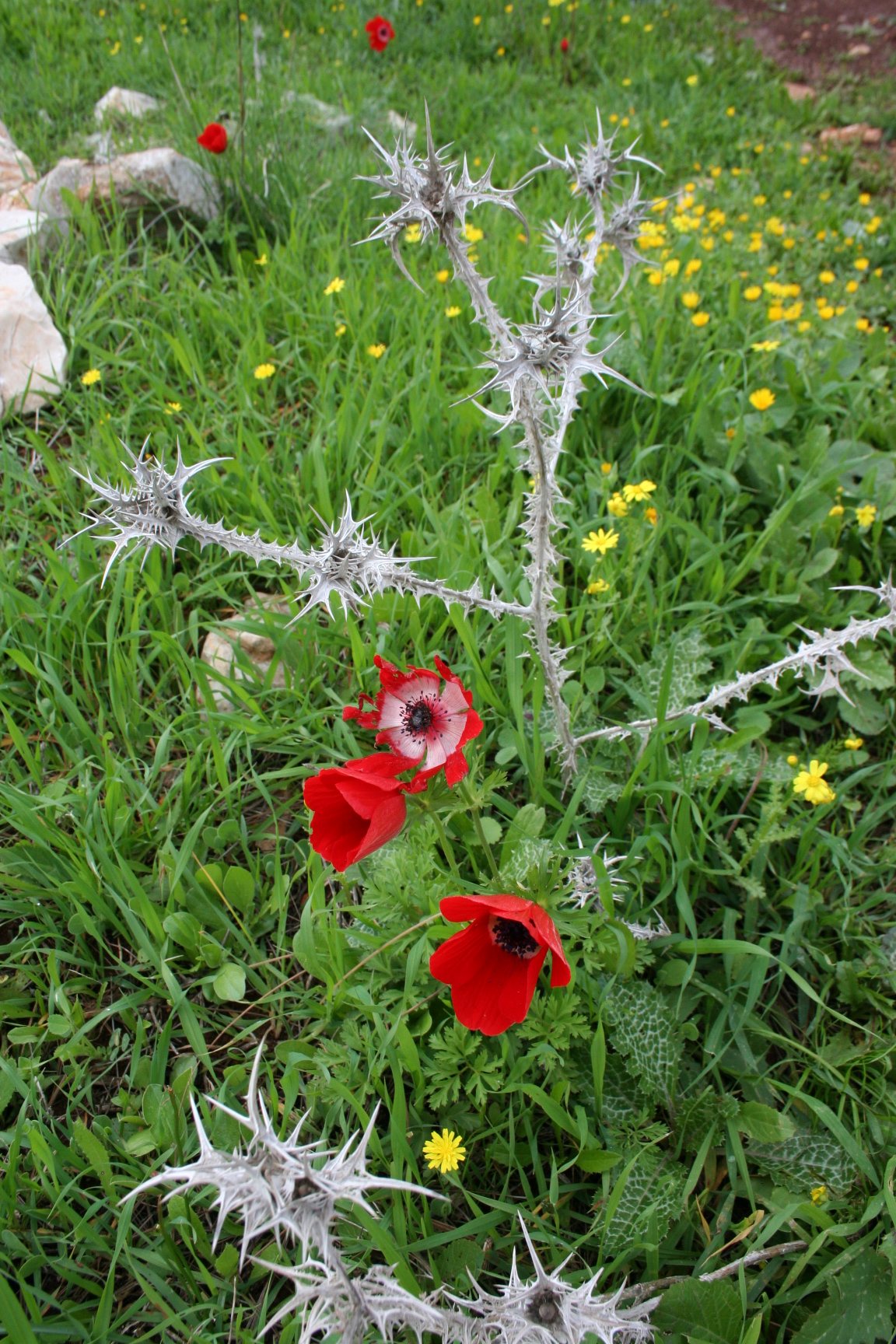
Soon after we made Aliyah in January 2010, my son and I created mini videos for our friends and family back in NJ with our Flip camera.  At the time, the kalaniyot were just beginning to bloom here in the North and there is this poignant moment during one of our virtual walking tours of Hannaton where my son, in the middle of some explanation of a particular cultural difference between the U.S. and Israel, stops walking, bends down, gazes at,  and then plucks from the ground a beautiful red anemone.

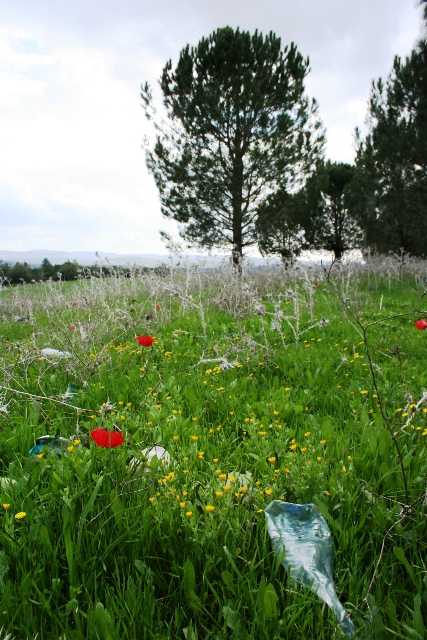
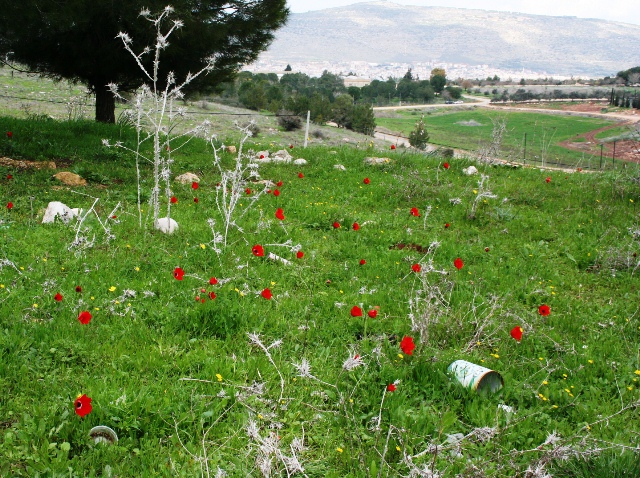
We learned soon after that these flowers are on the endangered list here in Israel, and it’s forbidden to pick them.  The kalaniyot (anemones in Hebrew) are so breathtaking it’s no wonder they caught my son’s ever wandering eye, and it’s no wonder they beckon us all to the fields when they start to pop up in January. If you do a Google search for pictures of kalaniyot, you’ll see what I mean.

I’ve been eager to go on a photo expedition myself among the kalaniyot on Hannaton, but I put it off due to sickness and continual bad weather. Finally the rains stopped enough for me to take a quiet Shabbat walk this past weekend to the fields above Hannaton overlooking nearby Kfar Manda and the Eshkol reservoir here in the Lower Galilee.

What I found was, as I expected, overwhelmingly and breathtakingly beautiful.

Kalaniyot overlook Hannaton

And, at the same time, heartbreaking.

Kalaniyot amongst the thorns

Heartbreaking how?

Heartbreaking in that as much as we revel in Israel’s beauty, and as much as we fight for ownership of her lands, we fail her.

To trash or protect, that is the question

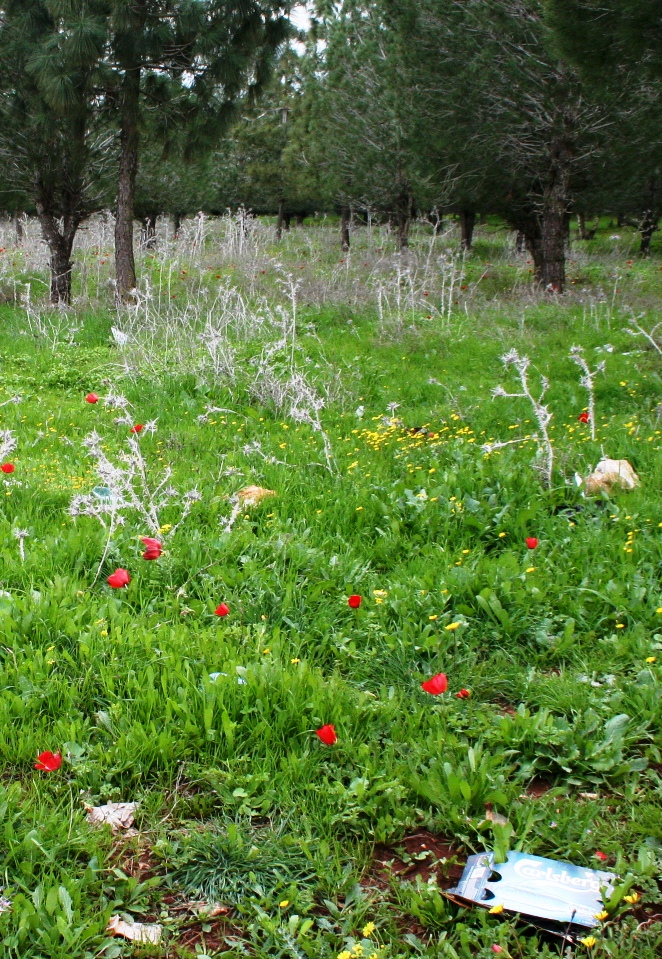
Do you see what I mean? We are prohibited from plucking her beauty, and perhaps rightfully so, in an effort to preserve it. And while efforts to maintain the wildflower population seem to be working, efforts to enforce cleanliness are failing…immensely.

Is this the land we're fighting over?

Garbage litters this beautiful land — from fields to parks to beaches to city streets.  When out and about amongst Israel’s unparalleled landscapes, I often feel transported back to 1970s-era America where it was still socially acceptable to toss trash out the window of a moving car or leave your Happy Meal bag in the mall parking lot next to your car instead of carrying it the extra few steps to the trash can. I see the remains of picnics left behind without a thought in our heavily funded Keren Kayemet national parks — picnics from many season ago no doubt. I grimace as I see plastic bottles floating along the rim of the Kinerret. I am ashamed when I bring tourists to a treasured local landmark, and they have to navigate around discarded cigarette packs and broken beer bottles.

It’s a puzzle to me.

Plastic bottles decorate our landscape

How is it that the most contended over real estate on the planet is not cleaner? How is it that our Holy Land is not treated as sacred? 

Remains of the Israeli picnic

How are we so disconnected, so unimpacted by this irony?

How is it that we will scream and shout our political battles over borders and boundaries, but we won’t speak up when we see our neighbor litter? How is it that we, as a country, are careful so about Kashrut, but not proactive as individuals in our daily lives with honoring “God’s creation,” our land?

Paint the landscape of the Galilee

When I bring this up among my friends, they often blame our “cousins,” by whom they mean our Arab neighbors. But if that were true, why is there so much trash here on Hannaton? And I don’t mean on the fields just beyond our yishuv gates where our Arab neighbors will often picnic (as will we). But also in the playground our children play in, in our yishuv streets, in our driveways and in our yards? I walked along the beach just outside Haifa a few months ago and it was covered in trash. Again, reminding me of Jersey beaches decades before when we had to be mindful not to walk barefoot on syringes.

Plastic bag dots the green

I don’t imagine our Arab neighbors are coming by with their Bamba bags and dropping them on our Hannaton basketball court. I don’t think our Arab neighbors are sending their dogs over to poop on our playground.

Bamba in the fields

In my work over the past few years educating our communities about holistic health and wellness, I often shied away from calling myself an “environmental activist.” My main intention was always to teach people ways they could prevent illness, in particular chronic illness or cancer, by adjusting their lifestyle and dietary habits. I always noted the secondary benefits of living a less toxic life included “healing our planet.”

But more and more over the years, I’ve come to understand exactly how hand-in-hand these two initiatives are: healing ourselves and healing our planet. They are one and the same. One cannot succeed without the other.

And those of us who yearn for peace in this land — in other words, her healing — must understand that this poor land is ravaged both by emotional and physical pain. And to heal her, we must take a holistic approach. We must understand the unspoken implication of dropping our garbage thoughtlessly onto Israel’s earth, of polluting Israel’s water, of suffocating her with toxic fumes.

What message do we send to her when we treat her this way?

You wouldn’t court a beautiful woman with screams, bloodshed, and empty plastic bottles and bags, would you?