Health, Kibbutz, Spirituality, War

Relevance

I just added a new category to my blog:

War.

I hesitated before I clicked.

I’m a superstitious kind of girl, for one. And, two, I do think our thoughts impact our reality.

If I add a war category to my blog, how does that impact my reality?

Call it what you want: law of attraction; positive thinking; pessimism; subjectivity. I’m someone who believes that we see the world the way we see it.  The world is interpreted by us. And every time we put an idea or an action into the world, we receive an idea and action in kind.

If we want our world to be different, we need to start thinking and acting differently.

If I want a world without war, what happens to that desire when I start blogging about war?

*   *   *   *

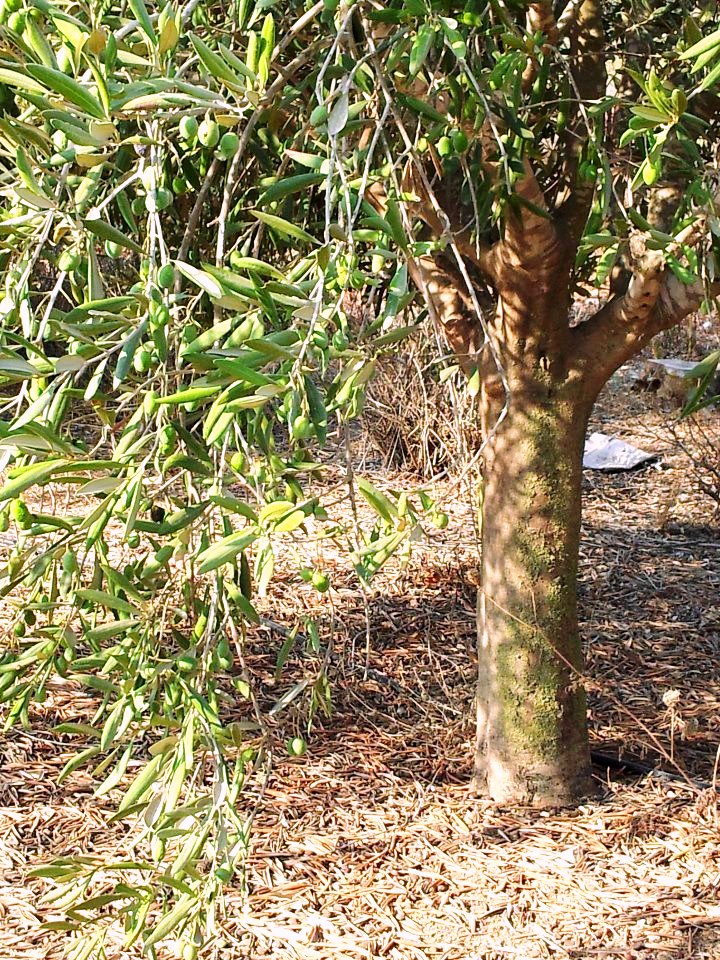
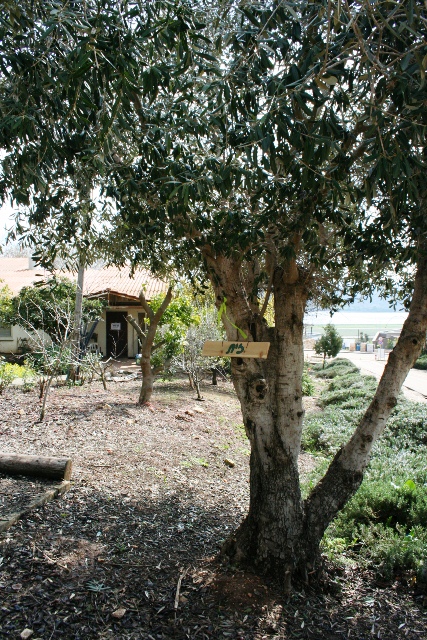
This morning, on my drive to work, I spotted a blossoming olive tree on the main road in the kibbutz. It made me so happy to see the baby green olives peppering the branches. On a macro level, it reminded me of what makes me happy about living on a kibbutz in Northern Israel. On a micro level, it reminded me that this August heat is half way out the door and autumn is just around the corner.

I snapped a photo of tree  and shared it on Facebook. I wanted my joy to spread. Spreading joy makes the world appear joyous.

I think it worked, at least a little. I smiled as I left Hannaton and turned left to drive towards Misgav.

Each weekday morning, I pass by Kfar Manda, the Arab village next door to ours. And every morning it’s a stark contrast of how we in Hannaton see the world differently from the people in Kfar Manda.

Of course, I can only guess that we see the world differently: Arab Israelis living in a mini city and Jewish Israelis living in a small kibbutz. I don’t have any friends from Kfar Manda so I have no one to interview and discuss this with.

Today, as I drove by Kfar Manda and held on to the joy that began with an olive tree, I saw smoke coming up from above the Western, residential side of the city. I felt my joy dissipate.

When I rounded the curve and passed the main entrance to the city, I saw the source of the smoke.

I couldn’t tell from my car if it was one of the trash fires I often see or smell burning in Kfar Manda. (A trash fire is exactly that –> burning trash.) Or if it was  intentionally set for an agricultural reason, since the fire was on the edge of a vegetable field. How an intentional fire serves any of us in this dry, scorching hot month of August is beyond me.

In any event, there was no one nearby trying to put out the fire. It just burned. And the smoke seeped into my nostrils as I rolled the car window down to take a picture of it.

And my joy disappeared.

My world was no longer olive blossoms. My world was fires burning at the edge of a beautiful field.

Community, Culture, Family, Kibbutz, Letting Go

Speechless

When I was a girl, I was a motor mouth.

How do I know this? Because Ms. Levin, my second grade teacher told me so. Seriously, my nickname in second grade was Motor Mouth, a moniker craftily created by my teacher at the time, who occasionally relented to my excessive hand-raising by saying, “Yes, M.M.?”

As borderline abusive as this practice was, there was some truth in the designation. I talked a lot. All the time, in fact. I talked to my neighbors at my table. I talked to my friends across the room. Often I would mutter to myself. I was a social creature. I still am.

My poor husband, not a social creature by nature, now carries the burden of Ms. Levin. But unfortunately for him, he has not only my incessant chatter to contend with, but also our oldest son’s and daughter’s. They inherited the Motor Mouth gene.

My chatter tends to run over into my writing. I’ve said often in the past that I “write in order to know what I think.” I didn’t make that up. Author Stephen King has said it. Historian Daniel Boorstin is claimed to have said a version of it. I wonder if those guys were motor mouths, too. Probably.

The best part about blogging is that it’s almost acceptable to be a motor mouth. Not so with traditional, published writing. In magazines, books, and newspapers — the kind of publications people still pay money to read on a regular basis — our motoring is required to be more thoughtful and refined. I respect this. I think it’s a sensible, if often boring, practice — carefully choosing your words and paying fastidious detail to grammar and punctuation.

Which is why, when I have a more thoughtful and potentially refined idea for a story, I don’t blog it. I save it.

I have one right now, in fact.

It’s been percolating inside of me for about two weeks, ever since I first started saving books from the recycling bin.

As you know, I live on a kibbutz in northern Israel. It’s a kibbutz that was established about 30 years ago by the Masorti movement in Israel; Masorti being the equivalent of Conservative Judaism in America. Many of the new residents of the kibbutz were from English speaking countries: the U.S., South Africa, England. When they came to Hannaton, they also brought with them their English language books, which presumably went into the communal library once they landed at Hannaton.

Recently, the library at Hannaton, like the kibbutz itself, underwent a huge renewal project. A volunteer committee sorted through the books to determine which ones would remain in the new library and which ones were either duplicates or in an unsuitable condition. There were thousands of books to sort — and since we’re in a Hebrew speaking country, there weren’t many nearby options for donating. The committee decided to put the unsuitable books in the recycling pile.

But, as we know, one person’s trash — or in this case, reusable waste — is another person’s treasure.

And this is how I came to spend a week and a half trash surfing for treasure; embarking on what I call the “Orphaned Book Project.”

When the books were finally hauled away by the recycling truck, I had saved about 30 books and 15 magazines, including Highlights from the 1980s with “Hidden Puzzles” left untouched for my 5 year old to explore; and a Cricket magazine from the year I was born, 1974. I saved a Scholastic paperback from 1981 written by Ann Reit, an author and editor I had the privilege of briefly working with, and who has since passed away from cancer.  I saved a much older Scholastic paperback whose jacket cover previews a young adult fiction story that centers on racial integration in the 1950s.  I saved a few ChildCraft How-to science books that are surprisingly still reasonably current, and a few history books that aren’t, but are still fun for my 9 year old to leaf through over a bowl of cereal in the morning.

There were Hebrew books, too, but I didn’t save any. The only Hebrew language publication I saved was a pamphlet printed by a professor in 1944 that documented all the agricultural settlements and their products up until that time.

On the title page, in English, are written the words:

Printed in Palestine.

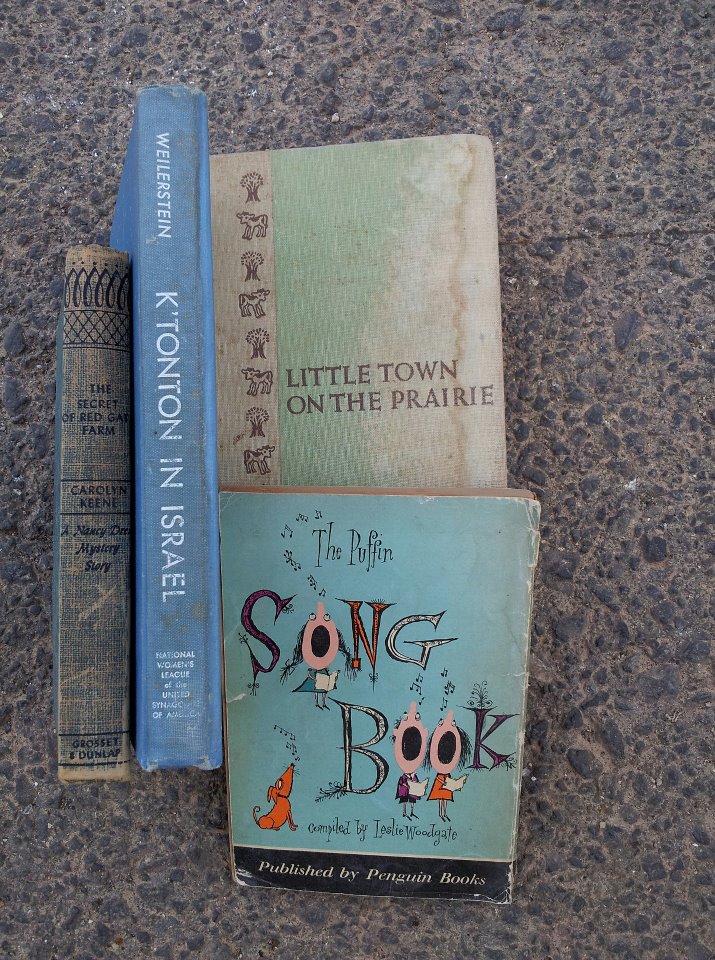
First I saved a couple of original Nancy Drews, and hardcover Little House, and a classic K’Ton Ton, and a kitschy song book
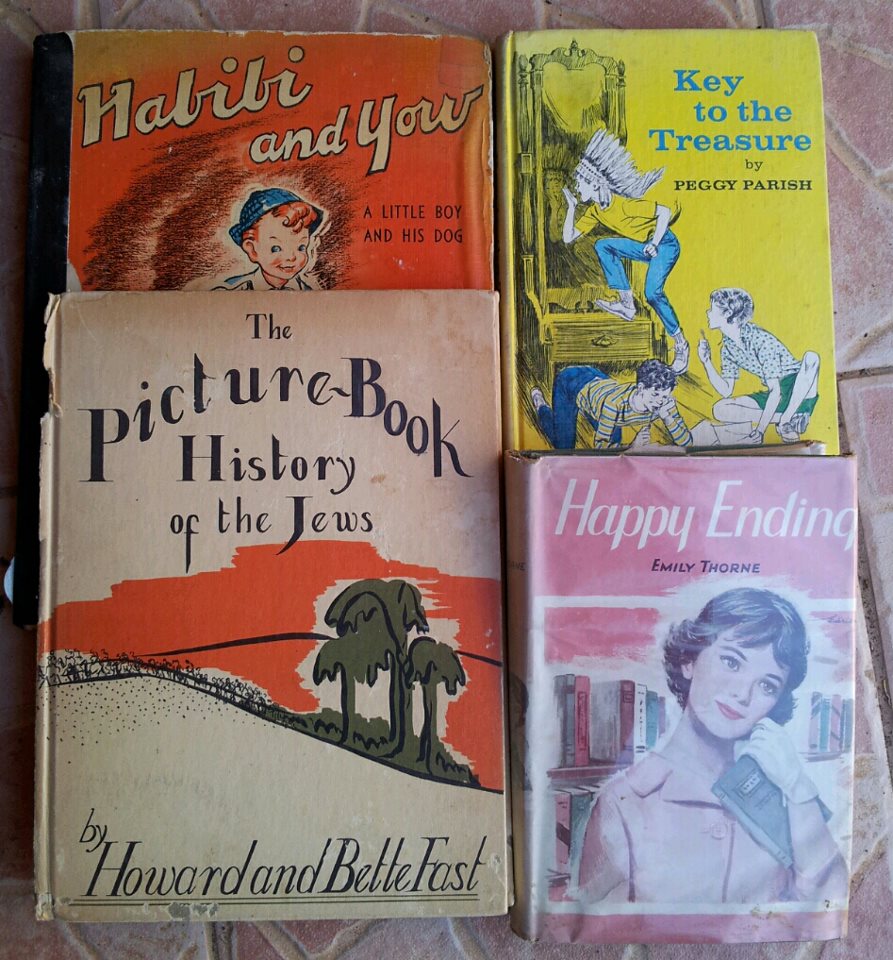
I have no need for more dusty coffee table books, but couldn’t resist this vintage They All Are Jews, a gift to “David” in 1951, after his confirmation. Inside I found a newspaper clipping from when Miss Israel won Miss Universe.
It wasn’t until my final visit that I found the true personal treasure: Peggy Parish’s Key to the Treasure, the last in a middle grade trilogy I loved as a girl and had been collecting
Family, Kibbutz

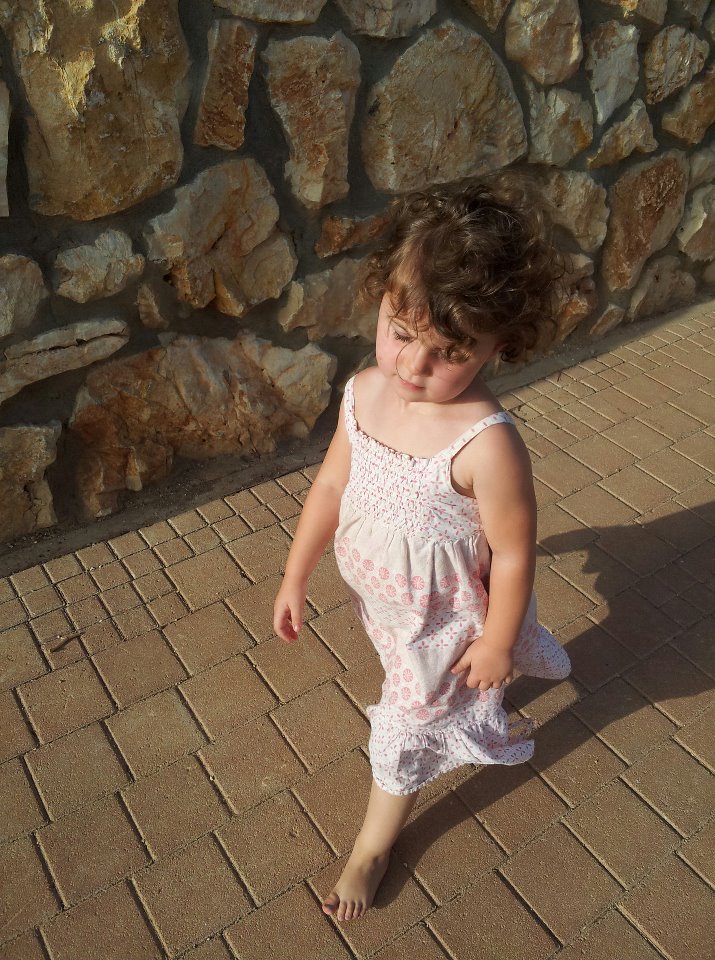
Barefoot kibbutz children make for good photo ops

My barefoot daughter walking along the sidewalk of our kibbutz

Ode to Found Love on Kibbutz

Flowers, dirt, and stray cats
Dogs that bark at midnight
The cow-infused downwind from the refet at 4:30 pm…
My children at 4:30 pm…
My husband at 4:30 pm…

Taking the trash out in my pajamas
Dressing up in grownup clothes for Shabbat
Singing Shiru L’adonai

Picking up snails, picking up trash
Picking up friends at the park
Showing up.
Speaking up… when I’m afraid to speak at all.

Finding out someone else is pregnant
Thanking God it’s not me.

Breathing in shnitzel,  shwarma, and secondhand smoke

The beach and the sunset and the Jerusalem stone
And the kibbutz children, my children
Who pepper my pictures with delight.

Culture, Education, Family, Kibbutz

What happens to the boys with flowers in their hair?

I have a theory about Israeli men.

The reason they’re so secure in their masculinity is not due to months of paratrooper training or mandatory military exercises out in the desert.

It’s because, from a very young age, boys are formally taught and encouraged to dance.

And wear leafy crowns.

And carry flowery baskets.

And hold hands.

And revel in the beauty of their own bodies.

Very subtly, the women of Israel (and in modern times, men as well) have taught our male children that moving their bodies in rhythm and wearing beautiful crowns are not signs of femininity. They are expressions of joy.

I was tickled pink the week I accompanied my then four-year-old son to gan when we first made Aliya last year. In addition to the culture shock I got as a mother – kids climbing on top of chairs to build block castles and digging through trash to find treasures in what seemed like a junkyard turned playground out back – I remarked at how integral both singing and dancing were to the preschool program.

Every day, the children would learn a new song, either about the approaching season or an upcoming holiday celebration, and most Fridays, I would arrive at pickup to find my son in the middle of a dance circle, made up only of boys, carrying and waving brightly-colored scarves and stepping in tune to the music.

Not a one stood outside the circle – ashamed to be holding a purple scarf or embarrassed to be moving his body and holding hands with other boys.

Instead, they threw themselves fully into the act – even the ones wearing cargo pants; even the ones who prefer toy trucks to dolls; even the ones who might grow up to be tough guys. They all danced.

Israeli children at gan, Shavuout

And, today, as our community celebrates the harvest festival of Shavuout, the young boys all arrived at school wearing olive crowns and carrying harvest baskets, decorated with white linen and flowers.

As a woman, but particularly as a mother of boys, it’s magnificent to witness – my son and his peers expressing their joy through movement and song without reserve.

But it’s also puzzling. What happens to these boys as they grow up? I wonder. How do they move from dancing to disrespecting and speaking harshly to each other on the soccer field? What happens to these boys who used to hold hands and dance? Who used to wear flowers in their hair and sing songs about the harvest?

I’m still so new in this country. And still so new as a mother, despite almost a decade of parenting.  It’s true, I don’t know yet of the heartache that hardens our sons. The burdens they think they bear. The walls they think they need to put up to protect themselves once they leave the safety of the garden.

I am also still naïve enough, however, to think that there must be something innocent that remains once they leave the gan – something that helps carry our boys through adolescence in a country where men often have to act like “MEN.” Where boys mock each other on the playground and fathers hurl insults at each other from their car windows. Where men, in particular, but all of us need often to operate in a “shuk mentality,” as my husband refers to it. Keep up your guard. Be wary of those who might want to cheat you or steal from you. Yell first, think later.

Something must remain. Something beyond the images the mothers hold dear to their hearts, images of young boys wearing white shirts and flowers in their hair.

It’s been told to me that men grow close to each other during the army. That bonds are formed there. Perhaps, this is true. It’s certainly the obvious answer.

But part of me thinks the bond starts earlier, and then is sidetracked by life. The bonds are built on top of foundations made from purple scarves and olive crowns.

The bonds begin with a dance.

Culture, Kibbutz, Learning Hebrew, Letting Go

The Jewish cowgirl rides again

(Originally posted as “Kibbutz girl in the city” on the Times of Israel)

Long ago and far way, before I got married and had kids, I worked in Manhattan for five years, almost three of which I spent living downtown in what is now chic NoHo. I’d say (and I often do) that such a biographical detail lends me an urban edge, but 12 years later, that edge has just about disappeared.

What I have retained, however, is the mythical city-girl handbook I used to carry; the informal list of safety rules I used at all hours of the day or night in that big city long ago, but have since shelved for only occasional browsing when I find myself in a big city without my car, or my husband, or a city dweller to hold my hand.

Last night, I dusted off the mythical city-girl handbook and slipped it into my trendy kisim handbag. (In case I’ve given you the idea that I actually know how to choose a trendy handbag, let me assure you it was a gift from my mother-in-law.)

After attending a work event in the outskirts of Tel Aviv, I was dropped off by my colleague in front of the Azrieli center downtown. We had just spent the day kicking off Israel’s 2012 Agritech conference with about 200 others at the AgriVest Summit, a conference where investors and entrepreneurs explored big topics like feeding the world and solving the global water crisis.

After getting dropped off at the center in front of one of the three towers at Azrieli, I was tired but still breathing in the fumes of post-conference self-assuredness. I thought my task would be easy: Find the Crowne Plaza Hotel, which supposedly was located somewhere in the Azrieli Center.

Azrieli Tower, Tel Aviv (courtesy Wikipedia)

Looking up to the top of the skyscrapers, I could see signs that indicated the shopping mecca inside: H&M, Forever 21, Fox.  But I couldn’t see a sign for the hotel.

Don’t panic, whispered the tall skinny girl sipping a frappacino on the cover of the city-girl handbook.When you don’t know where something is, she reminded me, ask a policeman or a taxi driver.

There were at least 10 taxi drivers in front of the Azrieli Center and not one of them knew where the Crowne Plaza City Center was. One told me, “Forty shekels, I take you there.” The other explained defiantly, “Crowne Plaza is by beach. I take you there. Forty shekels.” A third told me in Hebrew, “After the pedestrian bridge. See it? Just down the street? I take you there. Forty shekels.”

Hmm…I thought, maybe I should find a policeman.

Instead, I looked for a café where I could charge my phone, which had died an hour before. (The city girl handbook was written before there was 3G or Google maps.)

On my way to find the café, I happened upon the Crowne Plaza City Center exactly where it was supposed to be, in the lobby of one of the three towers. As I approached the reception area, I had to decide who I wanted to be: Israeli resident or tourist? When we’re in the big city, where you often find tourists, we olim get to choose — do our best attempt at native or pretend to be naive tourists. After our klita package runs out, this freedom to choose is just about the only benefit we olim have left.

Built up with confidence that the hotel receptionist was paid to be nice to me, I tried on my Israeli. I offered her my teudat zehut, my national identity card, instead of my passport when she asked for ID.

“Oh, so you are Israeli?” she asked. “Well, sorta,” I answered, the only response that comes naturally to me at this point, only 18 months post-aliya and still struggling with the future tense.

“Should we continue this transaction in Hebrew or English?” she asked me in a voice that sounded like a proposition.

Considering the last time a stranger flirted with me, I almost considered continuing the banter in English. Lack of stimulating banter is one of the things I miss most in this country. Instead, I shyly told her we could try and see how far we’d get in Hebrew.

We got pretty far. So far, in fact, I ended up holding a room key and a frequent traveler card.

After check in, I proceeded to the elevator, where I found myself in front of a panel of buttons that resembled no panel of buttons I had ever seen in front of an elevator. I couldn’t figure out how to get up to my room on the 14th floor. I once again consulted the city-girl handbook in my mind and remembered words from the final chapter: “When in doubt, watch what the person next to you is doing and mimic her.” Which is what I did, and yet I still wasn’t able to get to the 14th floor; the elevator only stopped at 12. And there were no up or down buttons. I was trapped!

Finally I asked the other rider for help — in Hebrew, but in a thick American accent because this is what you do in Israel when you need to ask a stupid question. She explained how the panel worked only by pressing the digits of the floor you need.

By the time I got into my hotel room I felt really, really foreign. Like a big fat 7-11-slurpee-drinking, baseball watching American foreigner. I went to sleep a bit defeated. Tomorrow would be a new day…hopefully.

The next day, however, didn’t start off much better. As I walked into the Agritech conference, my hands aching with the weight of the heavy boxes I was holding, the lobby was awash with long lines and pushing people. The wait at the registration desk seemed like it would take forever. Oy! When was this adventure going to get easier?

I stood in line for a few minutes and then looked around. I saw that there was no one monitoring the entrance to the exhibition hall. I picked up my boxes and headed toward the entrance. The American in me was hesitant to cross the invisible line that marked the boundary between the registration area and the exhibit hall. I didn’t have a badge. I hadn’t checked in yet. I couldn’t just walk in, could I? But the Israeli in me holding the heavy boxes had no more patience to spare.

And the Israeli is the one who crossed the invisible line.

The American in me shuddered at what I perceived as a security breach, but the Israeli in me (and the former city girl) was proud when I made it all the way to the booth without being stopped.

And the tall girl holding the frappacino on the cover of the city-girl handbook? She smiled and whispered knowingly, “When in Rome…”

= = = =

P.S. Thanks and love to Devora, my favorite Jewish cowgirl, for the inspiration for today’s headline.

Culture, Family, Kibbutz, Letting Go, Living in Community, Making Friends

Seeing double

When I first moved to Israel, before I got my full-time job here, I started networking in search of freelance writing work. I had already started writing this blog about my Aliyah experience and had gotten positive feedback from both friends and colleagues. One of my colleagues suggested I reach out to Kveller.com, a new blog for Jewish parents, thinking they would be interested in syndicating this blog or hiring me to write another.

I wrote to the editors at Kveller and pitched my blog idea, confident they would write back to me with a big, fat YES.

Pitch: Fun, snarky Jewish mom leaves the comfort of her chic New Jersey suburb with her husband and three kids to try to make it as a kibbutznik in Northern Israel.

The editors wrote back that they liked my writing style, but that they already had a cool Jewish mom makes Aliyah to kibbutz column.

What?!?

There’s two of us?

Well, apparently there are. At least two of us.

The editors forwarded me Sarah’s blog post about moving to Israel, and I thought to myself, “Hmm. I guess I’m not so unique after all.” Sarah’s writing reminded me of my own, a blend I like to consider “tell-it-like-it-is honesty infused with snarky vulnerability.”

Figuring out that someone else had already pitched my idea and got the gig before me was a tiny blow to the ego, I’ll admit. Nonetheless, I secretly smiled knowing there was another Jen-like new olah mom out there.

So it was little surprise to me to see it was Sarah who wrote the article that popped up today on my Facebook news feed from The Times of Israel called, My Israel: A Land of Spoiled Milk and Honey.

The first half of the article was like reading the California Girl version of my life, or at least an alterno-verse version of the summer I first visited Israel in 1992.

I laughed at Sarah’s recollections of her first visit to the Kotel which were “spiritual” and “meaningful” and “fucking awesome.”  And I smiled knowingly at what she recalled as her passionate statement to the Israeli passport control worker promising that “one day she would return.”

I remember being that passionate girl. I remember being madly in love with an Israeli soldier. Um, I mean, Israel.

I could also relate to her experience of missing that connection to Judaism once she returned to the States. It happened to me, too. And I spent years trying unsuccessfully to recreate it while living in America.

But what I couldn’t fully relate to in Sarah’s post were her expectations that moving to Israel would somehow be a seemless transition into Israeli life and culture.  I didn’t share the expectation that being a Jew in a Jewish land would naturally translate into being understood or loved or accepted by your friends and neighbors. In fact, I was really worried that no one here would get me. That our family would not fit in. That I would never feel like this was my home.

In fact, the one thing that drives me nuts about the “Aliyah Movement” is the idea that American Jews moving to Israel are, in fact, “coming home.”

That sentiment, when I am at my ugliest, makes me want to vomit. When I am feeling kind, it simply bewilders me.

This “Coming Home” slogan is plastered all over the Nefesh B’Nefesh marketing materials. It’s the titles of videos on YouTube. It’s written in permanent marker on poster board and embroidered onto hats.  And all the time I think to myself, “Is it true? Are you? Do you?”

For a little while, the fact that I didn’t feel that way made me feel like a fraud, like an imitation oleh. Like the fake tofu version of a new oleh.

Where was the meat?

Did I really deserve this Aliyah if I wasn’t 100% sure Israel was my home? That this decision was the right one? That I would be happy here? That I would stay?

In the 16 months since I made Aliyah, I have come a long way.  In the 16 months since my Aliyah, I have worked hard to make this country my home. I have worked hard to learn the language; to make friends; to take on challenges that scare me; and to be tolerant and even accepting of cultural difference that are so offensive to me that I want to jump on the next plane back to Newark Liberty International.

For instance, I have learned that I can both hate the Israeli woman up my ass in the line at the pharmacy and at the same time admire her for being ambitious and bold. I can both cringe at the reckless abandon of Israeli parents when it comes to their child’s safety; and at the same time, smile with pride at the independence my children have acquired since figuring out that falling 5 feet from the top of the jungle gym onto concrete really, really hurts. I can scream at the dogs who run off their leashes; and quietly be happy they’re around to bark at the would-be robbers.

I have learned to love and accept this country, and my community. And I still reserve the right to complain about her.

If that’s not home, what is?

The real problem lies not with Israel. Nor does it lie with immigrants who are constantly comparing their new home to their old one. And certainly, the  solution is not, as some of the commenters on Sarah’s post would have one believe, “If you don’t like it, then leave.”

If anything, what we new immigrants need is compassion. Compassion from our neighbors, both the Israelis and the olim who have figured it out already.

And compassion for ourselves, as it takes a lot more than a slogan or a birthright to feel at home.

Culture, Environment, Family, Kibbutz, Parenting

Second Spring

The weather is perfect today.

Blissfully perfect.

And by some magical alignment, my family is perfect today, too.

Tfoo. Tfoo. Tfoo.

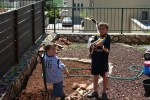
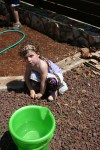
We spent the morning together cleaning our yard, which had gotten frightfully ghetto this winter. Miraculously, everyone pitched a hand. Even my 9 year old, whom we hardly ever see anymore because he spends most of his spare daylight hours running around with his friends.

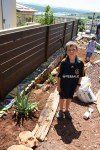
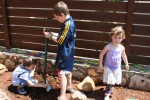
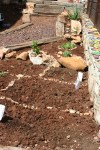
Our hand painted inspirational tiles from last spring didn’t make it through the winter, despite what we thought was a careful choice of paint and sealant. We laid them to rest along the side of our yard to make way for another herb garden and an experimental vegetable garden.

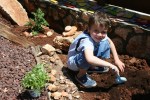
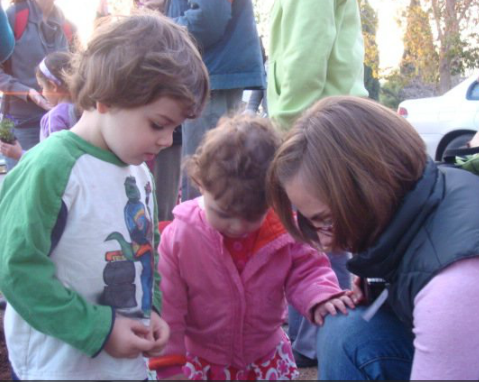
After spending some time together at the small nursery just outside Kfar Manda, we chose which plants to experiment with. With multi-generational love and care, with songs and brachot, with a little bit of mandatory blood, sweat and tears, we planted “Bubbi’s Garden,” in honor and loving memory of Bubbi (Marion Abrams) who would have been 87 years young tomorrow.

May we all only generate joy, love and beauty this spring and in the seasons to come.

Environment, Kibbutz

The green Zionist in me

Even though it’s officially more than a year since we made Aliyah, I just now feel as if one full cycle is complete.

My first real memory of our first real family experience  here in Israel (one that didn’t involve a government agency) is of Tu B’Shevat.

A week or two after we moved into our house on Hannaton, there was a Tu B’Shevat celebration for children that included arts and craft activities, picking up litter around the grounds, and planting new flowers. I look at the few pictures my friend Shira took of my kids and realize how far they, and we, have come since then. How little, and how American, they were then. And how big, and how Israeli, they have become in just one year.

Evidence of this is not just in their ability to speak Hebrew almost fluently, but in their transformation into real Israeli children.

My children dance when there is rain; my children sing with joy that Tu B’shevat has arrived; and they can identify not just dried fruits and nuts, but also leaves and trees by their Hebrew names. (When I compare what I know about our natural habitat to what they know, I am comforted in knowing that if the economy collapses and we need to depend on our local vegetation for food, they’ll know which ones are edible and which ones are poison.)

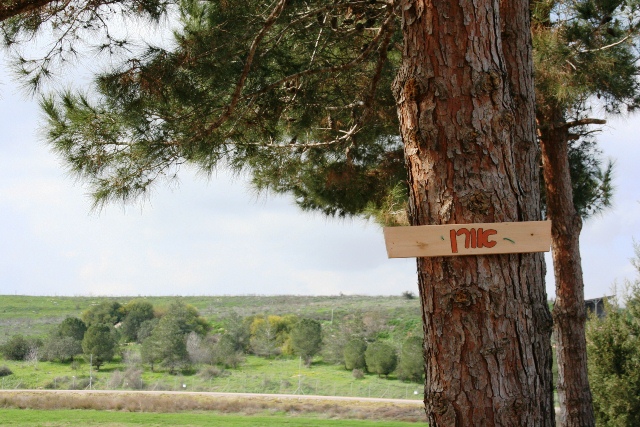
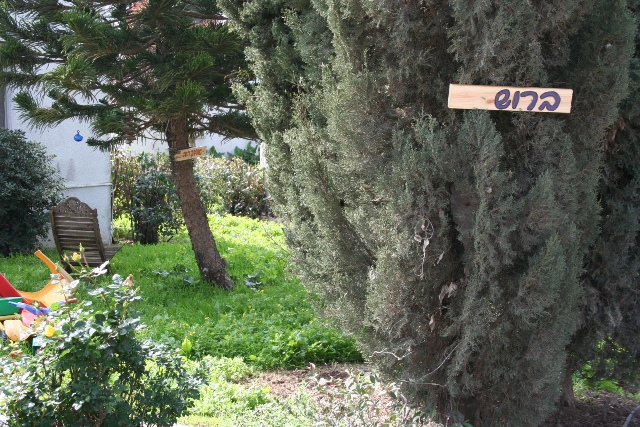
The other day, my middle son was home sick from school, but not sick enough for us not to take advantage of the brief break in the rain and to stroll around Hannaton admiring the blossoming trees and snapping photos of the ones tagged with signs in honor of Tu B’shevat. It was a fun mini scavenger hunt for us, and a brief eco-lesson.

When I think of my experience of  Tu B’Shevat growing up in the States, I remember a minor holiday celebrated at Hebrew School. I remember coloring in a line art cartoon drawing of a young Israeli pioneer child standing next to a pine tree and bringing home a certificate marking the planting of one by JNF in Israel.

I admit I get a little bit excited that my children are those pioneer children — minus the vintage overalls and cotton baseball cap. Even though it’s 2012 (and not 1948), my children’s hands are dirtied with Israeli soil, their voices sing with pride, and their hearts are filled with the love of Israeli land.

Eshkolit, Grapefruit
Zayit/Olive
Eucalyptus
Oren/Pine
Barosh/Cypress
Family, Kibbutz, Learning Hebrew, Letting Go, Living in Community, Love, Making Friends, Parenting, Religion

A year in reflection

In retrospect, I’m glad we made Aliyah at the end of a calendar year. At the time, moving during the first of New Jersey’s many blizzards and dealing with holiday travel didn’t seem like such a good idea. But now, as I reflect on the year that we’ve been living in Israel, I find comfort in the awareness that I will never have to struggle to remember when we moved here. It was at the end of December, in the winter of the end of a decade. 

And, as if leaving our friends and family to move to a new country wasn’t turbulent or memorable enough, there was plenty else to mark this year in my memory. I lost a cousin. I lost my grandmother. And through these and other extraordinarily difficult times for my family this year, I was here and they were there.

In the chapters that mark my life, 2011 will be one I remember without a bookmark, without a folded over corner.

My kind friends and loving husband might argue with this, but the marks of this year also show on my face, which seems to be finally showing signs of age. This year, as exciting as its been, has also been the year that I started feeling aches in my joints and noticing that my body is not as resilient as it used to be.

This was the year I closed my business and started a new job. It was the year I gave up my Blackberry and then found it again, at least the Israeli Nokia version. It was the year I moved to the house down the street of one of my oldest childhood friends and the year I found that sometimes, moving away from your closest friends, actually draws you nearer to them.

This was the year I stopped obsessively focusing on healing others; and truly starting looking inward in an effort to heal myself.  It was the year I rediscovered the healing power of song and prayer; love and community.

This was the year I decided that a heaping helping of humble pie was good for me. That learning something new every day can be painful, but active listening often works better than talking, even when you want so badly to communicate who you are and what you want.

This was the year my husband really learned to appreciated me as a mother. And I him as a hard-working professional. It was the year I resigned myself to the growing up of my children, and the year I decided that they would be okay — in spite of my fears and worries.

It was the year I let go.

This morning, after I dropped off my five-year-old at gan, I shook my head in amazement. He had woken up this morning with a bellyache and asked not to go to school. After hesitating only a minute, we decided it was okay if he stayed behind and rested in his room this morning. After all, it’s a long week, and Fridays are half-day, looser schedules for kids in preschool here.

At around 9 am, he decided he felt better and asked if he could go to gan. I asked him, “Are you sure? You can stay home if you want. It’s fine.” He insisted he felt well and asked that I take him up.

When we got to the door of his classroom, he gave me a quick kiss, and with one last look back, left my side to play with his friends.

This was the same kid who one year ago, walked off the plane at Ben Gurion Airport, pale as a ghost, after vomiting for 12 hours straight. This was the kid who cried every morning for months when we dropped him off at gan; who wouldn’t let us leave; who begged us to stay home.  This same kid was now opting for gan over a day off at home. This same kid, didn’t know a word of Hebrew when we arrived a year ago, but now speaks completely in Hebrew with his friends…and with confidence.

This morning, my five-year-old’s brother is off playing with his own friends; and his sister, I’m sure, is chatting away in Hebrew with hers at her own school. My husband is preparing food for our Shabbat meal tonight with friends, and I’m here, taking a break from cleaning the house.

This was the year we turned our life upside down.

And our life righted itself.

Climate Changes, Food, Kibbutz

Who Am I?

Somewhere, in the piles of bureacratic papers they handed us at Ben Gurion Airport last December, they must have hidden a green thumb.

For how else can I explain this new found commitment I have to what can only be characterized as…gardening? It’s clearly a bi-product of my Aliyah, this tender love and compassion for the newly sprouting and already rooted life in my yard.

My pre-Aliyah thumb was as black as black could be. I snubbed my thumb at greenery. I kept it safe and warm inside. My thumb knew only the tappity tap of the keyboard, whether it was the one on my laptop or the one on my Blackberry. My pre-Aliyah thumb did not know dirt; was not trained in carefully measuring the pressure placed on the nozzle of the garden hose; did not suffer the wounds of thorns.

My thumb…and I…wonder, “Who are we?”

Now we both suffer when we realize we’ve forgotten to water the plants. And we both yearn to be outside playing in the yard, rather than typing on a computer.

And we’re both, thumb and I, enjoying the fruits of our labor, and marveling at our transformation.

Growing fruit, veggies and art


Passionfruit vine spreading love


If you can't find 'em, grow 'em
 
 
Clementines are ready to pick
Culture, Family, Kibbutz, Letting Go, Living in Community, Love, Making Friends, Parenting, Spirituality, Uncategorized

Unwound

A friend of mine moved from NJ to Guam with her husband and two boys a few months before we decided to make Aliyah. On Facebook, I followed her move and her family’s transition with interest, particularly once we decided we were moving to Israel.

Despite what I assume must be vast differences in culture and landscape between Guam and Israel, I often find myself nodding in agreement and understanding when I read Shelley’s posts. (This could also have much to do with our common interests in holistic parenting and healthy eating, as well.)

There is, I’ve realized, companionship in leaving the busy American suburbs, the busy American life, for the “outskirts.”

Today Shelley wrote, “There are times when I miss living in the States with all of its modern conveniences, but then there are days like yesterday when I never want to leave our little bubble in Guam.”

I know exactly what she means.

Except our bubble is not Israel, per say, as Israel is no island paradise: She possesses as much hassle, aggravation, and overstimulation as any developed country.

My bubble is Kibbutz Hannaton, the small 120-or-so family Lower Galilee community in which we live. And a sub-bubble of Hannaton is my little red house with green shutters.  And yet another sub-bubble is my little work enclave of former Americans whom allow me eight hours a day to pretend I still live and work in the U.S.

But the true sub-bubble is the one I created for myself with intention last December when I  chose not just to live somewhere different, but to live differently.

I often tell people (in fact, I did so just yesterday during lunch) that our successful “absorption” here is due in large part to the community in which we chose to live: one made up of young, growing families like our own. One where friendships are only now being formed…because the community is still new and finding itself. So, despite being different, we still somehow fit in.

But I also credit our successful transition to the conscious lifestyle changes we, as a family unit, decided to make in conjunction with our move.

In addition to many of the comforts we gave up — the modern conveniences Shelley mentions in her post — we also gave up our attachments to what we knew up until then as the “right way to live” in the hopes that we might find happiness living another way.

One modern convenience I gave up was information overload.

I was (and still am in many ways) an information addict. My understanding up until recently was that with more information comes more control…over my own life…over what happens to me and to my kids. My understanding was that information made me safer; made my life easier. This is why I easily fell in love with the Internet, email, blogs, Facebook. And, to some extent all those modern conveniences have improved my life. But what I’ve discovered, retroactively, was how much they also controlled my life.

I had a really good excuse for feeding my addiction; addicts always do. I was a business owner. A writer. A blogger. My success depended on my communication with the outside world. I needed to check check check…all the time. Who knew when the next big opportunity, client or connection would land in my inbox? At the height of my addiction, I had six different email addresses, four blogs, two Facebook profiles, three Fan Pages, a LinkedIn and two Twitter accounts to manage. Not to mention those I managed for my clients. 

I also had kids with asthma and allergies. I had unexplained chronic illness of my own. I had an acute awareness that with more information about the world around me, the greater chance I had of healing myself and healing them. Information provided answers. Tools. Connections to the right people. How could I give up information? 

I also consciously understood that my information interface, so to speak, was possibly unhealthy.  Which made for a bit of a contradiction.

Despite my awareness that my commitment to my online personas (and to my business and clients) was likely impacting my real-life relationships with my husband and my kids, I persisted.  Despite the fact that my comments on your “feed” may have been keeping me from experiencing real, waking, daily pleasures, I couldn’t shut down. I couldn’t give it up. I couldn’t walk away from it.

Until I started walking away from it. Taking baby steps. That started once my feet touched ground in Israel.

As I said, my information withdrawal began first with an intention. But I followed through with an action: I purposefully did not register my Blackberry here in Israel. I got myself a regular old cellphone with a regular old phone call plan. No emails, no SMS packages. My husband did not register his IPhone either which was a HUGE shocker for me because my husband loves his IPhone more than I love information. Or, at least, equally as much.

Just this simple choice, along with the decision not to purchase Cable TV made a great impact on the quality of our lives in the first few months we lived here.  We quickly adjusted to checking emails only on our computer (remember when you used to do that?) and our kids spent more time outside and not in front of the TV than they had ever in their lives.

And that was nice for a while. I’d like to say that we remained unplugged, but we didn’t. A few months in, we used Hebrew immersion as an excuse to sign up for basic cable. The kids still only watch a portion of what they used to. (I haven’t watched an episode of the evening news or any sitcom, save for Israel’s Ramzor.)

A few months after that, my husband bought a new IPhone, much to my dismay, and I often find him face down fingering the thing with pleasure. That said, it only takes one semi- dirty look from me for him to put the thing down when the kids are asking him a question (repeatedly) and his finger keeps methodically sliding across the little touchpad as if it’s in a trance. He also gave up TV and for the first time in many years I can now find him in bed in the evenings reading e-books on the Nook. 

Once I got a full-time job, they handed me a Smartphone with my work email configured, but amazingly, without the unspoken expectation that I be attached to it 24-7. And I like that. I like that a lot.

Despite the reintroduction of information overload devices, my information withdrawal continues. I didn’t configure my personal email into to my new phone. I never check my work email after I leave the office or on the weekend. And I have found as the months pass, I check my personal email less and less often: Sometimes going as much as 2-3 days without checking. People who were used to hearing from me immediately would write back after only hours asking me, “Where are you? Did you get my email?”

Sure, I am still on Facebook. It’s my lifeline to friends and family who didn’t follow me to Israel. But I’m hardly on Twitter; have no interest in this new thing called Google Plus. Sometimes, I even find it difficult to motivate myself to blog. I find that at the end of the day, after working and spending time with my family, I prefer to walk and then to read. And then to sleep.

Yesterday, I discovered my main personal email account was down. I had forgotten to pay the web host for a month or two and they shut my account down temporarily. People reached out to me via Facebook or SMS asking me what happened to my email. Why were mails being bounced back?

At first I panicked that my email was down, “What if someone is trying to reach me??” But my panic lasted only a minute. Soon after, the feeling transformed into freedom.

I realized I had passed over the hurdle of my information addiction. I was now able to say no. To be without. To let go. In particular, I wasn’t worried about what I had missed or would miss over the day or so the email account would be down. I wasn’t worried about what people might think when they received their emails returned, unread.  In fact, I decided right then and there to pare down all my email accounts, returning only to one. One that I may or may not check during the day.

This is not to say I’m unplugging completely. Or that I will ever really be able to fully walk away from easy access information. There is no guarantee that this represents a permanent recovery from information addiction. But it certainly indicates a big step in the right direction.

I think I’ve developed a taste for something new.

Being here. Being present. Absorbing today. Still with an eye on tomorrow, but with a good solid foot planted in today.

Culture, Education, Family, Kibbutz, Learning Hebrew

Fool’s errand

This morning, as I was just starting to feel better about my tough week, my husband corrected my Hebrew.

It’s perfectly okay that he corrects my Hebrew — it’s something I have asked him to do with the intention of learning quicker. After all, aren’t your mistakes sometimes more memorable than your achievements?

Despite the fact that I’ve asked him to correct me, I still often feel like an asshole when he does. Particularly when I realize that I’ve previously made the same mistake in front of someone who didn’t correct me. Someone who let my mistake just hang there in midair. Who just nodded, but inside thought to herself either a) “awww…isn’t the new immigrant so cute?” or b) “dumbass.”

The correction, in case you are wondering, was my use of the word “chuggim” when I really meant “chaggim.” Chuggim, for those who don’t speak Hebrew, are after-school enrichment type classes. Chaggim are literally holidays or festivals, but refers here in Israel to the Jewish High Holidays. In  September, people are constantly referring to “achrei hachaggim” (after the holidays) because the chaggim are as disruptive to your life and schedule here in Israel as winter break is in the States. In September, you’re just getting your life back on track after the summer break and then WHAM, the chaggim hit you.

I actually know the difference between chuggim and chaggim. It wasn’t a true mistake; the kind where I used the wrong word because I thought it was the right word.  It was a mistake of confidence. It was a mistake rooted in my desire to speak Hebrew without thinking, which is what all the veteran immigrants advise you to do.

The two words are similar sounding and used frequently (at least by weary parents). Chuggim just came out. I quickly understood my mistake after my husband corrected me and also suddenly realized it wasn’t the first time I made it…and that the previous time was to a friend of mine. (A friend, I hope, in the “aww….isn’t she cute” category.)

The chuggim/chaggim mistake came up in the context of my mother’s upcoming visit to Israel, which we are all very excited for. (Yes, emphasis added with love for my mother who reads every word of every blog post…and then analyzes what I must have really meant when I wrote it.)

In June, I asked everyone I knew if they had a school calendar for the upcoming school year. My mother was planning a trip during the chuggim (which is probably what I  said at the time, though you now know I meant chaggim). It was my intention to coordinate her trip with the break from school and work during the chaggim.

Everyone assured me that yes, there would be a national holiday declared, but they couldn’t tell me the exact dates.

What?!? This was maddening to me, and more so to my mother, from whom I inherited my “bordering on maniacal” organizational skills and obsessive need to plan in advance. How could they not know in June the official school break for the High Holidays? Wasn’t it the same every year? Didn’t it occur between Rosh Hashana and Yom Kippur? Or during Sukkot? Or both? Sure, our winter break in the States varies from year to year, but it basically starts a few days before Christmas and ends a day or two after New Year’s. It’s predictable! You can plan around it! You don’t need to be a fortune teller to figure it out.

But no one here could answer my question. Not the parents with kids currently in the system and not parents of older kids. No one knew. I even searched our regional web site (in Hebrew!!!) to try to find out the answer on my own (after my husband politely decided not to on my behalf).

I finally just heard yesterday from a coworker who heard it announced on the radio that the school break would be during Sukkot (the week after my mom’s visit.) I think, but I’m not 100% sure, that the Ministry of Education just decided this the day before school started.

So much for trying to coordinate my mom’s visit. (Yes, mom, I am still taking time off work and we will keep the kids home so they can visit properly with you.)

“You could have called the school,” I blamed my husband this morning when he got the “official” announcement in his email inbox.

Huh, what are you talking about?, his look said back to me.

“Don’t you see? This is my life here,” I wailed at him this morning before he left for a meeting. “Half the time I feel like a moron and the other half I feel like an imbecile!!! Maybe you should take pity on me! Moving to Israel made me stupid!”

“On your walk to your meeting,” I spat at him with venom (but really sadness and frustration), “think about that! Spend some time thinking about what it must feel like to be ME! Stupid, stupid me!” (The words I actually used were a little more foul, but the above is basically what I meant.)

In a moment of brilliant patience and kindness, my husband kept his mouth shut, nodded, and walked out the door. Whether or not he actually spent time pitying me on his way to work is another issue.

I was blessed with a quiet house in the hour after he left. My oldest kid was out at a friend’s house and the two little ones were in Gan. I spent this luxurious hour sulking, cleaning my dirty house, sulking, putting in some dirty laundry, and catching up on the lives of my far-away friends through their posts on Facebook.

While scanning the Facebook updates from Hurricane Irene-damaged New Jersey (and still selfishly sulking), I was fortunate enough to find a video link in my News Feed from my FB friend Carol, a veteran American immigrant to Israel who I’ve never met in real life. The video she posted reminded me of something very important; something that wiped the sulk away and replaced it with a guilty sigh.

In between the moments I feel like a moron and the moments I feel like an imbecile, I actually feel alive. More alive than before. More connected to myself, my kids, my husband, my community, my planet.

It’s my acknowledgment of and addiction to this feeling that makes the stupid bearable. It makes me want to stay, instead of leave.

True, when I lived in New Jersey, when I had my own business, when I was considered a community leader and an educator, when I was writing for important publications and being interviewed by journalists, I felt like a smart Somebody. It was a really good feeling.  But, in truth, what was attached to that feeling of being smart was a compelling need to constantly know more and do more. To research, to learn and to share. Naturally, I was addicted to my computer, to my BlackBerry, and to social media outlets. In order to maintain my competitive edge in that space, I had to be turned on all the time.

All the time.

What were the consequences of being turned on all the time?

You know what they are. Think about your irritation when your husband interrupts you when you are in the middle of an email; or the compelling urge to check Facebook while you are sitting at a table in the Food Court across from your son; or the panic you feel when your internet isn’t working.

My life here has allowed me (forced me?) to disconnect. Not completely, obviously, but significantly.

And, suddenly, I remember there’s a good side to being Stupid.