Love, Parenting, Relationships

Dear 38-year-old Me

Dear Jen:

It’s a trend in the last decade or so for writers or celebrities to pen letters to their younger, seemingly more innocent and vulnerable selves.

While sometimes introspective and poignant, this practice is a waste of time.

Letters lead only to wistful and wishful thinking.

Energy is better spent focusing on inventing a time travel machine.  Time travel is an action plan.

The thing is, I have trouble understanding the directions blockersto my 6-year-old’s “Blockers” board game, let alone the mind-bending quantum physics required to figure out how time travel would work.

The closest we writers will likely get to inventing a time travel machine is live tweeting a Quantum Leap marathon.

And so, we write letters.

Reading and writing letters are the next best thing to time travel.

I learned this last week as I was looking at old emails from the past 10 years.

Why was I looking at old emails from the past 10 years?

Because today I celebrate 10 years of being a mother.

I was looking for something in particular in my old sent letters.

A file called, “Tobey Grows.”

When I was pregnant with Tobey, I was a complete lunatic.

My husband told me so at the time, but I didn’t believe him. I thought he was just being an insensitive asshole.

But time traveling back into 2002 and reading the journal I kept both during my pregnancy and during Tobey’s first year of life, I see what a complete and utter crazy, control freak I was.

Don’t get me wrong: I was also really cute. Hot even. (Man, my hair will never be that blonde again. Damn, hormones.)
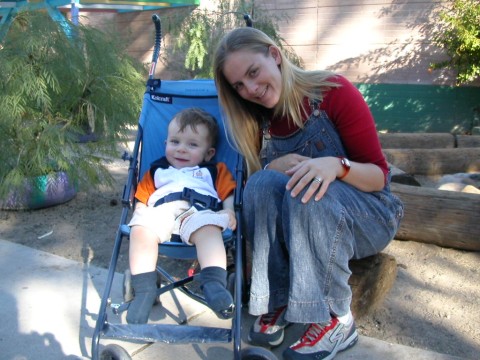
12/2003, Tucson, Arizona

But I was convinced that I was so powerful…and yet often felt completely and utterly powerless.

I thought that by maintaining control over my world, over my child’s world, that I could somehow protect him. Keep him safe. Turn him into the healthiest, strongest human being ever poised to be President of the United States of America.

And at the same time, as I read these journal entries and think back to that younger, blonder time, I realize how terrified I was.

How in a moment powerful transformed into powerless.

A fall from a swing. A slip in the bath. A bug bite. An allergic reaction.

That’s all it took to turn me into a powerless heap of Jello.

My life as a mother hasn’t changed all that much.  Powerful still turns into powerless in an instant.

But now, I know that powerful is an illusion.

I know that control is an illusion.

I know that I am not in control.

I’m not the driver.

I’m the navigator, sometimes.

I’m the backseat driver, a lot.

I’m the guy who writes the instructions manual.

I’m the girl upstairs who edits the manual three years later.

I’m the old lady who laughs at the manual years later when cars learn how to drive themselves.

*   *   *   *

This is not an easy understanding to retain, dear 38-year-old Me.

I’m still very susceptible to believing I am in control.

That I can keep him safe.

That I can protect him from this scary world.

That he will make it…thanks to me.

I’m still a bit of a complete lunatic. And I still think my husband is being a complete asshole when he tells me so.

But, for the record, he’s usually right.

The only difference now, 10 years later, is I can recognize my craziness a lot quicker.

And acknowledge it. And forgive it.

I’m a lot more forgiving of myself now.

It took me 10 years to let compassion for myself in.

And while my hair is not as blonde, my shoulders are a lot lighter than they were 10 years ago when I first became a mother.
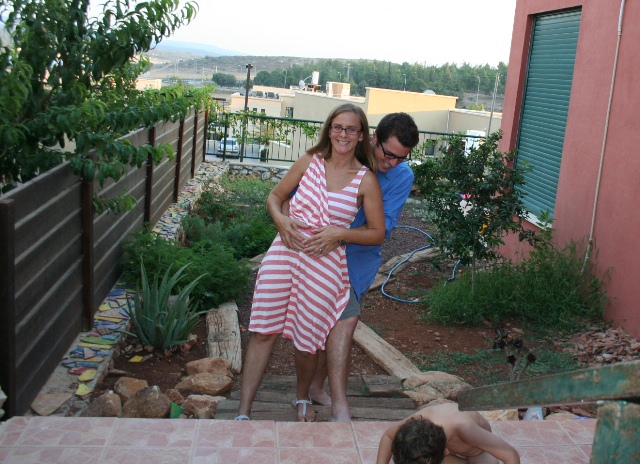
2012, Israel
2012, Israel

And the compassion I have for myself spreads to those around me…

To my husband.

To my own mother.

To my mother-in-law.

To my children.

To my friends.

To my enemies.

To strangers.

*   *   *   *

Dear 38-year-old Me:

Since opening my heart to my son 10 years ago, I have become so much more vulnerable to pain, to fear.

And somehow, strangely, during that same period of time I’ve managed to let go of pain, of fear.

A bit.

And let in love — a bit more.

I’m writing this letter to you today to remind you of that.

So that tomorrow, when fear creeps in, when control takes over, you remember that it’s all an illusion.

You remember that your husband is right.

You’re acting like a complete lunatic.

Love is more powerful than fear.

Breathe.

Love.

And breathe again.

Love,

38-year-old Me

Community, Letting Go, Love

There’s only this catastrophe

I’ve been a tad bit obsessed with catastrophe since I was nine years old.

Maybe longer; but I remember waking up in a sweat from catastrophe dreams around that time.

Tornadoes, earthquakes, tsunamis.

The dreams weren’t always nightmares. In fact, sometimes I woke up feeling empowered because no matter how scary the dream, I always woke up alive.

Sometimes I even kicked some tsunami ass.

jon kabat zinn

I learned later that catastrophe dreams typically indicate anxiety or stress. (Surprise, surprise.)

This understanding transformed a recurring nightmare into an opportunity for introspection. An ongoing opportunity.

And while I don’t have catastrophe dreams very often anymore, when I do, I know it’s time to slow down. It’s time to recalibrate. Return to the basics. Ask myself what’s important.

Remind myself to live less in my mind and more in the moment.

This moment.

It’s all we can do.

It’s all we have.

This moment.

This understanding is what we wake up to in the moment following tragedy.

This understanding is what we wake up to in the moment before a perceived catastrophe.

And then we fall asleep again.

But, what if we were to carry this understanding with us?

Into the next moment?

Into this very moment?

The only moment we have.

Life is a catastrophe, to paraphrase Jon Kabat-Zinn, the mindfulness guru who probably best perpetuated in the U.S. this concept of “living in the moment.”

Bills to pay. Kids to feed. Spouses to please. Bosses to appease. The everyday catastrophes of life.

Which means we can stop waiting for a catastrophe to happen.

This is it.

And to paraphrase an unwitting proponent of mindfulness, Jonathan Larsen, the creator of the hit Broadway musical Rent — who died the day before his show premiered Off-Broadway:

There’s no day but today.

Words that constitute the same concept as “living in the moment” but with a musically moving execution. And the topical catastrophe of AIDS.

AIDS or not. Natural disaster or not. Mayan apocalypse or not. Madness or not. Pain or not. Fear or not.

“There is no future. There is no past….”

There’s no day but today.  And it’s not bad background music to hum to a Mayan apocalypse.

Letting Go, Living in Community, Love

The magical power of you (yes, you)

Twice a month, on average, I travel to Tel Aviv for work.

And twice a month, on average, after I park my car on Menachem Begin street in Ramat Gan I walk over to Cafe Cafe to order an espresso k’tzar to go.

Today, I walked into Cafe Cafe and before I could order, the waitress hanging out by the bar looked at me and said “Espresso k’tzar?”

Incredulous, I asked her in Hebrew, “You remember? Really?”

She said, “Of course.”

Now, a skeptic might say, she has a statistically high chance of guessing what I will order at an espresso bar in Israel and nailing it. After all Cafe Cafe is no Starbucks, and there’s no peppermint or pumpkin or other array of holiday coffee drink specials.

However, anyone who knows Israel would know that the waitress’ chances would have been 5x as high if she had said instead of espresso k’tzar:

Hafooch?”

Since 9.75 times out of 10, Israelis in Tel Aviv order hafooch (a latte).

But she didn’t. She said a short espresso, which is what I always order the two times a month I am in Cafe Cafe in Ramat Gan.

And this little gesture — this “remembering” of little old me — made me stop. Completely stop. I stopped inside a moment I would normally speed through.

Suddenly, I looked at this stranger differently.  I interacted with my coffee differently.

All it took was one, seemingly simple interaction to change the way I walked the three blocks from the cafe to my destination.

Instead of noticing the sewage smell emanating from open garbage container like I normally do on this walk, I noticed the shimmer of a single bee stopping to buzz in the sunlight above a sidewalk block.

Do you see it?

bee2

I couldn’t capture its majesty in the moment. But I got closer to a bee than I ever have before. Because, for once, its beauty resonated with me more than its potential danger.

And, for me, this is huge.

Beauty overtook fear.

My interaction with a nameless barista was a moment of magic in my day. And considering I had just gotten out of my car after having spent two hours in bad traffic on the highway alone, magic was much-needed.

The magic of you is the minor yet major factor in whether or not my day starts off with wonder and hope or with cynicism and despair.

Of course, I play a part in the magic trick, too. I am the magician’s assistant. I need to be willing to see and believe in the magic in order for it to work.

It helped that I was listening to a series of TED talks on my commute to work this morning. It helped that one of those talks was Shawn Achor’s “The Happy Secret to Better Work.” I was in the right frame of mind to be happy. It helped that one of those talks was Louie Schwartzberg’s “Nature. Beauty. Gratitude.” I was in the right frame of mind to appreciate and be thankful for all that my eyes could see during that three block walk.

Shawn and Louie — strangers on a stage — helped.

Sometimes you are a magician. And I am your assistant.

And sometimes, we switch.

Switch on. Each other.

And the extraordinary magic in minor moments.

Love, Making Friends, Relationships, Spirituality

Wonder might be what saves us

(This was originally posted on The Times of Israel)

In college, one of my best friends was Stephanie. We met sophomore year as we both hesitantly decided to join the eager freshman girls in sorority rush. By the time Rush Week was over, we knew that no matter how much or little we ended up liking the girls dressed in matching t-shirts and hair ribbons, we’d have each other.

And we did. Until the summer before Junior year when Stephanie got sick. She didn’t return for fall semester, and instead spent the next nine months receiving treatment for lymphoma. We spoke on the phone often during that time — in fact, when I remember Stephanie, I remember her phone voice, “Hey Jen, It’s Steph.” But I visited her only once at her parent’s home in Pennsylvania, a winter break road trip I dared alone from my parent’s house across the Delaware River.

I remember carefully washing my hands when I entered the house, and I remember how cheerful Steph was that day despite being clearly weakened. We played board games, and she showed me her computer station in the basement. The place, she told me, where she still felt connected to the world.

This was in 1994. The internet was still very young. I can’t remember if I even had an email address yet. If I did, I didn’t use it for anything other than connecting with my friends at school. But to Steph, the internet was everything. It was her only thing.

She told me about the friends she had made online; the games they could actually play together; the chat rooms. I remember being curious, but also sad. Who were these “friends” that my friend was so eager to meet each day; and how could she possibly get to know them simply through the green letters peppering a dark monitor screen?

But now I understand.

Almost 20 years later, I understand.

I understand how a stranger can make you feel alive.

How technology can be a life line.

And while for some, this is a more literal truth than for others; I do believe it can be a truth for us all.

I’m no technophile. In fact, I’m the mom that severely limits her kid’s computer time; rolls her eyes at her husband’s urgent need for the new IPhone; and worries that the next generation will never learn how to spell because they’ve never lived without Spell Check.

But, I’m no technophobe either. In fact, I believe that technology, and more specifically social media, just might be what saves us.

It’s a lofty statement with modest origins.

I realized today, for instance, how using Instagram has reignited my sense of wonder.

Through the lens of my mobile phone camera and the filter of Instagram, I suddenly find myself marveling at the beauty that is the backyard of my otherwise unattractive rental home in the Galilee:

I’m touched by the remnants of a lost time and place:

I feel in my heart the true miracle that is my son playing on the playground the day after a cease fire:

Through Instagram, I see the world with hopeful eyes, and from that space find myself seeking new objects of wonder.

Every day.

Wonder. Hope.

I’m on the look out for wonder and hope.

And when I find it, I want to share it.

This is what the world needs more of.

And it’s not just Instagram. Twitter ignites my curiosity. It’s in this space that I meet up with science geeks; where I’m reminded of just how many people out there really, truly want to save our planet. It’s in this space that I found my community in Israel; where I realized I’m not alone in my quest to make this land and the gentle hearts of those of us who live here understood by those who don’t.

Wonder and hope.

And Facebook, too. It’s here I’m inspired by the joy of the people I love. It’s here where I’m reminded by just how much people care about me, and just how much I care about others. How much my heart can burst at the photograph of a new baby born to someone I’ve never met in real life, but know through her blog what a gift that baby truly is.

Wonder and hope.

Social media –and your sharing bits and pieces of your wonder and hope — makes me feel alive.

And together, our joy at living, just might be what saves us.

Family, Letting Go, Love, Middle East Conflict, Parenting, Politics

Listen to the mothers

We’re in the middle of a war.

It’s not a real war, not yet, my vatikim co-workers and friends tell me.

But they don’t live in the South. They don’t live in Gaza. And they don’t live on Twitter.

A real war is taking place on Twitter.

Instead of fiery op-eds in the New York Times, social media has become the new PR battleground for the Middle East Conflict.

As it should be.

Because the mainstream media is doing a poor job of telling it like it is.

To be fair, however, “telling it like it is” on Twitter also is pretty subjective. Even when it’s told by those of us with a traditional journalism background.

So what to do for a girl who wants to get the real story?

I say, listen to the mothers.

We mothers in Israel are keeping it real.

We mothers in Israel are having heartfelt, honest conversations with our children. We are keeping them calm.

We mothers in Israel might make up stories when the real becomes too real, but we share them only at bedtime and whisper them into innocent ears.

True, we aren’t always clear-headed.  We aren’t always fair. And sometimes we growl because that’s what mama bears do when they get scared.

But, mostly we observe; we ponder; and then we tell it like it is from a heart-centered mother’s point of view.

At least, those of us on the front lines of the social media war do.

* * * *

Politicians or military professionals, if they bothered to listen to the mothers,  would laugh at us. Belittle us. Keep us far away from the battleground.

We can’t risk opening our hearts too wide, the combat professionals  would say. We can’t allow ourselves to be too vulnerable.

And yet, what any social media expert will tell you is that the true value of social media is connection.

Don’t bother using social media — not for any cause, not for any business — unless you are prepared to be vulnerable. To share of yourself. To engage.

And this is why the mothers in Israel are a most effective tool in this social media war.

You believe us.

Why? Because our stories feel … real.

They feel real because you know us.

Or, at least you feel like you do.

Because we dared to open our hearts to you.

Yet, there’s a side effect to listening to the mothers …

Be prepared.

You might become susceptible to love.

Susceptible to love not just for your own child, but for another woman’s child.

(Even for the child of your supposed enemy in this not-quite-yet-a-war.)

When I listen to the mothers, my heart opens to other mothers.

Not just to the mothers of 19-year-old Israeli soldiers. Mothers who must be very conflicted: Protect my son? Or protect my country?

But also to the mother in Gaza, who might have a blog post ready to burst out from her heart, but no outlet through which to express it.

When I listen to the mothers, my heart opens

My heart…

Opens.

And it hurts. Like it should.

War should hurt.

War should hurt.

When war hurts, we are one step closer to being desperate enough to let go enough to end it.

Community, Love, Relationships

What comes after bliss

One of the first blogs I wrote about my Aliyah experience was a basic explanation of why we moved to Hannaton, and centered around our desire to live in an intentional community. I wrote this post less than a month after landing in Israel and only 12 days into our life on Hannaton.

I was in bliss mode.

Are you familiar with that method of operation?

Bliss mode:

* The first three months with your new boyfriend.
* The day before you marry your husband.
* The first two weeks your newborn baby is in the world. When he is so exhausted from birth he sleeps all the time. And you are still surrounded by friends and family who want to feed you and hold the baby.
* The first month at your new job. The one with the new title and the higher salary.

Bliss mode:

* The minutes after the editor accepts your pitch, but ten months and ten revisions before the piece is actually ready to submit.
* The first week in your new apartment, your new neighborhood. When you are absolutely, positively sure you made the best decision EVER!

When I look back at that post from January 2011, I can see how some of my friends and family back in New Jersey were upset with me. Put off by what they interpreted as my comparison between how I saw community here on Hannaton (“desired,” “nurtured,” “preserved”) and my all but outright trashing of community “back in America.”

Sorry about that. That was crappy of me. I would have been pissed off at me too.

Some of the less personally insulted friends and family, however, might have read the post and thought, “Ha! Give it time. You’re still in bliss mode, silly.”

I do that sometimes when someone is clearly operating in bliss mode.

And those seeming cynics would have been right.

The same way my brother-in-law — the one who told me and my husband in the first months of our courtship:

“You two are very cute. Enjoy it while it lasts.”

— was right.

Except, they’re not cynics. Not really.

His was not intended as a warning or a prediction or a buzz kill. It wasn’t a commentary on his own marriage or the strength of mine and my husband’s relationship or love for each other.

It’s just the truth.

Bliss mode begins and it ends.

It is scientifically proven.

And, as the researchers say, if we were constantly in bliss mode, we would never get anything done.

Think about it. Bliss mode is not sustainable.

Think about how much focused attention and energy it takes to build and maintain relationships; to create and raise a family; to build and sustain community; to develop a successful business.

If we were constantly in bliss mode … never in “Hey! You smell like cow manure all the time” mode … we would be so focused on our personal bliss that we couldn’t see the areas in which our situation could be improved.

Room for improvement doesn’t cancel out bliss.

It just reframes it.

And so I remind myself of this when I step in dog poop on my sidewalk for the 50th time this week. And I remind myself of this when I get yelled  at and honked at by an impatient driver, who happens to also be my neighbor. And I remind myself of this as my kids track in mud to my living room…and as your kids track in mud to my living room…and then they all eat shlukim on my new couch and spit out the wrappers onto the floor.

I remind myself that just because it’s no longer bliss…doesn’t mean it’s no longer love.

The best bliss is one that transforms into a loving and long-term attachment; a dedicated and loyal commitment.

Yes: Gorgeous sunsets over grassy hills and hot sex in inappropriate settings are bliss-scented bonuses that keep us warm during metaphorically cold, dark winter periods in our relationships — whether those relationships are with our partners or with our communities.

But attachment and commitment are what surely sustain us.


Love, Spirituality

Proof of Time Travel, and Other Conclusions Based on Raw Emotion

I am 38 years old.

Now you know.

But I don’t know.

I don’t know how I can possibly be 38 years old.

First, because in my mind, my mother is 38 years old. And physics teaches us that my mom and I can’t be the same age.

In my mind, my mother has brown hair with a few blonde highlights. She wears jeans and a polo shirt. She makes me peanut butter and jelly. Impossible, since my son is allergic to peanut butter and we don’t keep it in the house.

My mothers yells at me for waking up my baby brother from his nap. Who? Who is napping?

My brother? My son?

My mom is planning my bat mitzvah. My Sweet Sixteen. She’s dropping me off at my boyfriend’s house. At college. At my new apartment.

She’s 38.

And me?

I’m 20-something. Or something followed by the word “teen.”  Impossible, I know, but so is 38 years old.

In the day-to-day in which I wake up, shower, get myself and my three children ready for work and school, I can submit to the possibility of being 38 years old. A 38 year old, after all, is a grown up who does grown up things, such as taking care of herself, her children, her bills, her errands and her home.

And I do these things. I’m not crazy, after all.

But when I finally have a moment to myself, and I sit in the reality in which I am 38 years old, I am confused.

Almost as confused as if I woke up one morning and I was 63.

Or on Mars.

Or being awarded the Nobel Peace Prize.

I don’t know how I can possibly be 38 years old.

True, it was a long time ago I played kickball in the front yard with my brother and the neighborhood kids. I know it was a long time ago because the details of these games are blurry, faded.

And, yes, it was a long time ago that I walked down the football field in a graduation gown. I can’t remember the color of the dress I wore underneath. So it must have been long ago, as my memory is excellent. And if it happened recently, I would certainly remember the color of my dress. I would remember the restaurant we ate lunch at. I would remember why I told my parents I didn’t want a party.

This certainly all happened long ago. It’s the past. It’s before. It’s inaccessible. Or is it?

Because sometimes, when I press play on a particular song and I close my eyes, I can touch the wet sand on the beach in Margate. I can smell the Fruit Loops soaking in a bowl of milk in the basement of Thurston Hall. I can hear high-pitched giggles around a long table at a restaurant in the East Village. I am present. In the middle of a very important conversation. That’s taking place miles and miles away from where I am sitting with my headphones loosely dangling from my ears. And the girls are wearing Baby Doll dresses with leggings. And the guys have Caesar haircuts like David Schwimmer.

Sometimes, when I am in the space between waking and dreaming, I hear Stephanie’s voice.  If I was 38, Stephanie would already be long gone from this world.

Sometimes, I smell the burnt electric remnants of a blender mixing a chocolate Alba drink; I hear the organ playing; and I catch the vague outline of my Bubbi’s hydrangea-patterned nightgown. Impossible. It’s been 20 years since she would have been able to manage the steps to that apartment. And she’s gone, too.

You call it memory. But I call it time travel.

What’s the difference, really, between recall and time travel? If I can smell, hear, taste, and even touch 1992; how can you tell me I’m 38 years old?

I applaud their efforts, but physicists are looking in the wrong places for proof that time travel is possible.

They should be spending less time with quantum mechanics and  more time with the human heart and brain.

Relativity baby. It’s special.

Family, Letting Go, Love, Making Friends, Spirituality

The 5 minute answer to world peace? Imagination

Every other week I have the distinct pleasure of partaking in a woman’s group in the community in which I live in Northern Israel. The woman’s group, which was informally started almost a year ago and has grown to a bi-weekly gathering of about 10 – 12 women, has a multi-focused purpose. Mainly the goal is to gather and grow as individuals in an effort to move forward both as people and as community members. We also get the chance to do inner work and get to know our friends and neighbors on a more intimate level.

Most weeks, I’m happy to go.

Some weeks, however, I have PMS…and I am too raw and irritable to handle deep thinking or to listen with care and compassion to other people’s inner struggles.

Often on those nights, I leave the meeting a bit frustrated with my inability to understand the nuances of conversational Hebrew, and/or emotionally drained.

This week, our women’s group meeting fell on a PMS week. As much as I needed a night off from family time, I was worried how women’s group was going to mesh with my hormones

But lovely Linda was facilitating, which eased my concerns some because Linda is an art therapist, and her activities are ones I typically enjoy and move in and out of with ease. They don’t usually release the beast…or require too much Hebrew.

I was right. Her exercise was relaxing — essentially a visualization activity, but the way Linda positioned it to the group was like this:

Take ten minutes to imagine a dream world. A place of your choosing. There are no boundaries; no limitations. What does that world look like? Who are you there? What are you doing?


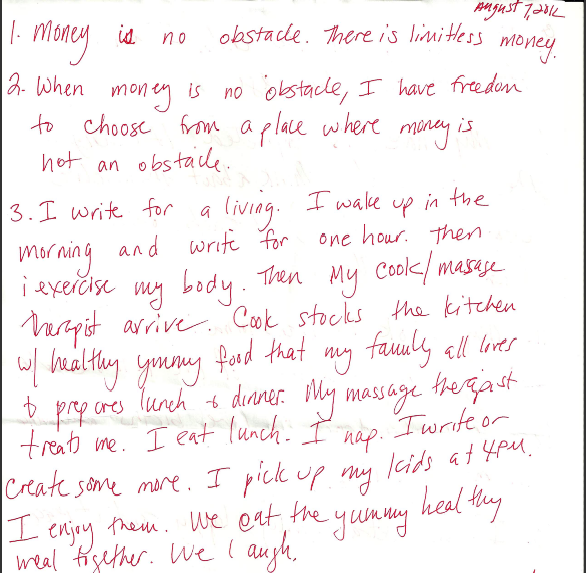
As soon as Linda handed us a sheet of paper and said go, I leapt into action. Without thinking at all, I started writing a sequential list. And this is what it looked like when I finished:

1. Money is no obstacle. There is limitless money.

2. When money is no obstacle, I have freedom to choose from a place where money is not an obstacle.

My handwritten visualization

3. I write for a living. I wake up in the morning and  I make myself an espresso. (I edited this from the original. Espresso is a necessity in my dream world.)

I sit down at a lovely wooden desk with a view and I write for one hour. Then I exercise my body. Then my cook and my massage therapist arrive. My cook stocks the kitchen with healthy, yummy food that my family all loves. She prepares our lunch and dinner. My massage therapist gives me a treatment for about an hour. I eat my healthy yummy lunch…slowly.  I nap.  I write or create some more. I pick up my kids at 4 pm. I enjoy them. We eat a yummy healthy dinner together. We laugh.

4. Once a week (maybe twice) my husband and I go out alone. Sex is sometimes involved.

5. We vacation often, and in luxury.

6. We discover the cure for food allergies and for all cancer.

7. We discover the secret to world peace, too. We implement it.

8. All my previous wrongdoings are forgiven.

9. I clean up all loose ends. I am free of guilt and emotional baggage.

10. I complete my book. It changes the way people think about themselves (for the better). It changes the way people treat each other.

11. My book is transformational. It brings an abundance of love into the world.

12. The abundance brought about by my book brings abundance into my own life.

13. I am extraordinarily happy and at peace.

14. And, most of all, I’ve managed to not mess up my kids or my marriage along the way.

As I completed the exercise, I had an overwhelming, yet unexplainable feeling that the entire kit and kaboodle was actually attainable. From the smallest triumph (write for a living) to the largest (world peace), that somehow the solution was as simple as imagining it.

I know for most people this concept is heresy — that all it takes to solve a problem is to dream up the answer. That all it takes to live the life we imagine, is to imagine it.

I mean, really, if it was as easy as all that, why haven’t we achieved world peace or cured cancer already?

And I see the truth in this way of thinking.

And yet, I see the truth in the accessibility of all I list above.

Really, what are dreams?

Are they involuntary and insignificant images that pop up during sleep? Are they the stories we concoct and ruminate over each day? The visions of the not so distant tomorrow that terrify us? That keep us in unhappy relationships or stressful jobs?

Are these really our dreams?

Or are our dreams the vehicles with which we create our reality?

One could say this visualization practice of mine the other night was no different from the anxious thoughts that keep us from doing what we really want. Except, in this case I let my mind spiral towards all that I want — not all that I am afraid of.

In the past, I’ve daydreamed a wish into reality. I bet you have, too.

My dream to fall in love. My dream to have children. My dream to move to Israel.

Once upon a time, those were dreams written out on a piece of paper — in a journal, or on an application.

And now, those dreams are my reality.

How do we reconcile this truth with the one we sell ourselves everyday? That dreams don’t come true?

Everything, in fact, begins as a dream.

And therefore everything — from personal cook to world peace — is ours for the taking.

Community, Letting Go, Love, Parenting

Tell me you love me

When someone dies, we often use that opportunity to express how we truly feel about them. And how we truly feel about them is often… beautiful.

“You were a light in my life.”

“I’m so grateful we were friends.”

“Thank you for making a difference in the world.”

It used to be that homages were reserved for funerals. Eulogies over a coffin or flowery obituaries. But now we eulogize everyone everywhere. RIP hashtags on Twitter. Memes on Facebook. Dedicated blog posts honoring people we’ve loved and lost; as well as people we never knew at all.

On the one hand, I think that this modern way of grieving and of consolation is extraordinarily cathartic and moving. On the other hand, online memorials and tributes often make me wonder how much goes unsaid during our lifetimes.

What drives us to bare our heart after someone dies? What prevents us from showering the people we know with our love and gratitude before they die? Before they fall ill?

It’s an age-old question; not one that was created by and for the new media age. But I do wonder if the new media age might not also offer us a platform to be just as generous with our love, gratitude, and praise in advance of death as we are after it. We’re already doing this for people we don’t know in real life.

One of many memes that circulated after Jobs’ death

Those of us active on social media likely spend more of our time updating our Facebook statuses with fond remarks for celebrities or politicians we have never met, than people who have directly impacted our lives — even if only for one moment. The neighbor who made you feel welcome when you moved into the community. The teacher who spent extra time working with your child. The co-worker who always remembers to ask you at the beginning of the week how your weekend was.

With ease, we acknowledge celebrities more readily than the folks who could match our picture with our first and last name if asked. And likely, one day, we will publicly mourn these dead celebrities in 140 characters or less more readily than we will tell our friends and neighbors how much they mean to us while they live. It’s only after they’re gone — the people who truly fashion the days of our lives — that we find ourselves moved to the point to express how much their being in the world made a difference in ours.

Buds of hope do surface every once in a while. Today, a friend commented on a picture of me I shared on Facebook by saying, “You grow even more beautiful as you grow older.”

I felt flush with love and gratitude when I read that.

But soon after — because my thinking often overpowers my feeling — I wondered, “Would she have told that to my face?”

I’m not sure she would have. Though not because she doesn’t think it, obviously.

The screen provides a bit of a safety net. Or else the speed with which we are used to responding on social media prompts us to type out the words we really mean rather than the ones we allow after self-censoring.

And while I’m often outraged at what people are willing to say online that they wouldn’t say to my face (think anonymous talkbacks on this blog), I cautiously posit that this impulsiveness may be used for good.

Tell someone you love them today.

Tell someone how pretty she is.

Tell someone how her smile makes you feel better about the world.

Tell someone that he was a role model for you.

That he turned a bad day into a good one.

That he taught you how to be a better man, a better dad, a better friend.

There is one day a year I can count on for public displays of affection. My birthday (which is in a few weeks, by the way.) On my birthday, my Facebook Wall is all a-clutter with love. But not in the same way I imagine it would be if I were dead.

“Have a great birthday” doesn’t carry the same weight as “You were a light in my life.”

It doesn’t mean I don’t appreciate the sentiments. Of course, I do.

But I think we can all do a better job at acknowledgment. Use talkbacks for good. Out our anonymous admiration, and be the light of someone’s life while they’re alive.

This was originally posted at The Times of Israel.

Family, Love, Mindfulness, Parenting

Taking a picture in my mind

Back when this little guy was a tad bit younger than he is today, he used to “take pictures with his mind.” He’d put his pointer fingers up to his temples, lean down towards the object he wanted to focus on (typically a kitten or a flower), and snap his eyes shut for a moment. He would soon open his eyes with a satisfied look on his face and later return home to sketch and color what he observed.

A boy with his homemade sun scope, after observing the Transit of Venus in 2012

When I was his age (or a little bit older), I used to call this practice “making memories.”

I read it in a book once.

It sounded romantic. The idea that every moment was an opportunity to make a memory if only we stopped to notice it.

I would sometimes walk home from the bus stop, forcing myself to quit counting steps and skipping over sidewalk cracks, and look around instead at the scene on my street: The sun shining through the oaks and birch trees that lined the sidewalks. The children coloring chalk figures in their driveways. The woman opening and shutting the mailbox.

I’d stop and make a memory.

It was an experiment. Something that made me feel exotic and older. Only now do I realize that this was my first attempt at practicing mindfulness, of being in the present moment.

Now, as a mother, I realize that there is indeed something very romantic about being in the moment, and it’s not the making of the memory. It is the moment itself that is romantic — for it’s the space in which you truly experience love and joy. But, recognizing this in the moment itself is one of the greatest challenges of parenthood.

Oftentimes, instead of embracing the love and joy of being with my child, I get caught up in the awareness that I’m already a memory.

A reflection. A reverberation. A remnant.

And sometimes I panic that I’m not making enough good memories of me. Or that the memory of me will land him on the analyst’s couch or on the streets shooting up.

But this morning, hours after my picture-in-his-mind-taking son woke me up at 3 am to ask “Is it time to watch Venus?,”  I found myself immersed in the 100% pure extract of love that comes only from being in the moment when it happens… and being aware of it.

There was a moment or two when my excitement almost got squashed by the unexpected falling boulders that often overwhelm us — the scope wasn’t working, the clouds were blocking the sun. And it’s a real challenge, to say the least, not to let them completely derail our original intentions.

But then suddenly the sun broke through from the clouds and lined up just as it should through the pinpoint of a dot at the top of the homemade cardboard box viewing scope and I shouted with delight, “There it is!”

There it is.

It is.

Is.

Ecstasy.

Love. Joy.

Right now.

Did we see Venus?

No, not really. But we saw something. And more important, we all felt something. Together. In the moment. Exactly in that moment.

Proving the experiment a success.

Culture, Letting Go, Love, Making Friends

Be kind to writers

Since I began chronicling my life experiences in a public forum like a blog, I’ve learned there are feelings and personal experiences I might have been better off keeping to myself. Looking at blog posts I wrote three years ago is almost as mortifying as leafing through the journal I kept in 9th grade; the one that’s peppered with love poems only an angst-ridden teenager living in upper middle class suburbia could write… READ MORE

Family, Love

Camaraderie

Last night, the siren sounded at 8 pm for Yom HaZikaron.

I didn’t expect the tears.

As the siren sounded, my children got up from the couch where they had been watching a cartoon and all stood at attention. Even as he stood, though, my five year old started to cry.

It might be easy to assume he cried out of fear: the siren is very loud and disturbing. My older son, like I do, associates the noise with rockets falling, even though we have never been close enough to hear a rocket fall. It would have been easy to say my younger son was crying because he was scared.

But when we asked him, my five year old told us he was crying for “all the lost ‘sabas,’ he said. Saba, the Hebrew word for grandfather.

He cried, even though he did not lose his Saba in a war.

He cried for all the sabas…and the men who would never become sabas.

For a moment, I worried the worries of an immigrant Israeli mother: What have I done? How did I bring my children to this country? How can I expose them to such pain? What does a five year old need to know of war and loss?

In the next moment though, I held him. And as he cried in my arms, I knew his tears were not the result of stories told to him at Gan. I also knew with certainty that even if we did not live in a country familiar with war and loss, and even if my child was not given at Gan the words to express what he felt in that moment, I knew that this sensitive child of mine would cry real tears in response to another’s pain.

I knew, as a mother knows, that his tears flowed directly from the Source.  The siren simply opened the door.