Childhood, Dreams, Letting Go, Love, Memory, Spirituality

These things

“Thoughts were things, to be collected, collated, analyzed, shelved, or resolved. Fragmentary ideas, apparently unrelated, were often found to be part of a special layer or stratum of thought and memory…”  –H.D., Writing on the Wall


I seal in plastic Ziploc bags photographs, letters, my child’s artwork. I pile up large Tupperware containers of high school journals, college scrapbooks, and sticker albums I’ve saved since 3rd grade.  There is even a small box inside a larger box in which I store cut-up cotton shirts; remnants of all the graphic tees I ever stuffed into the set of almond-colored formica drawers of my childhood bedroom. The idea was to make a quilt one day. But it’s been more than 20 years since I cut them and still they remain fragments of a former social life.

Sometimes, I let go. I purge, actually; for the movement is swift and forceful.

I gather up books and plastic toys from McDonald’s and washed out jelly jars I was saving for just-in-case. I rally the troops in their respective bedrooms and we dig out unaccounted for Lego, DVDs, and well-loved teddies they once birthed at Build-A-Bear.

It used to be that we would prepare a yard sale — display all our attachments large and small on the grass for others to descend upon and barter for. Now, I push it all down into a free tote bag I got once at the grocery store and drive to the recycling area.

My load becomes lighter then. I feel clean in the same way I do when I make the bed before sleeping in it.

It’s temporary, though, this weightlessness. I will feel dirty again. I will feel weighed down by the objects that make up my life.

* * *

Sometimes I want it all back.

Not all. But something specific.

Days or years pass, for instance, and suddenly I long for the floor-length sleeveless, blue and white flowered dress I traded in for credit at the secondhand shop on Broadway because I could never bend down when I wore it. When I realize it’s missing, I’m surprised. How could I have given up that dress? Didn’t I understand that one day it might fit me differently? There are photographs of me in that dress I can actually tolerate – black and white strip photos taken on the boardwalk in Ocean City. I was younger then. I wore contacts. But, I think it was the dress that made me pretty.

Sometimes, in a dream, I’ll be certain I still own a pair of shoes I have long since abandoned. Where are they, the black wedges I know will be perfect for the job interview I have tomorrow?  I frantically shuffle around my dusty, hardwood-lined closet floor, pushing to the side my brown suede clogs and my untied docksiders and my Naot sandals. My fingers will never find them because I listed them on a Freecycle board two years ago and subsequently dropped them off in front of a Tudor in South Orange, NJ.

One morning, I wake up and realize I’ve been dreaming about the brown leather backpack I carried with me through four years of college and some years after. I don’t even remember when I threw it away. This pains me. Documenting my losses is a coping mechanism.

Soft to the touch, but robust enough to manage three spiral-bound notebooks, a heavy “baby chem” textbook, and a glass bottle of Raspberry Snapple tucked away in a side unzippered pouch — that brown leather backpack was the security blanket of my young adulthood. Sometimes I tucked the yellow Sony Walkman into the other side pocket, a long track of rubber-lined wire snaking out and up into my ears as I hiked the city blocks between my apartment on F Street and the modern mirrored building on 22nd where I took beginner’s Hebrew on the 3rd floor and piano lessons in the basement.  There were crumbs of a chocolate chip cookie that smelled like nicotine once at the bottom of that brown leather backpack.

There was a flap, too, that closed off the main compartment, but also served as a wallet-like coin holder, with room enough for a wad of cash and easy access to my student ID. With one hand, I could click the flap shut into a magnetic metal clasp. Even though it appeared to be a complicated buckle, it wasn’t. It was very simple actually.

I must have gotten rid of the brown leather backpack in Tucson.

It must have been after my mother treated me to the high end, shiny Petunia Picklebottom diaper bag.  Like the brown leather backpack, it was a handy carryall with suitable compartments – an easy-access exterior pocket for diapers and wipes; one of the side pockets for bottles. It even came with an interior zippered pouch for personal items, a nursing pad, or eventually, a tampon.

When my son was two, we decided to leave Arizona to head back to where we came from in New Jersey.  That’s when we had our first yard sale. We sold the glass tables we registered for at Pottery Barn. We sold one of the lamps, too. We sold the swing set in the backyard.  I don’t remember what else.

It must have been then I parted with the brown leather backpack.

I guess.

* * *

Now, it’s a black canvas backpack I carry daily (a leftover promotional gift from a job I left 14 years ago). Inside are two pieces of uneaten fruit and half a cream cheese sandwich prepared on a gluten-free pita.  There is an unzippered side pocket from which a Laken thermo-insulated bottled filled with filtered water peeks out and another side pocket in which I carry plastic bags for “just in case.”  In two exterior zippered compartments, there is spare change for use in either Israel or in America, but not in both.  There are markers, pencils, pens, bubblegum already chewed.

It’s durable, my black canvas backpack.  And loved, too, in a colder more practical way. I carry it on two shoulders instead of one. I am often in awe of how long it’s lasted.

From time to time –in between classes at the university where I am studying for my Master’s degree or on a plane seated in the middle of two of my children — I consider how long and often I’ve weighed the black backpack down. How I’ve tested it. How it still serves me.

I wonder, too, how I will one day lose track of the black canvas backpack or if I will wear it until it breaks.

Childhood, Dreams, Love, Memory, Music

What is a classic?

What is a classic?

The Giving Tree in English. But not in Hebrew.

What is a classic?

The Wonder Years. Especially the one in which Paul becomes a bar mitzvah. Or any episode with The Byrds as background music.

What is a classic?

Mighty Love. Let My Love Open the Door. All You Need is Love. In My Room.

What is a classic?

Cornbread. Warmed.

What is a classic?

Square dancing in gym class. Sorry, more Wonder Years.

What is a classic?

I don’t know. Classics are supposed to be timeless and yet some classics have changed for me with time.  Like, The Giving Tree used to be IT for me and now I suppose The Missing Piece is. But that just happened 15 minutes ago. Can it be a classic already? Moby Dick is not a classic, and yet it is, just not for me. Not yet. But it might be one day and then I will look back at today and realize I was ignorant of the classics. The Wizard of Oz is a classic, but I’ve watched it too many times and now it is a classic, but stale.

Like The Shawshank Redemption.

Like TBS.

Like Apple Pie.

I suppose if I had to say, a classic is that which makes me cry when I am not sad.

What is a classic?

The tune to My Darling Clementine.

Mint.

Feet in the sand.

The Barbie Dreamhouse with the elevator.

Jim Croce.

Half-burnt marshmallow on a stick.

Josh and Jodie.

My dad’s green fiat.

Pepsi Free.

Yesterday.

That time my Bubbi cried at Denny’s because her eggs were runny.

That time my brother threw a rootbeer bottle at me.

That time the car was stuck in the mud in a rainstorm, but I only remember that one in a dream.

What is a classic?

Forgot my locker combo.

Forgot to study for the final.

Left my passport at home.

What is a classic?

“These poems do not live: it’s a sad diagnosis.”

What is a classic?

“In those years, people will say, we lost track
of the meaning of we, of you
we found ourselves reduced to I
and the whole thing became silly, ironic, terrible.”

What is a classic?

“It is startling
to realize that
some of our most cherished memories
may never have happened — or may
have happened to someone else.”

What is a classic?

What is         a classic?

——–

The above contains poetry by Sylvia Plath (“Stillborn”) and Adrienne Rich (“In Those Years”), and commentary on memory by Oliver Sacks

Childhood, Culture, Love, Memory, Music, Relationships

What time travel sounds like

Oh how I wish I was in your bedroom right now and could place inside your tiny paper plate ears a pair of plastic headphones so you could close your eyes and hear what time travel sounds like at least once before you die.

Since I can’t or, let’s face it, you won’t let me no matter how nicely I ask or how sane I try to sound, I will settle for the next best thing which is to request that you click through to this link and turn the volume up as high as it will go, press play and close your eyes.

The next 27 seconds is what time travel sounds like; and the three and a half minutes after is best suited for singing out loud. No, not lip syncing, but, singing out loud. Or (this part is optional and only for the truly possessed) pretend you are slow dancing — with me, or with someone else not me, someone you won’t let put headphones into your ears even though you really want to because you think she’s a little off or a little too sorrowful or a little off.

Close your eyes. Then, cross your arms. Rest your hands on opposite shoulders. Sway back and forth. Back and forth. Until

Dreams, Memory, Modern Life

Blogger fatigue

If it was a color, blogger fatigue would be mustard yellow and it would be caked on to the countertop like a booger.

You stare at it. Ponder it. Consider your options. You could walk away. Leave it for someone else, but in the end, you’re compelled to scrape it off with the nail of the middle finger of your right hand. (Or the other, if you’re a leftie.) Then, you use your thumb to extricate the pieces of blogger fatigue caught beneath the nail. You flick the hardened flakes into the sink — if you’re the kind of person who cares where boogers land. If not, you flick your blogger fatigue into the air where it floats down to the kitchen floor. You’re going to have to sweep it up anyway.

Blogger fatigue — by which I mean the temporary aversion to sharing any more inner thoughts, feelings, hopes, dreams, dream analyses, stream of consciousness poems about childhood shopping malls, lists of tomorrow’s tasks, casual references to cool things you’ve done or celebrated people you’ve met, tips for new moms, tips for old moms, tips for moms who wish they were lesbians, recipes with pretty Pinterest pictures, links to other bloggers whose interests I might share or not but who might link back to my blog and increase my traffic by two — is bringing me down. But not down enough to shut down. Not forever.

If there was a cure for blogger fatigue, it would be temporary, like sweatpants are a temporary relief for seasonal affective disorder. I promise, once my region of the world lights up again, I’ll return to wearing skinny jeans and telling you all about the time I touched Matt Dillon’s butt in the basement of a bar whose name I forget on the Lower East Side.

Books, Childhood, Food allergies, Health, Love, Making Friends, Memory, Relationships, Writing

5 Random Facts About Me

Deborah chose me and I’ll have to be honest — I was excited. In a tingly “you’ve been selected” sorta way. I felt it …well, I won’t tell you where, but it’s the same spot in my body and the same physical sensation I get whenever I’ve decided I’ve been designated special by someone.

Credit to http://wislrme.wordpress.com/tag/olivia-pope/ for the GIF
Credit: http://wislrme.wordpress.com/tag/olivia-pope/

Of course, this sensitivity to being chosen also makes me physically vulnerable to the dark side of egocentric arousal — for when someone decides I’m not special (or worse, unremarkable or overrated), the tingly sensation moves down to my lower digestive tract; I spend the next few hours in the bathroom, and … well you can imagine the rest.

Deborah dared me to reveal five random facts about myself. I use the word “dare” lightly because, let’s be honest, if I didn’t enjoy disclosing facts about myself, you and I wouldn’t be enjoying this writer/reader virtual pseudo-relationship. In fact, if I could just eliminate the urge to tell you stuff, I might be able to once and for all walk away from social media.

I could be happy.

But then, I wouldn’t be a writer.

Which leads me to Random Fact #1.

Everyday anxiety is an “organizing principle” in my life. In other words, it has made me who I am today and continues to make me who I am no matter how much yoga I practice, no matter which books I read, how much air I breathe, no matter how slowly or deeply. Anxiety is an essential element of me.

I did not realize there was a name for this condition until I read a passage yesterday about Joan Didion written by Vivian Gornick in her book on writing called The Situation and the Story:

For Joan Didion, ordinary, everyday anxiety is an organizing principle. Out of it she has created a depressed, quivering persona that serves her talent wonderfully … in [her] essays, where a subject beyond the self must be intersected with—migraine headache, the Black Panthers, California and the American Dream—Didion’s gorgeous nerves are brought under brilliant control. It is here, in this form, that her existential nervousness is developed with such artistry that insight transforms, and literature is made through the naked use of the writer’s emotional disability.

Don’t mistake my admission of Random Fact #1 as me comparing myself to successful memoirist and essayist Joan Didion. As if! But out of this I understand that my acid reflux and my artistry, my migraines and my imagination, like Didion’s, go hand and hand. And that I am far, far from alone.

Which leads me to …

Random Fact #2

One of my most notable appearances in the media was in the Associated Press when I was quoted as being a sufferer of irritable bowel syndrome. Equally classy, I was quoted in the Chicago Tribune as not only suffering from IBS, but also allergies and anxiety. At the time, those interviews seemed like a good idea for the personal brand I was building (as a wellness expert and writer). Now, I’m not so sure.

Random Fact #3

My bowel, ever irritable, offered me the distinct honor of pooping in the Executive Office building of the White House where I volunteered every Wednesday morning between the hours of 4 am  and 9 am for the Clinton administration’s Communications Office one semester in 1994. Also in the Embassy of Israel where I interned for a semester. And in the Starbucks on K Street.

I was just telling a friend of mine yesterday, in fact, that I had this brilliant idea when I used to live in Manhattan in the late 90s. I wanted to research and publish a Zagat type listing of all the best bathrooms in Manhattan. I zagathad mentally logged most of the cleanest ones in SoHo, where I lived and worked at the time, for my own personal benefit since I never knew where or when I would need quick access to a tidy and private stall. But what if I expanded my research to the entire island? And categorized the lists according to not just cleanliness, but also friendly to, let’s say, hookups? Cleaning up after an accidental coffee spills on the train? Best for vomiting? Ones with condoms? Tampons? Fresh mints? Luxury bathrooms easily accessed in hotel lobbies? Restrooms frequented by celebrities?

I never wrote the book, but it’s on my list of “good ideas that could have made me money if only I wasn’t so lazy.”

Which leads to …

Random Fact #4

I practically invented Facebook. If you don’t believe me, ask anyone who knew me in 1999. Especially my parents … because they like to brag about that almost as much as they like to say I was a “White House intern.” Which I wasn’t … I was a “volunteer.” You don’t need to watch Scandal to know that Washington has a hierarchy. A hierarchy, people. That said, I was a volunteer in the White House the same time Monica was an intern.

Back to Facebook and how I missed an opportunity to be a gajillionaire.

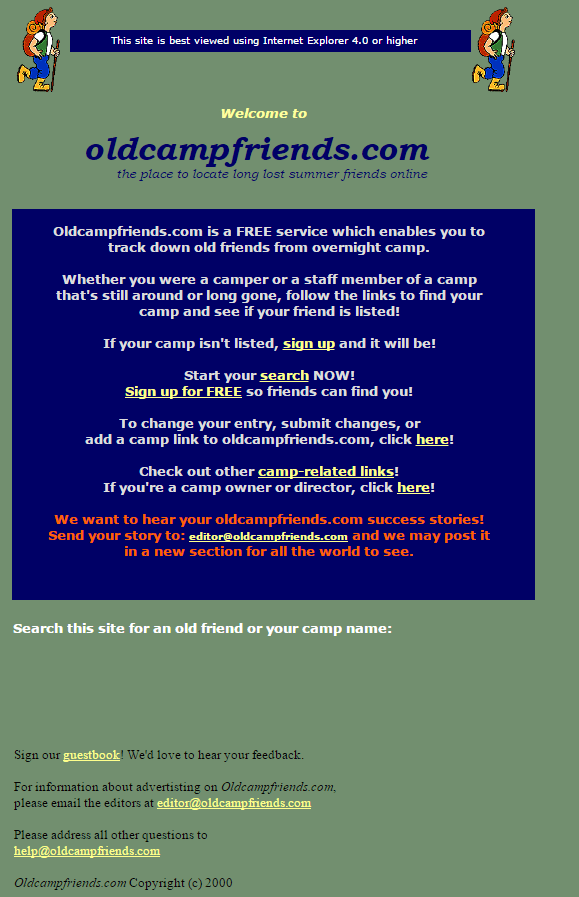
In 1999, a half a year or so before the internet bubble burst, I built on my Dell computer and maintained all on my own from my one bedroom apartment on Prince Street a web site called oldcampfriends.com. I came up with the idea because I was obsessed and preoccupied with my overnight camp experience and friends and figured other people were, too. This was before you could Google stalk anyone or pay $9.99 for a dossier on them. It was difficult, still, to track down old friends.

I built it on the old Homestead site builder online software. I created a form that people filled in and submitted. I HAND-FILLED in the information (their names and email addresses) on the profile pages I created for each camp: Camp Wekeela, Camp Wohelo, Pine Forest, Camp Anawana, Camp Ramah New England, Camp Nah-Jee-Way, Che-Na-Wah, Moshava, you name it. Your camp was there. Via oldcampfriends.com you were able to reconnect with your bunkmate, your first kiss, the counselor you always wanted to hook up with but who was too fearful of arrest … Oldcampfriends.com? It took you there.

Coulda been Facebook. Coulda been Facebook.

oldcampfriends screen shot 3

(Those hikers at the top were animated GIFs.)

If oldcampfriends.com leaves any legacy it is to illustrate how impactful the people who have passed through my life have been and continue to be even after they’re gone. It is to show that when you leave me — because leave me you must — you don’t ever really leave.

Random Fact #5

You remain inside me — sometimes as acid reflux, sometimes as tingles that recur when I look at your picture or handle between my thumbs the friendship bracelet you once wove for me in the arts and crafts cabin, or the mixed tape you made me that summer. You remain inside me, as a song or a slow dance or as a scene from a movie we watched together on Betamax in your basement. You remain inside me; sometimes as an eternal punishment, sometimes as an occasional pleasure. You remain.

Random fact: I am forever tagged by you.

You, the people.

==

I tag Sarah, Nina, Judy, Tienne, and Jason.

Family, Memory, Music

The soundtrack of home

I am not a music-while-I-work kinda girl. While writing or editing, music typically gets in my way. Instead of focusing on the project, I’ll often sing along or find my mind wandering back to a time before.

This morning, however, as I sat in front of the screen, I realized I needed music to kickstart my week and opened YouTube whose imaginary panel of advisors recommended a few playlists to me based on my previous choices; but all were from albums I knew would distract me from the careful proofreading I was required to perform.

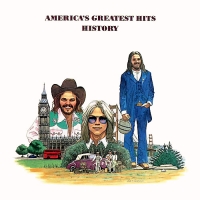
The last option in the row of recommended playlists was one I haven’t listened to … in almost forever: America’s Greatest Hits.

(courtesy Wikipedia)

I recognized the album cover as one that used to be among my parents’ combined record collection that moved to the finished basement once they purchased a stereo with a cassette player for the living room. I remember only really discovering these records, though — Kansas, The Eagles, The Beatles, Simon and Garfunkel, Jim Croce — the summer I turned ten and went off to sleepaway camp. Music, from that summer on, became the soundtrack to my memories. Music became longing.

That summer, now that I think about it, was also when I first discovered my own taste for music. It’s not that I didn’t appreciate music before — some of my earliest memories are singing harmonies in the backseat of my father’s car with my brother. But what I remember about discovering the record collection is understanding that music is not just words and melody strung together; it’s a legacy. There was a reason why certain songs ended up sung around a campfire. There was a reason why I laid on my back on the Berber carpet in the basement while Photographs and Memories crackled over the speakers, filling me with a certain sense of sorrow.

The only title familiar to me on America’s Greatest Hits.before I pressed play was “A Horse With No Name.” But as I faced the screen to review the manuscript I was working on and as the album moved along, I found myself humming along knowingly from time to time — curious that I had stumbled upon an album that was both surprisingly and pleasantly familiar, but neutral enough to allow me to stay focused on the task at hand. (Ironic since many of the songs are, indeed, about longing.)

This music, unlike my mixed tapes which seem to always jolt me back, kept me rooted in the present, but still subtly soothed by the comforts of home. Not the home I am often drawn back to — the emotionally-charged home of Milan Kundera or Proust. Home without the overwhelming nostalgia. Without the compelling need to look back.

Love, Memory, Music, Writing

We remember so little even as we remember it all

I am minorly obsessed with memory. Why we remember. What we remember. How we go about retaining and recalling memories. Which of our senses most trigger memory — is it smell? Is it sound?

I am not as obsessed as I could be. Most of the books I want to read about memory are still holding their place on my “want-to-read” shelf on GoodReads. The closest I do get to studying the topic is scanning every single article Maria Popova posts on the subject on BrainPickings and examining — both critically and creatively — my own memory and others’.

Generally, when I am not worrying about the future, I’m thinking about the past.

Based on conversations with friends, I get the sense that my memory is comparatively vivid and richly detailed. I can remember incidents as far back as age four; I remember the song I slow-danced to with my first camp boyfriend. I remember when I saw Jurassic Park, with whom, and at which theater.

But while I’ve forever prided myself on possessing accurate knowledge of when I did things and how and with whom and in what season and to what soundtrack … I’m beginning to understand just how inaccurate and filled with holes my memory is even in its breadth of knowledge. Moreso, I’ve started to recognize a pattern about what I can remember and what I can’t.

For instance, I remember scene well. My visual memory is stunning. But I get lost trying to conjure up anything physical — pain or pleasure. I remember sound more than smell. I remember color more than texture.

I remember sitting in the backseat of my dad’s green fiat convertible, the top down, the interior beige, my hair blowing back as we all sang — me, my dad, and my brother — at the top of our lungs Little Honda .

First gear, it’s all right (Honda, Honda, go faster, faster)
Second gear, I’ll lean right (Honda, Honda, go faster, faster)
Third gear, hang on tight (Honda, Honda, go faster, faster)

But I can’t remember if it was cold back there or comfortably breezy. What season was it? Early summer? I can’t remember if it was when my dad had a mustache or not. I can’t remember where we were going or what I was wearing.

Likewise, I can recall many a ride shotgun in my high school boyfriend’s used light blue BMW, a hand-me-down from his uncle. I remember the dashboard and pulling a Van Morrison compilation out of a gray canvas cassette holder and pushing it into the tape deck. But I can’t recall more than a handful of kisses — even though I must have kissed him thousands of times during our 10 year on-again off-again relationship.

The list goes on. I remember an Elvis Costello concert in Maryland the summer of 1994 (Crash Test Dummies opened). I remember it because said high school boyfriend had returned from a semester abroad in Israel and this concert was our first attempt at being “just friends.” But until I Googled Elvis Costello Concert Tour 1994, I couldn’t remember a single song on the playlist that night. And when I read the playlist, I still couldn’t recall hearing any of them or cheering for them or singing along.

I remember a fight with my brother in an airport in Denver. I remember he threw a glass rootbeer bottle at me, but I can’t remember over what we disagreed.

Then there was the time I first saw my now-husband. I can picture him sitting in a conference room in the JCC in Cherry Hill, NJ. I was there with a group of 8 or 9 20-somethings to be interviewed for a position to lead a teen tour to Israel. Get this: I remember the lighting in the room. I remember where I sat at the table in comparison to my future-husband. But I don’t remember his voice that day, what he wore, or any interaction we had.

All this matters because as I track down my memories in an attempt to write memoir — really, in an attempt to understand myself and my life — I find my memories with their limited and unreliable perspective are indeed not memories at all.  I find I understand what Oliver Sacks means when he says, our memories are “not fixed or frozen … but transformed, disassembled, reassembled, and recategorized with every act of recollection.”

All this matters because it is via this patched together quiltwork of recall that we assess and reassess the fabric of our lives. Whether or not we are writing memoir.

As I continue to examine my memory and put it through the hard test of being fact-checked, I find myself re-evaluating who I am and how I got this way.

And I remember it all with a grain of salt.

Books, Childhood, Love, Memory

I admit it. I am a bibliophile.

Is our melancholic love of books in the digital age just another reinterpretation of our nostalgia for home?

Today, I opened up a 1983 edition of  Madeline L’Engle’s A Swiftly Tilting Planet (the third book in the A Wrinkle In Time trilogy) and almost tilted over myself.

Okay — that is a tiny exaggeration.  But I wasn’t even able to move past the Table of Contents before I was overcome by a whoosh of emotion rushing through my chest and up into my throat.

“In this fateful hour…”

My pulse turned rapid.

“All Heaven with its power …”

The way I used to feel when a boy I liked was just about to kiss me.

“The sun with its brightness…”

Held my breath. Tried to steady myself.

“The snow with its whiteness…”

Leaned in. Closed my …

The fire with all the strength it hath…”

And took a picture of it on instagram to share with all of you.


SwiftlyTiltingPlanet

bib·lio·phile   noun \  ˈbi-blē-ə-ˌfī(-ə)l\
: a person who loves or collects books
: me

Childhood, Memory, Parenting, Poetry

Approaching Autumn

“How do you call ‘stav” in English, again, mommy?” he asks, as we make our way up the hill.

“Fall,” the bigger one says quickly.

“Or Autumn,” I say.

“Autumn,” he repeats. “Right.”

“Autumn is the fancier version,” says the bigger one.

“Yes, there’s something delicate about the word, Autumn,” I say.

Also, something composed and at ease, I think, and an ache passes through me. I decide to share it.

“You know,” I say, “sometimes you use the word ‘autumn’ when describing a time of your life. As in, ‘the autumn of her life.’  Spring is the beginning. Summer, the season of joy and play. Then Autumn. I think I might be approaching Autumn.”

“No, mom,” says the bigger one. “You’re still in Summer.”

“Really?” I ask. And I mean it.

Tell me, I want to say to him. Tell me how I’m still in Summer.

And he does, without my asking.

“You’re still healthy. You’re still young.” His brother nods.

I don’t correct them. Not out loud. I yearn to, though. To warn them. To make them see.

“You’re definitely not in Autumn yet,” he continues. “Autumn is like 50. At least 50.”

Later, we see an old man cautiously taking on a series of stone steps. He approaches each rise from the right, first with the rubber bottom of his cane; then lifting one leg; then the second.

As we pass this man on the stairs — we going down — I understand that if asked, this man might place me at the crossroads where Spring meets Summer. And I could see how he could see me there. How he’d laugh at me if I asked him “which season,” and respond with something like “youth is wasted on the young.”

My young one looks at me and says in a whisper, “That man is in Winter.” And then louder asks, “What season am I, mommy?”

I look at him and I laugh.


Childhood, Family, Love, Memory, Parenting, Poetry, Relationships

Hidden Pictures


Hidden Pictures

At Jennifer’s First Birthday, 1975

birthday0001

In this big picture, find the locket, the John Lennon spectacles, blue eyeshadow, bangs trimmed straight, August, yellow #5, a red balloon (not to be confused with The Red Balloon), a tray wiped clean, a downward glance, an elephant, love, another elephant, motherhood, hints of a Bubbi in a baby’s breath, a candle blown, “she looks like you Mom,” uncertainty, a glassy iris, love, the end of an exhale, one year, 26, 11 in between days, a hidden picture, gingham.

In this big picture, find


* * * * **
Happy birthday, Mom.
Hidden Pictures is a trademark of Highlights Kids magazine
.


Family, Love, Making Friends, Memory, Music, Poetry

A list of things I’d rather be doing than frowning

Wiping the dust off an antique mirror inside a shop in Nogales
Kissing my baby on the underside of his left ear
Smelling the crusty old spit-up there
Listening to Van Morrison on the tape deck of the blue BMW

Opening that teeny tiny folded up love note with the lift-the-flaps
Chewing Hubba Bubba with one of the Adams
Asking Suzanne to fix my bra strap in gym class
Fun fun fun til her daddy takes the t-bird away

Sipping cider right through a straw
Licking powdered sugar off my fingers
Baking chocolate chip cookies for a sundae
Memorizing the lyrics to Don’t Stop Believing

Watching the third season of Lost
Braiding hair, anyone’s hair, but mostly my mother’s
Lying on my right side while my back is tickled, by anyone, but mostly by my mother
When they’d play I’d sing along, it made me smile.

Riding my bicycle down Queen Anne
Jumping off the high dive at Woodcrest Swim Club
Reading Are You There God, It’s Me Margaret
That time Scott dedicated Love Bites

Lying on my back on the rooftop at sunrise at Nimrod
Someone’s basement, an old couch, Good Morning Vietnam
Odd’s or GG Flipps, whichever
Something by Blues Traveler

Swimming from the beach to the floating deck
Choosing Biff or Malibu for my birthday kiss
A wella wella wella uh tell me more
I Will.

Stepping off the bus on Old Route 16
We’ll set the air reverberating with a mighty cheer
Pretending I am psychic
Dreaming the good ones, even if I forget them.

Letting Go, Love, Memory, Poetry, Relationships

I’ve lost something. I’m not sure what it is.

Conjugate the word “find” any way you want —

To find.       To be found.      Finding.

and you will discover my obsession. Maybe you’ll become enchanted, too.

To know what I am talking about, listen to the long “i” in find and compare it with the “ow” inside found. There is, in those two words, a dance between longing and receiving; between the imagined and the concrete.

*    *    *

I can’t say it any better than this. Not yet.  I apologize if I am being vague. I am not used to being vague. I blame poetry.

*    *    *

A snapshot of a page inside my copy of  Adrienne Rich's Your Native Land, Your Life
A snapshot of a page inside my copy of Adrienne Rich’s Your Native Land, Your Life

Perhaps the anecdote behind this book (the one opened in the picture above)  will help.

I found it in the giveaway pile near the recycling bins a few months ago.  I was in the middle of a semester studying poetry and while I had heard of Adrienne Rich, I didn’t know much of her work. So I brought the book home, read the collection once, and it sat with me so-so, which is to say I didn’t find anything particularly meaningful to me just then.

But the other day I pulled the book out from the shelf and did what I do sometimes — opened up to any page and see what wisdom or guidance I am offered. My finger landed on this poem.

The wisdom  — and perhaps, a more concrete explanation of my obsession with finding — comes in the sixth stanza, beginning with “I’m trying for exactitude.” Because this, in some way, is the essence of my obsession  — a lifelong “trying for exactitude,” a lifelong desire for certainty, accuracy and control; a lifelong attempt to get it right; as if there is truly a way to find my way to found.


= = = = = = = = = = = = = = = =

What Was, Is:
What Might Have Been, Might Be

by Adrienne Rich

What’s kept.    What’s lost.   A snap decision.
Burn the archives.   Let them rot.
Begin by going ten years back.

A woman walks downstairs in a brownstone
in Brooklyn.    Late that night, some other night
snow crystals swarm in her hair
at the place we say, So long.

I’ve lost something.   I’m not sure what it is.
I’m going through my files.

Jewel-weed flashing
blue fire against an iron fence
Her head bent to a mailbox
long fingers ringed in gold   in red-eyed
golden serpents

the autumn sun
burns like a beak off the cars
parked along Riverside    we so deep in talk
in burnt September grass

I’m trying for exactitude
in the files I handle worn and faded labels
And how she drove, and danced, and fought, and worked
and loved, and sang, and hated
dashed into the record store    then out
with the Stevie Wonder    back in the car
flew on

Worn and faded labels . . . This was
our glamor for each other
underlined in bravado

Could it have been another way:
could we have been respectful comrades
parallel warriors    none of that
fast-falling

could we have kept a clean
and decent slate