Memory, Mindfulness, Music, Parenting

Love Song for a Vampire

If I had nothing else to do in my life right now — no full-time job, no school, no household chores, no parenting, no community commitments — I might decide to drop everything and pursue a journalistic investigation of music and memory.

Truth is, I am doing this already on a very personal level. For those of you who follow the blog, you might have already sensed my budding fascination in some of my recent posts (Check out “Both Sides,” Don’t You Remember You Told Me You Loved Me,” and “Seeking the Language of Music“). These snippets appear in large part due to a long form piece I am in the early stages of writing that explores how music shapes a person, and how a person, often unknowingly, shapes her Self under the spell of music. It’s about how embedded music is in our memory, how memory sticks because of its attachment to music, and how, we can or do use music to maintain memories we deem integral to our sense of Self.

But what about the memories that don’t stick? The ones we let sink down into the darkened depths of forgetfulness? Either on purpose, because they are too painful? Or accidentally, because we think we no longer have use for them?

I am finding that all it takes is a journey … an intentional journey of remembering … for those memories to ascend on their own from the deep. We have a drawer, I’m realizing, we didn’t know we had access to. It’s our subconscious — And we can open it and take out what we need if and when we need it. Of course, there are times a memory surfaces before we realize its usefulness. And then it’s up to us to make the connection.

One such memory levitated to the surface of my consciousness yesterday, seemingly from nowhere (though I am starting to understand that nothing surfaces from nowhere.) It happened like this:

<A few haunting notes tap tap tap on my brain>

What’s that?

<Paying closer attention now>

Are those train horns?

<Even closer attention>

It’s certainly familiar…

Wait, is it this?

No… no, not quite that. Something similar, though.

Wait a minute.

Oh my God.

<Startled look on my face>

<Heart skips a beat>

<Can’t catch my breath>

Oh my…

It’s this.

<Sigh>

I haven’t thought about that in years.

And it all comes flooding back.

The memory — the very visceral experience, actually — that I hadn’t recalled in oh so many years was that of listening over and over again on my Walkman freshman year of college to a love song. In particular, “Love Song for a Vampire,” performed by Annie Lennox off the soundtrack of Bram Stoker’s Dracula (a film I have never even seen …surprisingly.)

The introduction of the song, indeed, sounds like train horns. And maybe that’s all it took yesterday, as I rode the train from Binyamina to Tel Aviv, for a memory to stir, to shoot up like a bubble waiting to be uncorked. All it took was the sound a horn makes.

I searched for the song on my smartphone, but couldn’t get to it due to a bad connection. So I obsessed a little all day long until I could return to the computer. In the meantime, because I had time to kill on the train, I pondered.

Why? I thought. What purpose does this memory serve now? Why do I need it? How does it apply?

I still don’t know the answer.  It’s on the tip of my tongue, just like the song was yesterday, and while I don’t see the purpose yet, I know this memory will be a valuable one in my writing. This piece (this book, this short story, whatever it becomes)  — it’s not just about music and memory. It’s not a clinical piece. It’s about me. About my own passage into middle age. About coming to peace with my past in the face of my present and in the prospect of my future. It’s about accepting myself for who I was and who I am now — acknowledging and embracing the differences.

It’s about forgiving — yourself, others, the cruel linear aspect of time.

And I think, in there, lies the key to “Love Song for a Vampire.”

Maybe.

In the meantime, I’m listening…
 

Letting Go, Love, Memory, Mindfulness, Modern Life, Music, Philosophy, Relationships, Uncategorized

Both sides

On my drive home from work, I play a game sometimes.

I choose a song to listen to on YouTube. When it finishes and when I get to a stop sign, I look through the suggested songs at the bottom and choose one. That’s the game.

I typically get through three or four songs this way. (I have a 25 minute drive but not so many stops along the winding mountain roads.)

I play this game, as opposed to creating a playlist or listening to a CD, because I am lazy and because Pandora doesn’t work in Israel and because I have this notion that there is a certain magic to the way songs appear in the recommended song section, as opposed to this thing called an “algorithm” I hear so much about but have no idea what it really, truly means. And anyway, I’d rather believe in magic, in an elf DJ who lives inside my smartphone.

It was in this way that I came upon a live version of Both Sides Now sung in 2000 by Joni Mitchell.

I was first introduced to this song in 1988 by my friend Suzanne. I remember because anything folksy or hippiesh I pretty much learned from Suzanne, whose parents were once, apparently, hippie-like, or at least more hippie-like than any of my other friend’s parents in that they owned a guitar and watched Woody Allen movies and collected Bob Dylan records and other stuff I am not at liberty to reveal because you can only embarrass your own parents on your blog, not somebody else’s.

I say this only to let you know that I’ve been listening to Both Sides Now for a long time. I know all the words. I know Joni’s voice and pitch in the song by heart. It made many a mixed tape because I loved it so.

So when I heard Joni from 2000 sing Both Sides Now on my smartphone today, I almost didn’t recognize her. Her voice had changed so. It’s deeper, raspier, more…broken. In a way middle aged women are broken. In a way moons and Junes and Ferris wheels one day become broken after years of working hard on automatic.

I, like I’m sure many who’ve heard this later version of Joni sing this poignant song, thought, “how very perfect.” She is singing this from the other side, and the change in her voice — now alto and smoky with maturity — matches perfectly the impression of being there, then, in the days when clouds only block the sun. One listens to this version and really feels as if Joni has been through it all. One listens to this version and can sense beneath the vocals an oh so subtle laughter, as if…

She sounds resigned, Joni, and yet, satisfied. Good with the turns her life took. Or at least accepting of them, even those which were unexpected.

I listened to her and thought about the girl I once was; the girl who once listened to this song mournfully, as if I was already on the other side. As if…

I sang out loud and wondered, “what would you hear in my voice now?” You who knew me when I was young. You who knew me before the years… Before the years carried me over into the other side?

Family, Letting Go, Love, Making Friends, Memory, Mindfulness, Writing

The almost, so-very-lost, art of the letter

I’ve been finding letters.

Long lost letters.

Long saved letters.

Long ago, written-by-hand letters.

As and Es and Is strung together to form laughter and love and pain.

Through my veins runs remorse

then retraction

as I read the letters aloud.

Loopy script

Straight uppercase caps

Bubbled Oooos and lowercase bees

All of them stamps of time and postmarks of personality

Who knew then that you were a poet, dear Friend?

Who knew that you could dance with your words, dear Lover?

Who knew, Mother, that you missed me with an ache you hid away so I would never know

until I, too, was a mother?

Aching…

Who knew then

what I know now?

Did you?

And I simply

missed it?

Did you know I would read your words aloud

and fall in love with a version of you I never knew?

Childhood, Dreams, Family, Letting Go, Memory

Meditation on Yard Sales

I have a tendency to hold on.

This tendency is so strong, I’m confident I will end up a haunting ghost in someone’s house when I go.

I hold on to photographs, to letters, to my child’s sketches. I refuse to part with shoes I want to love but can’t because they give me blisters; nor can I say goodbye to the beat up stuffed animal I’ve had since sixth grade.  The t-shirt I received as a party favor at a forgotten friend’s bat mitzvah sits at the bottom of a box  with fifteen others waiting to be turned into a quilt I’ll never make.

I hold tight to first impressions, grudges, undeserved adulation.

And then sometimes, I let go.

No, not just that.

I purge.

I prepare a huge yard sale and lay all my attachments on the grass for everyone to peruse.  Everyone I know and don’t know descends on my beloved belongings.

“Please take them from me!” my eyes say. And they do. For a penny, for a song.

And my load becomes lighter.

If I were to die then and there, I could float up to Heaven like a feather on the wind.

Memory, Writing

Don’t you remember you told me you loved me baby?

The first song I can remember singing in the shower started like this:

“When I was young, I’d listen to the radio,
waiting for my favorite songs
When they’d play I’d sing along.
It’d make me smile.”

Do you know this song?

Do you hear the tune in your head?

Are you singing along with me?

If yes, you’re already in on the joke.

If not, play along for a few minutes. Humor me.

The song continues:

“Lookin’ back on how it was in years gone by
And the good times that I had
Makes today seem rather sad, so much has changed.

It was songs of love that I would sing to then
And I’d memorize each word
Those old melodies still sound so good to me
As they melt the years away…”

I was five then. I know only because I remember the blue paint on the walls of my parents bathroom and my reflection in the mirror that spanned the length of the vanity. I was beveled, like the glass of the shower door.

I was Karen Carpenter in that mirror. Singing my little heart out. Singing about the kind of pain I wouldn’t know until many years later — the simple heartache that is a result of nothing too tragic, just the passing of time.

Soon after those singing in the shower days, I’d lose the freedom to belt out Karen Carpenter to social pressure. The Carpenters, after all, were played only in the tape deck of my mom’s car and on the easy listening channel. The Carpenters were weak … and for losers.

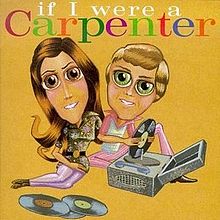
If_i_were_carpenterThis changed quite suddenly when I was a senior in college. A compilation CD was released called “If I Were A Carpenter” in which alternative rock bands got together to cover the songs of the brother-sister duo. The result was stunning. Mind-blowing. Just listen to Sonic Youth’s rendition of Superstar. It’s an entirely different song. Reinterpreted, and yet, carrying the same powerful message.

“Don’t you remember you told me you loved baby?
You said you’d be coming back this way again baby…”

It’s dreamy, this version, creepy even. Not sweet and innocent. Nothing a five year old girl would sing in the shower. It’s so not Karen Carpenter, and yet, her legacy remains between the lines.

Funny, I thought, this morning. At 5, I could hear a faint bit of optimism in Karen’s vibrato, as if maybe the superstar would one day return. At 39, listening to Sonic Youth, all I hear is drawn out hopelessness and the certainty that the superstar will never “be back this way again.”

Who was right?

“Yesterday Once More,” the song I used to sing in the shower was covered on the album by a band I never heard of (and still haven’t) called Redd Kross.  Their version introduced electric guitars and transforms a wistful reflection into an anthem. 

Consider what happened to Karen Carpenter when her songs were covered by alt rock bands. She became relatable to an entirely different audience.

Someone whose ears would have been closed shut to her poetry, to her message when she sang it … suddenly might have opened up when her words and music were expressed by someone else. In their accent.

This made me think of my listening of others. And others’ listening of me.

How quick we are to stop listening when the voice is unfamiliar, when the song isn’t one we want to sing along to. Or when we’ve already decided the person speaking is weak, or a loser.

We’ve already shut our ears … before they even have a chance to speak. Or sing.

And what happens when someone else steps in and offers the same message, but with a different tune.

Culture, Love, Memory, Writing

RIP Blockbuster: A pop culture haiku

(This haiku was inspired by “R.I.P. Blockbuster, You Frustratingly Magical Franchise, You” by Kevin Fallon in the Daily Beast)

==

RIP Blockbuster Video

By Jen Maidenberg

==

Neighborhood stop for

high school dates rated PG.

Press play. Then make out.

==

blockbuster-closing

Memory

One compulsion leads to another

I wrote recently about this superpower I possess called synesthesia. How I see letters and words in full color. And how I am going to defeat fear once I manage to harness my power properly.

It occurred to me this morning that my superpower might be the cause of quirky compulsions I also possess like the one that prevents me from listening to the Beach Boys in December, or drives me to listen to Van Morrison when the leaves start to change color and fall from the trees (even if I’m not living in the country in which they do.)

The connection between music and emotion is a studied one that’s not unique to me, but actually quite documented in human beings. But what about music and season? For me, the music must fit the weather outside. And there are singers or albums that are just completely inappropriate in winter, or off limits when I’m driving with the top down in July.

I looked into it a little. And guess what?

There’s a connection…and suddenly my strange compulsions don’t seem so compulsive anymore.

Studies show that music is connected to color and color is connected to emotion — particularly for people with synesthesia. From there, the connection is easy.  Emotion as it relates to season is a no-brainer. Lots of babies are born in August, nine months after couples snuggle up together inside supposedly to warm up from winter’s cold. I think it’s more than shelter from the cold they seek; but love and interpersonal connection that is often sacrificed in the isolation that winter brings.

Ask the average Joe or Jane which emotion is aroused when they envision summer. Most will say joy. Freedom. Fun. Ask the same person to describe the accompanying emotions to winter, Most will say introspection, introversion or sadness.

What about you? What do you say?

Having superpowers can make a girl feel lonely sometimes. Like I’m the only one whose heart hurts as fall moves towards winter. But when I get like that I cry it out to Randy Newman … whose voice and lyrics match perfectly the melancholy and nostalgia that crop up for me in fall.

Or I listen to this video — a performance of his “I Want You to Hurt Like I Do” in Berlin– and I laugh. Knowing I’m not really as alone as I think.

Childhood, Memory, Relationships, Writing

The yellow bowl

I am obsessed with my child’s memory of me

of this moment

of this yellow bowl.

This inaccessible ceramic yellow bowl

perched high upon a dusty refrigerator

will one day be dusty, too —

an image sitting in a drawer waiting to be opened

in my child’s memory.

Inside the yellow bowl are rainbow jelly beans, Polish lollipops

handmade by a retired couple sitting at a railway station.

There are remnants of chocolate wafers, too, and little crystal crumbs from an uneaten

sucking candy.

Pomegranate flavored.

In my child’s memory, this yellow bowl

is the key to happiness

and evidence of goodness

and bad.

It is what determines right and wrong.

It is — and will always be —

a beacon.

“Lost children,

find your way home.

The yellow bowl is calling you back.”

Family, Health, Memory, Writing

I’m no Katie Couric — but I really don’t want cancer

In order to be adequately prepared for a colonoscopy, you need to get to a point at which your poop looks like pee.

It’s the one time in your life when yellow liquid shooting out forcefully from your butt is a WIN!

I share this with you not to gross you out to the point of leaving my blog never to return, but in order to do my part towards colon cancer awareness and, like Katie Couric (although not as gracefully) to show that colonoscopies are not as bad as they sound.

I’ll let you know on Saturday if that’s true or not since I’m heading in for my first one tomorrow.

Sure — colonoscopies involve your butt, or as Dave Barry so appropriately coined it, your “behindular zone.”

And yes, the prep towards colonoscopy involves a lot — yes, a lot — of poop.

And no, poop blogs are not as popular as mommy blogs or political blogs, but since this is a personal blog, I decided I couldn’t receive full penetration by a camera attached to a long tube without sharing the experience with all of you.

I won’t be instagramming my IV insertion (since it’s usually a long and painful process for a nurse to find my veins), or tweeting my ease into sedative-induced slumber (because if the IV found its way in, it means it’s time to finally relax), but I do hope to encourage a few folks who have been putting off their recommended colonoscopy appointments by detailing how “not-so-bad” my experience was.

Here’s why:

My grandmother died of stomach cancer.

I was 12 when she died, but I vividly remember her wasting away in the months prior.

I remember what my grandmother looked like before — alive, full-busted and round. And what my grandmother looked like after — suffering, yellow and skeletal.

All my life, I have been troubled by a sensitive stomach and by these images of my grandmother, and if a colonoscopy can somehow alert me to pre-cancerous polyps, I think it’s well-worth the poop.

Wish me luck.

  • EDITOR’S NOTE

I completed the procedure this morning after the moderately challenging prep and happy to report clean results. I will say this — reading message boards about the prep before doing actual prep (drinking a laxative mix that makes you go for 24 hours straight) scared me into thinking the prep would be much worse than it was. It wasn’t that bad. Of course, this coming from a lifelong sufferer of IBS who is not stranger to spending 24 hours on the toilet.

Bottom line: Colonscopy is a lot scarier in your mind than in reality. Get it done. I’m not scheduled for another one for 10 more years. Woohoo!

Memory, Relationships, Writing

What I learned from Alice Munro’s Nobel Prize win in literature

Oh Alice Munro:

“For years and years, I thought that stories were just practice, till I got time to write a novel,” she told The New Yorker in 2012. “Then I found that they were all I could do, and so I faced that. I suppose that my trying to get so much into stories has been a compensation.”

Thank you for your well-timed win and wisdom, Ms. Munro, if I may call you that.

(Though I prefer to call you Alice.)

Your words in  The New Yorker were exactly what I needed to read right now, as a writer and as a human being:

As a writer who wishes to breathe life into the characters who infiltrate my dreams, but doesn’t yet know exactly what those characters really want or where they are going.  As a woman who yearns to give life to ideas stirring inside my heart — but often lacks the time or the energy. As a human being who is constantly wondering what in this life is practice and what is for real.

Thank you for writing real women, real marriage, real life … in a way that allows the reader to envision the beauty that exists even in those very real, raw circumstances.

I’ll be honest. I’ve only read Runaway, and selected short stories of yours, but you’ve always been a writer I’ve wanted to read more of.

And I love your name.

Alice.

Munro.

It’s a name that deserves celebrity.

I love that you’re Canadian, and that my Canadian best friend loves your writing, and that those two things together make me want to read more of your stories.

I love that your first collection was only published when you were 37. It offers this exhausted and overwhelmed 38 year old mother of three a glimmer of hope.

I love that you’ve lived to be 82, and I wonder if you always knew that you would live this long or if you always thought, like I do,  that you were only one year away from dying — a victim of a tragic disease or an automobile accident.

Too bad. So sad. No book for you.

I wonder when your heart stops breaking. Does it?

I wonder when you run out of vivid memories to weave into your stories.

I wonder when you stop caring what people think and just write what you must so that a weight is lifted from your shoulders, and you can move on.

I love that picture of you — the one in which you’re sitting on the edge of the railroad track in The New York Times’  article. You look defiant, brave, and yet serene.

I wonder what takes more courage? Writing your truth or having it read by others?

Or sitting on the edge of a railroad track?

I win too, from this celebrated win of yours, Alice Munro.  Through getting to know you better, I am reminded that writing about what you know is enough.

Writing about relationships, memory, your life in your town. It’s enough.

I don’t need to fabricate tales of magic and mystery. I don’t need to create a romance that is one for the ages.

My life alone offers enough content for me to mine — life itself is a gift to any attentive writer.

Isn’t it?

What would you say, Alice Munro?

To a grown woman who still imagines herself a girl?

To a writer who still imagines herself on the slow road to a Nobel Prize in literature?

What would you say?

Would you say,

“Slow down?”

“Don’t worry?”

Would you say,

“It was all worth it?”

“It doesn’t mean a thing?”

Oh, Alice Munro. You’ve taught me a thing or two just by winning a damn award.

Getting old is better than being dead, you said, to the New York Times reporter.

“I’ve done what I wanted to do,” you said. “And that makes me feel fairly content.”

Memory, Writing

Nibs give you magical powers, and other lies I told under the influence of candy

If I had written this article on the 25 best candy bars of all time, I probably would have replaced Caramello with Rolos, and left out anything with coconut. But to be fair Rolos isn’t a bar, which is probably why the author chose Caramello in the first place.

My first reaction to seeing the post in my Twitter feed was impulsive:

“Hey, it’s Halloween season! Who can I get to ship me some candy corn to Israel?”

My second reaction, after I read the article was:

“Man, it sucks that my kids have nut allergies. I really miss Butterfingers. More than I miss Reese’s and way more than I miss Snickers.”

But then something about seeing all these old friends — candy bars I haven’t touched in years — caused me to delve deeper.

In particular, the nougat-filled Charleston Chew shined a light into the subterranean caverns of my memory.

I remembered a better chew.

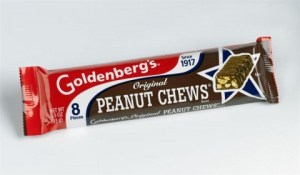
The Goldenberg’s Original Peanut Chew.

peanut chew

It was my favorite 5 cent purchase at the synagogue gift shop each Tuesday and Thursday afternoon when I was in elementary school.

Tuesdays and Thursdays were for Hebrew school, and for candy treats I could buy on my own. 4 pm was prime traffic time for the glass-enclosed gift shop at the end of a long hallway peppered with synagogue administrative offices. We lined up one behind the other inside the narrow non-room that was the gift shop, carefully avoiding the stained glass menorahs and brass kiddush cups sitting a top plexiglass shelves.

There was no regular, lovable character serving us at the register. No Candy Man. No Nat from the Peach Pit to welcome us. Just a retired old lady who walked over once or twice a week from the Windsor Towers to make a few bucks selling Judaica and sweets.

They didn’t sell regular candy at the gift shop, not that I can remember at least.

No Milky Ways or Hershey Bars or KitKats. The kind of treats you’d beg your mom for while waiting in line to pay for groceries at Pathmark.

No, the offerings at the gift shop were always obscure — come to think of it, either they were cheaper wholesale so the synagogue could make a higher margin of profit; or maybe back then, only B grade candy got a kosher certification.

Only old ladies dead and gone know for sure.

When I wasn’t buying 5 cent mini Peanut Chews, I was splurging on stick candy —

©Copyright 2010 Lewis Chocolate & Candies All Rights Reserved

Rootbeer was my favorite.

I also sucked on Necco wafers, Junior Mints, Broke my teeth on Mary Janes.

Something I never bought, but my little brother always did was Nibs. I was never a licorice fan. I’d eat a red Twizzlers if you gave it to me for free, but I wasn’t going to spend my penny candy money on licorice.

Nibs were (are) tiny bite-sized cherry flavored licorice candies that were packaged in a semi see-through pink plastic bag.

One morning, as my brother and I were waiting for the bus at the corner of our street, he pulled out a half-eaten bag of Nibs from the bottom of his backpack.

“What are those?” asked Pretty, the Indian girl who lived down the street from us.

My brother and I looked at each other quickly. Pretty was not only burdened with the enormous weight of being named Pretty, but she was also gullible.

We had played a few harmless tricks on her before — told her we could make the pictures on our — ahem  Freezy Freaky — gloves disappear using only our breath.

Earlier in the year, I easily convinced her my hair was really a wig, by moving my bangs back and forth slowly with my hand pressed hard against my forehead. She never bothered to ask why I had to wear a wig. She simply … believed.

Our tricks never really hurt Pretty — in fact, I’d say they added wonder and delight to her early mornings. But, as a mother, I know the tricks we played on Pretty would not be antics I’d want my kids caught doing to other children today. You live, you learn, and (hopefully) you realize that just because something makes you laugh, doesn’t mean it’s funny.

When my brother pulled out the Nibs that morning — a synagogue gift shop purchase and therefore an unusual and rare confectionery find for our non-Jewish schoolmates — we jumped on the opportunity to delight Pretty …and yes, test how far we could go,

“What are those?” asked Pretty.

“They’re magical candies,” I answered. “When you eat them, you can read people’s minds.”

“Not true!” Pretty exclaimed. She wasn’t stupid … just a bit of a sucker, if you’ll excuse the candy metaphor.

“Yes, true,” said my brother, passing me a “how are we going to pull this off” look.

“Listen,” I told Pretty. “I know it sounds weird, and maybe it doesn’t work for everyone, but yesterday when we were eating these, we totally read each other’s minds.”

“Really?” she said, looking back to my brother for confirmation.

My brother and I both casually nodded our heads.

“We didn’t believe it either, but after eating just one, suddenly I knew he was lying about a secret room he found playing Adventure.” I said, pointing to my brother. “He didn’t find it.”

My brother glared at me. This was a real argument we had the night before. We both had been searching for weeks for the elusive gray dot our cousin Greg had told us about.

“Wow. Can I try one?” Pretty asked.

My brother looked at me, uncertain of what would come next.

“You can,” I said, “but not now. It’s not good to do it right before school.”

“Why not?” asked Pretty.

“It’ll be too loud in your head — all those thoughts — you’ll get a headache.” I had read way too many young adult novels featuring characters with ESP.

Pretty considered this for a second and then said, “You’re probably right. It’s not a good idea. I’ll wait til after school.”

By the end of the day, however, after the bus dropped us off again at the corner, my little brother had already eaten the remaining Nibs. Conveniently, there were none left for Pretty to try.

And frankly, I don’t remember if she simply dropped the matter or if I came up with a reason why we never brought Nibs to the bus stop again.

But I do wonder where Pretty is now — and whether or not she ever truly believed our stories, or if she was, indeed the smartest one of us all, by approaching a remarkable claim with curiosity, instead of cynicism. Choosing to believe first, understand later.