Family, Letting Go, Love, Middle East Conflict, Parenting, Politics

Listen to the mothers

We’re in the middle of a war.

It’s not a real war, not yet, my vatikim co-workers and friends tell me.

But they don’t live in the South. They don’t live in Gaza. And they don’t live on Twitter.

A real war is taking place on Twitter.

Instead of fiery op-eds in the New York Times, social media has become the new PR battleground for the Middle East Conflict.

As it should be.

Because the mainstream media is doing a poor job of telling it like it is.

To be fair, however, “telling it like it is” on Twitter also is pretty subjective. Even when it’s told by those of us with a traditional journalism background.

So what to do for a girl who wants to get the real story?

I say, listen to the mothers.

We mothers in Israel are keeping it real.

We mothers in Israel are having heartfelt, honest conversations with our children. We are keeping them calm.

We mothers in Israel might make up stories when the real becomes too real, but we share them only at bedtime and whisper them into innocent ears.

True, we aren’t always clear-headed.  We aren’t always fair. And sometimes we growl because that’s what mama bears do when they get scared.

But, mostly we observe; we ponder; and then we tell it like it is from a heart-centered mother’s point of view.

At least, those of us on the front lines of the social media war do.

* * * *

Politicians or military professionals, if they bothered to listen to the mothers,  would laugh at us. Belittle us. Keep us far away from the battleground.

We can’t risk opening our hearts too wide, the combat professionals  would say. We can’t allow ourselves to be too vulnerable.

And yet, what any social media expert will tell you is that the true value of social media is connection.

Don’t bother using social media — not for any cause, not for any business — unless you are prepared to be vulnerable. To share of yourself. To engage.

And this is why the mothers in Israel are a most effective tool in this social media war.

You believe us.

Why? Because our stories feel … real.

They feel real because you know us.

Or, at least you feel like you do.

Because we dared to open our hearts to you.

Yet, there’s a side effect to listening to the mothers …

Be prepared.

You might become susceptible to love.

Susceptible to love not just for your own child, but for another woman’s child.

(Even for the child of your supposed enemy in this not-quite-yet-a-war.)

When I listen to the mothers, my heart opens to other mothers.

Not just to the mothers of 19-year-old Israeli soldiers. Mothers who must be very conflicted: Protect my son? Or protect my country?

But also to the mother in Gaza, who might have a blog post ready to burst out from her heart, but no outlet through which to express it.

When I listen to the mothers, my heart opens

My heart…

Opens.

And it hurts. Like it should.

War should hurt.

War should hurt.

When war hurts, we are one step closer to being desperate enough to let go enough to end it.

Community, Letting Go, Love, Parenting

Tell me you love me

When someone dies, we often use that opportunity to express how we truly feel about them. And how we truly feel about them is often… beautiful.

“You were a light in my life.”

“I’m so grateful we were friends.”

“Thank you for making a difference in the world.”

It used to be that homages were reserved for funerals. Eulogies over a coffin or flowery obituaries. But now we eulogize everyone everywhere. RIP hashtags on Twitter. Memes on Facebook. Dedicated blog posts honoring people we’ve loved and lost; as well as people we never knew at all.

On the one hand, I think that this modern way of grieving and of consolation is extraordinarily cathartic and moving. On the other hand, online memorials and tributes often make me wonder how much goes unsaid during our lifetimes.

What drives us to bare our heart after someone dies? What prevents us from showering the people we know with our love and gratitude before they die? Before they fall ill?

It’s an age-old question; not one that was created by and for the new media age. But I do wonder if the new media age might not also offer us a platform to be just as generous with our love, gratitude, and praise in advance of death as we are after it. We’re already doing this for people we don’t know in real life.

One of many memes that circulated after Jobs’ death

Those of us active on social media likely spend more of our time updating our Facebook statuses with fond remarks for celebrities or politicians we have never met, than people who have directly impacted our lives — even if only for one moment. The neighbor who made you feel welcome when you moved into the community. The teacher who spent extra time working with your child. The co-worker who always remembers to ask you at the beginning of the week how your weekend was.

With ease, we acknowledge celebrities more readily than the folks who could match our picture with our first and last name if asked. And likely, one day, we will publicly mourn these dead celebrities in 140 characters or less more readily than we will tell our friends and neighbors how much they mean to us while they live. It’s only after they’re gone — the people who truly fashion the days of our lives — that we find ourselves moved to the point to express how much their being in the world made a difference in ours.

Buds of hope do surface every once in a while. Today, a friend commented on a picture of me I shared on Facebook by saying, “You grow even more beautiful as you grow older.”

I felt flush with love and gratitude when I read that.

But soon after — because my thinking often overpowers my feeling — I wondered, “Would she have told that to my face?”

I’m not sure she would have. Though not because she doesn’t think it, obviously.

The screen provides a bit of a safety net. Or else the speed with which we are used to responding on social media prompts us to type out the words we really mean rather than the ones we allow after self-censoring.

And while I’m often outraged at what people are willing to say online that they wouldn’t say to my face (think anonymous talkbacks on this blog), I cautiously posit that this impulsiveness may be used for good.

Tell someone you love them today.

Tell someone how pretty she is.

Tell someone how her smile makes you feel better about the world.

Tell someone that he was a role model for you.

That he turned a bad day into a good one.

That he taught you how to be a better man, a better dad, a better friend.

There is one day a year I can count on for public displays of affection. My birthday (which is in a few weeks, by the way.) On my birthday, my Facebook Wall is all a-clutter with love. But not in the same way I imagine it would be if I were dead.

“Have a great birthday” doesn’t carry the same weight as “You were a light in my life.”

It doesn’t mean I don’t appreciate the sentiments. Of course, I do.

But I think we can all do a better job at acknowledgment. Use talkbacks for good. Out our anonymous admiration, and be the light of someone’s life while they’re alive.

This was originally posted at The Times of Israel.

Community, Family, Letting Go, Mindfulness, Parenting

Believing your inner rock star

Tonight my son was the student of a lesson I’ve been actively trying to learn all week all my life.

How to keep thinking you’re a rock star when the world hands you proof otherwise.

The setting? My son’s soccer ceremony. The kick in the gut?  Instead of being awarded the “best player” trophy at his soccer ceremony tonight, it was presented to one of his friends.

Props to my kid in that instead of losing his shit like one of the younger kids who screamed and stormed off at the end of the presentations, mine actually held back tears long enough to mutter a mom-forced congratulations to his friend, and pose for a picture with him. But as soon as possible, he grabbed my hand to walk far enough away to break down.

“It’s not fair,” he cried. “Everyone knows I’m the best player! The coach favors H. and everyone knows it! I should have gotten that trophy, not him.”

I nodded sympathetically. Maybe I agreed with him. But even if I didn’t, I couldn’t help but relate to how much it sucks when you know you’ve done something really great and people aren’t recognizing you adequately.

I feel this way at least once a day.

What I found truly amazing, however, as my son was lamenting his coach’s bias is that he never once said:

“I suck at soccer. I’ll never get the trophy.” Or,

“I’m not good enough. If I was, my coach would have given me the trophy!”

Instead, he insisted time and again some version of “It’s not fair. I’m the best. Everyone knows it. I deserved that trophy.”

So why the agony?

What stops us from just believing our inner rock star?

Like my son, I’ve always been moderately confident. And in a chicken or the egg sort of puzzle, I’ve never been able to figure out if I’m confident thanks to my successes or if my success is linked directly to my confidence.   But as confident as I often appear (to myself and others), there’s always a moment when cocksure turns to doubt.

Like my son, I want the trophy. I want the recognition. I want people to understand how great I am and tell me. Over and over and over again.

If the key opinion leaders in my life — the people I’ve deemed smart, successful, funny, cute, sexy, or otherwise worthy of my worship and/or attention — praise me for my work, I’m on cloud 9. “People really get me,” I think.  I have proof I am great.

But if the KOLs don’t agree with my own personal assessment of me (that I’m great/working hard/ trying to be kind), or they don’t shout it out loud, my confidence slowly begins to dissolve.

I like the applause. I like it when people think I’m special.

But is it possible to like it without believing it?

The recognition has clearly become an addiction, and I don’t like being dependent on it. As with any dependency, I suffer when I go through withdrawal. On the other hand, what happens to our greatness when no one notices? Or when someone else sees your greatness as mediocrity at best?

Philosophers, Buddhist monks, and fans of the Matrix still debate whether or not an object exists if someone is not around to perceive it.

How on earth do I evaluate my performance without counting on a grade/raise/applause/pat on the back/book deal?

*     *     *

My son and I both simultaneously live in two different realities. The one in which “I am great and I know it.” And the one in which “I am great and nobody knows it.”

In fact, most of us are constantly perched at the center of a seesaw, one foot on the side of certain and the other on the side of afraid.  It’s up to each of us, in every moment, to choose where to place our weight. This much I know.

But is believing our inner rock star really as simple as deciding to?

Can we simply choose to live the reality in which we are great? Instead of the reality in which we’re waiting for others to notice?

Is it possible to be the rock star without the audience?

Family, Love, Mindfulness, Parenting

Taking a picture in my mind

Back when this little guy was a tad bit younger than he is today, he used to “take pictures with his mind.” He’d put his pointer fingers up to his temples, lean down towards the object he wanted to focus on (typically a kitten or a flower), and snap his eyes shut for a moment. He would soon open his eyes with a satisfied look on his face and later return home to sketch and color what he observed.

A boy with his homemade sun scope, after observing the Transit of Venus in 2012

When I was his age (or a little bit older), I used to call this practice “making memories.”

I read it in a book once.

It sounded romantic. The idea that every moment was an opportunity to make a memory if only we stopped to notice it.

I would sometimes walk home from the bus stop, forcing myself to quit counting steps and skipping over sidewalk cracks, and look around instead at the scene on my street: The sun shining through the oaks and birch trees that lined the sidewalks. The children coloring chalk figures in their driveways. The woman opening and shutting the mailbox.

I’d stop and make a memory.

It was an experiment. Something that made me feel exotic and older. Only now do I realize that this was my first attempt at practicing mindfulness, of being in the present moment.

Now, as a mother, I realize that there is indeed something very romantic about being in the moment, and it’s not the making of the memory. It is the moment itself that is romantic — for it’s the space in which you truly experience love and joy. But, recognizing this in the moment itself is one of the greatest challenges of parenthood.

Oftentimes, instead of embracing the love and joy of being with my child, I get caught up in the awareness that I’m already a memory.

A reflection. A reverberation. A remnant.

And sometimes I panic that I’m not making enough good memories of me. Or that the memory of me will land him on the analyst’s couch or on the streets shooting up.

But this morning, hours after my picture-in-his-mind-taking son woke me up at 3 am to ask “Is it time to watch Venus?,”  I found myself immersed in the 100% pure extract of love that comes only from being in the moment when it happens… and being aware of it.

There was a moment or two when my excitement almost got squashed by the unexpected falling boulders that often overwhelm us — the scope wasn’t working, the clouds were blocking the sun. And it’s a real challenge, to say the least, not to let them completely derail our original intentions.

But then suddenly the sun broke through from the clouds and lined up just as it should through the pinpoint of a dot at the top of the homemade cardboard box viewing scope and I shouted with delight, “There it is!”

There it is.

It is.

Is.

Ecstasy.

Love. Joy.

Right now.

Did we see Venus?

No, not really. But we saw something. And more important, we all felt something. Together. In the moment. Exactly in that moment.

Proving the experiment a success.

Culture, Family, Food, Parenting

Transforming duty into delight

Every once in a while, someone says to me, “I don’t know how you do it – work full time, parent, and still have the energy to blog.”

I smile bashfully (but secretly pleased), and explain that “writing is not a choice for me.” I’m compulsive. When I get an idea into my head, I can’t move forward until it’s on the page. Writing offers me relief.

Additionally, I’m the lamest mother on earth when it comes to holiday celebrations, which affords me more time to write.

As compulsive as I am, I can’t compel myself to make flowery Shavuot baskets or hand-sew Purim costumes for my kids to show off at school.

Photo credit: J. Whine

I have very mixed feelings about this. I love seeing my daughter wearing the exquisite crown of flowers her grandmother made especially for her preschool celebration. I am so grateful that she gets to feel like a princess because my husband crafted her a breakfast basket filled with carefully prepared dairy delicacies. I just can’t be bothered to make the effort myself.

I’m not lazy. (Note comment above.) I just completely lack holiday spirit; in particular, I loathe school holiday celebrations.

It could have something to do with how much I resent arts & crafts.

I stopped liking arts & crafts in 2nd grade when I realized precision was integral when working with glue and felt. It frustrated me that I was never able to generate in reality the beautiful concept I had envisioned in my mind.  It frustrated me even more when I couldn’t remove the excess felt from my fingertips. Now, even the words “arts and crafts” conjure up only feelings of frustration and inadequacy.

But to blame my resistance solely on the arts and crafts would be bogus.

Bottom line? I’m the Jewish Grinch. There’s nothing about holidays I like.

I know that depending on what we’re commemorating, I’m supposed to feel grateful, blessed, or triumphant. But, mostly I feel obligated, stressed, or depressed. In Israel, holidays usually mean my three children require three different outfits that I have to remember to launder in advance; three different lists of supplies to bring to school – from burekas to bisquits to bisli. And, often three different days on which they’re celebrating!

Holidays mean dancing in front of other adults, a fate worse than death for me. Holidays mean gathering around bonfires singing songs I don’t know the words to. Holidays mean eating foods that I’d otherwise avoid because they give me cramps, or turn my children into demons.

In Israel, like in America, holidays mean vacation for my kids and their teachers, but not always vacation for working parents. So, holidays also mean I need to figure out babysitting for my kids, so my husband and I can work.

I’m a bummer. I’m a buzzkill. I’m a Grinch.

I want to revel. But I can’t. I don’t feel it.

I didn’t revel in American holidays either. It drove me nuts there, too. Sign up lists at Halloween and Thanksgiving – Who would bake the pumpkin pie? Who would bring in the orange frosted cupcakes?

I vaguely remember once upon a time when I used to feel joy for holiday celebrations. The excitement accompanying unexpected Valentine’s Day cards. The joy with which I sang songs at my Hebrew school’s mock Passover Seder.

Where has that joy gone? How can I transform duty back into delight?

= =

There is a moment, I’ll admit it.

There’s a moment when my heart opens. It’s like a wisp of a memory that I can almost touch, but not quite.

It happens when I watch my daughter twirl in her white gown. When I see my five year old son and his classmates dance with glee in front of their beaming parents. When I catch my 9 year old laughing and leaping with his friends from haystack to haystack.

In those moments, I feel my irritability dissolve; my load lighten. I let joy in. I feel relief.

There’s a glimmer of hope then — that next time I’ll be able to enjoy it…not just blog about it.

Culture, Environment, Family, Kibbutz, Parenting

Second Spring

The weather is perfect today.

Blissfully perfect.

And by some magical alignment, my family is perfect today, too.

Tfoo. Tfoo. Tfoo.

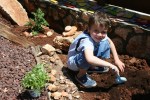
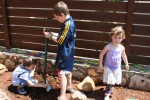
We spent the morning together cleaning our yard, which had gotten frightfully ghetto this winter. Miraculously, everyone pitched a hand. Even my 9 year old, whom we hardly ever see anymore because he spends most of his spare daylight hours running around with his friends.

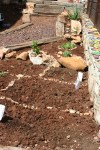
Our hand painted inspirational tiles from last spring didn’t make it through the winter, despite what we thought was a careful choice of paint and sealant. We laid them to rest along the side of our yard to make way for another herb garden and an experimental vegetable garden.

After spending some time together at the small nursery just outside Kfar Manda, we chose which plants to experiment with. With multi-generational love and care, with songs and brachot, with a little bit of mandatory blood, sweat and tears, we planted “Bubbi’s Garden,” in honor and loving memory of Bubbi (Marion Abrams) who would have been 87 years young tomorrow.

May we all only generate joy, love and beauty this spring and in the seasons to come.

Family, Kibbutz, Learning Hebrew, Letting Go, Living in Community, Love, Making Friends, Parenting, Religion

A year in reflection

In retrospect, I’m glad we made Aliyah at the end of a calendar year. At the time, moving during the first of New Jersey’s many blizzards and dealing with holiday travel didn’t seem like such a good idea. But now, as I reflect on the year that we’ve been living in Israel, I find comfort in the awareness that I will never have to struggle to remember when we moved here. It was at the end of December, in the winter of the end of a decade. 

And, as if leaving our friends and family to move to a new country wasn’t turbulent or memorable enough, there was plenty else to mark this year in my memory. I lost a cousin. I lost my grandmother. And through these and other extraordinarily difficult times for my family this year, I was here and they were there.

In the chapters that mark my life, 2011 will be one I remember without a bookmark, without a folded over corner.

My kind friends and loving husband might argue with this, but the marks of this year also show on my face, which seems to be finally showing signs of age. This year, as exciting as its been, has also been the year that I started feeling aches in my joints and noticing that my body is not as resilient as it used to be.

This was the year I closed my business and started a new job. It was the year I gave up my Blackberry and then found it again, at least the Israeli Nokia version. It was the year I moved to the house down the street of one of my oldest childhood friends and the year I found that sometimes, moving away from your closest friends, actually draws you nearer to them.

This was the year I stopped obsessively focusing on healing others; and truly starting looking inward in an effort to heal myself.  It was the year I rediscovered the healing power of song and prayer; love and community.

This was the year I decided that a heaping helping of humble pie was good for me. That learning something new every day can be painful, but active listening often works better than talking, even when you want so badly to communicate who you are and what you want.

This was the year my husband really learned to appreciated me as a mother. And I him as a hard-working professional. It was the year I resigned myself to the growing up of my children, and the year I decided that they would be okay — in spite of my fears and worries.

It was the year I let go.

This morning, after I dropped off my five-year-old at gan, I shook my head in amazement. He had woken up this morning with a bellyache and asked not to go to school. After hesitating only a minute, we decided it was okay if he stayed behind and rested in his room this morning. After all, it’s a long week, and Fridays are half-day, looser schedules for kids in preschool here.

At around 9 am, he decided he felt better and asked if he could go to gan. I asked him, “Are you sure? You can stay home if you want. It’s fine.” He insisted he felt well and asked that I take him up.

When we got to the door of his classroom, he gave me a quick kiss, and with one last look back, left my side to play with his friends.

This was the same kid who one year ago, walked off the plane at Ben Gurion Airport, pale as a ghost, after vomiting for 12 hours straight. This was the kid who cried every morning for months when we dropped him off at gan; who wouldn’t let us leave; who begged us to stay home.  This same kid was now opting for gan over a day off at home. This same kid, didn’t know a word of Hebrew when we arrived a year ago, but now speaks completely in Hebrew with his friends…and with confidence.

This morning, my five-year-old’s brother is off playing with his own friends; and his sister, I’m sure, is chatting away in Hebrew with hers at her own school. My husband is preparing food for our Shabbat meal tonight with friends, and I’m here, taking a break from cleaning the house.

This was the year we turned our life upside down.

And our life righted itself.

Family, Learning Hebrew, Making Friends, Parenting

What do you call this?

When I first started blogging about my Aliyah experience, about two weeks into our new life here, a friend in Israel (also an oleh from the States) told me he had also started a blog when he first made Aliyah. But he soon found he “didn’t have much to say or was too busy to write.”

I smiled and thought to myself, “I can’t imagine ever feeling as if I had nothing to say about our experience here or no time (or inclination, rather) to write about it.”

That was almost a year ago. And my last blog post was a month ago.

I have asked myself many times over this past month, “Why aren’t you blogging about this or that?”

The answer in my mind each time was some version of, “I’m too tired.”

But I think the real answer is, “I’m too busy living here to write about it.”

I am approaching my one year anniversary of making Aliyah. And, thus, approaching the time of reflection.

And suddenly, reflecting on my life here, seems a luxury I do not have.

There are too many va’adot (committees); too many aseifot (meetings); too many parent-teacher conferences; playdates; conference calls; rush projects; and networking meetings.

There are nights when I have to work late. There’s the weekly ulpan I am a part of. There’s the appointment with the massage therapist and the vaccinations the kids have to get.

Of course, there are the seven loads of laundry each week and the dishes every night. There’s homework, volunteer projects, yoga class, birthday parties, Shabbat dinners, and Skype calls with the folks back in the States.

There’s life.

For so long, our life was focused on klita (absorption.)  Our klita was front and center. For a time, our life revolved around visits to this Misrad or that Misrad. Our life was filled with papers to sign and documents to scan. Our life focused on meeting new people and navigating new roads.  Our world centered on making sure everyone was mentally safe and sound here in a new land, new community, new school. Our life revolved around figuring out whether or not we were “going to make it.”

I think we figured that one out.
 
At least, for now.

Psychologists would likely agree that all five of us in my little family unit are still very much in the process of “absorption,” particularly emotionally. But it’s clear to me, that we’ve pretty much been absorbed.

There’s a word in Hebrew for moving here: Aliyah.

There’s a word for the process of getting adjusted and trying to fit in: Klita.

But is there a word for the space in which I now exist? The space in which I live, with both feet planted, yet still not so firmly?

Is there a word to describe the space in which:

I still find myself fretting when I wait in line at the grocery store?

I still find myself scripting out all my conversations in my head before I have them in Hebrew?

I still find myself screaming at drivers?

I still find myself longing for American stores and American conveniences?

I still find myself grateful for English signs and English speakers?

I still find myself crying sometimes at how hard it all seems?

The space in which I do those things and yet  also know with confidence that I am happy? That I have friends? That my children have friends?

That we’re all better-than-okay?

Is there a word for this space?

There is a phrase, I’ve learned, that parents use to try to get their kids to calm down when they’re acting up or, in the case of our lovely Shabbat lunch last week, acting out while the grownups are trying to enjoy good food and wine.
 
Their parents say to them:

“Tistadroo!” Which loosely, and with typical Israeli brashness, translates as “Manage!” 

Often in response, the child will say Ani m’soodar! Which could be loosely translated as “I’m arranged!” or “I’m settled!”

Any person, but especially any parent, who has been through a big life change understands, there comes a point at which you, too, have to “Manage!” When you no longer have the luxury — or the inclination to– focus on “The Change.”

And one day, God willing, you notice you’re managing pretty well.

And that’s when you’re m’soodar.

You’re settled.

Culture, Family, Kibbutz, Letting Go, Living in Community, Love, Making Friends, Parenting, Spirituality, Uncategorized

Unwound

A friend of mine moved from NJ to Guam with her husband and two boys a few months before we decided to make Aliyah. On Facebook, I followed her move and her family’s transition with interest, particularly once we decided we were moving to Israel.

Despite what I assume must be vast differences in culture and landscape between Guam and Israel, I often find myself nodding in agreement and understanding when I read Shelley’s posts. (This could also have much to do with our common interests in holistic parenting and healthy eating, as well.)

There is, I’ve realized, companionship in leaving the busy American suburbs, the busy American life, for the “outskirts.”

Today Shelley wrote, “There are times when I miss living in the States with all of its modern conveniences, but then there are days like yesterday when I never want to leave our little bubble in Guam.”

I know exactly what she means.

Except our bubble is not Israel, per say, as Israel is no island paradise: She possesses as much hassle, aggravation, and overstimulation as any developed country.

My bubble is Kibbutz Hannaton, the small 120-or-so family Lower Galilee community in which we live. And a sub-bubble of Hannaton is my little red house with green shutters.  And yet another sub-bubble is my little work enclave of former Americans whom allow me eight hours a day to pretend I still live and work in the U.S.

But the true sub-bubble is the one I created for myself with intention last December when I  chose not just to live somewhere different, but to live differently.

I often tell people (in fact, I did so just yesterday during lunch) that our successful “absorption” here is due in large part to the community in which we chose to live: one made up of young, growing families like our own. One where friendships are only now being formed…because the community is still new and finding itself. So, despite being different, we still somehow fit in.

But I also credit our successful transition to the conscious lifestyle changes we, as a family unit, decided to make in conjunction with our move.

In addition to many of the comforts we gave up — the modern conveniences Shelley mentions in her post — we also gave up our attachments to what we knew up until then as the “right way to live” in the hopes that we might find happiness living another way.

One modern convenience I gave up was information overload.

I was (and still am in many ways) an information addict. My understanding up until recently was that with more information comes more control…over my own life…over what happens to me and to my kids. My understanding was that information made me safer; made my life easier. This is why I easily fell in love with the Internet, email, blogs, Facebook. And, to some extent all those modern conveniences have improved my life. But what I’ve discovered, retroactively, was how much they also controlled my life.

I had a really good excuse for feeding my addiction; addicts always do. I was a business owner. A writer. A blogger. My success depended on my communication with the outside world. I needed to check check check…all the time. Who knew when the next big opportunity, client or connection would land in my inbox? At the height of my addiction, I had six different email addresses, four blogs, two Facebook profiles, three Fan Pages, a LinkedIn and two Twitter accounts to manage. Not to mention those I managed for my clients. 

I also had kids with asthma and allergies. I had unexplained chronic illness of my own. I had an acute awareness that with more information about the world around me, the greater chance I had of healing myself and healing them. Information provided answers. Tools. Connections to the right people. How could I give up information? 

I also consciously understood that my information interface, so to speak, was possibly unhealthy.  Which made for a bit of a contradiction.

Despite my awareness that my commitment to my online personas (and to my business and clients) was likely impacting my real-life relationships with my husband and my kids, I persisted.  Despite the fact that my comments on your “feed” may have been keeping me from experiencing real, waking, daily pleasures, I couldn’t shut down. I couldn’t give it up. I couldn’t walk away from it.

Until I started walking away from it. Taking baby steps. That started once my feet touched ground in Israel.

As I said, my information withdrawal began first with an intention. But I followed through with an action: I purposefully did not register my Blackberry here in Israel. I got myself a regular old cellphone with a regular old phone call plan. No emails, no SMS packages. My husband did not register his IPhone either which was a HUGE shocker for me because my husband loves his IPhone more than I love information. Or, at least, equally as much.

Just this simple choice, along with the decision not to purchase Cable TV made a great impact on the quality of our lives in the first few months we lived here.  We quickly adjusted to checking emails only on our computer (remember when you used to do that?) and our kids spent more time outside and not in front of the TV than they had ever in their lives.

And that was nice for a while. I’d like to say that we remained unplugged, but we didn’t. A few months in, we used Hebrew immersion as an excuse to sign up for basic cable. The kids still only watch a portion of what they used to. (I haven’t watched an episode of the evening news or any sitcom, save for Israel’s Ramzor.)

A few months after that, my husband bought a new IPhone, much to my dismay, and I often find him face down fingering the thing with pleasure. That said, it only takes one semi- dirty look from me for him to put the thing down when the kids are asking him a question (repeatedly) and his finger keeps methodically sliding across the little touchpad as if it’s in a trance. He also gave up TV and for the first time in many years I can now find him in bed in the evenings reading e-books on the Nook. 

Once I got a full-time job, they handed me a Smartphone with my work email configured, but amazingly, without the unspoken expectation that I be attached to it 24-7. And I like that. I like that a lot.

Despite the reintroduction of information overload devices, my information withdrawal continues. I didn’t configure my personal email into to my new phone. I never check my work email after I leave the office or on the weekend. And I have found as the months pass, I check my personal email less and less often: Sometimes going as much as 2-3 days without checking. People who were used to hearing from me immediately would write back after only hours asking me, “Where are you? Did you get my email?”

Sure, I am still on Facebook. It’s my lifeline to friends and family who didn’t follow me to Israel. But I’m hardly on Twitter; have no interest in this new thing called Google Plus. Sometimes, I even find it difficult to motivate myself to blog. I find that at the end of the day, after working and spending time with my family, I prefer to walk and then to read. And then to sleep.

Yesterday, I discovered my main personal email account was down. I had forgotten to pay the web host for a month or two and they shut my account down temporarily. People reached out to me via Facebook or SMS asking me what happened to my email. Why were mails being bounced back?

At first I panicked that my email was down, “What if someone is trying to reach me??” But my panic lasted only a minute. Soon after, the feeling transformed into freedom.

I realized I had passed over the hurdle of my information addiction. I was now able to say no. To be without. To let go. In particular, I wasn’t worried about what I had missed or would miss over the day or so the email account would be down. I wasn’t worried about what people might think when they received their emails returned, unread.  In fact, I decided right then and there to pare down all my email accounts, returning only to one. One that I may or may not check during the day.

This is not to say I’m unplugging completely. Or that I will ever really be able to fully walk away from easy access information. There is no guarantee that this represents a permanent recovery from information addiction. But it certainly indicates a big step in the right direction.

I think I’ve developed a taste for something new.

Being here. Being present. Absorbing today. Still with an eye on tomorrow, but with a good solid foot planted in today.

Family, Kibbutz, Living in Community, Parenting

Our long, hot Israeli summer

Somewhere in the middle of the very long list of “Things they don’t tell you BEFORE you make Aliyah” – a list that would include tips like “Don’t sell all your stuff before coming; you’ll need more of that Target brand crap than you think;” or “Israeli Tupperware really stinks” or “Living on a kibbutz means feeding kids that aren’t your own at least two days a week” – is this doozy: There is nothing for your kids to do in August.

Now, as you know, I live on a small kibbutz in the North. So it could be that my kids have less to do in August than their city counterparts.  And we did have Gan for the little one until mid-August and some options for the bigger ones in early August. But compared to what abounds in New Jersey in terms of camps and summer programs, our options were extremely limited and extraordinarily pricey.

Not that day camp is cheap in New Jersey; but when you decide to suck it up and pay for camp you know you’re getting a full day of activities – so much so that when your kid finally gets off the bus in front of your house at 4:45 pm, he’s happy to sit in front of the television for two hours, and you don’t feel guilty about it one bit because you know he’s been learning to swim and dive and make campfires and knots, especially fancy ones that get turned into friendship bracelets. If your kid goes to Jewish camp, you know he’s even hearing a little bit of Hebrew or singing Zionist pioneering songs. You feel like he’s had a good solid day of stimulation and exercise.

Here in Israel, we had two options for August, one of which was a regional camp which was reasonably priced but got less than stellar recommendations from people we know whose kids went last year; and the second was a morning Nature Camp that sounded a little bit unbearable to me in the 100 + degree heat of summer, and I knew would be a disaster for my oldest who craves high energy activity, not quiet, contemplative exploration of nature in the boiling heat of Israel.

This August, our first since making Aliyah, has been the longest month of my entire life. And it’s been twice as long for my husband who has had the bulk of the childcare responsibility this summer.

I’ve been lucky on the one hand in that I have an excuse for an escape. My full time job right now is a large chunk of our family income; and since I don’t have any vacation days left after using my four days in June, I’m pretty much required to show up at work. But my poor husband, who is a consultant and a part-time work-at-home dad, has been at the center of a rude awakening this summer. A mistake he will never make again, which is children need something to do in the summer. As much as the 1950s era Leave it to Beaver idea of summer (wandering around the neighborhood looking for pet rocks or selling lemonade in front of the five & dime) might appeal to you, it’s just not the reality for our post-modern kids who have grown up over-stimulated and under-inspired. Sorry if that’s harsh, but it’s true; even for my kids who I try very hard to under-stimulate and over-inspire.

The fact is if you are not prepared to be the resident camp counselor for your kids, you better pay someone else to.

In May, I gently suggested to my husband that we try to round up the funds to send my oldest to the States for the summer. He could stay with my husband’s cousin who has a house in upstate New York and who we trust to parent our kid (who has nut allergies). My husband squashed that idea in an instant and assured me the summer would be filled with “Avi Camp” activities (Avi being my husband), such as drawing, hiking, and English and Hebrew lessons. Avi even suggested he and my oldest would work on making a movie with our Flip camera, part of a “turning off Phinneas and Ferb and learning Hebrew” project.

The film project lasted approximately three hours.

Instead, my 8-year-old has been in between our house and his grandparents’ house near Tiberias, similar to, as I’ve come to learn, most Israeli kids between the ages of 4 and 10.

It’s truly amazing, I have to say, how involved Israeli grandparents are in their grandchildren’s lives. It’s not true across the board, of course, but it’s noticeably truer here in Israeli society than it was for the families I knew on the East Coast of the U.S. This particular cultural difference between the two countries fits into the “family is a priority” category which could be broken down even smaller into the “we really take care of our children” category, which could be loosely interpreted as “we love to spoil our children because that’s what parents do.” Depends on who you ask.

The way this looks in day-to-day Israeli life is parents of little children nodding yes, yes, yes as their little ones scream for junk food (Why? Because it tastes good!); parents of teenagers stuffing their kids’ pockets with cash (Why? Because they’re only kids once!); or Israeli parents of adult children paying their kids’ rent or buying them groceries on a regular basis or putting a down payment on a new house (Why? Because they need a little help getting on their feet is all.)

I’m not criticizing this parenting style, mind you; that would be like biting off my nose to spite my face.  I’m just noticing it. And wondering if perhaps, the reason we don’t have more August summer programs for our kids is because working parents expect their parents to watch their children. And the grandparents are used to saying yes.

Or is the fact that there is no programming for our kids in August related to the long list of grievances coming from the folks protesting across the country in tents? The root of which would be, “We don’t get paid enough to afford rent and groceries; how could we possibly afford summer camp?”

No money to demand camp. No supply.

I’m not sure which is the reason for the lack of summer programming for kids. All I know is that if I were writing a book on “Things they don’t tell you before making Aliyah” (and I’m getting very close to that point), item #24 would be “Save money for a U.S. vacation in August.”

Trust me. If you follow tip #5 – “Save your garage sale for Israel; you’ll get a lot more money for your stuff” – you might be able to afford it.

Culture, Kibbutz, Learning Hebrew, Letting Go, Living in Community, Love, Making Friends, Parenting

Ties that bind

Last night, underneath a full moon, within the sacred space of our kibbutz mikveh, ten women gathered to acknowledge our friend who will be bringing a new life into our community in a few short weeks.

Debbie’s due at the end of August and it’s become somewhat of a tradition on Hannaton to create a “birth circle” for pregnant women. We sculpt the pregnant mother-to-be’s belly into a keepsake “mask;” we drink tea, and last night, we shared our birth stories.

It’s taken me some time to feel comfortable in a circle like the one I participated in last night. I blame it on the fact that I grew up without sisters.

Others, like me, who grew up with only brothers, or those with no siblings at all can back me up: What might be seamless and normal for women who grew up alongside sisters often takes a lot longer for us.  When you grow up with sisters, you have years to learn the ins and outs of interacting with other women, of being comfortable in the girl group dynamic. Even if you aren’t close with your sister, you’ve likely figured out the subtleties and intricacies of female conversation.  You know how to fight fair and eventually make up. You’ve shared beds and clothes; you’ve taken your bras off in front of each other.

The rest of us arrive at summer camp or at college completely clueless – and it takes us most of our adult lives to figure it out.

Fortunately, as I’ve discovered, giving birth speeds up the sense of sisterhood. There’s nothing like the aches of pregnancy and pains of childbirth to bond you with other women. And, in all seriousness, there’s nothing that creates kinship like sharing birth stories…even when, like me, you consider your birth experiences to have been less than ideal.

Last night, I smiled when we were invited to share our birth stories with each other.  Having already experienced the intimacy that comes with sharing birth stories in a circle of women, I was really excited to be part of this exercise with this group of women…my friends in the making.  I saw this as the perfect opportunity to learn more about each other, to open up, to move past the everyday niceties, to connect.  

Until it hit me…again.

It would all be in Hebrew. I felt my smile fade and my stomach turn.

You would think that by now it would take less time to compute – the Hebrew element. But it doesn’t. There is still a time lapse during which it occurs to me that my understanding of how an experience might be is not how it will be in actuality. Meaning: Hebrew makes it harder.  Tiresome. And eventually, mind-numbing. When it’s in Hebrew, I find it hard to engage; frustrating to participate; challenging to connect.

So I disengage. And the moments that might have moved me instead become tests…not just of language comprehension, but of pure will.

I did my best to keep up. But then, as it often does in these situations, my mind started to wander. First to that insecure place that masquerades as boredom…checking my watch and checking out; wishing I could leave and go home to watch reruns of The Office (in English).

And then the transition to the outsider’s feeling of sadness and longing…The inner thoughts of “I bet I would have laughed too if I had understood the joke” or the inner shame of “I wonder if they know I’m just nodding along.”

And then to the place where fear and desperation lives: Fear that I will never learn Hebrew well enough to blend in; to feel a “part” of anything meaningful here. That my relationships will always be surface-based; that my interactions in Hebrew will always be met with challenges and confusions; that I will never be able to fully participate. That no one will really know me and I won’t really know them.

Which might not be a big deal for you, but is for me. Because meaningful connections are what moves me. And without them, my life suffers.

Despite my discomfort, I didn’t leave the birth circle. Instead, I stayed and shifted my focus. I ate watermelon. I observed instead of listened. And at some point, I realized I could follow the stories without understanding the words. I could hear the subtle differences in the stories coming from the veteran moms of three versus the new mothers. I could catch the different expressions on my friends’ faces…of wonder…of embarrassment…of confidence…and of pride.  And each was moving and telling.

At some point, I realized too that just being a part of this circle, no matter how little I comprehended or contributed to the conversation, indeed connected me to the women sitting there. I realized that these women weren’t strangers to me anymore. That at least half in the room were women I had already confided in on some level and the other half were women I would want to.

While not quickly enough for my taste, I am moving from outsider to insider. And it’s simply because I’ve chosen to show up, and be as “me” as I can be in spite of the language barrier, in spite of my insecurities, and in spite of my fears.

Much like giving birth. Much like becoming a mother. There’s only so much you can know and absorb from sharing information…the rest comes with time and experience…and the courage to simply show up.

(This post originally appeared as “Israeli in Progress” on The Jerusalem Post blog.)

Kibbutz, Learning Hebrew, Letting Go, Living in Community, Parenting

Yin yang

It’s almost 6 months since we moved to Israel…and I’ll soon compose a contemplative look back at our transition to life here. But in the meantime, I’m doing eight loads of laundry in a crappy stackable washer/dryer set that’s shoved in too tight into our bathroom and it got me wondering…how is my life easier and harder compared to my life in the NJ suburbs?

I recently discovered this blog post at BrainPickings.org in which they feature a film of people discussing their “perfect city.” I loved watching what people had to say about their ideal community, and then thinking about my own answer, particularly since I have been so immersed in and focused on intentional community since we moved here.

The answer for me, if I’m offering the simple one, is “my ideal community would make my life feel easy.” Why? Because I find that the “easier” my life feels, the easier it is for me to give and receive. To love and be loved. To enjoy life. To live in the present. To smile. To breathe.

Why “feel” easy? Because, as you must know, there is no easy and hard. There’s only what you feel is easy and what you interpret as hard.

Now, of course, living in (or participating in)  intentional community isn’t always easy. Like life, living in a small, intentional community is give and take; sweet and sour; hot and cold; easy and hard. It’s our job to be mindful of the balance, no? 

Much of what makes my life feel easier here has to do with living in intentional community. I’m very present to that fact, and thankful for it, because it really counterbalances most of what makes my life seem harder here:

  • Bugs
  • Parasitic bugs that like to live in your hair
  • Critters
  • Poisonous critters
  • Critters that hang out on your ceiling while you’re sleeping
  • Critters that hang out on your porch waiting to bite you
  • Dirt
  • Dirt that somehow ends up in your dryer, despite going through a wash cycle
  • Dirt that won’t come out of your laundry…ever
  • Dust
  • Dust on your window screen, on your floors, car windows
  • Cleaning dust on a tri-weekly basis
  • Being far away from family and friends
  • Being far away from family and friends, and trying to find a good time to Skype with a 7-hour time difference
  • Food
  • Food-centric society
  • Food-centric society that loves the foods my kids are allergic to
  • Food-centric society that isn’t necessarily mindful about how said food leads to rotten teeth, poor behavior, and childhood obesity
  • Crappy appliances
  • Foreign germs
  • Language barriers
  • Bureacracy
  • Crazy drivers
  • And, in a nutshell, a society that cares little for clear order, rules, organization, structure, or advance notice

When I get aggravated about, annoyed with, or frustrated by the things that seem to make my life harder here, I try to remind myself of what makes my life feel easier:

  • Intentional community: Neighbors that want to get to know me, and do
  • Family-friendly community (and by community, I mean both specifically the “yishuv” of Hannaton, and Israeli society)
  • The sharing, caring, and intimacy that comes with living in small community
  • Open space
  • Open space filled with children my children’s ages
  • Mild weather
  • The beach
  • Less time in the car (walking the kids to preschool, the bus stop, etc.)
  • Family nearby
  • Shabbat
  • Shabbat dinners at my house (where your kids to entertain mine)
  • Shabbat dinners at your house (where my kids eat your food and you clean up after them)
  • English-speaking co-workers
  • English-speaking neighbors
  • Hebrew-speaking neighbors that are tolerant of my “Heeblish”
  • Minimalistic lifestyle
  • Yoga on my neighbbor’s rooftop

  • Letting go…

The list is much longer than this, I am sure. And could get a lot more detailed and specific. And perhaps it will…

I’d love to hear your thoughts on your “ideal community.” What about where you live makes your life easy or hard? If you could live anywhere, would you live where you do? And if not, where would you live?