To be fair, however, “telling it like it is” on Twitter also is pretty subjective. Even when it’s told by those of us with a traditional journalism background.
So what to do for a girl who wants to get the real story?
At least, those of us on the front lines of the social media war do.
* * * *
Politicians or military professionals, if they bothered to listen to the mothers, would laugh at us. Belittle us. Keep us far away from the battleground.
We can’t risk opening our hearts too wide, the combat professionals would say. We can’t allow ourselves to be too vulnerable.
And yet, what any social media expert will tell you is that the true value of social media is connection.
Don’t bother using social media — not for any cause, not for any business — unless you are prepared to be vulnerable. To share of yourself. To engage.
And this is why the mothers in Israel are a most effective tool in this social media war.
You believe us.
Why? Because our stories feel … real.
They feel real because you know us.
Or, at least you feel like you do.
Because we dared to open our hearts to you.
Yet, there’s a side effect to listening to the mothers …
Be prepared.
You might become susceptible to love.
Susceptible to love not just for your own child, but for another woman’s child.
(Even for the child of your supposed enemy in this not-quite-yet-a-war.)
When I listen to the mothers, my heart opens to other mothers.
Not just to the mothers of 19-year-old Israeli soldiers. Mothers who must be very conflicted: Protect my son? Or protect my country?
But also to the mother in Gaza, who might have a blog post ready to burst out from her heart, but no outlet through which to express it.
When I listen to the mothers, my heart opens
My heart…
Opens.
And it hurts. Like it should.
War should hurt.
War should hurt.
When war hurts, we are one step closer to being desperate enough to let go enough to end it.
You know that feeling you get — that rush of breath-stopping adrenaline — when you watch a scary movie and you helplessly watch the main character walk across the screen straight into the death trap of pure evil?
And her hand reaches for the door knob…and…
BAM!
Someone behind you — someone in real life — slams a door.
And you scream! You didn’t realize how tense you were. You didn’t realize just how edgy you were until you screamed.
That’s me right now.
I live in Israel.
But not the part of Israel that’s being bombarded by rockets or being forced into bomb shelters every few minutes in response to the Code Red sirens sounding.
I live in Northern Israel. The Lower Galilee.
In accordance with non-specific requests by the IDF, I am not going to tell you where I live or where rockets may or may not have landed.
Had we lived in this very house six years ago during the 2006 war with Lebanon, however, I’d be singing a different tune. A tune from inside my bomb shelter, where the acoustics are questionable and the air quality not so fresh. Six years ago, neighborhoods in our region and especially in the region where I work in the Western Galilee received the brunt of katyusha rockets targeted at Israeli civilian populations during that war.
Lucky for me, in the almost two years that we’ve lived here, I’ve only needed to visit my shelter to add another can of corn to my End of Days store.
A portion of our 2-week disaster supply
Unlike most Israelis, I keep my MAMAD clean and reasonably stocked. I’m just that kinda girl. But as prepared for disaster as I try to be, I know there is no way to emotionally prepare for disaster.
Try as I might with obsessive thoughts and compulsive behavior and endless rows of canned corn, there is no way to prepare for war. For cloudy with a chance of rockets.
* * * *
Supposedly, we’re just out of range for the rockets being fired by Hamas terrorists from Gaza. Does that help me sleep easier at night?
A little. But just like chicken pox spreads from one tight knit community to another, so does fear and dread. And with Hamas promising “big surprises,” I asked my husband, who was on his way out to a meeting, to close the outer protective shutters on the shatterproof windows to our bomb shelter.
We normally keep the heavy metal shutters open to avoid mold buildup in the airless room. (As if bombs weren’t bad enough…)
I was sitting on the couch trying to keep up with the latest tweets on the situation when I heard a very loud and extended wail from outside.
I jumped.
My heart almost leaped out of my chest.
When my mind started working. I realized the sound was just the creaking of the metal shutters.
Nothing to worry about.
“Yet,” I added out loud.
I’m more concerned for our safety than I thought I was. And more in denial than I thought I was.
It’s true that the Lower Galilee isn’t #israelunderfire in this moment. But what separates me from the families in real, true live danger right now is a highway shorter than the length of New Jersey Turnpike.
What separates me from them is a stronger rocket booster.
What separates me from them is a whim of a dictator to our North and a whim of a dictator to our East.
The whims of monsters who hate me simply because I’m Jewish and because I live on a particular piece of land.
Hamas would be sending rockets to my backyard if they could.
I tweet and I blog for Southern Israel because I know this is true.
I know I am only out of harm’s way this time.
My conscious mind is in denial, but my unconscious mind is screaming at the screen to “Watch out.”
In case you haven’t heard, Israel has launched an operation against the terrorists in Gaza who have been firing rockets on Southern Israel. Rockets that keep children from going to school. Rockets that force families to sleep in bomb shelters … if they can sleep at all with the alarms going off all night. Rockets that kill.
I heard about the Operation on Facebook and Twitter because this is how I get most of my news, but especially my news from Israel.
And as much I relish feeling part of a strong, supportive, active community here in Israel, it’s days like this that I feel torn about social media.
On the one hand, like any bad news, it’s better to hear it from friends than from a stiff news reporter. On the other hand, I feel like war brings out the worst in people. People I normally like. And on social media, people let their emotions rip. They don’t just type in 140 characters. They shout.
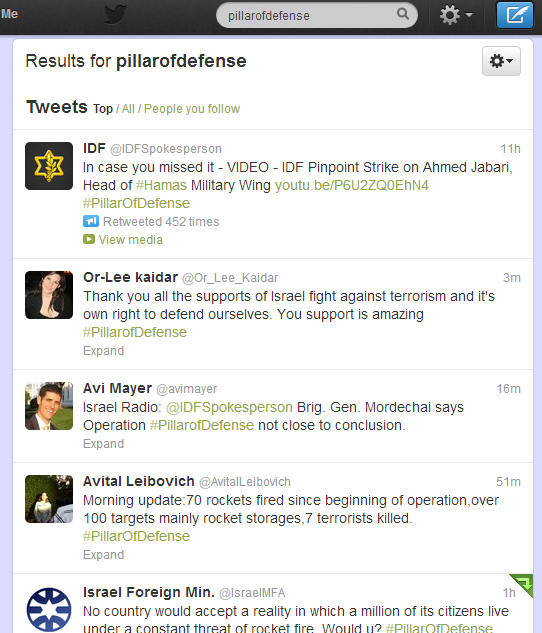
Today, during what’s been named Israel’s Operation Pillar of Defense, I can smell through the computer screen the adrenaline, hatred, rage.
It makes me very uncomfortable.
This is not to say I don’t firmly and strongly believe Israel has a right to defend herself. I do.
This is not to say if I were living in a city in which rockets were raining down, I wouldn’t want my government to act. I would.
Which sounds weird. It’s not how I picture myself at all. In fact, I normally tag myself as an “accidental activist.” I fight for what I believe in. I don’t stand idly by when I can educate or inform or make positive change.
But activism takes many forms. Blog-ins, rallies, strikes, marches: These are actions I have a strong stomach for.
But not for war. Not for violence. Not for rockets raining down on my neighbors in the south and not for missiles being sent down on Gaza.
On the one hand, I’m thankful I am not in the position to make a decision whether or not to shoot; whether or not to fire; whether or not to initiate or retaliate.
I’m just not built for war. I wouldn’t be able to make such a quick decision. I’d hesitate. I’d think of men as babies in their mothers arms. I’d think of children wailing.
Perhaps I’m not angry enough to make such a decision. Not broken enough.
But, on the other hand, I think: Who is? Who is built for war?
Who is born built for war? What man or woman meets her mate in bed with the express desire to bring a new solider into this world? A new terrorist?
What child is raised for war? What 4 year old, as he learns his letters and starts becoming more aware of himself and his surroundings, thinks to himself, “One day I will defend this beautiful blade of green grass with my life?”
Are any of us built for war?
What would war look like if the broken ones weren’t running the show?
* * * *
I’m a pacifist.
I can still see the good, the innocent in almost anyone.
Is this a gift? Or a hazard?
I don’t know.
But what I can tell you this morning as I sit both behind my screen and behind my country is that I support Israel’s right to defend herself. But I can’t comfortably nod my head at blithe tweets about people (terrorists or soldiers or civilians) being marked for death.
I can’t feel excited or grateful or proud.
War hurts my heart.
In my heart — one that some would call naive, but I see as loving and compassionate — there is still a flicker of light. It’s that flicker of light I often hear my observant Jewish friends talk about.
That flicker of light in all of us.
The flicker of light in my own heart tells me conflicts can be solved with the right people seated around the right table.
And so I can’t enter “operations” with firm resolve or unwavering decisive support.
Do you remember where you were during the September 11 attacks in the United States?
Do you remember where you were during the Holocaust?
Think now to how you relate to the victims of the 9/11 attacks compared to how you relate to the victims of the Holocaust.
If you are an American under the age of 60, it’s more likely that you knew someone, or knew someone who knew someone, that was personally impacted by the terrorist attacks of 9/11 than someone who was personally impacted by the Holocaust.
If you didn’t know someone affected personally by 9/11 you’re lucky, but perhaps you used to work in the World Trade Center, or you interned one summer at the Pentagon. Maybe you visited New York on a field trip once. Or your boyfriend had a friend who worked for Cantor Fitzgerald.
Or maybe you’re American and you watched the whole thing go down minute-by-minute on television.
Most likely, the tragedy of 9/11 is a lot more real to you than the Holocaust. And no matter how many times you see Schindler’s List or The Pianist; no matter how many times you try to wrap your mind around the horror of the Holocaust; and no matter how many times you try to imagine “what would I have done if that was me?”; it’s really challenging to personally connect to the tragedy.
Jewish or not.
It’s not a matter of compassion. It’s a matter of reality.
Philosophers, psychologists, scientists, and Zen masters have spent their entire lives, their entire careers, debating what’s real. Freud, Jung, Nietzsche, Wittgenstein, the Dalai Lama.
But for those of us on the ground, what’s real is what we know.
The closer we get to knowing something or someone, the more real it becomes.
I became present to this very human phenomenon over the past few days as I processed two horrific tragedies — the terrorist attack on Israeli tourists in Bulgaria and the shooting of movie-goers in a theater in Aurora, Colorado.
I wrote soon after the attacks in Bulgaria that for the first time I felt personally frightened by an act of terror on Israelis. Whereas before, as a Jew living in the States (and as a human being), I had always felt sorrow and compassion when Israelis were killed in terror attacks, I never felt it in my gut the way I did on Wednesday.
When you personally know a terror victim, the icky feelings stay long after their story has been told. The thoughts don’t leave you because you quickly understand that it could have been a family member or close friend. That it could have even been you and your boyfriend on the way to a long-awaited vacation.
Rebounding after a tragedy is deeply rooted in our human instinct for survival. But the closer to home a tragedy hits, the harder it is to rebound.
I felt equal amounts of horror in response to the two attacks this week, and yet I was painfully aware — on Facebook and on Twitter — that the majority of the people I know (mostly Americans), expressed greater public empathy for the victims of Aurora.
I understand this.
I understand how it’s easier to feel complete and utter horror when you hear that an innocent American citizen was gunned down simply because she wanted to catch the premiere of a Batman movie.
I understand how disturbing it is to hear about a seemingly random attack on seemingly normal folks in a movie theater in a suburb of Denver, Colorado.
Aurora is a suburb just like the one you live in. Those people were holding popcorn settling into a movie you saw the same night with your teenage son. The mourners look like you. They’re sobbing over their sister, their boyfriend, their wife: Alex, Matt, John, Jessica.
Not like the mourners in Israel crying over victims with foreign sounding names — Itzhik, Amir, Maor, Elior, Kochava. Names you can’t even pronounce.
Not like the victims of Israel’s tragedy — people who lived in towns a world away from where you live. Who were visiting a country you’ve never heard of, let alone considered vacationing in.
I understand this.
And, from the bottom of my heart, I don’t judge this.
But as someone who now understands Israeli reality (though not yet as well as I understand American reality), I am that much closer to understanding how the Israeli victims of terror were just like the Aurora victims of terror. They weren’t victims of war. They were innocent victims, plain and simple.
The Israeli victims were also doing something regular people do: They were on their summer vacation. They were giggling with excitement imagining the hot steamy sex they were about to have on their couples only romantic getaway — the first one since the baby was born. They couldn’t stop thanking their lucky stars they snagged such a great package deal complete with fruity drinks on the beach.
That morning, they had checked off all the items from their packing list before they left the house. Did they have their passport, camera, heart medication? They had printed out the “While We’re Away” list for the doting grandparents taking care of the baby. They had turned on their “out of the office” notification in Microsoft Outlook.
They’re as close to being real to me as the folks in Aurora.
I understand how my American friends may more easily relate to shooting victims in an Aurora, Colorado movie theater than to the victims of the terrorist attack on Israelis in Bulgaria
With my heart, I understand. And I pray that neither you nor I ever come close to experiencing the reality that is knowing someone who knows someone who has been the victim of a senseless attack on innocent victims.
With my heart, I pray neither ever becomes truly real.
In another lifetime, I was a budding talking head.
I arrived in Washington, DC, as an undergrad with the intention of studying political communications. But one boring “History of Journalism” class later I switched to archaeology. And one boring “Introduction to Archaeology” class after that I switched to international politics. It was in politics I stayed – mostly because I’m a rule follower, and the rule was you needed to choose a major by sophomore year.
The placement suited me, though, since the summer before I had traveled to Israel for the first time on a program organized by what was then ZOA/Masada and returned home armed with a love of Israel and firm ideas about how to keep her safe.
I wrote a term paper freshman year — practically copied straight from the 8 x 10 black paperback handbook I had received on my Israel trip — on why it was imperative that Israel never give up any of the West Bank. (I think I may have even used exclamation points in the title.) My TA, who would later go on to become a founding member of MEMRI, gave me an A+.
The following year, I landed a highly sought-after public affairs internship at the Embassy of Israel. This was in 1993, probably one of the most exciting times to be working at the Embassy of Israel, in the days leading up to Oslo and handshakes on the White House lawn. As I painfully tried to translate newspaper articles fresh off the fax machines, I reconsidered my stance on Arab-Israel relations. I started reading Amos Oz.
In my senior year of college, I applied for and got a research internship at the Washington Institute for Near East Policy, a think tank where one of my professors was working at the time, and an organization which was, at the time, generally regarded as a melting pot of opinion. But when my more right-leaning professor left the Washington Institute to head up a very right-leaning think tank, I left with him. I liked him better than the institute and this time, more important, I was offered a paying job, as an executive assistant. My ticket to adult freedom was only a few blocks away.
In this position, I was lucky enough to both observe history in the making, and not have my name attached to it. I proofread and formatted a very famous paper, written by brilliant lovers of Israel who would later become key decision-makers in a Republican government. I knew these “neocons” as real people, not as “foreign policy hard-liners” or strategists. These individuals were my professional mentors — no matter what their position was on Israel or Iraq or Iran — and they encouraged me to continue in the field, to go back to get a higher degree, to educate myself, and to be part of the continuing dialogue.
I didn’t, though. I quit before I even started. Only a handful of internships and two jobs into it, I was already frustrated, exhausted, and uninterested in working in a career where I couldn’t see the light at the end of the tunnel. As a thinker and a writer, I love dialogue. But I couldn’t see how we were ever going to solve the conflict with just dialogue. Educate, perhaps. Enlighten, maybe. But to solve this thing, we would need action. And I wasn’t convinced that either side would ever be interested in acting. In the summer of 1997, I left Washington, moved to New York, and started a career in publishing.
It’s only now, almost 15 years later, that I understand that my experience in DC at that time was not just educational, but truly formative as it relates to my stance on Israel. Accidentally, I became a centrist. And more specially, it was then I decided I preferred to be an observer of the region rather than a policy maker. A student of human relations rather than international relations.
* * *
Two days ago, I sat in an auditorium in Jerusalem with a thousand other attendees of the 2012 Israeli Presidential Conference, all passionate in one way or another about Israel. The strength of their convictions alone could fill the room. The energy was uplifting, but a voice nagged in the back of my head. “Words, words, words…” it said.
The VIP bloggers sit for a photo opp with President Shimon Peres (I’m sitting on the right)
As the conference continued, I sat and listened to well-renowned, content producing opinion makers debate whether Americans have the right to interfere in Israel’s national security policies (applause!) or whether Israel alone knows what’s best for herself (applause!). During the few politically inspired panels I sat in I thought to myself, “Have I traveled back in time? Either it’s 1997 or these guys have been talking in circles for the last 15 years.”
In all the political back and forth during the conference — back and forth that often felt more back than forth — two people I heard made me feel grounded in 2012: Peter Beinart, author of The Crisis of Zionism, and Ayaan Hirsu-Ali, a fellow at the American Enterprise Institute and the writer of Submission, a film about the oppression of women in conservative Islamic cultures.
It wasn’t their forward thinking strategies or their bright visions for the future that captured my attention. In fact, each of them possesses potentially dark visions of the future. Futures in which Israel may not exist, or in which our children are still carrying on the same back and forth we carry on today (as long as we avoid a nuclear war with Iran and survive the end of the Mayan calendar).
It was because when they spoke, they moved me. I felt the heart inside his and her words. I felt their love for humanity, their hopes for our children, and their desire to see change in our time, or at least in our children’s time. I didn’t hear talking heads when I sat in front of them. I heard human beings.
And while, admittedly, my experience at the conference was limited to a handful of panels and speakers, and my reasoning was based not on critical thinking, but on feeling, I move forward today, post-conference, with a firm belief that was planted almost 15 years ago.
It’s we, the students of human relations — not international relations — who will one day help guide this region to a solution. Humans, through their need for one another and their true, deep desire to connect and to love — not just survive — are the only true hope for peace.
* * *
My husband and I are growing passionfruit in our backyard in northern Israel. Passionfruit vines are known for their strength and their ability to grab hold of and flourish on fences. They’re stubborn plants, but susceptible to the blustery afternoon wind we get from the west.
We planted four next to our fence, but only one survived. For a time, I couldn’t understand how this one made it while the others didn’t. We watered them the same. They receive the same amount of sun and shade, and presumably the same quality of soil.
But one day, I saw peeking through our neighbors fence another passionfruit vine. Slowly but surely this vine has extended itself toward ours, and our vine reaches for it. One day soon they will connect – without any help from me. Why? Because they want to. One dared to reach across the fence.
Time passes slowly as I wait patiently for their two hands to grab hold of one another. Good days and bad days pass. My children grow. The weather changes. World opinion shifts.
There is so much I didn’t know or understand about Israel until I lived here.
That may sound obvious, but it wasn’t obvious to me.
After all, I had visited this country six times before I lived here.
I majored in International Politics with a concentration in Middle Eastern studies.
I studied the Hebrew language for three years at a University level.
I interned at the Embassy of Israel. And worked at three other Israel-related organizations all before I was 24.
I was an assistant editor of a Jewish newspaper in the United States.
And then a freelance journalist covering Jewish news.
I shepherded 20 teenagers on a teen tour through the country.
I married an Israeli.
I thought this qualified me as an expert.
And perhaps I am more expert than some…at reading and writing about Israel.
But not at living here.
Which is okay. Because, now I know so.
A lot of people outside of Israel don’t. And they write about this country, and they flaunt an expert bio and CV they’ve earned through study and degrees and guest spots on political commentary shows.
I don’t begrudge them their bios and CVs. I respect them for their dedication and commitment to the topic of Israel.
However, I do think what’s missing from the bios and CVs of experts on Israel is detailed information about how long they’ve lived here. About what it was like for them to live as a community member among Israelis. To share the roads and the air and the land with Arabs. To walk among us.
Today, on the drive to work, the same I drive five days a week, I found myself passing through Kfar Manda again. It’s the Arab village right next to Hannaton. I pass it every morning on my way to work.
Some mornings I’m listening to the news, and concentrating so hard, I hardly notice the details around me. Some mornings I’m singing Michelle Shocked at the top of my lungs (or the soundtrack from Miss Saigon) and I just give Kfar Manda a nod as I pass through. Some mornings there’s a mix playing, and Kfar Manda is a backdrop for the wistful melodies.
Some mornings, like today, the village comes alive and poetry is born. And in that moment I am far from an expert. Just a student of life. Exploring the world around me. Understanding what I think after writing it all down and seeing what turns up.
I’ve gone back to school. And it’s opening up a world of discovery unlike any I’ve known.
When I really want to feel life, I put on Billy Joel’s “Songs in the Attic” and drive to work.
It doesn’t have to be Billy Joel. Jackson Browne also works. Depending on the season, so does Randy Newman or the Beach Boys or Elvis Costello’s and Burt Bacharach’s Painted from Memory. In fact, I created a “Songs that Move Me” mix for the very purpose of crying in the car.
If I was more disciplined, I would commit to a regular heart-opening practice, such as meditation or journaling. But as a full-time immigrant executive mom of three, my ride to work is about the only reliable stretch of quiet time I’ve got these days.
I realized this one day, as I was driving the 20 minutes from my house to my office, amongst the green hills of the Western Galilee. “Hmm,” I thought. “Rather than listen to the news or gripe about the traffic, this would be quite the picturesque opportunity to feel.”
Not move. Not do. Not think.
Feel.
I can’t speak for the rest of humanity, but I’m not well-trained for feeling and being. Very well-trained for moving and doing, but not feeling and being.
One of my intentions when I moved to Israel was to get better at “being.” Being present. Experiencing life fully.
If there’s a place in the world to live that brings you ever closer to the realization that there’s “no day but today,” it’s the Middle East. But since I got a full-time job here, and moreso since I was promoted to a senior level management position at the company for which I work, my doing is trumping my being. I realized how severe the problem was when I started dreaming about people from work. I started to understand just how not present I was when rockets started falling again in Southern Israel a few weeks ago.
Like everyone else, I thought a lot about it. I read about it. I posted articles on Facebook.
But, in all honesty, I didn’t feel it much.
And that worries me.
I don’t miss the booming or the shaking — For that, I am grateful. I am grateful that we live three hours North of where the kassams are falling. I am grateful our kids are still going to school. I am grateful I can leave for work in the morning and feel fairly confident that all will be well when I return in the evening.
As much as any of us in the world can, at least.
But I worry that I don’t physically feel that ache in my heart for the children who are missing school because the sirens won’t stop or physically feel in my throat the lump that represents compassion for the parents who have to drop down to the ground and shield their children each time there is “tzeva adom” (red alert).
Of course, I am not an animal. I think compassion and I think worry and I even think fear. I think about it a lot. But I don’t know that I feel it. At least, not deeply enough to do me good.
“Emotional discomfort, when accepted, rises, crests and falls in a series of waves. Each wave washes a part of us away and deposits treasures we never imagined.
Out goes naivete, in comes wisdom; out goes anger, in comes discernment; out goes despair, in comes kindness. No one would call it easy, but the rhythm of emotional pain that we learn to tolerate is natural, constructive and expansive… The pain leaves you healthier than it found you.”
In her bestseller, Expecting Adam, Beck also writes, “You’ll never be hurt as much by being open as you have been hurt by remaining closed.”
I know this to be true. And yet sometimes I forget.
And while I can’t speak for all humanity, I would guess that a lot of us do. Forget, that is. Feel numb, that is. Turn our faces away from the scenes that disturb us. Turn up the loud music to drown out the voices that worry us, or the memories that cause us pain. Breathe a sigh of relief that someone else’s worry is not our worry today.
I won’t drive down South with my children to experience the fear and pain of rockets for myself. But I can and will drive to work with my “Songs that Move Me” mix or my Billy Joel so that I feel the rhythm of emotional pain.
It’s an emotional pain I can tolerate. It’s, as Beck says, constructive and expansive.
I often compare my “heart-opening drive” to Holly Hunter’s cry in “Broadcast News.” For some reason, since I first fell in love with this film at age 13, I always related to the Holly Hunter character. In particular, to the scene when she unplugs the phone in her motel room and allows herself five minutes just to cry.
What is she doing? I always thought, when I watched this movie as a young adult. I don’t get it.
But now I do.
That motel room. Those five minutes of silence. It’s a safe space for her to flirt with deep emotion.
And my mountainous, twisting and turning commute up towards the Western Galilee offers me the same.
The solitude provides me with the opportunity; and the right choice of music weakens my chest just enough to let a little feeling in.
Today on my car radio, Billy Joel sings Summer, Highland Falls. And I cry.
Perhaps Joel was writing about his messy divorce, or his childhood, but this morning when I listen to the emotionally heavy poetry woven into his words, I only hear Israel:
“And so we’ll argue and we’ll compromise, and realize that nothing’s ever changed.
For all our mutual experience, our separate conclusions are the same…
Now we are forced to recognize our inhumanity…A reason coexists with our insanity…
As I was getting my kids into the bath last night, I heard a helicopter fly by close over our house. And I didn’t jump or startle.
I must be getting used to Israel.
When we first moved here, I jumped at every little sound: Not just the military helicopters flying by, but any loud booming noise; of which there are many in rural Northern Israel. Sometimes the sound comes from a digger breaking ground on a new lot; sometimes it’s an invisible jet soaring by, leaving a sonic boom in its wake and shaking the windows “The Right Stuff” style. Sometimes it’s just a tractor trailer driving by on its way to deliver petrol or chickens.
When we first moved here, I did a lot of pretending. Pretending like I didn’t worry about terrorist attacks or war. It wasn’t strategic or intentional pretending, mind you, and I was never actively scared to live here. It was the kind of pretending young women do when they choose to walk home by themselves from the club on Avenue A at one o’clock in the morning. You know that it’s both unlikely and yet still possible that you will get raped or mugged. But you have calculated the odds manually in your head, and counted the spare change in your wallet, and decided that walking home is your best bet.
Israel seemed like a good bet for us, despite the possibilities of terrorism or war.
But still, before I got a job, I was home a lot during the day…and jumpy. One day, a small propeller plane flew so close to my house I could see the pilot’s face. He flew across my street and back again. I tried to keep my panic in check for a few minutes as I carefully observed his flight pattern, but after about 5 flybys, I frantically called my friend Shira, who lived down the street, and who was already by that time a veteran olah. When she didn’t answer the phone, I ran down the street in my flip flops, covering my head with my hands, hoping to avoid the spray of bullets or heavy metal things he might drop out the window of his plane.
“Do you see that plane flying by?” I shouted to her before she opened the front door. She said she saw it, but without much trace of worry in her voice.
“What is it doing here? Why is flying over our houses?” I asked her.
“I think it’s spraying the wheat,” she replied. “But I’ll call the security guy.” The security guy confirmed that yes indeed the plane was there to spray the wheat fields adjacent to our homes with pesticides. We had nothing to worry about, he said, except poison exposure. (Emphasis mine, of course.)
Phew.
If my friend Shira was not as kind as she is, she would tell you about the other time I freaked out; when I made her hide behind a tractor to avoid the creepy-looking, strung out guy driving around our neighborhood aimlessly. I was convinced he was hiding an Uzi beneath his seat, hunting for some Jews to kill.
Or the other time I freaked out; when I ran to my de facto shelter because they were making announcements over the loudspeaker and I couldn’t hear, let alone understand, what they were saying repetitively in Hebrew. In my imagination, it was surely, “Run! Rockets are falling!” But, in reality, turned out to be “Blood drive today! Blood drive today!”
It’s not that I’m no longer jumpy. The other day, in fact, I literally jumped twice in one day: Once when thunder boomed over head and shook the windows. (I think, in general, windows are crap here in Israel.) And the second time, when I was about the fall asleep and my daughter’s balloon popped in the kitchen. I didn’t run to the shelter, but I easily lost 5 or 6 years from my life thanks to that scare.
I suppose I have become, for the most part, desensitized to the regular military drills that happen and general presence in and around Israel.
I wonder about myself sometimes, though. Am I in denial? Stupid? Numb? Crazy?
And then I think about the fact that I used to live six minutes from one of the most dangerous cities in the U.S. — Newark, NJ. That muggings, drug deals and murders took place, literally sometimes, ten blocks away from my kids’ synagogue preschool, which sits on the border between South Orange and Newark, NJ. In fact, many of us New Jersey natives grew up only minutes away from some of the country’s most crime-ridden cities: Camden, Elizabeth, Paterson.
Is my life in Israel all that more dangerous?
Sure there’s tension, conflict, terrorism, really terrible drivers. But none of those things detract from the every day life stuff like homework, exams, chores, errands, my awesome sex life, mortgage, car repairs, illness, wellness, office politics, reality TV. The same stuff that distracts Americans from the dangers in their own backyards.
We humans have a lot to worry about: Purim costumes, for instance, and taxes and mammograms.
I can’t see spending much time worrying about Iran unless you’re paying me to.
I know it’s easy for me to say. I haven’t lived in Israel during an active time of war. I haven’t sent a kid off to the army. I haven’t been in the army myself. But I get the sense that even for those of my friends who have, and who do, the answer remains the same.
Life goes on here. There is only so much room in the human heart for worry.
Before I lived in Israel, I was a tourist to Israel.
I visited Israel three times as a program participant between the years 1992 and 2000, and twice independently with family.
Each time, there were outright rules and admonitions from tour guides, concerned locals, or experienced travelers to Israel (“Don’t drive to Jerusalem via Jericho.”); and unspoken or whispered advice (“You’re young. You’re blonde. Stay out of Arab villages and east Jerusalem.”)
The message received? “Sure, Israel is a lot safer than she often looks on t.v., but there is a real danger here nonetheless, and that danger is Arab.”
Twice during my earlier travels to Israel, I found myself alone with Arabs and frightened. Once deservedly – an Arab cab driver picked me up near the Kotel in Jerusalem and made me ride in the front seat with him and more than once on the way to my destination caressed my knee. Funny enough, I was less worried about being raped than I was of the idea of being dragged to east Jerusalem.
The second time was when I ended up lost on my way driving alone from Tel Aviv to Tiberias, and found myself in Nazareth. All it took for hysteria to set in was the sight of a billboard in Arabic promoting a fruit drink endorsed by Yasser Arafat. I quickly pulled into a parking lot and hid in my car trembling while I consulted the map. Thankfully, no one tried to make me drink the Arafat fruit punch.
When we made Aliyah, I arrived to Israel carrying the “Arabs are scary” baggage still.
In fact, it was only after we decided to live on Hannaton that I realized that Kfar Manda, the next big town over, was an Arab town, and that essentially, we were surrounded by Arab villages (some Muslim, some Druze — all Israeli). Once I found out, outwardly I felt proud, in the same way a white girl living in Harlem might. But inwardly, especially when I heard a rumor that Manda houses an active terrorist cell, I felt that same sense of discomfort. “Arabs are scary.” Whether or not the terrorist cell rumor has any truth to it, I still don’t know. But so far my comfort level extends only to getting gas at the station just outside of town (because it’s on my way home from work), but not heading into the town center alone for a shwarma or some vegetables.
I’m fully aware that my fear of Arabs is directly related to my ignorance and to lack of personal experience. That it has nothing to do with personal human interaction, and everything to do with stories spread by fearful people. Some of these stories are true, of course; but some are exaggerated. And, none of the stories belong to me.
In fact, all of my interactions with Arabs since I’ve moved to Israel have not only been benign, but a few have even been memorable examples of human kindness.
For instance, there’s a Middle Eastern restaurant my in-laws frequent: of all the restaurants we’ve been to Israel, it’s the one where the kitchen staff is the most sensitive to my kids’ food allergies. And just yesterday, I was driving home from a business meeting in Tel Aviv when I realized something was terribly wrong with my car. I ignored the noise for a good ten minutes, long enough to get off the beach highway and pull over to the shoulder. It didn’t take long to understand that the piece hanging off the front side of my car was not necessarily going to stop the car from running, but certainly was not going to allow me to get home safely if it kept dragging. I made it to the nearest gas station, one near an Arab Village, where two Arab attendants fixed my car temporarily. They didn’t hesitate when I asked them to help me and they didn’t ask for payment.
If I had followed the “Rules for American Jewish Girls Travelling in Israel,” I would have never made it home. The Arab-run gas station was the only one around for miles.
I can’t hold myself up as the picture of co-existence or tolerance just because I live in the lower Galilee and ask for help from handy, young Arab guys. But I have realized in the short time that I have lived here that my understanding of the situation between Jews and Arabs in Israel is transforming from one informed by stories to one informed by experience — and we all know that it’s real, live interaction between people that is the miraculous cure to both real and imagined conflict.
And my real, live Jewish interaction with real, live Arabs makes us all one teeny tiny step closer to peace
Just as I implied recently in my response to the online debate between Village Voice editor Allison Benedikt and columnist for The Atlantic Jeffrey Goldberg: Activists often wear blinders.
I include myself in that statement. It wouldn’t be fair otherwise. But I don’t think most activists acknowledge their own tunnel vision. They’re too busy protesting.
But what drives me absolutely bananas is that the human rights activists who are ever focused on Israel (in particular those whom live abroad) have much less to say about Syria committing daily acts of terror against their civilian residents than they do about Israel.
Do these activists understand what is happening on a daily basis in Syria these last few months? Have they read not only about the children being killed over the last four months, but the ones tortured?
None of us have the full picture considering Syria has stopped allowing members of the media or human rights organizations into their country. The reports comig “out of Syria” are coming from those who escaped into Lebanon or Turkey where reporters and aid organizations are standing by.
Contrary to Israel who has been navigating a diplomatic and public relations nightmare over the past weeks in regards to the “Gaza Flotilla Activists” and who this week is preparing for the influx of hundreds of protestors staging a “fly-in” to Ben Gurion Airport on Friday, Syria is giving the big F-U to everyone.
Activists can comment on the situation in Israel because there are various reports coming out of this country about events and activities, from various political viewpoints. News and opinions are ever-flowing out of Israel. Debate is considered healthy here and encouraged. Not so Syria.
I think this is something left-wing political activists protesting against Israel tend to conveniently forget.
It’s true that Israel is making efforts to keep these protestors out of the country. (And she’s been ripped a new one by the international media for doing so.) But, unlike Syria, Israel is not closing her doors to all who disagree with her policies. Syria, on the other hand, is and I do not need to be a paying member of Amnesty International to know this.
Going back to the Benedkit/Goldberg debate (because it will relate, I assure you): In his last words on Allison Benedikt, Goldberg shared some comments from his readers on the topic. One comment in particular was particularly powerful for me, and I’d like to share it here because it sums up a bit what I’d like to, if given the opportunity, sometimes yell back at left-wing activists who blast Israel. Particularly the ones who fail to shout just as loudly or write just as passionately about the atrocities commited by Israel’s neighbors.
After all, we do not in this region exist in a bubble. (As much as even I often pretend that we do.) We exist as one piece of a volatile puzzle. And if human rights activists really care about human beings, they would turn their heads slightly to the east and start shouting, too, about Syria.
From a reader who argues that Benedikt, and like-minded writers, mistake Israel for a fascist state, when in fact it is the most liberal country in its neighborhood:
Allison Benedikt portrays support for Israel as an illogical aberration among otherwise right-thinking liberals. How could someone who is ostensibly progressive support this oppressive vestige of the colonial era? But this couldn’t be more wrong. Here’s a list of liberal touchstones.
1) You support the rights of gay and lesbian men and women. Check.
Therefore you must support Israel, one of the few countries in the region where homosexuals aren’t persecuted and even murdered, by state sanction.
2) You support the rights of women. Check.
Therefore you must support Israel, one of the few countries in region where women enjoy all the rights men do, and aren’t required to drape every part of their body in the anonymity of the burqa or veil, and are allowed to drive, and may serve on the hight court, and are even the top general in the military.
3) You support the rights of minorities. Check.
Therefore you must support Israel, where a substantial number of cabinet members are Arab, where the quality of life for Israeli Arabs is higher than in neighboring states, where there is no tradition of legalized slavery as there was in the Arab states until the 1960s, when it was abolished under European pressure, but still continues in a form of servitude for migrant workers from abroad.
4) You support democratic government. Check.
Therefore you must support Israel, a fact that really speaks for itself, in these times in particular, where tyrants around Israel are slaughtering their citizens in droves as they hold on desperately to power, and where the people have always been disenfranchised.
5) You support a free press. Check.
Therefore you must support Israel, where an opposition thrives in the media. Has she read Haaretz?
You could go on and on and on, ad nauseum, but the truth is supporting Israel is consistent with liberalism. Not support Israel is consistent with totalitarianism.
I invite the activists out there, the ones on the flotilla and the ones boarding planes this week and the ones with blogs and the ones writing columns in newspapers, i invite you to diversify your interests, so to speak. Consider all the victims and violators in the region.
Ask yourself a really hard question: Why is it that I am so focused on Israel?
I do not like the heat, but I can’t stay out of the kitchen.
Meaning, I have a strong opinion. And I like to share that opinion with others. But then I get all bent out of shape when I have to defend my self-publicized opinion. My brand of bent out of shape usually looks like me whining to my husband (“That’s it! I am done with blogging!”) or, if involved in an in-person debate, looks like me blubbering.
I’m one those people who cannot argue without crying.
It’s genetic.
Since moving to Israel, I’ve intentionally steered clear of political conversations. Especially since I’m such a cry-baby and, come on, I’m trying to make friends, here!
The very few heated conversations I’ve accidentally found myself a part of have reminded me that I’m a little unpracticed in debate. Moreso, I’m not as schooled as I used to be in “the situation” here. I’m trying to recall data I learned in 1995 and quoting OpEd columnists now dead or retired.
Once upon a time, I was a recent college graduate with a degree in International Politics, and a concentration in Judaic Studies and the Middle East Conflict. I sported impressive internships and jobs on my resume. I read and wrote articles all the time related to American Jewry, as well as Israeli politics. Back in those days — before I had to worry about things like education, vaccination, and summer vacation — I could easily hold my own in a conversation about the region.
But I took a ten year hiatus from Israel…until I moved here. And now, I find myself gravitating back towards the articles I stopped reading when I traded politics for parenting.
Except, now I don’t read those articles as an academic or as a reporter or even as a student of the situation. I am full aware that I am reading these articles as an Israeli. As an American Jew living abroad. I know full well my response to these articles now is at least 75% subjective and is more emotionally-driven than intellectually.
Not to pat myself on the back or anything, but I think I am among a small group of writers on the topic of Israel who will actually admit that.
I mean, REALLY, how much of what is written about Israel is truly based on “fact?” On “truth?” On “history?”
Is it true because it’s in The Atlantic? Or written by a Village Voice editor? Is it truth when it’s in The New York Times International section? Or Newsweek? What about The Jerusalem Post? Al-Jazeera?
Is it the truth when it’s been photographed? Or featured in a documentary?
What about when it comes out of the mouth of a Jewish professor? Or an anti-semitic one?
Is it true because you think so? Or your parents told you so? Or you learned it in school or in camp?
There has been much conversation in the blogosphere over the past fews days stemming from Allison Benedikt’s first person essay, in which recalls the Zionist indoctrination of her youth and compares it to what she considers her enlightenment on the topic of Israel today.
Possibly surprising, I strongly related to Benedikt’s article, and could totally related to her experiences as a Jewish girl growing up in the suburbs, going to camp and Hebrew school, and participating in a Jewish youth group. And, where some were offended and put off by her tone, I was not. In fact, it reminded me a lot of my very first post on this blog, “Too Jewish.” Many of her critics are calling Benedikt naive; many think it took her too long to realize that the “situation” in the Middle East is a multi-faceted, complex one. But I think Benedikt knew a lot more than she claims to in her piece. I think she has to be brighter than she gives herself credit for.
In fact, I think Benedikt may be a lot like me, like a lot of American Jews. Her opinions on Israel are “in flux.” Influenced by the world around her. By the books and newspapers she reads. By how much taxes are taken out of her paycheck. By how old she is. By who she has to care for at home. By the tragedies she’s witnessed…or hasn’t. By the people she loves and spends her time with.
When she was a girl, in a Zionist home and at Zionist camp, these were people who wholeheartedly and unabashedly loved and supported Israel and her policies. Perhaps blindly, and perhaps not.
Now, not so much so.
But were her parents and Zionist camp counselors really more or less blind than her anti-Israel husband?
Are her and her husband’s opinions about Israel now really based more on fact than her opinions were as an active Jewish youth?
Or were they all…always…based mostly on emotion and experience (or lack thereof)?
I have an opinion about Israel. I think it would be impossible to live here and not have an opinion about Israel. But I am well aware that my opinion is not based on truth.
It’s not based on fantasy either.
It’s based on some education, some experience, some past dialogue and debate. It’s based on living for a time as a lone Jew in a non-Jewish community and Jew among Jews in a very Jewish community. It’s based on Hebrew school and Jewish day camp. It’s based on Thomas Friedman and Amos Oz and USY and two Congregation Beth Els and The Arizona Jewish Post and JCC Maccabi Xperience Summer 2000 and marrying an American Israeli/Israeli American and a host of other reading materials, dialogues, professional and personal experiences.
But, undeniably my opinions on Israel are 1) emotional and 2) ever-changing.
I think this fact is the main reason I don’t share them very often.
I don’t want to come off as one of the many people who I read and hear spouting off opinion as if its fact. Something members of both camps — pro and anti Israel — seem to be really good at these days.
The fact of the matter is there are a few things that when said out of the mouth of a non-Jew sound racist but are perfectly reasonable exiting the mouth of a fellow Tribe member.
This maybe be unfair. Un-PC. Un-liberal. Whatever. It’s fact.
A perfect example of such a remark is the statement: “She looks Jewish.”
Looking Jewish is, of course, a stereotype. It’s one that’s been used for hundreds of years by people who wanted to, at the very least, make fun of Jews, and at worst, completely annihilate them. But, as a Jew, I have found myself looking around the room from time to time, moreso when I was young and single, and asking myself or my Jewish companion: “Do you think he’s Jewish?” We’d then go about hazarding a guess based on the way he looked and how he dressed. As we got older, we might also take note of his hair, or lack therof.
Another twist on the same question is wondering out loud how a blonde-haired, fair-skinned girl is possibly Jewish. “She doesn’t look Jewish.” For many years, back when I used to be blonder than I am now, I often got strange looks from people when I told them I was Jewish.
I’m not the kinda Jewish girl who uses words like shiksa or goy; they don’t feel right coming out of my mouth. They never have. But I have said to a girl friend once, “That boy looks so ham sandwich. There’s no way he’s a Jew.” My friend, a Jew, knew exactly what I meant.
Since living in Israel, I have been amazed — yes, truly amazed– at how varied Jews actually can get. In the States, if you went to the AMC Marlton 8 movie theater in NJ when I was a kid, and there was a group of 5 guys standing smoking cigarettes in a corner, and those guys were all wearing black parachute pants, black v-neck t-shirts, and earrings, you knew those guys were not Jews. If you were a good Jewish girl, you knew not to date them; and if you were a naughty Jewish girl, you headed straight over. Those boys were Italian or Hispanic, or some version of Catholic.
Not so in Israel. That pack of Z-Cavaricci wearing boys either grew up, converted, and moved to Israel; or were born and raises in Tiberias. And YES, Mom, they’re Jewish! Here in Israel, the good boys and the bad boys — all Jews! The ones who open the door for you and the ones that would date rape you — all Jews! “Nice Jewish Boy” takes on a whole new meaning here in Israel. (Something I am fortunate not to have to worry about for another decade or so ’til my daughter starts looking at boys that way.)
Last week, I attended a hi-tech conference in Jerusalem. It was attended mostly by men, some of whom were non-Jews, I’m sure. (There was no formal poll, but it was a highly-attended international conference geared towards start ups and really rich people who want to invest in start ups.)
All the conference attendees were wearing name tags. If you are a Jew, you know (but likely won’t say out loud to a non-Jew) that it’s even easier to hit a bullseye when guessing if a man is Jewish by his name tag than it is by his looks. That said, without the name tags, if you had put these same guys in a hi-tech conference in San Francisco, I would never have been able to guess the Jews from the non-Jews.
I played a game with myself during breaks between workshops. I’d see a guy, and try to guess if he was a local (Israeli…Jew) or a foreigner. The fine-looking, finely dressed guys I thought were surely from Paris or Madrid or some other European cultural center were all named Yigal, Alon, and Amir! They were all Israeli. Jews!
This happens where ever I go here in Israel and it never ceases to amaze me. Whether I am buying my groceries or walking down the beach, there are Jews everywhere and they all look different. It astounds me that the most beautiful, model-like, bikini-wearing blonde leggy girl is sitting next to an obese, tattoo-covered guy smoking from a hookah in one hand and drinking a beer in the other; and they are both Jews!
(And if you’re wondering how you tell the Jews from the Arab Israelis, you can often hear a slight difference in the accent of their Hebrew.)
To the anti-Semites out there; or to the Jewish women (that I know personally) who sadly will not date Jewish men because they look “too Jewish;” I suggest the following antidote.
Visit Israel.
You will surely see once and for all that there is no way to color a Jew. We are hot; we are ugly; we are skinny; fat; dark; light; hairy; hairless; big breasted; flat-chested. We’ve got noses that look beaks and noses that look like buttons. We smell like aftershave; and we’ve got B.O. Some of us dress like hippies and some of us look like we just left our job at the strip club.
Why it took me moving to Israel to figure that out, I do not know.
But it’s clear to me that we Jews are a nation not only of many colors, but of hair textures, clothing preferences and chest size.





 and yadda yadda, an aliyah blog