Longing for the day
When my dreams count as real life
And I remember.
Only good ones though–
Sidewalk reunions, relief.
Scattered song and dance.
I could do without
underground caves teeming with
naked mannequins.

and yadda yadda, an aliyah blog
by Jen Maidenberg
Longing for the day
When my dreams count as real life
And I remember.
Only good ones though–
Sidewalk reunions, relief.
Scattered song and dance.
I could do without
underground caves teeming with
naked mannequins.
Three people, in as many months, have told me their creative efforts are “just for fun.”
This was in the context of showing me their wares — a brilliantly crocheted flower vase or a cat carrying-case re-purposed from a plastic water jug — and me remarking astoundedly, “This is fantastic. Are you selling them?”
Each smiled and said matter-of-fact, “No. It’s just a hobby. It’s just for fun.”
Once, I had a creative hobby that was just for fun. Once.
I used to be a scrapbooker.
<Pause for effect>
Yes, for about two years, I scrapbooked. I even had a scrapbooking friend — Debbie — who took me to a midnight scrapbooking event at a local crafts store in Tucson.
It was pretty much what you imagine.
Then I had kids, and unlike many moms who go scrapbooking crazy after birthing photogenic children, I just went plain crazy. Said craziness left me no time for cutting decorative borders and captioning weekends spent at the Jersey Shore.
My one creative hobby since then, which has only increased over the years since my day work has become more marketing focused, is creative writing.
In the last two years, especially, I have become a pretty serious creative writer and even started this year submitting some of my pieces to literary publications. No published pieces as a result of those submissions… yet.
So when each of those above-mentioned creative types told me they weren’t selling their pieces — not at a crafts fair, not to fancy shmancy boutiques on the lower east side of some city — I was taken aback; impressed, actually.
And I wondered.
Would it be possible for me to write … just for fun?
Without any expectations?
Of course, I do this already.
There are pieces (many) I have written that are sitting in a file somewhere, on a floppy disk in WordPerfect 2.0, that will never see the light of day, let alone end up in a literary journal. There are drafts of posts I don’t have the heart to delete sitting in limbo in a folder on the backend of this blog. There are starts of stories I never felt compelled to finish.
Were those all “just for fun?”
Before I get too didactic, let me clarify that I’m talking about the process, here. The intention.
Can I really write just for fun? Without the hope that what I write will become more than just an exercise,; will become
THE ONE?
The one that gets noticed?
The one that hits the right chord with the right person?
The one that gets me the top literary agent?
The one that enters me into the roster of authors that appear in a Prentice Hall Language Arts textbook?
The one that ends up sandwiched between two pieces of cardboard wrapped in a gorgeous cover with my name on it?
If “just for fun” means the same as, “for the sake of my sanity,” then yes, I write just for fun.
Or if “just for fun” means “I self-laughed a lot when I read my own blog post back to myself” then yes, I write just for fun.
But, more than anything, I write so that I will be read.
The reading by others is what makes my writing fun. This I know.
I just wish, sometimes, it weren’t so.
I love playing with the idea of time travel.
I’m not a quantum physicist. In fact, attempting to wrap my brain around the quantum physics aspects of time travel gives me such a headache I have to read a Danielle Steel novel to make it go away.
So instead of trying to understand the science behind time travel, I watch movies, read books, and write about time travel from an artist’s perspective. How writing letters to your younger self is almost a multi-dimensional portal waiting to be entered, and how reading poems you wrote as a child is like opening a window to the past.
From the view of an almost 40 year old woman who can still smell spaghetti sauce boiling in a pot in her childhood home when she closes her eyes and really tries, time travel is this easy. It’s the second step in a yet-unproven three-step process.
1. Dress up in period clothes.
2. Imagine yourself there.
3. Lock yourself in a dark room with a cassette tape playing over and over again, “This is 1987. You are now in 1987. When you leave this room you will see 21 Jump Street on the tv and the latest issue of Teen magazine on the kitchen counter. You will be madly in love with Matt Heitzer. Suzanne is leaving a message on your answering machine. It is 1987. You are now in 1987.”
This is, at least, how the Christopher Reeve character in Somewhere in Time goes back in time to meet a long-dead woman he’s obsessed with (played by Jane Seymour). And frankly, it always seemed the most likely way for time travel to work.
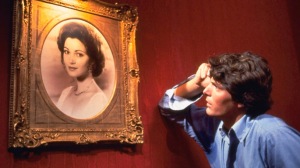
(Up until today, I always thought the movie was loosely based on the story Time and Again by Jack Finney. But it’s not. The main characters use a similar process to get back in time in both stories, but the guy in Finney’s book puts a lot more effort into his preparation. He’s trained by the U.S. military for the project, in fact, and therefore, his time travel success is a lot more believable.)
The common overlap between my time travel theory and practice, and those of the quantum physicists’, I firmly believe, is that both are indeed possible, but have not yet been pulled off successfully.
I think the reason why so many of us are obsessed with time travel is not because of it’s magical-like inaccessibility; not because we are imaginative children longing to explore cities and places far off and forgotten; not because we are approaching middle age and overwrought by nostalgia and an urge to fix our past mistakes.
But because we understand somewhere deep down that time travel is possible and we are only one tiny step away from realizing it.
Like a fog-covered windshield, we need just to wipe away the moisture to see clearly where we are going and how to get there.
Let’s move to San Fran
just on a whim, you and I.
We’ll bring the kids, too.
If I had written this article on the 25 best candy bars of all time, I probably would have replaced Caramello with Rolos, and left out anything with coconut. But to be fair Rolos isn’t a bar, which is probably why the author chose Caramello in the first place.
My first reaction to seeing the post in my Twitter feed was impulsive:
“Hey, it’s Halloween season! Who can I get to ship me some candy corn to Israel?”
My second reaction, after I read the article was:
“Man, it sucks that my kids have nut allergies. I really miss Butterfingers. More than I miss Reese’s and way more than I miss Snickers.”
But then something about seeing all these old friends — candy bars I haven’t touched in years — caused me to delve deeper.
In particular, the nougat-filled Charleston Chew shined a light into the subterranean caverns of my memory.
I remembered a better chew.
The Goldenberg’s Original Peanut Chew.

It was my favorite 5 cent purchase at the synagogue gift shop each Tuesday and Thursday afternoon when I was in elementary school.
Tuesdays and Thursdays were for Hebrew school, and for candy treats I could buy on my own. 4 pm was prime traffic time for the glass-enclosed gift shop at the end of a long hallway peppered with synagogue administrative offices. We lined up one behind the other inside the narrow non-room that was the gift shop, carefully avoiding the stained glass menorahs and brass kiddush cups sitting a top plexiglass shelves.
There was no regular, lovable character serving us at the register. No Candy Man. No Nat from the Peach Pit to welcome us. Just a retired old lady who walked over once or twice a week from the Windsor Towers to make a few bucks selling Judaica and sweets.
They didn’t sell regular candy at the gift shop, not that I can remember at least.
No Milky Ways or Hershey Bars or KitKats. The kind of treats you’d beg your mom for while waiting in line to pay for groceries at Pathmark.
No, the offerings at the gift shop were always obscure — come to think of it, either they were cheaper wholesale so the synagogue could make a higher margin of profit; or maybe back then, only B grade candy got a kosher certification.
Only old ladies dead and gone know for sure.
When I wasn’t buying 5 cent mini Peanut Chews, I was splurging on stick candy —

Rootbeer was my favorite.
I also sucked on Necco wafers, Junior Mints, Broke my teeth on Mary Janes.
Something I never bought, but my little brother always did was Nibs. I was never a licorice fan. I’d eat a red Twizzlers if you gave it to me for free, but I wasn’t going to spend my penny candy money on licorice.
Nibs were (are) tiny bite-sized cherry flavored licorice candies that were packaged in a semi see-through pink plastic bag.
One morning, as my brother and I were waiting for the bus at the corner of our street, he pulled out a half-eaten bag of Nibs from the bottom of his backpack.
“What are those?” asked Pretty, the Indian girl who lived down the street from us.
My brother and I looked at each other quickly. Pretty was not only burdened with the enormous weight of being named Pretty, but she was also gullible.
We had played a few harmless tricks on her before — told her we could make the pictures on our — ahem Freezy Freaky — gloves disappear using only our breath.
Earlier in the year, I easily convinced her my hair was really a wig, by moving my bangs back and forth slowly with my hand pressed hard against my forehead. She never bothered to ask why I had to wear a wig. She simply … believed.
Our tricks never really hurt Pretty — in fact, I’d say they added wonder and delight to her early mornings. But, as a mother, I know the tricks we played on Pretty would not be antics I’d want my kids caught doing to other children today. You live, you learn, and (hopefully) you realize that just because something makes you laugh, doesn’t mean it’s funny.
When my brother pulled out the Nibs that morning — a synagogue gift shop purchase and therefore an unusual and rare confectionery find for our non-Jewish schoolmates — we jumped on the opportunity to delight Pretty …and yes, test how far we could go,
“What are those?” asked Pretty.
“They’re magical candies,” I answered. “When you eat them, you can read people’s minds.”
“Not true!” Pretty exclaimed. She wasn’t stupid … just a bit of a sucker, if you’ll excuse the candy metaphor.
“Yes, true,” said my brother, passing me a “how are we going to pull this off” look.
“Listen,” I told Pretty. “I know it sounds weird, and maybe it doesn’t work for everyone, but yesterday when we were eating these, we totally read each other’s minds.”
“Really?” she said, looking back to my brother for confirmation.
My brother and I both casually nodded our heads.
“We didn’t believe it either, but after eating just one, suddenly I knew he was lying about a secret room he found playing Adventure.” I said, pointing to my brother. “He didn’t find it.”
My brother glared at me. This was a real argument we had the night before. We both had been searching for weeks for the elusive gray dot our cousin Greg had told us about.
“Wow. Can I try one?” Pretty asked.
My brother looked at me, uncertain of what would come next.
“You can,” I said, “but not now. It’s not good to do it right before school.”
“Why not?” asked Pretty.
“It’ll be too loud in your head — all those thoughts — you’ll get a headache.” I had read way too many young adult novels featuring characters with ESP.
Pretty considered this for a second and then said, “You’re probably right. It’s not a good idea. I’ll wait til after school.”
By the end of the day, however, after the bus dropped us off again at the corner, my little brother had already eaten the remaining Nibs. Conveniently, there were none left for Pretty to try.
And frankly, I don’t remember if she simply dropped the matter or if I came up with a reason why we never brought Nibs to the bus stop again.
But I do wonder where Pretty is now — and whether or not she ever truly believed our stories, or if she was, indeed the smartest one of us all, by approaching a remarkable claim with curiosity, instead of cynicism. Choosing to believe first, understand later.
For my 15-minute Friday exercise, I jotted down some thoughts I had while celebrating/not-celebrating the Jewish High Holidays in Israel this year.
The poem I produced out of this exercise may be found here on The Times of Israel and is a culmination of both my confusion and my devotion; of my acceptance and my denial. It is an admission of judgment — of myself, as well as others. And it is a declaration of hope.
Or maybe it’s just a poem.
A whim. A wish. An exercise. A prayer.
Amen.
Before I was in high tech, I was in publishing.
At Scholastic, I worked in the creative marketing department, not directly with authors, but with their work; trying to make their work appeal to the largest audience as possible.
My claim to fame is that I wrote responses to fan letters for R.L. Stine and K.A. Applegate. So if you came of age in the late 90s, we were probably pen pals.
I also was a part of the exciting marketing campaign surrounding the release in the U.S. of the first Harry Potter book.
Good times.
After I left Scholastic, I spent a few years in other publishing jobs: in the promotions department at Parade Magazine and as an assistant editor for a Jewish newspaper.
I soon became expert in making other people’s work better.
Of course, through this experience, my work became better, too. In addition to assigning and editing stories to freelance writers at the Jewish newspaper, I would report on local happenings and sometimes interview C-level Jewish celebrities for features.
Every time my boss, the Editor, would hand me back my first draft, I would grimace at the red marks in the margins.
But the marks, when implemented, always made my stories better.
In time, I became a confident writer of short form non-fiction. Your work becomes better the more you write and the more heavily you are edited.
I imagine the process is similar for any form of writing; especially in fiction and poetry, two genres in which I am experimenting and want to improve.
This is why so many emerging writers and published novelists come out of MFA programs.
They’ve dedicated themselves to writing, yes — but they’ve also committed to being publicly criticized for two years in the hopes of improving. In the hopes of one day being so good they will be noticed. Noticed like a misused metaphor, like a dangling participle.
This element of the writing program — the communal critical eye — is missing from the fantastic writing community that is the blog-o-sphere.
I never — or hardly ever — publicly criticize a blogger’s work. If I add a comment to a blog, 99% of the time it’s a positive comment. If it’s a negative comment, it’s finely worded so as to not offend the author.
I’m not talking about political blogs, where trolls feel completely uninhibited to offer their frank opinions about how the author is a stupid, naive right-wing psychopath. I’m talking about the community of essayists that have sprung up through the popularity and ease of the blogging platform.
Mommy bloggers.
Aspiring novelists.
Flash fiction writers.
People who feel the need to chronicle the every movement of their cats.
Everyone can be a published writer now.
A published author even — thanks to Amazon.com and a host of self-publishing software.
And, yes, this is awesome.
Really awesome.
And … not so awesome.
I like to read good writing.
I like to pay for good writing.
I’m annoyed when I read bad writing, especially when I’ve paid for it.
I want the books I read to have been written by people who cared enough to become better writers. I want those books to have been through at least one, if not five, careful revisions by an editor.
I say this not just as a writer, but as a consumer of the written word.
Maybe I hold myself up to too high a standard. (That sounds obnoxious, I know. )
Maybe if I didn’t, I would already be a published author myself now. (I’m not counting The Fantastic Adventures of Me & My Friends or the two other activity books I wrote for Scholastic. That also sounds a bit obnoxious, doesn’t it?)
Maybe I’m worrying for nothing.
Maybe the world is a happier place because more people are writing and finding their own audiences.
But I think there is room for criticism in the blogging world. Perhaps we would do more to support each other by not just commenting when we think a post is good, but when we think a post is almost good — when something could be just a little bit better if only it was rewritten once or twice.
It irritates me when I write a post that I think is really good and a commenter writes something simple like,
“Lovely.”
This happens a lot. Which should be a good thing.
But I want to follow up on that “lovely.” I want to know, “Why?”
“Why do you think this is lovely?”
Did it strike a chord?
Was it my careful phrasing?
Was it how elegantly I described the herd of goats by the side of the road?
And how could it be better? How could I rewrite it into something you’d be happy you paid for? Satisfied you spent your time on?
This is what is missing from the blogosphere. And why, at least now, blogging in community will never be as serious as a writing program.
Most of our comments are just blatant attempts at trying to attract new followers.
It doesn’t have to be that way.
Are you a blogging writer who seeks comments like this? Who wants more than just a
“Great post!”
If so, let me know — perhaps we can build a more critical commenting community together.
Help each other… emerge…from red marks in the margin.
Today’s Daily Prompt from the folks at WordPress:
Are you comfortable in front of people, or does the idea of public speaking make you want to hide in the bathroom? Why?
I read this prompt a few times before responding.
Frankly, I don’t think it’s an either/or, and just goes to show how careful one must be when making comparisons.
I am very comfortable in front of people.
AND the idea of public speaking makes me want to hide in the bathroom.
This is because I officially and comfortably straddle the extrovert/introvert border.
For example, I both like being with people and hate being with them. I am both energized by social gatherings and dread them. I crave attention, and sometimes scan my surroundings frantically looking for a ditch to hide in.
I am complicated.
I also straddle the thinking/feeling border on the Myers Briggs, which basically means I don’t have trouble making decisions, but I regret them soon after.
Personality evaluation is one of my favorite pastimes. But i don’t often get to partake in it with a partner. Most people are content just judging others, but I quietly sympathize with them, tagging them an E or an I; totally a J or completely a P.
“Oh…he is such an ENFP,” I think to myself. “Emphasis on the P! Jeez.”
(In addition to being complicated, I am also a big dork.)
My husband, who is finally reading Quiet by Susan Cain (after months of my starting many conversations with “well, if you had read Quiet by Susan Cain”), asked me tonight where I fell on the Myers Briggs test.
“I consider that foreplay, honey.” I told him. “We’ll definitely be having sex later.” I then reminded him I was a total J, and a massage would be in order along the way. After all, process matters. Plan ahead!
Wait: Do I like public speaking?
Was that the question?
Frankly, I dread it. I literally feel vomit in my throat the first 30 seconds I am speaking. But when I’m up there, and I’ve reeled them in (which I usually do), my heart alights and I get high on the focused attention — all on me.
And afterwards, when I know for certain I killed it, I gloat.
My face is all “S” even though I am a full on “N” most of the time.
Is there anyone out there who actually feels comfortable speaking in front of a crowd? Who just steps out onto the stage, grabs the mike, and from the very first moment feels at ease?
That seems a bit like a P to me.
And not P (perceiving) but P psychopathic.
But I am not judging.
Nope, not me.
If you write poetry and no one reads it, is it still a poem? What if no one likes it?
Gets it?
Shares it?
What if it’s never published?
Never praised?
Is it still a poem?

How — really — does one recognize a poet?
Is the title earned? Learned?
I admit —
I am a reluctant poet.
Reluctant, not because I don’t enjoy weaving short thoughtful phrases together and calling it poetry, and not because I don’t enjoy reading short thoughtful phrases woven together by others
but mostly because I am not 100% sure how to recognize a poem.
And I am not 100% sure I am a poet.
Poetry confuses me. It makes me insecure.
I doubt it. I judge it. In a way I don’t judge novels or articles or essays.
When I read poetry, I am often left confused.
When I write poetry, I am overly critical. Hungry for approval and acknowledgment.
Is it the writer in me, I wonder, that is anxious and unsure?
Or is it the human?
There was a time when I thought I knew poetry. When I thought that poetry was as simple as alliteration

as simple as limericks … as quatrains … as rhyme.
I was in third grade and poetry was the unit during Language Arts.
We created a poetry book — I still have it. It’s bound in wallpaper and decorated with a rainbow colored pride known only by nine year old girls and confident gay activists.
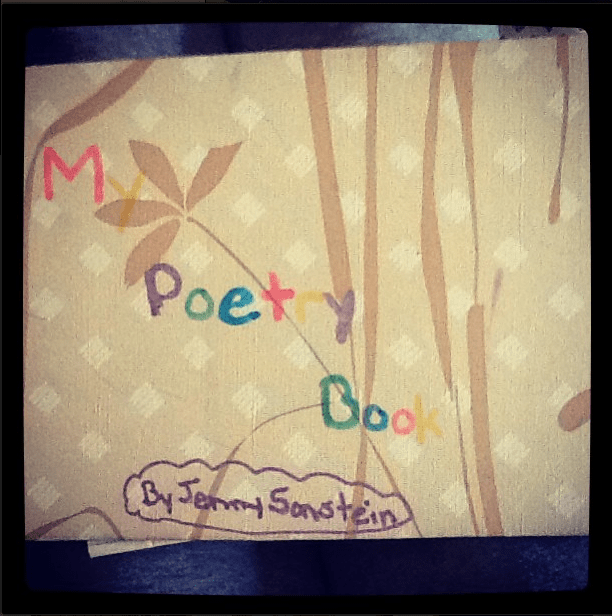
And I am moved by the poet I was then.
I am struck by how I saw the world when I was a poet, and I am envious of the girl who strung together lavish gibberish and confidently presented it as verse.
Oh, how the words flowed then…
/
walking down the stairs
holding tight to the staircase
taking your first step
Your parents at the bottom
finally your (sic) down the stairs.
/
In 1983, under the instruction and guidance of Mrs. Wald, I wrote a 12-page, wallpaper-bound book of poetry.
The pieces vary in length and in depth.
They cover topics that range from my childhood home to the mountains of Japan.
They make perfect sense and no sense at all.
Some rhyme, some reference people I no longer remember.
30 years later, I read this book of poetry and I am moved.
Does that make me a poet?
Is that enough?
I say it is.
It’s enough.
Not enough for contests or Ph.D.s or prizes, that’s for certain.
But enough to offer me the confidence
to write another poem
tomorrow.
Beyond the yellow gate
there is a woman.
Her airy black head scarf almost shields her effervescent eyes.
But when she looks up, sky blue bounces off her peasant shirt and into her pupils so they ignite.
She touches my wrist gently as she feels for my pulse.
Ba-boom. Ba-boom. Ba-boom.
.
Beyond the yellow gate
there is a man.
His navy blue striped rugby shirt and acid washed jeans foretell a deep, defiant voice.
But when his lips part and open wide, out fall directions in a timid, mouse-like squeak.
He guides me — turn left, turn right, and then
straight, straight, straight, always straight.
.
Beyond the yellow gate
there is a building.
A tall, two story white stone building, a dusty green awning greets the afternoon sun
But behind the glass door is woman with a cleft-lip
whose job is to collect, from everyone who enters, 30 shekelim
shosheem shkreem, she says. Ma? Shosheem shkreem.
.
Beyond the yellow gate
there is a town.
A busy town. A bustling town. A restless town.
But living in this town there is Farid and Dr. Haddad and the two girls
in pigtails eating popsicles
slurrrrrrrrrrrrrrrrp.
.
Beyond the yellow gate
there are people.
Their faces, weathered or leathery or lean,
are thumbnail previews of the beauty within.
—-
This poem is one in a series about Kfar Manda, an Arab village three miles down the road from Kibbutz Hannaton, where I live, in the Lower Galilee, Israel.
I imagine the ultimate test in letting go is when you die.
If you progress into the afterlife or Heaven or stay put, cold in the grave (depending on your beliefs and spiritual affiliation), you get an A+ in letting go.
If you turn into a nice ghost, just hanging around moving chairs and creaking doors ’cause you have a few things left on Earth to clean up, you can probably bank on a C + with the chance to take the test over when some nice human with special powers comes along, notices you moving chairs and stuff, and helps you transition into the post living world. If you turn into a scary ghost or some demon that possesses toy clowns (like in Poltergeist), you clearly are still majorly stuck, and have official failed the “letting go” test.
But if there were a midterm exam on letting go, I’d say that test would look like your laptop click click clicking and never turning on again.
And when your computer died — because apparently that’s what the click click clicking always means — and it took your creative writing and your photos to the grave with it, the midterm exam demands of you proof you know your material. You need to prove to your friends and your family and your readership — and most of all to yourself — that you truly live this thing called ‘letting go.’
To pass the midterm, you need to breathe in deep, say a prayer that you did do a backup a month ago — and then publicly show some gratitude for that.
To pass the midterm, you need to be thankful that living your life on Facebook and Instagram means that part of your life exists somewhere else — in that mythical land called “the Cloud.” To pass the midterm means writing an essay that explains why a dead computer is like ten times better than a dead person and five times better than a solar flare powerful enough to wipe out the electrical grid, and take the Cloud with it. To pass the midterm is to acknowledge that you do not know everything and to actively remember the times in your life when opportunity has appeared in the middle of an assumed catastrophe.
To pass the midterm, is to type your blog post on your smart phone and be happy you have a smart phone on which to communicate and smart people whom may guide you on how to cope with the loss of things that feel really really important…but are in the end, just things.
The best thing I never bought was this orange comb-brush.

How do I know?
Because I’ve had it now for more than 30 years.
I got it as a party favor at a girl’s sleepover party when I was six.
It’s traveled with me through 4 schools, 10 or so homes, and at least 100 handbags and backpacks.
It survived our Wheaton terrier — the one we had for less than a year — whose teeth marks are forever indented on its frame.
It survived at least two perms.
And it survived Israeli lice.
If this orange comb-brush could talk, it would say:
“You should have waited til after the bubble burst to buy a house.”
It’s a wise comb-brush.
About 15 years or so ago, I lost the orange comb-brush for a while.
I looked everywhere for it. Under the driver’s seat of my Nissan NX, inside eight or so Le Sport Sacs, behind the toilets and underneath the sinks of everyone I knew. I couldn’t find it.
Finally, I understood. It was really gone.
And so I bought the purple comb-brush. I carried it around with me for over a year until one day I found the orange comb-brush in a drawer inside my parent’s house.
I was elated. But also eerily aware that as happy as I was, I would have been perfectly okay had I never found the orange-comb brush.
I was okay.
Without the orange comb-brush.
Today, I still have both brushes. The orange returned to its rightful place in my handbag, while the purple spends most of its time lying next to my kids’ bathroom sink narrowly escaping Israeli lice.
I will never give up that orange comb-brush willingly. But I will be okay if it’s once again lost.
And while I thought for a long time, I would never feel as attached to the purple comb-brush as I did to the orange one, I notice my attachment shifting, my affinity for it growing. I see it in my memories and look for it when it’s missing.
It’s the purple comb-brush that I use to braid my daughter’s hair.
It’s the purple comb-brush that greets me in the evening as I turn off the lights to the bathroom and wipe down their crusty toothpaste from the sink.
And when three teeth from the purple comb-brush melted after someone accidentally left it on top of the toaster oven, I was really bummed.
But I kept the brush. Even though it’s deformed and not quite as useful, we still use it.
Osho writes that “attachment brings misery, unattachment brings blissfulness,” which sounds harsh except he softens his admonition with a dose of compassionate, measured reality:
“So use things, but don’t be used by them. Live life but don’t be lived by it. Possess things, but don’t be possessed by them. Have things — that’s not a problem. I am not for renunciation. Enjoy everything that life gives, but always remain free.”
And it’s this balance — between the bliss of having and the misery of not; between the misery of having and the bliss of not — that I seek.
I found it in that moment when I realized I didn’t miss the orange comb-brush so bad after all … but I was still happy to have her around again.
And the moment that I realized the purple comb-brush wasn’t just a meaningless replacement; that things change and people grow and new memories form …and new loves appear where there was once only plastic.
 and yadda yadda, an aliyah blog