Community, Religion, Spirituality, Writing

A poem about Israel

For my 15-minute Friday exercise, I jotted down some thoughts I had while celebrating/not-celebrating the Jewish High Holidays in Israel this year.

The poem I produced out of this exercise may be found here on The Times of Israel  and is a culmination of both my confusion and my devotion; of my acceptance and my denial. It is an admission of judgment — of myself, as well as others. And it is a declaration of hope.

Or maybe it’s just a poem.

A whim. A wish.  An exercise. A prayer.

Amen.


Community, Family, Food, Kibbutz, Living in Community, Mindfulness, Parenting, Relationships

Smells of Shabbat

One day in the future
My son will need some air.
He’ll leave home
Seeking solace
If only for a minute or two.

On his journey toward temporary peace
He will come upon
The smell of roasted potatoes with rosemary
Two minutes to go til burning
The scent will float beneath his nostrils
And he will remember tonight…

Walking with me
Up and down emptying streets
Through quieting paths
Around quickly passing cars
Parking on the other side of the gate.

A walk
A gasp for air
A last chance to let go of all that was
And open to
what will be
This week

Mindfulness, Relationships, Religion

The trouble with sorry

The hardest thing for me to tolerate on Yom Kippur is not absence of food;

It’s the absence of tomorrow.

On Yom Kippur, we are present.

We are asked to let go of yesterday’s mistakes,

to forgive others, and ourselves.

We are solemn in our awareness of the gift of a clean slate.

Of a clean tomorrow.

But this is difficult for me. My busy mind.

Everyone else’s mind is busy with thoughts of food

of kippered salmon, of potato pancakes.

My mind is busy in judgment.

“Is she really sorry?”

“Is he really going to change his ways?”

“Am I?”

With so much sorry in my face, I feel compulsive in my doubt.

And incapable, more than any other day during the year, of casting away judgment.

And present only to my dilemma;

To sinning once again.


Community, Culture

The characters must fit the story

I almost forgot to punch out my 15-minute Friday piece until I checked my WordPress Reader and saw that the Daily Prompt today pushes us to “Go Serial.” I started going serial accidentally last week when I found myself compelled to write yet another poem about Kfar Manda, the Arab Village down the street from Hannaton, the kibbutz village in which I live.

I was in Kfar Manda because I heard from my friend on Hannaton they had a great health clinic with good doctors and lots of services the smaller clinics here in the North don’t typically have. The two clinics I normally go to were closed and I wasn’t feeling well. I didn’t want to wait until the next morning, when my doctor would return to the office.

Going to the health clinic is always a test of bravery for me here in the outskirts of this country. You never know how good the doctor’s English will be and you never know if your Hebrew will be strong enough to indicate which organ feels busted or which region needs attention.

I still don’t know how to say vagina in Hebrew.

I do now, however, after many awkward interactions, know the grownup words for peepee and poop.

It took me 6 months of living in Israel before I felt comfortable going to the doctor without my husband in attendance. But it took me 2 1/2 years of living here before I felt comfortable driving in and around Kfar Manda.

This week was the first time I drove in alone. And I only felt comfortable doing so once I saw on Google Maps that the clinic was only a few blocks from the main road. That said, Google Maps doesn’t really work in villages  Northern Israel: neither the Jewish nor the Arab Villages have street signs. And so directions “to turn left  on Peleg Street” don’t help in real time. So even though the clinic was only a few blocks in, I needed help from the locals to get me there.

By a mix of my broken Hebrew and theirs, I found my way to the clinic and was graciously supported by the Arab doctors and nurses. The only difference between this clinic and the one I normally go to was language. The promotional signs from the health plan, for instance, were in Arabic instead of Hebrew; as were the conversations between the health professionals.

My solo trip into Kfar Manda didn’t end there. I had to go for an Xray. I could have waited a few days and scheduled an appointment in Karmiel, the nearest city. But I wanted to get the Xray over with. So I asked the doctor for directions.

In typical Middle Eastern style, he pointed out the window and told me in Hebrew to walk this way, that way, and then straight, straight, straight for 50 meters and I’d see it.

I nodded and did as I was told.

Except after 45 minutes in the heat of the day trying five different versions of “this way, that way, and straight straight straight” I only found myself at a market, a pharmacy, and at a store selling curtains.

It was time to go home or talk to people.

I chose to talk to people.

7 or 8 people later, I found the hair salon whose owner pointed me to the bank whose member directed me to the restaurant that was above the Xray center.

I found it.

And in doing so, I found another way of looking at Kfar Manda.

A perspective that involved real people, not just characters in stories. Stories based in fact, yes, but stories also based in fiction. In assumptions. In racism. In fear.

Stories I had been told and stories I told myself.

And so, with personal experience, my understanding of Kfar Manda shifts.


Health, Letting Go

Stuck in Your Throat

Your silence is a cover-up.

It’s a conspiracy between you and the way you think people see you.

Your silence is a ruse.

It’s a simple means of getting from here to there.

Avoiding an accident.

Your silence is a hushed conversation between you and yourself.

It’s a promise.

It’s a plan in the making.

It’s a vendetta.

Your silence is silent until it’s loud.

And then BOOM.

Destruction.

Why are you silent in the face of men who care not if you smile or frown, stay or go, live or die?

Why is your silence, then, in front of them, so valuable? Such a commodity?

Why are you loud in the face of children whose only desires lie in pleasing you?

Why is your silence, then, in front of them, so rare? Out of stock?

Stuck deep down in your throat are all the things you want to say

But you are silent

Anger rages like a river, swirling whirlpools in your throat you swallow.

Until a tidal wave of release

Drowns the ones you love.

Letting Go

How peeling eggs turned me into Ralph Macchio

I think the majority of the world falls into two camps.

People who don’t mind peeling eggs. And people who hate it with all their might.

Peeling eggs, for me, is torture.

It’s a slow torture, too.

It’s painful to my senses. The uneven, unexpected cracks that may or may not lace the eggs once they come out of the pot. The stretch of the skin as you pull off the hard, cracked outer shell.  The rubbery touch and feel of the skin beneath. All the small left over pieces that you can’t easily scrape off your fingertip.

I can hardly stand it.

What I like even less about peeling eggs is the amount of time it takes, and the fact that each egg must be peeled slowly and with care. This isn’t so bad if you want just one egg, but becomes more of a nuisance if you need to make egg salad …and much more of a pain if you are making egg salad for a party of 10 or 15 people.

That’s a lot of eggs to peel.

But what I like even LESS is when a piece of shell pulls off with it some of the meat of the egg white.

Grrrr… and you’re left with a very deformed, less than perfect, certainly not whole, egg.

As a borderline perfectionist, this truly is almost more than I can bear.

But I bear it.

Over the years, I have been given a few tips on how to peel eggs easier. (“Wait til they’ve cooled. Do it quick while they’re still hot. Crack a hole on each end and blow into it first.”)

No matter what the technique, it still is a process I wish I didn’t have to go through.

But I do it anyway.

Mindfulness comes in handy in these situations, I have found.

Unless you don’t mind chomping on shells, peeling eggs requires extraordinary presence and patience.  You need both hands to peel and you need a careful eye to search and find the leftover pieces of shell on the egg.

You need to be with the egg.

You can’t be typing a text to your husband or responding to an email from your boss.

You can’t be changing the baby’s diaper or sitting on the toilet.

You can’t speed through it — unless you don’t mind peeling half the egg off with the shell.

And you can’t do it in front of the TV or in the dark in bed.

And if you hate peeling eggs as much as I do — you tolerate all this in the hopes that the ends will justify the means. BUT, at the same time, you are required to completely give up expectations of the outcome.

You need to be okay with the mauled, ugly egg, for instance — or you’ll be boiling and peeling eggs all day long, over and over again.

I was peeling eggs semi-mindfully today — and by semi-mindfully, I mean my emotional state was somewhere between pulling out my hair and poking out my eyes — when my 6 year old son came over and asked if he could help.

I almost said, “Thank GOD!” and ran away.

Instead, I sat with him and patiently showed him how to peel an egg. I taught him the steps, instructed him on how to peel the shell completely, and coached him on letting go of the need for the egg to be perfect.

As I heard my voice out loud, guiding him on concepts I still myself need coaching on, I suddenly got the epiphany of  “peeling the eggs”

Do you hear Mr. Miyagi’s voice the way I do?

He’s saying:

“Peel the eggs eggs

Peel the eggs

Peel the eggs …

No, no look here.

Slowly, slowly.

Peel the eggs

Peel the eggs

Peel the eggs.

Very good, Jenny San.

Don’t forget to breathe…

Peel the eggs,

Peel the eggs.”

Food, Religion, Spirituality

The beet goes on

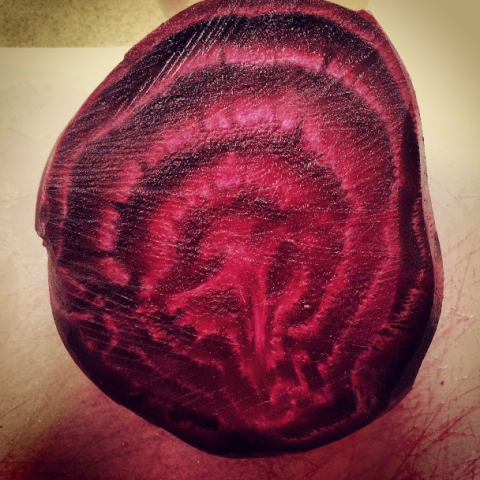
I thought the most interesting thing about today would be the beet.

I pulled four beets from the vegetable drawer because I knew if I didn’t do something with them today they’d go bad tomorrow.

I have a strange relationship with beets.

I want to love them.

I want to savor them like my friend Allison, who once said to me,

“Mmmm…I love beets.”

But I can’t. I just can’t. At best, I can tolerate beets when they’re roasted just so and soaked in a little olive oil and balsamic vinegar.

But beets are so incredibly beautiful that I will wash them and peel them and slice them and stand over them in wonderous amazement even if I won’t eat them.

dancing beet

The red pink of beets should not exist in nature.

It should be synthetic, it is so beautiful.

The spiral designs inside a beet, however, should exist in nature.

Beet innards are exactly the kinds of puzzles that nature produces and we call God.

I love beets, but I can’t eat them.

After the beets, I tried to take a nap.

Two of my kids were sleeping: one sprawled on the couch in a beet-colored dress with wrinkled flowers on the strap and the other with his head hanging off the bottom bunk.

He fell asleep in the middle of a tantrum while I tried to soothe him with Harry Potter and the Sorcerer’s Stone, Chapter 1, page 1.

There was a knock at the door.

It was Nachum.

Looking for my son.

I knew it was Nachum because I heard his fingers drumming on the metal railing outside.

I liked that I knew it was Nachum and didn’t mind so much that he was rousing me from my almost nap.

My son was not at home. He was at a basketball game with his dad.

I told this to Nachum. He turned around and left as quickly as he came.

I tried to take a nap.

There was a knock at the door.

It was not Nachum, but a man whose name should have been Nachum.

He was in a rumpled white button down shirt and black pants.

He had a long black beard, too.

He might have had a black yarmulke but I didn’t notice when he turned to walk away.

I was too busy remembering his smile.

I gave him 20 shekels and he was happy.

I was happy, too.

So happy, I stopped trying to take a nap.

= = =

(This post was written in less than 15 minutes. Wanna take on the Friday 15-minute challenge? Write today for 15 minutes and leave a link to your post in the comments below and tag your post 15-minute Friday.)

Letting Go

Friday writing challenge: 15 minutes of…

In Israel, Fridays are Saturdays. Which is to say — they are the first full day of the weekend.

But Fridays aren’t Saturdays.

For many reasons.

For one, Friday is the day leading up to Shabbat — the 25-hour or so rest period during the week for observant Jews.

We’re not observant Jews.

But we’re not, non-observant Jews.

I often refer to myself here in Israel as a Jew-in-progress.

I am playing with my Judaism.

It’s fun.

For me, Shabbat means dressed up Fridays and a Saturday morning buffet unlike any I’ve ever experienced before.

Fridays are a day to prepare for Shabbat, so that Saturday we may relax and enjoy being in the moment. Each moment. Whether the moment is a board game with my son, or a meditation group with my neighbors, or a quick nap in front of the TV.

On Fridays, we clean the house (since we never have time or energy during the work week); we prepare a nice dinner for our family or for guests (since Friday is the only night we truly eat together as  family); and — if we’re really lucky — my husband and I might find time for a snooze or a chapter or a whatever it is we want to do with our limited free time left.

My kids all have programs on Friday mornings, which is awesome.

But what typically happens is my husband and I spend the entire morning cleaning and cooking and then right at 11:45 am, 15 minutes before the kids come home, we’re finished.

We have 15 minutes left.

What can you do with 15 minutes?

Not really enough time to chill or read or watch the 12 hours of recorded programs on our DVR.

But 15 minutes IS enough time to write.

Most people would say, “not so.”

What can you write in 15 minutes?

What they really mean is: How well can you write in 15 minutes?

Well, what if the point was not to write well?

But just write … and share what you’ve written.

No time to think through your topic carefully. No time to outline your story. No time to proofread or edit.

No time left.

Writing this way requires a completely different mindset.

It means … you have to let go.

And just write.

For me, this is almost unspeakable. Except I just spoke it.

And I’m about to do it.

Want to play with me?

If so, go ahead. Write something. Then, add a link to your 15-minute Friday writing challenge post in the comments below. Tag your post 15-minute Friday.

Can’t wait to see what happens when you, too, choose to let go … and just write.