One of my dear friends turned 40 today. She was the first of my group of childhood friends to get her driver’s license, the downside of which, I said to her today, is that she also is the first of our group of friends to hit middle age.
Of course, none of that statement is true.
Our friends — the ones who celebrated her 17th birthday years ago — are now scattered around the world, and some are no more our friends than the random stranger from Kenya who friend requested me yesterday on Facebook.
And, what really is “middle age?”
Is it literally the day you turn 40 — is that truly the middle of your life?
I feel as if I passed middle age long ago. Could be that my opinion will change, but I measure time as BC (before children) and WMBBTS (when my boobs began to sag).
So I pretty much hit middle age 10 years ago.
Contemplating my friend’s birthday and hearing a familiar voice in the back of my mind, I searched YouTube for the last scene of one of my favorite childhood movies — Stand By Me.
Somehow — and I am constantly amazed at how prescient I was of the nostalgic longing that accompanies aging — 12-year-old me was certain that grown Gordie’s words in the closing scene of the film were, and would remain, poignantly, heart-breakingly true.
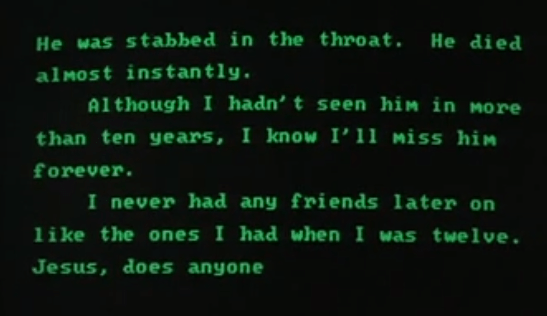
From the film Stand By Me
It’s Richard Dreyfuss’ voice I heard this morning and whose voice I hear from time to time when I consider the impact my friends from childhood had (and continue to have) on the creation that is grownup me:
“I never had any friends later on like the ones I had when I was twelve…. Jesus does anybody?”
But when I watched the final scene of the film today, what struck me for the very first time is the unspoken, yet classic writer’s epiphany that prompts Gordie to tap out satisfyingly the closing line of his book.
Grown Gordie’s son enters the study to find his father staring at the computer. The kids ask Gordie to hurry up and they roll their eyes when he (for the umpteenth time) tells them “Okay, I’ll be right there” and continues to stare at the computer monitor.
The son turns to his friend and says:
“My dad’s weird. He gets like that when he’s writing.”
Gordie laughs.
I laughed, too, when I watched the scene today. I know well the “like that” of which his son speaks.
I know it as this feeling, this presence that soars into my heart when I finally grasp one of my life’s great truths — like the incomparable experience of knowing someone when you were 12 — and when I am able to transform this truth into words.
And share them.
When I can nod my head along with the cosmic consciousness in understanding.
And know for certain that you, the reader, will understand it too.
If I had written this article on the 25 best candy bars of all time, I probably would have replaced Caramello with Rolos, and left out anything with coconut. But to be fair Rolos isn’t a bar, which is probably why the author chose Caramello in the first place.
My first reaction to seeing the post in my Twitter feed was impulsive:
“Hey, it’s Halloween season! Who can I get to ship me some candy corn to Israel?”
My second reaction, after I read the article was:
“Man, it sucks that my kids have nut allergies. I really miss Butterfingers. More than I miss Reese’s and way more than I miss Snickers.”
But then something about seeing all these old friends — candy bars I haven’t touched in years — caused me to delve deeper.
In particular, the nougat-filled Charleston Chew shined a light into the subterranean caverns of my memory.
It was my favorite 5 cent purchase at the synagogue gift shop each Tuesday and Thursday afternoon when I was in elementary school.
Tuesdays and Thursdays were for Hebrew school, and for candy treats I could buy on my own. 4 pm was prime traffic time for the glass-enclosed gift shop at the end of a long hallway peppered with synagogue administrative offices. We lined up one behind the other inside the narrow non-room that was the gift shop, carefully avoiding the stained glass menorahs and brass kiddush cups sitting a top plexiglass shelves.
There was no regular, lovable character serving us at the register. No Candy Man. No Nat from the Peach Pit to welcome us. Just a retired old lady who walked over once or twice a week from the Windsor Towers to make a few bucks selling Judaica and sweets.
They didn’t sell regular candy at the gift shop, not that I can remember at least.
No Milky Ways or Hershey Bars or KitKats. The kind of treats you’d beg your mom for while waiting in line to pay for groceries at Pathmark.
No, the offerings at the gift shop were always obscure — come to think of it, either they were cheaper wholesale so the synagogue could make a higher margin of profit; or maybe back then, only B grade candy got a kosher certification.
Only old ladies dead and gone know for sure.
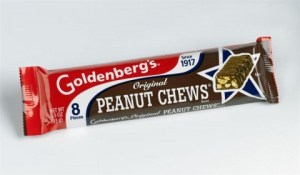
When I wasn’t buying 5 cent mini Peanut Chews, I was splurging on stick candy —
I also sucked on Necco wafers, Junior Mints, Broke my teeth on Mary Janes.
Something I never bought, but my little brother always did was Nibs. I was never a licorice fan. I’d eat a red Twizzlers if you gave it to me for free, but I wasn’t going to spend my penny candy money on licorice.
Nibs were (are) tiny bite-sized cherry flavored licorice candies that were packaged in a semi see-through pink plastic bag.
One morning, as my brother and I were waiting for the bus at the corner of our street, he pulled out a half-eaten bag of Nibs from the bottom of his backpack.
“What are those?” asked Pretty, the Indian girl who lived down the street from us.
My brother and I looked at each other quickly. Pretty was not only burdened with the enormous weight of being named Pretty, but she was also gullible.
We had played a few harmless tricks on her before — told her we could make the pictures on our — ahem Freezy Freaky — gloves disappear using only our breath.
Earlier in the year, I easily convinced her my hair was really a wig, by moving my bangs back and forth slowly with my hand pressed hard against my forehead. She never bothered to ask why I had to wear a wig. She simply … believed.
Our tricks never really hurt Pretty — in fact, I’d say they added wonder and delight to her early mornings. But, as a mother, I know the tricks we played on Pretty would not be antics I’d want my kids caught doing to other children today. You live, you learn, and (hopefully) you realize that just because something makes you laugh, doesn’t mean it’s funny.
When my brother pulled out the Nibs that morning — a synagogue gift shop purchase and therefore an unusual and rare confectionery find for our non-Jewish schoolmates — we jumped on the opportunity to delight Pretty …and yes, test how far we could go,
“What are those?” asked Pretty.
“They’re magical candies,” I answered. “When you eat them, you can read people’s minds.”
“Not true!” Pretty exclaimed. She wasn’t stupid … just a bit of a sucker, if you’ll excuse the candy metaphor.
“Yes, true,” said my brother, passing me a “how are we going to pull this off” look.
“Listen,” I told Pretty. “I know it sounds weird, and maybe it doesn’t work for everyone, but yesterday when we were eating these, we totally read each other’s minds.”
“Really?” she said, looking back to my brother for confirmation.
My brother and I both casually nodded our heads.
“We didn’t believe it either, but after eating just one, suddenly I knew he was lying about a secret room he found playing Adventure.” I said, pointing to my brother. “He didn’t find it.”
My brother looked at me, uncertain of what would come next.
“You can,” I said, “but not now. It’s not good to do it right before school.”
“Why not?” asked Pretty.
“It’ll be too loud in your head — all those thoughts — you’ll get a headache.” I had read way too many young adult novels featuring characters with ESP.
Pretty considered this for a second and then said, “You’re probably right. It’s not a good idea. I’ll wait til after school.”
By the end of the day, however, after the bus dropped us off again at the corner, my little brother had already eaten the remaining Nibs. Conveniently, there were none left for Pretty to try.
And frankly, I don’t remember if she simply dropped the matter or if I came up with a reason why we never brought Nibs to the bus stop again.
But I do wonder where Pretty is now — and whether or not she ever truly believed our stories, or if she was, indeed the smartest one of us all, by approaching a remarkable claim with curiosity, instead of cynicism. Choosing to believe first, understand later.
One day in the future
My son will need some air.
He’ll leave home
Seeking solace
If only for a minute or two.
On his journey toward temporary peace
He will come upon
The smell of roasted potatoes with rosemary
Two minutes to go til burning
The scent will float beneath his nostrils
And he will remember tonight…
Walking with me
Up and down emptying streets
Through quieting paths
Around quickly passing cars
Parking on the other side of the gate.
A walk
A gasp for air
A last chance to let go of all that was
And open to
what will be
This week
If you write poetry and no one reads it, is it still a poem? What if no one likes it?
Gets it?
Shares it?
What if it’s never published?
Never praised?
Is it still a poem?
How — really — does one recognize a poet?
Is the title earned? Learned?
I admit —
I am a reluctant poet.
Reluctant, not because I don’t enjoy weaving short thoughtful phrases together and calling it poetry, and not because I don’t enjoy reading short thoughtful phrases woven together by others
but mostly because I am not 100% sure how to recognize a poem.
And I am not 100% sure I am a poet.
Poetry confuses me. It makes me insecure.
I doubt it. I judge it. In a way I don’t judge novels or articles or essays.
When I read poetry, I am often left confused.
When I write poetry, I am overly critical. Hungry for approval and acknowledgment.
Is it the writer in me, I wonder, that is anxious and unsure?
Or is it the human?
There was a time when I thought I knew poetry. When I thought that poetry was as simple as alliteration
as simple as limericks … as quatrains … as rhyme.
I was in third grade and poetry was the unit during Language Arts.
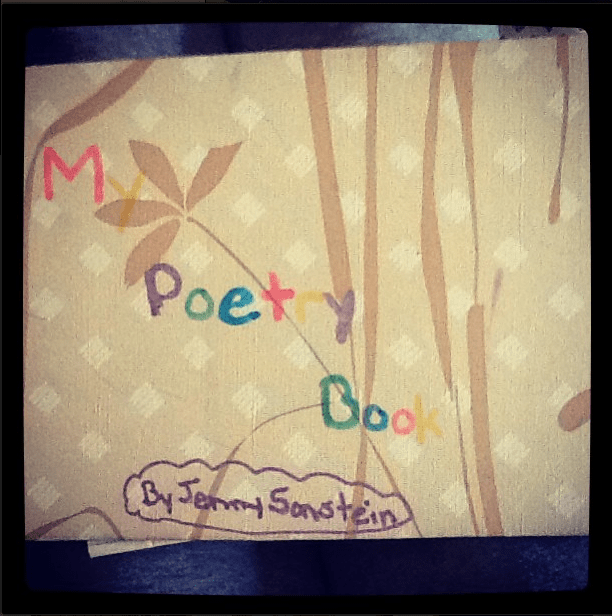
We created a poetry book — I still have it. It’s bound in wallpaper and decorated with a rainbow colored pride known only by nine year old girls and confident gay activists.
And I am moved by the poet I was then.
I am struck by how I saw the world when I was a poet, and I am envious of the girl who strung together lavish gibberish and confidently presented it as verse.
Oh, how the words flowed then…
/
walking down the stairs
holding tight to the staircase
taking your first step
Your parents at the bottom
finally your (sic) down the stairs.
/
In 1983, under the instruction and guidance of Mrs. Wald, I wrote a 12-page, wallpaper-bound book of poetry.
The pieces vary in length and in depth.
They cover topics that range from my childhood home to the mountains of Japan.
They make perfect sense and no sense at all.
Some rhyme, some reference people I no longer remember.
30 years later, I read this book of poetry and I am moved.
Does that make me a poet?
Is that enough?
I say it is.
It’s enough.
Not enough for contests or Ph.D.s or prizes, that’s for certain.
When we first moved to Israel, I felt uncomfortable sitting on buses and in cafes.
I would casually look around, trying to avoid notice, to see if there were any suspicious people or packages about; not sure, exactly, what my reaction would be if I spotted one.
Over time I have found myself less and less suspicious. More at ease in public places, as it so happens, but still not at ease.
“At ease” is not a behavior I was born with — or maybe I was — and was just spooked one too many times by a mischievous friend or traumatized by too many VC Andrews novels.
The world, for me, has almost always been a scary place.
And I have almost always been easily startled.
While here in Israel, I cautiously scan the room for bombs; in the States, I cautiously scanned darkened evening streets for rapists and quiet alleys for thugs. I walked quickly through empty hallways and avoided elevators with lone men. I double and triple locked my doors, and was known to sometimes sleep with the lights on. Especially the night after The Blair Witch Project.
I remember being in a bar watching a band perform in New York City once, in the months just before 9/11 but fresh enough after Columbine to still be jumpy, and leaping off my seat at the sound of a small explosion in the back of the room. Someone’s hair had caught fire accidentally on the tea light candle intended for atmosphere, and instead of atmosphere we were treated to dramatic special effects.
After I caught my breath, I laughed out loud at my reaction, but internally asked myself what I had been so concerned about. What immediate danger did I think the noise indicated?
A gun shot?
An explosion?
A brawl?
It’s the first time I remember my unease extending from mild anxiety to a heightened concern for my immediate well-being and the well-being of others.
From then and there, unfortunately, my unease has only become gradually uneasier.
And not because my anxiety has worsened, and not because I moved to Israel.
In fact, my anxiety has significantly improved in the last decade since I started acknowledging it and paying attention to it and using focused breathing, meditation and mindfulness.
Moving to the slow-paced countryside of Israel, in some ways, has helped, too.
But no matter how significantly my anxiety has improved, the world hasn’t. Since 9/11, the way I see it, we have been witness to more violent crimes like those in Aurora and Newtown and Boston and have experienced the communal aftermath of incomprehensible tragedies like Katrina and Sandy and are becoming more and more awakened to the devastation of our planet and the resources we have taken advantage of all our lives.
And suddenly I am no longer a minor statistic in a clinical journal.
It’s not just me and my world viewed through an anxiety-colored lens.
The world itself has become anxiety-colored. The world itself is on edge.
I watched this video of grown men jumping out of their seats; seemingly reaching to hug each other at the sound of thunder booming loudly over Yankee Stadium during a rain delay.
At first, I giggled. It was cute. Funny.
And then I paused, and realized, it wasn’t funny at all.
Grown men — baseball players, even, symbols of fearlessness and recklessness — jumping out of their seats at the sound of a …
Boom!
We are living in a world in which we are now, clearly, all easily startled.
The year I was born poet and activist Shel Silverstein wrote:
“There is a place where the sidewalk ends
And before the street begins,
And there the grass grows soft and white,
And there the sun burns crimson bright,
And there the moon-bird rests from his flight
To cool in the peppermint wind.
Let us leave this place where the smoke blows black
And the dark street winds and bends.
Past the pits where the asphalt flowers grow
We shall walk with a walk that is measured and slow,
And watch where the chalk-white arrows go
To the place where the sidewalk ends.
Yes we’ll walk with a walk that is measured and slow,
And we’ll go where the chalk-white arrows go,
For the children, they mark, and the children, they know
The place where the sidewalk ends.”
(Where the Sidewalk Ends, by Shel Silverstein)
Those children are now grown.
Those children are now us.
And it’s indeed possible we have come to where the sidewalk ends.
And we need to choose in which direction we will continue.
We may continue to jump at loud noises, and then numb ourselves to an unacknowledged shared pain.
Self-medicating with food, technology, entertainment, drink, drugs, sex, consumerism, waste, whatever — silently signing the same consent form to ignore, to waive liability.
Or we may create together a world in which we can imagine its future.
A future not out of a dystopian film, but one lined with the vibrant green grass of my childhood memories and narrated by Shel Silverstein.
I want a future lined with colorful sunsets for my children to fall in love under.
It’s not easy being a kid with nut allergies in Israel. Israelis love love love their nuts. It’s impossible (and I stand by that extreme) to find a baked good without them.
Bragging moment: I was accepted into the University Honors Program in college. I even got a scholarship.
That letter in the mail was likely the pinnacle of my academic career. That, or the poetry award I won from Mr. Schaeffer at the end of 9th Grade.
I was your classic underachiever in school. And in retrospect, I completely wasted the distinction The George Washington University placed on me.
In order to maintain the scholarship and my place in the program, I was required to take at least one class each semester offered by the honors track. As always, I did the bare minimum. I followed the rules and aimed for a grade acceptable to me and my parents. (A “B” or above.)
The only classes I remember are two semesters of “An Introduction to Soviet Cinema”– from which I walked away better educated about cinematographic license and with the easiest “A” I ever earned — and my senior seminar with Professor Harry Harding, an expert on Asian-American relations.
I don’t remember why I took this class with Harding, since my interest area was the Middle East. I probably heard from someone that he was kind or didn’t give a lot of homework. I do remember, however, the brilliant research thesis topic I dreamed up for the paper I had to write at the end of the year:
“The Influence of Zen Buddhism on American Pop Culture”
I wish I could get my hands on that paper. And, then completely rewrite it. Because whatever I wrote was complete crap and/or borderline plagiarism, I’m sure.
This time, if given the opportunity, I’d actually do the research. I’d read more than the three required books. I’d actually do primary research. Find people to interview. Listen to their stories. Imagine what their lives were like. Swim in their memories. Meditate on them. And then produce a paper that truly encapsulated my brilliant findings and analysis.
But, like most 20-year-olds, I hated writing research papers. And this was a 25 page research paper, which was the longest by far I was ever required to write before or since.
I loved learning, but I was too bound by the rules and the concern for a good grade and the concern for a good job and a good career and a good paycheck and a good pitcher of beer to actually do what I imagine most teachers want you to do — learn about something and carry that education forward into your life.
I remembered this research paper yesterday when I watched a video a friend shared on Facebook.
It’s a series of images that illustrate a lecture given once by Alan Watts entitled “What If Money Were No Object?”
The name sounded familiar. I Googled him. Oh, yeah. He was the guy in my research paper from senior seminar; recognized as one of the key individuals responsible for bringing Zen Buddhism to the West.
I chuckled. Here was the voice of Alan Watts speaking to me — primary research, 20 years too late.
If only the internet had been more than a chat room on AOL when I was in college.
If only I had heard Watts say:
“What do you desire?
What makes you itch?
What would you like to do if money were no object?
How would you really enjoy spending your life?”
I might have spent more time on my research paper. I might have spent more time wondering if this Alan Watts guy was more than just page filler.
What would I have thought if I had been in that crowd? Would Watts have inspired me?
What message would I have taken away from that lecture?
Would I be the philosopher, the novelist, the soap opera star I sometimes wish I was?
“Crowds of students say, ‘We’d like to be painters. We’d like to be poets. We’d like to be writers.’
But as everybody knows you can’t earn any money that way…
When we finally get down to something which the individual says they really want to do, I will say to them, “You do that. And forget the money.”
Amen, I thought to myself, when I heard Watts challenge the audience to “forget the money.”
And then, “I wish someone had said that to me when I was 20.”
Easy for me to say now.
Easy now, at 38 years old, with a steady paycheck and two decades of experience making it on my own.
But would I have been able to really hear Watts then?
Would his words have led me to walk a different path?
I don’t know.
My life might have turned out exactly the same.
I was a lot more stubborn then. A lot less likely to listen to someone wiser than me. I might have done exactly what I did. Graduate. Get a job in a non-profit. Be happy that I was finally earning my own paycheck and had my own money to spend on jeans at The Gap in Georgetown. Or on big scrunchies.
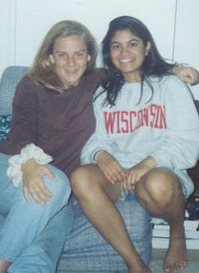
Jen in college.
I really wanted my own money back then. I wanted freedom from my parents. I wanted room to make my own choices. I didn’t see any possible way to achieve both freedom and my desire.
Which makes me think Watts’ advice would have registered only as a temporary instigation.
Not inspiration.
Learn more at alanwatts.com
Because in our current society set up, it’s practically impossible to forget the money.
We have to follow our desires in spite of the money.
What you need to know if you choose to forget the money is how you will stay true to your desire when the rest of the world says you need money over everything else. You need to know how you will navigate the expectations of your family, your friends, your neighbors. You need to know how to avoid the pitfalls of consumerism. How to live without a TV; without an SUV; without a weekend getaway.
You need to build your life so that your life is your weekend getaway.
= = = = =
If anyone had asked me when I was 20, I wouldn’t have said then, “I’d like to be a philosopher.”
I wouldn’t have said, “I’d like to be a craniosachral therapist.”
I absolutely would not have said, “I want, more than anything, to be a full-time, paid-loads-for-a-living celebrated writer.”
I didn’t know it then.
And I couldn’t see the way.
And yet, I’ve been fortunate to find my way. To have either landed in or created circumstances in which I’ve been able to recreate my career based on my passions and desires.
I listened to and followed my itch; years before hearing Alan Watts’ speech.
But, along the way, I’ve had to give up desires, too. Ignore certain itches.
I’ve had to choose.
Sometimes I’ve been able to forget the money.
And sometimes not.
Watts does not talk about choices…and consequences.
It’s not easy to follow your desire instead of following the money.
= = = = =
What would I say to a crowd of young people today?
How would I guide them?
I might say something similar to what Watts says: “Better to have a short life that is full of what you like doing, than a long life spent in a miserable way.”
I believe this to be true. And I like to think that somehow, accidentally, when I was writing that research paper in college, Watts’ advice penetrated my tired mind as I was lazily investigating the influence of Zen Buddhism on American pop culture.
Perhaps, subtly his words have been guiding me ever since.
But I would also suggest being as flexible as you are determined.
For who knows what you will be when you grow up?
You don’t.
I didn’t. I still don’t.
I still ask myself every day, “What do you desire?”
And then listen for the answer.
Forget the money, yes. But be flexible. At every turn, there is an opportunity if you are primed to notice it.
Ask yourself every day, “What do I desire?” And be strong enough to acknowledge the answer and take action, even if the answer is, “Money.”






 and yadda yadda, an aliyah blog