Love

Love is as close as the refrigerator door

When I was a girl, our refrigerator was stocked. Not just with food, but with memories.

My mother liked to collect magnets from places she had visited — and while it’s difficult to remember exactly from where and from when, I do distinctly recall a trail of experiences splattered like paint across the front of a series of refrigerator doors of my childhood.

It’s a tradition I’ve, without much serious intention, carried forward. It started when I moved in with my now-husband. He already had a few refrigerator magnets that predated me, but we began building a refrigerator of love of our own. The first addition was a magnet we found at a gift shop in Hoboken where we lived at the time.

We loved the quote so much we incorporated it into our wedding invitation.

Marcel Proust let us be grateful

A few weeks ago, after a bunch of dreams of messy houses, I realized my home was in need of attention. In the middle of mopping up the kitchen floor, I noticed how dirty, disorganized and jumbled our refrigerator had become. We had been mindlessly putting up A+ exams, beautiful art class drawings, and promotional magnets from every local business, from the hairdresser to Pinchi the clown, birthday party extraordinaire I don’t ever remember being entertained by.  I don’t have “before pictures,” but imagine a Leap Frog alphabet game scattered in more than 26 places; a Made in China set of Hebrew letters ready to be choked on by a visiting baby; and hidden beneath five field trip permission forms was the Marcel Proust quote.

I held it in my hands — saw how smudged and worn it had become in 13 years — but smiled knowing it remained. Intact, across continents and seas; still stuck to my refrigerator door.

I spent some time then sorting, throwing away, and putting the dusty alphabet letters in a bag to give to a friend whose children would use them — mine had grown too old for them while I wasn’t paying attention.

I filed away some papers, recycled others. I organized the promotional magnets in a big square on the hidden side of the fridge.

Afterwards, I pulled out the Marcel Proust quote — made it a centerpiece holding up a series of photographs that represented experiences we treasure, times and places … faces almost forgotten in the everyday rush of life.

I made love, once again, the focus of the refrigerator door. And said a quiet prayer that Proust’s words would continue to carry this family forward in 2014.

“Let us be grateful for people who make us happy; they are the charming gardeners who make our souls blossom.”

Yes, our days, if only we are lucky, will still be filled with exams to study for, dentist appointments to run to, and permission slips to sign, but somehow, in spite of it and in light of it, let us be grateful for the people who make us happy.
Love, Writing

Smushy mushy heart

Smushy mushy heart
springs back like Silly Putty
even when it’s broke.

Memory

One compulsion leads to another

I wrote recently about this superpower I possess called synesthesia. How I see letters and words in full color. And how I am going to defeat fear once I manage to harness my power properly.

It occurred to me this morning that my superpower might be the cause of quirky compulsions I also possess like the one that prevents me from listening to the Beach Boys in December, or drives me to listen to Van Morrison when the leaves start to change color and fall from the trees (even if I’m not living in the country in which they do.)

The connection between music and emotion is a studied one that’s not unique to me, but actually quite documented in human beings. But what about music and season? For me, the music must fit the weather outside. And there are singers or albums that are just completely inappropriate in winter, or off limits when I’m driving with the top down in July.

I looked into it a little. And guess what?

There’s a connection…and suddenly my strange compulsions don’t seem so compulsive anymore.

Studies show that music is connected to color and color is connected to emotion — particularly for people with synesthesia. From there, the connection is easy.  Emotion as it relates to season is a no-brainer. Lots of babies are born in August, nine months after couples snuggle up together inside supposedly to warm up from winter’s cold. I think it’s more than shelter from the cold they seek; but love and interpersonal connection that is often sacrificed in the isolation that winter brings.

Ask the average Joe or Jane which emotion is aroused when they envision summer. Most will say joy. Freedom. Fun. Ask the same person to describe the accompanying emotions to winter, Most will say introspection, introversion or sadness.

What about you? What do you say?

Having superpowers can make a girl feel lonely sometimes. Like I’m the only one whose heart hurts as fall moves towards winter. But when I get like that I cry it out to Randy Newman … whose voice and lyrics match perfectly the melancholy and nostalgia that crop up for me in fall.

Or I listen to this video — a performance of his “I Want You to Hurt Like I Do” in Berlin– and I laugh. Knowing I’m not really as alone as I think.

Childhood, Relationships, Writing

He gets like that

One of my dear friends turned 40 today. She was the first of my group of childhood friends to get her driver’s license, the downside of which, I said to her today, is that she also is the first of our group of friends to hit middle age.

Of course, none of that statement is true.

Our friends — the ones who celebrated her 17th birthday years ago — are now scattered around the world, and some are no more our friends than the random stranger from Kenya who friend requested me yesterday on Facebook.

And, what really is “middle age?”

Is it literally the day you turn 40 — is that truly the middle of your life?

I feel as if I passed middle age long ago. Could be that my opinion will change, but I measure time as BC (before children) and WMBBTS (when my boobs began to sag).

So I pretty much hit middle age 10 years ago.

Contemplating my friend’s birthday and hearing a familiar voice in the back of my mind, I searched YouTube for the last scene of one of my favorite childhood movies — Stand By Me.

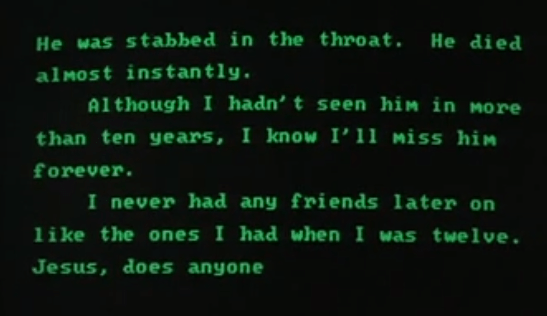
Somehow — and I am constantly amazed at how prescient I was of the nostalgic longing that accompanies aging — 12-year-old me was certain that grown Gordie’s words in the closing scene of the film were, and would remain, poignantly, heart-breakingly true.

From the film Stand By Me

It’s Richard Dreyfuss’ voice I heard this morning and whose voice I hear from time to time when I consider the impact my friends from childhood had (and continue to have) on the creation that is grownup me:

“I never had any friends later on like the ones I had when I was twelve…. Jesus does anybody?”

But when I watched the final scene of the film today, what struck me for the very first time is the unspoken, yet classic writer’s epiphany that prompts Gordie to tap out satisfyingly the closing line of his book.

Grown Gordie’s son enters the study to find his father staring at the computer. The kids ask Gordie to hurry up and they roll their eyes when he (for the umpteenth time) tells them “Okay, I’ll be right there” and continues to stare at the computer monitor.

The son turns to his friend and says:

“My dad’s weird. He gets like that when he’s writing.”

Gordie laughs.

I laughed, too, when I watched the scene today. I know well the “like that” of which his son speaks.

I know it as this feeling, this presence that soars into my heart when I finally grasp one of my life’s great truths — like the incomparable experience of knowing someone when you were 12 — and when I am able to transform this truth into words.

And share them.

When I can nod my head along with the cosmic consciousness in understanding.

And know for certain that you, the reader, will understand it too.

Uncategorized

Where dreams come from sometimes

If time were to

stand still,

I would kiss your lips

leaving no trace of me behind.

You’d awaken

when time moved again

and know your life had changed forever

but the only evidence

of the crime

would be a hazy cornered memory

hidden in the land of dreams.

= = =

(This vignette was prompted by The Daily Prompt: Standstill)

Community, Middle East Conflict, Relationships, Writing

Beyond the yellow gate

Beyond the yellow gate

there is a woman.

Her airy black head scarf almost shields her effervescent eyes.

But when she looks up, sky blue bounces off her peasant shirt and into her pupils so they ignite.

She touches my wrist gently as she feels for my pulse.

Ba-boom. Ba-boom. Ba-boom.

.

Beyond the yellow gate

there is a man.

His navy blue striped rugby shirt and acid washed jeans foretell a deep, defiant  voice.

But when his lips part and open wide, out fall directions in a timid, mouse-like squeak.

He guides me — turn left, turn right, and then

straight, straight, straight, always straight.

.

Beyond the yellow gate

there is a building.

A tall, two story white stone building, a dusty green awning greets the afternoon sun

But behind the glass door is woman with a cleft-lip

whose job is to collect, from everyone who enters, 30 shekelim

shosheem shkreem, she says. Ma? Shosheem shkreem.

.

Beyond the yellow gate

there is a town.

A busy town. A bustling town. A restless town.

But living in this town there is Farid and Dr. Haddad and the two girls

in pigtails eating popsicles

slurrrrrrrrrrrrrrrrp.

.

Beyond the yellow gate

there are people.

Their faces, weathered or leathery or lean,

are  thumbnail previews of the beauty within.

—-

This poem is one in a series about Kfar Manda, an Arab village three miles down the road from Kibbutz Hannaton, where I live, in the Lower Galilee, Israel.

Health, Living in Community, Love, Making Friends, Mindfulness, Relationships

I’m happy and I know it … clap your hands

I giggle.

I work hard to make others giggle.

I dream…and enjoy analyzing my dreams.

I engage on social media.

I innovate (at work)

I create (at home)

I write.

I share my writing with others.

I bake cookies.

I surprise the people I love with small treats or notes.

I want to be around people.

I want to know them.

I want to learn more about them.

I want to discover what we have in common and how we can help each other.

I sing.

I kiss my husband.

I take beautiful pictures.

Or silly ones.

Mr. Sunglasses Face

This isn’t a list of the things that make me happy.

It’s a list of ways I know that I am happy.

That life is working for me.

These are ways I know I am doing what is required to care for myself so that my life is one I enjoy … or, at least, feel reasonably satisfied by.

Often times, we think  — if we think at all — about the things that make us happy.

Ice cream.

Sex.

Vacation.

Money.

Baseball.

Air conditioning.

We make mental or actual lists of all the things we need in our life in order to be happy. Or we delineate end goals or possessions we are convinced will make us happier if only we reach them or one day have them.

Better job.

Better wife.

A baby.

Older kids.

A degree.

More sleep.

More quiet.

Less stress.

And while some of us are good at being grateful for what we have– and even acknowledging the good in our life — I don’t often hear from my inner voice listing off the ways I know I am happy now.

Right now.

Or what happy looked like back when it colored my life.

What does happy look like?

Who are you when you’re happy?

If we don’t know what happy looks like, how will we ever get there?

I’ve noticed over the past few weeks that my happy evidence is somewhat missing from the scene.

This was a red alert for me to DO SOMETHING.

So I started thinking about my list.

The list of things that act as evidence that I am happy.

And I started doing those things.

Even though I wasn’t yet happy.

And today, I’m happier.

(I didn’t say HAPPY.)

But

I’m writing.

I’m baking.

I’m spending time with real live human beings.

And engaging a little with the imaginary real live human beings on my screen.

What does happy look like for you?

How will you …

How do you…

recognize it?

Uncategorized

The felicity of freedom

I do not feel connected to Israel’s independence, nor America’s.

My heart does not swell enough on Yom HaAtzmaut, nor does it burst with pride on July 4th.

I am neither a loyal patriot nor a faithful expat.

I

am

clearly

a spoiled brat.

Or a heartless wench.

One or the other.

If I were put on the spot and asked why I am so numb when it comes to celebrating freedom, I’d choose spoiled brat.

Entitlement is what happens when you have always had something come easy and come free.

My freedom has always been free. And you are less likely to celebrate what you have always gotten for free.

If my freedom was a gift only to the 1000th citizen born on every third year — like a raffle or a supermarket prize — maybe I would jump up and down for joy.

If my freedom was a surprise miracle in a barren wasteland — like Sarah conceiving Isaac in her old age or a lone soaptree yucca surviving the desert heat of Death Valley — maybe then I would thank God in silent prayer.

If my freedom was one true thing in a sea of falsities — like my breath, like my love for my children — perhaps then I would weep tears of gratitude.

But my freedom is free.

And my freedom has never come with strings attached.

And my freedom will be here tomorrow, or so my entitled mind tells me.

We only know what we know.

And so therefore, on the 4th of July or any other day I choose, I must stop.

Pause.

Acknowledge.

The good fortune with which I was born.

The grace of good men and good women who do not know the life I know.

The felicity of FREEdom.

Climate Changes, Community, Environment, Family, Middle East Conflict, Survivalism, Terrorism

An imaginable future

When we first moved to Israel, I felt uncomfortable sitting on buses and in cafes.

I would casually look around, trying to avoid notice, to see if there were any suspicious people or packages about; not sure, exactly, what my reaction would be if I spotted one.

Over time I have found myself less and less suspicious. More at ease in public places, as it so happens, but still not at ease.

“At ease” is not a behavior I was born with — or maybe I was — and was just spooked one too many times by a mischievous friend or traumatized by too many VC Andrews novels.

The world, for me, has almost always been a scary place.

And I have almost always been easily startled.

While here in Israel, I cautiously scan the room for bombs; in the States, I cautiously scanned darkened evening streets for rapists and quiet alleys for thugs. I walked quickly through empty hallways and avoided elevators with lone men. I double and triple locked my doors, and was known to sometimes sleep with the lights on. Especially the night after The Blair Witch Project.

I remember being in a bar watching a band perform in New York City once, in the months just before 9/11 but fresh enough after Columbine to still be jumpy, and leaping off my seat at the sound of a small explosion in the back of the room. Someone’s hair had caught fire accidentally on the tea light candle intended for atmosphere, and instead of atmosphere we were treated to dramatic special effects.

After I caught my breath, I laughed out loud at my reaction, but internally asked myself what I had been so concerned about. What immediate danger did I think the noise indicated?

A gun shot?

An explosion?

A brawl?

It’s the first time I remember my unease extending from mild anxiety to a heightened concern for my immediate well-being and the well-being of others.

From then and there, unfortunately, my unease has only become gradually uneasier.

And not because my anxiety has worsened, and not because I moved to Israel.

In fact, my anxiety has significantly improved in the last decade since I started acknowledging it and paying attention to it and using focused breathing, meditation and mindfulness.

Moving to the slow-paced countryside of Israel, in some ways, has helped, too.

But no matter how significantly my anxiety has improved, the world hasn’t. Since 9/11, the way I see it, we have been witness to more violent crimes like those in Aurora and Newtown and Boston and have experienced the communal aftermath of incomprehensible tragedies like Katrina and Sandy and are becoming more and more awakened to the devastation of our planet and the resources we have taken advantage of all our lives.

And suddenly I am no longer a minor statistic in a clinical journal.

It’s not just me and my world viewed through an anxiety-colored lens.

The world itself has become anxiety-colored. The world itself is on edge.

I watched this video of grown men jumping out of their seats; seemingly reaching to hug each other at the sound of thunder booming loudly over Yankee Stadium during a rain delay.

At first, I giggled. It was cute. Funny.

And then I paused, and realized, it wasn’t funny at all.

Grown men — baseball players, even, symbols of fearlessness and recklessness — jumping out of their seats at the sound of a …

Boom!

We are living in a world in which we are now, clearly, all easily startled.

scaredy cats

I know I’m not the first to make the claim that the world is growing bleaker and blacker.

There are voices much louder than mine that have come before.

And even though my voice is not the first.

There is always a glimmer of hope it can become one of the last.

The year I was born poet and activist Shel Silverstein wrote:

“There is a place where the sidewalk ends
And before the street begins,
And there the grass grows soft and white,
And there the sun burns crimson bright,
And there the moon-bird rests from his flight
To cool in the peppermint wind.

Let us leave this place where the smoke blows black
And the dark street winds and bends.
Past the pits where the asphalt flowers grow
We shall walk with a walk that is measured and slow,
And watch where the chalk-white arrows go
To the place where the sidewalk ends.
Yes we’ll walk with a walk that is measured and slow,
And we’ll go where the chalk-white arrows go,
For the children, they mark, and the children, they know
The place where the sidewalk ends.”

(Where the Sidewalk Ends, by Shel Silverstein)

Those children are now grown.

Those children are now us.

And it’s indeed possible we have come to where the sidewalk ends.

And we need to choose in which direction we will continue.

We may continue to jump at loud noises, and then numb ourselves to an unacknowledged shared pain.

Self-medicating with food, technology, entertainment, drink, drugs, sex, consumerism, waste, whatever — silently signing the same consent form to ignore, to waive liability.

Or we may create together a world in which we can imagine its future.

A future not out of a dystopian film, but one lined with the vibrant green grass of my childhood memories and narrated by Shel Silverstein.

I want a future lined with colorful sunsets for my children to fall in love under.

And I want to hear thunder… and scream,

then giggle.

Knowing my fears are only imagined.

Family, Parenting

The woman she used to be

I’m a woman so I know

what she wants you to remember is

the woman she used to be

the prankster the flirt the gymnast

she wants you

when you look at her

to see the girl in the rain

in braids

invincible

Tho she is mother

she is woman, she is girl

And just before she heard the baby cry she was imagining how she would do her hair for prom

up or down

She is thin and underdeveloped underneath that oversized formula stained tshirt

She is agile and eager behind that tired, uninterested frown

She closes her eyes, smells the bouquet you handed her and remembers

the wedding

She looks up and sees the underside of her mother’s chin

her mother’s grin

kissing her, thanking her for the macrame owl that Troop 422 made for all their mothers

In the mirror she is mother

but in her mind’s eye she is woman

she is a girl

they blend together and

she wants you to remember

like she remembers

the her behind Mother

Letting Go, Living in Community, Love, Making Friends, Mindfulness, Relationships, Spirituality

Life is hard work and other things that make me feel tired, but alive

I am struck by the pictures my friend Holly is sending back to us from Hong Kong and Vietnam.

See more http://instagram.com/theculturemom

She’s feeding her wanderlust with banana pancakes, dim sum, and gorgeous panoramas, while feeding our desire for travel photography “porn.”

I love instagram.

Almost in the same moment that the drool drips down my chin,  while mesmerized by the lush green mountain ranges and Buddha statues, I long for the eyes through which I saw Israel in the first months I lived here.

The virgin immigrant eyes.

The virgin immigrant heart that burst with joy each and every day…at the beauty of this land; in curious awe of her people.

Cochav Hayarden, March 2012

When we first made Aliyah,  every drive was emotionally equivalent to a stroll through an art museum; every hike through a national park was a new adventure in a foreign land.

Every day I would find myself saying out loud: “Do I really live here?”

And I meant it in the same way a mother whispers over her newborn baby, “Are you really mine?”

Two years after making Aliyah, I find that my eyes and my heart are still capable of wonder.

But  it’s an experience that does not come as naturally and as automatic as before.

I need, instead, to make those moments happen.

And that takes a lot of work on my part.

I need to see the trash fire in Kfar Manda

smoke in kfar manda

— and turn my anger into compassion, and then activism.

And that’s really hard.

It’s much easier to be angry.  To rant. To shake my head.

I need to remember, in a moment I feel frustrated by my community, when I am outraged by their seeming indifference to the trash that peppers our fields

how grateful I am for my community.

How my community supports me.

How my community allows me the freedom to be a Jew in Progress. To be curious. To be a novice at living in this country.

Acknowledging my community as a gift, however, is really hard work when I am stuck in a moment of discontent.

It’s much easier for me to assume. To judge. To wish myself away from here.

It’s really hard work — and a huge emotional commitment — to be present in your life all the time.

To notice. To stop. To redirect. To be who you want to be, not your raw-emotion-of-the-moment.

It’s exhausting — living your best life.

It’s much easier to feel alive when you are on vacation — separate from the drudgery that often clouds your intentions.

It’s much easier to feel alive when you are first in love; experiencing a newness; your senses overwhelmed by glorious colors and smells.

I recognize this.

And I acknowledge that some days I am too tired to live my best life.

But on the alternate days — the ones in which I work hard for happiness, the ones in which I allow my heart to be open and my mind to be free — I find beauty that surpasses any landscape, any painting, any colorful market scene.

A vacation awaits me.

In my regular boring life.

And yours.

Culture, Family, Learning Hebrew, Letting Go, Love, Middle East Conflict, Spirituality

Daily practice

The other day I discovered the blog of writer, investor and entrepreneur James Altucher. Someone at work forwarded me a tech-related post Altucher had written; and after exploring his blog a bit I realized that 1) he has a foul tongue (and I like it!) and 2) has much more to offer than subjective evaluations of the market and tips for entrepreneurs: He’s insightful and introspective.

In particular, his August 20 post, “How to be a human,” was chock full of topics of interest to me — the end of the world, the fate of humanity, and the fear and anger that leads a person to spew hatred at a stranger on a public forum.  Certainly, as I am not addressing on this blog a virtual audience the size of Altucher Confidential, I don’t come up against as much public defamation as he might. But in the 15 years that I’ve written for public audiences — in newspapers, magazines, and extremely opinionated blogs — I’ve certainly set myself up to be taken down. And it’s a lot less fun than when someone shares your blog post on their Facebook wall; or when a more celebrated blogger mentions you in their weekly newsletter.

Altucher claims not to care; not to be impacted by what others write to or about him. He instead acknowledges their anger as representative of and outlets for dealing with past trauma (ie. “Their fathers or mothers didn’t love them;” Other kids beat on them; “Girls or guys didn’t like them or called them names.”)

Altucher credits his humanity for providing him with the ability to rise above his own past traumas; to stop him, he writes, from lying, cheating, stealing, and even killing. In particular,  Altucher credits what he calls “The Daily Practice” as the force by which he remains sane and suitable for society.

His “daily practice,” Altucher claims, is “the only way I’ve ever been able to rise above animal and be human.”

I like this. I like this a lot.

I absolutely agree with Altucher that the world is full of angry, scared, depressed people that often act like animals, but moreso I like how he offers useful tips in a frank, yet accessible voice. Tips that might, just might, lead an Average Joe to be more contemplative, seek help, or better yet, take action.

(In fact, he reminds me of someone I know and love who strives to do the same.)

In questioning the nature and formality of my own daily practice, I realized there is one thing I have committed to each and every day since I moved Israel — Something that is often difficult, very frequently humiliating, and yet so nourishing for my soul.

Every day, I choose to have one uncomfortable conversation.

Typically, my uncomfortable conversation is in Hebrew, but sometimes not. Sometimes the uncomfortable conversation might be with my English speaking neighbor or boss, on a topic that makes me squirm, like money.  And sometimes it’s on a topic I’m emotionally invested in, and the uncomfortable conversation is with my in-laws and or my kid’s teacher.

The more uncomfortable the conversation, I’ve found, the more I learn about myself. The more uncomfortable the conversation, the more I grow.

Particularly for me, the uncomfortable Hebrew conversations have been humbling…which I think my soul really needs. Like Altucher, my daily practice has taught me how to be more human. In particular, to listen, to feel, and to do both with compassion.

But uncomfortable conversations, I think, could be a useful daily practice for almost anyone.

For my shy husband, for instance, the daily practice of having an uncomfortable conversation might be empowering. Or, for my son, offer the thrill of independence.

The uncomfortable conversation can break down walls and stereotypes. It can open doors…and close them. The uncomfortable conversation is often less scary than you think. Instead, it’s often surprising and enlightening. It’s a daily opportunity to practice self-restraint, love, and compassion.

Based on the progress I’ve made since I started taking on the uncomfortable conversation as a daily practice, I daresay, it might be the key to Middle East peace. It might be the answer for world hunger and all that ails the world.

The key for progress and improvement lies somewhere within the uncomfortable conversation, I am sure of it. More specifically in the courage and compassion required to conduct the uncomfortable conversation (as opposed to the uncomfortable screaming match or the uncomfortable revolution or the uncomfortable war).

The uncomfortable conversation, by the way, doesn’t require two consenting participants. It only requires you: Committed, compassionate, humbled and empowered you.

You, as part of your daily practice, trying to be more human.