Letting Go, Love, Writing

Pretty lies

If I could play piano as deftly as I do in my dreams

If I could sing and you could hear the rich tones I do when my voice echoes in my ear

If I could put down words, the true ones that bubble up and swell in my heart

This is what I would bring forth into the world.

Something like this:

But I only tap, tap, tap a little Heart & Soul

I only whisper my skirmish with harmony

I reveal the yellows, the pinks, the browns of my soul only.

Not so much of the blues.

Or the blacks.

Pretty lies. Only pretty lies.

Writing

What’s Off-Limits When I Die

Who gets to decide what of yours gets published after you’re gone?

Who says that your journals, your letters, your doodles in the margins get to be publicly shared posthumously?

I assume the obvious: Your next of kin. Your estate’s executor.

But I wonder — those of us who read the words of the dead without their explicit permission (The Unabridged Journals of Sylvia Plath, The Diary of Anne Frank, Kafka’s The Trial) — do we care whether or not the author wanted the materials published and read? (Kafka apparently vehemently did not. Tough noogies for him.)

Sure, it’s fun to discover that Tolkien had a “semi-secret” talent for sketching. And Jim Morrison wrote psychadelic poetry.

Fun for us.

But for them?

I’m not so sure.

Of course, one could argue that they’re … um… dead. That would be a pretty good argument for why it doesn’t really, truly matter.

But why, then, do we respect the dead in other, superstitious ways? We wear black, hold our breath, cover our mirrors. Shouldn’t we think twice before reading their private journals?

Presumably their material was published in the name of art by someone who had something to gain from the publication: money, fame.

But does this mean we have to read it?

I think about this a lot as I go through my cardboard boxes.

At the end of the day, I save stuff for me. I might think I am saving it for my kids, but I’m really saving it for me to share with my kids. Not for them to discover on their own with no historical reference. No filter. No explanation.

And I wonder, what would I be okay with them sharing after I’m gone?

Anything marked “FINAL DRAFT,” I’d be good with, I guess. All files tagged “SUBMITTED_2_2013” or any such combination of publication name + date, I’d be good with.

But the other stuff? My journals? My notes to self? My letters? My teenage angst poser poetry?

I don’t know if I want those aired out in public by anyone else but me.

I might change my mind when I’m famous. (I’ll let you know.) But I doubt it.

What about you? What are your thoughts about publishing rough work or private writings posthumously?

Writing

The poetry inside other people’s cardboard boxes

A new hobby is birthing itself, pushing its way out. 

Like when I took to exploring New York with my neck cranked back

gazing up at building sides looking for signs of  shoe polish advertised 100 years ago.

A new research topic. A new obsession.

The confessional.

Sylvia Plath. Anne Sexton. These are writers I never read.

Can you believe it? I’m embarrassed to even admit to it. (Though I already did.)

I never read those ladies on purpose. Their tragic endings were enough to put me on alert.

Enough to scare me into avoidance.

I was terrified of discovery. Worried that by exploring their darknesses, mine would be triggered. I didn’t need any more triggers — my mind’s been busy enough for decades.

However, slowly, slowly — as I’ve begun to creatively confess here on the blog and privately in long-form and poetry — I’m dipping my toes into their confessions. Learning from them. Growing. Chuckling. Feeling relief that I am not the only one pained by the beauty of tulips.

Today, I discovered “All My Pretty Ones” by Sexton, and smiled as I realized her poem is a consequence of rooting through cardboard boxes, both literally, i imagine, and figuratively. 

“a gold key, your half of a woolen mill,

twenty suits from Dunne’s, an English Ford,

the love and legal verbiage of another will,

boxes of pictures of people I do not know.

I touch their cardboard faces. They must go.”

It’s humbling, knowing that you’re not the first person in this world to suffer. It’s reassuring knowing you’re not the first writer to reach for a thesaurus in search of just the right word because your mind will not allow you to escape from the hunt until you do. It’s a relief, in a sense, as Lena Dunham shared about her experience reading and exploring Plath in college to know that your darkness is a little bit lighter than it could be.

It was good I didn’t read Plath or Sexton until now, I suppose.

In the same way it’s all good.

All of it. The stuff we hide away accidentally or on purpose until it’s ready to be discovered, explored, shared.

Turned into poetry.

Letting Go, Love, Philosophy, Writing

An Open Letter to Time: I Know the Truth About You Babe

Dear Time:

Your linear passage is ruthless.

We notice this early, but don’t grasp it til it’s too late.

Your strict adherence to forward motion is maddening, and yet reliable.

It is a gift, in fact,

For we must flow with you, while

we foolishly ache to change you

(as if we could).

We cling to you, but you move at lightning speed.

We can’t hold on.

We spend you like there is no end

to you.

Waste you.

Take advantage of you … like you’re giving it away for free.

We kill you. And then beg for more.

For mercy.

Our love for you, Time, is a comedy.

Our abuse of you is tragic.

Be stingy with us, Time, as you would an ungrateful child.

But be loving, for we sigh (weep even) when we lose you.

We are just simple travelers, Time.

Greedy, yes,

But hopeful.

Never meant anyone harm.

Least of all you.

Relationships, Religion, Writing

View from above

No matter how blurred or undefined my picture of God is, no matter how my connection to religion swells or retreats; the one God-related belief I hold fairly dear is omniscience. If God were a storyteller, let’s say, he’d be third person with both a bird’s eye and a worm’s eye view of all that ever was and all that ever is and all that ever will be.

Which means, I also believe, that God laughs a lot.

Laughs at our missteps, our confusion, our despair — in a loving, playful way, the way a parent might smile watching her toddler fall hard on his bottom over and over again in his attempts to learn to walk.

Or the way a writer foolishly grins as he shapes his characters because a writer is, in a way, in love with all the characters he creates — no matter how ugly or beautiful, how wise or how foolish.

I don’t necessarily believe that God is omnipotent, however. I don’t believe he interferes in the doings of man, though I do imagine that he might adjust the direction or speed of the wind from time to time so that man might meaningfully turn his head or shift his gaze. I believe that God watches us, and more than anything else concrete, I understand God as a representation of that great unattainable knowledge and understanding I’ll never have, but will never stop seeking.

I imagine, too, from his third person point of view, God watches us with great compassion.

I wish I could borrow some of this compassion from time to time when I tell myself my own story; as I do when I lie in bed at night and review my day; as I do when I tell “truths” about myself or make claims about how other people see me (as if I could really know).

Or when I dig through the first person evidence of my life: When I read my old journals (and cringe at my naive innocence or unabashed immaturity); or remember (out of the blue or obsessively) the things I’ve done I wish I hadn’t or wish I had handled differently.

Did you ever notice how much compassion we can summon up for others? For strangers especially? How our hearts swell when someone else is dwelling on what they once did wrong?

Yet, it’s insanely difficult — if not near impossible — to summon up that same compassion for ourselves. To allow ourselves to view our stories as God might or as the third person omniscient narrator would– minus regret, minus shame, minus fear — simply with close observation, the space for varied interpretations, and occasionally, with a playful compassionate laugh out loud.

Relationships, Writing

Finish this haiku … if you can

I was attempting a haiku this morning when I realized there is no good antonym for alone.

Walking alone is
often the first step towards

These were the first two lines of an idea I was trying to work through by haiku. Except, I couldn’t finish it in a satisfying way.

“Together?” Is together really the only antonym for alone?

I was going for an emotion, a feeling, a deep sense of being close to another person or to humanity. Feeling less afraid. Feeling as if someone else understands you.

And “together” … just doesn’t do it.

Together is so physical. It’s a fixing word. It’s an extrovert’s word. It’s not the word I mean at all.

Want to help me finish the haiku?

Walking alone is
often the first step towards…

I’d love it if you’d give it a shot in the comments below or on your own blog with a pingback here. If your haiku especially speaks to me, I’ll reblog it.

Uncategorized

Exchange of letters

I was thinking of Sarah this morning when I realized how many similarities there are between the online friendships I’ve cultivated and the pen pals I used to collect as a young girl.

Sarah and I are planning to meet in real life for the first time. Despite the fact that we both are former Americans living in Israel, and only live an hour’s drive from each other, we’ve never sat to drink coffee together; have never spoken on the phone. I don’t know what Sarah’s voice sounds like even, and this is what I was thinking about when I realized that Sarah exists for me like my much-loved pen pals from childhood. The deep way one knows someone through letters. Except the letters are blogs, and Facebook chats.

When I was a girl — mostly from the ages of 12 – 16 — I exchanged letters with a few other kids my age. I vividly remember two of them, for they were strangers.

Thanks Ali Martell for the pic

Unlike Robert, my camp friend from Texas, or Natali from Mexico, both of whom became active pen pals of mine after shared experiences in real life; Kim and Phillipa, I never met. We starting writing each other because we were subscribers of Bop! magazine. (The original Match.com for pedophiles, Bop actually published in each issue a list of names and addresses of pre-pubescent girls. Can you imagine???)

Unlike my school friends, Kim and Phillipa exist in my memory only as curvy, bubbled Ms and skinny, drooping Qs; as unevenly snipped wallet-sized portraits taken during Picture Day. I never knew their voices so I can’t hear them in my head even if I try. I never knew how tall they were. Whether or not they were skinny or fat. Pimply or clear-skinned. Popular or tortured. Smelled like Chloé or B.O.

We never got in fights over a boy. We never stopped speaking to each other in the halls. We never shared sleepovers or sundaes.

And yet, I loved them in a way. I was grateful for their showing up in my life. In my mailbox.

I knew Kim’s hobbies; Phillipa’s favorite American movie stars. I knew about their jealousies of their siblings and their crushes on the neighborhood skater boy. I imagine they told me secrets they never shared with their school friends. I know I shared with them a few of mine.

There’s something sacred and safe in living and loving only through letters.

Isn’t that what most of us with online-only friends would say about many of those friendships? There’s something sacred and safe about them?

No, we don’t ‘know’ each other in ‘real life’ … but then again, what is ‘real’ life?

Uncategorized

Dance as a writing prompt?

My new friend Miriam is a long-time professional dancer and choreographer. I met her in a writing workshop at Bar Ilan University and have enjoyed hearing her tales of dance, particularly those she found herself in while living in far-flung areas of the world foreign to me.

But yesterday, Miriam surprised me even more when she led our group in a movement exercise designed to be used as a writing prompt.

Movement as a writing prompt?

While I’ve sometimes walked around outdoors as a way to move past writer’s block, I never would have guessed that following simple guided instructions on how to move in space would bring such a wealth of content to the surface …and so quickly.

The experience for me was remarkable. While in it, I was singularly focused on following Miriam’s instructions. But as it turned out, my body’s movement allowed my mind to relax … and open up to new ideas.

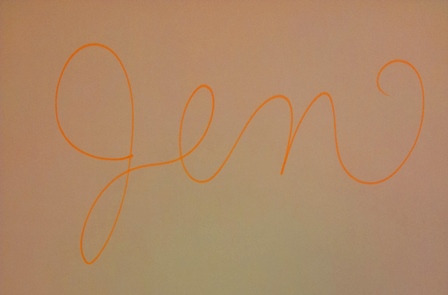
In the final of three exercises, Miriam instructed us through a series of varying movements during which we were to write our name in the air. For the final movement, however, we were to present ourselves to the group, then write our name in the air.

jen

I noticed a grave difference between how I felt when I moved independent of the group and wrote my name in the air, and how I felt presenting my name inside and to the group. The difference was physical. An ease that accompanied my independent movements … a stiffness that showed up once I faced the group.

This physical discomfort stirred inside my creative space afterwards, when we sat down for ten minutes to write.

And it was this discomfort that became a poem that I dare to share with you…

The Group.

Take care with my bare heart …

With the me out there.

===


Me Alone Meets Me Out There

Will I always be two Mes?

The Me alone and the Me out there?

When I am Me alone, fast or slow, I am me.

Giggly, thoughtful, silly me.

When I am Me out there, within without, I am not me.

I am a stilted lilted version of me.

A me wrapped in bubble wrap.

A me on display.

I am cute, a hoot, but not a whole

Me.

I wish the two Mes would meet one day

On the street, on the stage,

in the office, on the page

And decide to become one.

The Me alone

and the Me out there.

Easy peasy pair.

==

(All content, including poetry, is original — unless otherwise noted — and copyright Jen Maidenberg.)

Philosophy

The space between dreams

Fevered dreams
Unfulfilled chills
Can’t shake ’em off.

The space there
between awake and asleep
Hot outside
Cold inside
A mystery understood only by the archetype of me.

If I could write the space there
between awake and asleep
it’d be a bestseller.

The book of the month for vampires and demons
that dwell inside the space
between dreams.

Childhood, Memory, Relationships, Writing

The yellow bowl

I am obsessed with my child’s memory of me

of this moment

of this yellow bowl.

This inaccessible ceramic yellow bowl

perched high upon a dusty refrigerator

will one day be dusty, too —

an image sitting in a drawer waiting to be opened

in my child’s memory.

Inside the yellow bowl are rainbow jelly beans, Polish lollipops

handmade by a retired couple sitting at a railway station.

There are remnants of chocolate wafers, too, and little crystal crumbs from an uneaten

sucking candy.

Pomegranate flavored.

In my child’s memory, this yellow bowl

is the key to happiness

and evidence of goodness

and bad.

It is what determines right and wrong.

It is — and will always be —

a beacon.

“Lost children,

find your way home.

The yellow bowl is calling you back.”

Memory, Relationships, Writing

What I learned from Alice Munro’s Nobel Prize win in literature

Oh Alice Munro:

“For years and years, I thought that stories were just practice, till I got time to write a novel,” she told The New Yorker in 2012. “Then I found that they were all I could do, and so I faced that. I suppose that my trying to get so much into stories has been a compensation.”

Thank you for your well-timed win and wisdom, Ms. Munro, if I may call you that.

(Though I prefer to call you Alice.)

Your words in  The New Yorker were exactly what I needed to read right now, as a writer and as a human being:

As a writer who wishes to breathe life into the characters who infiltrate my dreams, but doesn’t yet know exactly what those characters really want or where they are going.  As a woman who yearns to give life to ideas stirring inside my heart — but often lacks the time or the energy. As a human being who is constantly wondering what in this life is practice and what is for real.

Thank you for writing real women, real marriage, real life … in a way that allows the reader to envision the beauty that exists even in those very real, raw circumstances.

I’ll be honest. I’ve only read Runaway, and selected short stories of yours, but you’ve always been a writer I’ve wanted to read more of.

And I love your name.

Alice.

Munro.

It’s a name that deserves celebrity.

I love that you’re Canadian, and that my Canadian best friend loves your writing, and that those two things together make me want to read more of your stories.

I love that your first collection was only published when you were 37. It offers this exhausted and overwhelmed 38 year old mother of three a glimmer of hope.

I love that you’ve lived to be 82, and I wonder if you always knew that you would live this long or if you always thought, like I do,  that you were only one year away from dying — a victim of a tragic disease or an automobile accident.

Too bad. So sad. No book for you.

I wonder when your heart stops breaking. Does it?

I wonder when you run out of vivid memories to weave into your stories.

I wonder when you stop caring what people think and just write what you must so that a weight is lifted from your shoulders, and you can move on.

I love that picture of you — the one in which you’re sitting on the edge of the railroad track in The New York Times’  article. You look defiant, brave, and yet serene.

I wonder what takes more courage? Writing your truth or having it read by others?

Or sitting on the edge of a railroad track?

I win too, from this celebrated win of yours, Alice Munro.  Through getting to know you better, I am reminded that writing about what you know is enough.

Writing about relationships, memory, your life in your town. It’s enough.

I don’t need to fabricate tales of magic and mystery. I don’t need to create a romance that is one for the ages.

My life alone offers enough content for me to mine — life itself is a gift to any attentive writer.

Isn’t it?

What would you say, Alice Munro?

To a grown woman who still imagines herself a girl?

To a writer who still imagines herself on the slow road to a Nobel Prize in literature?

What would you say?

Would you say,

“Slow down?”

“Don’t worry?”

Would you say,

“It was all worth it?”

“It doesn’t mean a thing?”

Oh, Alice Munro. You’ve taught me a thing or two just by winning a damn award.

Getting old is better than being dead, you said, to the New York Times reporter.

“I’ve done what I wanted to do,” you said. “And that makes me feel fairly content.”

Writing

Time spent dreaming

Longing for the day
When my dreams count as real life
And I remember.

Only good ones though–
Sidewalk reunions, relief.
Scattered song and dance.

I could do without
underground caves teeming with
naked mannequins.