Food, Mindfulness, Writing

Writing prompts change the world

A few years ago, I took a brief, but fantastic memoir writing course with poet and writing professor, Chloe Yelena Miller. It was in this course I was first introduced to the concept of writing from a prompt.

Wow, how I loved this exercise.

Not all writing prompts work for all people —  and it could be the ones that Chloe chose resonated with me personally — but, regardless, I had a lot a fun with them.

I wrote one piece about my childhood stuffed dog/bear, Floppy.

I wrote one piece about my ex-boyfriend’s family beach house.

I wrote another about a long-kept secret.

What exactly do I love about writing prompts? I’m not sure.

But I think it has to do with looking at life differently. From a different angle. Upside down. Inside out.

To see people and things in a way they’ve never been observed before. To imagine them in a purpose or a place they’re unused to.

Today, my writing prompt was Mr. Mushroom Butt.

mushroom butt

While slicing vegetables for my breakfast stir fry, I couldn’t help but notice the cute little butt in one of my deformed mushrooms.

In an instant, I could imagine the yellow peppers as arms and legs. And hurried to arrange them and photograph the scene before it disappeared from my imagination or I got too hungry not to eat it.

The Sad and Sorry End to Mushroom Butt was born from my breakfast.

A story was born …  a character, a fractured fairytale. And who knows what else? A film? A line of toys? A breakfast cereal?

One morning, I birthed Mushroom Butt . And now he exists.

This is what’s amazing about writing prompts.

And about writing.

This ability to birth something or someone anew.

There are writing prompts everywhere masquerading as boring nothingness.

But once you name them as writing prompts, someone or something exists where there was previously nothing and no one.

And the list of possibilities for their adventures becomes endless…


Letting Go, Mindfulness, Spirituality

Think lovely thoughts

Reading the blog yesterday of a childhood friend who grew up to be a rabbi, I came across a phrase I’ve heard before but had forgotten for a long time.

Thought experiment

I love this phrase.

In two words, it implies all that I believe about thinking.

That thoughts are ever-changeable.

That we can manipulate our own thoughts or the way others think about us.

That we have power over our thinking.

That we can be playful with our thoughts.

Make fun of them.

Laugh at them.

Shoo them away when they’re getting in the way.

Caress and nurture the ones that stir our hearts and bellies.

Abandon the ones that have stopped serving us.

Experiment with our thinking. Approach our thinking like we would scientific research — as an experience or an equation that is observable, malleable.

I believe in this method, and yet I often have a hard time employing it.

Like many scientists, I am a firm believer in what I know to be true.

In the facts of my life.

“He is …”

“She does…”

“I will always be…”

“It’s like this…”

“He’ll never…”

Those facts serve me. They allow me to be right about the world I live in. They allow me to make difficult decisions based on previously established and agreed upon evidence. They allow me to feel safe and secure in an existence that is often tenuous and unsure.

Therefore, it’s not so easy to approach those facts (my thoughts) as an experiment.

It means I have to give up being right: About the world, about people who’ve hurt me, or about situations I’ve long ago thought I forgot.

Not to mention — thought experiments are rarely controlled experiments. You’re not alone in a cozy lab coat in a quiet room with no other people, no additional stimulation. During your average thought experiment, it’s NOT just you, just your thoughts,  just listening carefully and watching and taking notes.

Yup. You are right there in the middle of it. All the time.

Thinking. Thinking. Thinking. Thinking. Thinking.

And there’s noise. And hunger. And resentment. And perceived requests, demands, insults.

All that thinking and feeling leaves little room to experiment.

And, if you’re like me, you’re not just thinking, thinking, thinking. Feeling, feeling, feeling.

You’re thinking about the thinking. And judging the feeling.

Not very playful. Not very fun.

Not very experimental.

This is why — and I’m having a light bulb experience myself RIGHT NOW as I write this — I meditate. And this is why I sing. And why I pray my version of prayer; keep my version of Shabbat. And why, on occasion, I seek 20 minutes alone in the bathroom pretending to poop.

So I can have my very own thought experiment.

So I can allow myself the opportunity to observe, explore, and possibly, change my thinking.

Do you do this too?

Do you give yourself an opportunity to thought experiment?

And does it work?

Work, Writing

My so-called writing life

The other day, I asked out loud on Facebook whether my friends thought that writers were born or made.

Most answered some version of “born, but….”

As in: Writers are born with the creative spark that’s a prerequisite to creative talent, but it’s a spark that requires not only nurturing, but also education, practice, and perfection in order to mature into talent, and then success.

Mostly, I’d agree.

I think about my own journey as a writer, and sometimes, admittedly, I even hiccup a little calling myself a writer at all.

When I think of myself as a writer, I still think of myself as the girl who wrote love poems in a small, tear-stained spiral bound notebook that I hid in the back of a drawer.

When I think of myself as a writer, I still think of the jittery young woman who spilled coffee on her pants on her way to her very first feature story interview for a newspaper article.

When I think of myself as a writer, I still think about blogging as playing for a minor league team, and published literary novels as the World Series.

I still think of myself as a novice, and sometimes as a would be somebody if only I had the time.

Then there are moments, hours, days even, when I catch a scent of my destiny and it smells like poetry and Bartlett’s Familiar Quotations and an antique oak writing desk facing a picture window.

The leaves casually drop from the trees as if there’s still time…

As if there’s only time.

…and words to discover.

Words slowly strung together like colored beads on a braided rope.

Letting Go, Love, Mindfulness, Writing

I really, really don’t want a book deal

I really, really don’t want a book deal.

Just kidding.

Which blogger doesn’t want a book deal?

Put your hands down.

Stop pretending like you blog for the fun of it.

I say that all the time, too.

I don’t mean it.

Except for when I do.

Which is a lot of the time.

But then there’s the day when a mommy blogger I’ve never met gets a book deal and my eyes bug out and steam pours from both of my ears and my heart and belly both get stuck in my throat and deep inside I

SCREAM!!!!

…In my inside voice. The louder of the two.

Where’s my book deal?!?!?

And then my other inside voice answers back,

“What makes you think you’re getting a book deal?”

And the scream, now subdued says, “Well, you know. Someone should just discover me and fall in love with my writing and offer me lots of advance money (or at least plumb royalties) and beg me to write a book. A whole SERIES even.”

“Oh,” the peaceful, reasonable voice answers with subtle condescension. “I see.”

What she’s not saying (in her peaceful, reasonable tone) is:

Stop waiting around for someone to discover you.

Stop wanting what other people have.

Stop being regretful about what you think you should have done, but didn’t. What blog you should have kept up, but didn’t. What career you should have stuck with, but didn’t. What path you should have taken, but didn’t.

She’s only being a little bit judgy, just enough to quiet the screaming.

===

I have a colleague whose dad is a celebrity.

She hardly ever talks about said celebrity, except in the context of his dad-ness.

I’ve never asked her about this. Or what it’s like to be the daughter of someone so famous.

I imagine, though, her modesty has something to do with her relationship to him.

To her, he’s dad. It doesn’t matter how famous he is or becomes, his celebrity will always be secondary to her.

And I think in all the glorifying we do of celebrity — of book deals, of magazine covers, of awards and prizes and titles — we lose sight of celebrity’s secondary-ness, its subservience.

We lose sight of the inevitable real life behind the celebrity. Why?

Because save for the tabloid spreads, we hardly see the real life behind the celebrity.

The anxiety that comes the day after a book deal was signed.

The self doubt.

The need to please, to produce, to win.

To look good. To smell good.

To smile. To have a good hair day.

We hardly ever hear of their breast cancer scares, their hemorrhoids, their financial troubles, their soured friendships. Save for the celebrities who’ve publicly shared bits and pieces of their angst in well-placed magazine features, we hardly hear of their suffering.

And they all, certainly, suffer.
everyone

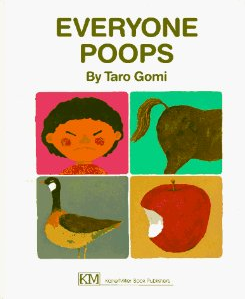
No matter how many times we read Everyone Poops, we still imagine that celebrities poop with greater ease, with more satisfaction, with softer toilet paper.

And maybe they do.

But, most likely they don’t.

And, as corny as it sounds, no matter how much we wish we were more famous, more successful, more educated, more experienced, we often fail to acknowledge or recognize how famous, successful, educated, and experienced we already are.

This is what I try to tell my screaming inside voice.

You are already famous.

Seriously, I can find at least three people who believe I’m famous (and yes, their last names are the same as mine.)

And I bet I could find someone out there who is not a blood relative that wishes they could have a job like mine, or a husband like mine, or write a blog like I do.

I am already famous.

Despite that: I still scream inside every now and again when somebody gets a book deal.

And I probably will until the day I finally accept that I am already famous enough.

The day I finally accept I am already famous, is the day I will finally achieve the pinnacle of my success.

Peace, love, and ease.

Behind all our secret or public clamoring for celebrity, what we really desire is peace, love and ease.

And that, my screaming inside voice, is better than a book deal.

Community, Culture, Family, Kibbutz, Letting Go

Speechless

When I was a girl, I was a motor mouth.

How do I know this? Because Ms. Levin, my second grade teacher told me so. Seriously, my nickname in second grade was Motor Mouth, a moniker craftily created by my teacher at the time, who occasionally relented to my excessive hand-raising by saying, “Yes, M.M.?”

As borderline abusive as this practice was, there was some truth in the designation. I talked a lot. All the time, in fact. I talked to my neighbors at my table. I talked to my friends across the room. Often I would mutter to myself. I was a social creature. I still am.

My poor husband, not a social creature by nature, now carries the burden of Ms. Levin. But unfortunately for him, he has not only my incessant chatter to contend with, but also our oldest son’s and daughter’s. They inherited the Motor Mouth gene.

My chatter tends to run over into my writing. I’ve said often in the past that I “write in order to know what I think.” I didn’t make that up. Author Stephen King has said it. Historian Daniel Boorstin is claimed to have said a version of it. I wonder if those guys were motor mouths, too. Probably.

The best part about blogging is that it’s almost acceptable to be a motor mouth. Not so with traditional, published writing. In magazines, books, and newspapers — the kind of publications people still pay money to read on a regular basis — our motoring is required to be more thoughtful and refined. I respect this. I think it’s a sensible, if often boring, practice — carefully choosing your words and paying fastidious detail to grammar and punctuation.

Which is why, when I have a more thoughtful and potentially refined idea for a story, I don’t blog it. I save it.

I have one right now, in fact.

It’s been percolating inside of me for about two weeks, ever since I first started saving books from the recycling bin.

As you know, I live on a kibbutz in northern Israel. It’s a kibbutz that was established about 30 years ago by the Masorti movement in Israel; Masorti being the equivalent of Conservative Judaism in America. Many of the new residents of the kibbutz were from English speaking countries: the U.S., South Africa, England. When they came to Hannaton, they also brought with them their English language books, which presumably went into the communal library once they landed at Hannaton.

Recently, the library at Hannaton, like the kibbutz itself, underwent a huge renewal project. A volunteer committee sorted through the books to determine which ones would remain in the new library and which ones were either duplicates or in an unsuitable condition. There were thousands of books to sort — and since we’re in a Hebrew speaking country, there weren’t many nearby options for donating. The committee decided to put the unsuitable books in the recycling pile.

But, as we know, one person’s trash — or in this case, reusable waste — is another person’s treasure.

And this is how I came to spend a week and a half trash surfing for treasure; embarking on what I call the “Orphaned Book Project.”

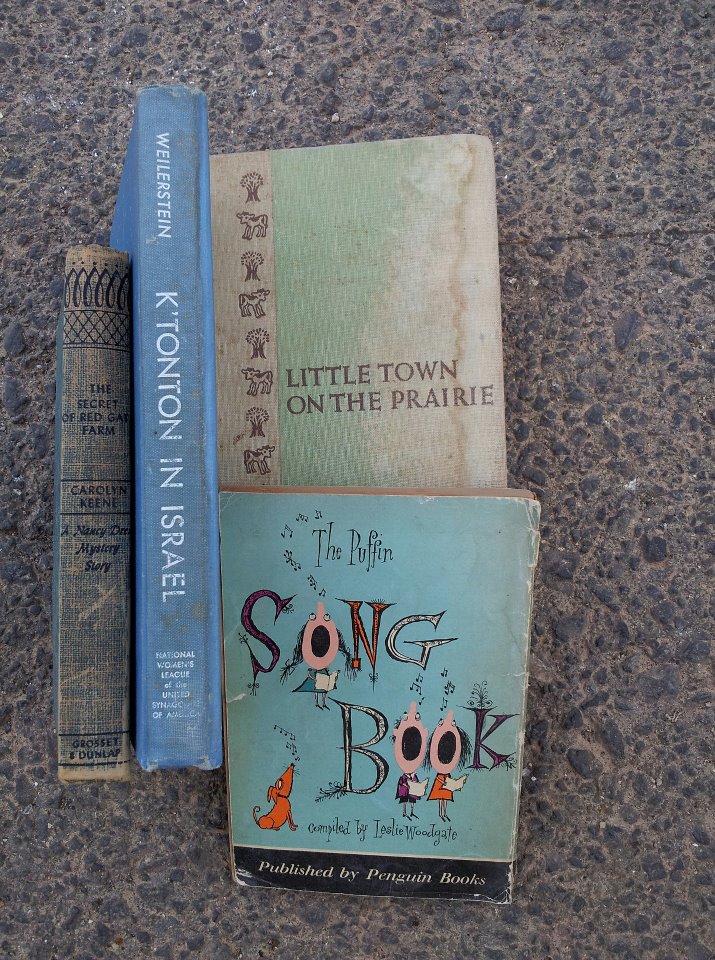
When the books were finally hauled away by the recycling truck, I had saved about 30 books and 15 magazines, including Highlights from the 1980s with “Hidden Puzzles” left untouched for my 5 year old to explore; and a Cricket magazine from the year I was born, 1974. I saved a Scholastic paperback from 1981 written by Ann Reit, an author and editor I had the privilege of briefly working with, and who has since passed away from cancer.  I saved a much older Scholastic paperback whose jacket cover previews a young adult fiction story that centers on racial integration in the 1950s.  I saved a few ChildCraft How-to science books that are surprisingly still reasonably current, and a few history books that aren’t, but are still fun for my 9 year old to leaf through over a bowl of cereal in the morning.

There were Hebrew books, too, but I didn’t save any. The only Hebrew language publication I saved was a pamphlet printed by a professor in 1944 that documented all the agricultural settlements and their products up until that time.

On the title page, in English, are written the words:

Printed in Palestine.

First I saved a couple of original Nancy Drews, and hardcover Little House, and a classic K’Ton Ton, and a kitschy song book
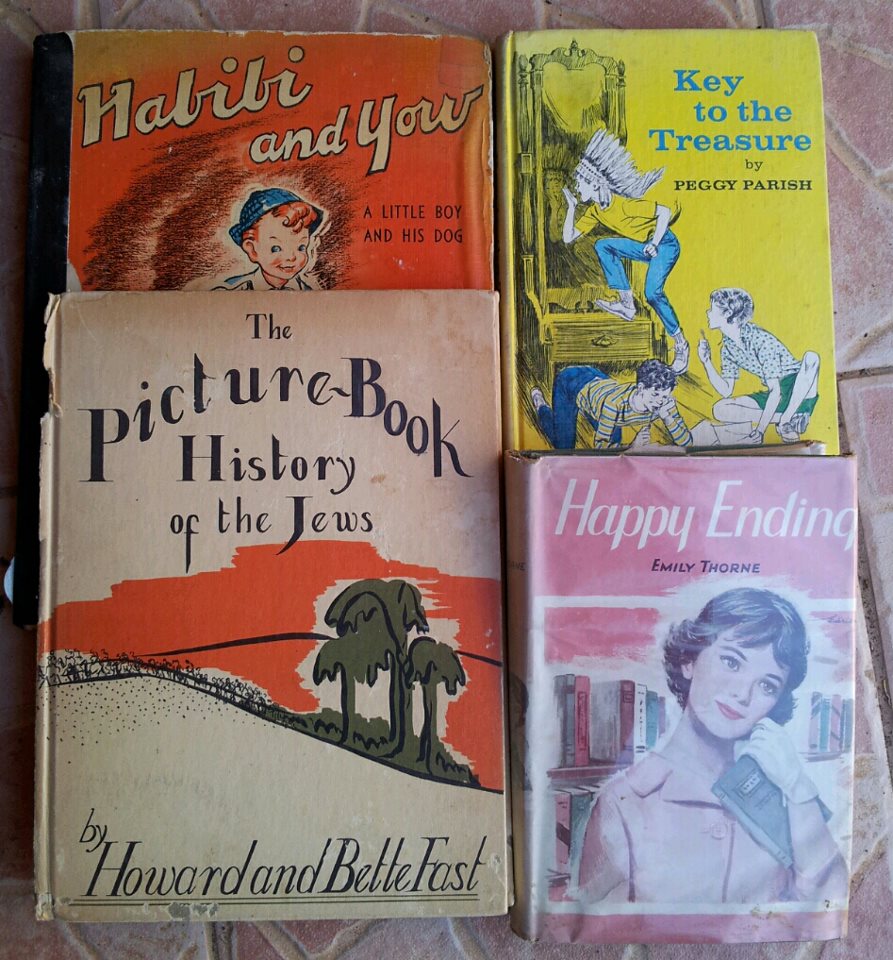
I have no need for more dusty coffee table books, but couldn’t resist this vintage They All Are Jews, a gift to “David” in 1951, after his confirmation. Inside I found a newspaper clipping from when Miss Israel won Miss Universe.
It wasn’t until my final visit that I found the true personal treasure: Peggy Parish’s Key to the Treasure, the last in a middle grade trilogy I loved as a girl and had been collecting