Books, Culture, Middle East Conflict, Mindfulness, Modern Life

The story within the story

Reporters will tell you there are two, maybe three narratives in the Middle East. They’ll split the stories into perspectives and call them Palestinian and Israeli or East and West or Arab and Jew. But that’s like saying Moby Dick is about a whale and a man. I don’t know what Moby Dick is about — I still haven’t read it. But hundreds of thousands of people have and I can’t believe it’s because it’s a story about a whale and a man.

So it is with the Middle East.

There are so many stories. People. Lives.

READ THE FULL POST (in the Times of Israel).


Books, Love, Modern Life, Parenting, Poetry

Makes me wanna keep going

I’ll be honest: I’m still not done reading Rachel Zucker’s The Pedestrians.

I have about 5 or 6 more poems to go before the end. The book is sitting on my nightstand in my bedroom; next to which is my middle son who just slipped off to sleep.   My other two children are on two different IPADs watching two different age appropriate American television programs. (Go ahead: rate my parenting.)

I could finish The Pedestrians right now. I could snuggle up to the middle son in his sweat lodge and read.

But, I had a thought just now I couldn’t suppress:

Rachel Zucker makes me want to read more poetry.

But more important, she makes me want to write more poetry.

And I couldn’t just keep that to myself.

I had just finished one of the selections in the book titled “paris dream.” It’s one of 13 dream-like poems (others are titled “brooklyn dream,” “egg dream,” “daycare dream.”) Each time I read one of her “dream” poems I notice how I am simultaneously drawn into the poetry and into the dream itself; into the conscious and subconscious levels of the language. I find myself savoring Zucker’s dream in the way I sometimes delight in my own in the minutes just after I wake. I felt the urge to analyze it and was pleased.

I could keep reading Rachel Zucker’s dreams, I thought.

And while I am generally attracted to poems that are “dream-like” (Mark Strand’s work is a good example), Zucker’s dream poems compel me to dig into my own dream journal — the one I started keeping again last week after a two-year hiatus — to fashion gems out of the scribbles there. I’m trying already, but Zucker inspires me to try harder.

I fell for Zucker after reading Museum of Accidents, the themes of which are marriage, parenting children, the writing life, and a brand of existential anxiety found only in the modern first-world. The collection is a brave confessional told through the eyes of a deeply sensitive and somewhat over-thinking (some might say over-brooding) creative woman.  I connected to both the content of her poems and the way in which she expressed herself.

I found myself giggling at her often brutally honest depiction of her husband, her marriage, and their sex life; giggles reminiscent of those that spurted out when my college roommate sat on my bed Freshman year and started talking about masturbation. Translated, both set of giggles meant, “You do that, too? AND we’re allowed to talk about it?”

It was through my reading of Zucker, along with poets Eula Biss and Maggie Nelson, that I really started finding my own brave voice in my poetry; and weaving into my prose darker and more daring language and themes.

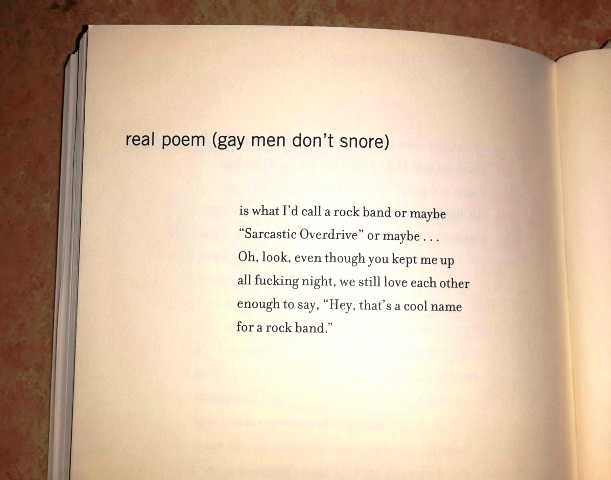
Pedestrians is just as honest as Museum of Accidents, but I find it less brutal. I don’t know if it’s me that’s changed or Zucker or both of us. In her poems in this collection, I hear a kind of acknowledgment and acceptance of the goodness in her life.  Take, for instance, the way she unearths and confesses “we still love each other” in “real poem (gay men don’t snore)”

Pedestrians by Rachel Zucker

Or the tenderness and compassion she offers herself in the first sentence of “real poem (personal statement)”:

“I skim sadness like fat off the surface
of cooling soup.”

If we’re to assume the narrator is Zucker herself (and it’s difficult not to since she refers to her husband by name in this collection); I sense that it’s not that Zucker’s sorrow and longing have been replaced with gratitude; but it’s that Zucker has stumbled upon the space in which they may exist together.

And that, perhaps, along with the intimacy she invites in the dream poems, appeals to me.  Moreso, as I said above: it makes me want to read and write more poetry. And not for the sake of being heard, or for the sake of future publication or celebrity.

But because poetry is where I go about discovering the goodness in my own life,  in my own loves. It’s where I best display tenderness, compassion, and devotion, even when I am being brutally honest.


Books

Book Review: Dear Luke, We Need to Talk

Book Details

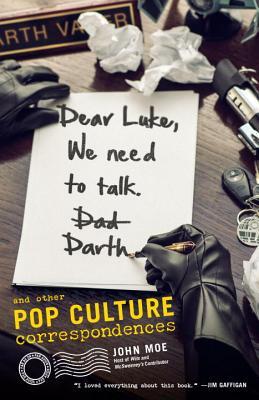
Title: Dear Luke, We Need to Talk, Darth: And Other Pop Culture Correspondences
Author: John Moe
Publisher: Three Rivers Press


Review

It was in one of my favorite online magazines, Fast CoCreate (a Fast Company publication) that I first heard about John Moe’s anthology of satiric correspondences which fictionally  “exposed” the behind-the-scenes letters and diary entries of some of  pop culture’s most famous characters and relationships, including the title characters’, Darth Vader and his son, Luke. I am a big fan of satire and pop culture, and as a writer was curious to see in which direction Moe, a regular contributor to McSweeney’s would take this. I imagined a mix of fan fiction and Dear Abby. I was excited for the book.

dear lukeSo I jumped on the opportunity to read it when Books for Bloggers made it available to me in exchange for an honest review. Unfortunately, though, I think this book was better off a collection of articles than an anthology of more than 50 imagined conversations and correspondences, most of which went on too long. My overall reaction to the book is that the ideas were funnier than the selections themselves; or that the selections would start off funny, but then went on too long.

For instance, I liked the idea of psychoanalyzing Bruce, the shark from Jaws as the author does in the second piece in Dear Luke, but tired of the concept after 3 or 4 journal entries (it continued for a total of eight). The list of “Jay Z’s 99 Problems” was funny, too, but again went on too long. (David Letterman stuck with a top 10 for a reason; Moe takes his list to 99. Is there a pop culture reference I’m missing? Probably.)

As I mentioned, there were spots in the book which I laughed out loud: Moe is a funny writer! Most of his ideas were really clever; it’s just that the execution could have benefited from a more serious editing job, especially for length. The best selections in the collection were the shorter ones, such as the “welp” listings of fictitious restaurants, including the Cheers bar, the Regal Beagle (which made me giggle just to see its inclusion), and Moe’s Tavern. Similarly, I laughed out loud at the concept alone of Gunther writing a letter to Rachel on the coffee shop chalkboard. But the letter itself (spoiler alert) is funny, too! Gunther explains to Rachel that she and her “friends” are all ghosts; dead after drowning in the fountain from the opening credits.  He writes to her in chalk because, “as everyone knows, that’s the only thing that can get a ghost’s attention.” (I always though ghosts preferred writing in the fog of mirrors.)

If I were to highlight the selection that worked best in terms of length, ingenuity and wit it would be “Exchange Between Neal Hefti, Creator of the Batman TV Theme Song, and the Show’s Producer” in which there is a correspondence that eventually leads to the explanation of why the theme song to the television show had no lyrics except for “Na na na na na na na na na Batman!”  During that one, I laughed out loud a bunch of times.

I’m bummed to give this book less than a stellar review because Moe deserves accolades for his creativity and success in execution in many of the selections. But I think the publisher might have been a little too over zealous in expecting readers to push through to the end of this collection.

Disclaimer: I received this book from the Blogging for Books program in exchange for this review.

Books, Survivalism, War

Review: How to Survive a Sharknado

Book Details

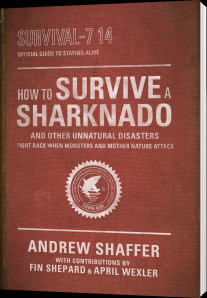
Title: How to Survive a Sharknado (and Other Unnatural Disasters)
Author: Andrew Shaffer (with contributions by Fin Shepard & April Wexler)
Publisher: Three Rivers Press, July 2014


Review

In 1999, when Chronicle Books published the first in what would eventually be the popular Worst-Case Scenario book series, I was an early adopter. I can’t say for certain where I purchased my now worn copy (it’s still in my personal library after six moves, including two cross country and one cross planet), but I have a feeling it was at the Urban Outfitters on 6th Avenue in Greenwich Village.  It was my go-to spot for specialty books typically displayed and marketed as kitschy gifts. The display table in the front corner of the store by the window was the table I often hit first, with the intention to buy for keeps. (The Book of Spells: Over 40 Secret Recipes to Get Your Own Way in Love, Work, and Play was another purchase.)

sharknadoI’ve been planning for disaster almost my whole life. Certainly since the first time I watched the tornado sweep Dorothy away from Kansas into Oz. But I took a more serious interest leading up to Y2K and then again in advance of the yet-to-be-realized Mayan Apocalypse.

Like the author of How to Survive a Sharknado, I tend to approach my prepping with a blend of earnestness and humorous self-deprecation. After all, there’s a fine line between prepared and crazy.  (Prepared, for instance, is a safe room in my house in Israel stocked with two weeks of food and water for me and my family. Crazy, on the other hand, is the underground bunker in West Virginia stocked with MREs for 15 years. I am prepped, but I only dream of being crazy.)

Of course, there’s a reason for Shaffer’s humorous approach to disaster in How to Survive a Sharknado: He’s writing a fictional movie tie-in book, as opposed to a true reference handbook a la The SAS Survival Handbook by Lofty Wiseman (which I also have in my personal library and which Shaffer references in the introduction to Sharknado.)  How to Survive a Sharknado is part of the Syfy Sharknado brand, a made-for-tv film franchise I’ve — regretfully? —  never seen. (Watch this trailer for “Sharknado 2” starring Tara Reid.)

Like any good B-movie horror flick, How to Survive a Sharknado is rooted in truth.  Bizarre one-off disasters do indeed happen (See 7 Global Apocalypse Scenarios That Might Really Happen and After Hundreds of Bee Stings and Thousands of Volts, Tree Trimmer Eager to Get Back to Work) and people — not just preppers — go bananas on social media when they do.

But, as far as I can tell, Shaffer’s book is as fictional as the Sharknado movie, a humor book mocking real-life disaster coverage and promoting, in a way, a host of B-movie disaster flicks on SyFy, such as “Arachnoquake,” “Mega Python vs. Gatoroid,” and “Sharktopus.”  Shaffer plays it so straight in the book, however, I almost believed some of the stories were real until I got to “Dinonami,”

How does he do it? In addition to leading off each “unnatural disaster” chapter with a table of vital statistics, Shaffer also offers “reports” of incidents and commentary by “real-life” witnesses and experts.  In the section for Extreme-Weather Vortex, for instance, Shaffer references “the morning of May 18, 2008” when “the air in the lower atmosphere above Manhattan began swirling.

“The first sign of trouble happened in Central Park. Six-foot-tall whirlwinds filled with subzero air whipped through the park. Children chased these ‘mini tornados’ around — until the tornados started chasing the kids back…A twister formed near the Liberty Island, killing dozens and ripping off the Statue of Liberty’s raised arm.”

Shaffer goes on to “quote” meteorologist Cassie Lawrence,

“At the site of one funnel touchdown in Midtown, I found evidence of lightning. It made perfect sense. Planets with high and low atmospheres are lightning machines. If the storm continued to build, I calculated the lightning would increase in frequency exponentially, building to a crescendo the likes of which we’d never seen on Earth before.”

I laughed out loud towards the end in the section called “Unnatural Disaster Kit” as I read the list of “tools and supplies,” which includes:

“Cash, coins, and Chuck E. Cheese tokens

and

“Packaged snacks: Although not very nutritious, most processed foods like crackers and snack cakes have shelf lives longer than basilisks”

(Basilisk is total insider geek speak. It makes me feel loved and a little less lonely.)

The book is cute and clever, but would be funnier, I think, if I was a bigger B-movie fan (like my husband, for instance, who dragged me to Piranha 3D) or if someone bought me this book at Urban Outfitters on Sixth Avenue as a gift for my upcoming birthday; as a way to gently, but lovingly mock my zombie apocalypse obsession.

As I said, there’s a fine line between prepping and crazy: I prefer laughter to lunacy.

Disclaimer: I received this book from the Blogging for Books program in exchange for this review.

Books, Climate Changes, Community, Environment, Food, Health, Modern Life, Relationships, Religion, Survivalism, War, Writing

What I imagine when I imagine the end of the world

Short Fiction

When I imagine the end of the world, I am alone at the edge of a cliff. It’s evening and God Only Knows by the Beach Boys is playing on a box radio I looted from my neighbor’s basement.

If it were a movie, I’d be gazing out over the city lights of Los Angeles just as the electricity went out, as one by one the skyscrapers lost power, and the city fell dark.

A blazing comet approaches.

Or a neon green burst of light from beyond the reaches of time.

Or a giant tidal wave shimmies up the coast.

If it were a movie, my heart would swell as I accepted my fate. I would open my arms and embrace humanity’s extinction for I knew I had lived life to its fullest.

But it’s not a movie.

It’s my real life.

In which almost every day is the end of the world.

* * *


I have a disease without a name.

If it had a name, it would be called something like redemptionitis or zombisteria or hypotrychtapocalypse.

The closest anyone has ever come to labelling my disease was in the years leading up to the much-publicized end of the Mayan Calendar in December 2012.

Doomsday Phobia, they called it.

Anyone who stocked their basements with toilet paper and canned sardines in preparation for Armageddon; anyone who hoarded books of medicinal herbs or learned how to forage for mushrooms in a weekend workshop held in the back woods of Westchester County, NY; anyone who stocked in the back of the medicine cabinet antibiotics from their child’s most recent prescription for strep throat: We were all quietly laughed at and labeled “preppers.”

Back when it was cute, the way a touch of crazy is cute, as long as it doesn’t lead to a shootout in a movie theater.

Back then, I wondered to myself if I was on a CIA watch list. Did they suspect me? A suburban New Jersey mom of two? A college educated professional with a real job and a real paycheck?

I certainly didn’t fit the profile.

I wore Ann Taylor suits and took the NJ Transit train every day from the suburbs into the city where I walked six blocks to my midtown workplace. In our open floor plan, I had the closest thing to an office – a transparent cube looking out over the East River, made from glass walls so others could look in. It was called the Rainbow Fish Bowl because of the stickers my daughter once placed on the sliding glass door. Every other Friday, I got a pedicure at Trudy’s Green Nails on Lexington Avenue. I was in a book club. I volunteered at the preschool. People liked me.

Each day, I put effort into smiling at my coworkers as if life wasn’t about to abruptly end by Avian Bird Flu.  I’d make jokes over the phone with the sales consultants who’d ask me if I thought wheatgrass was gluten free. I played along. Drank Nespresso in the coffee room with the writers; made snide remarks with the editors about our wacky advertisers; especially the ones who placed ads offering organic MREs (meals-ready-to-eat) purported to last 15 years. Secretly, I wondered if it made sense to pay for organic canned food when the cans were probably lined with BPA.

Could my coworkers view my computer monitor, however, they would have noticed I spent half the day reading headlines on alternative news web sites, corresponding in code with people named “Zen Grower” about the latest UFO sighting over New Mexico or the best price on bulk dehydrated food. I read blogs from people living in half-completed bunkers in the mountains of West Virginia; with strangers supposedly privy to knowledge that was never reported on CNN.  “The ‘Illuminati’ kills scientists, you know,” wrote Jade, my telepathic friend. She communicates with an alien race who is trying to save us from another alien race who’s been trying to destroy us since the Revolutionary War. “All war,” says Jade, “is the fault of the Reptilians.”

I would search “new world order Russian scientists reveal underwater pyramid” and “fourth dimensional beings plot to reprogram our brains” because I knew the search results would give me the intel I required to plan. And I planned. I had one to-do list that included vaccinations, playdates, and dentist appointments. Another to-do list for the end of the world.

My day job, I guess, was a ruse.

It was a way to satisfy my compulsion and still remain a member of society. Or so says Dr. Solomon. I saw it as a healthy way to educate myself on tactics I would surely need for the post-apocalyptic world I was certain was looming. Easily-learned skills like:

  • Reiki for when we no longer had the option to see surgeons for bone breaks or muscle sprains;
  • Acupressure, which I would use in the place of the anti-inflammatories we so depended on in the Before Times for headaches and menstrual cramps;
  • Nutritional supplements and herbal teas — like Chia and Flax seeds; dandelion and feverfew — I’d grow in a rooftop urban garden, where I’d herd my children before the Flood.

Back then, I was Advertising Director of a major national healthy living magazine. I courted and secured advertisers from multiple sectors: home and garden, health and wellness, exercise and fitness, diet and nutrition. And, of course, our bestsellers: classifieds from personal vegan chefs, Hindu tantric sex practitioners and Henna artists.

I was really good at my job. I was good at selling ads because I really believed all of the service providers and multi-level marketing professionals.  When they heard acknowledgment and acceptance in my voice over the phone, they eagerly placed half or more of their advertising budget in my hands.

I understood them, after all. Their fears. Their hopes. I knew intimately what it felt like to want to survive, but more so to want to be listened to and believed.

In my own experience, though, there were therapies and products that worked, and those that didn’t. Quackery, some might say. Except in my business, we never use the word quackery. This would alienate the chiropractors and homeopaths who placed half-page color ads for their self-published e-books.

Reiki, for instance, didn’t cure me of recurring yeast infections, as promised. But my Thursday afternoon sessions with Liane, the psychic massage therapist did help identify a sugar addiction. She also told me I had powers like hers; that I could, if I wanted to, study to be a healer.

She was right. I am a sugar addict. But she was also wrong. I can’t seem to heal anyone.

I kept seeing Liane on a regular basis and even believed most of the stories she would tell me: How her client was miraculously cured from testicular cancer by shiatsu and a six-week juice fast. How her deep tissue hot stone massage helped a couple overcome infertility. How the couple now had triplets – all girls.

I believed Liane. Except for that one time she told me that my migraines were the key to time travel, and that I should stop taking the Relert when the auras came on. I also believed the magazine readers who emailed testimony after testimony to our editorial staff profusely thanking us for publishing stories that changed their lives.  I believed the clippable lists we elegantly designed for ease-of-use, like “Pema Chodron’s Top 5 Mantras for Mindful Sex.”

I believed we were helping people.

I believed the jacket copy on the bestseller of contributing editor, celebrity physician Dr. Joel Willey– a book I personally reviewed for the magazine last December — promising increased sexual desire and stamina for peri-menopausal women by switching to a vegan, carbohydrate-free, anti-inflammatory diet.

I believed it all.

Which, apparently, is a symptom of my disease.

I have a disease without a name; without a designation, but with a host of exhibiting symptoms that collectively, for the past fifteen years, I called “conscious living,” but collectively make up a manilla folder of evidence against me, sitting on an antique desk in Dr. Solomon’s office.

All these “symptoms,” which were formerly advantageous qualities on a resume when applying for a job at a natural healthy living magazine, are now being offered up as evidence of my insanity. My inability to continue as a functioning member of society.

My disease is without a name. It’s as lonely as a woman standing on the edge of a cliff waiting for the world to end.

But, as it turns out, no name is necessary.

* * *


This work of fiction is an excerpt from an original short story by Jen Maidenberg, “What I imagine when I imagine the end of the world.”

Books, Childhood, Dreams, Family, Letting Go, Memory

Throw my suitcase out there, too

The best coworker I ever had was the one who every morning sat with me for a half hour while drinking our morning coffee and did dream analysis with me.

She was good.

So was I.

Coffee + dream analysis = best way to start the morning.

I’m pretty decent on my own, but it’s more fun to analyze your dreams with a friend. I also really enjoy showing people the obvious connections they are missing. It’s pretty hilarious as a listener to understand immediately that your friend is simply exploring her fear of intimacy in her dreams of lesbian sex with the boss, when she can hardly sputter out the words, “sex with….”

Anyway, last night I had a version of a recurring dream I’ve had since moving to Israel 3 1/2 years ago. It was a few hours after waking, however, during shavasana (the deep relaxation at the end of yoga class) that I understood it. When I got it, though, I laughed out loud it was so obvious. Had I shared it over coffee with an experienced dream analyzer, she would have understood it in 30 seconds.

In the dream, I am in my childhood bedroom. I am an adult. I am there with two black duffel bags. I am packing for Israel. I realize that I have forgotten to pack my childhood books to send on the cargo shipment by boat. The books will certainly put me over the 50 lb weight limit the airline allows. I also realize a lot of my clothes are still in the drawers. Clothes I could use in Israel. Thick socks and the like.

I start making piles.

Piles to bring. Piles to part with.

Some items are easier to put in the “part with” pile than others.

I resent this process. I want it all to come with me. Not the old, stretched out long sleeve tees, but I want the socks and the books. Why should I have to leave them behind?

I notice, too, the formica furniture set is still in really good condition and I wonder why we didn’t ship it to Israel. We could have used it there.

But the furniture, I am able to let go of pretty easily. Not the books, though. I continue to make piles.

Image courtesy Wikipedia Commons.

My 5 year old daughter appears. She has some extra room in her duffel. She lets me put books in there. I am grateful. I rearrange some of her clothes to make more room. I wish I had a bigger bag — a large sturdy suitcase would allow for more weight than this duffel.

Suddenly, I am on the plane. I have a white cardboard box, the kind you use to store files, and it’s filled with paperback books. I am able to lift it up into the overhead compartment despite its weight. I worry the flight attendant will call me out on this, but she does not. Instead, she gives me a resigned look and allows it.

I wake up.

Feel free to leave your dream in the comments and I will be happy to give you my analysis in return.

Thanks to Corvidae in the Fields for inspiring this post with his recent one on the “Cube test.


Books, Childhood, Memory, Mindfulness, Music, Parenting, Poetry, Relationships, Writing

My memory waited 14 years for this photo to catch up

annabel guitar may 2014

“We took our coffee into the living room. He stood at the stereo and asked if I had any requests. ‘Something Blue-ish,’ I said.

While he flipped through his records, he told me about the time he’d asked his daughter for requests; she was about three at the time and cranky after a nap, going down the stairs one at a time on her butt. He imitated her saying, ‘No music, Daddy.’

‘I told her we had to listen to something,’ he said. ‘And she languorously put her hair on top of her head and like a world-weary nightclub singer said, ‘Coltrane then.'”

The Girls’ Guide To Hunting and Fishing, Melissa Banks


Books, Childhood, Writing

From the eyes of Mrs. Murry

Meg’s mother picked up the pair of brown tortoise shell reading glasses from the top of the bedroom dresser. She gently put them on and leaned in to study her face in the reflection. Cocking her head to the right, she removed the pair, placed the chewed earpiece in her mouth, and sucked the grooves in between the teeth marks. Only then did she notice the smudge on the lens. Instinctively, she reached for a tissue to wipe it away, but a second later reconsidered. It might be — most likely would be — the closest she’d ever come again to holding her husband’s hand.

Photo courtesy Wikipedia Commons

= = =

This was the result of an exercise I took part in yesterday at The International Creative Writing Conference at Bar Ilan University, sponsored by the Shaindy Rudoff Creative Writing Program. Part of a hybrid literature workshop with Marcela Sulak and Xu Xi, participants were invited to be inspired by the technique used in Jenny Boully’s Not Merely Because of the Unknown that was Stalking Towards Them. Consider the perspective of a secondary character in a book you love. Write a scene from that perspective. This was spontaneous and fun for me — considering A Wrinkle in Time from Mrs. Murry’s point of view.

If it sounds fun to you, too; try it! And post a linkback in the comments below.

Books, Childhood, Kibbutz, Memory

Give me your tired your poor your books

It’s no secret I love old books.

I cry over them like they’re wounded, abandoned puppies crouching behind a garbage bin in the rain.

Sometimes I rescue them, but then have no use for them. (Again, like puppies.)

Often there’s a story behind the compulsion to save them.

I’ll save any Little House on the Prairie book I see, simply because I lost my original set of them in a flood. (For the same reason, I’m drawn to Choose Your Own Adventure.)

I’ll save many an illustrated children’s book from the 1960s because the art makes me want to shake my hips in a way I don’t know how.

I’ll save a book inscribed to Marty or to Catherine. Especially if it was inscribed before I was born.

I’ll save, on the rare occasion I find one, a COUPLES or a SISTERS or anything by Christopher Pike with the express intent to read them with my daughter when she’s 12.

I like old books.

I like to imagine the shelves they once sat in, the boats they traveled by, the author, the editor, the sweat poured into their being.

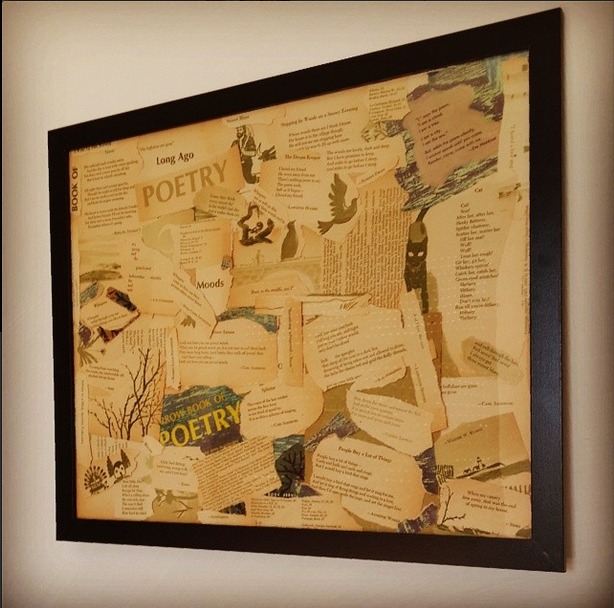
Which is why, when I discovered in the kibbutz giveaway pile a year ago a Scholastic Book of Poetry edited by Ann McGovern, I snatched it up and placed it on the saved books shelf on the top floor of my house.

It was a triple threat, quadruple even, the 1960s publication of a Scholastic book club book with its retro cover, with its pages filled with poems by ee cummings and Langston Hughes and Maxine Kumin and Basho, and peppered with adorable little one-color illustrations. For the cherry on top, there was editor Ann McGovern: a goddess of children’s books and someone I remember from my days as a young assistant at Scholastic. (What I didn’t know until after I completed the project below is that serendipitously McGovern also enjoys creating collage art.)

I’ve been meaning for some time to take a book from my saved collection and turn it into something new. So it serves a purpose other than collecting dust on the shelf. I got the idea after visiting a gallery in Jaffa last year. Passing a wall of framed art, I noticed one was simply a circa 1950s Dick and Jane book cover torn out, framed, and priced at 200 shekels. After I got over my shock that someone tore off a vintage book cover, put it in a frame, and priced it at 200 shekels, I realized, “Wait a minute. I just might buy that. I am someone who would buy something like that.” And if I would, others (with a lot more money to spend) would, too.

I didn’t decide then and there to start my own recycled books-as-art business, but I filed away the idea of it. I liked the prospect of saving old books from doom and turning them into new art. Thinking about it made me happy.

I’ve always loved creating collages. Looking back at old pictures of my childhood bedroom recently reminded me of this. Why not create collages with the old books I’ve saved?

Today, I dug in and created my first.

The process, I learned, is an art in and of itself. It was impromptu and yet fluid. I didn’t know exactly where I was going when I started, but when I went to the old books shelf and saw the Book of Poetry this morning, I knew that was the book to start with.

And so I sat in front of the patio door where the sun shines in brightest, and I read Frost and ripped.

Poetry Collage by Jen Maidenberg


I positioned Edna St. Vincent Millay and pasted her next to Paul Bunyan.

I made sure, too, Ann McGovern still got credit and that bits and pieces of the lovely retro cover remained.

And the result makes me happy. Like a rescued puppy brought in from the rain.


Books, Culture

Between us, there are books

It’s not difficult to spot us.

Those of us in love with old books.

We have shelves full of them.

We smuggle them into our homes despite the eye rolling of our spouses, our parents, our roommates.

We tolerate repetitive sneezing due to dust and the mildew and the ancient tree pollen lurking beneath pages 204 and 205 of the worn book of poetry; for the last time it was opened was beneath an olive tree in the rain.

We can be spotted inside libraries caressing the faded red jacket cover of a 1930s edition of Alice in Wonderland, both in awe that this edition is in our hands and moved by the many hands it has passed through.

Hands now wrinkled, hands now dead and buried, hands that have held wonders of their own in the years since they last held Alice’s.

old edition of Alice

We weep at inscriptions:

To John, Love Grandma

To my beloved wife on our 5th wedding anniversary

To the 8th grade graduates of Merrick Long Island Hebrew Academy. Mazel Tov!

We rescue old books from the recycling plant or, worse yet, from the dump.

We hold on to them in case of the apocalypse or hand them over to crafty friends to offer them a secondhand chance at life as a kitschy framed work of art for sale on etsy or as an IPAD cover, a final project for graphic design school.

Sometimes you hear us sighing in a used book store.

Sometimes we get lost in a used bookstore.

Sometimes we get caught longing for a used book store. Someone asks us, “What were you thinking about just then?” And we answer, “I was looking at your canvas tote bag from The Strand and wishing I was there right now.”

Truth be told: If I could be anywhere right now, I would be inside a used book store.

I would be sneezing my brains out. I would desperately need to use the bathroom (book stores have done this to me since I was 7.) I would lose track of time and part with lots of money, but this is where I would choose to be on any given day.

Even on a beach day.

I suppose TV had a hand in this, what with Charmed and Buffy and farther back even still, Friday the 13th The Series.

I suppose that movies had a hand in this, what with The Neverending Story and The Ninth Gate.

I suppose books themselves have had a hand in this, too. By becoming old. By becoming rare. By becoming obsolete in a way. By carrying in their spines the secrets of a thousand and one human beings.

I don’t know why, exactly, I have such a strong affection for old books, but I imagine it’s wrapped in my curious regard for the passing of time.

It’s a way to touch the past.

It’s a way to relate to people who I will never have the chance to speak to or behold.

It’s time travel of a sort. It is. Stop saying it isn’t.

Old books make me weep for the people who once read them.

For the person who will read it after me. Whom, I hope, might weep for me, too.

Might remember me, the ghost of me … with fondness.

For, despite the space and time between us, we both once turned this book over; swiped the top corner with a damp pointer finger; placed it spread open wide on a night stand or flat sandwiching a clean white tissue inside.

Times passes. We pass.

But between us, there are books.