“I may never be happy, but tonight I am content,” writes the young Sylvia Plath in her journal. (The Unabridged Journals of Sylvia Plath)
What does that road look like?
The road from “content” to put-my-head-in-the-gas-oven?
I can’t think about this for more than a minute. When I do, I myself get consumed.
Sylvia Plath is usually off limits for me.
As caught up in life as I get sometimes, so I get caught up in death. So I stay away. On purpose.
I first heard about Plath from my friend S., who was always much deeper and much more mature than any of my childhood friends, and who was reading her mother’s copy of The Bell Jar already in eighth or ninth grade. When I saw the book on her bed one day, S. told me of Plath’s depression and her rocky relationship without much fanfare. But I couldn’t get the image out of my head — the 1950s era housewife with her head in a 1950s era gas oven.
Perhaps because of how impressionable I was when I first heard about Plath, the image has been ingrained in my head ever since and so I’ve never read Plath.
I avoid her.
Yesterday, however, attracted by a well-crafted tweet, I clicked on to Brainpickings.org and found myself faced with Sylvia Plath.
I almost didn’t read the article, but I love BrainPickings so.
I really really love it.
So I dared.
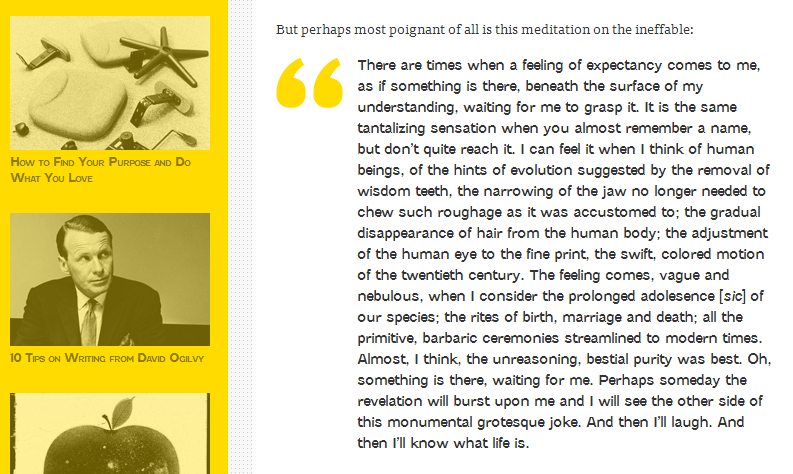
In a post commemorating the 50th anniversary of Plath’s suicide, Maria Popova pulls out entries from Plath’s journals that I can relate to. Entries, as Popova writes, that give us “a record of [Plath’s] incessant oscillation between hope and hopelessness;” Plath’s own “conflicted relationship with life and death;” and Plath’s apparent joy of life and her deep, thoughtful examination of the human species and her own humanity.
Screenshot from Brainpickings.org
The excerpts from Plath’s journals are exquisite and extraordinary.
And something I want to read more of.
But in order to do so, I need let go of my fear of Sylvia Plath.
I need to let go of the unknown. Of what I don’t understand.
I need to let go of the choices others make — the actions I have no control over or the reactions I can’t relate to.
Can I do this?
Can I let go?
Can I do this?
You understand why the answer must be, “Yes,” don’t you?
She’s feeding her wanderlust with banana pancakes, dim sum, and gorgeous panoramas, while feeding our desire for travel photography “porn.”
I love instagram.
Almost in the same moment that the drool drips down my chin, while mesmerized by the lush green mountain ranges and Buddha statues, I long for the eyes through which I saw Israel in the first months I lived here.
The virgin immigrant eyes.
The virgin immigrant heart that burst with joy each and every day…at the beauty of this land; in curious awe of her people.
Cochav Hayarden, March 2012
When we first made Aliyah, every drive was emotionally equivalent to a stroll through an art museum; every hike through a national park was a new adventure in a foreign land.
Every day I would find myself saying out loud: “Do I really live here?”
And I meant it in the same way a mother whispers over her newborn baby, “Are you really mine?”
Two years after making Aliyah, I find that my eyes and my heart are still capable of wonder.
But it’s an experience that does not come as naturally and as automatic as before.
I need, instead, to make those moments happen.
And that takes a lot of work on my part.
I need to see the trash fire in Kfar Manda
— and turn my anger into compassion, and then activism.
And that’s really hard.
It’s much easier to be angry. To rant. To shake my head.
I need to remember, in a moment I feel frustrated by my community, when I am outraged by their seeming indifference to the trash that peppers our fields
How my community allows me the freedom to be a Jew in Progress. To be curious. To be a novice at living in this country.
Acknowledging my community as a gift, however, is really hard work when I am stuck in a moment of discontent.
It’s much easier for me to assume. To judge. To wish myself away from here.
It’s really hard work — and a huge emotional commitment — to be present in your life all the time.
To notice. To stop. To redirect. To be who you want to be, not your raw-emotion-of-the-moment.
It’s exhausting — living your best life.
It’s much easier to feel alive when you are on vacation — separate from the drudgery that often clouds your intentions.
It’s much easier to feel alive when you are first in love; experiencing a newness; your senses overwhelmed by glorious colors and smells.
I recognize this.
And I acknowledge that some days I am too tired to live my best life.
But on the alternate days — the ones in which I work hard for happiness, the ones in which I allow my heart to be open and my mind to be free — I find beauty that surpasses any landscape, any painting, any colorful market scene.
A well-thought out middle name is an underused tool.
My middle name should be “in progress.”
Jen In Progress.
In my case, In Progress would remind me to be compassionate, to others, but mostly to myself.
Mother In Progress
Wife In Progress
Friend In Progress
It would remind me that I will always be a novice no matter how expert I might become at a skill or a task.
Employee In Progress
Coworker In Progress
Marketing Goddess In Progress
It would remind me that self-expression is a gift wrapped in complicated responsibility
Writer In Progress
Coach In Progress
Community leader In Progress
And that how I define myself is as temporary as it is permanent
Jew In Progress
Israeli In Progress
Kibbutznik In Progress
If my middle name was In Progress, every time I made a serious decision, committed myself to a long term action plan, said Yes or said No, I would acknowledge that I am doing so with the purest of intentions as well as the greatest of uncertainties.
That I am always “in progress” means that I may always forgive myself. I may always start over. I may always assume that tomorrow will be better.
Even when it’s not.
In Progress reminds me to be in motion. To repair that which I may have broken. To rediscover the gratitude I may have misplaced. To reignite the passion I have let wane.
This understanding transformed a recurring nightmare into an opportunity for introspection. An ongoing opportunity.
And while I don’t have catastrophe dreams very often anymore, when I do, I know it’s time to slow down. It’s time to recalibrate. Return to the basics. Ask myself what’s important.
Remind myself to live less in my mind and more in the moment.
This moment.
It’s all we can do.
It’s all we have.
This moment.
This understanding is what we wake up to in the moment following tragedy.
This understanding is what we wake up to in the moment before a perceived catastrophe.
And then we fall asleep again.
But, what if we were to carry this understanding with us?
Into the next moment?
Into this very moment?
The only moment we have.
Life is a catastrophe, to paraphrase Jon Kabat-Zinn, the mindfulness guru who probably best perpetuated in the U.S. this concept of “living in the moment.”
Bills to pay. Kids to feed. Spouses to please. Bosses to appease. The everyday catastrophes of life.
Which means we can stop waiting for a catastrophe to happen.
This is it.
And to paraphrase an unwitting proponent of mindfulness, Jonathan Larsen, the creator of the hit Broadway musical Rent — who died the day before his show premiered Off-Broadway:
There’s no day but today.
Words that constitute the same concept as “living in the moment” but with a musically moving execution. And the topical catastrophe of AIDS.
AIDS or not. Natural disaster or not. Mayan apocalypse or not. Madness or not. Pain or not. Fear or not.
“There is no future. There is no past….”
There’s no day but today. And it’s not bad background music to hum to a Mayan apocalypse.
Twice a month, on average, I travel to Tel Aviv for work.
And twice a month, on average, after I park my car on Menachem Begin street in Ramat Gan I walk over to Cafe Cafe to order an espresso k’tzar to go.
Today, I walked into Cafe Cafe and before I could order, the waitress hanging out by the bar looked at me and said “Espresso k’tzar?”
Incredulous, I asked her in Hebrew, “You remember? Really?”
She said, “Of course.”
Now, a skeptic might say, she has a statistically high chance of guessing what I will order at an espresso bar in Israel and nailing it. After all Cafe Cafe is no Starbucks, and there’s no peppermint or pumpkin or other array of holiday coffee drink specials.
However, anyone who knows Israel would know that the waitress’ chances would have been 5x as high if she had said instead of espresso k’tzar:
“Hafooch?”
Since 9.75 times out of 10, Israelis in Tel Aviv order hafooch (a latte).
But she didn’t. She said a short espresso, which is what I always order the two times a month I am in Cafe Cafe in Ramat Gan.
And this little gesture — this “remembering” of little old me — made me stop. Completely stop. I stopped inside a moment I would normally speed through.
Suddenly, I looked at this stranger differently. I interacted with my coffee differently.
All it took was one, seemingly simple interaction to change the way I walked the three blocks from the cafe to my destination.
Instead of noticing the sewage smell emanating from open garbage container like I normally do on this walk, I noticed the shimmer of a single bee stopping to buzz in the sunlight above a sidewalk block.
Do you see it?
I couldn’t capture its majesty in the moment. But I got closer to a bee than I ever have before. Because, for once, its beauty resonated with me more than its potential danger.
And, for me, this is huge.
Beauty overtook fear.
My interaction with a nameless barista was a moment of magic in my day. And considering I had just gotten out of my car after having spent two hours in bad traffic on the highway alone, magic was much-needed.
The magic of you is the minor yet major factor in whether or not my day starts off with wonder and hope or with cynicism and despair.
Of course, I play a part in the magic trick, too. I am the magician’s assistant. I need to be willing to see and believe in the magic in order for it to work.
It helped that I was listening to a series of TED talks on my commute to work this morning. It helped that one of those talks was Shawn Achor’s “The Happy Secret to Better Work.” I was in the right frame of mind to be happy. It helped that one of those talks was Louie Schwartzberg’s “Nature. Beauty. Gratitude.” I was in the right frame of mind to appreciate and be thankful for all that my eyes could see during that three block walk.
Shawn and Louie — strangers on a stage — helped.
Sometimes you are a magician. And I am your assistant.
To be fair, however, “telling it like it is” on Twitter also is pretty subjective. Even when it’s told by those of us with a traditional journalism background.
So what to do for a girl who wants to get the real story?
At least, those of us on the front lines of the social media war do.
* * * *
Politicians or military professionals, if they bothered to listen to the mothers, would laugh at us. Belittle us. Keep us far away from the battleground.
We can’t risk opening our hearts too wide, the combat professionals would say. We can’t allow ourselves to be too vulnerable.
And yet, what any social media expert will tell you is that the true value of social media is connection.
Don’t bother using social media — not for any cause, not for any business — unless you are prepared to be vulnerable. To share of yourself. To engage.
And this is why the mothers in Israel are a most effective tool in this social media war.
You believe us.
Why? Because our stories feel … real.
They feel real because you know us.
Or, at least you feel like you do.
Because we dared to open our hearts to you.
Yet, there’s a side effect to listening to the mothers …
Be prepared.
You might become susceptible to love.
Susceptible to love not just for your own child, but for another woman’s child.
(Even for the child of your supposed enemy in this not-quite-yet-a-war.)
When I listen to the mothers, my heart opens to other mothers.
Not just to the mothers of 19-year-old Israeli soldiers. Mothers who must be very conflicted: Protect my son? Or protect my country?
But also to the mother in Gaza, who might have a blog post ready to burst out from her heart, but no outlet through which to express it.
When I listen to the mothers, my heart opens
My heart…
Opens.
And it hurts. Like it should.
War should hurt.
War should hurt.
When war hurts, we are one step closer to being desperate enough to let go enough to end it.
Every other week I have the distinct pleasure of partaking in a woman’s group in the community in which I live in Northern Israel. The woman’s group, which was informally started almost a year ago and has grown to a bi-weekly gathering of about 10 – 12 women, has a multi-focused purpose. Mainly the goal is to gather and grow as individuals in an effort to move forward both as people and as community members. We also get the chance to do inner work and get to know our friends and neighbors on a more intimate level.
Most weeks, I’m happy to go.
Some weeks, however, I have PMS…and I am too raw and irritable to handle deep thinking or to listen with care and compassion to other people’s inner struggles.
Often on those nights, I leave the meeting a bit frustrated with my inability to understand the nuances of conversational Hebrew, and/or emotionally drained.
This week, our women’s group meeting fell on a PMS week. As much as I needed a night off from family time, I was worried how women’s group was going to mesh with my hormones
But lovely Linda was facilitating, which eased my concerns some because Linda is an art therapist, and her activities are ones I typically enjoy and move in and out of with ease. They don’t usually release the beast…or require too much Hebrew.
I was right. Her exercise was relaxing — essentially a visualization activity, but the way Linda positioned it to the group was like this:
Take ten minutes to imagine a dream world. A place of your choosing. There are no boundaries; no limitations. What does that world look like? Who are you there? What are you doing?
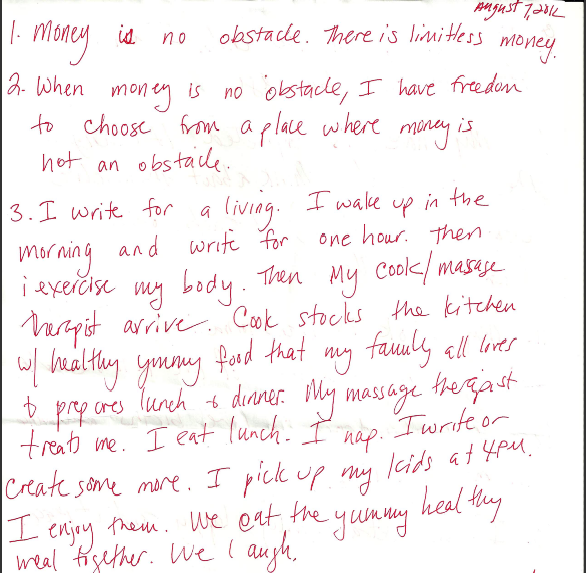
As soon as Linda handed us a sheet of paper and said go, I leapt into action. Without thinking at all, I started writing a sequential list. And this is what it looked like when I finished:
1. Money is no obstacle. There is limitless money.
2. When money is no obstacle, I have freedom to choose from a place where money is not an obstacle.
My handwritten visualization
3. I write for a living. I wake up in the morning and I make myself an espresso. (I edited this from the original. Espresso is a necessity in my dream world.)
I sit down at a lovely wooden desk with a view and I write for one hour. Then I exercise my body. Then my cook and my massage therapist arrive. My cook stocks the kitchen with healthy, yummy food that my family all loves. She prepares our lunch and dinner. My massage therapist gives me a treatment for about an hour. I eat my healthy yummy lunch…slowly. I nap. I write or create some more. I pick up my kids at 4 pm. I enjoy them. We eat a yummy healthy dinner together. We laugh.
4. Once a week (maybe twice) my husband and I go out alone. Sex is sometimes involved.
5. We vacation often, and in luxury.
6. We discover the cure for food allergies and for all cancer.
7. We discover the secret to world peace, too. We implement it.
8. All my previous wrongdoings are forgiven.
9. I clean up all loose ends. I am free of guilt and emotional baggage.
10. I complete my book. It changes the way people think about themselves (for the better). It changes the way people treat each other.
11. My book is transformational. It brings an abundance of love into the world.
12. The abundance brought about by my book brings abundance into my own life.
13. I am extraordinarily happy and at peace.
14. And, most of all, I’ve managed to not mess up my kids or my marriage along the way.
As I completed the exercise, I had an overwhelming, yet unexplainable feeling that the entire kit and kaboodle was actually attainable. From the smallest triumph (write for a living) to the largest (world peace), that somehow the solution was as simple as imagining it.
I know for most people this concept is heresy — that all it takes to solve a problem is to dream up the answer. That all it takes to live the life we imagine, is to imagine it.
I mean, really, if it was as easy as all that, why haven’t we achieved world peace or cured cancer already?
And I see the truth in this way of thinking.
And yet, I see the truth in the accessibility of all I list above.
Really, what are dreams?
Are they involuntary and insignificant images that pop up during sleep? Are they the stories we concoct and ruminate over each day? The visions of the not so distant tomorrow that terrify us? That keep us in unhappy relationships or stressful jobs?
Are these really our dreams?
Or are our dreams the vehicles with which we create our reality?
One could say this visualization practice of mine the other night was no different from the anxious thoughts that keep us from doing what we really want. Except, in this case I let my mind spiral towards all that I want — not all that I am afraid of.
In the past, I’ve daydreamed a wish into reality. I bet you have, too.
My dream to fall in love. My dream to have children. My dream to move to Israel.
Once upon a time, those were dreams written out on a piece of paper — in a journal, or on an application.
And now, those dreams are my reality.
How do we reconcile this truth with the one we sell ourselves everyday? That dreams don’t come true?
Everything, in fact, begins as a dream.
And therefore everything — from personal cook to world peace — is ours for the taking.
When someone dies, we often use that opportunity to express how we truly feel about them. And how we truly feel about them is often… beautiful.
“You were a light in my life.”
“I’m so grateful we were friends.”
“Thank you for making a difference in the world.”
It used to be that homages were reserved for funerals. Eulogies over a coffin or flowery obituaries. But now we eulogize everyone everywhere. RIP hashtags on Twitter. Memes on Facebook. Dedicated blog posts honoring people we’ve loved and lost; as well as people we never knew at all.
On the one hand, I think that this modern way of grieving and of consolation is extraordinarily cathartic and moving. On the other hand, online memorials and tributes often make me wonder how much goes unsaid during our lifetimes.
What drives us to bare our heart after someone dies? What prevents us from showering the people we know with our love and gratitude before they die? Before they fall ill?
It’s an age-old question; not one that was created by and for the new media age. But I do wonder if the new media age might not also offer us a platform to be just as generous with our love, gratitude, and praise in advance of death as we are after it. We’re already doing this for people we don’t know in real life.
One of many memes that circulated after Jobs’ death
Those of us active on social media likely spend more of our time updating our Facebook statuses with fond remarks for celebrities or politicians we have never met, than people who have directly impacted our lives — even if only for one moment. The neighbor who made you feel welcome when you moved into the community. The teacher who spent extra time working with your child. The co-worker who always remembers to ask you at the beginning of the week how your weekend was.
With ease, we acknowledge celebrities more readily than the folks who could match our picture with our first and last name if asked. And likely, one day, we will publicly mourn these dead celebrities in 140 characters or less more readily than we will tell our friends and neighbors how much they mean to us while they live. It’s only after they’re gone — the people who truly fashion the days of our lives — that we find ourselves moved to the point to express how much their being in the world made a difference in ours.
Buds of hope do surface every once in a while. Today, a friend commented on a picture of me I shared on Facebook by saying, “You grow even more beautiful as you grow older.”
I felt flush with love and gratitude when I read that.
But soon after — because my thinking often overpowers my feeling — I wondered, “Would she have told that to my face?”
I’m not sure she would have. Though not because she doesn’t think it, obviously.
The screen provides a bit of a safety net. Or else the speed with which we are used to responding on social media prompts us to type out the words we really mean rather than the ones we allow after self-censoring.
And while I’m often outraged at what people are willing to say online that they wouldn’t say to my face (think anonymous talkbacks on this blog), I cautiously posit that this impulsiveness may be used for good.
Tell someone you love them today.
Tell someone how pretty she is.
Tell someone how her smile makes you feel better about the world.
Tell someone that he was a role model for you.
That he turned a bad day into a good one.
That he taught you how to be a better man, a better dad, a better friend.
There is one day a year I can count on for public displays of affection. My birthday (which is in a few weeks, by the way.) On my birthday, my Facebook Wall is all a-clutter with love. But not in the same way I imagine it would be if I were dead.
“Have a great birthday” doesn’t carry the same weight as “You were a light in my life.”
It doesn’t mean I don’t appreciate the sentiments. Of course, I do.
But I think we can all do a better job at acknowledgment. Use talkbacks for good. Out our anonymous admiration, and be the light of someone’s life while they’re alive.
How do I know this? Because Ms. Levin, my second grade teacher told me so. Seriously, my nickname in second grade was Motor Mouth, a moniker craftily created by my teacher at the time, who occasionally relented to my excessive hand-raising by saying, “Yes, M.M.?”
As borderline abusive as this practice was, there was some truth in the designation. I talked a lot. All the time, in fact. I talked to my neighbors at my table. I talked to my friends across the room. Often I would mutter to myself. I was a social creature. I still am.
My poor husband, not a social creature by nature, now carries the burden of Ms. Levin. But unfortunately for him, he has not only my incessant chatter to contend with, but also our oldest son’s and daughter’s. They inherited the Motor Mouth gene.
My chatter tends to run over into my writing. I’ve said often in the past that I “write in order to know what I think.” I didn’t make that up. Author Stephen King has said it. Historian Daniel Boorstin is claimed to have said a version of it. I wonder if those guys were motor mouths, too. Probably.
The best part about blogging is that it’s almost acceptable to be a motor mouth. Not so with traditional, published writing. In magazines, books, and newspapers — the kind of publications people still pay money to read on a regular basis — our motoring is required to be more thoughtful and refined. I respect this. I think it’s a sensible, if often boring, practice — carefully choosing your words and paying fastidious detail to grammar and punctuation.
Which is why, when I have a more thoughtful and potentially refined idea for a story, I don’t blog it. I save it.
I have one right now, in fact.
It’s been percolating inside of me for about two weeks, ever since I first started saving books from the recycling bin.
As you know, I live on a kibbutz in northern Israel. It’s a kibbutz that was established about 30 years ago by the Masorti movement in Israel; Masorti being the equivalent of Conservative Judaism in America. Many of the new residents of the kibbutz were from English speaking countries: the U.S., South Africa, England. When they came to Hannaton, they also brought with them their English language books, which presumably went into the communal library once they landed at Hannaton.
Recently, the library at Hannaton, like the kibbutz itself, underwent a huge renewal project. A volunteer committee sorted through the books to determine which ones would remain in the new library and which ones were either duplicates or in an unsuitable condition. There were thousands of books to sort — and since we’re in a Hebrew speaking country, there weren’t many nearby options for donating. The committee decided to put the unsuitable books in the recycling pile.
But, as we know, one person’s trash — or in this case, reusable waste — is another person’s treasure.
And this is how I came to spend a week and a half trash surfing for treasure; embarking on what I call the “Orphaned Book Project.”
When the books were finally hauled away by the recycling truck, I had saved about 30 books and 15 magazines, including Highlights from the 1980s with “Hidden Puzzles” left untouched for my 5 year old to explore; and a Cricket magazine from the year I was born, 1974. I saved a Scholastic paperback from 1981 written by Ann Reit, an author and editor I had the privilege of briefly working with, and who has since passed away from cancer. I saved a much older Scholastic paperback whose jacket cover previews a young adult fiction story that centers on racial integration in the 1950s. I saved a few ChildCraft How-to science books that are surprisingly still reasonably current, and a few history books that aren’t, but are still fun for my 9 year old to leaf through over a bowl of cereal in the morning.
There were Hebrew books, too, but I didn’t save any. The only Hebrew language publication I saved was a pamphlet printed by a professor in 1944 that documented all the agricultural settlements and their products up until that time.
On the title page, in English, are written the words:
Printed in Palestine.
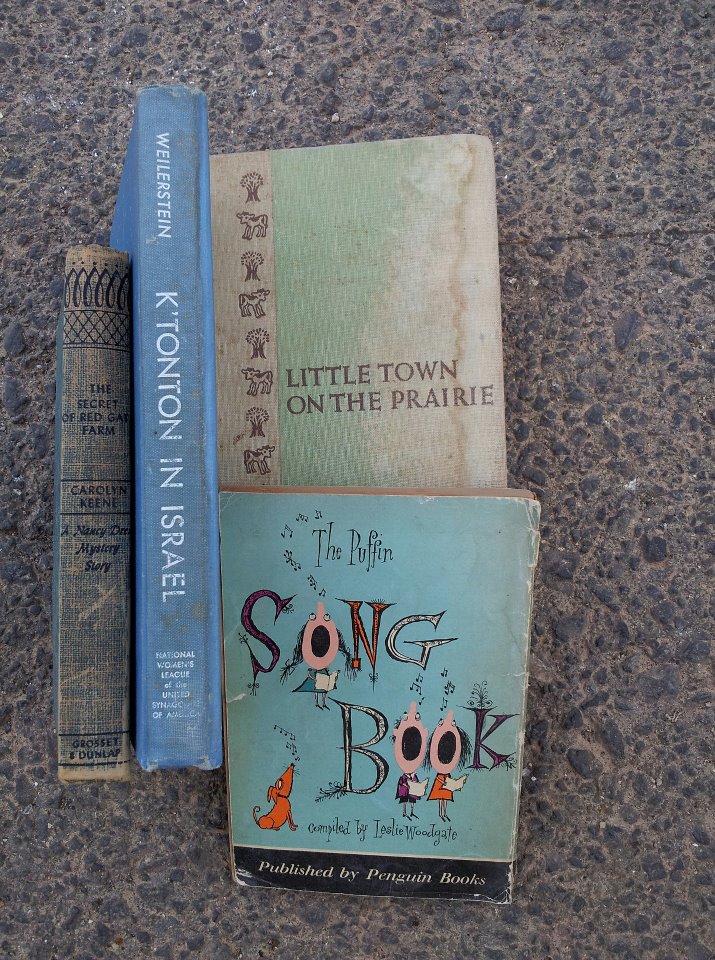
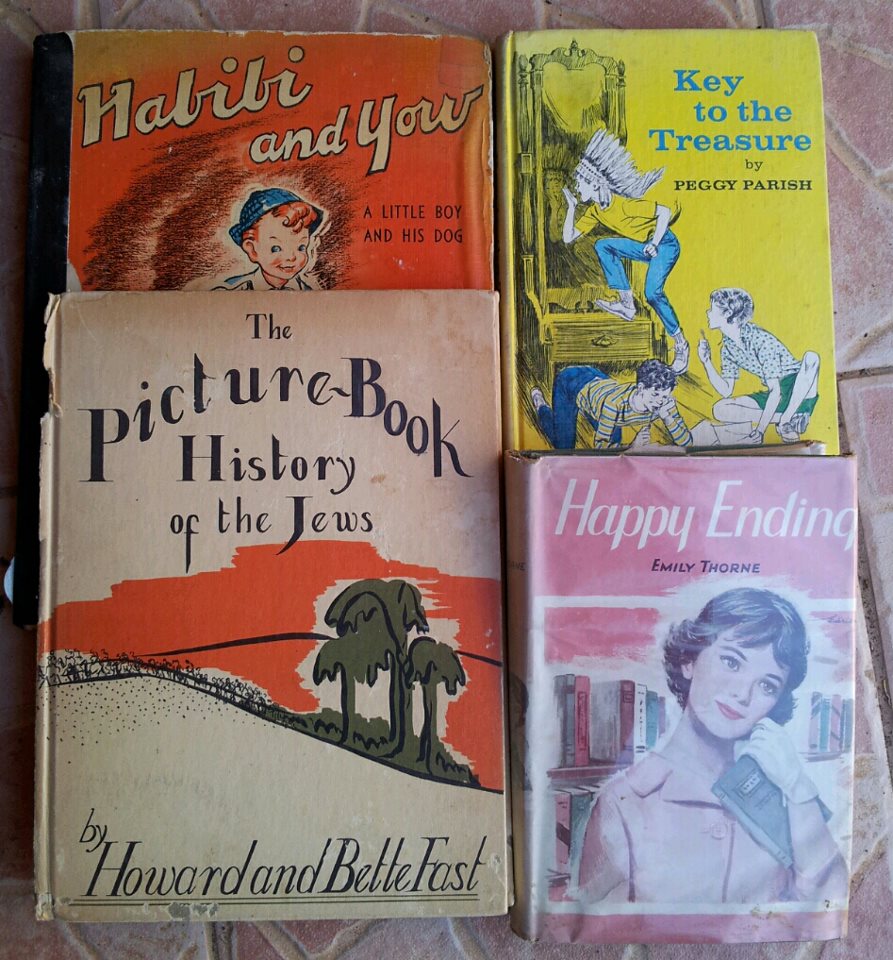
First I saved a couple of original Nancy Drews, and hardcover Little House, and a classic K’Ton Ton, and a kitschy song bookI have no need for more dusty coffee table books, but couldn’t resist this vintage They All Are Jews, a gift to “David” in 1951, after his confirmation. Inside I found a newspaper clipping from when Miss Israel won Miss Universe.It wasn’t until my final visit that I found the true personal treasure: Peggy Parish’s Key to the Treasure, the last in a middle grade trilogy I loved as a girl and had been collecting
So when I think back to the beginning of January 2011 when I got the “brilliant” idea to chronicle my Aliyah experience on a personal blog, I giggle in minor embarrassment.
When I started blogging about my life in Israel, about motherhood here, and about making friends, it was an exercise in maintaining sanity. Truly, the way I process life’s ever stimulating handouts is through writing.
Sometimes, of course, this practice gets me into trouble. Especially when I want to make and keep friends, or get good grades, or convince people to pay me a high salary.
“Running my mouth off” before thinking — a phrase I used to hear a lot from my mother and my 2nd grade teacher, Ms. Levin, and my 8th grade teacher Mrs. Lingo — isn’t necessarily wise. Luckily, as an immigrant who still can’t carry on a conversation with a 3rd grader, I’m not as much at risk of mouth running as I used to be.
That said, my fingers inevitably find their way to the laptop and my previously diagnosed diarrhea of the mouth expresses itself through the raised cavities of my keyboard.
It’s all part of the ever elusive “process” we writers apparently possess. A process that for me, basically looks like this:
Driving/pooping/singing my daughter to sleep for an hour ==>
Thought ==>
A-ha moment ==>
Aggravating pause in between deciding I want to write and having the time to write ==>
Bitter and ugly resentment at all the people in my life who keep me from writing when I want to write ==>
GRITTED TEETH ==>
Hiding in the bathroom with my laptop pretending to poop ==>
Writing…ahhh ==>
Wishing I had time to edit my post before publishing ==>
Deciding I don’t ==>
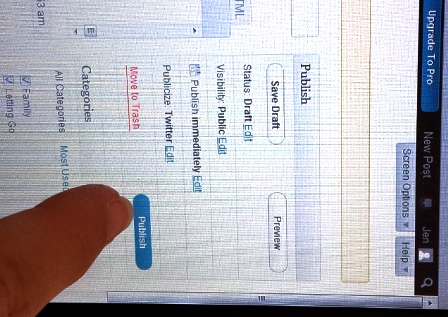
Pressing the PUBLISH button anyway ==>
Smiling with pleasure and relief, while simultaneously cringing with concern.
It looks something like this.
Yes, my friends. That is my process.
Maybe if I had a cartoon dog, things would be different.
I could run ideas by him before I wrote them down, before they ever reached another person’s pair of eyes. Before they reached my mother, my husband, my neighbor, my boss.
He could help me identify which ideas were good, and which better belonged in my journal/rant notebook.
He could warn me when I was likely going to piss someone off.
He could surreptitiously serve me cocktails so I do it anyway.
And then he could hug me all the way back to self-assuredness.
In real life, this person is called an editor. But sadly, in the imaginary world that is blogging while working full time and raising children, good editors are rare.
As is ample time to think twice before hitting publish.
Tonight my son was the student of a lesson I’ve been actively trying to learn all week all my life.
How to keep thinking you’re a rock star when the world hands you proof otherwise.
The setting? My son’s soccer ceremony. The kick in the gut? Instead of being awarded the “best player” trophy at his soccer ceremony tonight, it was presented to one of his friends.
Props to my kid in that instead of losing his shit like one of the younger kids who screamed and stormed off at the end of the presentations, mine actually held back tears long enough to mutter a mom-forced congratulations to his friend, and pose for a picture with him. But as soon as possible, he grabbed my hand to walk far enough away to break down.
“It’s not fair,” he cried. “Everyone knows I’m the best player! The coach favors H. and everyone knows it! I should have gotten that trophy, not him.”
I nodded sympathetically. Maybe I agreed with him. But even if I didn’t, I couldn’t help but relate to how much it sucks when you know you’ve done something really great and people aren’t recognizing you adequately.
I feel this way at least once a day.
What I found truly amazing, however, as my son was lamenting his coach’s bias is that he never once said:
“I suck at soccer. I’ll never get the trophy.” Or,
“I’m not good enough. If I was, my coach would have given me the trophy!”
Instead, he insisted time and again some version of “It’s not fair. I’m the best. Everyone knows it. I deserved that trophy.”
So why the agony?
What stops us from just believing our inner rock star?
Like my son, I’ve always been moderately confident. And in a chicken or the egg sort of puzzle, I’ve never been able to figure out if I’m confident thanks to my successes or if my success is linked directly to my confidence. But as confident as I often appear (to myself and others), there’s always a moment when cocksure turns to doubt.
Like my son, I want the trophy. I want the recognition. I want people to understand how great I am and tell me. Over and over and over again.
If the key opinion leaders in my life — the people I’ve deemed smart, successful, funny, cute, sexy, or otherwise worthy of my worship and/or attention — praise me for my work, I’m on cloud 9. “People really get me,” I think. I have proof I am great.
But if the KOLs don’t agree with my own personal assessment of me (that I’m great/working hard/ trying to be kind), or they don’t shout it out loud, my confidence slowly begins to dissolve.
I like the applause. I like it when people think I’m special.
But is it possible to like it without believing it?
The recognition has clearly become an addiction, and I don’t like being dependent on it. As with any dependency, I suffer when I go through withdrawal. On the other hand, what happens to our greatness when no one notices? Or when someone else sees your greatness as mediocrity at best?
Philosophers, Buddhist monks, and fans of the Matrix still debate whether or not an object exists if someone is not around to perceive it.
How on earth do I evaluate my performance without counting on a grade/raise/applause/pat on the back/book deal?
* * *
My son and I both simultaneously live in two different realities. The one in which “I am great and I know it.” And the one in which “I am great and nobody knows it.”
In fact, most of us are constantly perched at the center of a seesaw, one foot on the side of certain and the other on the side of afraid. It’s up to each of us, in every moment, to choose where to place our weight. This much I know.
But is believing our inner rock star really as simple as deciding to?
Can we simply choose to live the reality in which we are great? Instead of the reality in which we’re waiting for others to notice?
Is it possible to be the rock star without the audience?
They say an oleh is truly settled here when he starts buying Israeli deodorant instead of importing American roll-on via generous relatives, or when he finally settles for chunk light tuna instead of white albacore.
For sure, a girl’s showing signs of improvement when she commits to an Israeli hairdresser.
I walked into Effi’s Tiberias salon the other day looking for a cleanup. Since it’s summer, the season in which I let my hair grow long to remind myself of the blonde I used to be, I told him I didn’t want him to take too much off. Just enough to remind myself I’m a hot mama, not a Hanson brother.
I hadn’t had a haircut in more than six months; the last time was during an unexpected visit to New Jersey in December for my grandmother’s funeral. The day before the funeral, my mom treated me to a cut and blow (the words of which alone transform me from kibbutznik to suburban chic). Since then, however, I’ve been letting my hair grow out, compensating for the split ends with ponytails and braids. Until the other day, when a co-worker chuckled and asked me, “So? You’re going for the Princess Leia look now, huh?” At which point, I realized it was time for action.
I had tried out Effi once before, a few months after we made Aliya. He’s the regular hairdresser for both of my husband’s parents, and, get this, once employed Israeli celeb pop singer Moshe Peretz in his salon. I should have been really excited when Effi told me Moshe Peretz was due into his salon any minute to give Effi himself a cut.
Had I known who Moshe Peretz was, and had I not been reeling from what Effi had told me only minutes before, maybe I would have giggled. Instead, I was distracted and tingly in a way a woman approaching 40 can only be when a man who is not her husband or her five year old son gives her an accidental compliment.
As I sat down in his chair, I had told Effi I wanted to keep my hair long, but other than that he had free reign. Effi looked me up and down through the reflection in the mirror, paused, and told me what a big change he could see in me since the last time I was in.
“Really?” I asked. “How?”
“You don’t look so American anymore,” he said, working on his English. “When you were here last, I thought to myself, ‘This woman is so stiff. So square.’ You wouldn’t let me do anything. Now, look at you.”
A year ago, I would have been insulted. Instead, I took inventory. I looked at myself in the mirror. What was he talking about? I was wearing my standard pair of Old Navy Jeans, sporting the wannabe adorkable red glasses I bought at Cohen’s Fashion Optical right before we made Aliya, and my hair was growing in Zac Hanson circa 1997. True, I was wearing the new lemony top I had bought on sale from Azrieli’s Forever 21 store, but I can’t imagine one shirt made in China sold at a Tel Aviv chain store geared for teenagers and hookers could really make much of a difference.
What did he see in the mirror?
“I see it happen to people all the time,” he said. “They come to me fresh off the boat. And then a year or two later you can see Israel all over them. Their hair gets lighter. They buy funky clothes. This country gets into them. It…”
He struggled for the English.
“It makes them more alive?” I asked.
“Something like that,” he answered.
I sat with it for a bit. The old me – the one fresh off the boat – would probably have ruminated about his comments the entire time he cut my hair. But the me in the chair, the new me (apparently), could only shiver with delight as he snipped away the 12 year old Zac Hanson and created a haircut suitable to the Israeli woman he saw in the mirror.
I felt sexy in that chair…and, I guess, more alive.
After he finished his work, I paid and took the sexy Israeli with me out the door, along with a bag full of new hair products. I strut my stuff down the Tiberias boulevard, flipped my hair from side to side, and with my eyes, dared anyone to try, just try to speak English to me.
I’m no tourist, my eyes said sparkling. I’m no square immigrant.










 and yadda yadda, an aliyah blog