Family, Love, Making Friends, Parenting

When life is full, shep nachas

I’ve been lamenting lately a perceived lack of time to write new blog posts.

An idea will pop into my head, for instance, but in between the idea and the publish button is a perceived lack of opportunity to sit and transform the idea into a story.

Too busy at work. Too tired at home. No time in between.

Life is full.

Can you hear my voice?

How does it sound?

“Life is full,” she said with a sigh.

“Life is full,” she whispered as she let her head fall heavily onto the pillow.

“Life is full,” she grumbled as she hastily prepared dinner for three hungry, irritable children.

“Life is full,” she thought to herself as she watched her husband chase her daughter around the grassy field.

When I put aside my frustration and my lament, I can acknowledge that I am so very lucky that — blog posts or not —

Life is full.

*  *  *

So while I only have three minutes today in between this and that, I will use it to shep a little Aliyah nachas.

Purim at Givat El

That little guy in the top hat is my middle son.

He’s six years old.

When we arrived in Israel two years ago, he didn’t speak a word of Hebrew.  He was cute, but shy.

Lovable, but sensitive.
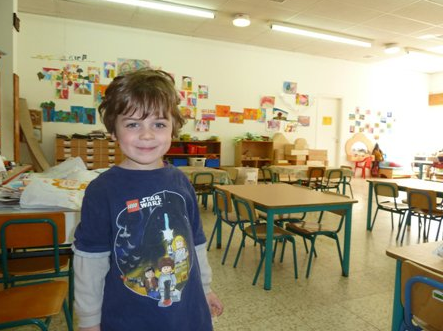
January 2011, at Gan on Kibbutz Hannaton

Little.

Breakable.

For the first two weeks at Gan, he didn’t speak a word to anyone.

In fact, one day he pretended he was blind.

Literally.

He walked around with his eyes closed all day.

The kids ran up to me at pickup time to ask me if it was true, “Is he blind?”

No, I told them. Just shy. Nervous.

When I asked him later why he pretended to be blind, he told me he didn’t want anyone to notice him.

It took him only three weeks to turn those confused children into his best friends.

He’s older now. Adjusted. Still cute, and a bit shy. Still sensitive, yes, but…

More Israeli.

When it comes to song and dance — this kid is Israeli through and through.

It doesn’t matter what the holiday, what the occasion, this kid’s got the soul and spirit of a sabra.

Purim in Givat Ela ceremony

This morning, my heart burst with joy and pride as his “Kitah Aleph” (first grade) class performed a Purim presentation for the rest of the school and for parents.

Yup: The middle guy in the top hat memorized his line in Hebrew, recited it flawlessly in front of the entire school, and sung and danced his little heart out.

Everyone noticed him.

Especially me.

My life is full.

And lucky for me it takes no time at all to shep nachas.

Just a moment to change your tune.

Letting Go, Living in Community, Love, Making Friends, Mindfulness, Relationships, Spirituality

Life is hard work and other things that make me feel tired, but alive

I am struck by the pictures my friend Holly is sending back to us from Hong Kong and Vietnam.

See more http://instagram.com/theculturemom

She’s feeding her wanderlust with banana pancakes, dim sum, and gorgeous panoramas, while feeding our desire for travel photography “porn.”

I love instagram.

Almost in the same moment that the drool drips down my chin,  while mesmerized by the lush green mountain ranges and Buddha statues, I long for the eyes through which I saw Israel in the first months I lived here.

The virgin immigrant eyes.

The virgin immigrant heart that burst with joy each and every day…at the beauty of this land; in curious awe of her people.

Cochav Hayarden, March 2012

When we first made Aliyah,  every drive was emotionally equivalent to a stroll through an art museum; every hike through a national park was a new adventure in a foreign land.

Every day I would find myself saying out loud: “Do I really live here?”

And I meant it in the same way a mother whispers over her newborn baby, “Are you really mine?”

Two years after making Aliyah, I find that my eyes and my heart are still capable of wonder.

But  it’s an experience that does not come as naturally and as automatic as before.

I need, instead, to make those moments happen.

And that takes a lot of work on my part.

I need to see the trash fire in Kfar Manda

smoke in kfar manda

— and turn my anger into compassion, and then activism.

And that’s really hard.

It’s much easier to be angry.  To rant. To shake my head.

I need to remember, in a moment I feel frustrated by my community, when I am outraged by their seeming indifference to the trash that peppers our fields

how grateful I am for my community.

How my community supports me.

How my community allows me the freedom to be a Jew in Progress. To be curious. To be a novice at living in this country.

Acknowledging my community as a gift, however, is really hard work when I am stuck in a moment of discontent.

It’s much easier for me to assume. To judge. To wish myself away from here.

It’s really hard work — and a huge emotional commitment — to be present in your life all the time.

To notice. To stop. To redirect. To be who you want to be, not your raw-emotion-of-the-moment.

It’s exhausting — living your best life.

It’s much easier to feel alive when you are on vacation — separate from the drudgery that often clouds your intentions.

It’s much easier to feel alive when you are first in love; experiencing a newness; your senses overwhelmed by glorious colors and smells.

I recognize this.

And I acknowledge that some days I am too tired to live my best life.

But on the alternate days — the ones in which I work hard for happiness, the ones in which I allow my heart to be open and my mind to be free — I find beauty that surpasses any landscape, any painting, any colorful market scene.

A vacation awaits me.

In my regular boring life.

And yours.

Family, Letting Go, Living in Community, Love, Making Friends, Mindfulness, Parenting, Uncategorized

I wasn’t always like this

A well-thought out middle name is an underused tool.

My middle name should be “in progress.”

Jen In Progress.

In my case, In Progress would remind me to be compassionate, to others, but mostly to myself.

Mother In Progress

Wife In Progress

Friend In Progress

It would remind me that I will always be a novice no matter how expert I might become at a skill or a task.

Employee In Progress

Coworker In Progress

Marketing Goddess In Progress

It would remind me that self-expression is a gift wrapped in complicated responsibility

Writer In Progress

Coach In Progress

Community leader In Progress

And that how I define myself is as temporary as it is permanent

Jew In Progress

Israeli In Progress

Kibbutznik In Progress

If my middle name was In Progress, every time I made a serious decision, committed myself to a long term action plan, said Yes or said No, I would acknowledge that I am doing so with the purest of intentions as well as the greatest of uncertainties.

That I am always “in progress” means that I may always forgive myself.  I may always start over. I may always assume that tomorrow will be better.

Even when it’s not.

In Progress reminds me to be in motion. To repair that which I may have broken. To rediscover the gratitude I may have misplaced. To reignite the passion I have let wane.

To progress.

To journey.

To grow.

Family, Living in Community, Love, Making Friends, Middle East Conflict

I can’t remember growing older

When you’re a parent, each day is a struggle not to live in the future.

What if?

What will be?

What will she look like?

How will he make it through?

And some days are harder than others.

The days when fear grips you.

When headlines make you want to keep your child locked inside a bubble-wrapped, sterilized room forever.

You want to be locked inside, too.

This morning, my 10-year-old son and his friends are enjoying a weekend morning.

They’re playing Playmobil and singing as they manipulate their imaginary worlds.

They’re chilling out, numbing their minds in front of the Wii.

As I hear their squeaky pre-pubescent voices belt out a mix of Shabbat songs and Rhianna, I laugh.

For a moment, I’m in the present.

They are cute.

But a moment later, I’m in the future.

They are tough. Or pretending to be.

These boys?

These four boys?

They’ll be soldiers some day?

boys playing

I don’t believe it.

I can’t picture it.

I wish it away.

How many other mothers in Israel have wished it away?

Countless. As many as there are mothers.

How many other mothers saw 10 turn into 18 in an instant?

How many other mothers can touch 10? Taste 10? Smell their 10 year old boy’s sweating, dirty self walking in the door at 6 o’clock?

They scream!

Someone has fallen into an imaginary Lego hole. Someone has knocked down a Playmobil brigade.

Oh please.

Please let those screams,

please please please,

always be screams of play.

Always be screams of who gets the first turn

Not screams of agony.

Let this moment last.

Community, Living in Community, Making Friends, Mindfulness, Parenting

Other people’s garbage

What I am about to say doesn’t apply to everyone.

It doesn’t apply to the immigrant family just arrived from Darfur.

It doesn’t apply to the disabled veteran living in a box on the corner.

But it DOES apply to anyone with enough money and sustenance to afford a computer, an IPhone, a tablet.

What I am about to say applies to those of us lucky enough to be in the middle or upper class.

What I am about to say applies to the family who pays 150 NIS to send their kid to basketball class, and another 500 NIS on the uniform.

What I am about to say applies to the family who owns a car, a three-bedroom home.

What I am about to say applies to the family who takes their kids on vacation to Eilat.

What I am about to say applies to some of my friends and neighbors.

What I am about to say is going to piss you off.

Your kid disgusts me.

Yes, your kid.

The 13-year-old who just threw a plastic cup under the bushes next to the preschool without thinking twice.

He disgusts me.

Sure, it’s only for a moment. A passing moment.

He’s only a kid after all.

Until it happens again.

Until the 6-year-old, the one who is in the same class as my son, rips the wrapper off his popsicle and drops it onto the street without worrying for a second about getting in trouble.

Disgust.

Again.

Today was not the first time I’ve seen a young person throw trash on the ground here in my community; here in Israel.

Today was not the first time I saw your kid throw trash on the ground as if the ground was going to take care of it.

As if the ground serves as his garbage can,

The same ground that braced your child’s fall when he was just learning to walk.

The same ground that nourishes the wildflowers you use as a beautiful background for family photos.

The same ground that you pay taxes to tend to.

Your kid just trashed that ground.

Now, you might think me harsh or judgmental.

You might think me smug.

You might spend the next two weeks watching my children like a hawk to see if they ever once throw trash on the ground.

They might.

And if they do, I hope that you will call to them, gently but not so gently scold them, insist they pick their garbage off the ground and place it in the proper receptacle.

Do what I didn’t just do.

Teach them.

I missed an opportunity. I let your kid walk away.

I let my ego get in the way — too afraid that I wouldn’t use the right words in Hebrew, I waited til he walked away and I picked up the cup myself.

And then I shook my head. At him. At you. At me.

It’s easy to make excuses.

My excuse is language.

My excuse is fear.

What is yours?

The truth is: There are no excuses for our children throwing garbage on the ground.

Not children who go to basketball, and play Wii, and own their own phones.

Not children who eat organic tomatoes or gluten-free pita.

Not children who are raised on hikes along the Jordan River; on a deep love for this land.

There are no excuses.

plastic on the ground

Is this the land we're fighting over?

Plastic bag dots the green

Love, Making Friends, Relationships, Spirituality

Wonder might be what saves us

(This was originally posted on The Times of Israel)

In college, one of my best friends was Stephanie. We met sophomore year as we both hesitantly decided to join the eager freshman girls in sorority rush. By the time Rush Week was over, we knew that no matter how much or little we ended up liking the girls dressed in matching t-shirts and hair ribbons, we’d have each other.

And we did. Until the summer before Junior year when Stephanie got sick. She didn’t return for fall semester, and instead spent the next nine months receiving treatment for lymphoma. We spoke on the phone often during that time — in fact, when I remember Stephanie, I remember her phone voice, “Hey Jen, It’s Steph.” But I visited her only once at her parent’s home in Pennsylvania, a winter break road trip I dared alone from my parent’s house across the Delaware River.

I remember carefully washing my hands when I entered the house, and I remember how cheerful Steph was that day despite being clearly weakened. We played board games, and she showed me her computer station in the basement. The place, she told me, where she still felt connected to the world.

This was in 1994. The internet was still very young. I can’t remember if I even had an email address yet. If I did, I didn’t use it for anything other than connecting with my friends at school. But to Steph, the internet was everything. It was her only thing.

She told me about the friends she had made online; the games they could actually play together; the chat rooms. I remember being curious, but also sad. Who were these “friends” that my friend was so eager to meet each day; and how could she possibly get to know them simply through the green letters peppering a dark monitor screen?

But now I understand.

Almost 20 years later, I understand.

I understand how a stranger can make you feel alive.

How technology can be a life line.

And while for some, this is a more literal truth than for others; I do believe it can be a truth for us all.

I’m no technophile. In fact, I’m the mom that severely limits her kid’s computer time; rolls her eyes at her husband’s urgent need for the new IPhone; and worries that the next generation will never learn how to spell because they’ve never lived without Spell Check.

But, I’m no technophobe either. In fact, I believe that technology, and more specifically social media, just might be what saves us.

It’s a lofty statement with modest origins.

I realized today, for instance, how using Instagram has reignited my sense of wonder.

Through the lens of my mobile phone camera and the filter of Instagram, I suddenly find myself marveling at the beauty that is the backyard of my otherwise unattractive rental home in the Galilee:

I’m touched by the remnants of a lost time and place:

I feel in my heart the true miracle that is my son playing on the playground the day after a cease fire:

Through Instagram, I see the world with hopeful eyes, and from that space find myself seeking new objects of wonder.

Every day.

Wonder. Hope.

I’m on the look out for wonder and hope.

And when I find it, I want to share it.

This is what the world needs more of.

And it’s not just Instagram. Twitter ignites my curiosity. It’s in this space that I meet up with science geeks; where I’m reminded of just how many people out there really, truly want to save our planet. It’s in this space that I found my community in Israel; where I realized I’m not alone in my quest to make this land and the gentle hearts of those of us who live here understood by those who don’t.

Wonder and hope.

And Facebook, too. It’s here I’m inspired by the joy of the people I love. It’s here where I’m reminded by just how much people care about me, and just how much I care about others. How much my heart can burst at the photograph of a new baby born to someone I’ve never met in real life, but know through her blog what a gift that baby truly is.

Wonder and hope.

Social media –and your sharing bits and pieces of your wonder and hope — makes me feel alive.

And together, our joy at living, just might be what saves us.

Community, Making Friends, Middle East Conflict

Narrow circles

“Everyone you know okay?

I SMSed my friend in Netanya.

This was only after I got confirmation that my two good friends in Tel Aviv were safe, and heard the same from my coworker who has an IDF-aged son stationed close to where it happened.  My online Tel Aviv based “tweeps” had all reported in, as well.

They weren’t on the bus.

But names of injured have not yet been released.

So you never know.

Not yet.

Who was on the bus?

Was it a friend of a friend? The cousin of a neighbor?

Back when I lived in the States, especially when I worked for the Jewish newspaper, I always waited anxiously for the list.

You know which list, right?

The one with the names. The one with the ages. Sometimes, the one with pictures. Faces that would never change.

Back then, we would get the news feed by email and fax. The Jerusalem Post was the main English news source reporting from the region at the time, and the only one with an online presence.

Now, we get our news everywhere. Up-to-the-minute. Unconfirmed. Confirmed. BREAKING. Photos from the scene. Retweets from eye witnesses.

And, as a result of the very same phenomenon — social media — our circles have widened…and at the same time narrowed.

Take my circle, for example.

I live in Israel.

I have community in Israel.

My real-life community in Israel and my online community in Israel.

If I could maneuver Adobe Illustrator, I’d show you all the hands I’m holding online. They would extend to America, Great Britain, Canada, Italy, and even Gaza.

Now, not just because I live here, but because I have an extended community here, I know more people in Israel.

More potential victims.

And you know me.

Or you feel like you do because you read my blogs. You follow my twitter feed. You’re subscribed to my posts on Facebook.

We’re holding hands in that imaginary graphic.

And now …

BOOM!

You know someone who lives here.

Now, when you read the lists, you’ll scan for someone you know.

Knowing someone here makes the situation a lot more real.

Almost as real as it gets.

But still, not quite real.

Family, Letting Go, Love, Making Friends, Spirituality

The 5 minute answer to world peace? Imagination

Every other week I have the distinct pleasure of partaking in a woman’s group in the community in which I live in Northern Israel. The woman’s group, which was informally started almost a year ago and has grown to a bi-weekly gathering of about 10 – 12 women, has a multi-focused purpose. Mainly the goal is to gather and grow as individuals in an effort to move forward both as people and as community members. We also get the chance to do inner work and get to know our friends and neighbors on a more intimate level.

Most weeks, I’m happy to go.

Some weeks, however, I have PMS…and I am too raw and irritable to handle deep thinking or to listen with care and compassion to other people’s inner struggles.

Often on those nights, I leave the meeting a bit frustrated with my inability to understand the nuances of conversational Hebrew, and/or emotionally drained.

This week, our women’s group meeting fell on a PMS week. As much as I needed a night off from family time, I was worried how women’s group was going to mesh with my hormones

But lovely Linda was facilitating, which eased my concerns some because Linda is an art therapist, and her activities are ones I typically enjoy and move in and out of with ease. They don’t usually release the beast…or require too much Hebrew.

I was right. Her exercise was relaxing — essentially a visualization activity, but the way Linda positioned it to the group was like this:

Take ten minutes to imagine a dream world. A place of your choosing. There are no boundaries; no limitations. What does that world look like? Who are you there? What are you doing?


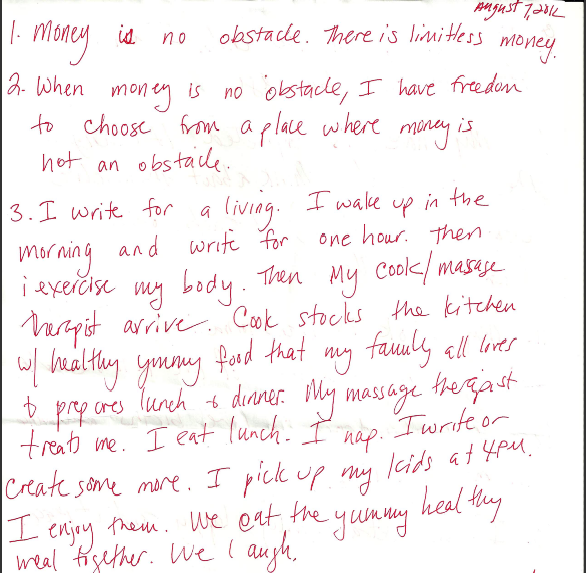
As soon as Linda handed us a sheet of paper and said go, I leapt into action. Without thinking at all, I started writing a sequential list. And this is what it looked like when I finished:

1. Money is no obstacle. There is limitless money.

2. When money is no obstacle, I have freedom to choose from a place where money is not an obstacle.

My handwritten visualization

3. I write for a living. I wake up in the morning and  I make myself an espresso. (I edited this from the original. Espresso is a necessity in my dream world.)

I sit down at a lovely wooden desk with a view and I write for one hour. Then I exercise my body. Then my cook and my massage therapist arrive. My cook stocks the kitchen with healthy, yummy food that my family all loves. She prepares our lunch and dinner. My massage therapist gives me a treatment for about an hour. I eat my healthy yummy lunch…slowly.  I nap.  I write or create some more. I pick up my kids at 4 pm. I enjoy them. We eat a yummy healthy dinner together. We laugh.

4. Once a week (maybe twice) my husband and I go out alone. Sex is sometimes involved.

5. We vacation often, and in luxury.

6. We discover the cure for food allergies and for all cancer.

7. We discover the secret to world peace, too. We implement it.

8. All my previous wrongdoings are forgiven.

9. I clean up all loose ends. I am free of guilt and emotional baggage.

10. I complete my book. It changes the way people think about themselves (for the better). It changes the way people treat each other.

11. My book is transformational. It brings an abundance of love into the world.

12. The abundance brought about by my book brings abundance into my own life.

13. I am extraordinarily happy and at peace.

14. And, most of all, I’ve managed to not mess up my kids or my marriage along the way.

As I completed the exercise, I had an overwhelming, yet unexplainable feeling that the entire kit and kaboodle was actually attainable. From the smallest triumph (write for a living) to the largest (world peace), that somehow the solution was as simple as imagining it.

I know for most people this concept is heresy — that all it takes to solve a problem is to dream up the answer. That all it takes to live the life we imagine, is to imagine it.

I mean, really, if it was as easy as all that, why haven’t we achieved world peace or cured cancer already?

And I see the truth in this way of thinking.

And yet, I see the truth in the accessibility of all I list above.

Really, what are dreams?

Are they involuntary and insignificant images that pop up during sleep? Are they the stories we concoct and ruminate over each day? The visions of the not so distant tomorrow that terrify us? That keep us in unhappy relationships or stressful jobs?

Are these really our dreams?

Or are our dreams the vehicles with which we create our reality?

One could say this visualization practice of mine the other night was no different from the anxious thoughts that keep us from doing what we really want. Except, in this case I let my mind spiral towards all that I want — not all that I am afraid of.

In the past, I’ve daydreamed a wish into reality. I bet you have, too.

My dream to fall in love. My dream to have children. My dream to move to Israel.

Once upon a time, those were dreams written out on a piece of paper — in a journal, or on an application.

And now, those dreams are my reality.

How do we reconcile this truth with the one we sell ourselves everyday? That dreams don’t come true?

Everything, in fact, begins as a dream.

And therefore everything — from personal cook to world peace — is ours for the taking.

Culture, Letting Go, Love, Making Friends

Be kind to writers

Since I began chronicling my life experiences in a public forum like a blog, I’ve learned there are feelings and personal experiences I might have been better off keeping to myself. Looking at blog posts I wrote three years ago is almost as mortifying as leafing through the journal I kept in 9th grade; the one that’s peppered with love poems only an angst-ridden teenager living in upper middle class suburbia could write… READ MORE

Culture, Family, Kibbutz, Letting Go, Living in Community, Making Friends

Seeing double

When I first moved to Israel, before I got my full-time job here, I started networking in search of freelance writing work. I had already started writing this blog about my Aliyah experience and had gotten positive feedback from both friends and colleagues. One of my colleagues suggested I reach out to Kveller.com, a new blog for Jewish parents, thinking they would be interested in syndicating this blog or hiring me to write another.

I wrote to the editors at Kveller and pitched my blog idea, confident they would write back to me with a big, fat YES.

Pitch: Fun, snarky Jewish mom leaves the comfort of her chic New Jersey suburb with her husband and three kids to try to make it as a kibbutznik in Northern Israel.

The editors wrote back that they liked my writing style, but that they already had a cool Jewish mom makes Aliyah to kibbutz column.

What?!?

There’s two of us?

Well, apparently there are. At least two of us.

The editors forwarded me Sarah’s blog post about moving to Israel, and I thought to myself, “Hmm. I guess I’m not so unique after all.” Sarah’s writing reminded me of my own, a blend I like to consider “tell-it-like-it-is honesty infused with snarky vulnerability.”

Figuring out that someone else had already pitched my idea and got the gig before me was a tiny blow to the ego, I’ll admit. Nonetheless, I secretly smiled knowing there was another Jen-like new olah mom out there.

So it was little surprise to me to see it was Sarah who wrote the article that popped up today on my Facebook news feed from The Times of Israel called, My Israel: A Land of Spoiled Milk and Honey.

The first half of the article was like reading the California Girl version of my life, or at least an alterno-verse version of the summer I first visited Israel in 1992.

I laughed at Sarah’s recollections of her first visit to the Kotel which were “spiritual” and “meaningful” and “fucking awesome.”  And I smiled knowingly at what she recalled as her passionate statement to the Israeli passport control worker promising that “one day she would return.”

I remember being that passionate girl. I remember being madly in love with an Israeli soldier. Um, I mean, Israel.

I could also relate to her experience of missing that connection to Judaism once she returned to the States. It happened to me, too. And I spent years trying unsuccessfully to recreate it while living in America.

But what I couldn’t fully relate to in Sarah’s post were her expectations that moving to Israel would somehow be a seemless transition into Israeli life and culture.  I didn’t share the expectation that being a Jew in a Jewish land would naturally translate into being understood or loved or accepted by your friends and neighbors. In fact, I was really worried that no one here would get me. That our family would not fit in. That I would never feel like this was my home.

In fact, the one thing that drives me nuts about the “Aliyah Movement” is the idea that American Jews moving to Israel are, in fact, “coming home.”

That sentiment, when I am at my ugliest, makes me want to vomit. When I am feeling kind, it simply bewilders me.

This “Coming Home” slogan is plastered all over the Nefesh B’Nefesh marketing materials. It’s the titles of videos on YouTube. It’s written in permanent marker on poster board and embroidered onto hats.  And all the time I think to myself, “Is it true? Are you? Do you?”

For a little while, the fact that I didn’t feel that way made me feel like a fraud, like an imitation oleh. Like the fake tofu version of a new oleh.

Where was the meat?

Did I really deserve this Aliyah if I wasn’t 100% sure Israel was my home? That this decision was the right one? That I would be happy here? That I would stay?

In the 16 months since I made Aliyah, I have come a long way.  In the 16 months since my Aliyah, I have worked hard to make this country my home. I have worked hard to learn the language; to make friends; to take on challenges that scare me; and to be tolerant and even accepting of cultural difference that are so offensive to me that I want to jump on the next plane back to Newark Liberty International.

For instance, I have learned that I can both hate the Israeli woman up my ass in the line at the pharmacy and at the same time admire her for being ambitious and bold. I can both cringe at the reckless abandon of Israeli parents when it comes to their child’s safety; and at the same time, smile with pride at the independence my children have acquired since figuring out that falling 5 feet from the top of the jungle gym onto concrete really, really hurts. I can scream at the dogs who run off their leashes; and quietly be happy they’re around to bark at the would-be robbers.

I have learned to love and accept this country, and my community. And I still reserve the right to complain about her.

If that’s not home, what is?

The real problem lies not with Israel. Nor does it lie with immigrants who are constantly comparing their new home to their old one. And certainly, the  solution is not, as some of the commenters on Sarah’s post would have one believe, “If you don’t like it, then leave.”

If anything, what we new immigrants need is compassion. Compassion from our neighbors, both the Israelis and the olim who have figured it out already.

And compassion for ourselves, as it takes a lot more than a slogan or a birthright to feel at home.

Family, Kibbutz, Learning Hebrew, Letting Go, Living in Community, Love, Making Friends, Parenting, Religion

A year in reflection

In retrospect, I’m glad we made Aliyah at the end of a calendar year. At the time, moving during the first of New Jersey’s many blizzards and dealing with holiday travel didn’t seem like such a good idea. But now, as I reflect on the year that we’ve been living in Israel, I find comfort in the awareness that I will never have to struggle to remember when we moved here. It was at the end of December, in the winter of the end of a decade. 

And, as if leaving our friends and family to move to a new country wasn’t turbulent or memorable enough, there was plenty else to mark this year in my memory. I lost a cousin. I lost my grandmother. And through these and other extraordinarily difficult times for my family this year, I was here and they were there.

In the chapters that mark my life, 2011 will be one I remember without a bookmark, without a folded over corner.

My kind friends and loving husband might argue with this, but the marks of this year also show on my face, which seems to be finally showing signs of age. This year, as exciting as its been, has also been the year that I started feeling aches in my joints and noticing that my body is not as resilient as it used to be.

This was the year I closed my business and started a new job. It was the year I gave up my Blackberry and then found it again, at least the Israeli Nokia version. It was the year I moved to the house down the street of one of my oldest childhood friends and the year I found that sometimes, moving away from your closest friends, actually draws you nearer to them.

This was the year I stopped obsessively focusing on healing others; and truly starting looking inward in an effort to heal myself.  It was the year I rediscovered the healing power of song and prayer; love and community.

This was the year I decided that a heaping helping of humble pie was good for me. That learning something new every day can be painful, but active listening often works better than talking, even when you want so badly to communicate who you are and what you want.

This was the year my husband really learned to appreciated me as a mother. And I him as a hard-working professional. It was the year I resigned myself to the growing up of my children, and the year I decided that they would be okay — in spite of my fears and worries.

It was the year I let go.

This morning, after I dropped off my five-year-old at gan, I shook my head in amazement. He had woken up this morning with a bellyache and asked not to go to school. After hesitating only a minute, we decided it was okay if he stayed behind and rested in his room this morning. After all, it’s a long week, and Fridays are half-day, looser schedules for kids in preschool here.

At around 9 am, he decided he felt better and asked if he could go to gan. I asked him, “Are you sure? You can stay home if you want. It’s fine.” He insisted he felt well and asked that I take him up.

When we got to the door of his classroom, he gave me a quick kiss, and with one last look back, left my side to play with his friends.

This was the same kid who one year ago, walked off the plane at Ben Gurion Airport, pale as a ghost, after vomiting for 12 hours straight. This was the kid who cried every morning for months when we dropped him off at gan; who wouldn’t let us leave; who begged us to stay home.  This same kid was now opting for gan over a day off at home. This same kid, didn’t know a word of Hebrew when we arrived a year ago, but now speaks completely in Hebrew with his friends…and with confidence.

This morning, my five-year-old’s brother is off playing with his own friends; and his sister, I’m sure, is chatting away in Hebrew with hers at her own school. My husband is preparing food for our Shabbat meal tonight with friends, and I’m here, taking a break from cleaning the house.

This was the year we turned our life upside down.

And our life righted itself.

Family, Learning Hebrew, Making Friends, Parenting

What do you call this?

When I first started blogging about my Aliyah experience, about two weeks into our new life here, a friend in Israel (also an oleh from the States) told me he had also started a blog when he first made Aliyah. But he soon found he “didn’t have much to say or was too busy to write.”

I smiled and thought to myself, “I can’t imagine ever feeling as if I had nothing to say about our experience here or no time (or inclination, rather) to write about it.”

That was almost a year ago. And my last blog post was a month ago.

I have asked myself many times over this past month, “Why aren’t you blogging about this or that?”

The answer in my mind each time was some version of, “I’m too tired.”

But I think the real answer is, “I’m too busy living here to write about it.”

I am approaching my one year anniversary of making Aliyah. And, thus, approaching the time of reflection.

And suddenly, reflecting on my life here, seems a luxury I do not have.

There are too many va’adot (committees); too many aseifot (meetings); too many parent-teacher conferences; playdates; conference calls; rush projects; and networking meetings.

There are nights when I have to work late. There’s the weekly ulpan I am a part of. There’s the appointment with the massage therapist and the vaccinations the kids have to get.

Of course, there are the seven loads of laundry each week and the dishes every night. There’s homework, volunteer projects, yoga class, birthday parties, Shabbat dinners, and Skype calls with the folks back in the States.

There’s life.

For so long, our life was focused on klita (absorption.)  Our klita was front and center. For a time, our life revolved around visits to this Misrad or that Misrad. Our life was filled with papers to sign and documents to scan. Our life focused on meeting new people and navigating new roads.  Our world centered on making sure everyone was mentally safe and sound here in a new land, new community, new school. Our life revolved around figuring out whether or not we were “going to make it.”

I think we figured that one out.
 
At least, for now.

Psychologists would likely agree that all five of us in my little family unit are still very much in the process of “absorption,” particularly emotionally. But it’s clear to me, that we’ve pretty much been absorbed.

There’s a word in Hebrew for moving here: Aliyah.

There’s a word for the process of getting adjusted and trying to fit in: Klita.

But is there a word for the space in which I now exist? The space in which I live, with both feet planted, yet still not so firmly?

Is there a word to describe the space in which:

I still find myself fretting when I wait in line at the grocery store?

I still find myself scripting out all my conversations in my head before I have them in Hebrew?

I still find myself screaming at drivers?

I still find myself longing for American stores and American conveniences?

I still find myself grateful for English signs and English speakers?

I still find myself crying sometimes at how hard it all seems?

The space in which I do those things and yet  also know with confidence that I am happy? That I have friends? That my children have friends?

That we’re all better-than-okay?

Is there a word for this space?

There is a phrase, I’ve learned, that parents use to try to get their kids to calm down when they’re acting up or, in the case of our lovely Shabbat lunch last week, acting out while the grownups are trying to enjoy good food and wine.
 
Their parents say to them:

“Tistadroo!” Which loosely, and with typical Israeli brashness, translates as “Manage!” 

Often in response, the child will say Ani m’soodar! Which could be loosely translated as “I’m arranged!” or “I’m settled!”

Any person, but especially any parent, who has been through a big life change understands, there comes a point at which you, too, have to “Manage!” When you no longer have the luxury — or the inclination to– focus on “The Change.”

And one day, God willing, you notice you’re managing pretty well.

And that’s when you’re m’soodar.

You’re settled.