Childhood, Dreams, Family, Letting Go, Love, Memory, Mindfulness, Philosophy

A case for hoarding

I’m a hoarder.

I hoard paper, photos, t-shirts, cozy socks, cookies, memories, books.

Especially books. And memories.

I’m not so compulsive to be recruited for a reality TV show, but I’m bad enough that closets are always full and there’s never enough storage space.

Not in my house, not in my brain.

Despite this need to hang on, each time I have moved homes (about 6 or 7 times in adulthood), I’ve let go of things I didn’t think I would need anymore.

I purge — in the rapid, violent way the word evokes.

Goodbye to the japanime LeSportSac bag I coveted. Sayonara to the collector’s set of Leonardo DiCaprio movies on VHS. Farewell to the Fall-inspired finger paintings done by my son when he was 18 months old.

When we moved to Israel, a country that does not believe in closets, nor basements, my husband and I did a major purge — in the form of a yard sale and of giveaways to friends and neighbors. But there were about a dozen boxes we knew not to bother opening — for they would go into storage until we figured out exactly what this aliyah thing would mean for our family.

Boxes sealed in brown packing tape marked in hastily drawn capital letters:

JEN’S MEMORABILIA

AVI’S OLD PAINTINGS

WEDDING PARAPHENALIA

MIXED TAPES, SCHOOL PAPERS OF JEN’S, DO NOT THROW AWAY!!!!!!

CARDS, PERSONAL

Those boxes landed in Israel on a cargo ship a few weeks ago and eventually — after the usual Israeli-style run-around at customs — arrived in our storage room/bomb shelter last week.

Carefully, carefully I am opening those cardboard boxes.

Because they aren’t just cardboard boxes, you know.

They are Pandora’s. Modern day Pandora’s boxes.

Carefully… because danger lurks in the folded over corners of hoarded memories

just as often as joyful surprise.

Carefully… because yellowed papers inside a stale smelling tupperware container may easily transform into messages in a bottle.

Carefully… because when you save, when you keep, when you store away, you might just get what you wish for one day–

a portal into the past.

a light unto what was once dark.

* * *

Watch this space to see what I discover inside a set of boxes.
Love, Mindfulness, Parenting, Philosophy

Guns are just a metaphor

This is not a post about gun control. It’s not a post about violence prevention in our schools or in our towns.

It’s a post about growing up — my growing up — as a mother.

And the single greatest lesson I have learned in my ten years, 364 days of parenting.

Ready?

I know nothing.

Absolutely nothing.

If I look at myself now from the future, this will always be true.

Each day, as a mother, I am growing and learning and changing. And when I look back at the mother I was two years ago, five years ago, 10 years ago, I understand instantly how little I know. And in knowing this, I know everything.

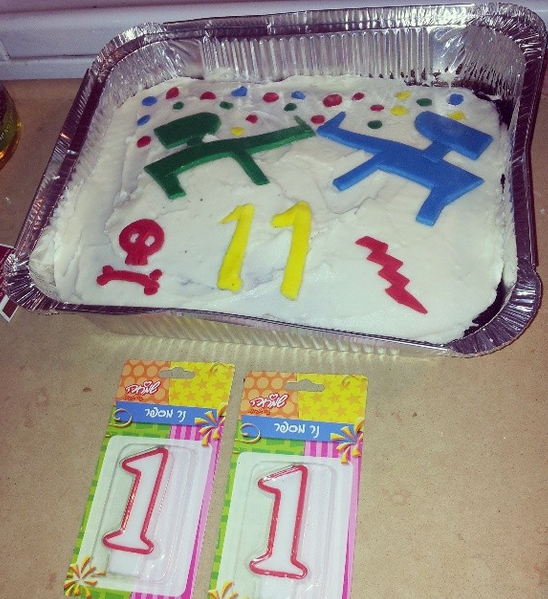
When my son, who is turning 11 this weekend, was a little boy and started to amass little boy toys, we had a rule (my rule): No guns in the house.

As my son transitioned from dinosaurs to Playmobil, the rule shifted a little: No handheld toy guns in the house. But Playmobil policemen were allowed.

And as he grew, in a house that didn’t allow guns, he still played with imaginary ones, as boys do. I could’ve attempted to enforce a new rule, “No pretend guns with clothes hangers,” but by that time I started to realize, just a little, that I might not be able to prevent imaginary gun play and so I instated a new rule: No video games or computer games with guns.

This, I knew, would prevent my son from turning into one of those scary people on the 6 o’clock news; I just knew it. Video games and TV were really the culprits in the downward cycle of violence in America. If our children didn’t see it on TV or in video games, we’d all be safe. I was certain of it.

But, as you probably have gathered by now and mothers more seasoned than I already know, my son grew older. He started to do things on his own — when I wasn’t around. He played shoot ’em up computer games at friends’ houses where rules didn’t get in the way, and watched Clint Eastwood movies on YouTube. And one day, last year, got a Nerf gun as a gift from his classmates for his birthday.

On that day, I had to choose: Would I rescind a parenting decision I had made 10 years prior? Or stick to my guns, so to speak?

I let the Nerf guns in.

I held up my palms to the air that day and looked skyward and said to someone (or no one) in that defeated mother’s voice:

“What, really, do I know?”

And an answer came down from somewhere or nowhere: You know nothing. And yet …

And yet, my son seems to. He seems to know something.

A year later, the kid has amassed a Nerf collection — guns, foam bullets, a vest.  And despite this, seems to know the difference between right and wrong. Play and reality. Seems to be able to function appropriately with peers — completely against my assumption 10 years ago about what happens to boys when they start playing with guns.

In a twist that feels unfathomable to me — a woman who once thought her sons would never handle a toy gun — my son is hosting 20 of his friends today at a paintball party. It makes me uncomfortable a bit; it does.  I find myself asking this morning: What does this say about my son that he wants a paintball party? Worse: What does it say about my parenting that I am allowing it?

And the only answer I can come up with is:

I know nothing.

This is my BIRTH-day gift.

This knowing does not release me from fear or from self-blame for whatever my son may choose to be or to do in the future.  But, rather, allows me to be free to love in the best way I know how … today.

I am certain that I will keep making rules for my children. Just as I am certain I will always be afraid for them.

But, I suppose, that with each passing year, as I understand more and more how little I know about what my raising them will ultimately lead to, I will allow myself to let go.

To trust them to raise themselves.

And hope that my loving them was enough.

Because really, I know nothing.

gun cake

Letting Go, Mindfulness, Modern Life

Happiness is a warm, crisp chocolate chip cookie

It’s pretty cold for Israel. Damp, too, and muddy. We’re in the middle of a patch of rain and about to get hit by a storm that will likely bring snow to parts of the desert. Just the right kind of weather to put me in a bad, bad mood.

But I’m not … yet. I’m working from home today and feeling really, really thankful for that.

And because I’m working from home, and because we still have electricity, I did two loads of laundry and made chocolate chip cookies. I’m a prepper, after all, and I wouldn’t want to be stuck with a power outtage and no cookies.

As soon as the cookies started to bake and I could smell “home” wafting through the house, I started to feel thankful again.

In the sudden sea of gratitude flowing through my life this morning, the makolet was open (when I thought it would be closed) and milk was in stock (when I was certain there would be none.) The rain stopped for five minutes as I made my way to the store, and only really fell down again just as I was getting back to my front door.

A smile broke through my face, just then;  just as the sun pierced the cloudy sky; just for a moment.

Gratitude is like that:  a chain reaction waiting for a spark.

Inside, I lifted a warm, crisp cookie to my lips — fresh out of the oven — I thought I was going to melt from pure happiness. It was the best cookie I’ve ever had.  I am not exaggerating. I have been on a quest for the best chocolate chip cookie recipe for many years, and I have finally nailed it.

cookie

Now brace yourself for cliche.

It occurred to me that, even in the middle of a storm that was bound to put me in a bad mood, happiness could be found in simple things.

Like working from home and the best chocolate chip cookie ever.

This is my blessing for you today, whether you are in stormy Israel or somewhere sunny, but facing an inner storm: May you find joy in simple pleasures today. May you be wise enough to notice them.

Memory, Mindfulness, Music, Parenting

Love Song for a Vampire

If I had nothing else to do in my life right now — no full-time job, no school, no household chores, no parenting, no community commitments — I might decide to drop everything and pursue a journalistic investigation of music and memory.

Truth is, I am doing this already on a very personal level. For those of you who follow the blog, you might have already sensed my budding fascination in some of my recent posts (Check out “Both Sides,” Don’t You Remember You Told Me You Loved Me,” and “Seeking the Language of Music“). These snippets appear in large part due to a long form piece I am in the early stages of writing that explores how music shapes a person, and how a person, often unknowingly, shapes her Self under the spell of music. It’s about how embedded music is in our memory, how memory sticks because of its attachment to music, and how, we can or do use music to maintain memories we deem integral to our sense of Self.

But what about the memories that don’t stick? The ones we let sink down into the darkened depths of forgetfulness? Either on purpose, because they are too painful? Or accidentally, because we think we no longer have use for them?

I am finding that all it takes is a journey … an intentional journey of remembering … for those memories to ascend on their own from the deep. We have a drawer, I’m realizing, we didn’t know we had access to. It’s our subconscious — And we can open it and take out what we need if and when we need it. Of course, there are times a memory surfaces before we realize its usefulness. And then it’s up to us to make the connection.

One such memory levitated to the surface of my consciousness yesterday, seemingly from nowhere (though I am starting to understand that nothing surfaces from nowhere.) It happened like this:

<A few haunting notes tap tap tap on my brain>

What’s that?

<Paying closer attention now>

Are those train horns?

<Even closer attention>

It’s certainly familiar…

Wait, is it this?

No… no, not quite that. Something similar, though.

Wait a minute.

Oh my God.

<Startled look on my face>

<Heart skips a beat>

<Can’t catch my breath>

Oh my…

It’s this.

<Sigh>

I haven’t thought about that in years.

And it all comes flooding back.

The memory — the very visceral experience, actually — that I hadn’t recalled in oh so many years was that of listening over and over again on my Walkman freshman year of college to a love song. In particular, “Love Song for a Vampire,” performed by Annie Lennox off the soundtrack of Bram Stoker’s Dracula (a film I have never even seen …surprisingly.)

The introduction of the song, indeed, sounds like train horns. And maybe that’s all it took yesterday, as I rode the train from Binyamina to Tel Aviv, for a memory to stir, to shoot up like a bubble waiting to be uncorked. All it took was the sound a horn makes.

I searched for the song on my smartphone, but couldn’t get to it due to a bad connection. So I obsessed a little all day long until I could return to the computer. In the meantime, because I had time to kill on the train, I pondered.

Why? I thought. What purpose does this memory serve now? Why do I need it? How does it apply?

I still don’t know the answer.  It’s on the tip of my tongue, just like the song was yesterday, and while I don’t see the purpose yet, I know this memory will be a valuable one in my writing. This piece (this book, this short story, whatever it becomes)  — it’s not just about music and memory. It’s not a clinical piece. It’s about me. About my own passage into middle age. About coming to peace with my past in the face of my present and in the prospect of my future. It’s about accepting myself for who I was and who I am now — acknowledging and embracing the differences.

It’s about forgiving — yourself, others, the cruel linear aspect of time.

And I think, in there, lies the key to “Love Song for a Vampire.”

Maybe.

In the meantime, I’m listening…


Health, Letting Go, Mindfulness, Modern Life

A virtual cure for anxiety is almost here

This morning, my hair dryer caught on fire.

Which is a lot better than my hair catching on fire — which actually happened once, the first time I visited Israel in 1992 and forgot to use a converter before I set my curling iron to my bangs.

I lost half my bangs that day … which was probably a good thing, in hindsight.

I sensed something was wrong this morning when I started to smell smoke. I smart girl.

By the time smoke started pouring out of the thing, my hand was already on its way to the outlet. So when fire sparks started shooting out from the plug, I pulled it out from the wall immediately.

RIP Conair Ion Shine. RIP smooth middle aged hair with no fly-aways.

It was startling, for sure, the fireworks display. It’s a fear of mine — electrical appliances spawning disasters. A friend of mine lost her house to a forgotten curling iron once when I was 10.

But the incident today was also strength-building.

How so?

As a lifelong anxiety sufferer, I’ve become really good at imagining the worst. My mind is programmed for disaster and tragedy; not so much survival and rescue. So that when I do save the day — when I manage to get myself out of a hairy situation or when, for instance, my child manages to narrowly escape harm all on his own — the grey matter in my mind has a new paradigm from which to think.

See, I can tell myself. You made it.

You are okay.

Not that I am inviting harm to myself or my children.

But I do firmly believe that a good, solid, quite startling, near tragedy is a muscle strengthener for those of us with anxiety. (As long as the outcome is a happy ending.)

It shows us that the worst isn’t always as bad as we think.

Perhaps one day, in the not-so-far away future, the smarty pants tech inventors I work with will come up with a virtual reality stimulator whose anxiety treatment is designed to fully scare the crap out of us.

So that we will see, once and for all, how strong, indeed, we are.

Letting Go, Love, Memory, Mindfulness, Modern Life, Music, Philosophy, Relationships, Uncategorized

Both sides

On my drive home from work, I play a game sometimes.

I choose a song to listen to on YouTube. When it finishes and when I get to a stop sign, I look through the suggested songs at the bottom and choose one. That’s the game.

I typically get through three or four songs this way. (I have a 25 minute drive but not so many stops along the winding mountain roads.)

I play this game, as opposed to creating a playlist or listening to a CD, because I am lazy and because Pandora doesn’t work in Israel and because I have this notion that there is a certain magic to the way songs appear in the recommended song section, as opposed to this thing called an “algorithm” I hear so much about but have no idea what it really, truly means. And anyway, I’d rather believe in magic, in an elf DJ who lives inside my smartphone.

It was in this way that I came upon a live version of Both Sides Now sung in 2000 by Joni Mitchell.

I was first introduced to this song in 1988 by my friend Suzanne. I remember because anything folksy or hippiesh I pretty much learned from Suzanne, whose parents were once, apparently, hippie-like, or at least more hippie-like than any of my other friend’s parents in that they owned a guitar and watched Woody Allen movies and collected Bob Dylan records and other stuff I am not at liberty to reveal because you can only embarrass your own parents on your blog, not somebody else’s.

I say this only to let you know that I’ve been listening to Both Sides Now for a long time. I know all the words. I know Joni’s voice and pitch in the song by heart. It made many a mixed tape because I loved it so.

So when I heard Joni from 2000 sing Both Sides Now on my smartphone today, I almost didn’t recognize her. Her voice had changed so. It’s deeper, raspier, more…broken. In a way middle aged women are broken. In a way moons and Junes and Ferris wheels one day become broken after years of working hard on automatic.

I, like I’m sure many who’ve heard this later version of Joni sing this poignant song, thought, “how very perfect.” She is singing this from the other side, and the change in her voice — now alto and smoky with maturity — matches perfectly the impression of being there, then, in the days when clouds only block the sun. One listens to this version and really feels as if Joni has been through it all. One listens to this version and can sense beneath the vocals an oh so subtle laughter, as if…

She sounds resigned, Joni, and yet, satisfied. Good with the turns her life took. Or at least accepting of them, even those which were unexpected.

I listened to her and thought about the girl I once was; the girl who once listened to this song mournfully, as if I was already on the other side. As if…

I sang out loud and wondered, “what would you hear in my voice now?” You who knew me when I was young. You who knew me before the years… Before the years carried me over into the other side?

Family, Letting Go, Love, Making Friends, Memory, Mindfulness, Writing

The almost, so-very-lost, art of the letter

I’ve been finding letters.

Long lost letters.

Long saved letters.

Long ago, written-by-hand letters.

As and Es and Is strung together to form laughter and love and pain.

Through my veins runs remorse

then retraction

as I read the letters aloud.

Loopy script

Straight uppercase caps

Bubbled Oooos and lowercase bees

All of them stamps of time and postmarks of personality

Who knew then that you were a poet, dear Friend?

Who knew that you could dance with your words, dear Lover?

Who knew, Mother, that you missed me with an ache you hid away so I would never know

until I, too, was a mother?

Aching…

Who knew then

what I know now?

Did you?

And I simply

missed it?

Did you know I would read your words aloud

and fall in love with a version of you I never knew?

Culture, Love, Mindfulness, Modern Life

I’m a zombie; really, truly, deeply

“As an immigrant, I feel both frustrated and grateful. Frustrated because I can’t communicate how and when I want to. Yet grateful for that fragile window of time in which I must pause. I have no other choice.”

Read the full piece about how I really, truly am…

a zombie.

Culture, Mindfulness, Modern Life, Writing

The internet has turned me into a distracted tree killer

The internet, while seemingly a solution to the problem of the environmental impact of paper, is in fact turning me into a murderer.

Of trees.

For the past decade, I’ve been an obnoxiously devoted supporter of replacing paper with screens.

I’ve forsaken writing, receiving, and hoarding handwritten letters in exchange for emails. I’ve replaced the amusing 20 minutes I used to spend browsing the  greeting card aisles of the Hallmark store in exchange for working too hard on a mildly humorous  Facebook birthday greeting. I’ve even given up one of my greatest pleasures — lounging in a hot bath with a paperback — because now I read on Kindle and I’m too afraid of electrocution to bring my IPAD within five feet of a pool of water.

Did Al Gore, when he created the internet, carelessly forget about this thing called evolution that has now made it literally impossible for me to read on screen anything longer than 300 words?!

Yes. I admit it. I cannot read on screen anything longer than six paragraphs. All those articles I share on Twitter? Only read the first 300 words. Skimmed the rest. Occasionally I will force myself to read an entire 1000-word post of a good friend first by leaning in (thank you Sheryl Sandberg) and then by literally hugging the monitor close to my face, forcing my mind to process each and every word.

When I really need to read something I don’t want to read — because for some reason, people keep writing ARTICLES, CONTRACTS, and DOCUMENTS longer than 300 words and I am professionally bound to edit and/or respond to those documents — I print them out on paper. I have to. Otherwise, I black out and find myself mindlessly scrolling Pinterest.

Yes, tree killing is coming back. Watch. You’ll see.  You and me — we’re headed towards a killing spree.

Letting Go, Mindfulness, Philosophy

What color is fear?

I have this thing.

After half a lifetime of thinking it was either a special power possessed by only a select few, or a strange sensory birth defect that generally didn’t interfere with my life, I discovered it was a thing.

With a name.

Synesthesia.

I see letters, and words, in color.

Not all words, and not all the time — only particular words and only really when I pay attention to it.

Months of the year, for instance, each appear as a particular color when I visualize them in my mind. So detailed, in fact, that June and July are both red, but different shades.

All the letters of the English alphabet are colored, too, but strangely, not the Hebrew alphabet. Some letters are (Aleph is white like “A”), and some aren’t. If I were a neurologist, I’d probably study that, but I’m not. I’m just the handicapped super hero with a colorful dictionary in her mind.

What’s particularly interesting to me, though, is how words can change color when they are paired with another.

Prickly is white. But pear is yellow. Prickly pear is white. Why?

I have no idea.

Home is red. But go is green. Go home is “green.” Does my mind automatically prefer the verb? Does the adjective always dominate?

Fear is a word whose color I’d like to change.

If  I could somehow convert fear from that rusty-tinted brown orange to a vibrant hot pink with purple polka dots, I somehow believe that my perception of fear might change, too.

Can you really be terrified of a word that is hot pink with purple polka dots?

What if, indeed, the secret power of synesthesia is the ability to use color to change the way you perceive ?

Change the color of a word in order to manipulate your world?

Into a place that’s less scary?

Mindfulness, Modern Life, Philosophy, Relationships

Imagining the Series Finale of My Life

“I’m going to die on this road one of these days,” I thought without actually thinking this morning, as I slowly took the sharp curve on the road between Kfar Manda and D’meida.

The cars opposite me, one by one, took the curve twice as fast as I did, every third car with their front tire on my side of the yellow line.

“Ironic,” I muttered, out loud. “You’re more likely to die from a car crash in this country than a terrorist attack.”

I shook my head. Chased the thought away.

“Why do you do that?” I asked myself. “Why are you always imagining yourself dead?”

This as Van Morrison sings “Into the Mystic” on the CD player and as I round the next curve, the one with the magnificent view over Haifa Bay. The one that always briefly sends me into a scene from an imaginary movie, especially when the sun is setting over the city in brilliant oranges and reds.

And herein lies the answer.

Cinematic and televised drama have become the paradigm for modern living.

We can’t help but imagine our lives as a climactic scene from an award-winning independent film; as a slapstick blunder out of a popular sitcom; as a lovers’ quarrel portrayed by a pop star in her latest music video;

Or even a carefully edited feature on the evening news.

Dramatic display of emotions and exaggerated interaction have become the familiar narratives of our modern lives, and we play it out at home, in the office, on Twitter, and in our minds.

This is how we live.

How can it be any other way? I am almost 40 years old pleasantvilleand I have spent my entire life learning about love, life and death through a lens.

This is a slight exaggeration, of course. I do have plenty of memories — good and bad — informed and outlined by a more commonplace framework, but I wonder sometimes how much of our disappointments in life come from expectations of

a kiss beneath fireworks.

a long-awaited reunion in the company of crashing ocean waves

an acknowledgement of our suffering realized via ascending applause in an over-crowded school hallway.

And how much of our anxiety comes from witnessing over and over again

high-speed highway chases

dramatic deaths by untimely tragic automobile accident.

All of it orchestrated with a powerfully-moving soundtrack.

Social media perpetuates this reality even further, bringing real-life people into our lives in a way we only used to allow afternoon soap opera characters:

An ill woman in need of bone marrow transplant

A child missing

I don’t mean to sound cruel — I know firsthand how social media can be a powerful tool to rally a community, to get a person who otherwise wouldn’t to care.

But has this familiarity with both real-life strangers and with fictional characters — with Richie Cunningham; with the staff of St. Eligius; with Rachel and Ross — blurred the line between reality and fiction?

Has the line mutated … into a line that is almost invisible?

And are we compelled — simply because these are the times we live in — to measure our lives against theirs?

This is what I thought this morning once I safely made it to work and as I carefully avoided spoilers from the series finale of Breaking Bad.

My social media networks were all abuzz — the anticipation over the weekend about how this would all unfold was palpable — and I live in Israel!

How will this all end?

Where and in what matter will this character leave our lives?

And will the end be … satisfying?

* * * * * * * * * *

This is the second in a series about Jen’s dramatic imaginary life. Read the first post here. 

Letting Go, Mindfulness, Philosophy, Relationships

Do you trust me?

My one son has the memory of an elephant.

He can remember the details of events that happened when he was three, trips we took when he was four.

My other son — not so much.

He hardly remembers his best friends from America, and what he does remember is from stories we’ve told him and pictures we’ve shown.

We’ve fabricated most of his memories by sharing our own.

What I mean by that is, my son now claims to remember things I’m not sure he does.

He’s recounting stories of stories. Not stories about actual events in his memory.

Elizabeth Loftus, a psychologist, claims that this is not unusual. That our memories are easily-manipulated.

Unintentionally, and intentionally.

In her recent Ted talk, she offers a firsthand account of working on a crime case gone horribly wrong.

A man was wrongly identified by his supposed victim and convicted of rape — purely on the testimony of a woman who claimed she remembered him doing it.

I’m conflicted by this.

On the one hand, I’m extremely uncomfortable that a person may be put in jail for a crime he didn’t commit simply because one or more people remembered seeing him at the crime — which apparently happens a lot (less so now that we can use DNA evidence). On the other hand,

I desperately want to be believed.

If it were me — If I remembered this man as the perpetrator of the crime against me — I’d better well be believed!

I want raped women to be believed.

I want children to be believed.

And, even when a crime hasn’t been committed against me, even when I have not been wronged, I want to believe in my memory.

I want to know that what I remember seeing and doing and feeling and hearing actually happened.

I am emotionally attached to my memory.

My memory serves me.

Most of the time.

And yet, intellectually I understand that my memory is nothing more than an ever-changing interpretation of an event or an experience.

I think about memory a lot — as a parent, as a child, as a wife, as a writer.

I am very conscious of making my children’s memories, for instance.

I am very conscious that no matter how hard I work to make them good, they might remember them bad.

It’s in these conscious moments that I have great compassion for my own parents.

It’s in these conscious moments that I feel frustrated, too — knowing that there is very little I can do to control or manipulate another person’s memory of me.

As a writer, I acknowledge that my memory is faulty, even though I happen to have one that’s particularly strong and sensitive to detail.

And yet, I honor my memory when I write. I let it lead me down dark hallways, and up vanilla-scented stairwells.

I let my memory pierce that outer wall of my heart so that I may feel love not just in the past but in the present.

We put ourselves at great risk by ascribing so much power to memory – -this is true — especially in situations where memory may put an innocent man in jail;

But if we don’t give so much power to memory; what then?

If we laugh at it; belittle it; if we judge it; doubt it; forget it …

What happens then?

Who are we without our memory?