A well-thought out middle name is an underused tool.
My middle name should be “in progress.”
Jen In Progress.
In my case, In Progress would remind me to be compassionate, to others, but mostly to myself.
Mother In Progress
Wife In Progress
Friend In Progress
It would remind me that I will always be a novice no matter how expert I might become at a skill or a task.
Employee In Progress
Coworker In Progress
Marketing Goddess In Progress
It would remind me that self-expression is a gift wrapped in complicated responsibility
Writer In Progress
Coach In Progress
Community leader In Progress
And that how I define myself is as temporary as it is permanent
Jew In Progress
Israeli In Progress
Kibbutznik In Progress
If my middle name was In Progress, every time I made a serious decision, committed myself to a long term action plan, said Yes or said No, I would acknowledge that I am doing so with the purest of intentions as well as the greatest of uncertainties.
That I am always “in progress” means that I may always forgive myself. I may always start over. I may always assume that tomorrow will be better.
Even when it’s not.
In Progress reminds me to be in motion. To repair that which I may have broken. To rediscover the gratitude I may have misplaced. To reignite the passion I have let wane.
It doesn’t apply to the immigrant family just arrived from Darfur.
It doesn’t apply to the disabled veteran living in a box on the corner.
But it DOES apply to anyone with enough money and sustenance to afford a computer, an IPhone, a tablet.
What I am about to say applies to those of us lucky enough to be in the middle or upper class.
What I am about to say applies to the family who pays 150 NIS to send their kid to basketball class, and another 500 NIS on the uniform.
What I am about to say applies to the family who owns a car, a three-bedroom home.
What I am about to say applies to the family who takes their kids on vacation to Eilat.
What I am about to say applies to some of my friends and neighbors.
What I am about to say is going to piss you off.
Your kid disgusts me.
Yes, your kid.
The 13-year-old who just threw a plastic cup under the bushes next to the preschool without thinking twice.
He disgusts me.
Sure, it’s only for a moment. A passing moment.
He’s only a kid after all.
Until it happens again.
Until the 6-year-old, the one who is in the same class as my son, rips the wrapper off his popsicle and drops it onto the street without worrying for a second about getting in trouble.
Disgust.
Again.
Today was not the first time I’ve seen a young person throw trash on the ground here in my community; here in Israel.
Today was not the first time I saw your kid throw trash on the ground as if the ground was going to take care of it.
As if the ground serves as his garbage can,
The same ground that braced your child’s fall when he was just learning to walk.
The same ground that nourishes the wildflowers you use as a beautiful background for family photos.
The same ground that you pay taxes to tend to.
Your kid just trashed that ground.
Now, you might think me harsh or judgmental.
You might think me smug.
You might spend the next two weeks watching my children like a hawk to see if they ever once throw trash on the ground.
They might.
And if they do, I hope that you will call to them, gently but not so gently scold them, insist they pick their garbage off the ground and place it in the proper receptacle.
Do what I didn’t just do.
Teach them.
I missed an opportunity. I let your kid walk away.
I let my ego get in the way — too afraid that I wouldn’t use the right words in Hebrew, I waited til he walked away and I picked up the cup myself.
And then I shook my head. At him. At you. At me.
It’s easy to make excuses.
My excuse is language.
My excuse is fear.
What is yours?
The truth is: There are no excuses for our children throwing garbage on the ground.
Not children who go to basketball, and play Wii, and own their own phones.
Not children who eat organic tomatoes or gluten-free pita.
Not children who are raised on hikes along the Jordan River; on a deep love for this land.
Bragging moment: I was accepted into the University Honors Program in college. I even got a scholarship.
That letter in the mail was likely the pinnacle of my academic career. That, or the poetry award I won from Mr. Schaeffer at the end of 9th Grade.
I was your classic underachiever in school. And in retrospect, I completely wasted the distinction The George Washington University placed on me.
In order to maintain the scholarship and my place in the program, I was required to take at least one class each semester offered by the honors track. As always, I did the bare minimum. I followed the rules and aimed for a grade acceptable to me and my parents. (A “B” or above.)
The only classes I remember are two semesters of “An Introduction to Soviet Cinema”– from which I walked away better educated about cinematographic license and with the easiest “A” I ever earned — and my senior seminar with Professor Harry Harding, an expert on Asian-American relations.
I don’t remember why I took this class with Harding, since my interest area was the Middle East. I probably heard from someone that he was kind or didn’t give a lot of homework. I do remember, however, the brilliant research thesis topic I dreamed up for the paper I had to write at the end of the year:
“The Influence of Zen Buddhism on American Pop Culture”
I wish I could get my hands on that paper. And, then completely rewrite it. Because whatever I wrote was complete crap and/or borderline plagiarism, I’m sure.
This time, if given the opportunity, I’d actually do the research. I’d read more than the three required books. I’d actually do primary research. Find people to interview. Listen to their stories. Imagine what their lives were like. Swim in their memories. Meditate on them. And then produce a paper that truly encapsulated my brilliant findings and analysis.
But, like most 20-year-olds, I hated writing research papers. And this was a 25 page research paper, which was the longest by far I was ever required to write before or since.
I loved learning, but I was too bound by the rules and the concern for a good grade and the concern for a good job and a good career and a good paycheck and a good pitcher of beer to actually do what I imagine most teachers want you to do — learn about something and carry that education forward into your life.
I remembered this research paper yesterday when I watched a video a friend shared on Facebook.
It’s a series of images that illustrate a lecture given once by Alan Watts entitled “What If Money Were No Object?”
The name sounded familiar. I Googled him. Oh, yeah. He was the guy in my research paper from senior seminar; recognized as one of the key individuals responsible for bringing Zen Buddhism to the West.
I chuckled. Here was the voice of Alan Watts speaking to me — primary research, 20 years too late.
If only the internet had been more than a chat room on AOL when I was in college.
If only I had heard Watts say:
“What do you desire?
What makes you itch?
What would you like to do if money were no object?
How would you really enjoy spending your life?”
I might have spent more time on my research paper. I might have spent more time wondering if this Alan Watts guy was more than just page filler.
What would I have thought if I had been in that crowd? Would Watts have inspired me?
What message would I have taken away from that lecture?
Would I be the philosopher, the novelist, the soap opera star I sometimes wish I was?
“Crowds of students say, ‘We’d like to be painters. We’d like to be poets. We’d like to be writers.’
But as everybody knows you can’t earn any money that way…
When we finally get down to something which the individual says they really want to do, I will say to them, “You do that. And forget the money.”
Amen, I thought to myself, when I heard Watts challenge the audience to “forget the money.”
And then, “I wish someone had said that to me when I was 20.”
Easy for me to say now.
Easy now, at 38 years old, with a steady paycheck and two decades of experience making it on my own.
But would I have been able to really hear Watts then?
Would his words have led me to walk a different path?
I don’t know.
My life might have turned out exactly the same.
I was a lot more stubborn then. A lot less likely to listen to someone wiser than me. I might have done exactly what I did. Graduate. Get a job in a non-profit. Be happy that I was finally earning my own paycheck and had my own money to spend on jeans at The Gap in Georgetown. Or on big scrunchies.
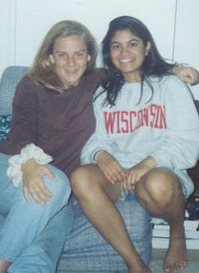
Jen in college.
I really wanted my own money back then. I wanted freedom from my parents. I wanted room to make my own choices. I didn’t see any possible way to achieve both freedom and my desire.
Which makes me think Watts’ advice would have registered only as a temporary instigation.
Not inspiration.
Learn more at alanwatts.com
Because in our current society set up, it’s practically impossible to forget the money.
We have to follow our desires in spite of the money.
What you need to know if you choose to forget the money is how you will stay true to your desire when the rest of the world says you need money over everything else. You need to know how you will navigate the expectations of your family, your friends, your neighbors. You need to know how to avoid the pitfalls of consumerism. How to live without a TV; without an SUV; without a weekend getaway.
You need to build your life so that your life is your weekend getaway.
= = = = =
If anyone had asked me when I was 20, I wouldn’t have said then, “I’d like to be a philosopher.”
I wouldn’t have said, “I’d like to be a craniosachral therapist.”
I absolutely would not have said, “I want, more than anything, to be a full-time, paid-loads-for-a-living celebrated writer.”
I didn’t know it then.
And I couldn’t see the way.
And yet, I’ve been fortunate to find my way. To have either landed in or created circumstances in which I’ve been able to recreate my career based on my passions and desires.
I listened to and followed my itch; years before hearing Alan Watts’ speech.
But, along the way, I’ve had to give up desires, too. Ignore certain itches.
I’ve had to choose.
Sometimes I’ve been able to forget the money.
And sometimes not.
Watts does not talk about choices…and consequences.
It’s not easy to follow your desire instead of following the money.
= = = = =
What would I say to a crowd of young people today?
How would I guide them?
I might say something similar to what Watts says: “Better to have a short life that is full of what you like doing, than a long life spent in a miserable way.”
I believe this to be true. And I like to think that somehow, accidentally, when I was writing that research paper in college, Watts’ advice penetrated my tired mind as I was lazily investigating the influence of Zen Buddhism on American pop culture.
Perhaps, subtly his words have been guiding me ever since.
But I would also suggest being as flexible as you are determined.
For who knows what you will be when you grow up?
You don’t.
I didn’t. I still don’t.
I still ask myself every day, “What do you desire?”
And then listen for the answer.
Forget the money, yes. But be flexible. At every turn, there is an opportunity if you are primed to notice it.
Ask yourself every day, “What do I desire?” And be strong enough to acknowledge the answer and take action, even if the answer is, “Money.”
Tonight my son was the student of a lesson I’ve been actively trying to learn all week all my life.
How to keep thinking you’re a rock star when the world hands you proof otherwise.
The setting? My son’s soccer ceremony. The kick in the gut? Instead of being awarded the “best player” trophy at his soccer ceremony tonight, it was presented to one of his friends.
Props to my kid in that instead of losing his shit like one of the younger kids who screamed and stormed off at the end of the presentations, mine actually held back tears long enough to mutter a mom-forced congratulations to his friend, and pose for a picture with him. But as soon as possible, he grabbed my hand to walk far enough away to break down.
“It’s not fair,” he cried. “Everyone knows I’m the best player! The coach favors H. and everyone knows it! I should have gotten that trophy, not him.”
I nodded sympathetically. Maybe I agreed with him. But even if I didn’t, I couldn’t help but relate to how much it sucks when you know you’ve done something really great and people aren’t recognizing you adequately.
I feel this way at least once a day.
What I found truly amazing, however, as my son was lamenting his coach’s bias is that he never once said:
“I suck at soccer. I’ll never get the trophy.” Or,
“I’m not good enough. If I was, my coach would have given me the trophy!”
Instead, he insisted time and again some version of “It’s not fair. I’m the best. Everyone knows it. I deserved that trophy.”
So why the agony?
What stops us from just believing our inner rock star?
Like my son, I’ve always been moderately confident. And in a chicken or the egg sort of puzzle, I’ve never been able to figure out if I’m confident thanks to my successes or if my success is linked directly to my confidence. But as confident as I often appear (to myself and others), there’s always a moment when cocksure turns to doubt.
Like my son, I want the trophy. I want the recognition. I want people to understand how great I am and tell me. Over and over and over again.
If the key opinion leaders in my life — the people I’ve deemed smart, successful, funny, cute, sexy, or otherwise worthy of my worship and/or attention — praise me for my work, I’m on cloud 9. “People really get me,” I think. I have proof I am great.
But if the KOLs don’t agree with my own personal assessment of me (that I’m great/working hard/ trying to be kind), or they don’t shout it out loud, my confidence slowly begins to dissolve.
I like the applause. I like it when people think I’m special.
But is it possible to like it without believing it?
The recognition has clearly become an addiction, and I don’t like being dependent on it. As with any dependency, I suffer when I go through withdrawal. On the other hand, what happens to our greatness when no one notices? Or when someone else sees your greatness as mediocrity at best?
Philosophers, Buddhist monks, and fans of the Matrix still debate whether or not an object exists if someone is not around to perceive it.
How on earth do I evaluate my performance without counting on a grade/raise/applause/pat on the back/book deal?
* * *
My son and I both simultaneously live in two different realities. The one in which “I am great and I know it.” And the one in which “I am great and nobody knows it.”
In fact, most of us are constantly perched at the center of a seesaw, one foot on the side of certain and the other on the side of afraid. It’s up to each of us, in every moment, to choose where to place our weight. This much I know.
But is believing our inner rock star really as simple as deciding to?
Can we simply choose to live the reality in which we are great? Instead of the reality in which we’re waiting for others to notice?
Is it possible to be the rock star without the audience?
Back when this little guy was a tad bit younger than he is today, he used to “take pictures with his mind.” He’d put his pointer fingers up to his temples, lean down towards the object he wanted to focus on (typically a kitten or a flower), and snap his eyes shut for a moment. He would soon open his eyes with a satisfied look on his face and later return home to sketch and color what he observed.
A boy with his homemade sun scope, after observing the Transit of Venus in 2012
When I was his age (or a little bit older), I used to call this practice “making memories.”
I read it in a book once.
It sounded romantic. The idea that every moment was an opportunity to make a memory if only we stopped to notice it.
I would sometimes walk home from the bus stop, forcing myself to quit counting steps and skipping over sidewalk cracks, and look around instead at the scene on my street: The sun shining through the oaks and birch trees that lined the sidewalks. The children coloring chalk figures in their driveways. The woman opening and shutting the mailbox.
I’d stop and make a memory.
It was an experiment. Something that made me feel exotic and older. Only now do I realize that this was my first attempt at practicing mindfulness, of being in the present moment.
Now, as a mother, I realize that there is indeed something very romantic about being in the moment, and it’s not the making of the memory. It is the moment itself that is romantic — for it’s the space in which you truly experience love and joy. But, recognizing this in the moment itself is one of the greatest challenges of parenthood.
Oftentimes, instead of embracing the love and joy of being with my child, I get caught up in the awareness that I’m already a memory.
A reflection. A reverberation. A remnant.
And sometimes I panic that I’m not making enough good memories of me. Or that the memory of me will land him on the analyst’s couch or on the streets shooting up.
But this morning, hours after my picture-in-his-mind-taking son woke me up at 3 am to ask “Is it time to watch Venus?,” I found myself immersed in the 100% pure extract of love that comes only from being in the moment when it happens… and being aware of it.
There was a moment or two when my excitement almost got squashed by the unexpected falling boulders that often overwhelm us — the scope wasn’t working, the clouds were blocking the sun. And it’s a real challenge, to say the least, not to let them completely derail our original intentions.
But then suddenly the sun broke through from the clouds and lined up just as it should through the pinpoint of a dot at the top of the homemade cardboard box viewing scope and I shouted with delight, “There it is!”
There it is.
It is.
Is.
Ecstasy.
Love. Joy.
Right now.
Did we see Venus?
No, not really. But we saw something. And more important, we all felt something. Together. In the moment. Exactly in that moment.
Minor because I’ve never fully engaged in studying the skies above me; rather remained content to swim in the magical mystery of it all:
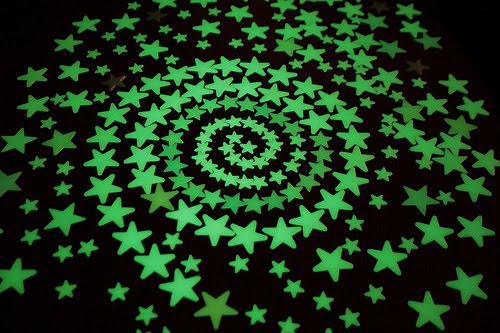
Glow-in-the dark constellations arranged haphazardly on my bedroom ceiling
“Star light star bright first star I see tonight”
Scanning the skies for falling streaks of light
Romantic summer nights
sprawled out on a blanket
Space is humbling. It’s a reminder of how much we have yet to discover.
And it’s awe-inspiring. When I allow myself to be swallowed up in space, I’ve suddenly accessed the wonder of a child.
Everything else slips away. Work. Mortgages. Car payments. Doctor’s appointments. The drama of the day-to-day.
It’s just me and space.
= = =
Since moving out to the countryside, far away from the city glare, I am no longer able to simply walk anywhere at night. I can only stroll, with my neck craning back, my eyes on countless stars, seeking understanding, succumbing to not.
I so easily get lost up there.
And so, for weeks I’ve been anticipating the transit of Venus. Transits of Venus “occur in pairs with more than a century separating each pair.” As if the mysteries of our solar system and what lies beyond isn’t enough of a draw, the idea of witnessing something that won’t again appear in my lifetime — or sharing this experience with my children — is simply irresistible. (We’ve created an “eclipse” scope to view the event together at sunrise on June 6 in Israel.)
Venus last passed in between Earth and the sun on June 8, 2004. I missed it. I was too busy parenting a toddler in his terrible twos, building a career in freelance writing, making mommy friends, navigating the precarious curves and junctions of “married with a kid.”
So much has happened in my life in the eight years between when Venus last transited and today. But my milestones can easily be squashed when you consider what’s become of humanity since Venus’ slow march across the glare of the sun in 1882 — back in the days of Billy the Kid and the OK Corral. Before the Brooklyn Bridge was built. Before George Eastmen created the modern camera. Before the moon landing. Before we glimpsed the Earth from above.
Before me. Before you.
And the mind can get lost in curiosity or despair when she imagines what might transpire between now and when Venus is scheduled for another transit 105 years from now.
After me. After you. After my children, too.
Humbling.
Mind bending.
===
As I said, I’m a minor space geek — more a magician’s apprentice than student. Content mostly to revel in the experience of being puzzled without having to actually solve anything. Content to point out a planet to my son. Content to scan the skies for a shooting star with my daughter. Content to share a bottle of wine with my husband on a blanket in the middle of a field under the romance-inducing canopy that is the vast night sky.
And content to stand in my backyard as the sun rises on June 6 staring into a cardboard box, eyes wide open — a child among my children. Dazzled and bewildered by space. Content to swim in the magical mystery of it all.
Our homemade eclipse scope for viewing Venus’ transit





 and yadda yadda, an aliyah blog