Mindfulness, Modern Life, Philosophy, Relationships

Imagining the Series Finale of My Life

“I’m going to die on this road one of these days,” I thought without actually thinking this morning, as I slowly took the sharp curve on the road between Kfar Manda and D’meida.

The cars opposite me, one by one, took the curve twice as fast as I did, every third car with their front tire on my side of the yellow line.

“Ironic,” I muttered, out loud. “You’re more likely to die from a car crash in this country than a terrorist attack.”

I shook my head. Chased the thought away.

“Why do you do that?” I asked myself. “Why are you always imagining yourself dead?”

This as Van Morrison sings “Into the Mystic” on the CD player and as I round the next curve, the one with the magnificent view over Haifa Bay. The one that always briefly sends me into a scene from an imaginary movie, especially when the sun is setting over the city in brilliant oranges and reds.

And herein lies the answer.

Cinematic and televised drama have become the paradigm for modern living.

We can’t help but imagine our lives as a climactic scene from an award-winning independent film; as a slapstick blunder out of a popular sitcom; as a lovers’ quarrel portrayed by a pop star in her latest music video;

Or even a carefully edited feature on the evening news.

Dramatic display of emotions and exaggerated interaction have become the familiar narratives of our modern lives, and we play it out at home, in the office, on Twitter, and in our minds.

This is how we live.

How can it be any other way? I am almost 40 years old pleasantvilleand I have spent my entire life learning about love, life and death through a lens.
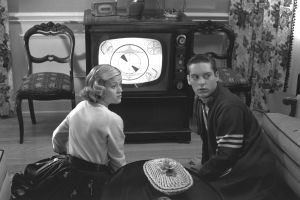
This is a slight exaggeration, of course. I do have plenty of memories — good and bad — informed and outlined by a more commonplace framework, but I wonder sometimes how much of our disappointments in life come from expectations of

a kiss beneath fireworks.

a long-awaited reunion in the company of crashing ocean waves

an acknowledgement of our suffering realized via ascending applause in an over-crowded school hallway.

And how much of our anxiety comes from witnessing over and over again

high-speed highway chases

dramatic deaths by untimely tragic automobile accident.

All of it orchestrated with a powerfully-moving soundtrack.

Social media perpetuates this reality even further, bringing real-life people into our lives in a way we only used to allow afternoon soap opera characters:

An ill woman in need of bone marrow transplant

A child missing

I don’t mean to sound cruel — I know firsthand how social media can be a powerful tool to rally a community, to get a person who otherwise wouldn’t to care.

But has this familiarity with both real-life strangers and with fictional characters — with Richie Cunningham; with the staff of St. Eligius; with Rachel and Ross — blurred the line between reality and fiction?

Has the line mutated … into a line that is almost invisible?

And are we compelled — simply because these are the times we live in — to measure our lives against theirs?

This is what I thought this morning once I safely made it to work and as I carefully avoided spoilers from the series finale of Breaking Bad.

My social media networks were all abuzz — the anticipation over the weekend about how this would all unfold was palpable — and I live in Israel!

How will this all end?

Where and in what matter will this character leave our lives?

And will the end be … satisfying?

* * * * * * * * * *

This is the second in a series about Jen’s dramatic imaginary life. Read the first post here. 
Letting Go, Mindfulness, Philosophy, Relationships

Do you trust me?

My one son has the memory of an elephant.

He can remember the details of events that happened when he was three, trips we took when he was four.

My other son — not so much.

He hardly remembers his best friends from America, and what he does remember is from stories we’ve told him and pictures we’ve shown.

We’ve fabricated most of his memories by sharing our own.

What I mean by that is, my son now claims to remember things I’m not sure he does.

He’s recounting stories of stories. Not stories about actual events in his memory.

Elizabeth Loftus, a psychologist, claims that this is not unusual. That our memories are easily-manipulated.

Unintentionally, and intentionally.

In her recent Ted talk, she offers a firsthand account of working on a crime case gone horribly wrong.

A man was wrongly identified by his supposed victim and convicted of rape — purely on the testimony of a woman who claimed she remembered him doing it.

I’m conflicted by this.

On the one hand, I’m extremely uncomfortable that a person may be put in jail for a crime he didn’t commit simply because one or more people remembered seeing him at the crime — which apparently happens a lot (less so now that we can use DNA evidence). On the other hand,

I desperately want to be believed.

If it were me — If I remembered this man as the perpetrator of the crime against me — I’d better well be believed!

I want raped women to be believed.

I want children to be believed.

And, even when a crime hasn’t been committed against me, even when I have not been wronged, I want to believe in my memory.

I want to know that what I remember seeing and doing and feeling and hearing actually happened.

I am emotionally attached to my memory.

My memory serves me.

Most of the time.

And yet, intellectually I understand that my memory is nothing more than an ever-changing interpretation of an event or an experience.

I think about memory a lot — as a parent, as a child, as a wife, as a writer.

I am very conscious of making my children’s memories, for instance.

I am very conscious that no matter how hard I work to make them good, they might remember them bad.

It’s in these conscious moments that I have great compassion for my own parents.

It’s in these conscious moments that I feel frustrated, too — knowing that there is very little I can do to control or manipulate another person’s memory of me.

As a writer, I acknowledge that my memory is faulty, even though I happen to have one that’s particularly strong and sensitive to detail.

And yet, I honor my memory when I write. I let it lead me down dark hallways, and up vanilla-scented stairwells.

I let my memory pierce that outer wall of my heart so that I may feel love not just in the past but in the present.

We put ourselves at great risk by ascribing so much power to memory – -this is true — especially in situations where memory may put an innocent man in jail;

But if we don’t give so much power to memory; what then?

If we laugh at it; belittle it; if we judge it; doubt it; forget it …

What happens then?

Who are we without our memory?

Community, Family, Food, Kibbutz, Living in Community, Mindfulness, Parenting, Relationships

Smells of Shabbat

One day in the future
My son will need some air.
He’ll leave home
Seeking solace
If only for a minute or two.

On his journey toward temporary peace
He will come upon
The smell of roasted potatoes with rosemary
Two minutes to go til burning
The scent will float beneath his nostrils
And he will remember tonight…

Walking with me
Up and down emptying streets
Through quieting paths
Around quickly passing cars
Parking on the other side of the gate.

A walk
A gasp for air
A last chance to let go of all that was
And open to
what will be
This week

Letting Go, Mindfulness, Parenting, Relationships

Learning by metaphor

You know you are meant to learn a lesson when it’s offered to you in metaphor three times in one week.

Last week, I wrote an ode to Yom Kippur. One of my friends commented by referencing a Dvar Torah given by a friend and neighbor during the holiday:

She used driving a car as symbolic of seeing into the future (forward) and the past (rear view mirror) at the same time. She said it may be the only time in life that we actually have that unique opportunity to do so. She spoke about being on auto-pilot and how lucky that we have 25 hours of Yom Kippur to actually stop.

Being a little obsessed with time travel, and still hopeful that one day I will be able to travel both into the future and into the past, I really appreciated this metaphor.

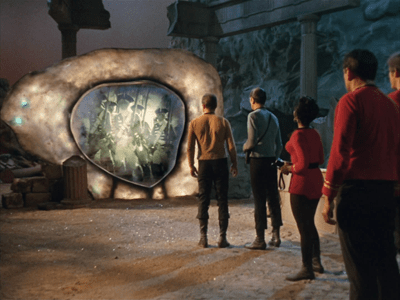
Driving a car is a little bit like time travel — or at least a little bit like the megalith “Guardian of Forever” in The City on the Edge of Forever (Star Trek, episode 1×28).

star trek
Courtesy Wikipedia

There are times, if you pay careful attention, when you may be privilege to what’s behind and what’s ahead, even if there is little to do to change it.

Yesterday, as I drove home from work, I passed by a 6 kilometer bumper-to-bumper back up. As I realized how long the traffic jam was, I started to feel more and more compassion for the drivers sitting in the jam on their way home from work. They had no idea how long the backup was — but I did.

Then, as I slowly made my way around the curvy bend just after the village of D’meida, but before Kfar Manda, I approached the end of the line. There, as cars slowed to a stop, I felt compelled to open up my window and shout:

“Turn around! You’re about to hit a major traffic jam! There’s no way out.”

I felt overwhelmed with sympathy for these people who had no idea what was about to happen to them.

Only minutes before, they were grooving to tunes, catching up on the news, joyfully anticipating a reunion with their kids at the end of a long day.

And now…

stuck.

I didn’t call out my window, though.

Even if I did, I asked myself, would they have heard me? Understood me?

Would they have listened?

Would they have done anything in response?

Many wouldn’t have understood. And even those who did, would use their own evaluation of the situation and past experience to decide what to do.

I chuckled to myself.

It’s a bit like parenting.

You think you know more than your kids. You’ve been there; done that, after all.

You worry. You nudge. You shout:

“Don’t do that!”

“Be careful!”

“You’re making the wrong choice!”

Sometimes they listen. Sometimes (rarely) they value your input.

But usually they don’t.

Like my daughter, for instance — who slammed the front door on her finger last Friday.

She closed the door with her hand in between the jam, despite 2 1/2 years of warnings from both me and my husband to please not.

Evidence that you can offer advice, insight, admonition,

But people — not just kids, but grown ups, too — usually need to learn from experience.

They hardly ever make decisions based solely on the advice of others.

Even if those others are knowledgeable.

Even if they can see into the future or the past.

* * *

Today, on my own drive into work, I found myself stuck in a traffic jam; almost in exactly the same spot as the jam yesterday.

Traffic sat still for a half hour. The minutes ticked away.

A few times I contemplated what to do.

Stay in the car and wait this out?

Try to make it 10 car lengths ahead and turn left to try to go around?

Do a k-turn and return home?

I chuckled. Clearly, there was a lesson to be learned with this whole car metaphor.

I checked Waze.

There was a major accident ahead. It had been there for over an hour.

I thought back to the day before, and then made a k-turn to return home.

I drove slowly, a little bit tripped out by the accident I never saw and the whole car metaphor.

I meditatively contemplated the take-away.

Is the only source of knowledge experience, as Albert Einstein once said?

Are we doomed to ignore others, until we experience things for ourselves?

Probably.

Or at least until we figure out time travel.

Mindfulness, Relationships, Religion

The trouble with sorry

The hardest thing for me to tolerate on Yom Kippur is not absence of food;

It’s the absence of tomorrow.

On Yom Kippur, we are present.

We are asked to let go of yesterday’s mistakes,

to forgive others, and ourselves.

We are solemn in our awareness of the gift of a clean slate.

Of a clean tomorrow.

But this is difficult for me. My busy mind.

Everyone else’s mind is busy with thoughts of food

of kippered salmon, of potato pancakes.

My mind is busy in judgment.

“Is she really sorry?”

“Is he really going to change his ways?”

“Am I?”

With so much sorry in my face, I feel compulsive in my doubt.

And incapable, more than any other day during the year, of casting away judgment.

And present only to my dilemma;

To sinning once again.


Culture, Letting Go, Mindfulness, Modern Life, Relationships, Technology

Crazy Jen and her digital detox

In a discussion with my mother last week, I explained to her with confidence that a group of people were surely talking about me when I left the room.

“How exactly do you know that?” she asked me.

“I just do,” I replied.

“How?” she pressed.

I explained to her that in the same way she is brilliant when it comes to data analysis or number crunching, I know people and their behavior.

It’s not my paranoia, it’s my specialty.

This is why I excel in marketing and branding — you need to be hyper sensitively tuned in to emotions and able to anticipate reactions in order to predict trends and behavior.

I like to tell people — because it’s true and a little self-deprecation is still attractive on a 39 year old who looks 34 — that I am a trend spotter, not a trendsetter.

I spotted the name Hannah, and sock monkeys, and gluten free all before they became Average Joe household-familiar trends.

It’s a blessing and a curse.

The bad part about being a trend spotter, much in the same way that it’s bad to be psychic — people tend to think you’re crazy until the moment after the trend hits the Today Show.

They either don’t listen to you or roll their eyes or … talk about you behind your back, often and with more eye rolling.

The worst part? I receive little to no vindication years later when the trend is obvious. Most people, except for my cousin Jami, have all forgotten by then that crazy Jen suggested years ago that probiotics were the key to fighting depression.

As for my digital detox, I was a little late on the uptake this time.

Only days after I finished my detox — which included the elimination of my smartphone and all computer-related activities for 2 1/2 weeks except for checking personal email once a week and Facebook on my birthday — someone sent me this smart and poignant short film about our cultural obsession with digital connection. The same day, as I returned to Twitter activity, this article from Fast Company appeared in my feed about “slow design” and mentions the digital detox trend. (Not to mention silent meditation retreats — something I’ve been doing, writing about, and suffering ridicule for over the last two years! )

Maybe my trend spotting eye has blurred in my old age, or maybe — like the rest of the world — I am too tired and over-stimulated to be spotting much of anything save for my second cup of espresso.

If digital detox has become  a trend before I spotted it, so be it.

It’s good for us.

We need it.

And we need it fast.

More and more I am hearing from my friends or seeing evidence on the social media networks I somehow feel compelled to follow even though I am getting more and more tired of the content, that —

life is too fast and too hard to keep up with

Just yesterday, my poor friend on Facebook posted an urgent plea for advice:

How do you all do it? She wanted to know.

How do you all keep up with everything? Work, kids, marital bliss, friends, community, world news?

How do you all do it?

I could hear the defeated sigh that followed the last question mark.

We don’t, was my answer.

We’re suffering, I told her.

I hoped to offer her some solace, some comfort. Misery, after all, loves company.

But I don’t know how much relief company will bring. In this case, the more we see others faking it, the more “less than” we feel. And it’s so easy to fake it. It’s so easy to distract yourself from your pain and discontent.

Until it’s not.

Courtesy gawker.com
Courtesy gawker.com

During my own digital detox, which took place during a family vacation, I become hyper aware — just like the girl in the video — of all that goes on, and all that is ignored, around me.

I also became acutely aware and appreciative of my own presence in my own life.

It took only 48 hours of being off Facebook to be so thankful to be off Facebook.

To be relieved.

It took less time for me to be thankful to be off Twitter.

To not know what was going on in the news.

To not have to be witty or responsive.

To tune out the latest trends.

To tune out other people, and the details of their lives.

This may sound mean or psychopathic. Or at the very least, depressive.

Maybe it is.

But if it is, it’s a cultural disease that most of us are severely suffering from.

Most of us just don’t know it — or acknowledge it – yet. OR we’re still convincing ourselves that information access trumps burn out.

Or we think there is no way out.

The symptoms of our cultural disease come out in little ways, like my friend’s Facebook plea, or in a whispered coffee chat between young mothers, or in a verbal spar between embarrassed male colleagues, both overtired and fearful that they will never be able to catch up on their emails or please neither their bosses nor their wives.

My heart hurts for those men, and

I mourn the loss of my freedom.

Because that is what digital detox is — a gateway drug to freedom.

It’s just too expensive for my pocketbook right now and not trendy enough to be available to the masses.

I’m waiting, though.

I’m watching the Today Show headlines on Twitter, and waiting.

Because years ago, back when people were complaining that $5.99/pound was too much to be paying for apples, I was secretly shopping organic at Wild Oats in Tucson, Arizona, waiting for Walmart to catch up.

And hoping for a trend to hit.

Hoping that I wasn’t mistaken and hoping I wasn’t alone.

Community, Middle East Conflict, Relationships, Writing

Beyond the yellow gate

Beyond the yellow gate

there is a woman.

Her airy black head scarf almost shields her effervescent eyes.

But when she looks up, sky blue bounces off her peasant shirt and into her pupils so they ignite.

She touches my wrist gently as she feels for my pulse.

Ba-boom. Ba-boom. Ba-boom.

.

Beyond the yellow gate

there is a man.

His navy blue striped rugby shirt and acid washed jeans foretell a deep, defiant  voice.

But when his lips part and open wide, out fall directions in a timid, mouse-like squeak.

He guides me — turn left, turn right, and then

straight, straight, straight, always straight.

.

Beyond the yellow gate

there is a building.

A tall, two story white stone building, a dusty green awning greets the afternoon sun

But behind the glass door is woman with a cleft-lip

whose job is to collect, from everyone who enters, 30 shekelim

shosheem shkreem, she says. Ma? Shosheem shkreem.

.

Beyond the yellow gate

there is a town.

A busy town. A bustling town. A restless town.

But living in this town there is Farid and Dr. Haddad and the two girls

in pigtails eating popsicles

slurrrrrrrrrrrrrrrrp.

.

Beyond the yellow gate

there are people.

Their faces, weathered or leathery or lean,

are  thumbnail previews of the beauty within.

—-

This poem is one in a series about Kfar Manda, an Arab village three miles down the road from Kibbutz Hannaton, where I live, in the Lower Galilee, Israel.

Mindfulness, Relationships, Survivalism

We’re all gonna die!

What do you think causes the majority of our existential angst?

A. Knowing we’re going to die (and not wanting to)

B. Not knowing exactly when we will die

C. Not knowing exactly how we will die

D. All of the above?

I struggle with all of the above.

But today I was having a conversation with myself that went like this:

Let’s say we are somehow able to accept we will die.

Not just understand it intellectually, but actually accept it.

And let’s say, by some magical twist, we are able to learn exactly when and how we will die…

Would we really live our life any differently than we do today?

And, what would World Order look like then?

(I don’t really talk to myself in the third person, by the way.)

There is a phrase:

live_each_day_

But the essential problem with that advice is that gleefully dancing as if nobody’s watching is not really an option if the machine is to keep running.

Quite the contrary, living each day as if it’s not our last is what allows us to pack the school lunches and separate the laundry and spend an hour with the accountant without feeling as if our life is completely pathetic.

We count on tomorrow being better.

= = = =

Most of us live –because we must — as if we have an endless supply of days.

And, yet, we’re terrified each and every day because we know that we don’t.

That is quite a quandary.

No one wants to be a machine.

Yet no one feels comfortable abandoning everything and everyone so they may live their last day every day.

This is the majority of our existential angst:

Finding the absolute perfect balance between living your last day and living as if you have an endless supply.

Health, Living in Community, Love, Making Friends, Mindfulness, Relationships

I’m happy and I know it … clap your hands

I giggle.

I work hard to make others giggle.

I dream…and enjoy analyzing my dreams.

I engage on social media.

I innovate (at work)

I create (at home)

I write.

I share my writing with others.

I bake cookies.

I surprise the people I love with small treats or notes.

I want to be around people.

I want to know them.

I want to learn more about them.

I want to discover what we have in common and how we can help each other.

I sing.

I kiss my husband.

I take beautiful pictures.

Or silly ones.

Mr. Sunglasses Face

This isn’t a list of the things that make me happy.

It’s a list of ways I know that I am happy.

That life is working for me.

These are ways I know I am doing what is required to care for myself so that my life is one I enjoy … or, at least, feel reasonably satisfied by.

Often times, we think  — if we think at all — about the things that make us happy.

Ice cream.

Sex.

Vacation.

Money.

Baseball.

Air conditioning.

We make mental or actual lists of all the things we need in our life in order to be happy. Or we delineate end goals or possessions we are convinced will make us happier if only we reach them or one day have them.

Better job.

Better wife.

A baby.

Older kids.

A degree.

More sleep.

More quiet.

Less stress.

And while some of us are good at being grateful for what we have– and even acknowledging the good in our life — I don’t often hear from my inner voice listing off the ways I know I am happy now.

Right now.

Or what happy looked like back when it colored my life.

What does happy look like?

Who are you when you’re happy?

If we don’t know what happy looks like, how will we ever get there?

I’ve noticed over the past few weeks that my happy evidence is somewhat missing from the scene.

This was a red alert for me to DO SOMETHING.

So I started thinking about my list.

The list of things that act as evidence that I am happy.

And I started doing those things.

Even though I wasn’t yet happy.

And today, I’m happier.

(I didn’t say HAPPY.)

But

I’m writing.

I’m baking.

I’m spending time with real live human beings.

And engaging a little with the imaginary real live human beings on my screen.

What does happy look like for you?

How will you …

How do you…

recognize it?

Letting Go, Love, Mindfulness, Parenting, Relationships, Survivalism

Fast or Slow, This is Life

I read and sighed and groaned with interest this morning, “The Day I Stopped Saying Hurry Up” by Hands Free Mama.

Her words resonated with me and stabbed me like a fork in the heart.

I know I hurry my kids too much.

I hurry through life too much.

And I know I don’t deserve an award for the fact that I hurry them a lot less now than I used to.

Or that I hurry life a lot less since I moved to the country.

But maybe I do deserve a pat on the back.

Just a little one.

Because there are certain people that have a really, really hard time slowing down.

They have a hard time sitting still.

They have a hard time being far away from action, from access, from information.

Because action and access and information make those particular people feel as if they have control over their very fast-moving, often frightening and sometimes frustrating lives.

I am one of these people.

Our busy, busy world of  24/7 cellphones, emails and carpools only accelerates my in-born madness.

I was born running.

Running my mouth.

Running my head.

Running the world the way I want it to run.

Running away from scary ideas or circumstances.

Running towards change, adventure.

For people like me, slowing down is infuriating and unnatural.

Until we do it.

And reap the very quiet rewards.

It’s still unnatural, but we can be trained to understand how slowing down sometimes works better and faster than running.

= = = =

I sometimes fantasize about the End Days — the day after the solar grid is taken down by a Coronal Mass Ejection and we’re all forced to live Frontier House style.

I’m sure I’d still be running in the End Days, but less like a lower paid, less inspiring Sheryl Sandberg. and more like a nicer Mrs. Olesen

Little House Mrs Oleson

I have this fantasy that if the world was forced to slow down, I would slow down too.

Because I want to experience life.

And I realize that running past or through life, blurs the experience.

But I also accept (with bitterness) that not all of my real life (the one I chose, and built, and need to maintain) can operate on slow, as much as I do appreciate what Hands Free Mama illustrates as the benefits of slow living.

My challenge — above and beyond trying to live slower — is to acknowledge that THIS is life.

Fast or slow

THIS is life.

This making-the-lunches

This sitting-with-my-daughter-for-ten-minutes-at-preschool-before-heading-to-work

This watching-my-son’s-school-performance

This taking-the-car-to-the-shop

This scheduling-the-parent-teacher-conference

This waiting-for-bloodwork

This wrapping-the-present-for-my-daughter’s-friend

This making-sure-all-three-kids-brushed-their-teeth

This listening-to-my-husband’s-day-at-work

This showing-up-for-book-club

This calling-the-plumber

This schlepping-the-kids-to-that-experience-we-really-want-them-to-have

Sure — I can and most definitely should– SLOW DOWN.

Because the slower I live life, the better I process it.

The deeper I experience it.

And the more vividly I remember it.

Slow works wonders.

I, too, have found that living life slower   (…and taking pictures with my camera or my mind)

MAKES LIFE LAST LONGER.

pee wee

But slow is hard.

And there are days I simply wish I could wind the world backwards the way Superman does

and there are days I wish I could simply freeze everyone and everything in it like Piper Halilwell.

Because that’s the only way I can imagine slowing down.

But then, there are days — moments of unexpected presence and awareness and awe — when I fully realize that THIS is life.

Fast or slow

This wanting

This noticing

This fixing

This laughing

This burping

This farting

This regretting

This missing

This needing

This freezing

This sweating

This balancing act

This being alive in this very awkward, too short, not-exactly-as-I-planned-it moment

THIS is life.

= = = =

Handsfree Mama, in her poignant and beautiful post, writes “pausing to delight in the simple joys of everyday life is the only way to truly live”

YES!

But this begs a question in my mind: how do we move through the less than simple (but required), the less than joyful (and often scary) parts of life?

May we move through those moments quickly?

Is “fast”, not “slow” what these moments call for?

Or do they also call for slow?

Dealing with the rotten eggs life sometimes throws me is where I tend to struggle the most

I want to run past those moments as quickly as I can

I want fast. not slow

= = = =

Will I one day, on my deathbed, understand that

THIS

too

is

life.

Those moments I ran through?

Will I suddenly smell the sweet smell hidden deep inside the rotten eggs of life and will it smell like cookies baking?

I don’t know.

Born a runner

I am trying to stop running

I am trying not to wish myself out of this moment.

I am trying not to judge this moment either.

THIS life.

Which is easy when you are in the middle of something magical, but not so easy when you are moving through something hard.

Fast or slow,

rotten or sweet

THIS is life.

Born a runner, I am trying to say those words

slowly

with a smile

with conviction

THIS is life.

Health, Love, Mindfulness, Relationships, Spirituality

Unconventional workout

I started running.

Yup.

I’m a runner.

A short-distance, short-time runner.

For almost a month, I have been running for 15 minutes every day except for Shabbat.

That’s it. 15 minutes.

And it works. I finally found an exercise regimen that works.

For now.

Maybe it’s not enough for everyone, but it’s enough for me.

For now.

I’ve also committed to writing more.

Tiny tidbits here and there.

A blog or the start of a new short story or a poem for fun spurred by a random writing prompt.

I find, the more I write, the more I write.

And the better I feel.

So between the running and the writing, my physical and emotional health seems to be on the up and up.

I know because my hormones say so.

They say so by being quiet when they are normally loud.

Quiet hormones. Quiet head.

Ahh….

But I think I could add a third element to my personalized workout:

Gratitude.

Gratitude, as we know, is such an energy boost. It’s a life lifter.

When we feel gratitude — the day after a violent stomach bug, or the minute after you avoided a tragedy or danger, or simple moments of love between you and your spouse or your child or your cat — we love life.

In the very moment we feel gratitude, we love life.

And loving life is all any of us ever want. It’s why we exercise. It’s why we write.

It’s why we exist at all — to love life.

So, I’m going to try to add 15 minutes of gratitude to my daily workout regimen.

If it’s that easy to love life, why wouldn’t I?

Want to join me?

Letting Go, Love, Mindfulness, Relationships

Practice hard what you preach; then practice some more

There is what I preach and there is what I practice and there is sometimes overlap.

All of my preaching is prepared and shared with good intentions.

Yet there is intention and there is action and in between there is emotion.

Emotion gets in the way, sometimes.

A lot of times.

Meaning, no matter how good my intentions, and no matter how loud my preachin’, my emotions trump.

My emotions are

Royal

Straight

Flush.

Which brings me back to practice.

Knowing that my emotions trump my intentions, I may be (and must be) mindful in situations in which emotions run high.

The only way I know how to get better at acting with intention is to notice when I’m not…

and turn it around.

traffic

I love my emotions.

Okay, I value them.

But there are times when I wish what I know to be true would run through and through

all the way to my heart

As opposed to the doubt, the anger, the hurt, the fear

That runs through instead.

And all I can do in those moments

when the through and through is

doubt, anger, hurt, fear

is practice.

= = =

P.S.: For those seeking the conclusion to my driving test saga, sigh, I didn’t pass.