Poetry, Writing

Announcing a new column on District Lit

I’m giddy with excitement to let you know my first feature column went up on District Lit yesterday. “My Time, Your Place” is an ongoing exploration of the boundaries between reality and dream, time and timelessness, place and wandering. (The title is borrowed in part from the Yehuda Amichai poem, “In My Time, In Your Place.”)

I hope you check it out from time to time, and share with your friends if the writing moves you to do so.

As a tribute to Amichai, whose poetry inspires me in so many ways, here is the poem the title references.

In my time in your place

Books, Middle East Conflict, Philosophy, Politics, Writing

Book Review: The Ambassador

For all my love of time travel and exploration of whether or not we could or should alter the past, I’m surprised I don’t read more fiction in the category of alternative history. Perhaps I will now, after reading The Ambassador (The Toby Press), a novel by the late Ambassador Yehuda Avner and award-winning novelist Matt Rees.

Set mostly in the late 1930s with World War II as its backdrop, The Ambassador imagines the impacts on Europe’s Jews had Israel been established in 1937, as opposed to 1948, when the Peel Commission recommended to the British cabinet to establish a Jewish state. The novel’s main character is Dan Lavi, a young diplomat sent by Ben Gurion to Germany to serve as the fledgling nation’s first ambassador to Berlin. Dan’s there with his wife Anna (an American) and Shmulik, who masquerades as part of the diplomatic team, but is really in Berlin on behalf of the Mossad.

The characters, their dialogue, and even the actions they take that veer from historical events come off realistic and plausible. I was caught up in Dan’s conflict once in Berlin as he struggles between proper diplomacy and his clear distaste for Nazi politics.

“The words of the Old Man, Ben-Gurion’s nasal Polish accent echoed in Dan’s mind, the order delivered in between reports from Shmulik on the first maneuvers of the War of Independence.

You will sup with the Devil, Dan. You will do everything the Devil requires. Whatever it takes, you will maintain the transfer of Jews from Germany to Israel.'”

The transfer of Jews from Germany is, in fact, Dan’s primary goal in Berlin. He is there, as he argues repeatedly, to “secure as many Jewish lives as we can.” He does so by working with and catering to the ego of Sturmbannfuhrer Adolph Eichmann, who serves (in this alternative reality) as head of the “Central Office for Jewish Emigration” offering Israeli visas to Europe’s Jews under the controversial “Transfer Agreement.” In this 1938 Berlin, Jews are permitted to leave the country, hundreds per day, for Israel. The Israeli Embassy’s main purpose is administrative, filling out and processing applications of families requesting exit. On the side, however, Shmulik and his Mossad team are investigating rumors of a “final solution” for the Jews, and recommending plans of action to Ben Gurion.

Most interesting to me — especially as a fan of time travel — was watching the story unfold and witnessing how some decisions in this alternative reality led the Jews to the exact same fate they met in our current reality, and how other actions managed to transform a people’s destiny. Less interesting to me were a few brief distracting side stories (based on some historical truth) of lost love and family secrets; though not distracting enough to take away from the main plot.

Any fiction pertaining to the Holocaust is potentially contentious. Still today, there are debates about who, if anyone, has the right to construct fictional tales set in or during the Holocaust. In the preface to The Ambassador, Avner writes “I fought in the war that established Israel. I worked decades in the highest circles of the Israeli government with every Prime Minister up to Rabin’s second term and as Ambassador to Britain and Australia.” One wonders if Avner is not attempting to stave off those critics of Holocaust fiction with this list of credentials. Whether or not he was, it certainly lends credibility to the story and his right to tell it.

“I sat among the crowd commemorating Holocaust Martyrs and Heroes Remembrance Day, as then-Prime Minister Shimon Peres addressed us. More precisely, he apologized to them. The ones taken by Hitler. ‘We were 10 years too late,’ he said.

And I thought, ‘What if we hadn’t been.'”

The Ambassador will be available in bookstores September 1, 2015.

==

This review was made possible by The Toby Press with an Advanced Reader’s Copy.


Childhood, Dreams, Letting Go, Relationships, Writing

What of the mountains?

I don’t know if I said it because of the dream or if I dreamt it because I was bound to say it later, but I said it and only after did I realize that it didn’t matter if the dream preceded the belief or the belief the dream.

*  *  *

What matters more than the man in the dream — a composite of men I have loved — is the woman who jumped so high as to be seen from the carved out window of the plane I was flying in.

She is not me. She was too tall to be me. And yet her hair …

What am I supposed to glean from her loose and long dirty blond hair, from the bohemian dress that floated up above her knees like a parachute each time she leapt from the valley as if the earth below was her trampoline? And what about the mountains, which were not the mountains of Denver, Colorado or the Golan Heights, mountains I have seen directly, both from above and below, but were, I am certain, the mountains of a European country, Spain or Portugal, a country in which there are less Jews than in the countries I am familiar with, countries I might even dare to call my homes?

What matters more than the man in the dream — who brought me to near tears with his collection of short stories recognizable as anecdotes from his childhood — is the woman who was sitting in the row ahead of me on the plane. She, too, saw the leaper, but she was not fazed. “I’ve seen her before,” the woman ahead of me noted. “We’re friends.”

She is not me, either. She was not Jewish enough. And she was also tall, even when seated.

Perhaps, what matters more is the man in the dream — perhaps, he is me.

*  *  *

Perhaps, I believed it and dreamed it both. Neither one before the other. Neither one bound to be first.

Books, Childhood, Dreams, Family, Home, Letting Go, Memory, Parenting, Relationships, Writing

Key to the Treasure

I keep dreaming of my childhood home. I won’t bore you with the details; with the recalling of the coat closet next to the front door; the fur that once lived there, but didn’t appear in my dream. In my dream, my mother pulled out a vintage polyester shirt draped over a wire hanger steam-pressed and plastic wrapped years ago, now eager to breathe. She handed it to me, “Do you want this?”

I wasn’t sure how to answer.

= =

My middle son is reading a musky-smelling original hardcover edition of Key to the Treasure by Peggy Parish. It’s not the edition I read when I was nine — mine was paperback. But mine was lost in the Flood.

= =

I know for certain someone somewhere is reading my copy of New York Then and Now on a toilet. It’s a book meant to be read on the toilet.

They call them coffee table books, but no one has time for coffee anymore. They ought to be called toilet books. This is where I go when I want to pore over pictures from then and now.

Why can’t I manage to hang on to my books? Especially the ones I sought out, hand-picked, then coveted?

I found some of my lost New York books at The Strand last December. I had an urge to buy them all in an effort to once again build a carefully curated collection. This would have been a redux since once before — on weekday afternoons at Bookman’s in Tucson — I spent my lunch hour scanning the children’s section for the titles lost in the Flood.

= =

I say it, but I don’t yet fully believe it: That there is something worthwhile in losing.

==

Except this.

I accept the hardcover original edition of Key to the Treasure, but I do so with a gentle stab of reluctance. I understand it’s the story I was wild about when I was nine — Jed and Bill and Liza and the feathered bonnet and the sorrow of missed connections passed down through the generations — not the texture of the pages or the color illustration on the cover. And yet, I want back what was once mine.

After all, if I had wanted to part with it I would have. I would have piled my copy of the book on top of the others that were going to Good Will. But I didn’t. I kept it on my shelf and then placed it in a cardboard box which I labelled “Jen’s books” before my father carried it down to the basement.

Those books, I believed, were meant to be found again one day.

= =

I say it, but I don’t yet fully believe it: That there is something worthwhile in losing.

= =

I can have almost anything I want: a Fisher Price Sesame Street set, a pair of gently-used docksiders, a Speak and Spell, an autographed pull-out poster of Mackenzie Astin. People are buying and selling my faded memories…and yours… all the time.

I can have almost anything I want.

==

And yet, there is something worthwhile in the losing. In the being lost.

Books, Childhood, Food allergies, Health, Love, Making Friends, Memory, Relationships, Writing

5 Random Facts About Me

Deborah chose me and I’ll have to be honest — I was excited. In a tingly “you’ve been selected” sorta way. I felt it …well, I won’t tell you where, but it’s the same spot in my body and the same physical sensation I get whenever I’ve decided I’ve been designated special by someone.

Credit to http://wislrme.wordpress.com/tag/olivia-pope/ for the GIF
Credit: http://wislrme.wordpress.com/tag/olivia-pope/

Of course, this sensitivity to being chosen also makes me physically vulnerable to the dark side of egocentric arousal — for when someone decides I’m not special (or worse, unremarkable or overrated), the tingly sensation moves down to my lower digestive tract; I spend the next few hours in the bathroom, and … well you can imagine the rest.

Deborah dared me to reveal five random facts about myself. I use the word “dare” lightly because, let’s be honest, if I didn’t enjoy disclosing facts about myself, you and I wouldn’t be enjoying this writer/reader virtual pseudo-relationship. In fact, if I could just eliminate the urge to tell you stuff, I might be able to once and for all walk away from social media.

I could be happy.

But then, I wouldn’t be a writer.

Which leads me to Random Fact #1.

Everyday anxiety is an “organizing principle” in my life. In other words, it has made me who I am today and continues to make me who I am no matter how much yoga I practice, no matter which books I read, how much air I breathe, no matter how slowly or deeply. Anxiety is an essential element of me.

I did not realize there was a name for this condition until I read a passage yesterday about Joan Didion written by Vivian Gornick in her book on writing called The Situation and the Story:

For Joan Didion, ordinary, everyday anxiety is an organizing principle. Out of it she has created a depressed, quivering persona that serves her talent wonderfully … in [her] essays, where a subject beyond the self must be intersected with—migraine headache, the Black Panthers, California and the American Dream—Didion’s gorgeous nerves are brought under brilliant control. It is here, in this form, that her existential nervousness is developed with such artistry that insight transforms, and literature is made through the naked use of the writer’s emotional disability.

Don’t mistake my admission of Random Fact #1 as me comparing myself to successful memoirist and essayist Joan Didion. As if! But out of this I understand that my acid reflux and my artistry, my migraines and my imagination, like Didion’s, go hand and hand. And that I am far, far from alone.

Which leads me to …

Random Fact #2

One of my most notable appearances in the media was in the Associated Press when I was quoted as being a sufferer of irritable bowel syndrome. Equally classy, I was quoted in the Chicago Tribune as not only suffering from IBS, but also allergies and anxiety. At the time, those interviews seemed like a good idea for the personal brand I was building (as a wellness expert and writer). Now, I’m not so sure.

Random Fact #3

My bowel, ever irritable, offered me the distinct honor of pooping in the Executive Office building of the White House where I volunteered every Wednesday morning between the hours of 4 am  and 9 am for the Clinton administration’s Communications Office one semester in 1994. Also in the Embassy of Israel where I interned for a semester. And in the Starbucks on K Street.

I was just telling a friend of mine yesterday, in fact, that I had this brilliant idea when I used to live in Manhattan in the late 90s. I wanted to research and publish a Zagat type listing of all the best bathrooms in Manhattan. I zagathad mentally logged most of the cleanest ones in SoHo, where I lived and worked at the time, for my own personal benefit since I never knew where or when I would need quick access to a tidy and private stall. But what if I expanded my research to the entire island? And categorized the lists according to not just cleanliness, but also friendly to, let’s say, hookups? Cleaning up after an accidental coffee spills on the train? Best for vomiting? Ones with condoms? Tampons? Fresh mints? Luxury bathrooms easily accessed in hotel lobbies? Restrooms frequented by celebrities?

I never wrote the book, but it’s on my list of “good ideas that could have made me money if only I wasn’t so lazy.”

Which leads to …

Random Fact #4

I practically invented Facebook. If you don’t believe me, ask anyone who knew me in 1999. Especially my parents … because they like to brag about that almost as much as they like to say I was a “White House intern.” Which I wasn’t … I was a “volunteer.” You don’t need to watch Scandal to know that Washington has a hierarchy. A hierarchy, people. That said, I was a volunteer in the White House the same time Monica was an intern.

Back to Facebook and how I missed an opportunity to be a gajillionaire.

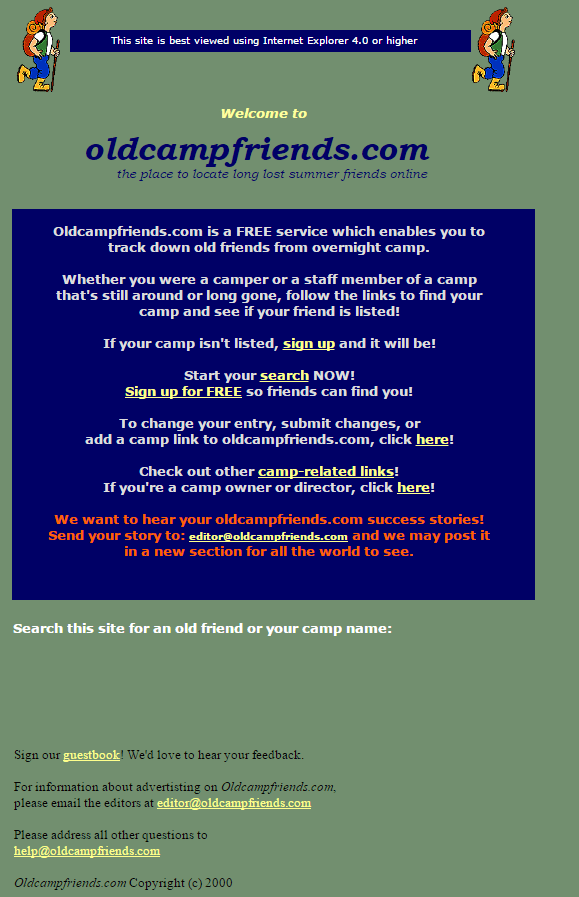
In 1999, a half a year or so before the internet bubble burst, I built on my Dell computer and maintained all on my own from my one bedroom apartment on Prince Street a web site called oldcampfriends.com. I came up with the idea because I was obsessed and preoccupied with my overnight camp experience and friends and figured other people were, too. This was before you could Google stalk anyone or pay $9.99 for a dossier on them. It was difficult, still, to track down old friends.

I built it on the old Homestead site builder online software. I created a form that people filled in and submitted. I HAND-FILLED in the information (their names and email addresses) on the profile pages I created for each camp: Camp Wekeela, Camp Wohelo, Pine Forest, Camp Anawana, Camp Ramah New England, Camp Nah-Jee-Way, Che-Na-Wah, Moshava, you name it. Your camp was there. Via oldcampfriends.com you were able to reconnect with your bunkmate, your first kiss, the counselor you always wanted to hook up with but who was too fearful of arrest … Oldcampfriends.com? It took you there.

Coulda been Facebook. Coulda been Facebook.

oldcampfriends screen shot 3

(Those hikers at the top were animated GIFs.)

If oldcampfriends.com leaves any legacy it is to illustrate how impactful the people who have passed through my life have been and continue to be even after they’re gone. It is to show that when you leave me — because leave me you must — you don’t ever really leave.

Random Fact #5

You remain inside me — sometimes as acid reflux, sometimes as tingles that recur when I look at your picture or handle between my thumbs the friendship bracelet you once wove for me in the arts and crafts cabin, or the mixed tape you made me that summer. You remain inside me, as a song or a slow dance or as a scene from a movie we watched together on Betamax in your basement. You remain inside me; sometimes as an eternal punishment, sometimes as an occasional pleasure. You remain.

Random fact: I am forever tagged by you.

You, the people.

==

I tag Sarah, Nina, Judy, Tienne, and Jason.

Love, Memory, Music, Writing

We remember so little even as we remember it all

I am minorly obsessed with memory. Why we remember. What we remember. How we go about retaining and recalling memories. Which of our senses most trigger memory — is it smell? Is it sound?

I am not as obsessed as I could be. Most of the books I want to read about memory are still holding their place on my “want-to-read” shelf on GoodReads. The closest I do get to studying the topic is scanning every single article Maria Popova posts on the subject on BrainPickings and examining — both critically and creatively — my own memory and others’.

Generally, when I am not worrying about the future, I’m thinking about the past.

Based on conversations with friends, I get the sense that my memory is comparatively vivid and richly detailed. I can remember incidents as far back as age four; I remember the song I slow-danced to with my first camp boyfriend. I remember when I saw Jurassic Park, with whom, and at which theater.

But while I’ve forever prided myself on possessing accurate knowledge of when I did things and how and with whom and in what season and to what soundtrack … I’m beginning to understand just how inaccurate and filled with holes my memory is even in its breadth of knowledge. Moreso, I’ve started to recognize a pattern about what I can remember and what I can’t.

For instance, I remember scene well. My visual memory is stunning. But I get lost trying to conjure up anything physical — pain or pleasure. I remember sound more than smell. I remember color more than texture.

I remember sitting in the backseat of my dad’s green fiat convertible, the top down, the interior beige, my hair blowing back as we all sang — me, my dad, and my brother — at the top of our lungs Little Honda .

First gear, it’s all right (Honda, Honda, go faster, faster)
Second gear, I’ll lean right (Honda, Honda, go faster, faster)
Third gear, hang on tight (Honda, Honda, go faster, faster)

But I can’t remember if it was cold back there or comfortably breezy. What season was it? Early summer? I can’t remember if it was when my dad had a mustache or not. I can’t remember where we were going or what I was wearing.

Likewise, I can recall many a ride shotgun in my high school boyfriend’s used light blue BMW, a hand-me-down from his uncle. I remember the dashboard and pulling a Van Morrison compilation out of a gray canvas cassette holder and pushing it into the tape deck. But I can’t recall more than a handful of kisses — even though I must have kissed him thousands of times during our 10 year on-again off-again relationship.

The list goes on. I remember an Elvis Costello concert in Maryland the summer of 1994 (Crash Test Dummies opened). I remember it because said high school boyfriend had returned from a semester abroad in Israel and this concert was our first attempt at being “just friends.” But until I Googled Elvis Costello Concert Tour 1994, I couldn’t remember a single song on the playlist that night. And when I read the playlist, I still couldn’t recall hearing any of them or cheering for them or singing along.

I remember a fight with my brother in an airport in Denver. I remember he threw a glass rootbeer bottle at me, but I can’t remember over what we disagreed.

Then there was the time I first saw my now-husband. I can picture him sitting in a conference room in the JCC in Cherry Hill, NJ. I was there with a group of 8 or 9 20-somethings to be interviewed for a position to lead a teen tour to Israel. Get this: I remember the lighting in the room. I remember where I sat at the table in comparison to my future-husband. But I don’t remember his voice that day, what he wore, or any interaction we had.

All this matters because as I track down my memories in an attempt to write memoir — really, in an attempt to understand myself and my life — I find my memories with their limited and unreliable perspective are indeed not memories at all.  I find I understand what Oliver Sacks means when he says, our memories are “not fixed or frozen … but transformed, disassembled, reassembled, and recategorized with every act of recollection.”

All this matters because it is via this patched together quiltwork of recall that we assess and reassess the fabric of our lives. Whether or not we are writing memoir.

As I continue to examine my memory and put it through the hard test of being fact-checked, I find myself re-evaluating who I am and how I got this way.

And I remember it all with a grain of salt.

Philosophy, Poetry, Writing

What appeals to me about found poetry

One of the reasons why I love to experiment with “found poetry” is that it allows me to make an artful experience last longer.

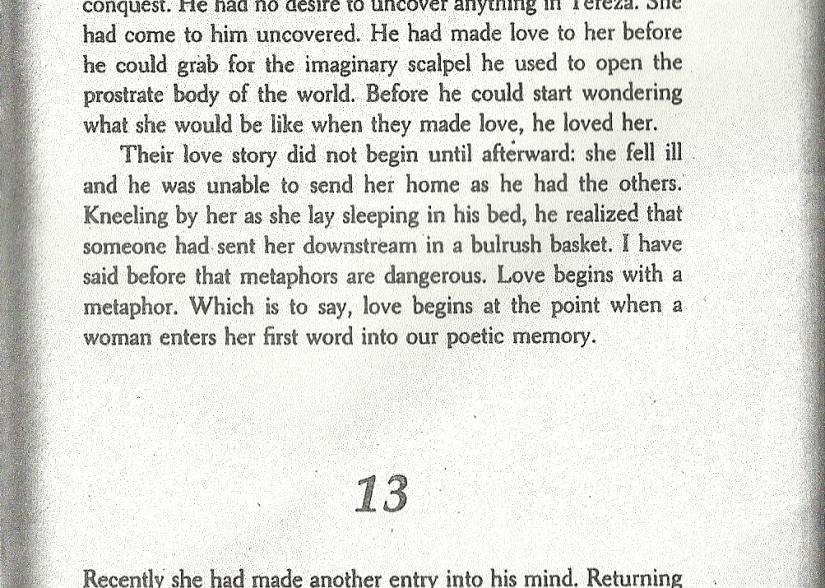
I just finished reading Milan Kundera’s “The Unbearable Lightness of Being,” for instance, and was struck often throughout by meaningful gems I wish I could spend more time contemplating.

In the absence of a classroom full of fellow philosophers or a literature professor, I turn to found poetry, otherwise known as “erasure poetry” or “blackout poetry.”

There is no correct way of digging in, but this is how I’ve been doing it with books. (You can also find poetry in songs or in newspaper articles. Why not?)

Instructions for finding poetry:

1. Xerox copy the page of the book or the document that stopped you in your tracks.

kundera metaphors are dangerous

2. Read it over a few times. Perhaps, out loud.

3. Listen.

4. Circle with pencil the words calling out to you.

When you’re certain (or certain enough) you’ve dug out something new or relevant or useful from the beauty or wisdom already expressed by the author, smudge out the words around those in paint or black ink or, like Mary Ruefle, with white out.

5. There. You’ve found something. A poem, perhaps, or an idea or a pathway.

Something.

Like most creative writing, a first draft of a found poem might only be a writing prompt for something more significant.

At the very least, you got to spend more time with beauty or wisdom … and upcycled it into your own life.


Poetry, Politics, War, Writing

Sexy Quiet

What if I made the choice
and the choice was
Quiet?

It’s true
sometimes Noise
tricks me
into believing
he is life.

What with all the
heart racing
and the jumping out of bed.
Gentle she,
Quiet,
though sometimes
tiresome
allows me the freedom
to kiss my children goodbye
and think like that again
only
when the front door crashes
open.
Unassuming Quiet
permits me to write
and eat ice cream.

I desire Quiet.

Noise, though sexy,
appetizing in an indulgent way
moves me in the way
ice cream does,
when I eat it from
a cone. One scoop
more than I needed.

Letting Go, Love, Poetry, Writing

Putting out fires at almost 40

Honesty bursts forth from me in fits, in starts.

This is 40.

This may not be 40 for you.

I realize, for you, this may be 43. Or 38. or 67.

I don’t know if it’s temporal, situational, or hormonal, this shift.

It certainly resembles the week leading up to my period with its moodiness, its gentle swaying between certainty and confusion.

There are moments, for instance, when I can’t speak anything but the absolute truth; even when I know it will hurt, even if I know I will pay.

There are moments, too, when I slip into a dark tunnel, the Hadron collider of womanhood: understanding that I can’t have both what I want and what I imagined I wanted years ago. They can’t live together in my world of almost 40. They will combust there together and set me on fire.

The kind of fire that burns people.

I can’t stretch my arm far enough down to reach the me who slipped behind the back of the sofa. She’s choking on dust bunnies down there, but I can’t reach her.

I almost don’t even want to.

“Sorry!” I yell to her; the one who dreamed of lots of babies. I leave her with the dust bunnies, and run off instead to play Hickory Dickory Dock.


Books, Climate Changes, Community, Environment, Food, Health, Modern Life, Relationships, Religion, Survivalism, War, Writing

What I imagine when I imagine the end of the world

Short Fiction

When I imagine the end of the world, I am alone at the edge of a cliff. It’s evening and God Only Knows by the Beach Boys is playing on a box radio I looted from my neighbor’s basement.

If it were a movie, I’d be gazing out over the city lights of Los Angeles just as the electricity went out, as one by one the skyscrapers lost power, and the city fell dark.

A blazing comet approaches.

Or a neon green burst of light from beyond the reaches of time.

Or a giant tidal wave shimmies up the coast.

If it were a movie, my heart would swell as I accepted my fate. I would open my arms and embrace humanity’s extinction for I knew I had lived life to its fullest.

But it’s not a movie.

It’s my real life.

In which almost every day is the end of the world.

* * *


I have a disease without a name.

If it had a name, it would be called something like redemptionitis or zombisteria or hypotrychtapocalypse.

The closest anyone has ever come to labelling my disease was in the years leading up to the much-publicized end of the Mayan Calendar in December 2012.

Doomsday Phobia, they called it.

Anyone who stocked their basements with toilet paper and canned sardines in preparation for Armageddon; anyone who hoarded books of medicinal herbs or learned how to forage for mushrooms in a weekend workshop held in the back woods of Westchester County, NY; anyone who stocked in the back of the medicine cabinet antibiotics from their child’s most recent prescription for strep throat: We were all quietly laughed at and labeled “preppers.”

Back when it was cute, the way a touch of crazy is cute, as long as it doesn’t lead to a shootout in a movie theater.

Back then, I wondered to myself if I was on a CIA watch list. Did they suspect me? A suburban New Jersey mom of two? A college educated professional with a real job and a real paycheck?

I certainly didn’t fit the profile.

I wore Ann Taylor suits and took the NJ Transit train every day from the suburbs into the city where I walked six blocks to my midtown workplace. In our open floor plan, I had the closest thing to an office – a transparent cube looking out over the East River, made from glass walls so others could look in. It was called the Rainbow Fish Bowl because of the stickers my daughter once placed on the sliding glass door. Every other Friday, I got a pedicure at Trudy’s Green Nails on Lexington Avenue. I was in a book club. I volunteered at the preschool. People liked me.

Each day, I put effort into smiling at my coworkers as if life wasn’t about to abruptly end by Avian Bird Flu.  I’d make jokes over the phone with the sales consultants who’d ask me if I thought wheatgrass was gluten free. I played along. Drank Nespresso in the coffee room with the writers; made snide remarks with the editors about our wacky advertisers; especially the ones who placed ads offering organic MREs (meals-ready-to-eat) purported to last 15 years. Secretly, I wondered if it made sense to pay for organic canned food when the cans were probably lined with BPA.

Could my coworkers view my computer monitor, however, they would have noticed I spent half the day reading headlines on alternative news web sites, corresponding in code with people named “Zen Grower” about the latest UFO sighting over New Mexico or the best price on bulk dehydrated food. I read blogs from people living in half-completed bunkers in the mountains of West Virginia; with strangers supposedly privy to knowledge that was never reported on CNN.  “The ‘Illuminati’ kills scientists, you know,” wrote Jade, my telepathic friend. She communicates with an alien race who is trying to save us from another alien race who’s been trying to destroy us since the Revolutionary War. “All war,” says Jade, “is the fault of the Reptilians.”

I would search “new world order Russian scientists reveal underwater pyramid” and “fourth dimensional beings plot to reprogram our brains” because I knew the search results would give me the intel I required to plan. And I planned. I had one to-do list that included vaccinations, playdates, and dentist appointments. Another to-do list for the end of the world.

My day job, I guess, was a ruse.

It was a way to satisfy my compulsion and still remain a member of society. Or so says Dr. Solomon. I saw it as a healthy way to educate myself on tactics I would surely need for the post-apocalyptic world I was certain was looming. Easily-learned skills like:

  • Reiki for when we no longer had the option to see surgeons for bone breaks or muscle sprains;
  • Acupressure, which I would use in the place of the anti-inflammatories we so depended on in the Before Times for headaches and menstrual cramps;
  • Nutritional supplements and herbal teas — like Chia and Flax seeds; dandelion and feverfew — I’d grow in a rooftop urban garden, where I’d herd my children before the Flood.

Back then, I was Advertising Director of a major national healthy living magazine. I courted and secured advertisers from multiple sectors: home and garden, health and wellness, exercise and fitness, diet and nutrition. And, of course, our bestsellers: classifieds from personal vegan chefs, Hindu tantric sex practitioners and Henna artists.

I was really good at my job. I was good at selling ads because I really believed all of the service providers and multi-level marketing professionals.  When they heard acknowledgment and acceptance in my voice over the phone, they eagerly placed half or more of their advertising budget in my hands.

I understood them, after all. Their fears. Their hopes. I knew intimately what it felt like to want to survive, but more so to want to be listened to and believed.

In my own experience, though, there were therapies and products that worked, and those that didn’t. Quackery, some might say. Except in my business, we never use the word quackery. This would alienate the chiropractors and homeopaths who placed half-page color ads for their self-published e-books.

Reiki, for instance, didn’t cure me of recurring yeast infections, as promised. But my Thursday afternoon sessions with Liane, the psychic massage therapist did help identify a sugar addiction. She also told me I had powers like hers; that I could, if I wanted to, study to be a healer.

She was right. I am a sugar addict. But she was also wrong. I can’t seem to heal anyone.

I kept seeing Liane on a regular basis and even believed most of the stories she would tell me: How her client was miraculously cured from testicular cancer by shiatsu and a six-week juice fast. How her deep tissue hot stone massage helped a couple overcome infertility. How the couple now had triplets – all girls.

I believed Liane. Except for that one time she told me that my migraines were the key to time travel, and that I should stop taking the Relert when the auras came on. I also believed the magazine readers who emailed testimony after testimony to our editorial staff profusely thanking us for publishing stories that changed their lives.  I believed the clippable lists we elegantly designed for ease-of-use, like “Pema Chodron’s Top 5 Mantras for Mindful Sex.”

I believed we were helping people.

I believed the jacket copy on the bestseller of contributing editor, celebrity physician Dr. Joel Willey– a book I personally reviewed for the magazine last December — promising increased sexual desire and stamina for peri-menopausal women by switching to a vegan, carbohydrate-free, anti-inflammatory diet.

I believed it all.

Which, apparently, is a symptom of my disease.

I have a disease without a name; without a designation, but with a host of exhibiting symptoms that collectively, for the past fifteen years, I called “conscious living,” but collectively make up a manilla folder of evidence against me, sitting on an antique desk in Dr. Solomon’s office.

All these “symptoms,” which were formerly advantageous qualities on a resume when applying for a job at a natural healthy living magazine, are now being offered up as evidence of my insanity. My inability to continue as a functioning member of society.

My disease is without a name. It’s as lonely as a woman standing on the edge of a cliff waiting for the world to end.

But, as it turns out, no name is necessary.

* * *


This work of fiction is an excerpt from an original short story by Jen Maidenberg, “What I imagine when I imagine the end of the world.”

Kibbutz, Writing

The obligatory notice

Almost as often as I change the furniture around in my house, I like to play with the look and feel of the blog.

Please note the new design only enough to be aware that it’s still me.

photo passover 2014

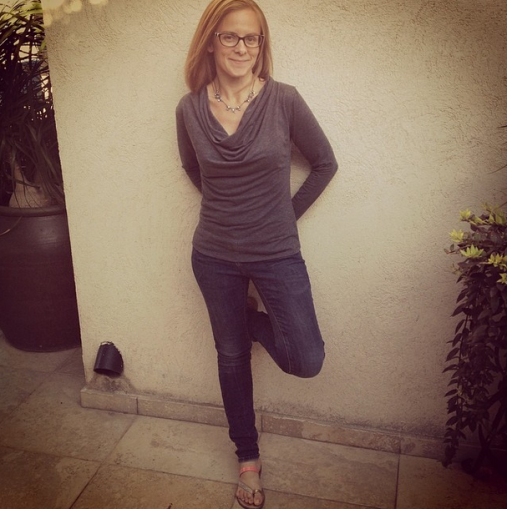
Fine. I admit it. I was really looking for an excuse to post this not-half-bad picture of almost-40-year-old-me. The redesign is just a ruse.

Not half bad, right?

But DO note the new MENU in the sidebar of the new blog design. (On mobile devices this menu should appear at the top, on the left hand side.)

Soon more menu selections will appear offering easy access to the types of posts you like most. (In other words, if you don’t love poetry, you can skip quickly to travel, wellness, essay, kibbutz life or photography.)

Thanks for hanging around.

Love, Memory, Music, Poetry, Relationships, Writing

Take heed

What if the woman who’s leaving Bob Dylan in Boots of Spanish Leather returns one day?

Maybe instead of boots she just brings her older, softer, leathery self to a cafe where it’s said Dylan sometimes drinks black coffee.

I imagined that woman

and with her in mind, played a little with blackout poetry.

It’s the first time I almost like the result.

spanish letter blackout2

 Take Heed

I just thought you might want
a long ol’ time alone.
From the storm
From the Mountains of Mad.

I remember saying
I don’t know when I’ll be back
back to where time
depends on true love.

Can you ask me again?

Just carry yourself back to me spoiled.
That’s all.

= = =

(You can listen to 50 different covers of Boots of Spanish Leather on YouTube or this sweet Lumineers version.)