Writing

Lay flat to dry

I’ve started to play with my label.

It’s itching me a little.

I tried

moving my neck side to side to see

if it would readjust comfortably

on its own.

Didn’t work.

So I reached my right hand back over my shoulder.

Stretched my collar

all the way ’round front to see

Mother.

Wife.

39.

Chief Marketing Officer.

Size small.

Made in America.

35 % Israeli. 100 % Woman. 21 % Buddhist-to-be.

Hand wash warm.

Prone to startling. Handle with care. Do not bleach … yet.

<NEW LOGO HERE>


Dreams, Letting Go, Mindfulness, Writing

Art of attraction

Art begets art, don’t you think?

Of course, we may disagree on the definition of art. But I find the more I notice, the more I notice.

The more I write, the more I photograph, the more I dream.

The more I read, the more I feel, the more I write.

When you open up — even just a little — to noticing and noting, you are actually working your art muscle.

What I say is not new. It’s not an original thought. Many more experienced at attracting art have said it before I just did.

But I notice it happening to me.

I see poetry in my photographs, and color in my poems. The art of one lends itself to the other, and suddenly I feel as if I am getting somewhere.

swoosh

It’s not that I am a constant rushing stream of good art. Some of it is just purge.

Pages filled with strike outs.

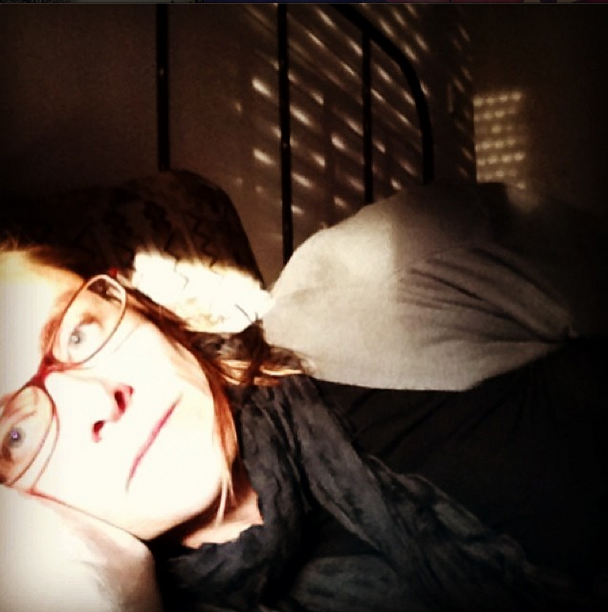
I look like this sometimes.

selfie beat poet

But then I laugh at myself. At my #selfie.

And I share it with you.

And my nervous heart strengthens a bit when you laugh along with me… in the knowing fully that you understand I’m half joking.

* * *

There’s something that gets in my way, though.

Thinking. Too much thinking. About getting somewhere with my art.

This, too, I notice.

It’s like that moment when I realize I am lucid dreaming and I know if I think too hard about it, I will wake up. So I try not to think — just breathe, I say — but this in itself is thinking.

POP!

Out of the dream.

Or, more simply, it’s like losing your cross-eyed stare once you finally become aware of the 3D image in a Magic Eye design. I see it! You cry. Then,

POP!

Back to staring at blurry peacock feathers.

What’s the real magic trick?

Minding your thinking, I suppose.

Noticing it, yes, but allowing thoughts to float away as easily as the 3D Magic Eye design.

Blur it away on purpose.

Master this, and become a Master.

Writing

This poem comes in pencil only

This guy popped out of nowhere after 30 or so years just when I needed him most.

pencial sharpener antique 1980s

He looks like a dapper old cat, but what you can’t see … what he’s hiding behind his back … is his secret weapon.

And exactly what I need right now.

A pencil sharpener.

It’s hard to explain exactly why I found him where I did (inside a personalized pink plastic container holding personalized pink hair ribbons), but I’m not one to question serendipity (okay, I am.)

It just so happens that I’ve been desperate for a good pencil sharpener lately.

If I had my choice, I’d get a vintage one from a 1950s midwestern schoolhouse and hammer it into my kitchen wall — BANG BANG BANG — but those guys seem to be going for big bucks on ebay and anyway I need mine to be the travelin’ type.

And this dandy cat looks ripe for travelin’, don’t you think?

He needs to fit in my handbag, the one holding a heavy spiral bound notebook with a hard cover decorated in mandalas.

I’m writing more by hand these days, you see.  Not because I want to. (Frankly, I prefer the feel of a circa 2005 keyboard against my rapidly tap tap tapping fingers. I also covet the ability to quickly delete the last thought I just had. See? I just deleted a thought you will never know.)

But because  I’ve accidentally become a poet: a compulsive stringer together of words. And poets (potentially the most compulsive artists of all) need at their side a means to satisfy their urges.

A computer won’t do. One needs to get down words with haste.

A smartphone won’t either. My thumbs are too thick, too clumsy. “Bogus” accidentally becomes “booger.”

If only I had a secretary by my side. … the cat would surely do if only he was alive.

“Please, kind sir, take down this line,” I might say to the cat if only he could lift his  hand away from his orange man purse and take dictation. “No, strike that! Change compulsive to inveterate.”

Community, Letting Go, Love, Memory, Writing

Tell me a secret I don’t already know

Almost as much as I am fascinated by memory and by man’s search for meaning, I am insanely curious about secrets. I’m fascinated by why we keep secrets, and what happens when they’re exposed.

But I am also very, very afraid of them.

Not just mine. And what may happen if and when they are revealed.

But yours.

Your secrets scare me, too.

I’m deathly afraid of the unknown.

Of the uncertainty of what you might someday show or tell me.

Will it hurt me? Change my beliefs about you? About people? Will your secrets make me sick to my stomach?

Knowing how scared I am of your secrets makes me desperately want to keep mine safe from view.

* * *

What I mean by secrets:

The things we think at 3 am

The feelings we feel, but hardly ever show or share

The desires we have that we’re certain we’d be tarred and feathered for if we were found out.

All the thoughts we’re certain will cause people to stop loving us (or never love us at all). Never hire us. Immediately fire us. Look down upon us with condemnation, ridicule. Worse, stop looking at us at all.

This is what I think will happen when I think about sharing my own secrets. And maybe I’m right. Certainly some of them, if shared, would bring about moderate to severe consequences.

But not all of them. Some would liberate me. I just know it.

And yet, I keep silent.

* * *

I’ve had conversations with friends, acquaintances who insist they have no secrets. As if the keeping of secrets is scandalous in and of itself.

They insist even harder when I push them that their boyfriend/spouse/partner certainly keeps secrets. No way, many of my friends have said to me.

“He’s a regular guy. What secrets could he possibly have?”

I try not to smile an arrogant smile. Though sometimes, depending on my mood, I’ll argue the point.

We all have secrets. 

Especially the regular guys.

Not all our secrets are Melrose Place-worthy; not all of them would necessarily damage our reputation; or disrupt our lives if revealed. But they are secrets nonetheless, and they weigh on us.

Some are low-spoken whispers in the inner ear:

“You’re stupid.”

“This will never work.”

“You’re doomed.”

“He doesn’t really love you. He never did.”

“If she really knew, she’d never speak to me again.”

Some secrets are roadblocks. Others are dams holding back figurative flood waters.

Some secrets are background noise. Garbled truths we never quite admit to, but haunt us.

Some are stories we’ve told ourselves so long we no longer recognize them as secrets. We believe they are real.

Everyone knows already, we think to ourselves. Why bother sharing them?

But they don’t know.

Or they do, but they need you to say it out loud.

“Nothing,” writes Paul Tournier, “makes us so lonely as our secrets.”

* * *

The best of what’s been written on Philip Seymour Hoffman’s death by drug overdose was Tom Junod’s op-ed in Esquire magazine. In trying to capture what drew us all into Hoffman’s character roles, Junod writes:

He held up a mirror to those who could barely stand to look at themselves and invited us not only to take a peek but to see someone we recognized.

When Hoffman died of a drug overdose, I was sick to my stomach. His secret made me sick. I won’t deny it.

The thought of him there in the bathroom. The thought of his wife; his children left behind. The shame. All the shame.

But within hours, my sick turned to compassion. To understanding. To love for someone I never knew.

Secrets are funny creatures. They soften and sweeten us in a way.

Not all of them, but maybe most of them.

Allowed into the light, liberated secrets prove not to be little monsters. But offspring of the human condition.

More commonplace than we realize.

In fact, there is a gift in the reveal of secrets. For sharing them shows others they’re not alone in their suffering.

* * *

This is what I do here, with you.

I liberate my secrets … a little.

I do it under my own name — on purpose.

I dare myself.

I work my “brave muscle.”

And most days, you are kind in return.

Proving my hypothesis. Allowing me to creep closer to freedom.

I hope I offer you some relief in return.

I hope you feel a little less alone.

Kibbutz, Making Friends, Memory, Mindfulness, Relationships, Writing

Return to sender

I let go of Shira yesterday.

I called her up on the phone, walked over to her house, met her on the path there, and let her go.

She laughed.

So did I.

It was swell.

I had in my hand 18 year old Shira.

With love, I gave her back. To 40 year old Shira.

Some would call this surreal. Others would call it silly. I call it an extraordinary gift.

How did it happen?

In my cardboard boxes, I found letters. Shoeboxes filled with letters. Composition notebooks bookmarked for years with unsealed envelopes torn open by younger hands. Manilla folders stuffed with old exams, but peppered here and there by notes unsigned; the author’s identity only revealed by her handwriting.

I found a few from Shira. (Even if she didn’t live across the street from me here on this kibbutz in Israel, I would have recognized her 18 year old handwriting. It’s distinct. And handwriting, like phone numbers from childhood, is something I tend to hold on to strongly in my memory.)

The letters were from 1991 and 1992. The summers she and I respectively traveled to Israel for the first time.  In 1993, we’d arrive here together one winter break during college as participants on a 2-week volunteer program. We’d be stationed on an army base that’s now less than an hour drive away from where we live.

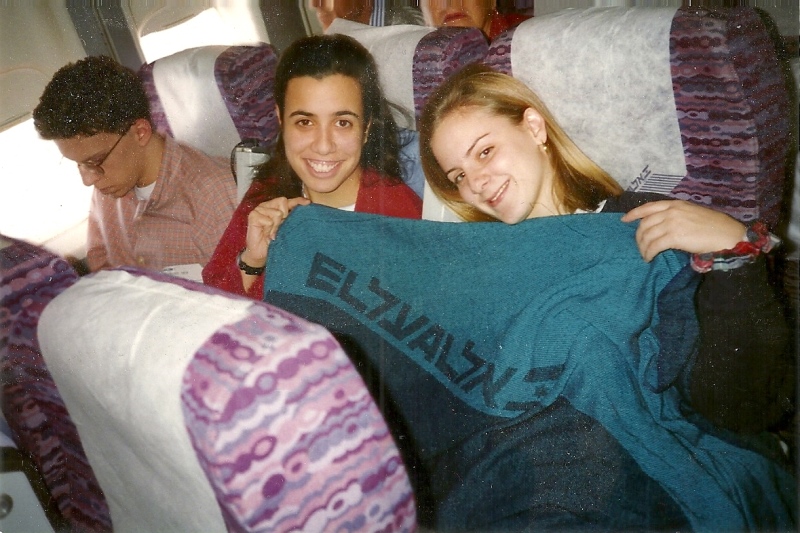
shira and jen 1993

The letters, when I read them yesterday for the first time in more than 20 years, emphasized a certain awareness I’ve already arrived at on my own.

Shira, I’m so grateful to say, has known two different Jens, maybe three, maybe even four or five, depending on where you slice me.

It’s a gift, indeed. A friend who knew you as a girl. Who knew you when you were thinner, blonder, filled with greater energy than you are now.

But an even greater gift is a friend who notices how much you’ve grown since then. Who knew you when you were less worldly, to say the least, less clever, less kind …and has forgiven you your youth.

In reading the letters, I remembered a younger Jen and a younger Shira, and a much younger friendship. I remembered the moments that punctuated that time. In her short letters — one scribbled in cursive on airmail stationery, another stuffed inside letterhead from her father’s business — our world in ’91 and ’92 came  alive for a moment and made me smile. In a different voice than the one I know today, 18 year old Shira reminded me of who we were then.  I was touched by the Shira I had forgotten; touched by the Shira I had never known then. I also fell in love for a moment with the Jen I must have been then. A Jen I never knew I was; not at the time.

It’s complicated — the gift of old letters, of old friends — but it’s also so very simple.

I could have thrown them away, the letters. Like I’ve tossed other papers found inside the cardboard boxes.

Instead, I decided to return them to sender.

It seemed symbolically appropriate. I can’t explain it, though I’ll try.

I returned them not because I was certain Shira would want them or need them (though it was a kick to laugh over them for a minute or two), but because handing over Shira to Shira seemed like the right thing to do.

Giving Shira’s letters back to her — instead of holding on to them — allows Shira to be whoever she wants to be in the world. Now.

And forces me, in a way, to accept her as such.

Not the Shira I used to know. Not the Shira who was what she was then. Not the Shira I thought she was yesterday.

Just Shira. Now.

Giving Shira back her letters gave me the opportunity to explore a concept I have great difficulty with (and the chance to practice on someone I knew would make it easy on me!)

The concept? Giving up my past so I can be present.

I can’t say I know what the outcome of this experiment will be. But something about it just seemed right.

Just like, I suppose, something felt right about saving letters in a shoebox.

* * *

This is one in a series of essays inspired by my cardboard boxes. If you like this post, and want to know how it began, read A Case for Hoarding. One post in the series, Note to Self,” was recently featured on Freshly PressedAdditional posts are tagged “the boxed set series“.


Letting Go, Love, Writing

Pretty lies

If I could play piano as deftly as I do in my dreams

If I could sing and you could hear the rich tones I do when my voice echoes in my ear

If I could put down words, the true ones that bubble up and swell in my heart

This is what I would bring forth into the world.

Something like this:

But I only tap, tap, tap a little Heart & Soul

I only whisper my skirmish with harmony

I reveal the yellows, the pinks, the browns of my soul only.

Not so much of the blues.

Or the blacks.

Pretty lies. Only pretty lies.

Writing

What’s Off-Limits When I Die

Who gets to decide what of yours gets published after you’re gone?

Who says that your journals, your letters, your doodles in the margins get to be publicly shared posthumously?

I assume the obvious: Your next of kin. Your estate’s executor.

But I wonder — those of us who read the words of the dead without their explicit permission (The Unabridged Journals of Sylvia Plath, The Diary of Anne Frank, Kafka’s The Trial) — do we care whether or not the author wanted the materials published and read? (Kafka apparently vehemently did not. Tough noogies for him.)

Sure, it’s fun to discover that Tolkien had a “semi-secret” talent for sketching. And Jim Morrison wrote psychadelic poetry.

Fun for us.

But for them?

I’m not so sure.

Of course, one could argue that they’re … um… dead. That would be a pretty good argument for why it doesn’t really, truly matter.

But why, then, do we respect the dead in other, superstitious ways? We wear black, hold our breath, cover our mirrors. Shouldn’t we think twice before reading their private journals?

Presumably their material was published in the name of art by someone who had something to gain from the publication: money, fame.

But does this mean we have to read it?

I think about this a lot as I go through my cardboard boxes.

At the end of the day, I save stuff for me. I might think I am saving it for my kids, but I’m really saving it for me to share with my kids. Not for them to discover on their own with no historical reference. No filter. No explanation.

And I wonder, what would I be okay with them sharing after I’m gone?

Anything marked “FINAL DRAFT,” I’d be good with, I guess. All files tagged “SUBMITTED_2_2013” or any such combination of publication name + date, I’d be good with.

But the other stuff? My journals? My notes to self? My letters? My teenage angst poser poetry?

I don’t know if I want those aired out in public by anyone else but me.

I might change my mind when I’m famous. (I’ll let you know.) But I doubt it.

What about you? What are your thoughts about publishing rough work or private writings posthumously?

Writing

The poetry inside other people’s cardboard boxes

A new hobby is birthing itself, pushing its way out. 

Like when I took to exploring New York with my neck cranked back

gazing up at building sides looking for signs of  shoe polish advertised 100 years ago.

A new research topic. A new obsession.

The confessional.

Sylvia Plath. Anne Sexton. These are writers I never read.

Can you believe it? I’m embarrassed to even admit to it. (Though I already did.)

I never read those ladies on purpose. Their tragic endings were enough to put me on alert.

Enough to scare me into avoidance.

I was terrified of discovery. Worried that by exploring their darknesses, mine would be triggered. I didn’t need any more triggers — my mind’s been busy enough for decades.

However, slowly, slowly — as I’ve begun to creatively confess here on the blog and privately in long-form and poetry — I’m dipping my toes into their confessions. Learning from them. Growing. Chuckling. Feeling relief that I am not the only one pained by the beauty of tulips.

Today, I discovered “All My Pretty Ones” by Sexton, and smiled as I realized her poem is a consequence of rooting through cardboard boxes, both literally, i imagine, and figuratively. 

“a gold key, your half of a woolen mill,

twenty suits from Dunne’s, an English Ford,

the love and legal verbiage of another will,

boxes of pictures of people I do not know.

I touch their cardboard faces. They must go.”

It’s humbling, knowing that you’re not the first person in this world to suffer. It’s reassuring knowing you’re not the first writer to reach for a thesaurus in search of just the right word because your mind will not allow you to escape from the hunt until you do. It’s a relief, in a sense, as Lena Dunham shared about her experience reading and exploring Plath in college to know that your darkness is a little bit lighter than it could be.

It was good I didn’t read Plath or Sexton until now, I suppose.

In the same way it’s all good.

All of it. The stuff we hide away accidentally or on purpose until it’s ready to be discovered, explored, shared.

Turned into poetry.

Letting Go, Love, Philosophy, Writing

An Open Letter to Time: I Know the Truth About You Babe

Dear Time:

Your linear passage is ruthless.

We notice this early, but don’t grasp it til it’s too late.

Your strict adherence to forward motion is maddening, and yet reliable.

It is a gift, in fact,

For we must flow with you, while

we foolishly ache to change you

(as if we could).

We cling to you, but you move at lightning speed.

We can’t hold on.

We spend you like there is no end

to you.

Waste you.

Take advantage of you … like you’re giving it away for free.

We kill you. And then beg for more.

For mercy.

Our love for you, Time, is a comedy.

Our abuse of you is tragic.

Be stingy with us, Time, as you would an ungrateful child.

But be loving, for we sigh (weep even) when we lose you.

We are just simple travelers, Time.

Greedy, yes,

But hopeful.

Never meant anyone harm.

Least of all you.

Relationships, Religion, Writing

View from above

No matter how blurred or undefined my picture of God is, no matter how my connection to religion swells or retreats; the one God-related belief I hold fairly dear is omniscience. If God were a storyteller, let’s say, he’d be third person with both a bird’s eye and a worm’s eye view of all that ever was and all that ever is and all that ever will be.

Which means, I also believe, that God laughs a lot.

Laughs at our missteps, our confusion, our despair — in a loving, playful way, the way a parent might smile watching her toddler fall hard on his bottom over and over again in his attempts to learn to walk.

Or the way a writer foolishly grins as he shapes his characters because a writer is, in a way, in love with all the characters he creates — no matter how ugly or beautiful, how wise or how foolish.

I don’t necessarily believe that God is omnipotent, however. I don’t believe he interferes in the doings of man, though I do imagine that he might adjust the direction or speed of the wind from time to time so that man might meaningfully turn his head or shift his gaze. I believe that God watches us, and more than anything else concrete, I understand God as a representation of that great unattainable knowledge and understanding I’ll never have, but will never stop seeking.

I imagine, too, from his third person point of view, God watches us with great compassion.

I wish I could borrow some of this compassion from time to time when I tell myself my own story; as I do when I lie in bed at night and review my day; as I do when I tell “truths” about myself or make claims about how other people see me (as if I could really know).

Or when I dig through the first person evidence of my life: When I read my old journals (and cringe at my naive innocence or unabashed immaturity); or remember (out of the blue or obsessively) the things I’ve done I wish I hadn’t or wish I had handled differently.

Did you ever notice how much compassion we can summon up for others? For strangers especially? How our hearts swell when someone else is dwelling on what they once did wrong?

Yet, it’s insanely difficult — if not near impossible — to summon up that same compassion for ourselves. To allow ourselves to view our stories as God might or as the third person omniscient narrator would– minus regret, minus shame, minus fear — simply with close observation, the space for varied interpretations, and occasionally, with a playful compassionate laugh out loud.

Relationships, Writing

Finish this haiku … if you can

I was attempting a haiku this morning when I realized there is no good antonym for alone.

Walking alone is
often the first step towards

These were the first two lines of an idea I was trying to work through by haiku. Except, I couldn’t finish it in a satisfying way.

“Together?” Is together really the only antonym for alone?

I was going for an emotion, a feeling, a deep sense of being close to another person or to humanity. Feeling less afraid. Feeling as if someone else understands you.

And “together” … just doesn’t do it.

Together is so physical. It’s a fixing word. It’s an extrovert’s word. It’s not the word I mean at all.

Want to help me finish the haiku?

Walking alone is
often the first step towards…

I’d love it if you’d give it a shot in the comments below or on your own blog with a pingback here. If your haiku especially speaks to me, I’ll reblog it.

Writing

Spyware (A Telepathic Blogger’s Haiku)

I know you’re reading.

I feel you each time you do.

But more when you don’t.