Most of us spend our entire lives figuring out who we are.
Parallel to this, we also seek the confidence to admit to ourselves who we are and share that self with others.
It can be an entire life’s work.
Imagine, then, being reborn smack dab in the middle of that project.
This is what it has been for me to make Aliyah.
Some will say just the opposite.
That making Aliyah was like “coming home.”
That moving to Israel allowed them to finally “find themselves; ” to finally feel a part of something, rather than apart from.
And there are elements of that sentiment I can relate to, but I wouldn’t say this has been my overarching experience until now.
Moving to Israel was a move away from who I am.
I am a communicator.
This is what I do. It’s what I love to do and it’s what I’m good at.
I’m also a relationship builder and an information gatherer.
And those are probably the three hardest things to do and be when you are a new immigrant, especially one in a country in which the main language is not your native tongue.
But just as we do after many of the big life decisions we make — getting married, having kids, taking a new job — I ask myself now:
Who am I?
Who am I now?
Am I still me?
Some of my family and friends would insist I managed to be “me” even here in Israel. That I found a way to be the communicator, the relationship builder, and the information gatherer despite the challenges of language and culture.
On some days, I’d agree (and pat myself on the back, thank you very much).
But then there are the unforgiving days…
The days when I run into another parent in the parking lot, and I take that breath
You know that breath?
It’s the one you hardly notice but you take it right before you jump into a casual conversation with a casual friend in the parking lot.
Before you just “shoot the shit.”
You take that breath
I take that breath
but then I remember:
Im not me anymore. Not exactly.
This me thinks, “it’s going to be too, too hard for me to figure out which shit is the appropriate shit to shoot.And it’ll be even harder for me to understand the shit she is shooting back to me in Hebrew.”
And then I take another breath. This time, more of a sigh.
And I ask myself, Is it worth the mild humiliation? Discomfort?
I’m not sure.
So I don’t.
This is never a question I asked myself before.
Never.
And, similarly, there are some days…
Days when I know it’s really necessary for me to have a heart-to-heart with the teacher at my kid’s school. And I force myself to have the conversation.
Not because I am “the communicator” or the “information gatherer,” but because it’s what I HAVE to do. It’s on my to-do list. And maybe I have that conversation, but I know it’s the mediocre version of what I could have pulled off in English.
And, oh how I judge myself afterwards.
And question myself.
In a way I never ever did before.
Never.
Because I knew who I was.
At least I thought I did…
Now, I’m not so sure.
Is who we are so fragile that POOF a move to a foreign country can change us?
Or do we just have to dig deeper, try harder to be
I didn’t write this, but oh how I wish I did. Actually, no, I’m grateful for the words. For knowing that someone sees the world this way. Saw the world this way. Grateful to David Foster Wallace for writing it, and speaking the “capital T truth.”
This video is powerful and touching and true.
* * * *
This is Water
By David Foster Wallace
“The only thing that is capital T true is that you get to decide how you’re going to try to see it.”
“Please don’t just dismiss it as one finger-wagging Dr. Laura sermon. None of this stuff is really about morality or religion or dogma or big fancy questions of life after death. The capital T truth is about life before death. It is about the real value of a real education….which has almost nothing to do with knowledge and everything to do with simple awareness.”
In two words, it implies all that I believe about thinking.
That thoughts are ever-changeable.
That we can manipulate our own thoughts or the way others think about us.
That we have power over our thinking.
That we can be playful with our thoughts.
Make fun of them.
Laugh at them.
Shoo them away when they’re getting in the way.
Caress and nurture the ones that stir our hearts and bellies.
Abandon the ones that have stopped serving us.
Experiment with our thinking. Approach our thinking like we would scientific research — as an experience or an equation that is observable, malleable.
I believe in this method, and yet I often have a hard time employing it.
Like many scientists, I am a firm believer in what I know to be true.
In the facts of my life.
“He is …”
“She does…”
“I will always be…”
“It’s like this…”
“He’ll never…”
Those facts serve me. They allow me to be right about the world I live in. They allow me to make difficult decisions based on previously established and agreed upon evidence. They allow me to feel safe and secure in an existence that is often tenuous and unsure.
Therefore, it’s not so easy to approach those facts (my thoughts) as an experiment.
It means I have to give up being right: About the world, about people who’ve hurt me, or about situations I’ve long ago thought I forgot.
Not to mention — thought experiments are rarely controlled experiments. You’re not alone in a cozy lab coat in a quiet room with no other people, no additional stimulation. During your average thought experiment, it’s NOT just you, just your thoughts, just listening carefully and watching and taking notes.
Yup. You are right there in the middle of it. All the time.
Thinking. Thinking. Thinking. Thinking. Thinking.
And there’s noise. And hunger. And resentment. And perceived requests, demands, insults.
All that thinking and feeling leaves little room to experiment.
And, if you’re like me, you’re not just thinking, thinking, thinking. Feeling, feeling, feeling.
You’re thinking about the thinking. And judging the feeling.
Not very playful. Not very fun.
Not very experimental.
This is why — and I’m having a light bulb experience myself RIGHT NOW as I write this — I meditate. And this is why I sing. And why I pray my version of prayer; keep my version of Shabbat. And why, on occasion, I seek 20 minutes alone in the bathroom pretending to poop.
So I can have my very own thought experiment.
So I can allow myself the opportunity to observe, explore, and possibly, change my thinking.
Do you do this too?
Do you give yourself an opportunity to thought experiment?
Who made religion so beautiful and so ugly at the same time?
Who made it so I could find solace and comfort in prayer and community, while at the same time feel so ashamed at the behavior of my community leaders and fellow members?
Who made religion so beautiful and so ugly at the same time?
Who made it so I could be so energized and enlightened by religious texts, and so confused and hurt by their antiquated, yet still upheld laws?
My kids running in the fields behind Kibbutz Hannaton, Lower Galilee, Israel
I have a bad temper. And I hold on to anger.
I don’t know if I was born sullen and stubborn or if I cultivated these attractive personality traits over time.
Regardless, what I’ve fortunately learned in recent years is that “letting go” is the gateway to peace and ease — the path away from sullen and stubborn.
In the few years before I moved to Israel, I studied with teachers experienced in the mind/body connection, many of whom introduced me to the concepts of mindfulness I often write about. Through their teaching, I understood this practice could alleviate everything from aggravation to anxiety to physical pain.
As a writer, I’m really good at listening to other people’s stories and sharing them with others. Which I did a lot with mindfulness, but looking back, I was not so good at practicing it in real life.
Living in Israel, though — mostly because of the language and cultural differences — has been a daily practice in the art of letting go.
Letting go of my ego.
Letting go of my sense of control.
Letting go of my assumptions .. .about myself, my neighbors, the region, the world.
Letting go of stereotypes.
Letting go of the tight hold over my children.
Letting go of certain dreams and expectations.
I’m nowhere near a master of the art of letting go.
Maybe an experienced student. Possibly, good enough to be a T.A.
Still a long way from Zen bliss.
But with this particular type of study, thankfully, the culmination of my efforts is not in a certificate or a degree, right?
The win is in the practice itself.
I win every single time I let go.
Again and again and again.
Which means I also have the space in which to mess up, without worrying about failure. Because, think about it, failure (hanging on to something ugly like jealousy, resentment, or righteous indignation — all favorites of the stubborn and sullen) just sets me up for an immediate opportunity to win once again.
Bragging moment: I was accepted into the University Honors Program in college. I even got a scholarship.
That letter in the mail was likely the pinnacle of my academic career. That, or the poetry award I won from Mr. Schaeffer at the end of 9th Grade.
I was your classic underachiever in school. And in retrospect, I completely wasted the distinction The George Washington University placed on me.
In order to maintain the scholarship and my place in the program, I was required to take at least one class each semester offered by the honors track. As always, I did the bare minimum. I followed the rules and aimed for a grade acceptable to me and my parents. (A “B” or above.)
The only classes I remember are two semesters of “An Introduction to Soviet Cinema”– from which I walked away better educated about cinematographic license and with the easiest “A” I ever earned — and my senior seminar with Professor Harry Harding, an expert on Asian-American relations.
I don’t remember why I took this class with Harding, since my interest area was the Middle East. I probably heard from someone that he was kind or didn’t give a lot of homework. I do remember, however, the brilliant research thesis topic I dreamed up for the paper I had to write at the end of the year:
“The Influence of Zen Buddhism on American Pop Culture”
I wish I could get my hands on that paper. And, then completely rewrite it. Because whatever I wrote was complete crap and/or borderline plagiarism, I’m sure.
This time, if given the opportunity, I’d actually do the research. I’d read more than the three required books. I’d actually do primary research. Find people to interview. Listen to their stories. Imagine what their lives were like. Swim in their memories. Meditate on them. And then produce a paper that truly encapsulated my brilliant findings and analysis.
But, like most 20-year-olds, I hated writing research papers. And this was a 25 page research paper, which was the longest by far I was ever required to write before or since.
I loved learning, but I was too bound by the rules and the concern for a good grade and the concern for a good job and a good career and a good paycheck and a good pitcher of beer to actually do what I imagine most teachers want you to do — learn about something and carry that education forward into your life.
I remembered this research paper yesterday when I watched a video a friend shared on Facebook.
It’s a series of images that illustrate a lecture given once by Alan Watts entitled “What If Money Were No Object?”
The name sounded familiar. I Googled him. Oh, yeah. He was the guy in my research paper from senior seminar; recognized as one of the key individuals responsible for bringing Zen Buddhism to the West.
I chuckled. Here was the voice of Alan Watts speaking to me — primary research, 20 years too late.
If only the internet had been more than a chat room on AOL when I was in college.
If only I had heard Watts say:
“What do you desire?
What makes you itch?
What would you like to do if money were no object?
How would you really enjoy spending your life?”
I might have spent more time on my research paper. I might have spent more time wondering if this Alan Watts guy was more than just page filler.
What would I have thought if I had been in that crowd? Would Watts have inspired me?
What message would I have taken away from that lecture?
Would I be the philosopher, the novelist, the soap opera star I sometimes wish I was?
“Crowds of students say, ‘We’d like to be painters. We’d like to be poets. We’d like to be writers.’
But as everybody knows you can’t earn any money that way…
When we finally get down to something which the individual says they really want to do, I will say to them, “You do that. And forget the money.”
Amen, I thought to myself, when I heard Watts challenge the audience to “forget the money.”
And then, “I wish someone had said that to me when I was 20.”
Easy for me to say now.
Easy now, at 38 years old, with a steady paycheck and two decades of experience making it on my own.
But would I have been able to really hear Watts then?
Would his words have led me to walk a different path?
I don’t know.
My life might have turned out exactly the same.
I was a lot more stubborn then. A lot less likely to listen to someone wiser than me. I might have done exactly what I did. Graduate. Get a job in a non-profit. Be happy that I was finally earning my own paycheck and had my own money to spend on jeans at The Gap in Georgetown. Or on big scrunchies.
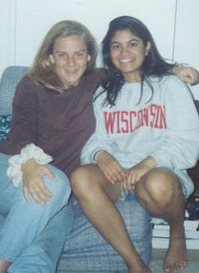
Jen in college.
I really wanted my own money back then. I wanted freedom from my parents. I wanted room to make my own choices. I didn’t see any possible way to achieve both freedom and my desire.
Which makes me think Watts’ advice would have registered only as a temporary instigation.
Not inspiration.
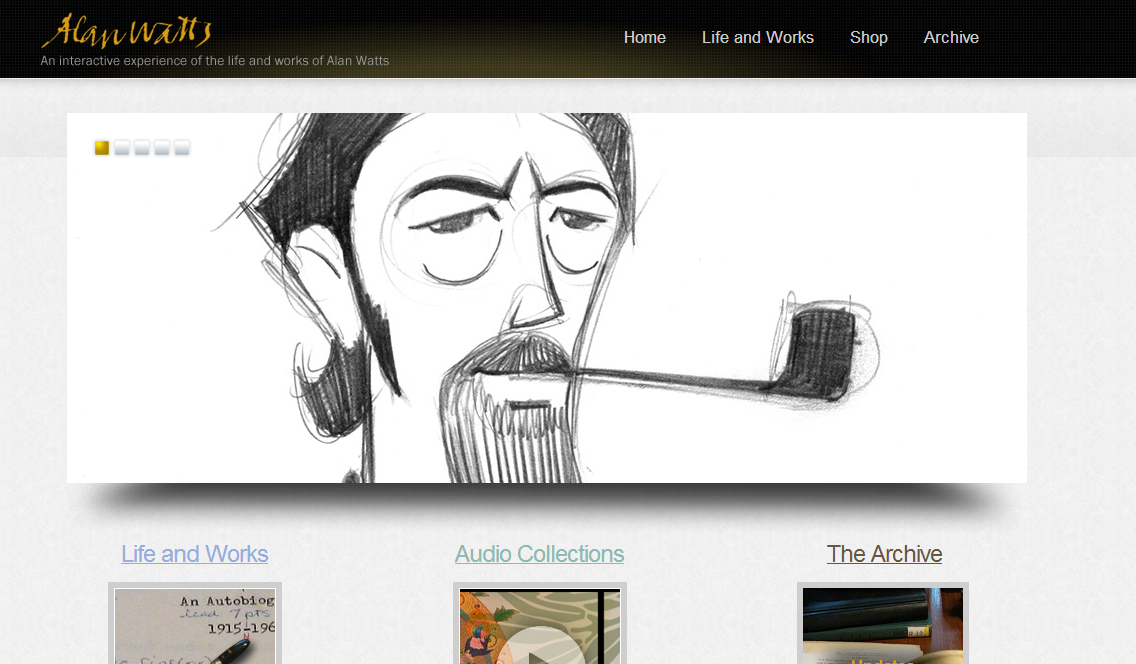
Learn more at alanwatts.com
Because in our current society set up, it’s practically impossible to forget the money.
We have to follow our desires in spite of the money.
What you need to know if you choose to forget the money is how you will stay true to your desire when the rest of the world says you need money over everything else. You need to know how you will navigate the expectations of your family, your friends, your neighbors. You need to know how to avoid the pitfalls of consumerism. How to live without a TV; without an SUV; without a weekend getaway.
You need to build your life so that your life is your weekend getaway.
= = = = =
If anyone had asked me when I was 20, I wouldn’t have said then, “I’d like to be a philosopher.”
I wouldn’t have said, “I’d like to be a craniosachral therapist.”
I absolutely would not have said, “I want, more than anything, to be a full-time, paid-loads-for-a-living celebrated writer.”
I didn’t know it then.
And I couldn’t see the way.
And yet, I’ve been fortunate to find my way. To have either landed in or created circumstances in which I’ve been able to recreate my career based on my passions and desires.
I listened to and followed my itch; years before hearing Alan Watts’ speech.
But, along the way, I’ve had to give up desires, too. Ignore certain itches.
I’ve had to choose.
Sometimes I’ve been able to forget the money.
And sometimes not.
Watts does not talk about choices…and consequences.
It’s not easy to follow your desire instead of following the money.
= = = = =
What would I say to a crowd of young people today?
How would I guide them?
I might say something similar to what Watts says: “Better to have a short life that is full of what you like doing, than a long life spent in a miserable way.”
I believe this to be true. And I like to think that somehow, accidentally, when I was writing that research paper in college, Watts’ advice penetrated my tired mind as I was lazily investigating the influence of Zen Buddhism on American pop culture.
Perhaps, subtly his words have been guiding me ever since.
But I would also suggest being as flexible as you are determined.
For who knows what you will be when you grow up?
You don’t.
I didn’t. I still don’t.
I still ask myself every day, “What do you desire?”
And then listen for the answer.
Forget the money, yes. But be flexible. At every turn, there is an opportunity if you are primed to notice it.
Ask yourself every day, “What do I desire?” And be strong enough to acknowledge the answer and take action, even if the answer is, “Money.”




 and yadda yadda, an aliyah blog