Philosophy, Poetry, Writing

What appeals to me about found poetry

One of the reasons why I love to experiment with “found poetry” is that it allows me to make an artful experience last longer.

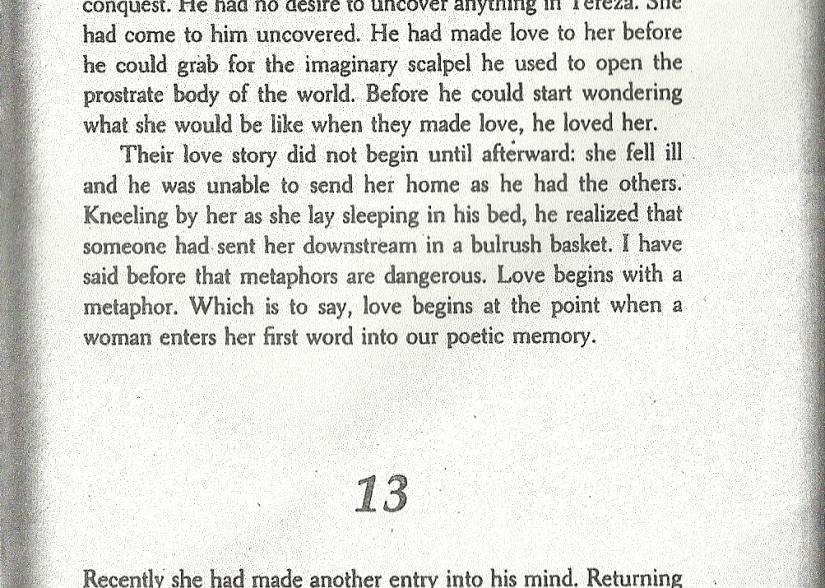
I just finished reading Milan Kundera’s “The Unbearable Lightness of Being,” for instance, and was struck often throughout by meaningful gems I wish I could spend more time contemplating.

In the absence of a classroom full of fellow philosophers or a literature professor, I turn to found poetry, otherwise known as “erasure poetry” or “blackout poetry.”

There is no correct way of digging in, but this is how I’ve been doing it with books. (You can also find poetry in songs or in newspaper articles. Why not?)

Instructions for finding poetry:

1. Xerox copy the page of the book or the document that stopped you in your tracks.

kundera metaphors are dangerous

2. Read it over a few times. Perhaps, out loud.

3. Listen.

4. Circle with pencil the words calling out to you.

When you’re certain (or certain enough) you’ve dug out something new or relevant or useful from the beauty or wisdom already expressed by the author, smudge out the words around those in paint or black ink or, like Mary Ruefle, with white out.

5. There. You’ve found something. A poem, perhaps, or an idea or a pathway.

Something.

Like most creative writing, a first draft of a found poem might only be a writing prompt for something more significant.

At the very least, you got to spend more time with beauty or wisdom … and upcycled it into your own life.


Poetry, Relationships

When all else fails, shave your legs

<FOUND POETRY>

Ultra Sensitive
Ultra Sensible
Contents under pressure.

You don’t have to sacrifice
comfort or
closeness.

We recommend       shave gel
like my dad on Saturday
over wet skin
like Bernie at Atlas Paints

You don’t have to sacrifice
comfort or
closeness.

We recommend       shave gel
like the neck of a hairy bear
almost man
who promises the Blair Witch Project
isn’t real

Do not place near
sources of            puncture.

like my husband on Saturday

Keep out of reach

like a chilled river running over a boulder
and I am that boulder with my head bowed down
and 

Glide.


Books, Love, Modern Life, Parenting, Poetry

Makes me wanna keep going

I’ll be honest: I’m still not done reading Rachel Zucker’s The Pedestrians.

I have about 5 or 6 more poems to go before the end. The book is sitting on my nightstand in my bedroom; next to which is my middle son who just slipped off to sleep.   My other two children are on two different IPADs watching two different age appropriate American television programs. (Go ahead: rate my parenting.)

I could finish The Pedestrians right now. I could snuggle up to the middle son in his sweat lodge and read.

But, I had a thought just now I couldn’t suppress:

Rachel Zucker makes me want to read more poetry.

But more important, she makes me want to write more poetry.

And I couldn’t just keep that to myself.

I had just finished one of the selections in the book titled “paris dream.” It’s one of 13 dream-like poems (others are titled “brooklyn dream,” “egg dream,” “daycare dream.”) Each time I read one of her “dream” poems I notice how I am simultaneously drawn into the poetry and into the dream itself; into the conscious and subconscious levels of the language. I find myself savoring Zucker’s dream in the way I sometimes delight in my own in the minutes just after I wake. I felt the urge to analyze it and was pleased.

I could keep reading Rachel Zucker’s dreams, I thought.

And while I am generally attracted to poems that are “dream-like” (Mark Strand’s work is a good example), Zucker’s dream poems compel me to dig into my own dream journal — the one I started keeping again last week after a two-year hiatus — to fashion gems out of the scribbles there. I’m trying already, but Zucker inspires me to try harder.

I fell for Zucker after reading Museum of Accidents, the themes of which are marriage, parenting children, the writing life, and a brand of existential anxiety found only in the modern first-world. The collection is a brave confessional told through the eyes of a deeply sensitive and somewhat over-thinking (some might say over-brooding) creative woman.  I connected to both the content of her poems and the way in which she expressed herself.

I found myself giggling at her often brutally honest depiction of her husband, her marriage, and their sex life; giggles reminiscent of those that spurted out when my college roommate sat on my bed Freshman year and started talking about masturbation. Translated, both set of giggles meant, “You do that, too? AND we’re allowed to talk about it?”

It was through my reading of Zucker, along with poets Eula Biss and Maggie Nelson, that I really started finding my own brave voice in my poetry; and weaving into my prose darker and more daring language and themes.

Pedestrians is just as honest as Museum of Accidents, but I find it less brutal. I don’t know if it’s me that’s changed or Zucker or both of us. In her poems in this collection, I hear a kind of acknowledgment and acceptance of the goodness in her life.  Take, for instance, the way she unearths and confesses “we still love each other” in “real poem (gay men don’t snore)”
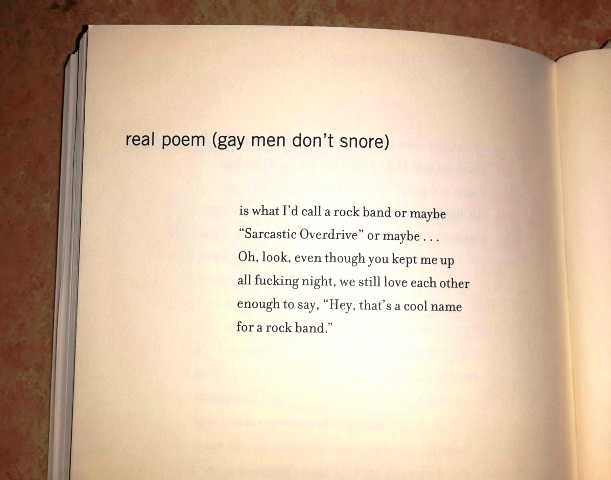
Pedestrians by Rachel Zucker

Or the tenderness and compassion she offers herself in the first sentence of “real poem (personal statement)”:

“I skim sadness like fat off the surface
of cooling soup.”

If we’re to assume the narrator is Zucker herself (and it’s difficult not to since she refers to her husband by name in this collection); I sense that it’s not that Zucker’s sorrow and longing have been replaced with gratitude; but it’s that Zucker has stumbled upon the space in which they may exist together.

And that, perhaps, along with the intimacy she invites in the dream poems, appeals to me.  Moreso, as I said above: it makes me want to read and write more poetry. And not for the sake of being heard, or for the sake of future publication or celebrity.

But because poetry is where I go about discovering the goodness in my own life,  in my own loves. It’s where I best display tenderness, compassion, and devotion, even when I am being brutally honest.



Poetry, Terrorism, War

When there is beauty inside bad news

<FOUND POETRY>

“Parking lots have sprouted
outside each kibbutz;
as reservists mass
for entry into
Gaza, their hatchbacks
with toddler seats
gather
the dust of days.”

— Jodi Rudoren in
The New York Times
Tunnels Lead Right to Heart of Israeli Fear
July 28, 2014

Family, Love, Poetry, Survivalism, Terrorism, War

Head Shaking Madness

This war    this war    this war    this war

This  world    This world    This world    This world

My kid’s food allergies.

This world.


This war    this war    this war    this war

This world    This world    This world     This world

Cancer. The bad kind.

This world.


This war    this war    this war    this war

This world    This world    This world     This world

The boogeyman’s make believe.

This world.


This war    this war    this war    this war

This world    This world    This world     This world

My husband on a plane somewhere.

This world.


This war    this war    this war    this war

This world    This world    This world     This world

I can’t throw up like that again.

This world.


This war    this war    this war    this war

This world    This world    This world     This world

Miss you.

This world.


This war    this war    this war    this war

This world    This world    This world     This world

Money in the way.

This world.


This war    this war    this war    this war

This world    This world    This world     This world

I killed the cat. That was       THE CAT.     FUCK.

This world.


This war    this war    this war    this war

This world    This world    This world     This world

Gotta make it before the siren.

This world.


This war    this war    this war    this war

This world    This world    This world     This world

How many miles til Hadera?

This world.


This war    this war    this war    this war

This world    This world    This world     This world

She’s going to die. She’s dying.

This world.


This war    this war    this war    this war

This world    This world    This world     This world

These people      These pronouns

These words            These words

This world.

Dreams, Letting Go, Poetry

The Situation

I don’t write about it because

writing about it

would be like the abortive attempt I made

in my spiral bound notebook —

the one with the mandala —

to describe the scene

with the wedding gown,

in the ground floor shop

of my dream last night.

The one with Winona Ryder who

donned a 1920s inspired

off-white sleeveless gown

(really, they were cap sleeves).

I opened the curtain of

the dressing room to find her

half-naked due to the

deep and dramatic V

reaching down her abdomen

revealing the

underscoop of her breasts

and half of one nipple.

“It’s beautiful,” I told her.

“But you’ll need to have it altered.

I’m worried they won’t be able

to maintain the look

once it’s fitted to your frame.”

She didn’t listen.

She told the seamstress to

press on and then, of course,

the dream shifted to the scene

in the ice cream shop

where the chiropractor I used

to know was offering me pills —

rat poison packaged as RU486 flavored

jelly beans.

They were red, with the taste of cherry,

and they made me gag as I chewed them.

So you see why

I can’t write about it.

There is beauty

and there is darkness

and they blend together at times

in a way that’s describable

but only to the point of

surreal not to the point

of understanding.

Not to the point

at which you know

you have  navigated

directly into my thoughts.


Family, Making Friends, Philosophy, Poetry

I wrote a letter to a friend

I wrote a letter to a friend today and inside that letter — which was not a letter but something like a letter sent by electronic mail — I composed my feelings into something like feelings. And it’s a pattern, my tendency to compose somethings like. It’s not a pattern but something like a pattern, something I do again and again, with or without noticing, with or without intention. Mine is not a compulsion, but something like a compulsion, for I am compelled to be something like me so that people like me. Not just people but something like people — specific persons who specifically like me but might not if I was anything else but something like me.

Something about this is unsettling, and settling.

For although there is something like disappointment every single time, something like failure; there is something like relief because something remains; this something is due, in fact, only to the space between the letters.

Love, Philosophy, Poetry, War

Color of

“War is what happens when language fails.” — Margaret Atwood

* * * * *

This is the color of my voice these days … Almost Silent.

Imagine it there

in a box of 64 crayons.

In my mind’s eye, Almost Silent is wrapped in Ecru

Courtesy http://www.art-paints.com/Paints/Body/Ben-Nye/Color-Cake/Ecru/Ecru-xlg.jpg

But its waxy innards are sea green.

Almost Silent, when taken to paper,

magically scribbles in a shade of blue

known only to the indigenous people

of an island yet to be discovered.

But I recognize it instantly when

I see the child’s drawing of a

heart within a heart within a heart within a heart.

Once, I remember, I fingered gel

that shade on my way out of the womb.


Family, Parenting, Poetry, Politics, War

If it was a place

fortitude

If it was a place —
cognitive dissonance, it
would be here, Israel.

Where in one swift shift
I move from embarrassment
(I forgot about swimming

lessons) to fear of
war. Shame I forgot about
it; murder and them

(those who can’t forget
except in dreams which aren’t real)
and yelled at my son

for telling me he
was bored on the second day
after school ended.

If it was a place —
cognitive dissonance, it
would be here, Israel.

Where over coffee
I compose long to-do lists
grateful in a way

to be a mother
with room in my heart for lists.
For tomorrow’s plans.

If it was a place —
cognitive dissonance, it
would be here, Israel.

Where over bacon
(made from turkey) I slowly
savor the almost flavor

of America,
and imagine I lived there
again. Would the world

be less dissonant?
More in tune with my inner
rhythms? harmony?

If it was a place —
cognitive dissonance, it
would be now, this, we.

It would be — it is —
the surreal surrender in
waking, in spite of.


Love, Memory, Music, Poetry, Relationships, Writing

Take heed

What if the woman who’s leaving Bob Dylan in Boots of Spanish Leather returns one day?

Maybe instead of boots she just brings her older, softer, leathery self to a cafe where it’s said Dylan sometimes drinks black coffee.

I imagined that woman

and with her in mind, played a little with blackout poetry.

It’s the first time I almost like the result.

spanish letter blackout2

 Take Heed

I just thought you might want
a long ol’ time alone.
From the storm
From the Mountains of Mad.

I remember saying
I don’t know when I’ll be back
back to where time
depends on true love.

Can you ask me again?

Just carry yourself back to me spoiled.
That’s all.

= = =

(You can listen to 50 different covers of Boots of Spanish Leather on YouTube or this sweet Lumineers version.)

Letting Go, Love, Memory, Mindfulness, Poetry, Uncategorized

Subway metaphor

It’s likely I will never
understand
the passage of time.
By the time
I understand
I will have passed time.
Quickly
like the express train.
People
some I know
become blurred colors
along a tiled wall.
Their names
once tiled too in a mosaic of sorts
crumble
and all that is left is a private joke
as private as can be
because it’s with me now.
I see myself at the turnstile
at the 18th Street station.
What do I do?
I can’t get on the local now.
It’s too late.
Much
I have to let her go.
She’ll be fine, I whisper.
That’s what her colors tell me.

Memory, Philosophy, Poetry, Spirituality

The after-taste of a dream

My dreams are poems

Righting themselves upside down

in Not-for-long Ville.


Still fresh with relief

when I wake I take a pen

so I may keep them.


But the poems fade

faster than the dream even

when I whisper, “Don’t.”


What’s left then, but last

night’s dream, which will never be

anything more than