Of course, we may disagree on the definition of art. But I find the more I notice, the more I notice.
The more I write, the more I photograph, the more I dream.
The more I read, the more I feel, the more I write.
When you open up — even just a little — to noticing and noting, you are actually working your art muscle.
What I say is not new. It’s not an original thought. Many more experienced at attracting art have said it before I just did.
But I notice it happening to me.
I see poetry in my photographs, and color in my poems. The art of one lends itself to the other, and suddenly I feel as if I am getting somewhere.
It’s not that I am a constant rushing stream of good art. Some of it is just purge.
Pages filled with strike outs.
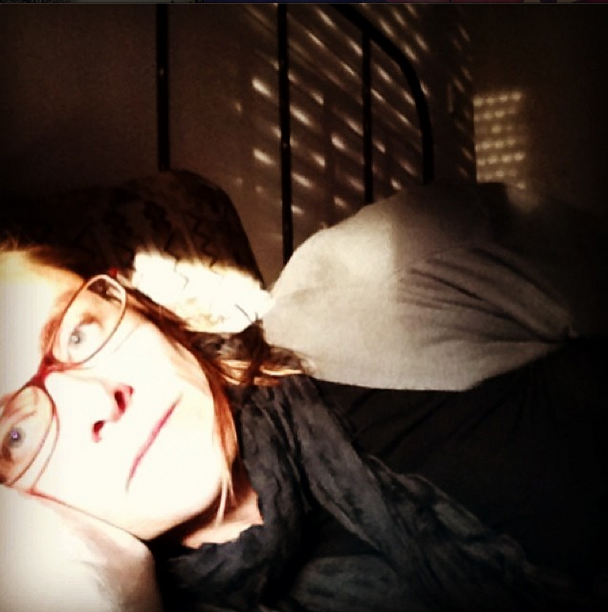
I look like this sometimes.
But then I laugh at myself. At my #selfie.
And I share it with you.
And my nervous heart strengthens a bit when you laugh along with me… in the knowing fully that you understand I’m half joking.
* * *
There’s something that gets in my way, though.
Thinking. Too much thinking. About getting somewhere with my art.
This, too, I notice.
It’s like that moment when I realize I am lucid dreaming and I know if I think too hard about it, I will wake up. So I try not to think — just breathe, I say — but this in itself is thinking.
POP!
Out of the dream.
Or, more simply, it’s like losing your cross-eyed stare once you finally become aware of the 3D image in a Magic Eye design. I see it! You cry. Then,
POP!
Back to staring at blurry peacock feathers.
What’s the real magic trick?
Minding your thinking, I suppose.
Noticing it, yes, but allowing thoughts to float away as easily as the 3D Magic Eye design.
This guy popped out of nowhere after 30 or so years just when I needed him most.
He looks like a dapper old cat, but what you can’t see … what he’s hiding behind his back … is his secret weapon.
And exactly what I need right now.
A pencil sharpener.
It’s hard to explain exactly why I found him where I did (inside a personalized pink plastic container holding personalized pink hair ribbons), but I’m not one to question serendipity (okay, I am.)
It just so happens that I’ve been desperate for a good pencil sharpener lately.
If I had my choice, I’d get a vintage one from a 1950s midwestern schoolhouse and hammer it into my kitchen wall — BANG BANG BANG — but those guys seem to be going for big bucks on ebay and anyway I need mine to be the travelin’ type.
And this dandy cat looks ripe for travelin’, don’t you think?
He needs to fit in my handbag, the one holding a heavy spiral bound notebook with a hard cover decorated in mandalas.
I’m writing more by hand these days, you see. Not because I want to. (Frankly, I prefer the feel of a circa 2005 keyboard against my rapidly tap tap tapping fingers. I also covet the ability to quickly delete the last thought I just had. See? I just deleted a thought you will never know.)
But because I’ve accidentally become a poet: a compulsive stringer together of words. And poets (potentially the most compulsive artists of all) need at their side a means to satisfy their urges.
A computer won’t do. One needs to get down words with haste.
A smartphone won’t either. My thumbs are too thick, too clumsy. “Bogus” accidentally becomes “booger.”
If only I had a secretary by my side. … the cat would surely do if only he was alive.
“Please, kind sir, take down this line,” I might say to the cat if only he could lift his hand away from his orange man purse and take dictation. “No, strike that! Change compulsive to inveterate.”
Who gets to decide what of yours gets published after you’re gone?
Who says that your journals, your letters, your doodles in the margins get to be publicly shared posthumously?
I assume the obvious: Your next of kin. Your estate’s executor.
But I wonder — those of us who read the words of the dead without their explicit permission (The Unabridged Journals of Sylvia Plath, The Diary of Anne Frank, Kafka’s The Trial) — do we care whether or not the author wanted the materials published and read? (Kafka apparently vehemently did not. Tough noogies for him.)
Of course, one could argue that they’re … um… dead. That would be a pretty good argument for why it doesn’t really, truly matter.
But why, then, do we respect the dead in other, superstitious ways? We wear black, hold our breath, cover our mirrors. Shouldn’t we think twice before reading their private journals?
Presumably their material was published in the name of art by someone who had something to gain from the publication: money, fame.
At the end of the day, I save stuff for me. I might think I am saving it for my kids, but I’m really saving it for me to share with my kids. Not for them to discover on their own with no historical reference. No filter. No explanation.
And I wonder, what would I be okay with them sharing after I’m gone?
Anything marked “FINAL DRAFT,” I’d be good with, I guess. All files tagged “SUBMITTED_2_2013” or any such combination of publication name + date, I’d be good with.
But the other stuff? My journals? My notes to self? My letters? My teenage angst poser poetry?
I don’t know if I want those aired out in public by anyone else but me.
I might change my mind when I’m famous. (I’ll let you know.) But I doubt it.
What about you? What are your thoughts about publishing rough work or private writings posthumously?
A new hobby is birthing itself, pushing its way out.
Like when I took to exploring New York with my neck cranked back
gazing up at building sides looking for signs of shoe polish advertised 100 years ago.
A new research topic. A new obsession.
The confessional.
Sylvia Plath. Anne Sexton. These are writers I never read.
Can you believe it? I’m embarrassed to even admit to it. (Though I already did.)
I never read those ladies on purpose. Their tragic endings were enough to put me on alert.
Enough to scare me into avoidance.
I was terrified of discovery. Worried that by exploring their darknesses, mine would be triggered. I didn’t need any more triggers — my mind’s been busy enough for decades.
However, slowly, slowly — as I’ve begun to creatively confess here on the blog and privately in long-form and poetry — I’m dipping my toes into their confessions. Learning from them. Growing. Chuckling. Feeling relief that I am not the only one pained by the beauty of tulips.
It’s humbling, knowing that you’re not the first person in this world to suffer. It’s reassuring knowing you’re not the first writer to reach for a thesaurus in search of just the right word because your mind will not allow you to escape from the hunt until you do. It’s a relief, in a sense, as Lena Dunham shared about her experience reading and exploring Plath in college to know that your darkness is a little bit lighter than it could be.
It was good I didn’t read Plath or Sexton until now, I suppose.
In the same way it’s all good.
All of it. The stuff we hide away accidentally or on purpose until it’s ready to be discovered, explored, shared.
I am often troubled when I hear people use the word “serendipity” when I think they mean “synchronicity.” But I never really investigated the difference between the two words.
In my unresearched opinion, I always imagined synchronicity as attached to “meaningful” or extraordinary. Whereas serendipity is more playful, like a cup of frozen hot chocolate.
Lucky. Fortuitous. Unexpected. Right place at the right time sorta thing. Whereas synchronicity … when it happens … almost feels as if its arrival was fated. Expected, even if not by the participants. Anticipated, in some way, even if unseen to all but the gods until the very moment the synchronicity occurs.
Synchronicity, to me, carries in its meaning a certain divinity, a certain magic.
So much so that I remember distinctly when and where I was when I first heard the word and its layperson’s explanation. I was at the lake house of a friend in celebration of her engagement. While dipping my feet in the lake, I chatted with a friend of the bride-to-be whom I’d never met before. She shared with me the details of a paper she was working on (perhaps her Master’s thesis or her dissertation), all on the topic of this experience called “synchronicity.”
I admitted to her that I’d never heard the word before.
“Oh,” she smiled. “But you’ve certainly had this experience.” She went on to describe what I had always thought of (at least since reading The Celestine Prophecy in 9th grade) as “meaningful coincidence.”
However, “meaningful coincidence” always sounded lame. Such a deeply moving or spiritual encounter needed a better descriptor.
“Synchronicity,” a word steeped in the concept of time (my favorite philosophical topic of conversation both then and now), was perfect for me. I was so thankful for having met this woman at the lake. Our meeting was, in fact, meaningful. Synchronicitous (synchronistic?), we joked at the time.
Perhaps this is why I loved so much Ginz’s response to my “haiku challenge” yesterday.
Walking alone is often the first step towards
synchronicity.
This, indeed, is what I was going for when I was trying to describe the outcome of a walk alone I took yesterday. Too me, synchronicity, isn’t just a word, but a timely, yet timeless explanation for magic, for meaning, for connection.
When “alone” unexpectedly transforms into “no longer alone.” And loneliness is replaced by oneness.
I was attempting a haiku this morning when I realized there is no good antonym for alone.
Walking alone is often the first step towards
These were the first two lines of an idea I was trying to work through by haiku. Except, I couldn’t finish it in a satisfying way.
“Together?” Is together really the only antonym for alone?
I was going for an emotion, a feeling, a deep sense of being close to another person or to humanity. Feeling less afraid. Feeling as if someone else understands you.
And “together” … just doesn’t do it.
Together is so physical. It’s a fixing word. It’s an extrovert’s word. It’s not the word I mean at all.
Want to help me finish the haiku?
Walking alone is often the first step towards…
I’d love it if you’d give it a shot in the comments below or on your own blog with a pingback here. If your haiku especially speaks to me, I’ll reblog it.
In one of my cardboard boxes, I found a folder with some work samples from my time as a book club manager at Scholastic.
While rifling through the R.L. Stine Goosebumps newsletters and colorful seasonal book catalogs I used to edit, a typed out note on white paper fluttered through the air and landed on the floor. It took me only seconds to realize what it was: a note from my former co-worker, Nelson, a kind man, the production manager of the creative team.
The words gracing the page were in Spanish, and though I hadn’t thought of them or heard them in years, I knew they were the lyrics of a song.
Nuestro tema esta …
Cantado con arena, espuma y aves del amanecer.
I rushed to the computer. Standing in front of the monitor, I typed in YouTube, then the words:
“nuestro tema”
The song appeared in the search bar. I held my breath.
You know the kind of breath holding I mean?
When you know you’re about to get the wind knocked out of you … but in a good way?
I pressed play and waited to get the wind knocked out of me.
And, as I could have predicted, I was overcome … a wave rolled over me.
I closed my eyes. And smiled.
* * *
The song, by Cuban musician Silvio Rodriguez, was on a mixed tape someone made me. Smitten by Rodriguez’s voice and guitar, I brought the tape into work and asked Nelson, a native Spanish speaker, to listen and transcribe the lyrics for me. (This was back before there was “lyricsfreak” and other easily available websites.) Even though my high school Spanish was rough, when I got the words from him, I immediately understood enough of the sentiment, and some of the imagery to know for certain it was a love song. A metaphor. A painting in words. Pure poetry.
” …besos a las seis de la manana”
Best of all, with the words in hand, I could sing along to the achingly beautiful voice.
Which is what I did for weeks and weeks and weeks until I eventually lost interest … and track of the song.
* * *
“Nuestro tema esta… Nos cuesta tanto
Que ya es un sueo y una cancion.”
Back in the present, I hummed along, thankful for the easy access of YouTube (and wishing I had never given away my Yellow Sony Walkman…who would’ve guessed?)
I only became aware of my breath again when the song was finished. I had apparently let it out at some point. My chest was relaxed; my shoulders loosened. My soul lighter. The wave had passed over me and back out to shore.
For this is what “Nuestro Tema” always did for me. Let me believe I could let go of some of the weight of the beauty and agony of this world, knowing that others were bearing it for me.
I couldn’t have told you all that then, though. That stuff about the beauty and the agony. About carrying the weight of it all on my shoulders.
I didn’t understand it then. The weight of all that beauty … that agony. The ability to let it go when we listen to music or allow our hearts to swell with someone else’s description of it.
All I knew is that I loved the song so much I had to know the words.
My new friend Miriam is a long-time professional dancer and choreographer. I met her in a writing workshop at Bar Ilan University and have enjoyed hearing her tales of dance, particularly those she found herself in while living in far-flung areas of the world foreign to me.
But yesterday, Miriam surprised me even more when she led our group in a movement exercise designed to be used as a writing prompt.
Movement as a writing prompt?
While I’ve sometimes walked around outdoors as a way to move past writer’s block, I never would have guessed that following simple guided instructions on how to move in space would bring such a wealth of content to the surface …and so quickly.
The experience for me was remarkable. While in it, I was singularly focused on following Miriam’s instructions. But as it turned out, my body’s movement allowed my mind to relax … and open up to new ideas.
In the final of three exercises, Miriam instructed us through a series of varying movements during which we were to write our name in the air. For the final movement, however, we were to present ourselves to the group, then write our name in the air.
I noticed a grave difference between how I felt when I moved independent of the group and wrote my name in the air, and how I felt presenting my name inside and to the group. The difference was physical. An ease that accompanied my independent movements … a stiffness that showed up once I faced the group.
This physical discomfort stirred inside my creative space afterwards, when we sat down for ten minutes to write.
And it was this discomfort that became a poem that I dare to share with you…
The Group.
Take care with my bare heart …
With the me out there.
===
Me Alone Meets Me Out There
Will I always be two Mes?
The Me alone and the Me out there?
When I am Me alone, fast or slow, I am me.
Giggly, thoughtful, silly me.
When I am Me out there, within without, I am not me.
I am a stilted lilted version of me.
A me wrapped in bubble wrap.
A me on display.
I am cute, a hoot, but not a whole
Me.
I wish the two Mes would meet one day
On the street, on the stage,
in the office, on the page
And decide to become one.
The Me alone
and the Me out there.
Easy peasy pair.
==
(All content, including poetry, is original — unless otherwise noted — and copyright Jen Maidenberg.)



 and yadda yadda, an aliyah blog