Writing

How to recognize a poet

If you write poetry and no one reads it, is it still a poem? What if no one likes it?

Gets it?

Shares it?

What if it’s never published?

Never praised?

Is it still a poem?

How — really — does one recognize a poet?

Is the title earned? Learned?

I admit —

I am a reluctant poet.

Reluctant, not because I don’t enjoy weaving short thoughtful phrases together and calling it poetry, and not because I don’t enjoy reading short thoughtful phrases woven together by others

but mostly because I am not 100% sure how to recognize a poem.

And I am not 100% sure I am a poet.

Poetry confuses me. It makes me insecure.

I doubt it. I judge it. In a way I don’t judge novels or articles or essays.

When I read poetry, I am often left confused.

When I write poetry, I am overly critical. Hungry for approval and acknowledgment.

Is it the writer in me, I wonder, that is anxious and unsure?

Or is it the human?

There was a time when I thought I knew poetry. When I thought that poetry was as simple as alliteration

alliteration

as simple as limericks … as quatrains … as rhyme.

I was in third grade and poetry was the unit during Language Arts.

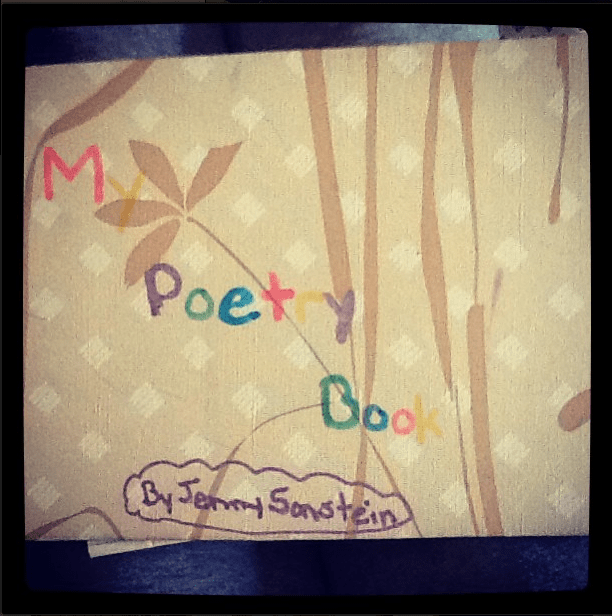
We created a poetry book — I still have it. It’s bound in wallpaper and decorated with a rainbow colored pride known only by nine year old girls and confident gay activists.

poetry book

And I am moved by the poet I was then.

I am struck by how I saw the world when I was a poet, and I am envious of the girl who strung together lavish gibberish and confidently presented it as verse.

Oh, how the words flowed then…

/

walking down the stairs

holding tight to the staircase

taking your first step

Your parents at the bottom

finally your (sic) down the stairs.

/

In 1983, under the instruction and guidance of Mrs. Wald, I wrote a 12-page, wallpaper-bound book of poetry.

The pieces vary in length and in depth.

They cover topics that range from my childhood home to the mountains of Japan.

They make perfect sense and no sense at all.

Some rhyme, some reference people I no longer remember.

30 years later, I read this book of poetry and I am moved.

Does that make me a poet?

Is that enough?

I say it is.

It’s enough.

Not enough for contests or Ph.D.s or prizes, that’s for certain.

But enough to offer me the confidence

to write another poem

tomorrow.

Community, Middle East Conflict, Relationships, Writing

Beyond the yellow gate

Beyond the yellow gate

there is a woman.

Her airy black head scarf almost shields her effervescent eyes.

But when she looks up, sky blue bounces off her peasant shirt and into her pupils so they ignite.

She touches my wrist gently as she feels for my pulse.

Ba-boom. Ba-boom. Ba-boom.

.

Beyond the yellow gate

there is a man.

His navy blue striped rugby shirt and acid washed jeans foretell a deep, defiant  voice.

But when his lips part and open wide, out fall directions in a timid, mouse-like squeak.

He guides me — turn left, turn right, and then

straight, straight, straight, always straight.

.

Beyond the yellow gate

there is a building.

A tall, two story white stone building, a dusty green awning greets the afternoon sun

But behind the glass door is woman with a cleft-lip

whose job is to collect, from everyone who enters, 30 shekelim

shosheem shkreem, she says. Ma? Shosheem shkreem.

.

Beyond the yellow gate

there is a town.

A busy town. A bustling town. A restless town.

But living in this town there is Farid and Dr. Haddad and the two girls

in pigtails eating popsicles

slurrrrrrrrrrrrrrrrp.

.

Beyond the yellow gate

there are people.

Their faces, weathered or leathery or lean,

are  thumbnail previews of the beauty within.

—-

This poem is one in a series about Kfar Manda, an Arab village three miles down the road from Kibbutz Hannaton, where I live, in the Lower Galilee, Israel.

Health, Letting Go

Stuck in Your Throat

Your silence is a cover-up.

It’s a conspiracy between you and the way you think people see you.

Your silence is a ruse.

It’s a simple means of getting from here to there.

Avoiding an accident.

Your silence is a hushed conversation between you and yourself.

It’s a promise.

It’s a plan in the making.

It’s a vendetta.

Your silence is silent until it’s loud.

And then BOOM.

Destruction.

Why are you silent in the face of men who care not if you smile or frown, stay or go, live or die?

Why is your silence, then, in front of them, so valuable? Such a commodity?

Why are you loud in the face of children whose only desires lie in pleasing you?

Why is your silence, then, in front of them, so rare? Out of stock?

Stuck deep down in your throat are all the things you want to say

But you are silent

Anger rages like a river, swirling whirlpools in your throat you swallow.

Until a tidal wave of release

Drowns the ones you love.

Uncategorized

The felicity of freedom

I do not feel connected to Israel’s independence, nor America’s.

My heart does not swell enough on Yom HaAtzmaut, nor does it burst with pride on July 4th.

I am neither a loyal patriot nor a faithful expat.

I

am

clearly

a spoiled brat.

Or a heartless wench.

One or the other.

If I were put on the spot and asked why I am so numb when it comes to celebrating freedom, I’d choose spoiled brat.

Entitlement is what happens when you have always had something come easy and come free.

My freedom has always been free. And you are less likely to celebrate what you have always gotten for free.

If my freedom was a gift only to the 1000th citizen born on every third year — like a raffle or a supermarket prize — maybe I would jump up and down for joy.

If my freedom was a surprise miracle in a barren wasteland — like Sarah conceiving Isaac in her old age or a lone soaptree yucca surviving the desert heat of Death Valley — maybe then I would thank God in silent prayer.

If my freedom was one true thing in a sea of falsities — like my breath, like my love for my children — perhaps then I would weep tears of gratitude.

But my freedom is free.

And my freedom has never come with strings attached.

And my freedom will be here tomorrow, or so my entitled mind tells me.

We only know what we know.

And so therefore, on the 4th of July or any other day I choose, I must stop.

Pause.

Acknowledge.

The good fortune with which I was born.

The grace of good men and good women who do not know the life I know.

The felicity of FREEdom.

Health, Love, Mindfulness, Relationships, Spirituality

Unconventional workout

I started running.

Yup.

I’m a runner.

A short-distance, short-time runner.

For almost a month, I have been running for 15 minutes every day except for Shabbat.

That’s it. 15 minutes.

And it works. I finally found an exercise regimen that works.

For now.

Maybe it’s not enough for everyone, but it’s enough for me.

For now.

I’ve also committed to writing more.

Tiny tidbits here and there.

A blog or the start of a new short story or a poem for fun spurred by a random writing prompt.

I find, the more I write, the more I write.

And the better I feel.

So between the running and the writing, my physical and emotional health seems to be on the up and up.

I know because my hormones say so.

They say so by being quiet when they are normally loud.

Quiet hormones. Quiet head.

Ahh….

But I think I could add a third element to my personalized workout:

Gratitude.

Gratitude, as we know, is such an energy boost. It’s a life lifter.

When we feel gratitude — the day after a violent stomach bug, or the minute after you avoided a tragedy or danger, or simple moments of love between you and your spouse or your child or your cat — we love life.

In the very moment we feel gratitude, we love life.

And loving life is all any of us ever want. It’s why we exercise. It’s why we write.

It’s why we exist at all — to love life.

So, I’m going to try to add 15 minutes of gratitude to my daily workout regimen.

If it’s that easy to love life, why wouldn’t I?

Want to join me?

Letting Go, Love, Mindfulness, Relationships

Practice hard what you preach; then practice some more

There is what I preach and there is what I practice and there is sometimes overlap.

All of my preaching is prepared and shared with good intentions.

Yet there is intention and there is action and in between there is emotion.

Emotion gets in the way, sometimes.

A lot of times.

Meaning, no matter how good my intentions, and no matter how loud my preachin’, my emotions trump.

My emotions are

Royal

Straight

Flush.

Which brings me back to practice.

Knowing that my emotions trump my intentions, I may be (and must be) mindful in situations in which emotions run high.

The only way I know how to get better at acting with intention is to notice when I’m not…

and turn it around.

traffic

I love my emotions.

Okay, I value them.

But there are times when I wish what I know to be true would run through and through

all the way to my heart

As opposed to the doubt, the anger, the hurt, the fear

That runs through instead.

And all I can do in those moments

when the through and through is

doubt, anger, hurt, fear

is practice.

= = =

P.S.: For those seeking the conclusion to my driving test saga, sigh, I didn’t pass.

Letting Go

Friday writing challenge: 15 minutes of…

In Israel, Fridays are Saturdays. Which is to say — they are the first full day of the weekend.

But Fridays aren’t Saturdays.

For many reasons.

For one, Friday is the day leading up to Shabbat — the 25-hour or so rest period during the week for observant Jews.

We’re not observant Jews.

But we’re not, non-observant Jews.

I often refer to myself here in Israel as a Jew-in-progress.

I am playing with my Judaism.

It’s fun.

For me, Shabbat means dressed up Fridays and a Saturday morning buffet unlike any I’ve ever experienced before.

Fridays are a day to prepare for Shabbat, so that Saturday we may relax and enjoy being in the moment. Each moment. Whether the moment is a board game with my son, or a meditation group with my neighbors, or a quick nap in front of the TV.

On Fridays, we clean the house (since we never have time or energy during the work week); we prepare a nice dinner for our family or for guests (since Friday is the only night we truly eat together as  family); and — if we’re really lucky — my husband and I might find time for a snooze or a chapter or a whatever it is we want to do with our limited free time left.

My kids all have programs on Friday mornings, which is awesome.

But what typically happens is my husband and I spend the entire morning cleaning and cooking and then right at 11:45 am, 15 minutes before the kids come home, we’re finished.

We have 15 minutes left.

What can you do with 15 minutes?

Not really enough time to chill or read or watch the 12 hours of recorded programs on our DVR.

But 15 minutes IS enough time to write.

Most people would say, “not so.”

What can you write in 15 minutes?

What they really mean is: How well can you write in 15 minutes?

Well, what if the point was not to write well?

But just write … and share what you’ve written.

No time to think through your topic carefully. No time to outline your story. No time to proofread or edit.

No time left.

Writing this way requires a completely different mindset.

It means … you have to let go.

And just write.

For me, this is almost unspeakable. Except I just spoke it.

And I’m about to do it.

Want to play with me?

If so, go ahead. Write something. Then, add a link to your 15-minute Friday writing challenge post in the comments below. Tag your post 15-minute Friday.

Can’t wait to see what happens when you, too, choose to let go … and just write.

Climate Changes, Community, Environment, Family, Middle East Conflict, Survivalism, Terrorism

An imaginable future

When we first moved to Israel, I felt uncomfortable sitting on buses and in cafes.

I would casually look around, trying to avoid notice, to see if there were any suspicious people or packages about; not sure, exactly, what my reaction would be if I spotted one.

Over time I have found myself less and less suspicious. More at ease in public places, as it so happens, but still not at ease.

“At ease” is not a behavior I was born with — or maybe I was — and was just spooked one too many times by a mischievous friend or traumatized by too many VC Andrews novels.

The world, for me, has almost always been a scary place.

And I have almost always been easily startled.

While here in Israel, I cautiously scan the room for bombs; in the States, I cautiously scanned darkened evening streets for rapists and quiet alleys for thugs. I walked quickly through empty hallways and avoided elevators with lone men. I double and triple locked my doors, and was known to sometimes sleep with the lights on. Especially the night after The Blair Witch Project.

I remember being in a bar watching a band perform in New York City once, in the months just before 9/11 but fresh enough after Columbine to still be jumpy, and leaping off my seat at the sound of a small explosion in the back of the room. Someone’s hair had caught fire accidentally on the tea light candle intended for atmosphere, and instead of atmosphere we were treated to dramatic special effects.

After I caught my breath, I laughed out loud at my reaction, but internally asked myself what I had been so concerned about. What immediate danger did I think the noise indicated?

A gun shot?

An explosion?

A brawl?

It’s the first time I remember my unease extending from mild anxiety to a heightened concern for my immediate well-being and the well-being of others.

From then and there, unfortunately, my unease has only become gradually uneasier.

And not because my anxiety has worsened, and not because I moved to Israel.

In fact, my anxiety has significantly improved in the last decade since I started acknowledging it and paying attention to it and using focused breathing, meditation and mindfulness.

Moving to the slow-paced countryside of Israel, in some ways, has helped, too.

But no matter how significantly my anxiety has improved, the world hasn’t. Since 9/11, the way I see it, we have been witness to more violent crimes like those in Aurora and Newtown and Boston and have experienced the communal aftermath of incomprehensible tragedies like Katrina and Sandy and are becoming more and more awakened to the devastation of our planet and the resources we have taken advantage of all our lives.

And suddenly I am no longer a minor statistic in a clinical journal.

It’s not just me and my world viewed through an anxiety-colored lens.

The world itself has become anxiety-colored. The world itself is on edge.

I watched this video of grown men jumping out of their seats; seemingly reaching to hug each other at the sound of thunder booming loudly over Yankee Stadium during a rain delay.

At first, I giggled. It was cute. Funny.

And then I paused, and realized, it wasn’t funny at all.

Grown men — baseball players, even, symbols of fearlessness and recklessness — jumping out of their seats at the sound of a …

Boom!

We are living in a world in which we are now, clearly, all easily startled.

scaredy cats

I know I’m not the first to make the claim that the world is growing bleaker and blacker.

There are voices much louder than mine that have come before.

And even though my voice is not the first.

There is always a glimmer of hope it can become one of the last.

The year I was born poet and activist Shel Silverstein wrote:

“There is a place where the sidewalk ends
And before the street begins,
And there the grass grows soft and white,
And there the sun burns crimson bright,
And there the moon-bird rests from his flight
To cool in the peppermint wind.

Let us leave this place where the smoke blows black
And the dark street winds and bends.
Past the pits where the asphalt flowers grow
We shall walk with a walk that is measured and slow,
And watch where the chalk-white arrows go
To the place where the sidewalk ends.
Yes we’ll walk with a walk that is measured and slow,
And we’ll go where the chalk-white arrows go,
For the children, they mark, and the children, they know
The place where the sidewalk ends.”

(Where the Sidewalk Ends, by Shel Silverstein)

Those children are now grown.

Those children are now us.

And it’s indeed possible we have come to where the sidewalk ends.

And we need to choose in which direction we will continue.

We may continue to jump at loud noises, and then numb ourselves to an unacknowledged shared pain.

Self-medicating with food, technology, entertainment, drink, drugs, sex, consumerism, waste, whatever — silently signing the same consent form to ignore, to waive liability.

Or we may create together a world in which we can imagine its future.

A future not out of a dystopian film, but one lined with the vibrant green grass of my childhood memories and narrated by Shel Silverstein.

I want a future lined with colorful sunsets for my children to fall in love under.

And I want to hear thunder… and scream,

then giggle.

Knowing my fears are only imagined.

Food allergies, Health

Ode to Nut-free Desserts (an allergic Israeli kid’s lament)

ode to nut free desserts

It’s not easy being a kid with nut allergies in Israel. Israelis love love love their nuts. It’s impossible (and I stand by that extreme) to find a baked good without them.

Family, Parenting

The woman she used to be

I’m a woman so I know

what she wants you to remember is

the woman she used to be

the prankster the flirt the gymnast

she wants you

when you look at her

to see the girl in the rain

in braids

invincible

Tho she is mother

she is woman, she is girl

And just before she heard the baby cry she was imagining how she would do her hair for prom

up or down

She is thin and underdeveloped underneath that oversized formula stained tshirt

She is agile and eager behind that tired, uninterested frown

She closes her eyes, smells the bouquet you handed her and remembers

the wedding

She looks up and sees the underside of her mother’s chin

her mother’s grin

kissing her, thanking her for the macrame owl that Troop 422 made for all their mothers

In the mirror she is mother

but in her mind’s eye she is woman

she is a girl

they blend together and

she wants you to remember

like she remembers

the her behind Mother