Books, Survivalism, War

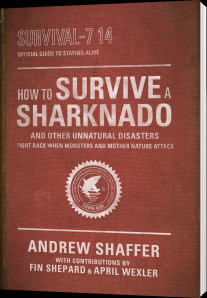
Review: How to Survive a Sharknado

Book Details

Title: How to Survive a Sharknado (and Other Unnatural Disasters)
Author: Andrew Shaffer (with contributions by Fin Shepard & April Wexler)
Publisher: Three Rivers Press, July 2014


Review

In 1999, when Chronicle Books published the first in what would eventually be the popular Worst-Case Scenario book series, I was an early adopter. I can’t say for certain where I purchased my now worn copy (it’s still in my personal library after six moves, including two cross country and one cross planet), but I have a feeling it was at the Urban Outfitters on 6th Avenue in Greenwich Village.  It was my go-to spot for specialty books typically displayed and marketed as kitschy gifts. The display table in the front corner of the store by the window was the table I often hit first, with the intention to buy for keeps. (The Book of Spells: Over 40 Secret Recipes to Get Your Own Way in Love, Work, and Play was another purchase.)
sharknadoI’ve been planning for disaster almost my whole life. Certainly since the first time I watched the tornado sweep Dorothy away from Kansas into Oz. But I took a more serious interest leading up to Y2K and then again in advance of the yet-to-be-realized Mayan Apocalypse.

Like the author of How to Survive a Sharknado, I tend to approach my prepping with a blend of earnestness and humorous self-deprecation. After all, there’s a fine line between prepared and crazy.  (Prepared, for instance, is a safe room in my house in Israel stocked with two weeks of food and water for me and my family. Crazy, on the other hand, is the underground bunker in West Virginia stocked with MREs for 15 years. I am prepped, but I only dream of being crazy.)

Of course, there’s a reason for Shaffer’s humorous approach to disaster in How to Survive a Sharknado: He’s writing a fictional movie tie-in book, as opposed to a true reference handbook a la The SAS Survival Handbook by Lofty Wiseman (which I also have in my personal library and which Shaffer references in the introduction to Sharknado.)  How to Survive a Sharknado is part of the Syfy Sharknado brand, a made-for-tv film franchise I’ve — regretfully? —  never seen. (Watch this trailer for “Sharknado 2” starring Tara Reid.)

Like any good B-movie horror flick, How to Survive a Sharknado is rooted in truth.  Bizarre one-off disasters do indeed happen (See 7 Global Apocalypse Scenarios That Might Really Happen and After Hundreds of Bee Stings and Thousands of Volts, Tree Trimmer Eager to Get Back to Work) and people — not just preppers — go bananas on social media when they do.

But, as far as I can tell, Shaffer’s book is as fictional as the Sharknado movie, a humor book mocking real-life disaster coverage and promoting, in a way, a host of B-movie disaster flicks on SyFy, such as “Arachnoquake,” “Mega Python vs. Gatoroid,” and “Sharktopus.”  Shaffer plays it so straight in the book, however, I almost believed some of the stories were real until I got to “Dinonami,”

How does he do it? In addition to leading off each “unnatural disaster” chapter with a table of vital statistics, Shaffer also offers “reports” of incidents and commentary by “real-life” witnesses and experts.  In the section for Extreme-Weather Vortex, for instance, Shaffer references “the morning of May 18, 2008” when “the air in the lower atmosphere above Manhattan began swirling.

“The first sign of trouble happened in Central Park. Six-foot-tall whirlwinds filled with subzero air whipped through the park. Children chased these ‘mini tornados’ around — until the tornados started chasing the kids back…A twister formed near the Liberty Island, killing dozens and ripping off the Statue of Liberty’s raised arm.”

Shaffer goes on to “quote” meteorologist Cassie Lawrence,

“At the site of one funnel touchdown in Midtown, I found evidence of lightning. It made perfect sense. Planets with high and low atmospheres are lightning machines. If the storm continued to build, I calculated the lightning would increase in frequency exponentially, building to a crescendo the likes of which we’d never seen on Earth before.”

I laughed out loud towards the end in the section called “Unnatural Disaster Kit” as I read the list of “tools and supplies,” which includes:

“Cash, coins, and Chuck E. Cheese tokens

and

“Packaged snacks: Although not very nutritious, most processed foods like crackers and snack cakes have shelf lives longer than basilisks”

(Basilisk is total insider geek speak. It makes me feel loved and a little less lonely.)

The book is cute and clever, but would be funnier, I think, if I was a bigger B-movie fan (like my husband, for instance, who dragged me to Piranha 3D) or if someone bought me this book at Urban Outfitters on Sixth Avenue as a gift for my upcoming birthday; as a way to gently, but lovingly mock my zombie apocalypse obsession.

As I said, there’s a fine line between prepping and crazy: I prefer laughter to lunacy.

Disclaimer: I received this book from the Blogging for Books program in exchange for this review.

Poetry, Politics, War, Writing

Sexy Quiet

What if I made the choice
and the choice was
Quiet?

It’s true
sometimes Noise
tricks me
into believing
he is life.

What with all the
heart racing
and the jumping out of bed.
Gentle she,
Quiet,
though sometimes
tiresome
allows me the freedom
to kiss my children goodbye
and think like that again
only
when the front door crashes
open.
Unassuming Quiet
permits me to write
and eat ice cream.

I desire Quiet.

Noise, though sexy,
appetizing in an indulgent way
moves me in the way
ice cream does,
when I eat it from
a cone. One scoop
more than I needed.

Community, Philosophy, Politics, War

What the world needs now

I spent the morning with my father-in-law in a cafe in Kfar Tavor.

He was generous enough to be an interview subject for me in regards to a creative writing project I’m preparing for a class called “Art, Atrocity, and Truth.”

My father-in-law is a child of the Holocaust. He is, in a way, art born of atrocity. His story is fascinating, as are the stories of so many whose parents survived the Holocaust, either in camps or in hiding or in brave revolt in the woods of Poland.

But his story is not my story today. My story is brief and bubbled up for me this morning on the drive home from the cafe.

My story is in response to the despair I often feel in this world; and the despair I feel specifically right now in this region.

I woke up this morning with a headache, and with a swelling I get in the hollow of my neck where sadness lurks. The news, the last thing I read before falling asleep last night, still lingered there.

But two hours later, after a spinach quiche and cafe hafooch at Cafederaztia, after taking 8 pages of notes, after probing my father-in-law for details about the small Polish village, about the time in Lublin, and the after time in Germany, and the time after that in Lod and in Petach Tikva, and eventually Newark, NJ …

I felt alive again.

The headache is still there a bit, but the hollow less congested. And if I had to say why, I’d say it was the listening. It was the act of being a vessel — even temporarily — of someone else’s story. Someone else’s past; someone else’s meaning. I bet if you asked my father-in-law immediately after our conversation, he would probably say he felt lifted up too. For having been actively and intentionally listened to.

It’s not the first time I’ve listened. It’s something I enjoy. It’s something of myself I want to give to others, if that makes sense.

I sense they need it. And I sense I do, too.

I know this is a luxury — drinking coffee, listening. I know it’s a luxury of living here in the Lower Galilee where, for the time being, war is more a headline than a reality. I know this is not a luxury for those in shelters in Southern Israel or others whose life stories are characterized more by war than by living.

I am not naive, though this is an accusation sometimes leveled on people who still suggest conflict may be resolved by talking and listening.

But I repeat, I am not naive.

I am just open. A vessel.

And there are more like me. A lot more.

We could band together. Form our own little revolution of listening. Create art not out of, but instead of atrocity.


Letting Go, Love, Poetry, Writing

Putting out fires at almost 40

Honesty bursts forth from me in fits, in starts.

This is 40.

This may not be 40 for you.

I realize, for you, this may be 43. Or 38. or 67.

I don’t know if it’s temporal, situational, or hormonal, this shift.

It certainly resembles the week leading up to my period with its moodiness, its gentle swaying between certainty and confusion.

There are moments, for instance, when I can’t speak anything but the absolute truth; even when I know it will hurt, even if I know I will pay.

There are moments, too, when I slip into a dark tunnel, the Hadron collider of womanhood: understanding that I can’t have both what I want and what I imagined I wanted years ago. They can’t live together in my world of almost 40. They will combust there together and set me on fire.

The kind of fire that burns people.

I can’t stretch my arm far enough down to reach the me who slipped behind the back of the sofa. She’s choking on dust bunnies down there, but I can’t reach her.

I almost don’t even want to.

“Sorry!” I yell to her; the one who dreamed of lots of babies. I leave her with the dust bunnies, and run off instead to play Hickory Dickory Dock.


Family, Parenting, Poetry, Politics, War

If it was a place

fortitude

If it was a place —
cognitive dissonance, it
would be here, Israel.

Where in one swift shift
I move from embarrassment
(I forgot about swimming

lessons) to fear of
war. Shame I forgot about
it; murder and them

(those who can’t forget
except in dreams which aren’t real)
and yelled at my son

for telling me he
was bored on the second day
after school ended.

If it was a place —
cognitive dissonance, it
would be here, Israel.

Where over coffee
I compose long to-do lists
grateful in a way

to be a mother
with room in my heart for lists.
For tomorrow’s plans.

If it was a place —
cognitive dissonance, it
would be here, Israel.

Where over bacon
(made from turkey) I slowly
savor the almost flavor

of America,
and imagine I lived there
again. Would the world

be less dissonant?
More in tune with my inner
rhythms? harmony?

If it was a place —
cognitive dissonance, it
would be now, this, we.

It would be — it is —
the surreal surrender in
waking, in spite of.


Mindfulness, Parenting

How to be a happy fool

The Buddha never said this, but it’s the noise of parenthood that propels me to appreciate the quiet. This is probably the greatest lesson I’ve learned so far in the 11 and a half years I’ve been mothering.  This is also why I wouldn’t use time travel to go back and change being a parent because these little butterflies that look almost nothing like me have had an active and passive role in shaping me; both the parts I like and the parts I don’t. (For the record, I’d use time travel to visit late 19th century Vienna like in The Little Book or watch my husband play in a park in Herzliya when he was a child.)

They don’t tell you before conception that noise is an occupational hazard of parenting, especially when you are me or you are my husband, both of us easily startled. It should be obvious, I know, but nothing is obvious until it sleeps with its stinky feet flush up against your nose. (The Buddha didn’t say this either.)

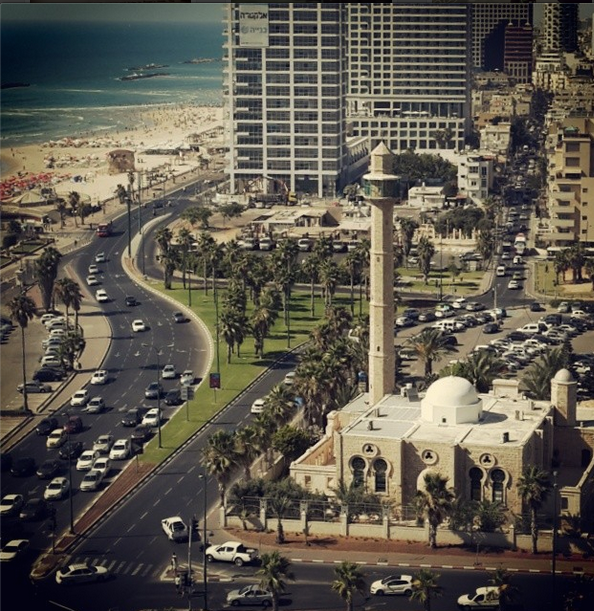
To appreciate the quiet, I arranged for an overnight away last week during one of Tel Aviv’s loudest nights to celebrate my husband’s milestone 40th birthday. Dan Panorama Tel Aviv made it easy to find quiet by upgrading our room in the hotel to a VIP suite on the 17th floor far away from the characteristic Thursday night noise and with an incredible view of the sea.

view from dan panorama tel aviv

Knowing in advance it was my husband’s birthday, they also sent us up a complimentary bottle of wine and other goodies (travel tip: always tell the hotel when you are celebrating a special occasion. They want you to feel special.)

Taking advantage of Tel Aviv’s annual White Night, we headed over to the Tel Aviv Museum of Art to explore. Nothing like a few hours of mindless meandering and contemplative staring to help you completely forget you have children (also helps that I completely trust my kids in the care of their grandparents.) We spent a lot of time in David Nipo’s “I Returned and Saw Under the Sun” exhibit of figurative-realist paintings; astounded by how real his figurative-realistic paintings come across. It was difficult not to touch the canvas to confirm the images were created from paint and not photography.

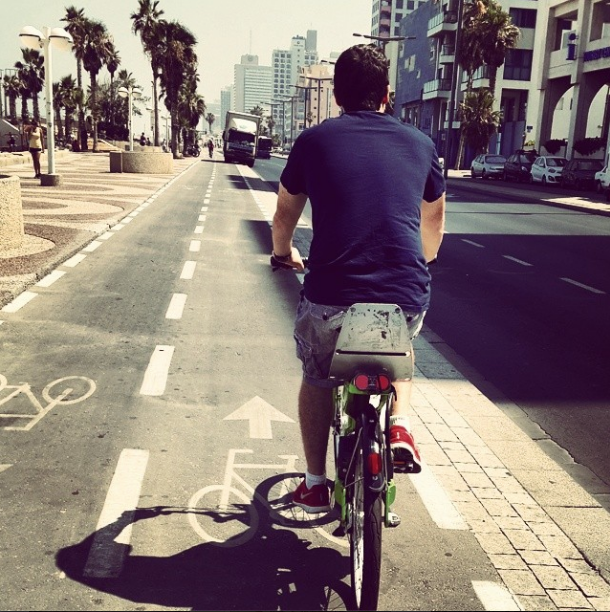
The next morning after a fantastically enormous Israeli breakfast buffet, my husband wanted to ride bikes. I wasn’t so eager because we were in the middle of a heat wave — even at 9 am near the beach the air felt oppressive. But I humored him and was glad in the end.

Husband on Bike. Photo by Jen Maidenberg

We rode up the beach and then through city streets, stopping at a vintage shop where I bought a record (which I can’t play) and a set of books on tape (which I can) and then headed back through the city to the Dan Panorama to clean up before checking out.

I noticed as I was dressing that I was dressing for life with children. The previous afternoon I wore my strapless dress with nothing underneath (nothing but underwear, dirty mind!) I wasn’t worried about having to bend down to pick up a crying child, nor was I concerned said child would want to grab me, as my children often do, without thinking what gravity will do to a strapless dress when it meets with a tiny clutched  fist.

I can’t say I didn’t want more — more time dressed like the woman who didn’t need to worry about the elements. More time meandering off schedule. More time listening without paying attention. I wanted more.

But as the Buddha did say: “A fool is happy until his mischief turns against him.”

There is a time for mischief (for desire, the Buddha might or might not say) and there is a time for responsibility.

I hope that in my next parenting chapter, I learn better how to blend the two … and more often.

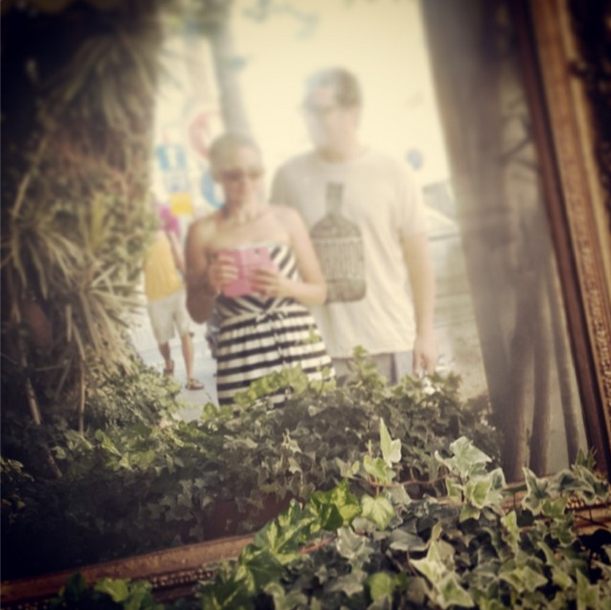
jen and avi reflection june 2014

Because I believe it’s at the intersection of noise and quiet that we are most joyful.

Even those of us easily startled.


Climate Changes, Community, Culture, Letting Go, Love, Mindfulness

Totally awesome redefined

I’m a girl who grew up in the totally awesome eighties, so it’s taken time for me to integrate the word awesome into my system with an emphasis on awe. But as I am awakening more to the magic in my life and in the world around me, I’m finding it necessary to rethink, “awesome.”

I processed this realization as I watched a trailer of an upcoming film in which astronauts describe what many of them say was the life-changing experience of viewing Earth from space.  Shuttle/ISS Astronaut Nicole Stott (who looks more or less my generation) says, “Awe is one of those words that you have a better understanding of once you see [what the planet looks like.]  I felt like using the word awesome was totally appropriate.”

(OVERVIEW from Planetary Collective on Vimeo.)

Listening to the interviews with the astronauts, combined with commentary from philosophers, made me think that a trip to space would be a suitable prerequisite for all youth entering adulthood. What if, instead of going to college or the military, human beings first shot up to space, gazed out at our collectiveness on this planet, and wrote a poem or a song? What if they curated a photo exhibit or painted a picture or choreographed a dance or just simply wept with understanding and wrote an essay called, “What I did on my summer vacation in space?”

Astronaut Edgar Mitchell may have been the most impacted by his experience viewing our civilization from above. Back on Earth, he later formed a non-profit institute that researches meditation, consciousness, and human potential. Mitchell says in the film trailer:

“That’s a powerful experience, to see Earth rise over the surface [of the Moon].   But instead of being an intellectual experience, it was a personal feeling… accompanied by a sense of joy and ecstasy, which caused me to say ‘What is this?’ It was only after I came back that I did the research and found that the term in ancient Sanskrit was Samadhi.”

I highly recommend watching this powerful trailer and then letting me know what was awe-inspiring for you today. For me, it was a dream I had last night that came true a little today; it was a work opportunity that appeared at the perfect time; it was a song I hadn’t heard in 18 years but appropriately so since it only suited me today.

Some say there was a shift in consciousness that took place in 1968 once humans got a glimpse of the planet from space. And that this shift is ongoing today.

“This view of the Earth from space — the whole earth perspective — is the true symbol of this age and i believe what will happen is there is going to be a greater interest in communicating this idea because, after all, it’s key to our survival. We have to start acting as one species with one destiny. We are not going to survive if we don’t.”  — Frank White, author, The Overview Effect


Love, Relationships

A date with Haifa

Yesterday I took my husband to the ER for symptoms he has been suffering for over a week. Fortunately he was released at the end of a very long day and evening with a diagnosis of pneumonia. Serious, but not as serious as we thought, and treatable with antibiotics. And so … relief.

We both hate the hospital. I suppose most people do. Worse than the fear of germs for me, though, is the overwhelm I experience in the middle of all that humanity.

I’m a Real Emotional Girl.

As much as my sensitivity allows me to understand and connect deeply to people, it also is able to submerge me beneath a deluge of compassion.

I may drown there.

The ill. The ones who are afraid for the ill. The ones who care for the ill. The ones who pray for the ill. The ones who clean the toilets, the floors. The ones who secure the entrances. The ones who drive the ambulances. The ones who are too young to be there. Too old to be there. The ones who moan in pain. The ones who moan with grief. The ones too weak to moan.

Through an invisible intravenous line, they enter me.

It’s rough.

For a while there in curtained off section #17, I wrote poems and jotted down notes for story ideas. Tried to read a few pages of the book I brought with me. Scrolled social media for updates on the three kidnapped boys. Then my husband told me to leave.

“Go get lunch,” he said. But he meant, “Leave here since you are able.”

I never walk around Haifa. Never; except from my parked car to the ER or from my parked car to a doctor’s office and once from my parked car to get my Israeli driver’s license.

In fact, I have never walked around Haifa for fun. Even though I live only a short drive away, I end up in Israel’s city by the bay for appointments or by surprise. And not the kind of surprise you look forward to.

I’ve never explored Haifa even though the views are known to be incredible.

Haifa at dusk from Carmel Hospital

Without much hesitation, I did as my husband instructed. I knew I could use some fresh air, especially since an orderly had just rolled in a new elderly patient who looked as if she was on her way to meet the Maker.

I walked down quiet Smolenskin Street where I had parked the car, past old-school Israeli apartment buildings, some with beautiful gardens.

Garden apartment on Smolenskin Street

and momentarily felt uplifted. I traveled by foot up to Horev Street where I got an hafooch and a cheese croissant at Roladin. I hadn’t had much of an appetite all day. I think the worry finally hit my belly.

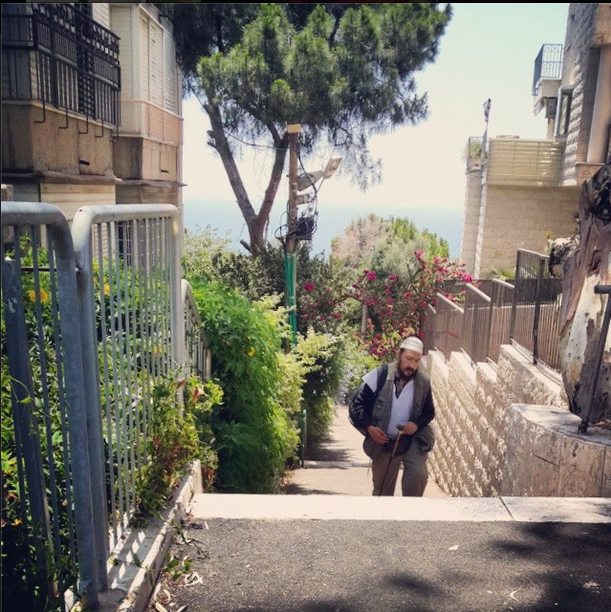
I wandered in and out of a few shops, met a Tarot teacher, spotted a Tibetan bowl I liked (hint hint: possibly a birthday present for me!), discovered the Rabbi Yosef Dana steps

HaRav Yosef Dana steps with view of the Mediterranean, Haifa

And, most unexpectedly, stumbled upon a small shop inside a mall on the corner of Horev and Gat, a small corner of which was stocked with used books. A whole shelf full of English titles! From Umberto Eco to VC Andrews.

used book store in haifa

I was in the middle of debating whether or not to buy Paul Auster’s Oracle Night when my husband called asking me to return to the hospital. I quickly paid for the book based solely on the jacket cover copy and the title (I’m a sucker that way for marketing). Only when I got back to his bedside did I read the first line of the book in a bit of astonishment:

“I had been sick for a long time. When the day came for me to leave the hospital, I barely knew how to walk anymore.”

It stopped me. Compelled me to look over at my husband with a bit of concern. I’m susceptible to coincidence that way in the same way I’m sensitive to the swarm of human emotions.

But he looked okay. Better, even. I wrote a note to myself: Sometimes all is well. Sometimes all is now. Sometimes all is here.

What I meant was: Sometimes if it looks like it’s going to be okay, it actually is.  No matter what upset is happening inside the region of your heart.

My husband further allayed my concerns by sitting up and chatting a bit with a me for the first time in a week.

When the doctor came by with a diagnosis (not as severe as we feared) and with a release form to leave the ER, I turned with relief to my husband and smirked, “Thanks, hun. That was the best date I’ve been on in a long time.”  My husband gave me a half smile. He knew what I meant. He’s sensitive that way.


Childhood, Letting Go, Love, Making Friends, Memory, Relationships, Spirituality

The New 40

“40 is the new 30,” said a friend of mine the other day.

That would totally and completely suck, I just realized.

Yes, my hair was blonder.

Me and my first, Dec. 2003, Tucson

Yes, my breasts were firmer.

Yes, I had ten years ahead of me still ‘ til 40.

But …

wow. 30. 2004. Mom of one very restless baby. Up to my eyeballs in change … not bad change but the kind that causes upheaval that equals frequent upset. Orange vomit on my shoulder a lot. Not a lot of friends nearby. Unrealistic expectations of marriage, parenthood, community, work, friendship, life.

It’s not that I’m BRILLIANT now.

But I am now aware enough to know how dumb I am. And how age brings a wisdom born of experience that in some ways is better than firm breasts.

The more I speak about and write about 40, the more people (read “women”) say to me:

I loved my 40s

The 40s have been the best years of my life

I really found myself in my 40s

These kind of comments, from real people, are uplifting and have actually started to ignite in me a desired anticipation — the kind I remember feeling in the months leading up to 13. When was the last time we were truly excited for a birthday … not because we had a crazy evening planned or a vacation, but because it was appropriate to celebrate our advance? What happens to our birthday joy as we age?

I have a summer birthday and so I used to be very familiar with anticipation in advance of birthdays. My friends often reached milestones ahead of me : 13, 17 (driving age in NJ), 18, 21, etc. Those last few months before it was my turn were always killer. The summer I was 12, waiting for 13, I remember telling boys when they asked at the camp social, “how old are you?” that I was 13. That my birthday had been in April. For some reason, that mattered then. As if they wouldn’t ask me to dance unless I was old enough to have boobs. (The boobs wouldn’t come for 4 more summers.)

Last summer, when I turned 39, I remember feeling a sense of dread.  It didn’t help that last summer I also suffered from a bunch of moderate health issues, serious enough to impact my daily life . (It’s likely that at least half of them were stress-related, and maybe 1/4 “pre-40” related.)

My 39th birthday, spent with family by the Jersey shore was lovely, but undercut by a constant heartburn. The antacids didn’t help. The gluten-free diet didn’t help. The technology detox didn’t help. I understand now it’s because the heartburn was only partly physical. Much of it was existential. Prilosec can’t help with that. Not even the Wild Berry flavor.

This summer, I am determined to drop the burn. Be all heart. Feel 12 again. I am determined to want 40.  So badly that I pretend like I already am.

Boobs, or not.


Books, Climate Changes, Community, Environment, Food, Health, Modern Life, Relationships, Religion, Survivalism, War, Writing

What I imagine when I imagine the end of the world

Short Fiction

When I imagine the end of the world, I am alone at the edge of a cliff. It’s evening and God Only Knows by the Beach Boys is playing on a box radio I looted from my neighbor’s basement.

If it were a movie, I’d be gazing out over the city lights of Los Angeles just as the electricity went out, as one by one the skyscrapers lost power, and the city fell dark.

A blazing comet approaches.

Or a neon green burst of light from beyond the reaches of time.

Or a giant tidal wave shimmies up the coast.

If it were a movie, my heart would swell as I accepted my fate. I would open my arms and embrace humanity’s extinction for I knew I had lived life to its fullest.

But it’s not a movie.

It’s my real life.

In which almost every day is the end of the world.

* * *


I have a disease without a name.

If it had a name, it would be called something like redemptionitis or zombisteria or hypotrychtapocalypse.

The closest anyone has ever come to labelling my disease was in the years leading up to the much-publicized end of the Mayan Calendar in December 2012.

Doomsday Phobia, they called it.

Anyone who stocked their basements with toilet paper and canned sardines in preparation for Armageddon; anyone who hoarded books of medicinal herbs or learned how to forage for mushrooms in a weekend workshop held in the back woods of Westchester County, NY; anyone who stocked in the back of the medicine cabinet antibiotics from their child’s most recent prescription for strep throat: We were all quietly laughed at and labeled “preppers.”

Back when it was cute, the way a touch of crazy is cute, as long as it doesn’t lead to a shootout in a movie theater.

Back then, I wondered to myself if I was on a CIA watch list. Did they suspect me? A suburban New Jersey mom of two? A college educated professional with a real job and a real paycheck?

I certainly didn’t fit the profile.

I wore Ann Taylor suits and took the NJ Transit train every day from the suburbs into the city where I walked six blocks to my midtown workplace. In our open floor plan, I had the closest thing to an office – a transparent cube looking out over the East River, made from glass walls so others could look in. It was called the Rainbow Fish Bowl because of the stickers my daughter once placed on the sliding glass door. Every other Friday, I got a pedicure at Trudy’s Green Nails on Lexington Avenue. I was in a book club. I volunteered at the preschool. People liked me.

Each day, I put effort into smiling at my coworkers as if life wasn’t about to abruptly end by Avian Bird Flu.  I’d make jokes over the phone with the sales consultants who’d ask me if I thought wheatgrass was gluten free. I played along. Drank Nespresso in the coffee room with the writers; made snide remarks with the editors about our wacky advertisers; especially the ones who placed ads offering organic MREs (meals-ready-to-eat) purported to last 15 years. Secretly, I wondered if it made sense to pay for organic canned food when the cans were probably lined with BPA.

Could my coworkers view my computer monitor, however, they would have noticed I spent half the day reading headlines on alternative news web sites, corresponding in code with people named “Zen Grower” about the latest UFO sighting over New Mexico or the best price on bulk dehydrated food. I read blogs from people living in half-completed bunkers in the mountains of West Virginia; with strangers supposedly privy to knowledge that was never reported on CNN.  “The ‘Illuminati’ kills scientists, you know,” wrote Jade, my telepathic friend. She communicates with an alien race who is trying to save us from another alien race who’s been trying to destroy us since the Revolutionary War. “All war,” says Jade, “is the fault of the Reptilians.”

I would search “new world order Russian scientists reveal underwater pyramid” and “fourth dimensional beings plot to reprogram our brains” because I knew the search results would give me the intel I required to plan. And I planned. I had one to-do list that included vaccinations, playdates, and dentist appointments. Another to-do list for the end of the world.

My day job, I guess, was a ruse.

It was a way to satisfy my compulsion and still remain a member of society. Or so says Dr. Solomon. I saw it as a healthy way to educate myself on tactics I would surely need for the post-apocalyptic world I was certain was looming. Easily-learned skills like:

  • Reiki for when we no longer had the option to see surgeons for bone breaks or muscle sprains;
  • Acupressure, which I would use in the place of the anti-inflammatories we so depended on in the Before Times for headaches and menstrual cramps;
  • Nutritional supplements and herbal teas — like Chia and Flax seeds; dandelion and feverfew — I’d grow in a rooftop urban garden, where I’d herd my children before the Flood.

Back then, I was Advertising Director of a major national healthy living magazine. I courted and secured advertisers from multiple sectors: home and garden, health and wellness, exercise and fitness, diet and nutrition. And, of course, our bestsellers: classifieds from personal vegan chefs, Hindu tantric sex practitioners and Henna artists.

I was really good at my job. I was good at selling ads because I really believed all of the service providers and multi-level marketing professionals.  When they heard acknowledgment and acceptance in my voice over the phone, they eagerly placed half or more of their advertising budget in my hands.

I understood them, after all. Their fears. Their hopes. I knew intimately what it felt like to want to survive, but more so to want to be listened to and believed.

In my own experience, though, there were therapies and products that worked, and those that didn’t. Quackery, some might say. Except in my business, we never use the word quackery. This would alienate the chiropractors and homeopaths who placed half-page color ads for their self-published e-books.

Reiki, for instance, didn’t cure me of recurring yeast infections, as promised. But my Thursday afternoon sessions with Liane, the psychic massage therapist did help identify a sugar addiction. She also told me I had powers like hers; that I could, if I wanted to, study to be a healer.

She was right. I am a sugar addict. But she was also wrong. I can’t seem to heal anyone.

I kept seeing Liane on a regular basis and even believed most of the stories she would tell me: How her client was miraculously cured from testicular cancer by shiatsu and a six-week juice fast. How her deep tissue hot stone massage helped a couple overcome infertility. How the couple now had triplets – all girls.

I believed Liane. Except for that one time she told me that my migraines were the key to time travel, and that I should stop taking the Relert when the auras came on. I also believed the magazine readers who emailed testimony after testimony to our editorial staff profusely thanking us for publishing stories that changed their lives.  I believed the clippable lists we elegantly designed for ease-of-use, like “Pema Chodron’s Top 5 Mantras for Mindful Sex.”

I believed we were helping people.

I believed the jacket copy on the bestseller of contributing editor, celebrity physician Dr. Joel Willey– a book I personally reviewed for the magazine last December — promising increased sexual desire and stamina for peri-menopausal women by switching to a vegan, carbohydrate-free, anti-inflammatory diet.

I believed it all.

Which, apparently, is a symptom of my disease.

I have a disease without a name; without a designation, but with a host of exhibiting symptoms that collectively, for the past fifteen years, I called “conscious living,” but collectively make up a manilla folder of evidence against me, sitting on an antique desk in Dr. Solomon’s office.

All these “symptoms,” which were formerly advantageous qualities on a resume when applying for a job at a natural healthy living magazine, are now being offered up as evidence of my insanity. My inability to continue as a functioning member of society.

My disease is without a name. It’s as lonely as a woman standing on the edge of a cliff waiting for the world to end.

But, as it turns out, no name is necessary.

* * *


This work of fiction is an excerpt from an original short story by Jen Maidenberg, “What I imagine when I imagine the end of the world.”

Family, Love, Memory

Let the summer of 40 begin

When I was a younger girl, I never imagined I’d marry a guy my own age.

It’s not that I was into older guys.

Mamash, LO, as we say in Hebrew. Definitely NOT.

Older guys scared me. I typically dated guys who were maximum two years older.  This was my boyfriend demographic for many years.

Guys my own age were my friends; little brothers. Guys older than me by more than two years also landed in the friend zone; as the older brother type.

An older guy liked me once. He was in his late twenties. I was still in college. The difference between 28 and 20 at the time seemed immeasurable. He was also British. He drank premium beer from a bottle because he liked the taste. I was still a 25 cent pitcher, chug it to get drunk sorta girl. When I was drunk, I didn’t understand what he was saying. Something about football, something that rhymed.

A younger guy liked me once. I went on one date with him. I was worried about kissing him because I had eaten garlic pizza earlier in the day and the taste would not leave my mouth. But kissing him was the closest I ever came to kissing my brother. It was like that scene in Back to the Future where Marty kisses his mom in the car. We did not go on a second date. But we’re Facebook friends.

Once, just after I graduated college a much older guy liked me. He was a television reporter. Even though that held significant appeal to me, I was still too afraid of the age difference to do anything but flirt and giggle, flirt and giggle. When he called me on the phone to ask me out the next day, I screened his call on my answering machine. Multiple times.  Later, it came out that I was just one of many young co-eds this reporter asked out over many, many years of being married and on the news.

All that happened many years ago and is really the long way of getting to the fact that in the end I married a guy born less than two months before I was. And this summer, we both turn 40.

??????????????????????????????????????????????????????????

And while I never imagined I’d marry a guy my age, I have to say there’s something comfortably fun about reaching this milestone together. And definitely about celebrating it — slowly and extended over an entire summer.  We kick it off in June with his (I’ve already planned a birthday weekend spectacular in Tel Aviv at the Dan Panorama hotel) and finish it at the end of August with mine (still a surprise hanging over my husband’s head).

In the middle? A summer of celebrating the unexpected pleasures and surprises 40 brings … because I am determined to manifest a magical summer. Let’s consider it an advance on my birthday candle wish.

Stay tuned and so will I.


Kibbutz, Writing

The obligatory notice

Almost as often as I change the furniture around in my house, I like to play with the look and feel of the blog.

Please note the new design only enough to be aware that it’s still me.

photo passover 2014

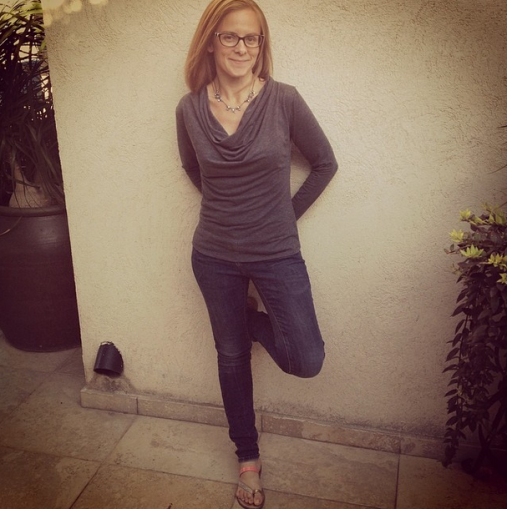
Fine. I admit it. I was really looking for an excuse to post this not-half-bad picture of almost-40-year-old-me. The redesign is just a ruse.

Not half bad, right?

But DO note the new MENU in the sidebar of the new blog design. (On mobile devices this menu should appear at the top, on the left hand side.)

Soon more menu selections will appear offering easy access to the types of posts you like most. (In other words, if you don’t love poetry, you can skip quickly to travel, wellness, essay, kibbutz life or photography.)

Thanks for hanging around.