Childhood, Education, Family, Letting Go, Love, Memory, Relationships, Writing

First love

Among my cardboard boxes, there is another. It’s plastic. A clear Tupperware container with a blue cover marked “Jen’s papers.”

I laugh a little at this because the markings on the masking tape are in my mother’s handwriting and I would have expected it to read “Jennifer’s papers.”

But Jen is shorter than Jennifer, shorter than Jenny, shorter than any of the names I answered to during the time of the papers. And easier to write on a label.

I opened this container a few months ago when the shipment arrived, and was first struck sick by the smell, a strong combination of mildew and 30-year-old paste.

I quickly secured the top back on  (imagining my own ironic, horrible scifi death by spores) and put it back on the pile of boxes for later review.

A bit heartbroken, I intended to throw the whole thing away. Clearly the papers inside were ruined; forgotten leftovers stored too long. But before I got rid of all of it I wanted to document the contents.  After all, my mother took care to fill this container over the course of a decade and to rescue it — not once, but many times — from basement catastrophe (flood, hurricane, divorce).

Despite potential ruin, after all these years, the Tupperware reached its destination: in the hands of grown-up Me. It would be a shame not to unload its cargo. Also, and most important, as a mother who hoards, I know well the affection wrapped up in the saving of those papers.

I approached the container again this week, when I had a few hours to myself during the day and when the weather was mild enough to be able to go through them in fresher air outside.

I took out our good camera and prepared to archive my findings.

I knew that most of what I’d find would be handwriting exercises, A+ papers, and art projects. Nothing extraordinary, I imagined, would be discovered inside. What could I possibly have produced in elementary school that would elicit any deeper emotions than sentimentality? On the other hand, my boxes  constantly surprise me and this one was no different.

Among the findings:

  • My first voting ballot — indecision written all over it — from a Weekly Reader in 1980. Anderson or Reagan for the Win? I had checked off both, though I wonder if the Reagan was an afterthought as I remember distinctly wanting Anderson.
  • A report on Voyager 2 when it was still hovering near Saturn
  • A now-vintage souvenir postcard sent to me and my brother (addressed to Miss Jennifer and Master Jason) from Disneyland
  • And, a drawing I made when I was three or four in which my mother’s image was a presence greater than anyone else on page, larger than me, larger than life.

I also found love letters.

Between me and Mrs. Aducat.

I completely forgot loving Mrs. Aducat.

Mrs. Aducat, who wasn’t even my homeroom teacher, not even the woman I spent most of my day with in first grade, but simply my reading teacher. The woman who taught me language, sentence construction, how to express myself with carefully crafted words.

Based on the persistence with which I sought her love, my affection was strong.

ms aducat i love you

Over the course of months, I wrote many love notes to Mrs. Aducat on the back of my writing exercises.

And she wrote me back.

“I love you, too, sweetie,” she wrote in red cursive on the back of one.

And with a smiling heart on another.

i love you too jenny

“Yes!” she answered me with an exclamation point one time when I asked her if she loved me too.

I even made it simple for her once. YES or NO, I wrote under two boxes. An ultimatum, perhaps?  If so, she took the bait and checked off YES. “Lots and lots,” she wrote underneath it in her red pen.

I am struck by this.

I am struck by the love given me by a grownup; not a relative, just a woman paid to teach me to read.

And I am struck by the unrestrained expression and bold audacity with which I expressed my love for her and asked for it in return.

Oh, to love and be loved again — unabashedly, without reserve — as I did, and was, when I was seven.

= = =

This is one in a series of essays inspired by my cardboard boxes. If you like this post, and want to know how it began, read A Case for Hoarding. One post in the series, Note to Self,” was recently featured on Freshly PressedAdditional posts are tagged “the boxed set series“.
Family, Love, Parenting, Relationships

The lump in my throat called life

The first sensation

is a swell

in the space

behind the back of my tongue but before my

esophagus.

What is that space called?

High up

on the other side of gagging?

I call it my crying space.

The space tears come from.

Ha!

You thought crying started scientifically in some space

known as

ducts,

No way, Jose.

Crying starts as a lump —

there in that undefined on the anatomical map because it’s function is almost obsolete

like the appendix.

Except it functions still.

I know it because I try to make it stop sometimes and it won’t.

Good cries

Bad cries

Nervous anxious I don’t want to talk to you right now cries

How could this happen I don’t understand it cries

My baby’s okay my baby’s ok my baby’s o.k. cries

And you …

you little one little new one little brand new life that just began first as an idea then as a mister mister then as a real live thing in the world as a lump in my throat cries.

You started in someone else’s belly but for me you start now as a lump in my throat trickling up through that space between my esophagus and the back of my tongue.

I breathe in relief and gratitude and respect for your mother.

(I also sigh a long sigh called MOTHERHOOD because this is what all mothers silently sigh the minute a new baby is born and all our collective memories swirl together in an almost scream.)

But then I stop.

You are you. Something new.

The lump, I swallowed it.

You are in my stomach now. In the space I hold allllllllll my love. All my love is there. So much. Too much. Old love. New love. If I could keep it all there I would but I can’t and it turns into lumps sometimes. But what’s there in my belly, all that love, keeps me alive and going and facing forward.

Love. New love.

New life.

You.

Letting Go, Love, Memory, Relationships

Music is a Gift with Legs

I’m a big believer in the magic of books, music, and people falling into your lap when you least expect them to and when you are most ready to appreciate their messages.

(For this reason, I’m about to download The Happiness Project since three people in as many days have referenced it to me.)

But just because the wisdom fortuitously appears at just the right time doesn’t mean its vessel hasn’t fallen into your lap previously … maybe even shimmied back and forth a bit; stirred almost otherworldy sensations down there. Somehow, though, you overlooked the deeper message the first time around.

What’s even more incredible is when the words of comfort or inspiration have been there all along — in your CD cabinet, let’s say — just waiting to be understood.

There all the time
There all the time

This is the case with my collection of Grooves compilation CDs that were a hand-me-down gift from a boyfriend’s mom in the mid-90s.

I have seven of them still. Two I’ve loved since college, but the rest mostly gathered dust buried there at the bottom of my alt/folk rock section. This past week I’ve been listening to volume five (one of the dusty ones) on my way to work and school. It’s been a week of transition, and a week in which I need to feel understood, and loved.

It’s been, as I like to say (quietly to myself), a sing-with-the-windows-down kinda week.

Here’s the playlist of volume five:

Hold Me Up – Velvet Crush

Layer By Layer – Steve Wynn

You R Loved – Victoria Williams

Tell Everybody I Know – Keb Mo

Partisan – Katell Keineg

Holding Back The River – Luka Bloom

Who’s So Scared – Disappear Fear

Dreams In Motion – Felix Cavaliere

Good Times – Edie Brickell

Mockingbirds – Grant Lee Buffalo

Send Me On My Way – Rusted Root

Her Man Leaves Town – Rebecca Pidgeon

Two Lovers Stop – Freedy Johnston

You And Eye – David Byrne

Oye Isabel – Iguanas

And If Venice Is Sinking – Spirit Of The West

Century Plant – Victoria Williams

I’ve had this CD in my possession for two decades (the copyright says 1994 on the disk jacket), but I’m only now finding meaning in the messages.

Only now.

This is what good music does to a soul: Seeks it out and seeps in deep just when the spirit craves it most.

And the songs, just as they were advertised at the time, are fresh. juicy. like new. 

Gifts …even in the form of hand-me-down compilations CDs … have legs, I guess. And can walk a long, long distance in order to deliver a much-needed message.

Kibbutz, Making Friends, Memory, Mindfulness, Relationships, Writing

Return to sender

I let go of Shira yesterday.

I called her up on the phone, walked over to her house, met her on the path there, and let her go.

She laughed.

So did I.

It was swell.

I had in my hand 18 year old Shira.

With love, I gave her back. To 40 year old Shira.

Some would call this surreal. Others would call it silly. I call it an extraordinary gift.

How did it happen?

In my cardboard boxes, I found letters. Shoeboxes filled with letters. Composition notebooks bookmarked for years with unsealed envelopes torn open by younger hands. Manilla folders stuffed with old exams, but peppered here and there by notes unsigned; the author’s identity only revealed by her handwriting.

I found a few from Shira. (Even if she didn’t live across the street from me here on this kibbutz in Israel, I would have recognized her 18 year old handwriting. It’s distinct. And handwriting, like phone numbers from childhood, is something I tend to hold on to strongly in my memory.)

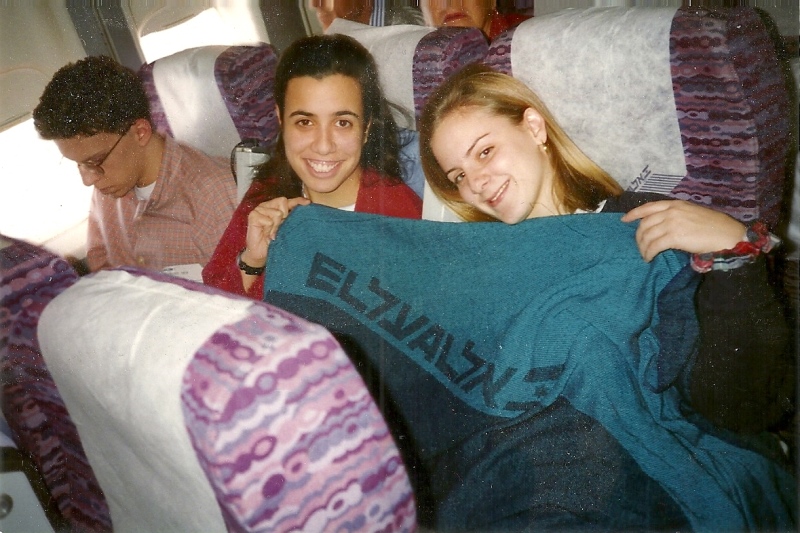
The letters were from 1991 and 1992. The summers she and I respectively traveled to Israel for the first time.  In 1993, we’d arrive here together one winter break during college as participants on a 2-week volunteer program. We’d be stationed on an army base that’s now less than an hour drive away from where we live.

shira and jen 1993

The letters, when I read them yesterday for the first time in more than 20 years, emphasized a certain awareness I’ve already arrived at on my own.

Shira, I’m so grateful to say, has known two different Jens, maybe three, maybe even four or five, depending on where you slice me.

It’s a gift, indeed. A friend who knew you as a girl. Who knew you when you were thinner, blonder, filled with greater energy than you are now.

But an even greater gift is a friend who notices how much you’ve grown since then. Who knew you when you were less worldly, to say the least, less clever, less kind …and has forgiven you your youth.

In reading the letters, I remembered a younger Jen and a younger Shira, and a much younger friendship. I remembered the moments that punctuated that time. In her short letters — one scribbled in cursive on airmail stationery, another stuffed inside letterhead from her father’s business — our world in ’91 and ’92 came  alive for a moment and made me smile. In a different voice than the one I know today, 18 year old Shira reminded me of who we were then.  I was touched by the Shira I had forgotten; touched by the Shira I had never known then. I also fell in love for a moment with the Jen I must have been then. A Jen I never knew I was; not at the time.

It’s complicated — the gift of old letters, of old friends — but it’s also so very simple.

I could have thrown them away, the letters. Like I’ve tossed other papers found inside the cardboard boxes.

Instead, I decided to return them to sender.

It seemed symbolically appropriate. I can’t explain it, though I’ll try.

I returned them not because I was certain Shira would want them or need them (though it was a kick to laugh over them for a minute or two), but because handing over Shira to Shira seemed like the right thing to do.

Giving Shira’s letters back to her — instead of holding on to them — allows Shira to be whoever she wants to be in the world. Now.

And forces me, in a way, to accept her as such.

Not the Shira I used to know. Not the Shira who was what she was then. Not the Shira I thought she was yesterday.

Just Shira. Now.

Giving Shira back her letters gave me the opportunity to explore a concept I have great difficulty with (and the chance to practice on someone I knew would make it easy on me!)

The concept? Giving up my past so I can be present.

I can’t say I know what the outcome of this experiment will be. But something about it just seemed right.

Just like, I suppose, something felt right about saving letters in a shoebox.

* * *

This is one in a series of essays inspired by my cardboard boxes. If you like this post, and want to know how it began, read A Case for Hoarding. One post in the series, Note to Self,” was recently featured on Freshly PressedAdditional posts are tagged “the boxed set series“.
 

Mindfulness, Modern Life, Philosophy, Relationships, Spirituality

The Unlikely Path to Inner Peace

I just finished reading The Unlikely Pilgrimage of Harold Fry, a story of a man who sets out on a journey, both metaphorical and literal, in search of inner peace and acceptance. A friend, after hearing about “the boxed set series” project I’m working on, recommended the novel as a complementary “research tool.”

It was a good suggestion.

Harold is in his mid-sixties when he receives a letter from a former colleague – a terminally ill woman with whom we understand from the beginning he has unfinished business. On his way to the post office, to drop off a return letter to the woman, he instead decides to deliver the message himself, by journeying on foot across England.

In addition to the truisms delivered throughout the book – wisdom worthy of highlighters and stars in the margins – I walked away with a sense of hope … and of more time. After all, if I am facing and acknowledging my past now at 39, I’m a few steps ahead of Harold, aren’t I? Doesn’t this mean I might actually find my inner peace SOON?

I smile even as I write the words. I know how silly this mindset is – how contrary it is to the intention of finding inner peace.

“Finding it” requires work.  “Soon” implies a deadline. Neither of which allows for the relief that I associate with inner peace. Did I learn nothing from Harold Fry? My imaginary book club asks me right now.

What I did learn from Harold is that we always think we are wiser than we are; that “now” we finally get “it.” And this is where we trip up.

At least, this is where I trip up.

So often, I cringe at or even attack my younger self, as if I am oh-so-much-wiser now than I was then. (I’m not.)

As if I am not making the exact same mistakes now that I did then — just with different supporting characters, and saggier boobs. (I am.)

What if the way to inner peace actually is acknowledging we will never truly be wise? Just more aware. Just more willing to learn from our past and from our present. Just more compassionate of ourselves and others when we trip up (again and again and again).

And what if the work to do was actually not such hard work? What if the assignment was to simply be more open to not knowing.

Not knowing the way to inner peace; and saying, “cool.”

Allowing for the possibility of finding it in unexpected places, faces, and moments.

***

I imagine a fat, happy Buddha smiling at me and nodding.

“Yes, my young padawan, that is Buddhism 101.”

What can I say? I’m a slow learner.

Very, very unwise, indeed.

Relationships, Religion, Writing

View from above

No matter how blurred or undefined my picture of God is, no matter how my connection to religion swells or retreats; the one God-related belief I hold fairly dear is omniscience. If God were a storyteller, let’s say, he’d be third person with both a bird’s eye and a worm’s eye view of all that ever was and all that ever is and all that ever will be.

Which means, I also believe, that God laughs a lot.

Laughs at our missteps, our confusion, our despair — in a loving, playful way, the way a parent might smile watching her toddler fall hard on his bottom over and over again in his attempts to learn to walk.

Or the way a writer foolishly grins as he shapes his characters because a writer is, in a way, in love with all the characters he creates — no matter how ugly or beautiful, how wise or how foolish.

I don’t necessarily believe that God is omnipotent, however. I don’t believe he interferes in the doings of man, though I do imagine that he might adjust the direction or speed of the wind from time to time so that man might meaningfully turn his head or shift his gaze. I believe that God watches us, and more than anything else concrete, I understand God as a representation of that great unattainable knowledge and understanding I’ll never have, but will never stop seeking.

I imagine, too, from his third person point of view, God watches us with great compassion.

I wish I could borrow some of this compassion from time to time when I tell myself my own story; as I do when I lie in bed at night and review my day; as I do when I tell “truths” about myself or make claims about how other people see me (as if I could really know).

Or when I dig through the first person evidence of my life: When I read my old journals (and cringe at my naive innocence or unabashed immaturity); or remember (out of the blue or obsessively) the things I’ve done I wish I hadn’t or wish I had handled differently.

Did you ever notice how much compassion we can summon up for others? For strangers especially? How our hearts swell when someone else is dwelling on what they once did wrong?

Yet, it’s insanely difficult — if not near impossible — to summon up that same compassion for ourselves. To allow ourselves to view our stories as God might or as the third person omniscient narrator would– minus regret, minus shame, minus fear — simply with close observation, the space for varied interpretations, and occasionally, with a playful compassionate laugh out loud.

Community, Love, Mindfulness, Philosophy, Relationships, Religion, Spirituality

Synchronistically delicious

I am often troubled when I hear people use the word “serendipity” when I think they mean “synchronicity.” But I never really investigated the difference between the two words.

In my unresearched opinion, I always imagined synchronicity as attached to “meaningful” or extraordinary. Whereas serendipity is more playful, like a cup of frozen hot chocolate.

serendipity

Lucky. Fortuitous. Unexpected. Right place at the right time sorta thing.  Whereas synchronicity … when it happens … almost feels as if its arrival was fated. Expected, even if not by the participants. Anticipated, in some way, even if unseen to all but the gods until the very moment the synchronicity occurs.

Synchronicity, to me, carries in its meaning a certain divinity, a certain magic.

So much so that I remember distinctly when and where I was when I first heard the word and its layperson’s explanation.  I was at the lake house of a friend in celebration of her engagement. While dipping my feet in the lake, I chatted with a friend of the bride-to-be whom I’d never met before. She shared with me the details of a paper she was working on (perhaps her Master’s thesis or her dissertation), all on the topic of this experience called “synchronicity.”

I admitted to her that I’d never heard the word before.

“Oh,” she smiled. “But you’ve certainly had this experience.” She went on to describe what I had always thought of (at least since reading The Celestine Prophecy in 9th grade) as “meaningful coincidence.”

However, “meaningful coincidence” always sounded lame. Such a deeply moving or spiritual encounter needed a better descriptor.

“Synchronicity,” a word steeped in the concept of time (my favorite philosophical topic of conversation both then and now), was perfect for me. I was so thankful for having met this woman at the lake. Our meeting was, in fact, meaningful. Synchronicitous (synchronistic?), we joked at the time.

Perhaps this is why I loved so much Ginz’s response to my “haiku challenge” yesterday.

Walking alone is
often the first step towards
synchronicity.

This, indeed, is what I was going for when I was trying to describe the outcome of a walk alone I took yesterday. Too me, synchronicity, isn’t just a word, but a timely, yet timeless explanation for magic, for meaning, for connection.

When “alone” unexpectedly transforms into “no longer alone.” And loneliness is replaced by oneness.

Relationships, Writing

Finish this haiku … if you can

I was attempting a haiku this morning when I realized there is no good antonym for alone.

Walking alone is
often the first step towards

These were the first two lines of an idea I was trying to work through by haiku. Except, I couldn’t finish it in a satisfying way.

“Together?” Is together really the only antonym for alone?

I was going for an emotion, a feeling, a deep sense of being close to another person or to humanity. Feeling less afraid. Feeling as if someone else understands you.

And “together” … just doesn’t do it.

Together is so physical. It’s a fixing word. It’s an extrovert’s word. It’s not the word I mean at all.

Want to help me finish the haiku?

Walking alone is
often the first step towards…

I’d love it if you’d give it a shot in the comments below or on your own blog with a pingback here. If your haiku especially speaks to me, I’ll reblog it.

Letting Go, Love, Memory, Mindfulness, Modern Life, Music, Philosophy, Relationships, Uncategorized

Both sides

On my drive home from work, I play a game sometimes.

I choose a song to listen to on YouTube. When it finishes and when I get to a stop sign, I look through the suggested songs at the bottom and choose one. That’s the game.

I typically get through three or four songs this way. (I have a 25 minute drive but not so many stops along the winding mountain roads.)

I play this game, as opposed to creating a playlist or listening to a CD, because I am lazy and because Pandora doesn’t work in Israel and because I have this notion that there is a certain magic to the way songs appear in the recommended song section, as opposed to this thing called an “algorithm” I hear so much about but have no idea what it really, truly means. And anyway, I’d rather believe in magic, in an elf DJ who lives inside my smartphone.

It was in this way that I came upon a live version of Both Sides Now sung in 2000 by Joni Mitchell.

I was first introduced to this song in 1988 by my friend Suzanne. I remember because anything folksy or hippiesh I pretty much learned from Suzanne, whose parents were once, apparently, hippie-like, or at least more hippie-like than any of my other friend’s parents in that they owned a guitar and watched Woody Allen movies and collected Bob Dylan records and other stuff I am not at liberty to reveal because you can only embarrass your own parents on your blog, not somebody else’s.

I say this only to let you know that I’ve been listening to Both Sides Now for a long time. I know all the words. I know Joni’s voice and pitch in the song by heart. It made many a mixed tape because I loved it so.

So when I heard Joni from 2000 sing Both Sides Now on my smartphone today, I almost didn’t recognize her. Her voice had changed so. It’s deeper, raspier, more…broken. In a way middle aged women are broken. In a way moons and Junes and Ferris wheels one day become broken after years of working hard on automatic.

I, like I’m sure many who’ve heard this later version of Joni sing this poignant song, thought, “how very perfect.” She is singing this from the other side, and the change in her voice — now alto and smoky with maturity — matches perfectly the impression of being there, then, in the days when clouds only block the sun. One listens to this version and really feels as if Joni has been through it all. One listens to this version and can sense beneath the vocals an oh so subtle laughter, as if…

She sounds resigned, Joni, and yet, satisfied. Good with the turns her life took. Or at least accepting of them, even those which were unexpected.

I listened to her and thought about the girl I once was; the girl who once listened to this song mournfully, as if I was already on the other side. As if…

I sang out loud and wondered, “what would you hear in my voice now?” You who knew me when I was young. You who knew me before the years… Before the years carried me over into the other side?

Childhood, Memory, Relationships, Writing

The yellow bowl

I am obsessed with my child’s memory of me

of this moment

of this yellow bowl.

This inaccessible ceramic yellow bowl

perched high upon a dusty refrigerator

will one day be dusty, too —

an image sitting in a drawer waiting to be opened

in my child’s memory.

Inside the yellow bowl are rainbow jelly beans, Polish lollipops

handmade by a retired couple sitting at a railway station.

There are remnants of chocolate wafers, too, and little crystal crumbs from an uneaten

sucking candy.

Pomegranate flavored.

In my child’s memory, this yellow bowl

is the key to happiness

and evidence of goodness

and bad.

It is what determines right and wrong.

It is — and will always be —

a beacon.

“Lost children,

find your way home.

The yellow bowl is calling you back.”

Childhood, Relationships, Writing

He gets like that

One of my dear friends turned 40 today. She was the first of my group of childhood friends to get her driver’s license, the downside of which, I said to her today, is that she also is the first of our group of friends to hit middle age.

Of course, none of that statement is true.

Our friends — the ones who celebrated her 17th birthday years ago — are now scattered around the world, and some are no more our friends than the random stranger from Kenya who friend requested me yesterday on Facebook.

And, what really is “middle age?”

Is it literally the day you turn 40 — is that truly the middle of your life?

I feel as if I passed middle age long ago. Could be that my opinion will change, but I measure time as BC (before children) and WMBBTS (when my boobs began to sag).

So I pretty much hit middle age 10 years ago.

Contemplating my friend’s birthday and hearing a familiar voice in the back of my mind, I searched YouTube for the last scene of one of my favorite childhood movies — Stand By Me.

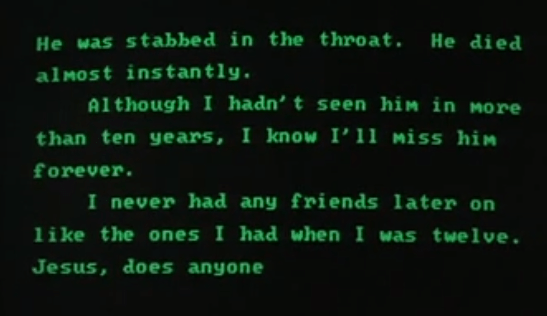
Somehow — and I am constantly amazed at how prescient I was of the nostalgic longing that accompanies aging — 12-year-old me was certain that grown Gordie’s words in the closing scene of the film were, and would remain, poignantly, heart-breakingly true.

From the film Stand By Me

It’s Richard Dreyfuss’ voice I heard this morning and whose voice I hear from time to time when I consider the impact my friends from childhood had (and continue to have) on the creation that is grownup me:

“I never had any friends later on like the ones I had when I was twelve…. Jesus does anybody?”

But when I watched the final scene of the film today, what struck me for the very first time is the unspoken, yet classic writer’s epiphany that prompts Gordie to tap out satisfyingly the closing line of his book.

Grown Gordie’s son enters the study to find his father staring at the computer. The kids ask Gordie to hurry up and they roll their eyes when he (for the umpteenth time) tells them “Okay, I’ll be right there” and continues to stare at the computer monitor.

The son turns to his friend and says:

“My dad’s weird. He gets like that when he’s writing.”

Gordie laughs.

I laughed, too, when I watched the scene today. I know well the “like that” of which his son speaks.

I know it as this feeling, this presence that soars into my heart when I finally grasp one of my life’s great truths — like the incomparable experience of knowing someone when you were 12 — and when I am able to transform this truth into words.

And share them.

When I can nod my head along with the cosmic consciousness in understanding.

And know for certain that you, the reader, will understand it too.

Memory, Relationships, Writing

What I learned from Alice Munro’s Nobel Prize win in literature

Oh Alice Munro:

“For years and years, I thought that stories were just practice, till I got time to write a novel,” she told The New Yorker in 2012. “Then I found that they were all I could do, and so I faced that. I suppose that my trying to get so much into stories has been a compensation.”

Thank you for your well-timed win and wisdom, Ms. Munro, if I may call you that.

(Though I prefer to call you Alice.)

Your words in  The New Yorker were exactly what I needed to read right now, as a writer and as a human being:

As a writer who wishes to breathe life into the characters who infiltrate my dreams, but doesn’t yet know exactly what those characters really want or where they are going.  As a woman who yearns to give life to ideas stirring inside my heart — but often lacks the time or the energy. As a human being who is constantly wondering what in this life is practice and what is for real.

Thank you for writing real women, real marriage, real life … in a way that allows the reader to envision the beauty that exists even in those very real, raw circumstances.

I’ll be honest. I’ve only read Runaway, and selected short stories of yours, but you’ve always been a writer I’ve wanted to read more of.

And I love your name.

Alice.

Munro.

It’s a name that deserves celebrity.

I love that you’re Canadian, and that my Canadian best friend loves your writing, and that those two things together make me want to read more of your stories.

I love that your first collection was only published when you were 37. It offers this exhausted and overwhelmed 38 year old mother of three a glimmer of hope.

I love that you’ve lived to be 82, and I wonder if you always knew that you would live this long or if you always thought, like I do,  that you were only one year away from dying — a victim of a tragic disease or an automobile accident.

Too bad. So sad. No book for you.

I wonder when your heart stops breaking. Does it?

I wonder when you run out of vivid memories to weave into your stories.

I wonder when you stop caring what people think and just write what you must so that a weight is lifted from your shoulders, and you can move on.

I love that picture of you — the one in which you’re sitting on the edge of the railroad track in The New York Times’  article. You look defiant, brave, and yet serene.

I wonder what takes more courage? Writing your truth or having it read by others?

Or sitting on the edge of a railroad track?

I win too, from this celebrated win of yours, Alice Munro.  Through getting to know you better, I am reminded that writing about what you know is enough.

Writing about relationships, memory, your life in your town. It’s enough.

I don’t need to fabricate tales of magic and mystery. I don’t need to create a romance that is one for the ages.

My life alone offers enough content for me to mine — life itself is a gift to any attentive writer.

Isn’t it?

What would you say, Alice Munro?

To a grown woman who still imagines herself a girl?

To a writer who still imagines herself on the slow road to a Nobel Prize in literature?

What would you say?

Would you say,

“Slow down?”

“Don’t worry?”

Would you say,

“It was all worth it?”

“It doesn’t mean a thing?”

Oh, Alice Munro. You’ve taught me a thing or two just by winning a damn award.

Getting old is better than being dead, you said, to the New York Times reporter.

“I’ve done what I wanted to do,” you said. “And that makes me feel fairly content.”