Community, Love, Mindfulness, Philosophy, Relationships, Religion, Spirituality

Synchronistically delicious

I am often troubled when I hear people use the word “serendipity” when I think they mean “synchronicity.” But I never really investigated the difference between the two words.

In my unresearched opinion, I always imagined synchronicity as attached to “meaningful” or extraordinary. Whereas serendipity is more playful, like a cup of frozen hot chocolate.

serendipity

Lucky. Fortuitous. Unexpected. Right place at the right time sorta thing.  Whereas synchronicity … when it happens … almost feels as if its arrival was fated. Expected, even if not by the participants. Anticipated, in some way, even if unseen to all but the gods until the very moment the synchronicity occurs.

Synchronicity, to me, carries in its meaning a certain divinity, a certain magic.

So much so that I remember distinctly when and where I was when I first heard the word and its layperson’s explanation.  I was at the lake house of a friend in celebration of her engagement. While dipping my feet in the lake, I chatted with a friend of the bride-to-be whom I’d never met before. She shared with me the details of a paper she was working on (perhaps her Master’s thesis or her dissertation), all on the topic of this experience called “synchronicity.”

I admitted to her that I’d never heard the word before.

“Oh,” she smiled. “But you’ve certainly had this experience.” She went on to describe what I had always thought of (at least since reading The Celestine Prophecy in 9th grade) as “meaningful coincidence.”

However, “meaningful coincidence” always sounded lame. Such a deeply moving or spiritual encounter needed a better descriptor.

“Synchronicity,” a word steeped in the concept of time (my favorite philosophical topic of conversation both then and now), was perfect for me. I was so thankful for having met this woman at the lake. Our meeting was, in fact, meaningful. Synchronicitous (synchronistic?), we joked at the time.

Perhaps this is why I loved so much Ginz’s response to my “haiku challenge” yesterday.

Walking alone is
often the first step towards
synchronicity.

This, indeed, is what I was going for when I was trying to describe the outcome of a walk alone I took yesterday. Too me, synchronicity, isn’t just a word, but a timely, yet timeless explanation for magic, for meaning, for connection.

When “alone” unexpectedly transforms into “no longer alone.” And loneliness is replaced by oneness.

Culture, Spirituality, Technology

Do your dreams predict your Facebook feed?

I’m entering dangerous territory.

Dreamland.

Dreams — and how they figure into our waking lives — fascinate me. I don’t remember which came first —  my vibrant dream life or my wonder for that version of reality. But both have been with me since childhood.

What’s curious to me these days is lucid dreaming and predictive dreaming, both of which I seem to be getting better at.

The other night, for instance, I noticed I was in the middle of a super frightening nightmare, and I willed myself awake.  Not bad, I thought, when I woke up in a sweat. Now how do I start teaching myself how to fly?

For the past year or so, I’ve occasionally (a few times a month) experienced deja vu during the day in which I am certain I dreamt the interaction already the night before. Nothing momentous; in fact, regular every day occurrences that have a particular interesting twist. Not just the regular drop off at my daughter’s preschool, for instance, but one in which her classmate starts to speak to me in Russian.

I’ve read that such predictive dreaming is, in fact, not uncommon. Famous physicist Russell Targ (most well-known for his work with the military on remote viewing) writes about his own experience with precognitive dreams “predicting” newspaper headlines that he’d then read the next day.

But here’s a peculiar phenomenon I haven’t come across yet in reading on the subject of dreams, and I’m wondering if any of you have: Sometimes I dream my Facebook feed before it happens.

I have 851 Facebook friends. I’m pretty well aware of the 50 or so who appear regularly in my feed. So that when I dream of someone far away — who is not present in my day-to-day interactions and who is not one of the regular 50 people who appear in my feed — and that person shows up in my Facebook feed the next day, I am … to say the least … startled. Like, “Hey you, weren’t you just randomly in my dream last night? What are you doing in my Facebook face?”

Is there an algorithm to explain that experience? I say that only half-facetiously. There probably IS an algorithm to explain that. (If so, please share it, and if possible, in graphic novel format, which is how I best understand geek.)

In addition to dreaming about someone the day before they show up in my feed, I have, on multiple occasions, been talking about something with my colleague at work during the lunch hour — something seemingly obscure — only to find the topic being explored in an article posted by one of my Facebook friends in my feed when I return from lunch. As if Facebook was eavesdropping on our conversation.

Is there an algorithm for that? For overhearing a discussion on, let’s say, the ecosystem of the gut after eating meat or milk? Is there an internet worm crawling from our ears, our minds, and back into “the system?”

I know that readers of this blog span the spectrum of futurists believing we already live in the Matrix to religious devotees who believe the Bible literally happened. (And I appreciate that diversity!)

So tell me:  what do you think? Does this ever happen to you, too?

Is it more common than I think,  this transmission from mind to physical matter (our computers) and back again?

Or am I naive to think of “the internet” as matter, at all? Isn’t it, too, mind?


Spirituality

Turning away from evil

I had a dream last night.

An epic, Joseph Campbell/ CG Jung type dream.

The part I want to share with you involved a snake.

Back off, Freud wanna-be. Before you go analyzing me, let’s take a journey together.

It wasn’t really a snake — more like a supernatural serpent demon type thing — the body of a serpent but the head of a monster — that most everyone else around me was mistaking for an interesting, but somewhat harmless boa constrictor.

In the dream, I was safe inside an enclosed car. The serpent thing couldn’t really hurt me. I knew this, but I also knew he was a threat. My boss was in the car, too. He noticed the evil behind us and suggested we high tail it out of the forest we were in. Smart thinking.

As I looked back, however, I saw the serpent make its way towards another car — an open-topped convertible– in which a young child sat alone strapped into a car seat. I screamed as I watched the serpent begin to devour the child.

I turned away then.

I urged with my eyes my boss to look too, but he refused. He knew what was back there and knew there was nothing we could do to save the child. We drove away.

As we often do in dreams, I suddenly appeared in a different setting with different people, but the serpent still loomed. This time, I wasn’t shielded by the metal frame of the car. I was in an old kibbutz building. The roof and windows were open. I knew it was only time before I would be in grave danger again.

Obviously disturbing, I soon forgot the dream when I woke up this morning. But I recalled it just now as I also recalled the incident that happened to me in real life yesterday that likely inspired the dream.

On my way to work yesterday morning, minutes before arriving at my destination, I had slowed behind another vehicle as we were both approaching a traffic light.

Suddenly, I saw the driver, clearly a grown man, reach across to the passenger seat and strike violently at the person sitting there.

I couldn’t tell if the passenger was a child or a small woman. All I knew is that the person was small enough that his or her head didn’t reach above the head rest, and that what the driver was doing was very, very wrong.

My mouth gaped open in shock. It was that jarring.

Immediately, the person in the passenger seat reached out in a defensive swipe back at the offender and the driver returned to the road.

Moments later, as the light turned green and we inched toward it, the driver did it again. Struck at the passenger violently with his right hand, while his left remained on the wheel.

This time, horrified, I honked my horn. The driver looked up into his rear view mirror.

He understood I was honking at him. That I had seen him.

But my seeing him did not stop him. Not for long.

As we drove through the green light, his car swerved a little from side to side as he again struck out at the passenger.

Beside myself, I started to feel my heart in my throat. But my left turn into the industrial park where my office is located was approaching. I quickly memorized his licensed plate number before making the turn.

And then he was gone.

Evil. There in front of me.

Me. An observer. Powerless.

Now, of course, I don’t know what was taking place in that car. I don’t know the words exchanged or the history between the passenger and the driver.

But I do know one thing. In the back seat, sat a young child …strapped into a car seat …witnessing the entire ordeal.

So, no matter what was taking place in the front seat, the child in the back seat, like I, was exposed to something horrific.  The child, in a sense, had been devoured, while I watched in horror.

I didn’t do anything with the license plate number. I didn’t report the incident. In fact, I did everything I could to forget about it as soon as I parked my car and walked the steps up to my office.

But clearly, I couldn’t forget about it. The experience haunted me in my dreams. It haunts me still.

What is my role when faced with evil in the world?

When can I be an active force — not a hero, per say, but a force — against evil?

And when am I compelled by time or by space or by powerlessness to remain a spectator? Left behind with only my heart in my throat and a deep sense of regret that there is some evil in the world in which we must simply turn away from.

Acknowledging it exists. And hoping that in the acknowledgement, we have done something small to stop it in its tracks.

Community, Religion, Spirituality, Writing

A poem about Israel

For my 15-minute Friday exercise, I jotted down some thoughts I had while celebrating/not-celebrating the Jewish High Holidays in Israel this year.

The poem I produced out of this exercise may be found here on The Times of Israel  and is a culmination of both my confusion and my devotion; of my acceptance and my denial. It is an admission of judgment — of myself, as well as others. And it is a declaration of hope.

Or maybe it’s just a poem.

A whim. A wish.  An exercise. A prayer.

Amen.


Health, Love, Mindfulness, Relationships, Spirituality

Unconventional workout

I started running.

Yup.

I’m a runner.

A short-distance, short-time runner.

For almost a month, I have been running for 15 minutes every day except for Shabbat.

That’s it. 15 minutes.

And it works. I finally found an exercise regimen that works.

For now.

Maybe it’s not enough for everyone, but it’s enough for me.

For now.

I’ve also committed to writing more.

Tiny tidbits here and there.

A blog or the start of a new short story or a poem for fun spurred by a random writing prompt.

I find, the more I write, the more I write.

And the better I feel.

So between the running and the writing, my physical and emotional health seems to be on the up and up.

I know because my hormones say so.

They say so by being quiet when they are normally loud.

Quiet hormones. Quiet head.

Ahh….

But I think I could add a third element to my personalized workout:

Gratitude.

Gratitude, as we know, is such an energy boost. It’s a life lifter.

When we feel gratitude — the day after a violent stomach bug, or the minute after you avoided a tragedy or danger, or simple moments of love between you and your spouse or your child or your cat — we love life.

In the very moment we feel gratitude, we love life.

And loving life is all any of us ever want. It’s why we exercise. It’s why we write.

It’s why we exist at all — to love life.

So, I’m going to try to add 15 minutes of gratitude to my daily workout regimen.

If it’s that easy to love life, why wouldn’t I?

Want to join me?

Food, Religion, Spirituality

The beet goes on

I thought the most interesting thing about today would be the beet.

I pulled four beets from the vegetable drawer because I knew if I didn’t do something with them today they’d go bad tomorrow.

I have a strange relationship with beets.

I want to love them.

I want to savor them like my friend Allison, who once said to me,

“Mmmm…I love beets.”

But I can’t. I just can’t. At best, I can tolerate beets when they’re roasted just so and soaked in a little olive oil and balsamic vinegar.

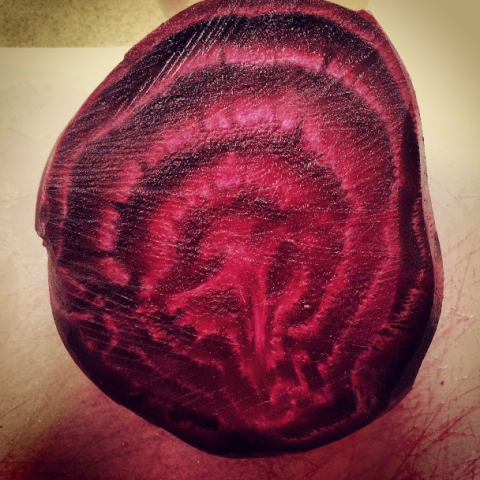
But beets are so incredibly beautiful that I will wash them and peel them and slice them and stand over them in wonderous amazement even if I won’t eat them.

dancing beet

The red pink of beets should not exist in nature.

It should be synthetic, it is so beautiful.

The spiral designs inside a beet, however, should exist in nature.

Beet innards are exactly the kinds of puzzles that nature produces and we call God.

I love beets, but I can’t eat them.

After the beets, I tried to take a nap.

Two of my kids were sleeping: one sprawled on the couch in a beet-colored dress with wrinkled flowers on the strap and the other with his head hanging off the bottom bunk.

He fell asleep in the middle of a tantrum while I tried to soothe him with Harry Potter and the Sorcerer’s Stone, Chapter 1, page 1.

There was a knock at the door.

It was Nachum.

Looking for my son.

I knew it was Nachum because I heard his fingers drumming on the metal railing outside.

I liked that I knew it was Nachum and didn’t mind so much that he was rousing me from my almost nap.

My son was not at home. He was at a basketball game with his dad.

I told this to Nachum. He turned around and left as quickly as he came.

I tried to take a nap.

There was a knock at the door.

It was not Nachum, but a man whose name should have been Nachum.

He was in a rumpled white button down shirt and black pants.

He had a long black beard, too.

He might have had a black yarmulke but I didn’t notice when he turned to walk away.

I was too busy remembering his smile.

I gave him 20 shekels and he was happy.

I was happy, too.

So happy, I stopped trying to take a nap.

= = =

(This post was written in less than 15 minutes. Wanna take on the Friday 15-minute challenge? Write today for 15 minutes and leave a link to your post in the comments below and tag your post 15-minute Friday.)

Culture, Letting Go, Mindfulness, Spirituality

Ideas that spread

I love TED talks.

I love the concept.

I love the execution.

TED

As a marketing professional, I think TED talks are often brilliant examples of storytelling and I often share them with my clients to show how delivery can reel a person into a topic that might be dense or unfamiliar.

I have watched TED talks that seem to have nothing to do with my life — that are by people so foreign to me or about ideas that are a million miles away from what I think or care about.

And yet, by the end, I’m crying. Or nodding. Or shaking my head in stunned disbelief.

That’s what a good story does to you.

As a human being, I think TED talks enrich my life.

I love learning about problems I never knew existed.

And being surprised by how the solutions to those problems end up applying to my own life.

I have the TED app downloaded on my smartphone and when I remember, I will often listen to a TED talk on the drive home from work.

I hardly ever spend time browsing the videos. I choose one of the top three recommended.

Today I chose “Phil Hansen: Embrace the shake.”

I had no idea who Phil Hansen was before I watched his talk, nor did I understand the reference to the word, “shake” in the title.

But I love the word “embrace.”

embrace

It’s physical.

It’s emotional.

And this word alone in the title was enough to pique my curiosity and press play.

I’m very much into embracing. (And tips on how to do it better…)

Embracing my uncertainty.

Embracing my fear.

Embracing the new and unfamiliar.

Embracing …so that you may let go.

What Hansen suggests in his talk is that embracing our limitations actually opens us up to limitless possibilities.

I agree with him.

I won’t spoil the 10 minute talk.

Enjoy it for yourself, but be prepared to be surprised.

And to let go … of your expectations.

About the speaker.

About the talk.

About everything.

“As I destroyed each project, I was learning to let go,” Hansen says. “Let go of outcomes. Let go of failures. And let go of imperfections…”

See what happened, when he did.

Letting Go, Mindfulness, Spirituality

Think lovely thoughts

Reading the blog yesterday of a childhood friend who grew up to be a rabbi, I came across a phrase I’ve heard before but had forgotten for a long time.

Thought experiment

I love this phrase.

In two words, it implies all that I believe about thinking.

That thoughts are ever-changeable.

That we can manipulate our own thoughts or the way others think about us.

That we have power over our thinking.

That we can be playful with our thoughts.

Make fun of them.

Laugh at them.

Shoo them away when they’re getting in the way.

Caress and nurture the ones that stir our hearts and bellies.

Abandon the ones that have stopped serving us.

Experiment with our thinking. Approach our thinking like we would scientific research — as an experience or an equation that is observable, malleable.

I believe in this method, and yet I often have a hard time employing it.

Like many scientists, I am a firm believer in what I know to be true.

In the facts of my life.

“He is …”

“She does…”

“I will always be…”

“It’s like this…”

“He’ll never…”

Those facts serve me. They allow me to be right about the world I live in. They allow me to make difficult decisions based on previously established and agreed upon evidence. They allow me to feel safe and secure in an existence that is often tenuous and unsure.

Therefore, it’s not so easy to approach those facts (my thoughts) as an experiment.

It means I have to give up being right: About the world, about people who’ve hurt me, or about situations I’ve long ago thought I forgot.

Not to mention — thought experiments are rarely controlled experiments. You’re not alone in a cozy lab coat in a quiet room with no other people, no additional stimulation. During your average thought experiment, it’s NOT just you, just your thoughts,  just listening carefully and watching and taking notes.

Yup. You are right there in the middle of it. All the time.

Thinking. Thinking. Thinking. Thinking. Thinking.

And there’s noise. And hunger. And resentment. And perceived requests, demands, insults.

All that thinking and feeling leaves little room to experiment.

And, if you’re like me, you’re not just thinking, thinking, thinking. Feeling, feeling, feeling.

You’re thinking about the thinking. And judging the feeling.

Not very playful. Not very fun.

Not very experimental.

This is why — and I’m having a light bulb experience myself RIGHT NOW as I write this — I meditate. And this is why I sing. And why I pray my version of prayer; keep my version of Shabbat. And why, on occasion, I seek 20 minutes alone in the bathroom pretending to poop.

So I can have my very own thought experiment.

So I can allow myself the opportunity to observe, explore, and possibly, change my thinking.

Do you do this too?

Do you give yourself an opportunity to thought experiment?

And does it work?

Environment, Love, Mindfulness, Relationships, Spirituality

The Abundance Tree has sprouted

Seth Godin.

That man has a gift for producing nuggets of wisdom. Little snippets, little treasures of thoughtful brilliance that may equally apply to your personal life as they would to your career.

Today, his wisdom nugget was a metaphor plucked from nature. Here it is in its entirety:

seth godin plant seeds

It’s a lesson on abundance of which I need constant reminding:

The more unreservedly I give, the more abundantly I receive.

Thank you, Seth Godin. Message received. Seed planted. Abundance tree growing.

Soon after reading Seth’s nugget, I wrote … a bit reservedly… a rather vulnerable post. It was one of those that make me hesitate to hit the publish button.

In my hesitation, I heard the online voice of James Altucher who writes all the time that his most well-read blog posts –the ones that most touch a nerve — are the ones he almost didn’t publish.

So, feeling vulnerable, I hit publish anyway.

I published the vulnerable post because somewhere deep down beneath the fear and apprehension was a belief that some good would come from hitting the publish button; some good would come from sharing of myself; someone’s head somewhere would nod along with me; someone’s heart somewhere would swell with compassion or fellowship.

Hitting the publish button was me planting the seed.

A half hour later I saw a comment come in from Miss Corinne at A Green (ish) Life responding to my vulnerable post (positively) and telling me, by the way, she nominated me for a Liebster Award. I’m not sure what I was more excited about — that she liked my vulnerable post or that she nominated me for an award I never heard of before.

Either way, I felt all warm and fuzzy inside.

Abundance sprouting.

The very essence of the Liebster Award, it turns out, is unreserved giving. The trophy? Paying it forward.

Thank you, Seth Godin. Thank you, Miss Corinne. Thank you, James Altucher.

Stay tuned for my Liebster acceptance speech and nominations … and watch my abundance tree grow.

Letting Go, Living in Community, Love, Making Friends, Mindfulness, Relationships, Spirituality

Life is hard work and other things that make me feel tired, but alive

I am struck by the pictures my friend Holly is sending back to us from Hong Kong and Vietnam.

See more http://instagram.com/theculturemom

She’s feeding her wanderlust with banana pancakes, dim sum, and gorgeous panoramas, while feeding our desire for travel photography “porn.”

I love instagram.

Almost in the same moment that the drool drips down my chin,  while mesmerized by the lush green mountain ranges and Buddha statues, I long for the eyes through which I saw Israel in the first months I lived here.

The virgin immigrant eyes.

The virgin immigrant heart that burst with joy each and every day…at the beauty of this land; in curious awe of her people.

Cochav Hayarden, March 2012

When we first made Aliyah,  every drive was emotionally equivalent to a stroll through an art museum; every hike through a national park was a new adventure in a foreign land.

Every day I would find myself saying out loud: “Do I really live here?”

And I meant it in the same way a mother whispers over her newborn baby, “Are you really mine?”

Two years after making Aliyah, I find that my eyes and my heart are still capable of wonder.

But  it’s an experience that does not come as naturally and as automatic as before.

I need, instead, to make those moments happen.

And that takes a lot of work on my part.

I need to see the trash fire in Kfar Manda

smoke in kfar manda

— and turn my anger into compassion, and then activism.

And that’s really hard.

It’s much easier to be angry.  To rant. To shake my head.

I need to remember, in a moment I feel frustrated by my community, when I am outraged by their seeming indifference to the trash that peppers our fields

how grateful I am for my community.

How my community supports me.

How my community allows me the freedom to be a Jew in Progress. To be curious. To be a novice at living in this country.

Acknowledging my community as a gift, however, is really hard work when I am stuck in a moment of discontent.

It’s much easier for me to assume. To judge. To wish myself away from here.

It’s really hard work — and a huge emotional commitment — to be present in your life all the time.

To notice. To stop. To redirect. To be who you want to be, not your raw-emotion-of-the-moment.

It’s exhausting — living your best life.

It’s much easier to feel alive when you are on vacation — separate from the drudgery that often clouds your intentions.

It’s much easier to feel alive when you are first in love; experiencing a newness; your senses overwhelmed by glorious colors and smells.

I recognize this.

And I acknowledge that some days I am too tired to live my best life.

But on the alternate days — the ones in which I work hard for happiness, the ones in which I allow my heart to be open and my mind to be free — I find beauty that surpasses any landscape, any painting, any colorful market scene.

A vacation awaits me.

In my regular boring life.

And yours.

Community, Mindfulness, Religion, Spirituality

Finding religion in a Saturday morning buffet

Today is Saturday.

Shabbat.

What did you do?

I went to Shacharit for the first time ever on Hannaton.

I sang.

After the 50 minute special chanting service, I snuck out before the Torah was taken out.

I walked home.

I drank coffee.

I meditated in the morning sun.

I grabbed my phone, put it on “silent” and walked back up the hill to meet my neighbors for Kiddush.

I got there only after the prayers were spoken.

I chatted with a friend. About Facebook.

I continued my walk with my phone in my pocket, took it off “silent.”

I meditated in the afternoon sun.

I waved to my neighbors walking their dog.

I found God … in a patch of flowers.

kalaniyot with containers

In a moth resting along a forgotten wall.

moth

I thought about my yesterday and my tomorrow.

I said out loud quiet prayers of gratitude that my children are healthy.

I breathed in deep.

I said “thank you” to the sun.

I ate a quiet lunch alone.

I moved closer to the computer.

I opened up a window.

I moved my fingers across rows of raised letters.

I reached out to you.

* * * *

Is this Judaism?

Is this religion?

Is this observance?

Is this prayer?

Is this devotion?

What do you call this religion of mine?

I call it

A Saturday-morning buffet

Religion, Spirituality

One Shabbat

Sometimes…

All it takes is one Shabbat

annie shabbat jan 2013

One morning to clean

One afternoon to cook

One evening to shower and dress  in your handsome clothes…

Just one Shabbat.

One morning to sleep in … until 7.

One weekly meditation group.

One quiet admission.

One hour to sit

with your coffee.

One hour to zooooooooommmm down the slide

with your son

oliver january 2013

Just one Shabbat.

One new idea.

One minute to hold your husband’s hand.

One glimpse of your children with your weekend pair of eyes.

kids forest jan 2013

Just one Shabbat.

Just one

to remember how it feels to laugh

late at night

in bed…

without looking at the clock.

Just one

to remember what breakfast tastes like.

Just one

to rediscover your purpose.

Your passion.

You.

Just one

Just one Shabbat.