Letting Go, Love, Mindfulness

Kindness is less expensive than you think

I was sitting at a sidewalk cafe table when I noticed a praying mantis slowly crawling on the arm of the plastic chair next to me.

praying mantis
A bug in Israel

I was sitting there because I had nothing to do but kill time  — 15 minutes to kill — until my scheduled driving test in downtown Haifa.

It would be, in fact, my second driving test in as many weeks. I failed the first one.

Since waking up with a startle at 4:30 am, I had been psyching myself up for the test. Trying to remind myself that the test was not that big of a deal; that passing or failing wasn’t life or death. I told myself I’m a good and safe driver, but (as I learned last time) there is only so much I can be prepared for such a test.

As in life, sometimes a street cleaner in an orange vest decides to walk backwards into traffic and you have to make a split second decision, and hope for the least messy result….and, in the case of a driving test, the kindness of the instructor.

Sitting in that cafe chair with 15 minutes to go and nothing else to do, I noticed the praying mantis. I thought to myself, “That guy is lucky I sat next to him and not some 6 year old serial-killer-to-be who would have enjoyed pulling off his skinny little legs one by one.”

I examined the creature closely. How was he so calm? How could he possibly just meander along like that without worry? Did he sense the presence of the fat hairy guy standing next to him drinking an espresso? Was he worried at all that the guy would sit down and rest his heavy arm on top of him?

In fact, I could very easily smush that bug myself, I thought. Or at least swat him away, off the chair, simply because I don’t like bugs.

Instead, I’m observing him, I thought. Acknowledging him. Letting him be.

Lucky him. I kinda wish I were that praying mantis right now.

Or, at least, I wish for the same kind of luck.

I need to be let alone today.

I need a lucky break.

I need the simple kindness of a stranger.

Then it hit me.

Sometimes, just letting someone — or something — be is an act of kindness.

To be kind doesn’t require a lot of time or money. Nor does it require great courage or forethought.

Sometimes, you just need to let someone be.

Leave a bug alone.

Allow someone a mistake (without reprimanding her for it)

Give someone a break (when she doesn’t necessarily deserve it)

Back off  someone when you could just as easily crush her

(Pass her when you could just as easily fail her).

Sometimes (just as our listening is sometimes a bigger gift than our speaking)our inaction is a greater kindness than our action.

Environment, Health, Middle East Conflict, Mindfulness, Work

An Israel Story Only I Can Tell

The title of my blog references my aliyah.

Aliyah is the Hebrew word used when a Jew moves from somewhere outside Israel to Israel.  If you have been to a synagogue on Saturday, you might have heard the word also used to reference someone being called up to the Torah for a blessing. The word aliyah literally translates as elevation or ‘going up.’

My going up was from New Jersey.

Depending on how much of a Jersey fan you are, you might not have difficulty seeing how moving to Israel from New Jersey was ‘elevating.’ (I’m staying out of that debate.)

On the other hand, depending on how much of a fan of Israel you are, you might have a lot of difficulty understanding why my husband and I picked up our three young children and moved here. (I’m staying out of that debate, too.)

We’re not particularly religious. Nor are we ardent Zionists.

We are reasonably observant moderate Jews from New Jersey, emphasis on the word reasonable.

This — reasonableness  — is what Israel, and the world that talks about Israel, needs more of. So, you can say, we’re contributing to that cause.  When I blog from Israel, I hope to share stories that most people outside of Israel never hear. The stories of the people who live here: Our daily lives, minus the conflict, minus the politics, minus the fear.

I don’t blog often about what I do during the day when I’m not blogging. I’m the Chief Marketing Officer for an investment group that invests in and develops start-up companies.

A lot of new olim (immigrants) try to break into high tech when they move here because a) it’s a great marketplace for English speakers and b) Start-up Nation is where it’s at.

Not me, though.

That wasn’t my plan at all.

My plan was to move here, get adjusted, learn Hebrew, grow an organic garden, and write a few freelance articles for The Jerusalem Post.

However, a few months after landing here a job opened up at a nearby company and the job description basically described me. My husband encouraged me to apply for the job. I did. And that’s what I’ve been doing for the past 2 1/2 years all day, 5 days a week — helping grow start-up companies.

I never write about my job because it’s not what I think about when I am not working. I like to leave my work at work.

Mindfulness, and all.

But last night, something incredible happened that is still with me today.

Two companies who I’ve worked with — portfolio companies of my employer, The Trendlines Group — won awards for best start-ups of the year. Out of dozens that were eligible, the award was offered to three companies, and two of the companies were from our group.

That in and of itself is something to take pride in — companies who I’ve worked with are now award-winning companies. But my greater pride comes from the types of technologies the companies are developing. One, Sol Chip, has created a tiny chip that harvests energy from the sun in a way that’s going to change how we use electricity everywhere from offices to farms. The other, ApiFix, has revolutionized treatment for adolescent scoliosis. It’s literally going to change the lives of hundreds of thousands of young girls with severe curvature of the spine.

These are the kinds of companies Trendlines invests in — companies really poised to improve the human condition.

These are the kinds of ideas and technologies that come out of Israel.

Not just technologies that help you find your way from the bar to the post office.

waze

But technologies that will save your life some day. If not yours, than your child’s or your neighbor’s.

Technologies that will one day be used not just in Israel, but everywhere.

Even in countries that are anti-Israel.

This. Is. Quite. A. Story.

And so, I blog about it.

You see: The Israel story — and my story living here — is even more complex than you ever thought.

When I moved to Israel, I braced myself for potential backlash from friends who, for reasons of politics or ignorance, might see my move to Israel as a statement, or worse, as a mistake.

But that didn’t happen.

What did happen was a door opened.

I got to be a part of an Israel that people who live outside Israel hardly ever see.

And I got to be someone who shares that story.

So, thank you.

Thank you for reading.

And thank you for letting me be a reasonable voice in a very noisy, and complex world.

team at awards jm
Part of the Trendlines team with Chief Scientist Avi Hasson and Israel’s Technology Incubator Program Director Yossi Smoler, June 2013

ocs award

Health, Love, Mindfulness, Relationships, Spirituality

Unconventional workout

I started running.

Yup.

I’m a runner.

A short-distance, short-time runner.

For almost a month, I have been running for 15 minutes every day except for Shabbat.

That’s it. 15 minutes.

And it works. I finally found an exercise regimen that works.

For now.

Maybe it’s not enough for everyone, but it’s enough for me.

For now.

I’ve also committed to writing more.

Tiny tidbits here and there.

A blog or the start of a new short story or a poem for fun spurred by a random writing prompt.

I find, the more I write, the more I write.

And the better I feel.

So between the running and the writing, my physical and emotional health seems to be on the up and up.

I know because my hormones say so.

They say so by being quiet when they are normally loud.

Quiet hormones. Quiet head.

Ahh….

But I think I could add a third element to my personalized workout:

Gratitude.

Gratitude, as we know, is such an energy boost. It’s a life lifter.

When we feel gratitude — the day after a violent stomach bug, or the minute after you avoided a tragedy or danger, or simple moments of love between you and your spouse or your child or your cat — we love life.

In the very moment we feel gratitude, we love life.

And loving life is all any of us ever want. It’s why we exercise. It’s why we write.

It’s why we exist at all — to love life.

So, I’m going to try to add 15 minutes of gratitude to my daily workout regimen.

If it’s that easy to love life, why wouldn’t I?

Want to join me?

Letting Go, Mindfulness, Parenting

Sick with motherhood

I’m watching my 10 year old son move in and out of a sleep much lighter than I wish; his breath too rapid for my comfort.

He’s disturbed.

So am I.

The muscles in my neck are tight. So are his.

I realize just now my jaw is clenched. His knees move back and forth; the rapid shaking an effort to release his fear and pain.

He’s home sick today.

I’m home sick today.

But his sick is of the variety that comes and goes. And while it seems as if it will never pass — especially when you are in the throes of throwing your insides up — it will, God willing, pass.

But my sick is different.

It’s not viral.

It’s not contagious.

And I can’t be sure it will ever pass.

My sick is a panic turned into a tension turning into an ache.

When my son was little, I remember remarking what a trooper he was when he was sick. The mess was often minimal — even as a toddler he would make it just in time to vomit into the toilet; he’d hardly ever cry after — and his needs were easy to address.

I would ask him, “What do you need?” And he’d say:

More water in my sippy cup.

Some toast with jam.

A new Wiggles video.

He knew he was sick. But he knew he would feel better. We told him so, after all.

But my son is older now. And his simple desire to feel better has turned into grief that the world has inflicted such suffering on him and the anxious worry that he will never feel better again.

“Why me?” my son shouts with a burst of sudden energy.

I don’t know how to help him.

I sit next to him as he finally closes his eyes and he lets me smooth his hair off his forehead and lets his head rest on the back of my palm.

I count the freckles on his right cheek.

1 – 2 – 3 – 8 – 12 … when did he get so many freckles?

I remember we used to count them one-by-one in the bath and I’d point out when there was a new one.

But that was years ago.

Years before the lump that sits in my throat. The lump that will surely turn to tears in

5-4-3-2-1…

My son is older now.

It’s no surprise to me.

I saw it coming.

But still I am sick with motherhood

The kind of motherhood you catch when your child suddenly becomes more than a child and his needs more than a child’s needs.

The kind of sick you feel when you realize that slowly, slowly your power to heal weakens.

And he will soon need to learn how to heal on his own.

Letting Go, Love, Mindfulness, Relationships

Practice hard what you preach; then practice some more

There is what I preach and there is what I practice and there is sometimes overlap.

All of my preaching is prepared and shared with good intentions.

Yet there is intention and there is action and in between there is emotion.

Emotion gets in the way, sometimes.

A lot of times.

Meaning, no matter how good my intentions, and no matter how loud my preachin’, my emotions trump.

My emotions are

Royal

Straight

Flush.

Which brings me back to practice.

Knowing that my emotions trump my intentions, I may be (and must be) mindful in situations in which emotions run high.

The only way I know how to get better at acting with intention is to notice when I’m not…

and turn it around.

traffic

I love my emotions.

Okay, I value them.

But there are times when I wish what I know to be true would run through and through

all the way to my heart

As opposed to the doubt, the anger, the hurt, the fear

That runs through instead.

And all I can do in those moments

when the through and through is

doubt, anger, hurt, fear

is practice.

= = =

P.S.: For those seeking the conclusion to my driving test saga, sigh, I didn’t pass.

Culture, Letting Go, Mindfulness, Spirituality

Ideas that spread

I love TED talks.

I love the concept.

I love the execution.

TED

As a marketing professional, I think TED talks are often brilliant examples of storytelling and I often share them with my clients to show how delivery can reel a person into a topic that might be dense or unfamiliar.

I have watched TED talks that seem to have nothing to do with my life — that are by people so foreign to me or about ideas that are a million miles away from what I think or care about.

And yet, by the end, I’m crying. Or nodding. Or shaking my head in stunned disbelief.

That’s what a good story does to you.

As a human being, I think TED talks enrich my life.

I love learning about problems I never knew existed.

And being surprised by how the solutions to those problems end up applying to my own life.

I have the TED app downloaded on my smartphone and when I remember, I will often listen to a TED talk on the drive home from work.

I hardly ever spend time browsing the videos. I choose one of the top three recommended.

Today I chose “Phil Hansen: Embrace the shake.”

I had no idea who Phil Hansen was before I watched his talk, nor did I understand the reference to the word, “shake” in the title.

But I love the word “embrace.”

embrace

It’s physical.

It’s emotional.

And this word alone in the title was enough to pique my curiosity and press play.

I’m very much into embracing. (And tips on how to do it better…)

Embracing my uncertainty.

Embracing my fear.

Embracing the new and unfamiliar.

Embracing …so that you may let go.

What Hansen suggests in his talk is that embracing our limitations actually opens us up to limitless possibilities.

I agree with him.

I won’t spoil the 10 minute talk.

Enjoy it for yourself, but be prepared to be surprised.

And to let go … of your expectations.

About the speaker.

About the talk.

About everything.

“As I destroyed each project, I was learning to let go,” Hansen says. “Let go of outcomes. Let go of failures. And let go of imperfections…”

See what happened, when he did.

Letting Go, Love, Mindfulness, Writing

Easily attached

The best thing I never bought was this orange comb-brush.

my orange brush

How do I know?

Because I’ve had it now for more than 30 years.

I got it as a party favor at a girl’s sleepover party when I was six.

It’s traveled with me through 4 schools, 10 or so homes, and at least 100 handbags and backpacks.

It survived our Wheaton terrier — the one we had for less than a year — whose teeth marks are forever indented on its frame.

It survived at least two perms.

And it survived Israeli lice.

If this orange comb-brush could talk, it would say:

“You should have waited til after the bubble burst to buy a house.”

It’s a wise comb-brush.

About 15 years or so ago, I lost the orange comb-brush for a while.

I looked everywhere for it. Under the driver’s seat of my Nissan NX, inside eight or so Le Sport Sacs, behind the toilets and underneath the sinks of everyone I knew. I couldn’t find it.

Finally, I understood. It was really gone.

And so I bought the purple comb-brush. I carried it around with me for over a year until one day I found the orange comb-brush in a drawer inside my parent’s house.

I was elated. But also eerily aware that as happy as I was, I would have been perfectly okay had I never found the orange-comb brush.

I was okay.

Without the orange comb-brush.

Today, I still have both brushes. The orange returned to its rightful place in my handbag, while the purple spends most of its time lying next to my kids’ bathroom sink narrowly escaping Israeli lice.

I will never give up that orange comb-brush willingly. But I will be okay if it’s once again lost.

And while I thought for a long time, I would never feel as attached to the purple comb-brush as I did to the orange one, I notice my attachment shifting, my affinity for it growing. I see it in my memories and look for it when it’s missing.

It’s the purple comb-brush that I use to braid my daughter’s hair.

It’s the purple comb-brush that greets me in the evening as I turn off the lights to the bathroom and wipe down their crusty toothpaste from the sink.

And when three teeth from the purple comb-brush melted after someone accidentally left it on top of the toaster oven, I was really bummed.

But I kept the brush. Even though it’s deformed and not quite as useful, we still use it.

Osho writes that “attachment brings misery, unattachment brings blissfulness,” which sounds harsh except he softens his admonition with a dose of compassionate, measured reality:

“So use things, but don’t be used by them. Live life but don’t be lived by it. Possess things, but don’t be possessed by them. Have things — that’s not a problem. I am not for renunciation. Enjoy everything that life gives, but always remain free.”

And it’s this balance — between the bliss of having and the misery of not; between the misery of having and the bliss of not — that I seek.

I found it in that moment when I realized I didn’t miss the orange comb-brush so bad after all … but I was still happy to have her around again.

And the moment that I realized the purple comb-brush wasn’t just a meaningless replacement; that things change and people grow and new memories form …and new loves appear where there was once only plastic.

Food, Mindfulness, Writing

Writing prompts change the world

A few years ago, I took a brief, but fantastic memoir writing course with poet and writing professor, Chloe Yelena Miller. It was in this course I was first introduced to the concept of writing from a prompt.

Wow, how I loved this exercise.

Not all writing prompts work for all people —  and it could be the ones that Chloe chose resonated with me personally — but, regardless, I had a lot a fun with them.

I wrote one piece about my childhood stuffed dog/bear, Floppy.

I wrote one piece about my ex-boyfriend’s family beach house.

I wrote another about a long-kept secret.

What exactly do I love about writing prompts? I’m not sure.

But I think it has to do with looking at life differently. From a different angle. Upside down. Inside out.

To see people and things in a way they’ve never been observed before. To imagine them in a purpose or a place they’re unused to.

Today, my writing prompt was Mr. Mushroom Butt.

mushroom butt

While slicing vegetables for my breakfast stir fry, I couldn’t help but notice the cute little butt in one of my deformed mushrooms.

In an instant, I could imagine the yellow peppers as arms and legs. And hurried to arrange them and photograph the scene before it disappeared from my imagination or I got too hungry not to eat it.

The Sad and Sorry End to Mushroom Butt was born from my breakfast.

A story was born …  a character, a fractured fairytale. And who knows what else? A film? A line of toys? A breakfast cereal?

One morning, I birthed Mushroom Butt . And now he exists.

This is what’s amazing about writing prompts.

And about writing.

This ability to birth something or someone anew.

There are writing prompts everywhere masquerading as boring nothingness.

But once you name them as writing prompts, someone or something exists where there was previously nothing and no one.

And the list of possibilities for their adventures becomes endless…


Letting Go, Love, Mindfulness

Giving it up to Cory Booker

It’s widely agreed among women that following Cory Booker on Twitter is more groin stimulating than the hottest 1980s era episode of All My Children.

But Cory is also a deep thinker, and a spiritual guy –at least his social media strategy team would have us believe.

It’s working. He’s totally got me wrapped around his finger.

Cory shared this on Facebook yesterday:

Courtesy: http://waywire.com/

It was timely for me. (aka “Wow, that Cory Booker is so in my head!)

I’ve been thinking and writing about what I gave up to become who I am now.

Truth is, I think about it a lot. Almost all the time. Definitely, way too much.

Sometimes I wonder if I breathe in nostalgia instead of air.

What could I have been had I made a left instead of a right?

Stayed in Washington instead of moving to New York?

Continued in children’s book publishing instead of leaving to freelance?

Stayed single longer?

Stayed married without kids longer?

Stopped having kids at just one?

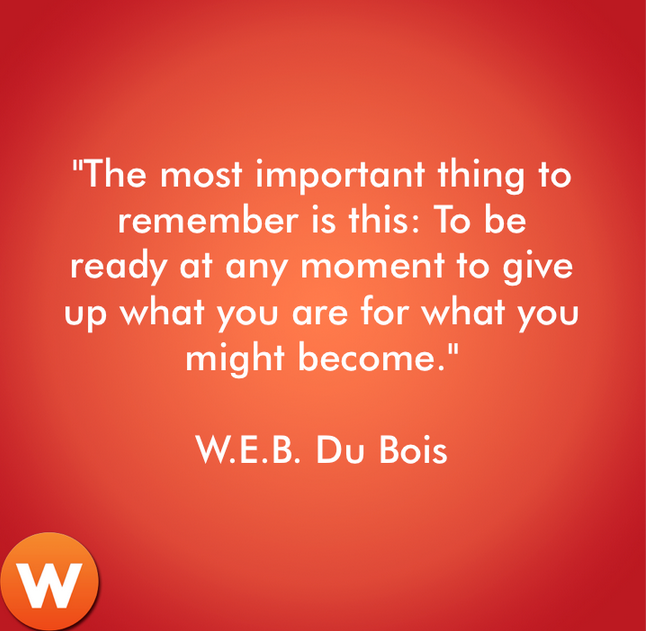
At every given moment, indeed, we give up who we are in order to become who we might be.

Right, Cory Booker?

This is automatic. It’s quantum physics (I think). After all, it’s impossible to be who you were and who you are at the very same time. At least, not without a migraine.

If we could do this, we’d be time travelling already. Or having coffee with multi-dimensional beings.

True: We’re often not ready to give up who we are, but just as often we do so in spite of ourselves. Every single day, every single action, may require this on a small level.

And big choices certainly do.

So why not, give it up willingly,  for ourselves?

Life is, indeed, a marathon. Through which we shed many layers of skin.

And each time, we birth ourselves anew.

It’s a much better way to approach life — to approach our Self — than constantly imagining “what might have been.”

The intentional act of giving up who we are propels us forward — from past, to present, to unimaginably awesome future.

Letting Go, Love, Mindfulness, Relationships, Religion

Graduating to grownup

I didn’t write this, but oh how I wish I did. Actually, no, I’m grateful for the words. For knowing that someone sees the world this way. Saw the world this way. Grateful to David Foster Wallace for writing it, and speaking the “capital T truth.”

This video is powerful and touching and true.

*   *   *   *

This is Water

By David Foster Wallace


“The only thing that is capital T true is that you get to decide how you’re going to try to see it.”

“Please don’t just dismiss it as one finger-wagging Dr. Laura sermon. None of this stuff is really about morality or religion or dogma or big fancy questions of life after death. The capital T truth is about life before death. It is about the real value of a real education….which has almost nothing to do with knowledge and everything to do with simple awareness.”

Letting Go, Mindfulness, Spirituality

Think lovely thoughts

Reading the blog yesterday of a childhood friend who grew up to be a rabbi, I came across a phrase I’ve heard before but had forgotten for a long time.

Thought experiment

I love this phrase.

In two words, it implies all that I believe about thinking.

That thoughts are ever-changeable.

That we can manipulate our own thoughts or the way others think about us.

That we have power over our thinking.

That we can be playful with our thoughts.

Make fun of them.

Laugh at them.

Shoo them away when they’re getting in the way.

Caress and nurture the ones that stir our hearts and bellies.

Abandon the ones that have stopped serving us.

Experiment with our thinking. Approach our thinking like we would scientific research — as an experience or an equation that is observable, malleable.

I believe in this method, and yet I often have a hard time employing it.

Like many scientists, I am a firm believer in what I know to be true.

In the facts of my life.

“He is …”

“She does…”

“I will always be…”

“It’s like this…”

“He’ll never…”

Those facts serve me. They allow me to be right about the world I live in. They allow me to make difficult decisions based on previously established and agreed upon evidence. They allow me to feel safe and secure in an existence that is often tenuous and unsure.

Therefore, it’s not so easy to approach those facts (my thoughts) as an experiment.

It means I have to give up being right: About the world, about people who’ve hurt me, or about situations I’ve long ago thought I forgot.

Not to mention — thought experiments are rarely controlled experiments. You’re not alone in a cozy lab coat in a quiet room with no other people, no additional stimulation. During your average thought experiment, it’s NOT just you, just your thoughts,  just listening carefully and watching and taking notes.

Yup. You are right there in the middle of it. All the time.

Thinking. Thinking. Thinking. Thinking. Thinking.

And there’s noise. And hunger. And resentment. And perceived requests, demands, insults.

All that thinking and feeling leaves little room to experiment.

And, if you’re like me, you’re not just thinking, thinking, thinking. Feeling, feeling, feeling.

You’re thinking about the thinking. And judging the feeling.

Not very playful. Not very fun.

Not very experimental.

This is why — and I’m having a light bulb experience myself RIGHT NOW as I write this — I meditate. And this is why I sing. And why I pray my version of prayer; keep my version of Shabbat. And why, on occasion, I seek 20 minutes alone in the bathroom pretending to poop.

So I can have my very own thought experiment.

So I can allow myself the opportunity to observe, explore, and possibly, change my thinking.

Do you do this too?

Do you give yourself an opportunity to thought experiment?

And does it work?

Mindfulness

Mindfulness is knowing that today sucks …emphasis on today

Some days just suck.

How do you find mindfulness in the sucky days?

Some days just suck.

1. Be aware that today sucks.

2. Emphasize the today instead of the sucks.

3. For fun: Walk around and say “today fucking sucks” out loud. This especially works if you never ever use the word fuck in your daily vocabulary. It works exceptionally well for individuals who never read anything that has the word “fuck” in it because they think it weakens or degrades the message.

There is nothing that brings you back to the present like walking around your house in sweatpants and a ponytail shouting “Today fucking sucks.” It often works quicker than choosing to let go or sitting in meditative prayer.

And frankly, we imperfect human beings sometimes need to acknowledge the fucking sucky in the world, the sucky in today, the sucky in ourselves, the sucky in other people, and in our relationships.

When we also acknowledge its immediacy, however, we mindfully frame the suckiness.

As in: Today sucks. This moment fucking sucks.

Ahhh…

Try it with a friend: It might make your day a little less sucky.

(And if that doesn’t work, play this Pink song at the the maximum volume and scream along like a 12 year old at a bat mitzvah.)